ABSTRACT
Objectives: The purpose of the study is to investigate the attitude toward medical health information in the dental hygiene students.
Methods: The subjects were 370 dental hygiene college students in the metropolitan area. A self-reported questionnaire was completed by 350 students from March 2 to May, 3, 2014. Except 20 incomplete answers, data were analyzed by frequency analysis, t-test, and one-way ANOVA using SPSS 12.0 program. The questionnaire consisted of general characteristics of the subjects, satisfaction of internet use, and attitude toward medical health information.
Results: Most of the students had personal computers and they did not receive computer education. The students used internet in the variety of the fields. Satisfaction level was 3.28 by 5 point Likert scale. The attitude toward medical health information was 3.20. They would not use computer if possible, and the score was 3.50 points that was the highest mark. There was no statistically significant difference in medical health information by the general characteristics of the subjects.
Conclusions: The attitude toward medical health information was not fully satisfactory in many fields. The curriculum for the dental hygiene must include step-by-step computer course and the computer education must provide the diverse educational opportunities for the students.
Key Words: medical health care, internet usage, information system, dental hygiene students 색인: 보건의료, 인터넷이용도, 정보시스템, 치위생과 학생
서론10)
정보기술의 발전은 사회 전반적인 분야의 업무처리 방법 을 급속도로 변화시키고 있다. 특히 인터넷이나 PC등을 통 한 멀티미디어의 발달과 통신 기술의 통합시스템이 접목되
Copyrightⓒ2015 by Journal of Korean Society of Dental Hygiene
This is an open-access article distributed under the terms of the Creative Commons Attribution Non-Commercial License (http://creativecommons.org/
licenses/by-nc/3.0/), which permits unrestricted non-commercial use, distribution, and reproduction in medium, provided the original work is properly cited.
면서 보건의료 정보화는 환자의 치료와 연구 및 보건 교육 등 다양한 분야에서 실무 향상을 도모하고 있다1). 이러한 변화는 의료기관의 정보시스템의 개발을 우선시하게 되었으 며 단순한 업무처리 수준에서 탈피하여 업무 영역이 확대되 고 다양해짐에 따라 정보화의 지식과 기술을 갖추도록 요구 하고 있는 실정이다. 정보기술의 사용은 개인의 업무 효율 성 향상과 서비스의 질 개선 및 조직 비용을 감소시켰다2). 그러나 효율적인 정보화를 위해서는 실제적으로 진료와 업 무에 대한 긍정적 요인과 부정적 요인을 파악하여 효율적인 방안을 마련해야 한다고 하였다3,4). 이에 다양한 선행연구가
http://dx.doi.org/10.13065/jksdh.2015.15.06.1027 ISSN 2288-2294(Online) J
치위생과 학생들의 보건의료 정보화에 대한 태도
이성숙
여주대학교 치위생과
Attitude toward medical health information in the dental hygiene students
Seong-Sook Lee
Department of Dental Hygiene, Yeoju Institute of Technology
*Corresponding Author: Seong-Sook Lee, Department of Dental Hygiene, Yeoju Institute of Technology, 338, sejongro, yeoju City Gyeonggi-do, Korea, Tel: +82-10-7999-2333, E-mail: [email protected]
Received: 10 July 2015; Revised: 30 September 2015; Accepted: 6 October 2015
한국치위생학회
이루어졌다. 최 등5)은 병원정보시스템을 활용함으로써 간호 업무의 정확성, 신속성, 편리성과 직접간호시간의 증가와 간 접간호시간을 감소시키는 효과가 있다고 보고하였으며 정6) 은 전산체계 운용능력이 높은 간호사가 그러하지 않은 간호 사보다 업무 효율성이 높다고 하였다. 인터넷을 활용하여 실시간 정보제공을 하고 의사소통을 증진하며 계속적인 환 자 모니터링을 통해 보건의료서비스의 질을 향상시켰다1).
정보화 체제의 효율적인 관리 및 구축을 위해서는 정보 화 태도가 무엇보다 중요한 요인으로 파악된다. 긍정적이고 동기화가 높은 태도일수록 만족도와 업무수행도가 높다는 연구가 보고되었다7). 컴퓨터에 대한 태도를 조사한 선행연 구는 대부분 병원 간호사의 태도에 대한 연구가 대부분이 다. 서와 이8)는 간호업무 전산화 활성화의 문제점 요인은 간호사의 전반적인 컴퓨터 활용과 문제처리에 있어서의 지 식 부족이라고 보고하였으며 Bongartz9)는 컴퓨터에 대한 간호사의 태도를 조사한 결과 컴퓨터를 활용함으로써 직업 안전성에 긍정적인 영향을 미친다고 하였다. Jiang 등10)은 효율적 컴퓨터 조작이 가능한 간호사는 환자간호와 관련하 여 정보 접근성이 용이하여 보다 효율적인 간호를 제공 할 수 있으므로 컴퓨터의 활용능력이 중요한 요인이라고 하였 다. 한편 정보화의 태도에 대한 업무 분석은 교육 시스템에도 적용되고 있다. 학교 보건업무 실무자들이 컴퓨터 설치 및 프 로그램 개발 참여는 어렵기 때문에 효과적인 학교보건업무 전산화 운영을 위해서는 사용자 양호교사의 정보화에 대한 태도와 요구를 파악하여 요구에 맞는 보건정보화 시스템을 구축하는 것이 무엇보다 중요하다고 하였다11). Stronge 등
12)은 교육수준과 경력이 높은 간호사가 정보화에 긍정적인 태도를 보였다고 하였다. 박 등1)은 간호대학생을 대상으로 연구한 정보화에 대한 태도는 고학력일수록 간호학습에 컴 퓨터 활용이 필요하며 긍정적 태도를 보였으나 정보화의 부 정적인 문제점인 프라이버시 침해, 모든 자료 전산화에 따 른 문제 동의는 낮았다.
이와 같이 정보화에 대한 연구는 대부분 보건정보시스템 의 활용도와 태도에 대한 연구이며 대부분 간호사와 간호 대학생들을 대상으로 한 연구들이다. 그러나 치과위생사에 대한 구체적인 정보화 태도 연구는 이루어진 바가 없다. 치 과위생사는 구강건강을 책임지는 중요한 임상술식가이면서 동시에 구강보건교육가이다. 특히 치위생과 학생들이 전문 인력으로 활동을 하기 위해서는 학생들의 정보화에 태도에 대한 연구가 필요하다.
이에 본 연구는 치위생과 학생의 컴퓨터와 인터넷 사용 실태 확인을 통해 보건정보화 태도를 파악하고 이를 바탕으 로 효율적인 보건의료정보체계의 시스템 구축과 정보화에 대한 긍정적 태도를 위한 실질적인 기초자료를 제공하고자 한다.
연구방법
1. 연구 대상
본 연구 대상은 2014년 3월 2일부터 5월 3일까지 수도 권에 소재한 치위생과 학생을 대상으로 370부를 배부 하였 고, 그 중 응답이 부실한 20부를 제외한 350부의 설문지를 최종 분석 자료로 사용하였다. 자료수집 방법은 편의추출 방법으로 학교 관계자에게 전화로 연구목적을 설명하고 동 의를 얻은 후, 구조화된 설문지를 자기 기입방식으로 설문 지를 작성하게 하였다.
2. 연구 방법
정보화에 대한 치위생과 학생들의 태도 측정도구는 박 등1)이 간호사들을 대상으로 측정하였던 도구를 수정 보완 하여 이용하였다.
각 문항은 ‘매우 그렇다’에 5점, ‘매우 그렇지 않다’에 1 점으로 5점 리커트(Likert)척도이고 점수가 높을수록 보건 의료 정보에 대한 태도가 긍정적인 것을 의미한다. 본 연구 에서 사용된 도구의 신뢰도 Cronbach 'α는 0.71이었다.
3. 분석 방법
본 연구에서 수집된 자료는 전산 부호화하여 SPSS 12.0 for Windows 프로그램을 이용하여 일반적인 특성은 빈도 분석을 실시하였고, 각 변수의 평균과 표준편차를 산출하기 위하여 기술통계분석을 통해 요인별 특성에 따른 전반적인 경향을 분석하였다. 조사 대상자의 일반적인 특성과 보건의 료 정보화에 대한 특성을 분석하기 위해 t-test와 one-way ANOVA를 실시하였다.
연구결과
1. 대상자의 일반적 특성 및 컴퓨터 사용실태
연구대상의 치위생과 학생 일반적 특성 및 컴퓨터 사용 실태 결과는 <Table 1>에 제시된 바와 같다.
1학년이 19.1%, 2학년이 31.4%, 3학년이 49.4%였다.
개인용 컴퓨터를 소유하고 있는 학생이 83.4%로 대다수 가 지고 있었으나 컴퓨터 교육경험 조사에 있어서는 경험 학생 은 38.9%로 경험이 없는 학생 61.1%에 비해 적은 결과를 나타냈다. 1일 컴퓨터 사용 시간은 2시간 이하가 36.9%로 가장 많았으며, 1시간 이하 31.4%, 3시간 이하 22.9%, 4시 간 이상이 8.9%로 가장 낮았다.
2. 치위생과 학생들의 인터넷 이용도
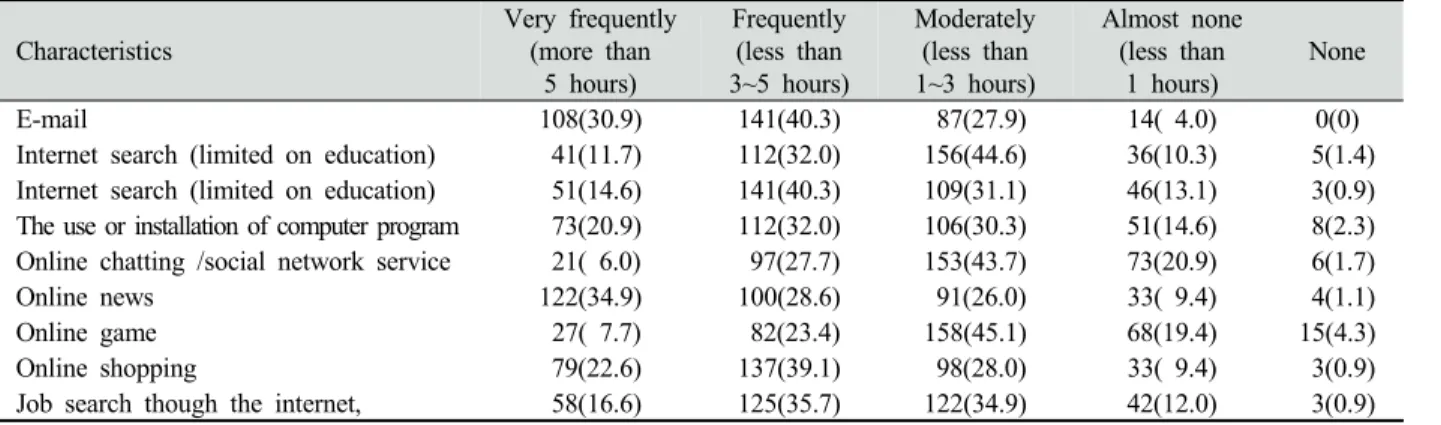
연구대상의 치위생과 학생 인터넷 이용도의 결과는
<Table 2>에 제시된 바와 같다.
치위생과 학생들은 E-mail 주고 받기에서는 매우 자주 사용 30.9%, 자주사용 40.3%, 보통 27.9%순으로 자주사용 이 가장 높았다. 교육 정보 검색은 보통 44.6%가 가장 높았 으며, 자주사용 32.0%, 매우자주사용 11.7%순이었다. 컴퓨 터 프로그램 설치 및 사용에서도 자주사용 40.3%로 가장 높았으며 보통 31.1%, 매우자주사용 14.6%순이었다. 채팅 (chatting) 및 SNS 사용은 자주사용 32.0%로 가장 높았으
며, 보통 30.3%, 매우자주사용 20.9% 순이었다. 온라인 뉴 스 시청은 43.7%로 보통에서 가장 높았으며, 자주사용 27.7%, 거의 사용 안함이 20.9% 순이었다. 온라인 쇼핑에 서는 보통이 45.1%로 가장 높았으며, 자주사용 23.4%, 거 의 사용 안함이 19.4%순이었다. 온라인 구인.구직 정보는 자주사용이 39.1%로 가장 높았으며, 보통 28.0%, 매우자주 사용 22.6% 순으로 나타났다. 온라인 게시판 접속은 자주 사용 35.7%, 보통 34.9% , 매우자주 사용 16.6%순이었다.
Characteristics
Very frequently (more than
5 hours)
Frequently (less than 3~5 hours)
Moderately (less than 1~3 hours)
Almost none (less than
1 hours)
None
E-mail 108(30.9) 141(40.3) 87(27.9) 14( 4.0) 0(0)
Internet search (limited on education) 41(11.7) 112(32.0) 156(44.6) 36(10.3) 5(1.4) Internet search (limited on education) 51(14.6) 141(40.3) 109(31.1) 46(13.1) 3(0.9) The use or installation of computer program 73(20.9) 112(32.0) 106(30.3) 51(14.6) 8(2.3) Online chatting /social network service 21( 6.0) 97(27.7) 153(43.7) 73(20.9) 6(1.7)
Online news 122(34.9) 100(28.6) 91(26.0) 33( 9.4) 4(1.1)
Online game 27( 7.7) 82(23.4) 158(45.1) 68(19.4) 15(4.3)
Online shopping 79(22.6) 137(39.1) 98(28.0) 33( 9.4) 3(0.9)
Job search though the internet, 58(16.6) 125(35.7) 122(34.9) 42(12.0) 3(0.9) Table 2. Purpose of the internet use in the dental hygiene students Unit: N(%)
Characteristics Division N %
Grade 1 67 19.1
2 110 31.4
3 173 49.4
Computer education experiences yes 136 38.9
no 214 61.1
Personal computer ownership yes 292 83.4
no 58 16.6
Computer use per day less than 1 hour 110 31.4
less than 2 hours 129 36.9
less than 3 hours 80 22.9
more than 4 hours 31 8.9
Table 1. General characteristics and internet use of the subjects
Characteristics Mean SD
E-mail 3.19 0.619
Internet search (limited on education) 3.38 0.674
The use or installation of computer program 3.26 0.725
Online chatting / social network service 3.19 0.907
Online news 3.47 0.778
Online game 3.12 0.779
Online shopping 3.48 0.875
Job search though the internet, 3.18 0.759
The access of online bulletin board 3.29 0.794
Table 3. Satisfaction level of internet use in the dental hygiene students
3. 치위생과 학생들의 인터넷 만족도
연구대상의 치위생과 학생 인터넷 이용도의 결과는
<Table 3>에 제시된 바와 같다. 1-5점 점수 범위에서 모든 항목에서 3점대의 비슷한 만족도 분포를 보였다. 온라인 쇼 핑이 3.48점, 온라인 뉴스시청이 3.47점, 교육정보검색이 3.38점 순으로 높았으며 온라인 게임이 3.12점으로 가장 낮 은 값을 보였다.
4. 보건의료 정보화에 대한 치위생과 학생들의 태도 연구대상의 치위생과 학생 보건의료 정보화에 대한 치위 생과 학생들의 태도 결과는 <Table 4>에 제시된 바와 같다.
1-5점 점수 범위에서 거의 모든 항목에서 3점대를 보였으며 그 중 선택이 주어진다면 치과위생사들은 컴퓨터를 사용하 지 않을 것이다. 항목이 3.50점으로 가장 높은 점수를 보였 으며 다음은 컴퓨터는 업무단계를 줄여 치과업무를 더 효율 적으로 만들어줄 것이다. 항목이 3.46점으로 높았다. 반면에 컴퓨터는 너무 많은 자료를 포함하고 있어서 개방적으로 사
Attitude toward medical health information Mean SD
*01. The computer can increase the workload of dental hygienist and eventually rise the treatment cost
for the patient. 3.134 0.947
*02. The computer decreases communication between staff working at dental hospital. 3.200 1.001
*03. The computer will allow spending more time on their tasks for dental hygienist. 3.250 0.814
*04. The increased cost of dental treatment is due to the use of computer. 3.274 0.914
*05. The conveniences and benefits of the computer usage is greater than time spending on computer 3.080 0.895
*06. The computer will breach personal privacy of patients. 3.017 0.921
*07. The efficiency of tasks will decline because only one person can use the computer at once. 3.137 0.892
*08. The computerization of the data in dental hospital provides improved opportunity for dental hygienist
in terms of patient management. 3.420 0.858
*09. The computer can not be opened for the public as it contains too much information. 2.946 0.924
*10. The computer reduces patient management time of dental hygienist.. 2.866 1.002
*11. Dental hygienists will not use the computer if they can choose. 3.500 1.015
*12. The computer only be used for data management. 3.277 0.940
*13. The computer makes ease of dental hygienist's task. 3.420 0.910
*14. The paper work of dental hygienists will significantly decrease because of computer usage. 3.370 0.894
*15. there will be delay on the task because of extended orientation time related to the computer for
newly recruited dental hygienists. 3.203 0.844
*16. Not all data in dental hospital can not be computerized. 3.000 0.915
*17. The computer will allow more effective treatment by reducing the workload for dental hygienists. 3.460 0.838
*18. Dental hygienists will face reduced tasks when there will be more computers. 3.090 0.936
*19. Dental hygienists will spend more time on patient management as a result of the use of computer. 3.270 0.817
*20. Dental hygienists will be sued more as a result of the computer usage. 3.089 0.873
*Reverse scored items
Table 4. Attitude toward medical health information in the dental hygiene students
Characteristics Division Mean SD F or t p-value*
Grade 1 3.159 0.362
2.345 0.097
2 3.231 0.340
3 3.254 0.353
Computer education experiences yes 3.227 0.344
2.462 0.118
no 3.183 0.361
Personal computer ownership yes 3.233 0.353
2.462 0.118
no 3.034 0.317
Computer use per day less than 1 hour 3.248 0.334
1.966 0.119 less than 2 hour 3.207 0.368
less than 3 hour 3.164 0.334 more than 4 hour 3.090 0.404
*by t-test or one-way ANOVA
Table 5. Attitude difference in information of medical health treatment by general characteristics of the subjects
용 될 수 없다 항목과 컴퓨터는 치과위생사가 환자관리를 할 시간을 줄인다 항목이 각각 2.95점과 2.90점으로 낮은 점수를 나타냈다.
5. 대상자의 일반적 특성에 따른 보건의료 정보화에 대한 태도 차이
연구대상의 치위생과 학생 일반적 특성에 따른 보건의료 정보화에 대한 태도 차이 결과는 <Table 5>에 제시된 바와 같다. 1-5점 점수 범위에서 모든 항목에서 3점의 평균값을 보였으며 학년에 따라서는 학년이 높아질수록 3학년이 가장 높았고 2학년, 1학년 순이었으나 통계적 유의성은 나타나지 않았다(p>0.05). 컴퓨터 교육경험에 따라서는 경험이 있는 경우가 그러하지 않은 경우보다 높았으나 유의한 차이는 나 타나지 않았다(p>0.05). 개인용 컴퓨터 소유에 따라서는 소 유한 경우가 없을 경우보다 높았으나 유의한 차이는 나타나 지 않았다(p>0.05). 1일 컴퓨터 사용시간에 따라서는 시간 이 증가할수록 감소하는 경향을 보였으나 통계적 유의한 차 이는 나타나지 않았다(p>0.05).
총괄 및 고안
최근 내⋅외적으로 병원 업무 환경이 정보화 기술을 도 입하여 각 전문인력들의 업무체계 및 처리방법들이 업무의 간소화, 정확성, 효율성면에서 성과를 기대하고 있다. 그러 나 실제적인 성과는 정보 시스템 보다는 사용하는 실무자들 의 활용성에 따라서 성과는 달라질 수 있다. 김13)은 정보기 술 활용에 있어서 사용자의 정보기술 활용능력이 영향을 끼 치는 중요한 요소라고 하였다. 치과 의료의 주요 업무를 맡 고 있는 치과위생사도 점차 단순기능에서 복잡기능으로 변 화 발전되는 정보전산화 시스템의 컴퓨터와 네트워크 장치 를 기반으로 치과위생사 개인의 정보기술 활용능력을 증진 시킬 수 있는 교육 방안이 구체적으로 마련되어야 한다. 이 에 본 연구는 치위생과 학생들의 일반적 특성, 컴퓨터 사용 실태, 인터넷 이용도와 만족도를 파악하고 보건의료 정보화 에 대한 태도를 살펴보았다. 치위생과 학생들 83.4%가 개 인용 컴퓨터를 소유하고 있었으나 컴퓨터에 대한 교육경험 이 없는 경우가 61.1% 로 높은 비율을 차지하고 있었다. 이 는 치위생과 학생들의 개인컴퓨터 활용이 높아 컴퓨터의 접 근성이 높다는 것을 알 수 있으나 컴퓨터 교육이 미비함을 알 수 있다.
이러한 결과를 통해 치위생과 교육과정 중 컴퓨터 관련 교육에 적극적으로 참여할 수 있는 방안을 마련해야 할 것 이다. 인터넷 이용도와 만족도에 대한 결과는 E-mail 주고 받기, 컴퓨터 프로그램 설치 및 사용, 온라인 구인. 구직 정 보와 교육 정보 검색 부분 등 다양한 분야에서 치위생과 학
생들의 인터넷 이용도가 높음을 알 수 있었고 만족도는 평 균 3.28이었으며 모든 분야에서 균일한 값을 보였다. 따라 서 치위생과 정보기반 교육 프로그램 등의 구축 시 이용도 가 높은 E-mail 주고받기, 컴퓨터 프로그램 설치 및 사용, 온라인 구인. 구직 정보와 교육 정보 검색등 기본적 인터넷 기능 분야를 활용하면 치위생과 학생들의 자발적 참여도가 높아질 것이다.
보건의료 정보화에 대한 학생들의 태도는 2.90-3.50 범 위였으며 평균점수는 3.20 범위였다. 이는 황과 박14)이 간 호사들을 대상으로 병원정보시스템에 대한 요구도와 도입전 후 태도 변화 연구에서 도입 전 3.24와 비슷하였다. 본 연구 결과 컴퓨터를 활용함으로 발생하는 긍정적 효과인 환자관 리 능력 향상, 치과업무의 효율성 증가, 전문직 업무 향상 등에서 높은 점수를 보였으며 특히 선택이 주어진다면 치과 위생사들은 컴퓨터를 사용하지 않을 것이다가 3.50점으로 가장 높았다. 컴퓨터 활용에 대한 소극적 태도와 인터넷 검 색 등에는 익숙하지만 컴퓨터에 대한 기계적 거부감 형성 등 심리적 요인이라 여겨지므로 교과과정에 컴퓨터에 대한 교육 프로그램 도입이 필요하다. 반면에 컴퓨터를 활용함으 로 발생하는 환자의 프라이버시 침해, 업무의 효율성 저하 등 부정적인 요소 부분에서는 낮은 점수를 보였고 장비를 활용함으로써 상승하는 의료비용의 증가는 높은 점수를 보 였다.
치위생과 학생들의 일반적 특성이 정보화의 태도에 미치 는 영향에 대한 결과는 학년, 교육경험, 개인용 컴퓨터 소 유, 1일 사용시간에 따른 통계적 유의성은 보이지 않았으 나 많은 선행 연구에서는 학년이 높아질수록 교육경험이 많을수록 정보화에 우호적인 결과를 나타냈다. 김 등15)과 박 등16)은 병원전산화 도입 시 받은 교육이 업무 만족도와 전산 활용에 도움이 되었다고 보고하였으며 김 등17)은 연령 과 근무경력이 높을수록 병원정보시스템 활용도가 높다고 보고하였다. 그러나 임18)은 공무원을 대상으로 한 연구에서 는 연령이 영향을 미치지 않는다고 보고하였는데 이는 전 공무원들의 업무가 전산화를 통해 이루어지는 반면에 치위 생과 학생의 경우는 보건정보화에 대한 교육 기회가 전반적 으로 이루어지지 않는 결과로 판단된다. 본 연구 결과와 많 은 선행연구 결과를 바탕으로 볼 때 보건정보화의 효율적인 운영 및 관리를 위한 최소한의 교육은 필연적이라 여겨진 다. 이에 치위생과 교육에서 컴퓨터 관련 정보화 프로그램 교육의 개선이 필요함을 보여준다. 이를 개선하기 위해서는 치위생과 학생들이 컴퓨터에 대한 거부감 없이 익숙하게 접 할 수 있는 웹기반 프로그램을 바탕으로 한 컴퓨터 관련 교 육과정 개발이 필요할 것으로 사료된다.
본 연구의 제한점은 연구대상이 수도권에 한정되어 있기 에 일반화하는데 다소 한계가 있다. 따라서 향후 연구에서 는 보건정보화에 대한 보다 구체적인 자료를 분석하기 위해 서 보다 많은 신뢰된 자료를 바탕으로 이루어져야 할 것이
다. 그러나 치위생과 학생의 보건정보화에 대한 능력을 향 상을 위한 교육과정 개발 방안 모색에 기초자료를 제공했다 는 점에서 의의가 있다.
결론
본 연구는 치위생과 학생들의 정보화 태도를 알아보고자 2014년 3월 2일부터 5월 3일까지 수도권에 소재한 치위생 과 학생을 대상으로 350부의 설문지를 최종 분석 자료로 사 용하여 다음과 같은 결과를 얻었다.
1. 대상자들 대부분이 개인용 컴퓨터를 소유하고 있었으 나 컴퓨터에 대한 교육경험은 낮은 수치를 보였다. 2. 대상자들은 다양한 분야에서 높은 인터넷 이용도를
보였고, 만족도는 평점 3.28점으로 수치를 보였다.
3. 대상자의 보건의료 정보화에 대한 태도는 평점 3.20 점이었으며 선택이 주어진다면 치과위생사들은 컴퓨 터를 사용하지 않을 것이다 항목이 3.50점으로 가장 높았다.
4. 대상자의 일반적 특성에 따른 정보화의 태도는 모든 영역에서 통계적으로 유의한 차이를 나타내지 않았다 (p>0.05).
이상의 연구 결과를 종합해 볼 때 치위생과 학생의 보건 정보화 태도는 여러모로 미흡하다. 이는 치위생학 교육과정 에 정보화를 향상시킬 수 있는 컴퓨터 교육 과정 이외에 다 양한 교육기회를 제공할 수 있는 충분한 교과운영 과정이 필요하다고 생각한다.
References
1. Park YH, Kim MH, Ha HJ, Kim SA. Students nurses's attitude toward computerization. J Korean Acad Soc Nurs Educ 2004;
10(2): 220-8.
2. Scott RE. e-Records in health-presserving our future. Intern J Med Inform 2007; 76(5-6): 427-31. http://dx.doi.org/10.
1016/j.ijmedinf.2006.09.007.
3. Rim BM, Yoo KS. An empirical study on effectiveness of hospital information system and its influncing factors (with emphasis on the order communication system). Korean J Hosp Manage 2001; 6(2): 115-37.
4. Doll WJ, Torkzadeh G. The measurement of end-user computing satisfaction: theoretical and methodological issues.
MIS Quarterly 1991; 15(1): 5-10. http://dx.doi.org/10.
2307/249429.
5. Choi OJ, Park SH, Park IS, Shin HJ. A study of the efficiency of nursing time, nursing information system(NIS)-focused on direct and indirect, the frequencies of telephone and verbal orders. J Korean Clinic Nurs Res 2003; 9(2): 163-9.
6. Jeong MK. A Study on nurses' perception and job efficiency of computerized nursing services[Masters thesis]. Seoul:
Univ. of Hanyang, 2001.
7. Burkes M. Identifying and relating nurses’ attitudes toward computer use. Comput Nurs 1991; 9(5): 90-201.
8. Seo NR, Lee MH. Evalation of nursing information systems in a general hospital. J Korean Acad Nurs Admin 2001;
7(1): 111-26.
9. Bongartz C. Computer-oriented patient care. a comparison of nurses’s attitudes and perceptions. Comput Nurs 1988;
6(5): 204-10.
10. Jiang WW, Chen W, Chen YC. Important computer competerncies for the nursing profession. J Nurs Res 2004;
12(3): 213-25. http://dx.doi.org/10.1097/01.jnr.0000387505.
98877.6d.
11. Park HE, Ji SE. A study on school nurses' attitude and needs about school health care information system. The chung-Ang J Nurs 2000; 4(2): 51-68.
12. Stronge JH, Brodt A. Assessment of nurses’ attitude towared computer use. Comput Nurs 1985; 9(5): 190-201.
13. Kim G. A study of the factors of the ICT application in public administration. Korean Pub Admin Review 2001;
35(4): 31-53.
14. Hwang JI, Park HA. Nurses’ attitude toward computerization and their need assessment in pre and post hospital information systems. Healthcare Informatic Res 2001; 7(1): 57-66.
15. Kim YA, Kim NH, Kim IS. Analysis of nurses satisfaction on job process after acquiring ward-order communication system. Healthcare Informatic Res 2000; 6(2): 27-44.
16. Park KS, Choi IS, Kang HW, Kim NY, Kim MJ, Kim SH et al. A survey on nurses' utilization of computerization in nursing practice. J Korean Acad Nurs Admin 2003; 9(3):
367-78.
17. Kim SS, Ju HO, Park IS. Factors affecting utilization of clinical nurses' hospital information system. J Korean Acad Nurs Admin 2008; 14(4): 440-7.
18. Im YJ. A study on activaion factor of information technology in Korean public organization. [Doctoral dissertation]. Seoul:
Univ. of Kyung Hee, 1997.