ABSTRACT
Objectives: The purpose of the study is to investigate the cardiopulmonary resuscitation(CPR) knowledge and performance in the dental hygiene students in Gyeongju.
Methods: A self-reported questionnaire was completed by 106 dental hygiene students in Gyeongju. The questionnaire consisted of CPR knowledge and performance, and was collected from April 4 to 12. The data were analyzed using SPSS version 18.0 by t-test, correlation analysis, ANOVA, and multiple regression analysis.
Results: The average age of the subjects was 20.6 years and 97.2% were female students. The students did not experience the emergency situation(96.2%). Approximately half of the students received CPR education(51.9%), but they did not have the CPR certificate(94.3%).
There was a significantly statistical correlation between the CPR knowledge and performance(p<0.01). The CPR knowledge was proportional to the CPR performance skill. The CPR knowledge (p<0.05) and performance (p<0.01) showed a statistical difference by the grade of the students. The CPR knowledge of the senior students was higher than that of the freshmen and sophomore. The CPR knowledge (p<0.01) and performance (p<0.01) showed a statistical difference by the education experience. The CPR education provided the students with CPR knowledge and performance.
Conclusions: In order to promote and maintain CPR knowledge and performance on dental hygiene student, it should be reinforced the more systematic training program which can be repeatedly evaluated and retrained than the present. In addition, a follow-up study will also be needed for the student and clinical dental hygienist.
Key Words: cardiopulmonary resuscitation(CPR), dental hygiene student, knowledge, performance
Introduction13)
The emergency situation is increasing in dental treatment[1,2]. The emergency conditions are caused by
Copyrightⓒ2016 by Journal of Korean Society of Dental Hygiene
This is an open-access article distributed under the terms of the Creative Commons Attribution Non-Commercial License (http://creativecommons.org/
licenses/by-nc/3.0/), which permits unrestricted non-commercial use, distribution, and reproduction in medium, provided the original work is properly cited.
pharmacological agents, treatment time, and increase of the elderly patients.
The cardiovascular patients are always subject to sudden death or serious brain damage in dental surgery at any time.
The rapid identification of the cardiac arrest patients is the key to save the lives of the patients because within 4 minutes the brain can revive by chest compressions[3].
The rapid identification and chest compression can
http://dx.doi.org/10.13065/jksdh.2016.16.04.601 ISSN 2288-2294(Online) J
일부 치위생과 학생들의 심폐소생술 지식과 수행능력
이승훈
청암대학교 치위생과
Knowledge and performance of cardiopulmonary resuscitation (CPR) in dental hygiene students
Seung-Hun Lee
Department of Dental Hygiene, Cheongam College
*Corresponding Author: Seung-Hun Lee, Department of Dental Hygiene, Cheongam College, #1641 Noksae-ro, Suncheon, Jeonnam, Korea 57997, Tel: +82-61-740-7382, Fax: +82-61-740-7418, E-mail: [email protected]
Received: 18 April 2016; Revised: 9 August 2016; Accepted: 10 August 2016
한국치위생학회
affect the resuscitation success rate. The dentist and the dental hygienists should learn CPR in order to prepare for the cardiac arrest patients. So CPR education is very important to the dental clinic staff[4].
So far, CPR education in Korea has been focused on nurses, doctors, and paramedics[5-7]. Most of the study on CPR education included nurse students by Yoon et al[8] and Cho et al[9]. Jeong and Ha[10] reported the CPR knowledge and the attitude of the dental hygienist.
Park et al[11] and Choi et al[12] reported the CPR knowledge and performance of mannequin hands-on training by DVD. But this study did not fully show the relationship between the CPR knowledge and performance.
The purpose of the study is to investigate the relationship between CPR knowledge and performance in the dental hygiene students.
Materials and methods
1. Study subjects
The subjects were 106 dental hygiene student in Gyeongju.
After explanation for the purpose of the study, the students were assigned to the study and institutional review board(IRB) was received by Korea National Institute for Bioethics Policy(KoNIBP; P01-201604-23-002).
A self-reported questionnaire was completed by 106 students on April 12, 2016. The minimum number of study samples was calculated as 102 using G Power 3.0 program by t-test, 0.05 significance level, power of test 80%, and 0.50 effect size. Assuming elimination by 10%, 106 subjects were participated in the minimum sample size for analysis.
2. Study methods
The questionnaire was modified and adapted from Cho[13]. The questionnaire consisted of CPR knowledge (16 items), CPR performance (10 items), and general characteristics of the study subjects (6 items). The CPR knowledge was measured by right(1 point) and wrong or do not know(0 point). The performance was measured by Likert 5 point scale including very good(5 points), good(4 points), average(3 points), poor(2 points), and very poor(1 point). Cronbach's α was 0.916 for the internal consistency of survey. Cronbach's α was 0.787 in
the knowledge and 0.958 in the performance.
3. Data analysis
The characteristics of the study subjects were calculated the frequency, percentage, mean, the CPR knowledge and the performance were computed the standard deviation and the mean. The data were analyzed by SPSS version 18.0 including t-test, one way ANOVA, multiple regression analysis and post hoc Scheffé test.
Results
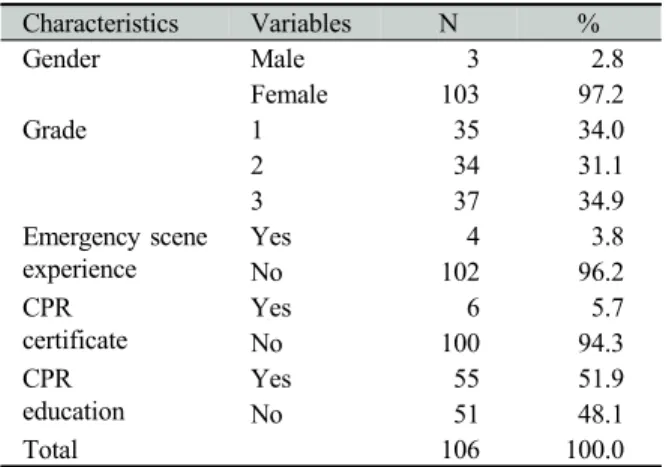
1. The general characteristics of the study subjects The average age of the subjects was 20.6 years and the majority was women(97.2%). The subjects were 106 students including grade 1(35 people), grade 2(34 people), and grade 3(37 people). They had not experience an emergency situation(96.2%). Most of the subjects did not have CPR certificate(94.3%), and 51.9% had CPR training experience<Table 1>.
Characteristics Variables N %
Gender Male 3 2.8
Female 103 97.2
Grade 1 35 34.0
2 34 31.1
3 37 34.9
Emergency scene experience
Yes 4 3.8
No 102 96.2
CPR certificate
Yes 6 5.7
No 100 94.3
CPR education
Yes 55 51.9
No 51 48.1
Total 106 100.0
Table 1. General characteristics of the study subjects
2. The CPR knowledge
The CPR knowledge of the subjects was shown in <Table 2>. It was 0.67 out of 1 point. In question, "Hold the nose of the patient and blow into the breath to raise the chest."
was 0.93 at the time of artificial respiration, "Press the forehead with one hand and lift the jaw with the other hand in order to maintain the airway." was 0.92, and "Palpate the carotid artery and check for the carotid pulse." was 0.82 in the order of high ranking. However, “Artificial respiration should avoid
hyperventilation." was 0.17, "The patient lay up on the unit chair in a supine position to perform CPR." was 0.39, and
"The rate of chest compressions is about 100 times per minute."
was 0.40 in the order of low ranking.
3. The CPR performance
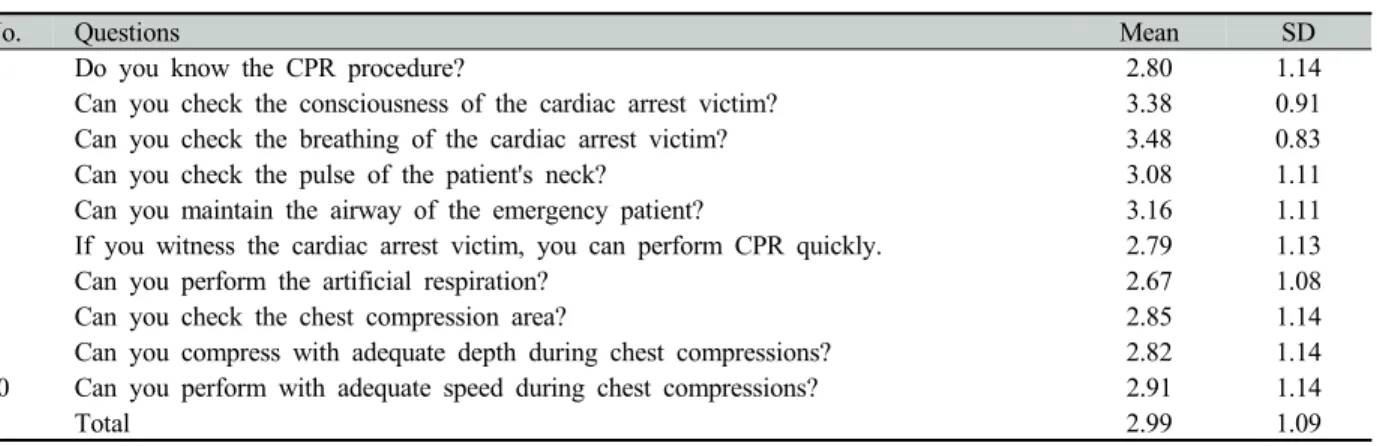
The CPR performance of subjects was as follows
<Table 3>. It was 2.99 out of 5 points. According to high ranking, there were ‘check the breathing’, ‘check the consciousness’, and ‘maintain the airway’, 3.48, 3.38, and 3.16 respectively. But the low scores appeared low in 2.67, 2.79, and 2.80 in ‘perform the artificial respiration’, ‘perform the quick CPR’ and ‘know the CPR procedure’, respectively.
4. Difference between the knowledge and the performance by characteristics
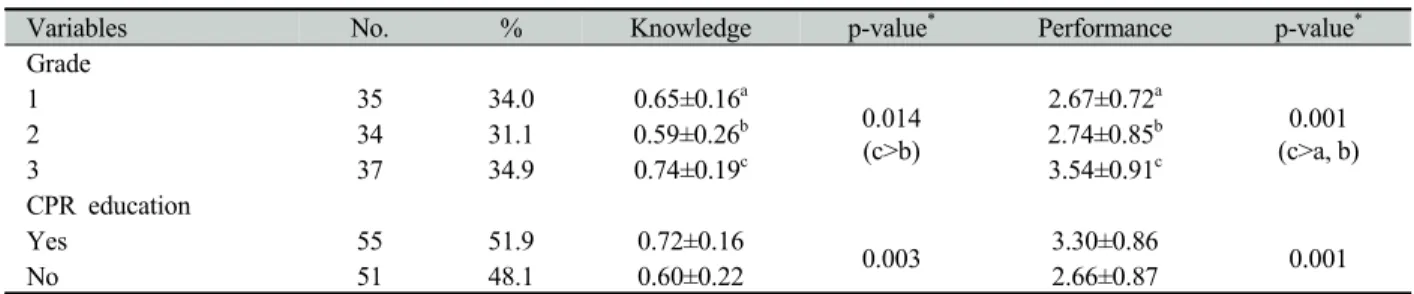
Table 4 showed the difference between the knowledge and the performance according to the CPR education and the grade of the subjects. The CPR knowledge(p<0.01) and the performance(p<0.01) showed statistically significant differences depending on the grade. The CPR knowledge of 3 grade was higher than that of 2 grade, and the CPR performance of 3 grade was higher than those of 1 and 2 grades. Also the CPR knowledge(p<0.01) and performance (p<0.01) showed statistically significant differences depending on the education. Those who received CPR education were higher both in the knowledge and the performance.
No. Questions Mean SD
1 Loss of consciousness, breathing and pulse can influence on cardiopulmonary function. 0.64 0.48 2 Witnessing the cardiac arrest patient, you will shout for help and check for consciousness. 0.79 0.41 3 Tapping the patient' shoulders while asking "Are you okay?", you should check the consciousness. 0.77 0.42 4 The main factor in airway obstruction is a blockage of the pharynx due to the tongue and the
epiglottis. 0.63 0.49
5 The patient lay up on the unit chair in a supine position to perform CPR. 0.39 0.49 6 Tilt the head with one hand and lift the jaw with the other hand in order to maintain the airway. 0.92 0.28 7 Put your ear to the mouth of the patient while watching the patient's chest. 0.81 0.39 8 Hold the nose of the patient and give two breaths for chest rise. 0.93 0.27
9 Artificial respiration should avoid hyperventilation 0.17 0.38
10 Palpate the carotid artery and check for the carotid pulse. 0.82 0.39
11 In the midline of the sternum and center of the nipples, apply the chest compression. 0.70 0.46 12 The shoulder is paralleled to the palm and the elbow joint is straightened during chest compressions. 0.72 0.45
13 The depth of chest compressions is 5-6cm. 0.56 0.50
14 The rate of chest compressions is at least 100 times per minute. 0.40 0.49 15 The artificial respiration is given twice after 30 chest compressions. 0.68 0.47 16 The chest compressions and artificial respiration are repeated alternately by return of spontaneous
circulation(ROSC). 0.74 0.44
Total 0.67 0.47
Table 2. The CPR knowledge
No. Questions Mean SD
1 Do you know the CPR procedure? 2.80 1.14
2 Can you check the consciousness of the cardiac arrest victim? 3.38 0.91
3 Can you check the breathing of the cardiac arrest victim? 3.48 0.83
4 Can you check the pulse of the patient's neck? 3.08 1.11
5 Can you maintain the airway of the emergency patient? 3.16 1.11
6 If you witness the cardiac arrest victim, you can perform CPR quickly. 2.79 1.13
7 Can you perform the artificial respiration? 2.67 1.08
8 Can you check the chest compression area? 2.85 1.14
9 Can you compress with adequate depth during chest compressions? 2.82 1.14 10 Can you perform with adequate speed during chest compressions? 2.91 1.14
Total 2.99 1.09
Table 3. The CPR performance
Table 5 showed the CPR education according to the grade.
The CPR knowledge of the senior students was higher than those of the freshmen and sophomore. The CPR education provided the students with CPR knowledge and performance.
The CPR knowledge influenced on the education, the CPR performance was improved by the education.<Table 6 and Table 7>.
5. Correlation between knowledge and performance The correlation between CPR knowledge and performance of the study subjects was shown in <Table 8>. The Correlation(r=0.44) of knowledge and the performance were
statistically significant(p <0.01). The CPR knowledge was proportional to the CPR performance(r=0.44, p<0.01).
Knowledge Performance
Knowledge 1.00 0.44*
Performance 0.44* 1.00
*p<0.01 by pearson correlation coefficient
Table 8. Correlation between knowledge and performance
Discussion
Korea goes into the aging society and the emergency
Variables No. % Knowledge p-value* Performance p-value*
Grade
1 35 34.0 0.65±0.16a
0.014 (c>b)
2.67±0.72a
0.001 (c>a, b)
2 34 31.1 0.59±0.26b 2.74±0.85b
3 37 34.9 0.74±0.19c 3.54±0.91c
CPR education
Yes 55 51.9 0.72±0.16
0.003 3.30±0.86
0.001
No 51 48.1 0.60±0.22 2.66±0.87
*by t-test or one-way ANOVA
a,b,conly presented statistically significant results by Post Hoc Scheffé test, a: grade 1, b: grade 2, c: grade 3 Table 4. Difference between the knowledge and the performance by characteristics of the subjects
CPR education
Total
Yes No
Grade 1 N 14 21 35
% 25.5 41.2 33.0
2 N 10 24 34
% 18.2 47.1 32.1
3 N 31 6 37
% 56.4 11.8 34.9
Total N 55 51 106
% 51.9 48.1 100.0
Table 5. 2 test of CPR education and grade
Variables B S.E. t p-value*
Grade 0.023 0.026 0.092 0.913 0.364
CPR education -0.104 0.042 -0.249 -2.460 0.016
*by multiple linear regression
Table 6. Influencing factors of CPR knowledge
Variables B S.E t p-value*
Grade 0.348 0.105 0.314 3.332 .001
CPR education -0.429 0.172 -0.235 -2.489 .014
*by multiple linear regression
Table 7. Influencing factors of CPR performance
situation is increasing in the dental treatment. So dental hygienists should be able to know CPR performance. The dental hygienists must be prepared for the CPR performance and this study focused on the importance of the CPR education in the dental hygienists.
The CPR knowledge of the subjects(0.67 points) and performance(2.99 points) was average in Likert 5 point scale. The CPR knowledge(p<0.05) showed statistically significant differences depending on the grade and the CPR education in this study. Compared with previous study of Choi[14], Yoo and Yu[7], the knowledge levels was different depending on the CPR education experience and the certification. The CPR experience of Cho’s report[15] was not associated with the knowledge, in the study of Cho[13], the level of knowledge was different according to job, workplace, career. The difference of the prior studies resulted from differences in the study subjects or methods. Also the level of the knowledge was due to the grade and the CPR education, because the differences were limited to the CPR education for the elective course.
The the study of Oh and Han[16] reported that the CPR knowledge level showed a significant difference within four months after the education, Oh et al[17]
suggested that the knowledge scores of the group receiving the education and the practice was higher than that of only the educated group, and the educational effect was significantly different to the evaluation of CPR education by Kim et al[5]. The continuous education of CPR performance is very important to maintain the competency of the dental hygienists. In addition, students must be able to get step-by-step training program.
The points were high in the question of "Hold the nose of the patient and blow into the breath for the chest rise.", "Tilt the head with one hand and lift the jaw with the other hand for the airway.", and "Palpate the carotid artery of the patient, and check carotid pulse." in the order. But, there were the lower points items that were
"Artificial respiration is breathing in the usual amounts, not as deep", "The patient was placed on the unit chair in a supine position to perform CPR.", and "The rate of chest compressions is at least 100 times per minute.".
The results were showed similar to the studies of Cho[13], Cho[15], and Park and Jeon[6]. The results of studie showed that the current education did not provid the CPR knowledge sufficiently in the college.
Underrated items are required retraining and continuous evaluation.
The CPR performance of subject showed statistically significant differences depending on the grade and the CPR education. Compared with previous studies, in the study of Cho[14], the CPR performance was different from the age and the education, the study of Yoo and Yu[7] had the differences depending on the employment, the CPR education, and the certificate. And Cho[13]
reported that the CPR performance varied from the age, the education level, the job, the employment, the career, and the CPR education. These results were similar with the previous studies.
In CPR performance, there were was the higher points in 'check the breathing’, ‘check the consciousness’, and
‘maintain the airway’. However, there were the lower points items, which were ‘perform the artificial respiration’, ‘perform the quick CPR’ and ‘know the CPR procedure’. These results were similar with the studies that were Choi[14] and Choi[13]. The performance of hands-on training of chest compression and artificial respiration was better than instructor-led education.
There was correlation between the CPR knowledge and performance in this study. This result was similar to the previous studies that the study of Choi[14], and Yoo and Yu[7] showed the proportion of CPR knowledge and performance.
For dental hygiene students, the effective CPR education will be continuously conducted together with the knowledge and performance practice. Referring to previous studies, it was significantly reduced after 4 weeks of training in the study of Kim Choi[17] that is the accuracy technique of the artificial respiration and the chest compression. Oh and Han[16] reported that the training with mannequins was good for retention of the accurate knowledge and performance. Park et al[18] emphasized the importance of hands-on training. Instructor-led education had its limitation to provide the accuracy of chest compression and artificial ventilation, so the learner oriented education should be implemented.
Therefore, in order to promote and maintain CPR knowledge and performance on dental hygiene student, it should be reinforced the more systematic training program which can be repeated evaluation and retrained than the present. In addition, a follow-up study will also be needed for student, clinical dental hygienist in other areas.
Conclusions
This study was conducted to provide the more effective CPR education for dental hygiene students.
The study subjects were 106 students of dental hygiene in Gyeongju, the questionnaire was used to measure the CPR knowledge and performance of the subjects. The collected data were analyzed using correlation analysis, t test, ANOVA, and multiple regression analysis.
The average age of the subjects was 20.6 years, and majority was women(97.2%). They did not experience an emergency situation(96.2%). And they had not a CPR certificate(94.3%), 51.9% were received the CPR education.
1. The correlation between the CPR knowledge and performance had statistically significant(p<0.01). The CPR knowledge was proportional to the CPR performance(r=0.44, p<0.01).
2. The CPR knowledge(p<0.05) and performance (p<0.01) showed statistically significant differences depending on the grade. The CPR knowledge of the senior student was higher than those of the sophomore, and the CPR performance of the senior student was higher than those of the freshmen and sophomore.
3. The CPR knowledge(p<0.01) and performance (p<0.01) showed statistically significant differences depending on the education. Those who received CPR education were higher both the knowledge and performance.
Acknowledgements
This research was supported by the Research Grant of Cheongam College in 2016.
References
1. Jang CS, Lee CY, Kim JW, Yim JH, Kim JY, Kim YH, et al. A clinical study on the dental emergency patients visiting an university hospital emergency room. J Korean Assoc Oral Maxillofac Surg 2011; 37: 439-47. http://dx.doi.org/10.
5125/jkaoms.2011.37.6.439.
2. Keum KC, Paeng JY, Choi BY, Choi JG, Oh SR, Lee J, et al. An clinical analysis on the dental emergency patients visiting the emergency room of dental hospital of Wonkwang
University. J Korean Assoc Maxillofac Plast Reconstr Surg 2009; 31: 35-40.
3. Oh YH, Kim BJ. The effect of a cpr training for non-healthcare providers. J Korean Acad Soc Nurs 2005; 11(2): 278-86.
4. Alexander RE. Summary of the new 2010 american heart association guidelines for basic life support(cpr). Tex Dent J 2011; 128(3): 279-88.
5. Min MK, Ryu JH. Comparison of chest compression quality between compression-only CPR and 30:2 conventional CPR.
Korean J Emerg Med Ser 2015; 19(3): 139-48. http://dx.
doi.org/10.14408/KJEMS.2015.19.3.139.
6. Park JS, Jeon HR. The effect of basic life support education using a standardized basic life support video program in nurses` cardiopulmonary resuscitation knowledge, attitude and performance. J Korean Acad Soc Nurs Edu 2010; 16(2):
301-11. http://dx.doi.org/10.5977/JKASNE.2010.16.2.301.
7. Yoo SY, Yu JA. A study on knowledge, competence, and actual performance of nursing officers in performing cardiopulmonary resuscitation. J mil Nurs Res 2011; 29(1):
65-80.
8. Yoon JA, Kang JK, Ahn HJ, Choi JH, Kim CY. A study on types and counterplans of medical accident experienced by dentists in seoul(2004). Korean J Oral Med 2005; 30(2):
163-200.
9. Cho KA. Kim H, Lee BS, Kwon WY, Kim MS, Seo KS, et al. The survey of dentists: updated knowledge about basic life support and experiences of dental emergency in Korea.
J Korean Dent Sci Anesthesiol 2014; 14(1): 17-27.
10. Jeong KY, Ha MO. Knowledge and attitude toward cardiopulmonary resuscitation in dental hygienists. J Korean Soc Dent Hyg 2014; 14(5): 703-13. http://dx.doi.org/10.
13065/jksdh.2014.14.05.703.
11. Park SS, Jang GW, Hwang MY. Perception, attitude and knowledge of cardiopulmonary resuscitation in dental hygiene students. J Korean Soc Dent Hyg 2013; 13(6):
1079-86. http://dx.doi.org/10.13065/jksdh.2013.13.06.1079 12. Choi HJ, Jun SK, Yoo EM. Knowledge and attitude according
to learning experiences of CPR for dental hygiene students in some areas. J Korean Soc Dent Hyg 2011; 11(2): 223-32.
13. Cho HS. Relationship between cardiopulmonary resuscitation (cpr) knowledge, professional attitude, and job performance [Master's thesis]. Suwon: Univ. of Ajou, 2013.
14. Choi HO. A study on knowledge and competence of hospital nurses in performing cardiopulmonary resuscitation. J Korean Crit Care Nurs 2008; 1(1): 85-97.
15. Cho HY. Analysis of nurses' attitude toward basic life support and influencing factors[Master's thesis]. Seoul: Univ. of
Yonsei, 2008.
16. Oh SI, Han SS. A study on the sustainable effects of reeducation on cardiopulmonary resuscitation on nurses’
knowledge and skills. J Korean Acad Nurs 2008; 38(3):
383-92. http://dx.doi.org/10.4040/jkan.2008.38.3.383.
17. Kim HS, Choi EY. Continuity of BLS training effects in nursing students. J Korean Acad Soc Nurs Edu 2012; 18(1):
102-10. http://dx.doi.org/10.5977/jkasne.2012.18.1.102.
18. Park YS, Kim YM, Lee WJ, Kim HJ, Kim YB, Jeong WJ, et al. How knowledge-only reinforcement can impact time-related changes in basic life support(bls) skills of medical students on clinical clerkship. J Korean Soc Emerg Med 2006; 17(1): 45-50.