Balanced Information Potentials for PDF-Distance Algorithms with Constant Modulus Error
Namyong Kim* ABSTRACT
Blind equalization techniques have been widely used in wireless communication systems. In this paper, we propose to apply the balanced information potentials to the criterion of minimum Euclidian distance between two PDFs with constant modulus errors for adaptive blind equalizers.
One of the two PDFs is constructed with constant modulus error samples and another does with Dirac delta functions. Two information potentials derived from the criterion are balanced in order to have better performance by putting a weighting factor to each information potentials. The proposed blind algorithm has shown in the MSE convergence performance that it can produce enhanced performance by over 3 dB of steady state MSE.
Keywords : Blind equalization, PDF, Constant modulus error, balanced, Information potential
* Professor, Dep. of Information & Comm. Eng., Kangwon National University, Samcheok e-mail: [email protected]
접수일자 : 2011년 11월 13일, 수정일자 : 2011년 11월 30일, 심사완료일자 : 2011년 12월 10일
1. Introduction
Multipoint communication networks and the wireless broadcasting networks require efficient blind equalizers to cope with intersymbol inter- ference in the environment that training se- quences are not available [1][2].
Most blind algorithms are developed based on mean-squared-error (MSE) criterion for minimization of constant modulus error (CME). One of the drawbacks of MSE criterion can be the truth that it utilizes only second order statistics such as error power. The constant modulus algorithm (CMA) popularly being used is to use the second order statistics for CME.
In the recently developed information theoretic op- timization criteria, higher order informations are utilized in that optimization method introduced by
Princepe [3]. This approach is to adjust the adaptive system based on a combination of a nonparametric kernel density estimator for prob- ability density function (PDF) and a procedure to compute entropy or information potential (IP) [3]. For approximating Shannon's entropy, Renyi's generalized entropy [4] is employed by way of the kernel density estimation method with a Gaussian kernel [5]. The Renyi entropy with the Kernel density method leads to an es- timation of information potential defined as in- teractions among pairs of samples.
For CME, when the error PDF is forced to match the delta function, the CME samples gather together around zero by minimizing the distance between the error PDF and the delta function [6] which is a different approach from
the error-entropy minimization in blind equalization. In error-entropy method [7] the difference of two error samples are used. This error distance can have valuable information about error distribution in supervised systems, but in CME-type blind equalization the error difference between two CMEs loses the im- portant information of constant modulus value, so that error-entropy method with CME can not be employed in blind equalization.
In the process of minimizing the distance be- tween the PDF of CME and the Dirac delta func- tion, the interactions among CMEs are revealed to have two information potentials acting towards op- posite directions in this research, so we propose in this paper to balance the two IPs in order to miti- gate their conflicts in the IP field.
2. The Distance of CME-PDF and Dirac delta function
When L-ary PAM signaling systems with Llevels being equally likely to be transmitted are employed and the transmitted levels Alare Al=2l-1-L, l=1,2,...,L, the constant modulus R2 becomes
] [ / ]
[ 4 2
2 E Al E Al
R = (1)
In this section we introduce briefly the dis- tance between the PDF of CME and the Dirac-delta function [6]. With the definition of
2
2 R
y
eCME= k - , we can describe the distance )]
( ), (
[fCME eCME eCME
D d between the two PDFs, the CME-PDF fCME(eCME) and Dirac-delta function
) (eCME
d as
ò
ò +
= x x d x x
d e f d d
e f
D[ CME( CME), (CME)] CME2 ( ) 2( ) -2òfCME(x)d(x)dx. (2)
From the research [6] we can notice the first term on the right side òfCME2 (x d) x is the in- formation potential for CMEs, so we write it as VCMEin this paper.
Then we obtain
) 0 ( 2 1 )]
( ), (
[fCME eCME eCME VCME fCME
D d = + -
(3) Since we can also remove the constant term from (3) for it is not controllable, the mini- mization of D[fCME(eCME),d(eCME)]remains as the new criterion for constant modulus errors.
)}
0 ( 2 {
min CME CME
W V - f (4)
For convenience sake, we refer to (4) as minimum ED for CME (MED-CME) criterion.
Using the kernel density estimation method [5], the PDF of CME fCME(eCME)with Gaussian kernel and a block ofN CME samples can be described as
å- +
=
-
=
k
N k i
i CME CME CME
CME G e e
e N f
1
,) 1 (
)
( s
(5) The kernel density estimation method can make us write the IP VCMEin (4) as follows:
ò
= f x dx VCME CME2 ( )
å å
+ -
= =- +
-
=
k
N k i
k
N k j
j CME i
CME e
e N 1 G1
, 2 ,
2 ( )
1
s (6)
From (6) with eCME=0, the probability
) 0
CME(
f in (4) becomes
å- +
=
-
=
k
N k i
i CME
CME G e
f N
1 ,) 1 (
) 0
( s
(7)
Then the cost function PCME-MEDof MED-CME criterion becomes
å å
+ -
= =- +
- = -
k
N k i
k
N k j
j CME i CME MED
CME G e e
P N
1 1
, 2 ,
2 ( )
1
s
å
+ -
=
- -
k
N k i
i
eCME
N G1 ,) 1 (
2 s
(8)
3. The proposed Algorithm with Balanced Information Potentials
By inserting eCMA=yk2-R2 into the pro- posed cost function PCME-MED and using a block of past output samples Yk={yk,yk-1,...,yk-N+1}, the cost function PCME-MED[8] can be rewritten as
å å
+ -
= =- +
- = -
k
N k i
k
N k j
j i MED
CME G y y
P N
1 1
2 2
2 2( )
1
s
å
+ -
=
- - -
k
N k i
i R
y N G1
2
2 ])
[ 2 (
s (9)
The first term on the right side which was the information potential for CMEs now has be- come the information potential for output sam- ples so that we can express it as VCME -MED(y,y). We also can treat the second term on that side as an interaction among instant output powers and constant modulus, therefore it can be de- fined here as another information potential,
) , (R2 y
VCME -MED . Then the cost function PCME-MED can be rewritten as PCME-MED=VCME-MED(y,y)
) , ( 2×VCME-MED R2 y
- . The two information poten- tials VCME -MED(y,y), VCME -MED(R2,y)contribute to minimizing the cost function (8). An important aspect to be noticed is that when VCME -MED(y,y) decreases, it contributes positively to mini- mization of the cost function, while
) , (R2 y
VCME -MED has to decrease in order to con-
tribute to the minimization process. This leads us to the truth that the two information poten- tials are pushing and pulling each other on min- imization process of the cost function. If we place some balanced point on the line of influen- ces from the two information potentials, we might be able to find an optimal balance of forces between the two information potentials.
From this motivation, we propose to put a weighting factor a to the information potentials
) , (y y
VCME -MED and VCME -MED(R2,y)to balance their effect on the cost function as
a
×
=V - (y,y) Pproposed CMEMED
) 1 ( ) , (
2× 2 × -a
- VCME-MED R y (10)
Now we apply the gradient descent method for the minimization of the cost function (10).
The gradient is evaluated from
å å
+ -
= =- +
-
¶ =
¶ k
N k i
k
N k j
j i k
proposed
y N y
W P
1 1
2 2 2
2 ( )
s a
) )(
( 2 2
2
*
*- -
×Gs yi yj yjXj yiXi
å
+ -
=
- - -
k
N k i
i R
y N G1
2 2
2 ) ( )
1 ( 2
s s
a
2 *
2 )
(R -yi ×yi×Xi
× , (11)
Using this gradient, we can write the pro- posed algorithm (we will refer to this in this paper as Balanced-MED-CME) as
å å
+ -
= =- +
+ = - -
k
N k i
k
N k j
j i k
k y y
W N W
1 1
2 2 2
1 [ 2 ( )
s m a
) )(
( 2 2
2
*
*- -
×Gs yi yj yjXj yiXi
å
+ -
=
- - -
k
N k i
i R
y N G1
2 2
2 ) ( )
1 ( 2
s s
a
] ) (R2-yi2 ×yi×Xi*
× (12)
where m is the step-size for convergence
control of the proposed algorithm.
4. Simulation results and Discussion
For performance evaluation, in this section, we present and discuss simulation results that illustrate the comparative performance of the proposed algorithm versus MED-CME in blind equalization. The 4 level random signal {±3,±1} is transmitted to the channel and the impulse response, hiof the channel model in [9] is
]}
/ ) 2 ( 2 cos[
1 2{
1 i BW
hi= + p -
, i=1,2,3 (13)
where BW =3.3, the eigenvalue spread ratio ESR=21.71. The number of weights is set to 11.
The step-size for convergence control is 006
. 0
m= The data-block size N = 20 and the fixed kernel size s =0.5. The in- formation potential weighting factor
a
is set to2. The MSE curve performance of the MED-CME algorithm and the proposed is illus- trated in Fig. 1.
0 2000 4000 6000 8000 10000
-30 -25 -20 -15 -10 -5 0 5
MSE (dB)
Iterations (symbols) MED-CME Balanced-MED-CME
Fig. 1. MSE convergence performance
-0.4 -0.2 0.0 0.2 0.4
-0.0025 0.0000 0.0025 0.0050 0.0075 0.0100 0.0125 0.0150 0.0175
Probability density
Error value MED-CME Balanced-MED-CME
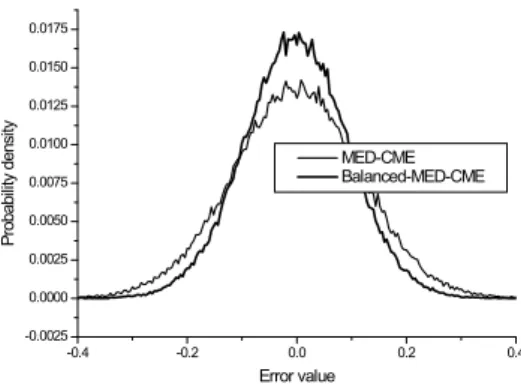
Fig. 2. Probability density for errors
In case of channel 1 with ESR=11.12, the MSE performance in Fig. 1 shows that the con- ventional MED-CME converges to -23 dB of steady state MSE, while the proposed algorithm reaches -27 dB. The proposed algorithm gives enhanced performance by above 3 dB of steady state MSE with faster convergence speed in comparison with MED-CME. In Fig. 2, the sys- tem error densities are shown and their per- formance difference is clearer showing the sys- tem error distribution of the proposed algorithm more concentrated around zero.
5. Conclusion
In this paper, a new algorithm balancing two information potentials derived from the criterion of minimizing PDF-distance between the PDF of constant modulus error and Dirac delta function is presented. By placing a appropriate weighting value on the proposed balancing equation com- posed of the two information potentials, the pro- posed method is proved to produce significantly enhanced performance in blind equalization.
References
[1] W. Moh, Y. Chen, " Multicasting flow con- trol for hybrid wired/wireless ATM net-
works," Performance Evaluation, Vol. 40, pp. 161-194 2000.
[2] L. M. Garth, " A dynamic convergence analysis of blind equalization algorithms,"
IEEE Trans. on Comm., Vol. 49, pp.
624-634, 2001.
[3] J. Principe, D. Xu and J. Fisher, Information Theoretic Learning, in: S. Haykin, Unsupervised Adaptive Filtering, Wiley, New York, Vol. I, pp 265-319, 2000.
[4] A. Reny, On measures of entropy and information. Selected papers of Alfred Renyi, Akademia Kiado, Budapest. 1976.
[5] E. Parzen, On the estimation of a proba- bility density function and the mode. Ann.
Math. Stat. vol. 33, p. 1065, 1962.
[6] N. Kim, “A New Constant Modulus Algorithm based on Minimum Euclidian Distance Criterion for Blind Channel Equalization,” Journal of Korean Society for Internet Information, vol.10, pp. 19-26, 2009.
[7] D. Erdogmus, and J. Principe, “An Entropy Minimization algorithm for Supervised Training of Nonlinear Systems,” IEEE Trans. Signal Processing, vol. 50, pp.
1780-1786, 2009.
[8] N. Kim, K. Jung, and L. Yang, "Maximum Zero-Error Probability for Adaptive Channel Equalization," JCN, vol. 12, pp. 459-465, 2010.
[9] S. Haykin, Adaptive Filter Theory, Prentice Hall, Upper Saddle River, 4th edition, 2001.
저자약력
김 남 용(Namyong Kim) 정회원
1986년 2월:연세대학교 전자공학과 학사 1988년 2월:연세대학교 전자공학과 석사 1991년 8월 : 연세대학교
전자공학과 박사 1992년 8월~1998년 2월:
관동대학교 전자통신 공학과 부교수
1998년 3월~현재: 강원대학교 공학대학 정보통신
공학과 교수
<관심분야> Adaptive equalization, RBFN algorithms, Odor sensing systems.