Single Center Experiences of Conversion from Twice-daily Tacrolimus (Prograf) to Once-daily Tacrolimus (Advagraf) in Stable Liver
Transplant Recipients
Tae-Seok Kim, M.D., Keun Soo Ahn, M.D., Yong Hoon Kim, M.D., Hyoung Tae Kim, M.D.
and Koo Jeong Kang, M.D.
Department of Surgery, Keimyung University Dongsan Medical Center, Keimyung University School of Medicine, Daegu, Korea
Background: Patient adherence to immunosuppressant regimens after organ transplant is crucial to preserve graft function, and simplifying the regimen improves adherence. In this study, our experience of conversion from twice-daily (b.i.d.) to once-daily (q.d.) tacrolimus (TAC) in stable liver transplant recipients is reviewed and the proper conversion regimen is investigated.
Methods: Between November 2011 and August 2012, the regimen was converted in 32 stable liver transplant recipients, and data on the conversions gathered retrospectively from medical records. TAC trough level, dose, and laboratory findings were evaluated at preconversion and 1 to 12 months after conversion.
Results: Conversion from b.i.d. to q.d. regimen was based on 1:1 proportion in 16 patients and dose escalation in 16 patients.
The mean conversion time after transplant was 56.8 months (range; 21∼94). Reconversion to b.i.d. regimen was needed in nine patients. Among these patients, seven patients needed titration due to elevated liver enzyme. The trough level decreased sig- nificantly after conversion (from 4.7 to 3.1 ng/mL) in patients with conversion at 1:1 proportion, while increasing slightly without statistical significance (3.7 to 4.0 ng/mL) in patients with dose escalation. At 1 year after conversion, dose adjustment was required to preserve trough level and graft function in 14 patients.
Conclusions: Based on our results, TAC q.d. formulation can be a useful option to improve adherence in stable liver transplant recipients. However, dose titration should be considered for preserving proper trough level in case of low TAC level or TAC single regimen.
Key Words: Tacrolimus, Immunosuppression, Once-daily tacrolimus
중심 단어: 타크로리무스, 면역억제요법, 하루 1회 타크로리무스Received January 5, 2016 Revised June 9, 2016 Accepted June 9, 2016
Corresponding author: Koo Jeong Kang
Division of Hepatobiliary and Pancreatic Surgery, Department of Surgery, Keimyung University Dongsan Medical Center, Keimyung University School of Medicine, 56 Dalseong-ro, Jung-gu, Daegu 41931, Korea
Tel: 82-53-250-7655, Fax: 82-53-250-7322 E-mail: [email protected]
INTRODUCTION
Immune tolerance research to withdraw or minimize im- munosuppressive drugs after solid organ transplantation is an active field. However, life-long intake of immunosup- pressive drugs is essential to preserve graft function, and non-compliance remains a major problem after solid organ transplantation, leading to increased rejection episodes and graft loss(1,2).
Tacrolimus (TAC) is the major immunosuppressive drug in solid organ transplantation. Before the introduction of once-daily (q.d.) formulation, TAC was available as an im-
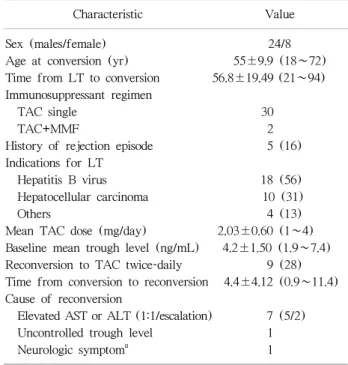
Table 1. Patients characteristics at the time of conversion (n=32)
Characteristic Value
Sex (males/female) 24/8
Age at conversion (yr) 55±9.9 (18∼72)
Time from LT to conversion 56.8±19.49 (21∼94) Immunosuppressant regimen
TAC single 30
TAC+MMF 2
History of rejection episode 5 (16)
Indications for LT
Hepatitis B virus 18 (56)
Hepatocellular carcinoma 10 (31)
Others 4 (13)
Mean TAC dose (mg/day) 2.03±0.60 (1∼4) Baseline mean trough level (ng/mL) 4.2±1.50 (1.9∼7.4) Reconversion to TAC twice-daily 9 (28) Time from conversion to reconversion 4.4±4.12 (0.9∼11.4) Cause of reconversion
Elevated AST or ALT (1:1/escalation) 7 (5/2)
Uncontrolled trough level 1
Neurologic symptom
a1
Data are presented as mean±SD (range) or number (%).
Abbreviations: LT, liver transplant; MMF, mycophenolate mofetil;
TAC, tacrolimus; AST, aspartate aminotransferase; ALT, alanine aminotransferase.
a
Perioral numbness.
mediate-release formulation administered twice-daily (b.i.d.) to prevent allograft rejection. A prolonged-release formula- tion TAC administered q.d. in the morning provides more consistent exposure, improves patient adherence(3), and im- proves therapeutic efficacy, safety, and adherence in pa- tients with solid organ transplants(3-8).
In this study, we review our experience of conversion from TAC b.i.d. to TAC q.d. formulation in stable liver transplant (LT) recipients, evaluate the safety and feasi- bility of conversion to TAC q.d. formulation, and examine the proper method of conversion, through level, liver func- tion and kidney function.
MATERIALS AND METHODS
From November 2011 to August 2012, TAC b.i.d. regi- men was converted to TAC q.d. in 32 patients following LT in Keimyung University Dongsan Medical Center, Daegu, Korea. All patients in this study fulfilled the following cri- teria: at least 12 months’ posttransplant follow-up, no re- jection episode in the last 6 months, and stable liver func- tion and TAC trough level in the last 6 months. The con- version from TAC b.i.d. to TAC q.d. was performed with 1:1 dose ratio in 16 patients and with modified dose escala- tion of 0.5 mg or 1 mg based on TAC dose in 16 patients.
Conversion dose was decided based on trough level at the time of conversion and dose adjustment for preserving prop- er trough level after conversion was performed at each visit based on the variation of the serum trough level. The pri- mary end-point of this study was proportion of patients with reconversion to TAC b.i.d. formulation over time. Recon- version to TAC b.i.d. was performed without further dose adjustment in patients with any complications, uncontrolled trough level in spite of dose adjustment and clinically sus- pected rejection (elevated liver enzyme without other caus- es). Liver and renal function test, TAC dose, serum trough level, and adverse events at 1, 2, 6, and 12 months after conversion were reviewed. Renal function was evaluated by serum creatinine levels and estimated glomerular filtration rate derived from the Modification of Diet in Renal Disease equation.
Quantitative variables were described with mean±stand- ard deviation and ranges. The Wilcoxon test (paired t-test)
was used to compare the change of through level of TAC before and after conversion and chi-square test to compare categorical variables. Null hypotheses of no difference were rejected if
P
-values were less than 0.05. All statistical analy- sis and graph were made using GraphPad Prism ver. 5.0 for Windows (GraphPad Software, San Diego, CA, USA).RESULTS
Patient characteristics and conversion results are shown in Table 1. Among 32 patients enrolled in this study, 24 pa- tients were male and eight were female. The mean age at the time of conversion was 55 years (range; 18∼72) and mean time since LT was 56.8 months (range; 21∼94).
Immunosuppresive therapy at the time of conversion con- sisted of TAC alone in most patients (94%); TAC and my- cophenolate mofetil in only two patients (6%). Liver cir- rhosis caused by hepatitis B virus with or without hep- atocellular carcinoma was the main indication of LT.
Biopsy-proven acute celluar rejection after LT occurred in
Fig. 1. Trough level change at 1 month after conversion (n=32).
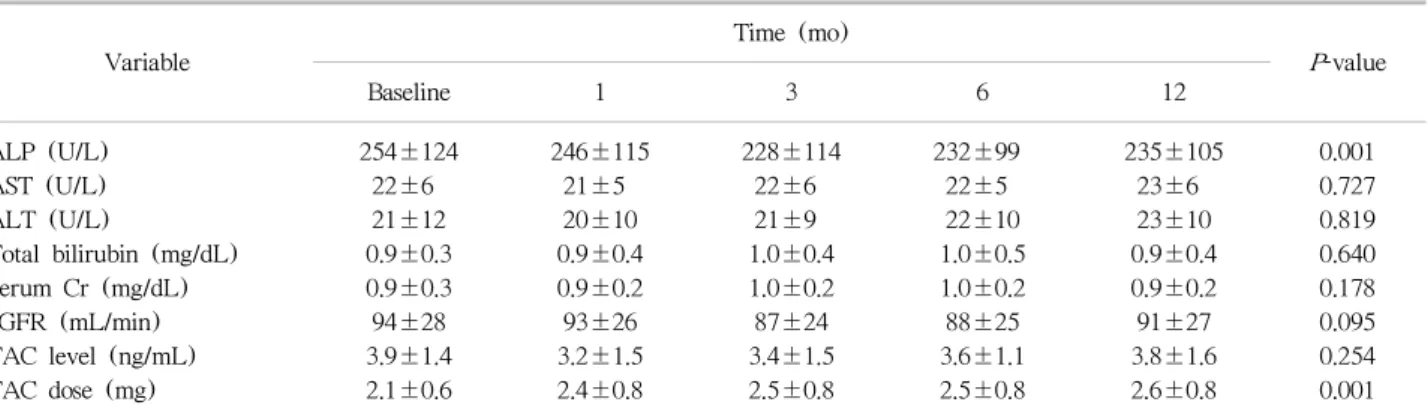
Table 2. Liver function, kidney function, serum trough level, and dose of TAC in patients with successful conversion at baseline and after the conversion from TAC twice-daily to TAC once-daily (n=23)
Variable
Time (mo)
P -value
Baseline 1 3 6 12
ALP (U/L) 254±124 246±115 228±114 232±99 235±105 0.001
AST (U/L) 22±6 21±5 22±6 22±5 23±6 0.727
ALT (U/L) 21±12 20±10 21±9 22±10 23±10 0.819
Total bilirubin (mg/dL) 0.9±0.3 0.9±0.4 1.0±0.4 1.0±0.5 0.9±0.4 0.640
Serum Cr (mg/dL) 0.9±0.3 0.9±0.2 1.0±0.2 1.0±0.2 0.9±0.2 0.178
eGFR (mL/min) 94±28 93±26 87±24 88±25 91±27 0.095
TAC level (ng/mL) 3.9±1.4 3.2±1.5 3.4±1.5 3.6±1.1 3.8±1.6 0.254
TAC dose (mg) 2.1±0.6 2.4±0.8 2.5±0.8 2.5±0.8 2.6±0.8 0.001
Data are presented as mean±SD.
Abbreviations: TAC, tacrolimus; ALP, alkaline phosphatase; AST, aspartate aminotransferase; ALT, alanine aminotransferase; eGFR, estimated glomerular filtration rate.
five patients (16%) prior to the last 6 months before conversion.
The mean TAC serum through level before conversion was 4.2±1.5 ng/mL with a daily dose of 2.0±0.6 mg.
Conversion to TAC q.d. was performed with 1:1 ratio dose in 16 patients and with dose escalation in 16 patients. The mean serum TAC trough level decreased significantly by 1 month after conversion in 1:1 ratio conversion group (from 4.7 to 3.1 ng/mL,
P
=0.001), while there was no significant change of serum trough level (from 3.7 to 4.0 ng/mL) in the dose escalation group (Fig. 1). During follow-up period, nine patients returned to TAC b.i.d., and 23 patients were still on TAC q.d. without deterioration of liver and kidneyfunction. For these 23 patients with successful conversion, a significantly increased dose of TAC (from 2.1 to 2.6 mg/day,
P
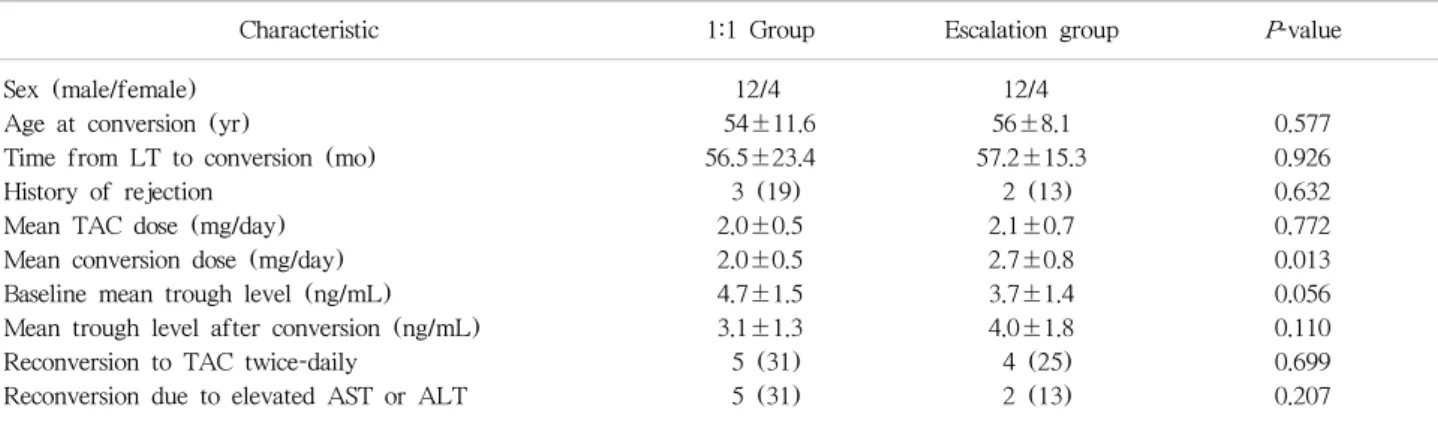
=0.001) was required to maintain the serum trough level (Table 2). The mean time from converion to recon- version was 4.4 months (range; 0.9∼11.4). The reconversion from TAC q.d. to TAC b.i.d. was due to elevated liver en- zyme (n=7), uncontrolled trough level (n=1), or develop- ment of neurologic symptoms (n=1). Comparing the 1:1 and dose escalation groups, there was no statistically significant difference in charateristics between groups except con- version dose (Table 3). However, mean trough level at the time of conversion was lower in dose escalation group (3.7 ng/mL vs. 4.7 ng/mL) than 1:1 group, although not a sig- nificant difference due to small number of cases. This is the reason for dose escalation during converison. There were slightly more patients who need reconversion to TAC b.i.d.formulation (31% vs. 13%), not a significant difference.
For these seven patients who returned to TAC b.i.d. due to elevated liver enzyme, the mean serum trough level was decreased from 4.9 ng/mL at the time of conversion to 4.0 ng/mL at the time of reconversion and trough level de- creased more in five patients in the 1:1 dose group (from 5.0 to 3.8 ng/mL vs. from 4.5 to 4.4 ng/mL). After the re- conversion, the mean trough level increased significantly while taking the same daily dose of TAC except one patient (from 4.0 to 5.7 ng/mL,
P
=0.013). After the reconversion to TAC b.i.d., liver function maintained stable levels and symptoms improved in all patients.Table 3. Comparison of characteristics and results between 1:1 dose group and escalation group
Characteristic 1:1 Group Escalation group P -value
Sex (male/female) 12/4 12/4
Age at conversion (yr) 54±11.6 56±8.1 0.577
Time from LT to conversion (mo) 56.5±23.4 57.2±15.3 0.926
History of rejection 3 (19) 2 (13) 0.632
Mean TAC dose (mg/day) 2.0±0.5 2.1±0.7 0.772
Mean conversion dose (mg/day) 2.0±0.5 2.7±0.8 0.013
Baseline mean trough level (ng/mL) 4.7±1.5 3.7±1.4 0.056
Mean trough level after conversion (ng/mL) 3.1±1.3 4.0±1.8 0.110
Reconversion to TAC twice-daily 5 (31) 4 (25) 0.699
Reconversion due to elevated AST or ALT 5 (31) 2 (13) 0.207
Data are presented as mean±SD or number (%).
Abbreviations: LT, liver transplant; TAC, tacrolimus; AST, aspartate aminotransferase; ALT, alanine aminotransferase.
DISCUSSION
Drug adherence declines over time in patients after organ transplantation and depends on the type of medication, the number of drugs and daily doses(9). With b.i.d. formula- tion, adherence appears significantly lower for the evening versus the morning dose(10). Introduction of TAC q.d. for- mulation, administered in the morning, is associated with better adherence and improved graft survival(4,6,11,12).
The safety and efficacy of TAC q.d. formulation after solid organ transplantation was reported by many groups. In our study, TAC q.d. formulation seems a useful therapeutic op- tion in most patients, which can improve adherence to im- munosuppressive therapy. However, reconversion rate was about 28% and higher than reported in the literature. One of the causes of higher reconversion rate was immediate re- conversion to TAC b.i.d. without biopsy or dose adjustment when liver enzymes became elevated. In these patients, the mean trough level decreased significantly after conversion and increased after reconversion despite the same daily dose of TAC b.i.d., and the liver enzyme stablized after recon- version. This trend was more frequently observed in 1:1 dose group. Based on this result, we suggest that dose titra- tion based on serum trough level could improve conversion to TAC q.d. formulation.
Decreased TAC trough level after a 1:1 conversion in sta- ble LT recipients was reported by several authors(3,12-14).
We also observed significantly decreased TAC trough levels after a 1:1 conversion and dose escalation was required to
maintain TAC trough level in our study. Dopazo et al.(13) reported that TAC trough level decreased approximately 20% 1 month after conversion and reached initial value 6 to 12 months after conversion without dose adjustment in most patients (88%). However, dose adjustment was re- quired to maintain proper TAC trough level in our study.
Sanko-Resmer et al.(14) included 112 stable LT recipients converted formulation with 1:1 ratio in whom the mean TAC trough level was reduced by 15% without any acute rejection, and remained stable (74.5% of the patients re- quired no dose adjustment on conversion). In our study, 52% of the patients with stable liver function after con- version later required dose adjustment maintain TAC trough level and stable liver function. We suppose that these results were caused by the differences in immunosuppressant regi- men and baseline TAC level. In our study, the TAC single regimen was adopted in most patients, and the baseline trough level was lower than in other studies due to mini- mization of TAC dose. Thus, dose adjustment was per- formed in more patients.
Seven patients (22%) developed elevated liver enzyme and required reconversion (although the acute rejection was not proven by biopsy despite elevated liver enzyme). In these patients, decreased trough level after conversion was observed and this trend was more definite in the 1:1 dose group. Therefore, we suggest that initial dose escalation of TAC or close monitoring and maintaining of trough level by adjustment of TAC dose could be helpful for successful conversion to TAC q.d. formulation in patients with low
TAC level.
However, our study has some limitations. First, our study is retrospective with a very small sample size. Therefore it is hard to generalize our result. Second, in patients with ele- vated liver enzyme, reconversion to TAC b.i.d. formulation was performed immediately without dose adjustment or biopsy. Therefore the reconversion rate in our study was higher than other studies, and our study is limited on the investigation into the effect of TAC q.d. formulation on rejection. So, further study, well-designed with a large sam- ple size will be needed to confirm our result.
CONCLUSION
The theapeutic equivalence of TAC q.d. compared to TAC b.i.d. is supported strongly by many studies, and our study showed feasible results after conversion to TAC q.d.
formulation. Therefore, TAC q.d. formulation is a useful option for effective immunosuppressive therapy and im- proving adherence after LT. However, dose escalation and adjustment after close monitoring of trough level could be required when TAC level maintains low or single TAC regi- men is applied.