Review Article
Optimal First-Line Treatment for Helicobacter pylori Infection:
Recent Strategies
Ju Yup Lee and Kyung Sik Park
Department of Internal Medicine, Keimyung University School of Medicine, Daegu, Republic of Korea
Correspondence should be addressed to Kyung Sik Park; [email protected] Received 11 August 2016; Revised 15 October 2016; Accepted 3 November 2016 Academic Editor: Vikram Kate
Copyright © 2016 J. Y. Lee and K. S. Park. This is an open access article distributed under the Creative Commons Attribution License, which permits unrestricted use, distribution, and reproduction in any medium, provided the original work is properly cited.
A new treatment strategy is needed, as the efficacy of triple therapy containing clarithromycin—the current standard treatment for Helicobacter pylori infection—is declining. Increasing antibiotic resistance of H. pylori is the most significant factor contributing to eradication failure. Thus, selecting the most appropriate regimen depending on resistance is optimal, but identifying resistance to specific antibiotics is clinically challenging. In a region suspected to have high clarithromycin resistance, bismuth quadruple therapy and so-called nonbismuth quadruple therapies (sequential, concomitant, and sequential-concomitant hybrid) are some first-line regimen options. However, more research is needed regarding appropriate second-line treatments after first-line treatment failure.
Tailored therapy, which is based on antibiotic sensitivity testing, would be optimal but has several limitations for clinical use, and an alternative technique is required. A novel potassium-competitive acid blocker-based eradication regimen could be a valuable eradication option in the near future.
1. Introduction
Although triple therapy containing proton pump inhibitors (PPIs), amoxicillin, and clarithromycin has been recom- mended worldwide as the standard treatment for Helicobacter pylori infection, the need for a new treatment strategy has developed, since the efficacy of triple therapy is declining in most countries [1]. Several factors play a role in the failure of H. pylori eradication, but resistance to antibiotics is considered the major cause [2]. Hence, the present study examines the recommended first-line treatments in different countries and analyzes the problems associated with such regimens in association with antibiotic resistance, in an attempt to identify appropriate treatment strategies.
2. First-Line Treatment Recommendations and the Problem of Antibiotic Resistance
The 2013 revision of the Korea Guideline for H. pylori recom- mends triple therapy containing clarithromycin as the first- line treatment and bismuth quadruple therapy in regions with suspected clarithromycin resistance [3]. However, according
to a recent meta-analysis conducted in Korea, the eradication rate with triple therapy containing clarithromycin has been in significant decline for the last 10 years [4] as a result of antibi- otic resistance of H. pylori. In fact, worldwide reports and a Korean report of primary antibiotic resistance in H. pylori suggest that the resistance rate is >20% for clarithromycin,
>40% for metronidazole, and >10% for quinolones [5].
Similar to Korea, China recommends a 7–14-day regimen of the standard triple therapy containing clarithromycin and amoxicillin as first-line treatment [6], but the eradication rate is known to be <80% [7]. Hence, bismuth quadruple therapy is recommended as first-line treatment in regions where H. pylori resistance to clarithromycin exceeds 15–20%
[6]. Because there are considerable regional differences in H.
pylori antibiotic resistance in China, regional characteristics should be considered when determining treatment [8, 9];
most regions have high metronidazole and clarithromycin resistance rates. For example, the H. pylori rate of resistance to metronidazole in Shanghai is approximately 60–70%, while the rate of resistance to clarithromycin is approximately 20–
38% [10].
Volume 2016, Article ID 9086581, 7 pages
http://dx.doi.org/10.1155/2016/9086581
Triple Clarithromycin resistance, low
Bismuth quadruple
Sequential therapy Bismuth quadruple
Clarithromycin resistance, high
Concomitant therapy
Hybrid therapy
Reverse hybrid
Amoxicillin, 5 d
Clarithromycin, 5 d Metronidazole, 5 d PPI, 7– 14 d
Amoxiciliin, 7– 14 d Clarithromycin, 7– 14 d
Metronidazole, 7– 14 d
Clarithromycin, 7 d Metronidazole, 7 d
Clarithromycin, 7 d Metronidazole, 7 d
PPI, 10 d
PPI, 14 d Amoxiciliin, 14 d
PPI, 14 d Amoxiciliin, 14 d therapy
Nonbismuth quadruple
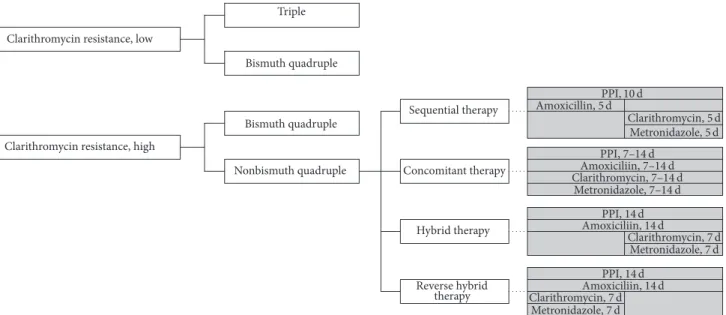
Figure 1: The recent treatment strategy and administration method for nonbismuth quadruple therapy. Dose of each drug: proton pump inhibitor (PPI) standard dose twice a day, amoxicillin 1.0 g twice a day, clarithromycin 500 mg twice a day, and metronidazole 500 mg twice a day.
On the other hand, Japan uses lower doses of antibiotics for eradication than Korea or China [11]. The recommended primary treatment comprises twice-a-day administration of a standard dose of PPI, amoxicillin 750 mg, and clarithromycin 200 or 400 mg for 7 days, while the secondary treatment comprises twice-a-day administrations of PPI, amoxicillin 750 mg, and metronidazole 250 mg for 7 days. Fourteen- day treatment or bismuth quadruple treatment is not rec- ommended as first- or second-line therapy in Japan [7]. The eradication rate associated with first-line treatment in Japan is 70%, while that for second-line treatment is 90%, maintaining an eradication rate >95% with these two regimens [12, 13].
One notable phenomenon in Japan is that it has relatively low antibiotic resistance rates of H. pylori compared to those of other countries; thus, the high eradication rates in Japan are a testament to the fact that triple therapy containing clar- ithromycin or metronidazole remains efficacious in regions with low antibiotic resistance rates. However, the prevalence of H. pylori antibiotic resistance is growing in Japan as well. According to a multi-institutional survey in Japan, the clarithromycin resistance rate of H. pylori was 18.9% in 2002, which escalated to 27.2% in 2006 [14]. Although there are some regional differences, metronidazole resistance largely remains low at 2.1–24.0% [14].
The 2012 revision of the European guideline for Heli- cobacter introduces a treatment strategy for clarithromycin- resistant H. pylori [15]. Whereas triple therapy containing clarithromycin is recommended as first-line treatment in regions with a clarithromycin resistance rate <20%, bis- muth quadruple therapy, sequential therapy, or concomitant therapy is recommended as first-line treatment in regions with clarithromycin resistance >20% [15]. According to prior reports, despite the fact that sequential or concomitant ther- apies contain clarithromycin, they overcome clarithromycin
resistance to a certain extent, with approximately 75–95%
therapeutic success rates.
3. First-Line Treatment Options for Cases with High Antibiotic Resistance
Alternatives to primary treatment with clarithromycin triple therapy include bismuth quadruple therapy and so-called nonbismuth quadruple therapies: sequential, concomitant, and sequential-concomitant hybrid. The treatment strategy and administration method for each regimen are shown in Figure 1 [15, 16].
3.1. Bismuth Quadruple Therapy. Traditional bismuth quad-
ruple therapy involves 7- or 14-day administration of a stan-
dard dose of PPI (twice daily), bismuth 120 mg (4 times/day),
tetracycline 500 mg (4 times/day), and metronidazole 500 mg
(3 times/day). Theoretically, bismuth easily reaches H. pylori
since it is released into the gastric mucosa and is associated
with low resistance; thus, there have been arguments that
quadruple therapy containing bismuth should preferentially
be employed as the first-line treatment for H. pylori infection
instead of triple therapy containing a PPI [17]. Discussions
on whether bismuth quadruple therapy can replace PPI
triple therapy as first-line treatment are ongoing, but for
now, this is considered the most appropriate alternative,
especially in regions with high clarithromycin resistance. In
a meta-analysis conducted in 2003, there was no statistically
significant difference between PPI triple therapy and bismuth
quadruple therapy [18], and a meta-analysis conducted in
2013 of 12 randomized controlled trials (RCTs) reported
that the eradication rate associated with bismuth quadruple
therapy was 77.6%, while that associated with PPI triple
therapy was 68.9% (relative risk [RR], 1.13; 95% confidence
interval [CI], 1.07–1.18) [19]. However, interpretations of meta-analyses should be performed with caution since dif- ferent studies established different selection and exclusion criteria, used different types of PPIs, and used different doses for quadruple therapy. One new consideration for bismuth quadruple therapy is the development of three- in-one capsules comprising bismuth, metronidazole, and tetracycline [20, 21]. The intention-to-treat (ITT) eradication rate associated with quadruple therapy using three-in-one capsules is 80% (95% CI, 73.9–84.9%) in Europe [20] and 87.7% (95% CI, 82.2–93.2%) in the United States [21], showing relatively satisfactory performance. However, this regimen consisted of 14 dosing units (3 three-in-one capsules 4 times a day, with a PPI twice a day) daily for 10–14 days [20];
therefore, compliance is a concern when these many doses are prescribed in actual clinical practice. Antibiotic resistance is also a factor contributing to bismuth quadruple therapy failure. Bismuth quadruple therapy contains tetracycline and metronidazole, but tetracycline resistance rates are reportedly low worldwide [5, 22, 23], implying that metronidazole resis- tance would influence the therapeutic outcomes of bismuth quadruple therapy.
3.2. Sequential Therapy. Zullo et al. [24] first introduced sequential therapy in 2000, reporting a 98% ITT eradication rate (95% CI, 94.3–100%). According to three meta-analyses based on RCTs conducted in Italy before 2008, an ITT analysis revealed that the eradication rate with sequential therapy was 91.0–93.5%, which was significantly higher than that with triple therapy (75.7–79.2%) [25–27]. ITT analyses revealed that the eradication rates with sequential treatment in RCTs conducted in Europe (Italy, Spain) after 2008 were generally >80%, and although this was a slight decline compared to earlier implementation periods, the eradication rates with sequential treatment remain higher than those with triple therapies [28–34]. However, ITT eradication rates in Asia, including Korea, were approximately 10% lower than that of Italy in the earlier days of implementation [35, 36], which is presumed to be due to the regional characteristics of H. pylori antibiotic resistance in Asia. Although the dual resistance rate to clarithromycin and metronidazole in Italy is only 3.5–4.3% [37, 38], the rates in Asian regions are higher (9.6–44.7%) [39, 40]. Another cause is the use of metronidazole instead of tinidazole, as suggested in the original regimen proposed in Italy [41]. This, at least in part, could explain why sequential therapy achieved inferior success rates outside Italy, where metronidazole has generally been used. Many studies have reported that the eradication rate associated with sequential therapy slightly decreases in the presence of monoresistance to clarithromycin but remains markedly higher than that of standard triple therapy [42–45]. However, sequential therapy is associated with a higher eradication rate than that of standard triple therapy, but antibiotic resistance would reduce such results to below the expected rate. For instance, one meta-analysis reported eradication rates for sequential and standard therapy in the presence of clarithromycin resistance to be 70.3% and 33.8%, respectively [27]. The eradication rate with sequential therapy
also decreases for monometronidazole resistance, but there has been little relevant research.
In addition, sequential therapy was proven to be highly effective and superior to triple therapies in children [46] and elderly patients [47]; however, no similar data were available for either concomitant or bismuth quadruple therapy.
The drugs administered in the first and last half are different in a sequential regimen; therefore, it is likely that patient compliance could decrease due to dosing complexity.
However, the compliance with sequential therapy was almost the same as that with standard triple therapy (97.4% and 96.8%, resp.) in a previous meta-analysis [25]; furthermore, most studies showed high compliance with sequential ther- apy in clinical practice [48–50].
3.3. Concomitant Therapy. Concomitant therapy involves the simultaneous administration of PPI, amoxicillin, clar- ithromycin, and metronidazole. ITT analyses conducted in two meta-analyses on studies published up until the early 2000s revealed that the eradication rate with concomitant therapy was approximately 90%, exceeding that of stan- dard triple therapy [51, 52]. Similarly, a meta-analysis of 15 studies (1,723 patients) up until 2011 showed that ITT eradication rates associated with concomitant therapy were approximately 90%, which was higher than that with standard triple therapy [53]. The average ITT eradication rate with concomitant therapy reported by a follow-up meta-analysis published in 2012 on 19 studies (2,070 patients) was 88% [54].
There were no differences in the side effects with concomitant therapy versus triple therapy, and none of the prior studies reported severe side effects associated with concomitant ther- apies [51]. Several studies reported that concomitant therapy has therapeutic effects similar to that of sequential therapy [31, 33, 55, 56] but is associated with more frequent side effects [31]. The compliance with concomitant therapy was similar to that for sequential therapy [45, 56, 57]. However, higher compliance was achieved with concomitant therapy than with sequential therapy in a meta-analysis of RCTs in Chinese regions [58]. Concomitant therapy is known to demonstrate better eradication rates in patients with clarithromycin- or metronidazole-resistant strains [59, 60], and the selection of secondary antibiotics after first-line concomitant therapy failure remains challenging.
3.4. Sequential-Concomitant Hybrid Therapy. Hybrid therapy is a combination of sequential and concomitant therapy and consists of administering PPI and amoxicillin for 14 days and adding clarithromycin and metronidazole in the last 7 days.
A multi-institutional study in Taiwan that first described the use of hybrid therapy reported an ITT eradication rate of 97.4% and a per-protocol eradication rate of 99.1% [61], which was about 5% higher than the eradication rate with 14-day sequential therapy performed by the same institution [62].
However, in a study in Korea, there was no difference in
the eradication rates with 14-day hybrid therapy and 14-day
sequential therapy [63]; similarly, there was no difference
in the eradication rates with 14-day hybrid therapy and
14-day concomitant therapy conducted in Italy and Spain
[64]. A recent meta-analysis showed there was no significant
difference in eradication rates between hybrid and sequential (RR 1.01, 95% CI: 0.92–1.11) or concomitant therapy (RR 0.98, 95% CI: 0.93–1.02) [16]. However, it is difficult to generalize a conclusion regarding hybrid therapy because the number of studies remains small, while studies that compared hybrid therapy with sequential and concomitant therapies involved different administration durations [57]. Nevertheless, eradi- cation rates associated with hybrid therapy have been deter- mined to exceed those of standard triple therapy. Recently, Hsu et al. [65] showed a high eradication rate with reverse hybrid therapy. Reverse hybrid therapy consists of a PPI and amoxicillin for 14 days, with addition of clarithromycin and metronidazole for the first 7 days. The ITT eradication rate of reverse hybrid therapy was 93.6%, which was superior to that of standard triple therapy [65]. The drug compliance rates for hybrid and reverse hybrid therapy were 96.2% [16] and 96.8%
[65], respectively, and were comparable to those for standard triple therapy. Hybrid therapy displayed a slightly higher compliance rate than concomitant therapy (95.8% versus 93.2%) in a recent meta-analysis including 12 RCTs of hybrid therapy [57].
3.5. Tailored Therapy. Since antibiotic resistance is the main cause of eradication failure, a tailored therapy that selects the most appropriate regimen to overcome antibiotic resis- tance would be the optimal treatment. However, tailored therapies are complex and costly. Therefore, a new method to detect antibiotic resistance is needed. One such solution is the polymerase chain reaction (PCR) kit, which uses the dual-priming oligonucleotide-based multiplex PCR test [66]. This kit identifies the presence of point mutations of clarithromycin 23S rRNA that are known to be associated with resistance, namely, A2142G and A2143G, using a PCR [67]. The test can be performed with a sample of gastric mucosa and takes only a few hours, making it relatively simple to use; its sensitivity and specificity are approximately 80–
85% [68].
3.6. Potassium-Competitive Acid Blocker. The potassium- competitive acid blocker (P-CAB), vonoprazan, could improve eradication rates by increasing the intragastric pH and thus increasing bacterial antibiotic susceptibility. Vono- prazan 20 mg demonstrated a more rapid and sustained acid- inhibitory effect than esomeprazole 20 mg or rabeprazole 10 mg [69]. Recent studies revealed that P-CAB based triple therapy was more effective than PPI-based triple therapy as a first-line H. pylori eradication method [70–73]. Furthermore, even in the presence of clarithromycin-resistant strains, P-CAB-based triple therapy showed good eradication rates that were superior to those for PPI-based triple therapy (76.1% versus 40.2%) [74].
4. Conclusion
Triple therapy containing clarithromycin is now largely con- sidered a “legacy therapy” because its therapeutic efficacy decreases even with a clarithromycin resistance of 7–10%
[75]; thus, it has become ineffective in regions with high clarithromycin resistance. Hence, sequential or concomitant
regimens are recommended as first-line treatment in regions with high clarithromycin resistance rates. However, the ther- apeutic effects of these two regimens in the presence of dual resistance to clarithromycin and metronidazole have yet to be determined [60]. In such cases, the hybrid regi- men could be an alternative [64]. The bismuth quadruple regimen could be a good first-line alternative regardless of clarithromycin resistance rates, but its efficacy parallels that of triple therapy and it requires a 14-day administration, which would undermine medication compliance. When first-line therapy of the bismuth quadruple or nonbismuth quadruple regimen fails, an appropriate second-line regimen should contain a quinolone; however, there is little research to support this, and it should be noted that many regions have high quinolone resistance rates. Tailored therapy based on antibiotic sensitivity testing would be the optimal approach but has several limitations for clinical use, calling for the development of a new alternative technique. A novel P-CAB- based regimen would be a valuable H. pylori eradication option.
Competing Interests
The authors declare no competing interests.
Acknowledgments
This work was supported by the National Research Founda- tion of Korea (NRF) Grant funded by the Korean Govern- ment (MSIP) (no. 2014R1A5A2010008).
References
[1] D. Y. Graham and L. Fischbach, “Helicobacter pylori treatment in the era of increasing antibiotic resistance,” Gut, vol. 59, no. 8, pp. 1143–1153, 2010.
[2] F. M´egraud, “H pylori antibiotic resistance: prevalence, impor- tance, and advances in testing,” Gut, vol. 53, no. 9, pp. 1374–1384, 2004.
[3] S. G. Kim, H.-K. Jung, H. L. Lee et al., “Guidelines for the diagnosis and treatment of Helicobacter pylori infection in Korea, 2013 revised edition,” Journal of Gastroenterology and Hepatology, vol. 29, no. 7, pp. 1371–1386, 2014.
[4] E. J. Gong, S.-C. Yun, H.-Y. Jung et al., “Meta-analysis of first- line triple therapy for Helicobacter pylori eradication in Korea:
is it time to change?” Journal of Korean Medical Science, vol. 29, no. 5, pp. 704–713, 2014.
[5] L. Boyanova and I. Mitov, “Geographic map and evolution of primary Helicobacter pylori resistance to antibacterial agents,”
Expert Review of Anti-Infective Therapy, vol. 8, no. 1, pp. 59–70, 2010.
[6] W. Z. Liu, Y. Xie, H. Cheng et al., “Fourth Chinese National Consensus Report on the management of Helicobacter pylori infection,” Journal of Digestive Diseases, vol. 14, no. 5, pp. 211–
221, 2013.
[7] S.-Y. Lee, “Current progress toward eradicating helicobacter
pylori in east Asian countries: differences in the 2013 revised
guidelines between China, Japan, and South Korea,” World
Journal of Gastroenterology, vol. 20, no. 6, pp. 1493–1502, 2014.
[8] P. Su, Y. Li, H. Li et al., “Antibiotic resistance of Helicobacter pylori isolated in the Southeast Coastal Region of China,”
Helicobacter, vol. 18, no. 4, pp. 274–279, 2013.
[9] W. Cai, L. Zhou, W. Ren, L. Deng, and M. Yu, “Variables influencing outcome of Helicobacter pylori eradication therapy in South China,” Helicobacter, vol. 14, no. 5, pp. 91–96, 2009.
[10] Q.-J. Sun, X. Liang, Q. Zheng et al., “Resistance of Helicobacter pylori to antibiotics from 2000 to 2009 in Shanghai,” World Journal of Gastroenterology, vol. 16, no. 40, pp. 5118–5121, 2010.
[11] M. Asaka, “A new approach for elimination of gastric cancer deaths in Japan,” International Journal of Cancer, vol. 132, no.
6, pp. 1272–1276, 2013.
[12] N. Horiki, F. Omata, M. Uemura et al., “Annual change of primary resistance to clarithromycin among helicobacter pylori isolates from 1996 through 2008 in Japan,” Helicobacter, vol. 14, no. 5, pp. 86–90, 2009.
[13] T. Shimoyama, S. Fukuda, T. Mikami, M. Fukushi, and A.
Munakata, “Efficacy of metronidazole for the treatment of clarithromycin-resistant Helicobacter pylori infection in a Japanese population,” Journal of Gastroenterology, vol. 39, no. 10, pp. 927–930, 2004.
[14] I. Kobayashi, K. Murakami, M. Kato et al., “Changing antimi- crobial susceptibility epidemiology of Helicobacter pylori strains in Japan between 2002 and 2005,” Journal of Clinical Microbiology, vol. 45, no. 12, pp. 4006–4010, 2007.
[15] P. Malfertheiner, F. Megraud, C. A. O’Morain et al.,
“Management of Helicobacter pylori infection—the Maastricht IV/Florence Consensus Report,” Gut, vol. 61, no. 5, pp. 646–664, 2012.
[16] P.-I. Hsu, P.-C. Lin, and D. Y. Graham, “Hybrid therapy for Helicobacter pylori infection: a systemic review and meta- analysis,” World Journal of Gastroenterology, vol. 21, no. 45, pp.
12954–12962, 2015.
[17] H. J. Jo, D. H. Lee, S. J. Kang et al., “Comparison of the efficacy of Bismuth containing PPI-based quadruple therapy with PPI- based triple therapy only as first-line Treatment for Helicobacter pylori Infection,” Korean Journal of Gastrointestinal Endoscopy, vol. 37, no. 4, pp. 259–264, 2008.
[18] E. Gen´e, X. Calvet, R. Azagra, and J. P. Gisbert, “Triple vs.
quadruple therapy for treating Helicobacter pylori infection: a meta-analysis,” Alimentary Pharmacology and Therapeutics, vol.
17, no. 9, pp. 1137–1143, 2003.
[19] M. Venerito, T. Krieger, T. Ecker, G. Leandro, and P. Malfer- theiner, “Meta-analysis of bismuth quadruple therapy versus clarithromycin triple therapy for empiric primary treatment of Helicobacter pylori infection,” Digestion, vol. 88, no. 1, pp. 33–
45, 2013.
[20] P. Malfertheiner, F. Bazzoli, J.-C. Delchier et al., “Helicobacter pylori eradication with a capsule containing bismuth subcitrate potassium, metronidazole, and tetracycline given with omepra- zole versus clarithromycin-based triple therapy: a randomised, open-label, non-inferiority, phase 3 trial,” The Lancet, vol. 377, no. 9769, pp. 905–913, 2011.
[21] L. Laine, R. Hunt, H. EI-Zimaity, B. Nguyen, M. Osato, and J.
Sp´enard, “Bismuth-based quadruple therapy using a single cap- sule of bismuth biskalcitrate, metronidazole, and tetracycline given with omeprazole versus omeprazole, amoxicillin, and clarithromycin for eradication of Helicobacter pylori in duo- denal ulcer patients: a prospective, randomized, multicenter, North American trial,” American Journal of Gastroenterology, vol. 98, no. 3, pp. 562–567, 2003.
[22] V. de Francesco, F. Giorgio, C. Hassan et al., “Worldwide H.
pylori antibiotic resistance: a systematic review,” Journal of Gastrointestinal and Liver Diseases, vol. 19, no. 4, pp. 409–414, 2010.
[23] F. Megraud, S. Coenen, A. Versporten et al., “Helicobacter pylori resistance to antibiotics in Europe and its relationship to antibiotic consumption,” Gut, vol. 62, no. 1, pp. 34–42, 2013.
[24] A. Zullo, V. Rinaldi, S. Winn et al., “A new highly effective shout- term therapy schedule for Helicobacter pylori eradication,”
Alimentary Pharmacology and Therapeutics, vol. 14, no. 6, pp.
715–718, 2000.
[25] N. S. Jafri, C. A. Hornung, and C. W. Howden, “Meta-analysis:
sequential therapy appears superior to standard therapy for Helicobacter pylori infection in patients naive to treatment,”
Annals of Internal Medicine, vol. 148, no. 12, pp. 923–931, 2008.
[26] L. Gatta, N. Vakil, G. Leandro, F. Di Mario, and D. Vaira,
“Sequential therapy or triple therapy for helicobacter pylori infection: Systematic review and meta-analysis of randomized controlled trials in adults and children,” American Journal of Gastroenterology, vol. 104, no. 12, pp. 3069–3079, 2009.
[27] J. L. Tong, Z. H. Ran, J. Shen, and S. D. Xiao, “Sequential therapy vs. standard triple therapies for Helicobacter pylori infection: a meta-analysis,” Journal of Clinical Pharmacy and Therapeutics, vol. 34, no. 1, pp. 41–53, 2009.
[28] R. Urgesi, G. Pelecca, R. Cianci et al., “Helicobacter pylori infection: is sequential therapy superior to standard triple therapy? A single-centre Italian study in treatment-naive and non-treatment-naive patients,” Canadian Journal of Gastroen- terology, vol. 25, no. 6, pp. 315–318, 2011.
[29] O. A. Paoluzi, E. Visconti, F. Andrei et al., “Ten and eight-day sequential therapy in comparison to standard triple therapy for eradicating helicobacter pylori infection: a randomized controlled study on efficacy and tolerability,” Journal of Clinical Gastroenterology, vol. 44, no. 4, pp. 261–266, 2010.
[30] M. Romano, A. Cuomo, A. G. Gravina et al., “Empiri- cal levofloxacin-containing versus clarithromycin-containing sequential therapy for Helicobacter pylori eradication: a ran- domised trial,” Gut, vol. 59, no. 11, pp. 1465–1470, 2010.
[31] A. Zullo, G. Scaccianoce, V. De Francesco et al., “Concomitant, sequential, and hybrid therapy for H. pylori eradication: A Pilot Study,” Clinics and Research in Hepatology and Gastroenterology, vol. 37, no. 6, pp. 647–650, 2013.
[32] J. Molina-Infante, B. Perez-Gallardo, M. Fernandez-Bermejo et al., “Clinical trial: clarithromycin vs. levofloxacin in first- line triple and sequential regimens for Helicobacter pylori eradication,” Alimentary Pharmacology and Therapeutics, vol.
31, no. 10, pp. 1077–1084, 2010.
[33] A. G. McNicholl, A. C. Marin, J. Molina-Infante et al., “Ran- domised clinical trial comparing sequential and concomitant therapies for Helicobacter pylori eradication in routine clinical practice,” Gut, vol. 63, no. 2, pp. 244–249, 2014.
[34] L. Gatta, N. Vakil, D. Vaira, and C. Scarpignato, “Global eradication rates for Helicobacter pylori infection: systematic review and meta-analysis of sequential therapy,” The British Medical Journal, vol. 347, no. 7920, Article ID f4587, 2013.
[35] H. Yoon, D. H. Lee, N. Kim et al., “Meta-analysis: is sequential therapy superior to standard triple therapy for Helicobacter pylori infection in Asian adults?” Journal of Gastroenterology and Hepatology, vol. 28, no. 12, pp. 1801–1809, 2013.
[36] J. S. Kim, B. W. Kim, S. J. Hong et al., “Sequential therapy versus
triple therapy for the first line treatment of Helicobacter pylori
in Korea: a nationwide randomized trial,” Gut Liver, vol. 10, no.
4, pp. 556–561, 2016.
[37] D. Vaira, A. Zullo, N. Vakil et al., “Sequential therapy versus standard triple-drug therapy for Helicobacter pylori eradica- tion: a randomized trial,” Annals of Internal Medicine, vol. 146, no. 8, pp. 556–563, 2007.
[38] A. Zullo, F. Perna, C. Hassan et al., “Primary antibiotic resis- tance in Helicobacter pylori strains isolated in northern and central Italy,” Alimentary Pharmacology and Therapeutics, vol.
25, no. 12, pp. 1429–1434, 2007.
[39] S. P. Thyagarajan, P. Ray, B. K. Das et al., “Geographical difference in antimicrobial resistance pattern of Helicobacter pylori clinical isolates from Indian patients: multicentric study,”
Journal of Gastroenterology and Hepatology, vol. 18, no. 12, pp.
1373–1378, 2003.
[40] J.-W. Chung, Y. K. Jung, Y. J. Kim et al., “Ten-day sequential ver- sus triple therapy for Helicobacterpylori eradication: a prospec- tive, open-label, randomized trial,” Journal of Gastroenterology and Hepatology, vol. 27, no. 11, pp. 1675–1680, 2012.
[41] D. Vaira, A. Zullo, C. Hassan, G. Fiorini, and N. Vakil, “Sequen- tial therapy for Helicobacter pylori eradication: the time is now!,” Therapeutic Advances in Gastroenterology, vol. 2, no. 6, pp. 317–322, 2009.
[42] V. De Francesco, M. Margiotta, A. Zullo et al., “Clarithromycin- resistant genotypes and eradication of Helicobacter pylori,”
Annals of Internal Medicine, vol. 144, no. 2, pp. 94–100, 2006.
[43] V. Mahachai, N. Sirimontaporn, S. Tumwasorn, D. Thong- Ngam, and R.-K. Vilaichone, “Sequential therapy in clarithromycin-sensitive and -resistant Helicobacter pylori based on polymerase chain reaction molecular test,” Journal of Gastroenterology and Hepatology, vol. 26, no. 5, pp. 825–828, 2011.
[44] N. Sirimontaporn, D. Thong-Ngam, S. Tumwasorn, and V.
Mahachai, “Ten-day sequential therapy of Helicobacter pylori infection in Thailand,” The American Journal of Gastroenterol- ogy, vol. 105, no. 5, pp. 1071–1075, 2010.
[45] J. W. Chung, J. P. Han, K. O. Kim et al., “Ten-day empirical sequential or concomitant therapy is more effective than triple therapy for Helicobacter pylori eradication: a multicenter, prospective study,” Digestive and Liver Disease, vol. 48, no. 8, pp. 888–892, 2016.
[46] R. Francavilla, E. Lionetti, S. P. Castellaneta et al., “Improved efficacy of 10-day sequential treatment for Helicobacter pylori eradication in children: a randomized trial,” Gastroenterology, vol. 129, no. 5, pp. 1414–1419, 2005.
[47] A. Zullo, L. Gatta, V. De Francesco et al., “High rate of Heli- cobacter pylori eradication with sequential therapy in elderly patients with peptic ulcer: A Prospective Controlled Study,”
Alimentary Pharmacology and Therapeutics, vol. 21, no. 12, pp.
1419–1424, 2005.
[48] A. Tursi, W. Elisei, G. Giorgetti, M. Picchio, and G. Brandimarte,
“Efficacy, tolerability, and factors affecting the efficacy of the sequential therapy in curing Helicobacter pylori infection in clinical setting,” Journal of Investigative Medicine, vol. 59, no. 6, pp. 917–920, 2011.
[49] M. Manfredi, B. Bizzarri, and G. L. de’Angelis, “Helicobacter pylori infection: sequential therapy followed by levofloxacin- containing triple therapy provides a good cumulative eradica- tion rate,” Helicobacter, vol. 17, no. 4, pp. 246–253, 2012.
[50] S. Pontone, M. Standoli, R. Angelini, and P. Pontone, “Efficacy of H. pylori eradication with a sequential regimen followed by
rescue therapy in clinical practice,” Digestive and Liver Disease, vol. 42, no. 8, pp. 541–543, 2010.
[51] A. S. Essa, J. R. Kramer, D. Y. Graham, and G. Treiber, “Meta- analysis: four-drug, three-antibiotic, non-bismuth-containing
“concomitant therapy” versus triple therapy for helicobacter pylori eradication,” Helicobacter, vol. 14, no. 2, pp. 109–118, 2009.
[52] L. A. Fischbach, S. V. Van Zanten, and J. Dickason, “Meta- analysis: the efficacy, adverse events, and adherence related to first-line anti-Helicobacter pylori quadruple therapies,” Alimen- tary Pharmacology and Therapeutics, vol. 20, no. 10, pp. 1071–
1082, 2004.
[53] J. P. Gisbert and X. Calvet, “Review article: non-bismuth quadruple (concomitant) therapy for eradication of Helicobater pylori,” Alimentary Pharmacology and Therapeutics, vol. 34, no.
6, pp. 604–617, 2011.
[54] J. P. Gisbert and X. Calvet, “Update on non-bismuth quadruple (concomitant) therapy for eradication of Helicobacter pylori,”
Clinical and Experimental Gastroenterology, vol. 5, no. 1, pp. 23–
34, 2012.
[55] S. M. Jung, D. Y. Cheung, J. I. Kim, I. Kim, and H. Seong,
“Comparing the efficacy of concomitant therapy with sequential therapy as the first-line therapy of Helicobacter pylori eradica- tion,” Gastroenterology Research and Practice, vol. 2016, Article ID 1293649, 2016.
[56] S. M. Park, J. S. Kim, B. W. Kim, J. S. Ji, and H. Choi, “A randomised clinical trial comparing 10- or 14-day sequential therapy and 10- or 14-day concomitant therapy for the first line empirical treatment of Helicobacter pylori infection,” Journal of Gastroenterology and Hepatology, 2016.
[57] Z. Q. Song and L. Y. Zhou, “Hybrid, sequential and concomitant therapies for Helicobacter pylori eradication: a systematic review and meta-analysis,” World Journal of Gastroenterology, vol. 22, no. 19, pp. 4766–4775, 2016.
[58] L. C. Lin, T. H. Hsu, K. W. Huang, and K. W. Tam, “Nonbis- muth concomitant quadruple therapy for Helicobacter pylori eradication in Chinese regions: a meta-analysis of randomized controlled trials,” World Journal of Gastroenterology, vol. 22, no.
23, pp. 5445–5453, 2016.
[59] B. Tepeˇs, M. Vujasinovi´c, M. ˇSeruga, M. Stefanoviˇc, A. Forte, and S. Jeverica, “Randomized clinical trial comparing 10- day sequential, 7-day concomitant and 7-day standard triple therapies for Helicobacter pylori eradication,” European Journal of Gastroenterology and Hepatology, vol. 28, no. 6, pp. 676–683, 2016.
[60] D. Y. Graham, Y.-C. Lee, and M.-S. Wu, “Rational Helicobacter pylori therapy: evidence-based medicine rather than medicine- based evidence,” Clinical Gastroenterology and Hepatology, vol.
12, no. 2, pp. 177.e3–186.e3, 2014.
[61] P.-I. Hsu, D.-C. Wu, J.-Y. Wu, and D. Y. Graham, “Modified sequential Helicobacter pylori therapy: proton pump inhibitor and amoxicillin for 14 days with clarithromycin and metronida- zole added as a quadruple (hybrid) therapy for the final 7 days,”
Helicobacter, vol. 16, no. 2, pp. 139–145, 2011.
[62] P. I. Hsu, D.-C. Wu, J.-Y. Wu, and D. Y. Graham, “Is there a benefit to extending the duration of Helicobacter pylori sequential therapy to 14 days?” Helicobacter, vol. 16, no. 2, pp.
146–152, 2011.
[63] D. H. Oh, D. H. Lee, K. K. Kang et al., “The efficacy of hybrid
therapy as first-line regimen for Helicobacter pylori infection
compared with sequential therapy,” Journal of Gastroenterology
and Hepatology, vol. 29, no. 6, pp. 1171–1176, 2014.
[64] J. Molina-Infante, M. Romano, M. Fernandez-Bermejo et al., “Optimized nonbismuth quadruple therapies cure most patients with Helicobacter pylori infection in populations with high rates of antibiotic resistance,” Gastroenterology, vol. 145, no.
1, pp. 121.e1–128.e1, 2013.
[65] P.-I. Hsu, S.-S. Kao, D.-C. Wu et al., “A randomized controlled study comparing reverse hybrid therapy and standard triple therapy for helicobacter pylori infection,” Medicine, vol. 94, no.
48, Article ID e2104, 2015.
[66] H.-Y. Woo, D. I. Park, H. Park et al., “Dual-priming oligonu- cleotide-based multiplex PCR for the detection of Helicobacter pylori and determination of clarithromycin resistance with gastric biopsy specimens,” Helicobacter, vol. 14, no. 1, pp. 22–28, 2009.
[67] M. M. Gerrits, A. H. van Vliet, E. J. Kuipers, and J. G. Kusters,
“Helicobacter pylori and antimicrobial resistance: molecular mechanisms and clinical implications,” Lancet Infectious Dis- eases, vol. 6, no. 11, pp. 699–709, 2006.
[68] T. J. Hwang, N. Kim, H. B. Kim et al., “Change in antibiotic resis- tance of Helicobacter pylori strains and the effect of A2143G point mutation of 23S rRNA on the eradication of H. pylori in a single center of Korea,” Journal of Clinical Gastroenterology, vol.
44, no. 8, pp. 536–543, 2010.
[69] Y. Sakurai, Y. Mori, H. Okamoto et al., “Acid-inhibitory effects of vonoprazan 20 mg compared with esomeprazole 20 mg or rabeprazole 10 mg in healthy adult male subjects—A Ran- domised Open-Label Cross-Over Study,” Alimentary Pharma- cology and Therapeutics, vol. 42, no. 6, pp. 719–730, 2015.
[70] S. Shichijo, Y. Hirata, R. Niikura et al., “Vonoprazan versus conventional proton pump inhibitor-based triple therapy as first-line treatment against Helicobacter pylori: a multicenter retrospective study in clinical practice,” Journal of Digestive Diseases, 2016.
[71] K. Murakami, Y. Sakurai, M. Shiino, N. Funao, A. Nishimura, and M. Asaka, “Vonoprazan, a novel potassium-competitive acid blocker, as a component of first-line and second-line triple therapy for Helicobacter pylori eradication: a phase III, randomised, double-blind study,” Gut, vol. 65, no. 9, pp. 1439–
1446, 2016.
[72] S. Suzuki, T. Gotoda, C. Kusano, K. Iwatsuka, and M. Moriyama,
“The efficacy and tolerability of a triple therapy containing a potassium-competitive acid blocker compared with a 7- day, PPI-based low-dose clarithromycin triple therapy,” The American Journal of Gastroenterology, vol. 111, no. 7, pp. 949–
956, 2016.
[73] H. Noda, S. Noguchi, T. Yoshimine et al., “A novel potassium- competitive acid blocker improves the efficacy of Clarithro- mycin-containing 7-day triple therapy against Helicobacter pylori,” Journal of Gastrointestinal and Liver Diseases, vol. 25, no. 3, pp. 283–288, 2016.
[74] H. Matsumoto, A. Shiotani, R. Katsumata et al., “Helicobacter pylori eradication with proton pump inhibitors or potassium- competitive acid blockers: the effect of clarithromycin resis- tance,” Digestive Diseases and Sciences, vol. 61, no. 11, pp. 3215–
3220, 2016.
[75] A. Federico, A. G. Gravina, A. Miranda, C. Loguercio, and M.
Romano, “Eradication of Helicobacter pylori infection: which regimen first?” World Journal of Gastroenterology, vol. 20, no.
3, pp. 665–672, 2014.
Submit your manuscripts at http://www.hindawi.com
Stem Cells International
Hindawi Publishing Corporation
http://www.hindawi.com Volume 2014
Hindawi Publishing Corporation
http://www.hindawi.com Volume 2014
INFLAMMATION
Hindawi Publishing Corporation
http://www.hindawi.com Volume 2014
Behavioural Neurology
Endocrinology International Journal of
Hindawi Publishing Corporation
http://www.hindawi.com Volume 2014
Hindawi Publishing Corporation
http://www.hindawi.com Volume 2014
Disease Markers
Hindawi Publishing Corporation
http://www.hindawi.com Volume 2014
BioMed
Research International
Oncology Journal of
Hindawi Publishing Corporation
http://www.hindawi.com Volume 2014
Hindawi Publishing Corporation
http://www.hindawi.com Volume 2014
Oxidative Medicine and Cellular Longevity
Hindawi Publishing Corporation
http://www.hindawi.com Volume 2014
PPAR Research The Scientific World Journal
Hindawi Publishing Corporation
http://www.hindawi.com Volume 2014
Immunology Research
Hindawi Publishing Corporation
http://www.hindawi.com Volume 2014
Journal of
Obesity Journal of
Hindawi Publishing Corporation
http://www.hindawi.com Volume 2014
Hindawi Publishing Corporation
http://www.hindawi.com Volume 2014
Computational and Mathematical Methods in Medicine
Ophthalmology Journal of
Hindawi Publishing Corporation
http://www.hindawi.com Volume 2014
Diabetes Research Journal of
Hindawi Publishing Corporation
http://www.hindawi.com Volume 2014
Hindawi Publishing Corporation
http://www.hindawi.com Volume 2014
Research and Treatment
AIDS
Hindawi Publishing Corporation
http://www.hindawi.com Volume 2014
Gastroenterology Research and Practice
Hindawi Publishing Corporation
http://www.hindawi.com Volume 2014
Parkinson’s Disease
Evidence-Based Complementary and Alternative Medicine
Volume 2014 Hindawi Publishing Corporation
http://www.hindawi.com