• 검색 결과가 없습니다.

Analysis of Water Quality improvement of Upper Stream for the Chung-ju Dam according to Reducing Pollution Using QUAL2E Model

N/A
N/A
Protected

Academic year: 2021

Share "Analysis of Water Quality improvement of Upper Stream for the Chung-ju Dam according to Reducing Pollution Using QUAL2E Model"

Copied!
10
0
0

로드 중.... (전체 텍스트 보기)

전체 글

(1)

1. Introduction

Various researches are being implemented for water quality improvement of rivers and lakes in water system as water quality management of the river is getting major concern due to rapid population growth, economic development, and citification(Gang et al., 1996; Gang and Yang, 1996; Gang and Hyeon, 1997;

Lee et al., 2006; Kim et al., 2009; Park et al., 2011).

Futhermore, water quality management of lake water which is mainly used for drinking water source is highly getting important according as social concern about drinking water increases. Especially, water quality management of the water in dam and the river water flowing into it that are generally used for service water in wide area will be conducted carefully in consideration of hydraulic properties on the lake which are deep and very slow in terms of the speed

Analysis of Water Quality improvement of Upper Stream for the Chung-ju Dam according to Reducing Pollution Using QUAL2E Model

Chang-Wha Han ․ Jong-Seok Park

+

․ Jun-Shik Shin ․ Jae-Joo Lee Ui-Gyu Hwang ․ Kyoung-Hoon Rhee

Department of Civil Engineering, Chonnam National University

QUAL2E 모형을 이용한 오염원변화에 따른 충주댐 상류 유역의 수질 개선 효과 분석

한창화 · 박종석+ · 신준식 · 이재주 · 황의규 · 이경훈

전남대학교 토목공학과 수자원·상하수도 연구실

Abstract

The research grasps water quality contamination source by investigating the data that are superordinate laws and the related plans implemented for establishing water quality improvement measures of upper stream for Chung-Ju Dam, present conditions of the hydraulic and hydrology, the present conditions and plans of environment basic facilities, and present conditions of main contamination source’s occurrence load and discharge load, etc. The research used the QUAL2E simulation which is being widely applied to simulation of river water quality because the QUAL2E has high credibility among water quality simulations known throughout the country. On basis of this research, regulations and politic alternatives are required in order to water quality improvement upper stream for the Chung-ju dam, especially establishing processing facilities in the region where loading amount is concentrated should be considered with the additional research regarding cost-efficient facility of pollution source.

Keywords : Environment facility, Pollutant load, Pollution source, QUAL2E model, Water quality simulation

요 약

본 연구는 충주댐 상류유역의 수질개선대책을 수립하기 위해 실시된 상위 및 관련계획, 수리·수문환경, 환경기초시설 현 황 및 계획, 수질현황, 주요 오염원 발생 및 배출현황 등의 자료조사를 통하여 수질오염원을 파악하고 국내에 알려져 있 는 수질모델 중 신뢰도가 인정되어 하천수질모의에 널리 적용되고 있는 QUAL2E 모형을 적용하였다. 연구 결과를 토대 로 하여 충주댐 상류 유역의 수질개선을 위한 규제와 정책 방안들을 고려한 수질예측이 필요할 것으로 판단되며, 특히 충주댐 상류 유역의 오염원별 수질을 관리하는 방안과 더불어 오염원별 배출부하량이 높은 지역의 대형 환경기초시설에 의한 고도처리시설 도입 및 비점오염 저감시설에 의한 부분을 고려한 추가적인 연구가 필요할 것으로 판단된다.

핵심용어 : 환경기초시설, 오염원, 배출부하, 수질모의, QUAL2E 모형

+ corresponding author email : [email protected]
(2)

of a moving fluid(Kim, 2009). Futhermore, various phenomenons occurring in the river appear because of not problems at one spot but knock-on problems between upstream and downstream. Due to the reasons, overall establishment of management plans concerning not one spot but entire river basin is essential in order to use continually and develop water resources in the river. The change of water quality in water system induced by inflow of external contamination sources can be grasped by using mathematic model which is metrizable. Water quality is determined by the size of inflow pollution load, and pollutants in water system are changed by characteristics of foreign material which are chemical, biological, and also by physical characteristics in water system. Loading amount originated from contamination source is grasped by concentration through water quality model, which is compared and checked with water criteria needed for water usage. It is necessary that water quality management measures will get established by finding various methods, in case of exceeding objective for water criteria. A commercialized model is properly being used for establishing measures and investigating those phenomena(Chapra, 1997).

The research grasps water quality contamination source by investigating the data that are superordinate laws and the related plans implemented for establishing water quality improvement measures of upper stream for Chung-Ju Dam, present conditions of the hydraulic and hydrology, the present conditions and plans of environment basic facilities, and present conditions of main contamination source’s occurrence load and discharge load, etc. The research used the QUAL2E simulation which is being widely applied to simulation of river water quality because the QUAL2E has high credibility among water quality simulations known throughout the country(Tolman, 1992; DeGasperi and Khangaonkar, 1996; Venter et al., 1997; Ning et al., 2001; McAvoy et al., 2003).

Therefore, the research analyses and examines the prediction and impact of water quality improvement effect which are induced by constructing environmental basic facilities and reducing contamination source in upper stream basin for Chung-ju dam.

2. Method of study

The behavior of pollutant and pollution load in pertinent basin shoule be grasped for future water quality prediction using the model. For the sake of them, water quality and results of discharge measurement must be secured. The rate of flow is basic respect of calculating inflow concentration by inflowing contamination source in the basin, but measuring network of rate of flow that can precisely calculate the rate of flow in the pertinent basin for managing pollutants isn’t presently constructed. The existing measuring network of the rate of flow is mainly aimed at flood control of a flood season in summer and don’t almost accord with location of measuring network of water quality, so it is less likely to utilize data for grasping the effects of river’s inflow of contamination source.

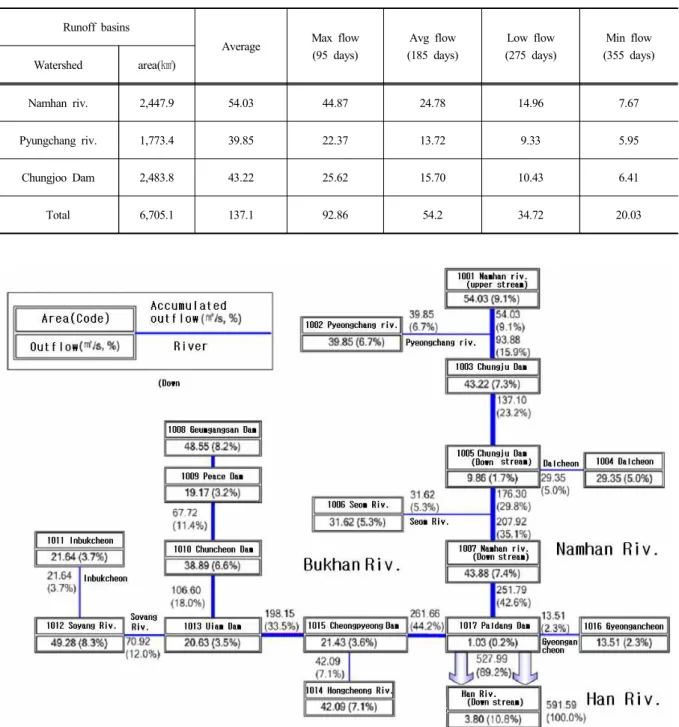
This research simulated to construct environment basic facilities and water quality during pondage according to reducing contamination source by using QUAL2E model. It calculated the rate of flow by basin using runoff block diagram of natural rate of flow that is existing investigated for constructing the rate of flow data which are aimed at grasping the influence induced by inflow of contamination source;

moreover, it calculated inflow concentration by inflow of contamination source by basins using data between the basic year(2009) and the prediction year(2015): the current state of contamination source, rate of flow, water quality, occurrence load and discharge load, flow duration analysis. The research constructed the input data of QUAL2E model using data that are water quality by basin, rate of flow, environment basic facilities, and pollution load.

It conducted calibration and verification of the

model using the data on the rate of flow and water

quality in March~April(calibration) and October~November

(verification) that have conditions comparatively having

less of an effect on rainfall and being close to dry

season. It implemented the model establishing virtual

scenario according to existence of environment basic

facilities for predicting the effect of water quality

improvement by the change of contamination source in

upper stream basin of Chung-ju dam.

(3)

2.1. Outline of QUAL2E model

The QUAL2E model is a model of water quality which can be normally applied to interpreting one-dimensional water quality in the river; it can simulate the 13 water contamination factors in the light of point pollution source, non-point pollution source, tributaries of the river, and water intake. etc. The most of water quality items are simulated as a steady state, but algae are simulated as a simular dynamic state.

Material delivery movement in the river is described as the formula (1) by one-dimensional interpretation .

 

 

  

  



 

   

  

  (1)

In this formula, C: contaminants concentration of cross section mean

D: longitudinal dispersion coefficient U: mean flow velocity of cross section Z: sinks, sources and internal change rate

The left term in the formula (1) means the rate of change of concentration for the time at any point, and the right terms respectively mean in order, longitudinal dispersion term, advection term, outflow and inflow term including biochemical reaction between each of contaminations.

The formula in case of the steady state means

     .

Hydro condition in the river is interpreted as steady non-uniform flow, and hydrometric data such as the rate of flow, flow velocity, and depth of water, etc.

are calculated as the formulas (2) or (3).

   

,    

(2)

 

 





(3)

In those formulas,     : coefficient of discharge in the section of the river

h: mean depth U: mean velocity Q: rate of flow

: cross sectional area of flow R: hydraulic radius

S: energy inclination

n: coefficient of roughness in Manning

    in the formula (2) are calculated by a correlation, and the formula (3) is calculated by the formula of Newton-Raphson according to the formula of Manning on mean velocity and rate of flow for cross section of trapezoidal channel(Kim, 2009).

2.2. Sectionalization of target basin

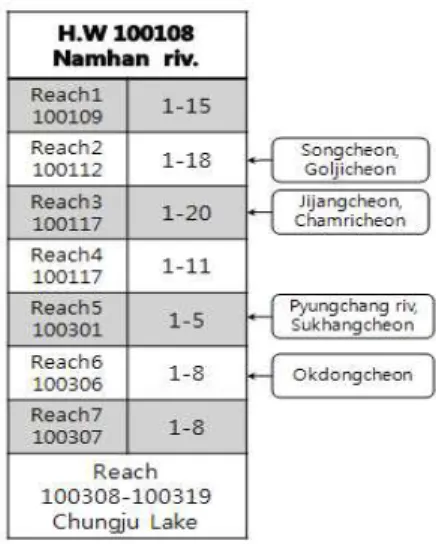
The research departmentalized the target basin into each of elements which measures 2km, and sectionalized the target basin which measures 170km from the upper stream basin for Nam Han River to the lower basin of Ok-Dong Stream into total 7 sections(Reach) on basis of hydrologic unit map.

2.3 The rate of flow and the present condition of water quality in upper stream basin of Chung-Ju Dam

The input data of rate of flow in this research are standard rate of flow based on the average data of discharge in Chung ju dam in March-April(2009) and October-November(2009) that have conditions of rate of flow comparatively having less of an effect on rainfall and being close to dry season. The input data divided the rate of flow by each of the sections for area ratio of occupation basin. It calculated delivery ratio using the data which are the rate of flow and water quality in March-April(2009) and October-November(2009), and is used for conducting calibration and verification of the model.

Fig. 1. Channel reach of QUAL2E model

(4)

Jan Feb March April May June July Aug Sept Oct Nov Dem Avg.

2009 69.37 57.19 65.45 65.85 69.94 81.13 677.76 162.29 72.29 59.54 63.33 70.40 127.21 Table 1. Runoff from Chung-Ju Dam(2009, unit : ㎥/s)

Runoff basins

Average Max flow (95 days)

Avg flow (185 days)

Low flow (275 days)

Min flow (355 days) Watershed area(㎢)

Namhan riv. 2,447.9 54.03 44.87 24.78 14.96 7.67

Pyungchang riv. 1,773.4 39.85 22.37 13.72 9.33 5.95

Chungjoo Dam 2,483.8 43.22 25.62 15.70 10.43 6.41

Total 6,705.1 137.1 92.86 54.2 34.72 20.03

Table 2. Result of Flow Duration Analysis by PRMS(36 Year Average) (unit : ㎥/s)

Fig. 2. Natural Flow Runoff Map of Chung-ju Dam

(5)

Area Nam-han river Place Chung-sun1, Chung-sun2, Gwang-ha, Dongang, Young-wol1

BOD(Biological Oxygen Demand) DO(Dissolved Oxygen)

Area Pyung-chang river Place Pyung_chang gang1, 2, 3

BOD(Biological Oxygen Demand) DO(Dissolved Oxygen)

Area Chung-ju dam Place Young-wol2, Ga-gok, Deok-cheon, Chungjudam,

Chungju

BOD(Biological Oxygen Demand) DO(Dissolved Oxygen)

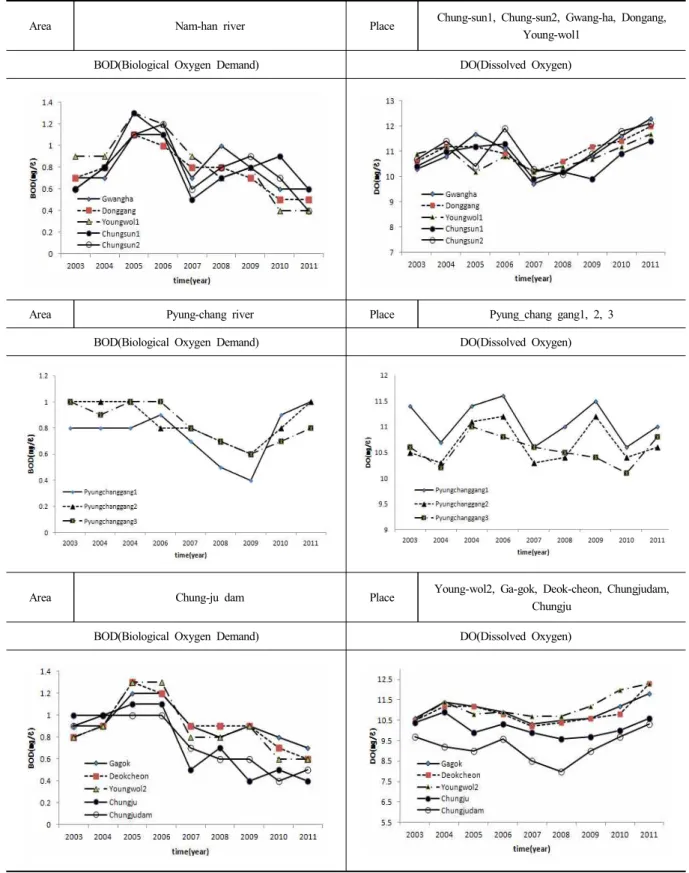
Fig. 3. Characteristics of Water Quality in the Area

2.4 The present condition of water quality in upper stream basin of Chung-ju Dam

Administrative districts of upper stream basin in

Chung-Ju Dam consist of Gangwon-do, Gyeongsangbuk-do,

and Chungcheongbuk-do, which consist of the total 14

Si-Gun-Gu and 71 Up-Myun-Dong; it consist of 3

Middle Zone. The present condition of water quality in

(6)

the basin present that the BOD in upper stream basin of Nam Han River was 0.6 ㎎/ℓ at Jeongseon 1 point in 2003, 0.5㎎/ℓ at Jeongseon 1 point in 2007, 0.6㎎/ℓ at Jeongseon 1 point in 2011, 0.7㎎/ℓat Gwangha point in 2003, 0.7㎎/ℓat Gwangha point in 2007, 0.6㎎/ℓat Gwangha point in 2011, 0.7㎎/ℓat Donggang point in 2003, 0.8㎎/ℓat Donggang point in 2007, 0.5㎎/ℓat Donggang point in 2011, 0.9㎎/ℓat Yeongwol point in 2003, 0.9㎎/ℓat Yeongwol point in 2007, and 0.4㎎/ℓ at Yeongwol point in 2011.

The DO was 10.4 ㎎/ℓJeongseon 1 point in 2003, 9.9 ㎎/ℓJeongseon 1 point in 2007, 11.4 ㎎/ℓJeongseon 1 point in 2011, 10.7 ㎎/ℓJeongseon 2 point in 2003, 10.3 ㎎/ℓ Jeongseon 2 point in 2007, 12.1 ㎎/ℓ Jeongseon 2 point in 2011, 10.3 ㎎/ℓat Gwangha point in 2003, 9.7 ㎎/ℓat Gwangha point in 2007, 12.3 ㎎/ℓ at Gwangha point in 2011, 10.6 ㎎/ℓat Donggang point in 2003, 10.2 ㎎/ℓat Donggang point in 2007, 12 ㎎/ℓ at Donggang point in 2011, 10.9 ㎎/ℓat Yeongwol 1 point in 2003, 10.2 ㎎/ℓat Yeongwol 1 point in 2007, and 11.7 ㎎/ℓat Yeongwol 1 point in 2011.

The BOD in Pyoungchang River basin was 0.8 ㎎/ℓ at Pyoungchang River 1 point in 2003, 0.7 ㎎/ℓat Pyoungchang River 1 point in 2007, 1 ㎎/ℓat Pyoungchang River 1 point in 2011, 1 ㎎/ℓat Pyoungchang River 2 point in 2003, 0.8 ㎎/ℓat Pyoungchang River 2 point in 2007, 1 ㎎/ℓat Pyoungchang River 2 point in 2011, 1 ㎎/ℓat Pyoungchang River 3 point in 2003, 0.8 ㎎/ℓat Pyoungchang River 3 point in 2007, and 0.8 ㎎/ℓat Pyoungchang River 3 point in 2011.

The DO was 11.4 ㎎/ℓat Pyoungchang River 1 point in 2003, 10.6 ㎎/ℓ at Pyoungchang River 1 point in 2007, 11 ㎎/ℓat Pyoungchang River 1 point in 2011, 10.5 ㎎/ℓat Pyoungchang River 2 point in 2003, 10.3

㎎/ℓat Pyoungchang River 2 point in 2007, 10.6 ㎎/ℓat Pyoungchang River 2 point in 2011, 10.6 ㎎/ℓat Pyoungchang River 3 point in 2003, 10.6 ㎎/ℓat Pyoungchang River 3 point in 2007, and 10.8 ㎎/ℓat Pyoungchang River 3 point in 2011. The BOD and DO of river water quality in 2011 for three points of Pyoungchang River basin presented ‘very good’

applying to environmental standard for water quality.

The BOD in Chung-ju dam basin presents 0.8 ㎎/ℓat Yeongwol 2 point in 2003, 0.8 ㎎/ℓat Yeongwol 2 point in 2007, 0.6 ㎎/ℓat Yeongwol 2 point in 2011, 0.9 ㎎/ℓat Gagok point in 2003, 0.9 ㎎/ℓat Gagok point in 2007, 0.7 ㎎/ℓat Gagok point in 2011, 0.8 ㎎/

ℓat Deokcheon point in 2003, 0.9 ㎎/ℓat Deokcheon point in 2007, 0.6 ㎎/ℓat Deokcheon point in 2011, 0.9

㎎/ℓat Chung-ju dam point in 2003, 0.7 ㎎/ℓat Chung-ju dam point in 2007, 0.5 ㎎/ℓat Chung-ju dam point in 2011, 1㎎/ℓat Chung-ju point in 2003, 0.5 ㎎/

ℓat Chung-ju point in 2007, and 0.4 ㎎/ℓat Chung-ju point in 2011.

The DO was 10.5 ㎎/ℓat Yeongwol 2 point in 2003, 10.7 ㎎/ℓat Yeongwol 2 point in 2007, 12.3 ㎎/ℓat Yeongwol 2 point in 2011, 10.6 ㎎/ℓat Gagok point in 2003, 10.3 ㎎/ℓat Gagok point in 2007, 11.8 ㎎/ℓat Gagok point in 2011, 10.5 ㎎/ℓat Deokcheon point in 2003, 10.2 ㎎/ℓat Deokcheon point in 2007, 12.3 ㎎/ℓat Deokcheon point in 2013, 9.7 ㎎/ℓat Chung-ju dam point in 2003, 8.5 ㎎/ℓat Chung-ju dam point in 2007, 10.3 ㎎/ℓat Chung-ju dam point in 2011, 10.4 ㎎/ℓat Chung-ju point in 2003, 9.9 ㎎/ℓat Chung-ju point in 2007, and 10.6 ㎎/ℓat Chung-ju point in 2011.

The BOD and DO of river water quality in 2011 for five points of Chung-ju dam basin presented ‘very good’ applying to environmental standard for water quality.

3. Result and Consideration

3.1 Calibration and Verification of the Model

Calibration means that it makes model value approach to measured value. It is the process of reducing the differences between model value and measured value by changing parameters of the model.

This research conducted the method of trial and

error many times. It used the data on the rate of flow

and water quality in March~April(calibration of the

model) and October~November(verification of the

model) that have less of a change in rate of flow on

basis of 2009 for calibration and verification of the

model.

(7)

Reach

Number Element

related coefficient Manning

coefficient

a b α β

Reach1 15 0.1804 0.2983 0.2095 0.4189 0.033

Reach2 18 0.1804 0.2983 0.2095 0.1160 0.033

Reach3 20 0.1804 0.2983 0.2095 0.1160 0.033

Reach4 11 0.1804 0.2983 0.2095 0.1160 0.033

Reach5 5 0.1804 0.2983 0.2095 0.1160 0.033

Reach6 8 0.0655 0.4454 0.2799 0.4134 0.033

Reach7 8 0.0655 0.4454 0.2799 0.4134 0.033

Table 3. Discharge coefficient applied to QUAL2E

(a) BOD (b) BOD

(a) T-N (b) T-N

(a) T-P (b) T-P

Fig. 4. calibration(a) and verification(b) of QUAL2E water quality model

Item Parameter

Reach Number

1 2 3 4 5 6 7

BOD DO

K1 0.055 0.121 0.208 0.072 0.367 0.042 0.635

K3 0.173 0.057 0.002 0.047 0.020 0.130 0.063

K4 0.090 1.093 2.762 0.013 2.690 0.375 3.691

Table 4. Parameter values estimated by QUAL2E

(8)

watershed

Produced loading(2015) Effluent loading(2015)

1)

Effluent loading(2015)

2)

BOD T-N T-P BOD T-N T-P BOD T-N T-P

Chungju dam 144,871.7 49,911.3 8,923.4 20,521.5 13,571.5 1,640.2 8,467.1 10,240.2 1,189.4 Namhan river 25,712.7 13,192.0 1,719.5 5,952.7 3,945.8 336.5 3,310.4 3,032.9 232.7

Inbukcheon 6,651.7 4,336.2 499.1 1,402.1 1,222.2 94.9 944.8 1,007.2 72.4 Soyang river 4,094.8 2,329.2 280.4 934.6 684.6 57.5 895.7 608.2 50.5 Uiam dam 14,966.2 6,526.6 940.0 3,616.0 2,039.0 184.2 1,469.9 1,417.6 109.8 Pyungchang river 56,278.5 18,115.2 3,988.8 6,472.2 4,084.7 639.0 1,260.8 2,878.0 450.1 Jucheon river 22,948.6 7,027.1 1,533.1 2,285.8 1,438.8 153.1 307.9 938.9 98.1 Pyungchang river 33,329.9 11,088.1 2,455.7 4,186.4 2,645.9 485.9 952.9 1,939.1 352.0

Chungju dam 62,880.4 18,604.1 3,215.1 8,096.6 5,541.1 664.7 3,896.0 4,329.2 506.6 Okdongcheon 4,280.1 2,196.3 286.0 633.6 555.6 44.3 201.4 302.9 24.7 Chungju lake 54,342.0 15,218.2 2,621.4 6,023.6 4,004.9 350.8 2,292.8 3,108.6 229.7

Dalcheon 4,258.2 1,189.6 307.7 1,439.4 980.6 269.6 1,401.8 917.7 252.3 1) excluding the environmental facilities

2) including the environmental facilities

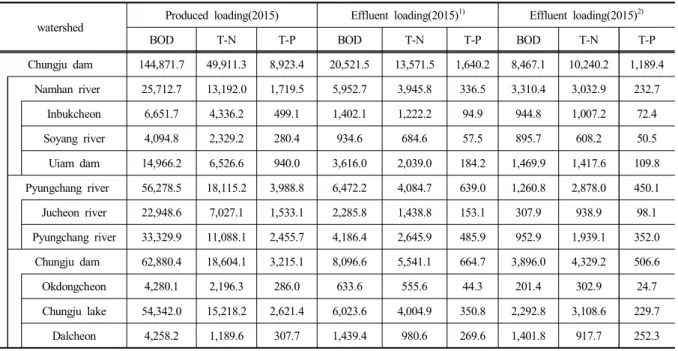
Table 5. Prediction of produced and effluent loadings in Chungju dam (2015)

(unit : ㎏/day)

3.2 Result of simulating water quality

The research implemented the model establishing virtual scenario according to existence of environment basic facilities for predicting the effect of water quality improvement by the reduction of contamination source and the installation of environment basic facilities in upper stream basin of Chung-ju dam.

The total BOD discharge load in Chung-ju dam basin was calculated as being reducing from 21,475kg/day in 2009 to 20,521kg/day in 2015 by the result of predicting contamination source occurrence and discharge load. The total BOD discharge load in 2015 was calculated as 8,467kg/day in case of establishing environment basic facilities in 2015.

Fig. 5. Simulation result from the pollution source reduction based on the low flow(2015, BOD)

Fig. 6. Simulation result from the pollution source reduction based on the low flow(2015, T-N)

Fig. 7. Simulation result from the pollution source

reduction based on the low flow(2015, T-P)

(9)

4. Conclusion

This research calculated occurrence load and discharge load in upper stream basin of Chung-ju dam for simulating upper stream water quality of Chung-ju dam, and the results of water quality modeling using QUAL2E model are as in the following.

1. The present condition of water quality in the basin presented that the BOD was 0.4 ㎎/ℓ∼0.6

㎎/ℓat upper stream basin of Nam Han River, 0.4

㎎/ℓ∼0.7 ㎎/ℓat Chung Ju Dam basin, and the DO was 11.4 ㎎/ℓ∼12.3 ㎎/ℓat upper stream basin of Nam Han River , 0.6 ㎎/ℓ∼11 ㎎/ℓat Pyoungchang River basin, 10.3 ㎎/ℓ∼12.3 ㎎/ℓ at Chung Ju Dam basin. The BOD and DO of river water quality in 2011 for the total basin presented ‘very good’ applying to environmental standard for water quality.

2. The total BOD discharge load in Chung-ju dam basin was calculated as being reducing from 21,475kg/day in 2009 to 20,521kg/day in 2015 ,and the total BOD discharge load in 2015 was calculated as 8,467kg/day in case of establishing environment basic facilities in 2015.

3. Pollution load in upper stream basin of Chung-ju dam presented that contamination source is gradually getting a decrease trend. The effect of about 23% water quality improvement on T-N and T-P was predicted according to establishing environment basic facilities in 2015.

It is recommended that predictions of water quality considering regulations and policy measures for water quality improvement in upper stream basin of Chung-ju dam on basis of the results of this research. would be needed. Additional researches with consideration for management plans of water quality by contamination sources of upper stream basin for Chung-ju dam, introduction of advanced wastewater treatment facilities by massive environment basic facilities at the regions highly having discharge load by contamination sources, and point pollution improvement facilities would be needed.

Reference

Chapra, SC (1997). Surface Water-Quality Modeling. New York : McGraw-Hill, p. 174.

DeGasperi, CL and Khangaonkar, T (1996). A steady- state model of the Willamette river: implications for flow control of dissolved oxygen and phytoplankton biomass. In river quality dynamics and restoration (Laenena A. and Dunnette D. A., eds), pp. 163-171.

Gang, YT, Hyeon, GS and Yang, HC (1996). Water quality modeling and management measures for the Nakdong river, J. of Water Treatment, 4(3), pp.

3-15. [Korean Literature]

Gang, YT and Yang, HC (1996). Predicting on water quality and water treatment measures for the Nakdong river, J. of Water Treatment, 4(4). pp. 11-26.

[Korean Literature]

Gang, YT and Hyeon, GS (1997). Modeling of water quality improvement by mass loading regulation in the Nakdong river basin, J. of Water Treatment, 5(1), pp. 3-10. [Korean Literature]

Kim, SH (2009). Application of QUAL2E model for water quality simulation of Hoengseong lake. J. of Korean Society on Water Quality, 25(5), pp. 651- 660. [Korean Literature]

Kim, JY, Hyeon, GS and Choi JW (2009). Investigation of effects of environmental characteristics of mid- region unit consisting of Geum river, J. of Water Treatment, 17(2), pp. 117-124. [Korean Literature]

Lee. SJ, Hyeon, GS and Choi, JW (2006). Investigation on water and wastewater treatment techniques according to water environmental change in Nakdong river basin, J. of Water Treatment, 14(4), pp. 41-49.

[Korean Literature]

McAvoy, DC, Asscheleyn, P, Peng, C, Morrall, SW, Casilla, AB, Lim, MU and Gregorio, EG (2003).

Risk assessment approach for untreated wastewater using the QUAL2E water quality model. Chemosphere, 52, pp. 55-66.

Ning, SK, Chang, NB, Chen, HW and Hsu, HY (2001). Assessing pollution prevention program by QUAL2E simulation analysis for the Kao-Ping river basin, Taiwan, Environmental Management, 61, pp.

61-76.

(10)

Park, JS, Baek, KJ, Lim, DJ, Lee, DJ, Jeong, SJ and Rhee, KH (2011). Analysis of water pollution sources in Yeongsan river basin on streams using GIS.

Korean society of civil engineers Busan·Ulsan·

Gyeongnam Branch, pp. 122-125. [Korean Literature]

Tolman, RA (1992). Modified QUAL2E modeling of a stream acutely impacted by photosynthesis and respiration. Water resources planning and management:

saving a threatened resource. In Search of Solutions, Proceedings of the water resources sessions at water forum. ASCE, New York, USA, pp.

194-199.

Venter, SN, Steynberg, MC, Wet, CME de, Hohls, D, Plessis, G and Kfir, R (1997). A situational analysis of the microbial water quality in a peri-urban catchment in South Africa. Water Science and Technology, 35, pp. 119-124.

○ 논문접수일 : 2013년 09월 23일

○ 심사의뢰일 : 2013년 09월 25일

○ 심사완료일 : 2013년 10월 24일

수치

Fig.  1.  Channel  reach  of  QUAL2E  model
Fig.  2.  Natural  Flow  Runoff  Map  of  Chung-ju  Dam
Fig.  3.  Characteristics  of  Water  Quality  in  the  Area
Fig.  4.  calibration(a)  and  verification(b)  of  QUAL2E  water  quality  model
+2

참조

관련 문서

The concentration of the dissolved metal as well as that of the adsorbed to solid particles depends mainly on the concentration of the metal in the inflow water

The goal of this research is worked one reasonable function analysis of the cost reduction and quality enhancement to spread out by using QFD (Quality

The purpose of this research was to suggest the water quality improvement in streams by evaluating the distribution characteristics of organics and ammonia nitrogen

In Chapter 3, by establishing teaching and learning plans based on famous paintings for children of the fifth to sixth grade of elementary school, the

– Treat wastewater before it is discharged to maintain the water quality of the natural waters for the benefit of humans and aquatic ecosystem. • Wastewater management goal

According to the analysis results, the characteristics obtainable by the human model based motion capture system are the Euler angle, 3 dimensional location

Current water quality standards for phosphorus in the sewage effluent from 2012 0.2mg/L until tightened according to the existing sewage treatment facilities

- Computer modeling of the function of the human heart - Writing software for analysis of medical research data - Analysis of medical device hazards for safety and