1대구대학교 동물자원학과(Department of Animal Resources Science, Daegu University, Gyeongsan 712-714, Korea)
2경상남도 축산진흥연구소(Gyeongsangnamdo Livestock Promotion Research Institute, Sancheong 666-962, Korea)
3국립식량과학원(National Institute of Crop Science, Rural Development Administration, Iksan 570-080, Korea) Corresponding author : Ik Hwan Jo, Department of Animal Resources Science, Daegu University, Gyeongsan
712-714, Korea. Tel) +82-53-850-6725, Fax) +82-53-850-6729, E-mail: [email protected]
셀레늄함유 청보리 사일리지급여가 육성기 거세한우의 생산성 및 혈액성상에 미치는 영향
김국원
1⋅조익환
1*⋅황보순
1⋅이성훈
2⋅한옥규
3⋅박태일
3⋅최인배
3Influences of Feeding Seleniferous Whole Crop Barley Silage on Growth Performance and Blood Characteristics in Growing
Hanwoo Steers
Guk Won Kim
1, Ik Hwan Jo
1, Soon Hwangbo
1, Sung Hoon Lee
2, Ouk Kyu Han
3, Tae Il Park
3and In Bae Choi
3ABSTRACT
This study was conducted to investigate effects of feeding seleniferous whole crop barley silage (WCBS) on growth performance and blood characteristics in growing Hanwoo steers. A total of 20 growing Hanwoo steers, initially weighing on average 208.8 kg of body weight, were used and treatments were consisted of 1) controls : 0.1 mg/kg Se, 2) T1 : 0.3 mg/kg Se, 3) T2 : 0.9 mg/kg Se by combining seleniferous and/or non-seleniferous WCBS, and 4) T3 : 0.9 mg/kg Se of inorganic Se treatment. Five steers were allocated to each treatment, and the trial was lasted for 90 days. All experimental diets were included to 30% of combination of seleniferous and/or non-seleniferous WCBS, and in T3 diet, sodium selenite that corresponds to 0.9 mg/kg Se was added to control diets. Also, the diets were isonitrogenous and isocaloric among treatments. Dietary level and type of selenium did not affect feed intakes and daily gain, and blood glucose concentration was significantly (p<0.05) lower for controls than T1 and T2 treatments. Blood total lipid concentration was significantly (p<0.05) decreased with increasing levels of dietary selenium, and also that of T2 and T3 was significantly (p<0.05) lower than controls. LDL-cholesterol concentration was significantly (p<0.05) lower for treatments including dietary selenium than controls, and also blood triglyceride concentration was significantly (p<0.05) lower for T2 than controls. Overall, it was tended that feeding seleniferous WCBS or inorganic Se increased blood IgG concentration, and in the same dietary selenium levels, T2 treatment was higher for IgG than T3 group (p>0.05). Blood selenium concentration was significantly (p<0.05) increased by feeding increasing levels of seleniferous WCBS, but there was no significant difference between controls and T3 group. These results showed that feeding seleniferous WCBS to growing Hanwoo steers was responsible for saccharide and lipid metabolism, and in particular, it reduced their total lipid and blood LDL-cholesterol concentrations. Furthermore, selenium present in seleniferous WCBS rather than inorganic selenium was better available in intestinal absorption, and it might help to enhance immunity in growing and younger stages of Hanwoo steers.
(Key words : Seleniferous whole crop barley silage, Blood characteristics, Inorganic Se, Immunity, Growing Hanwoo stees)
Ⅰ. 서 론
최근 우리나라 축산업은 규모면에서 커다란 성장을 가져와 점차 전업 기업형으로 대규모화 되어 축산식품의 공급이 확대되고 있으며 , 국 민들의 육류 소비형태도 변화하면서 기존의 단 순 동물성 단백질 섭취목적의 먹거리를 찾는 것이 아니라 보다 나은 삶을 영위하기 위해 건 강 지향적으로 기능이 강화된 축산물의 관심이 높아지고 있다.
셀레늄은 1817년 스웨덴에서 처음으로 발견 되었으며 사람과 동물에 매우 낮은 농도로 요 구되는 필수 미량요소로서 (Wendel, 1989), 동 물의 장기와 근육, 어패류, 낙농식품 등에 많이 함유되어 있으며, 성인의 하루 추천 섭취량은 55 ㎍ 이며 암예방을 위해 효과적인 섭취량은 200 ㎍이다 (Clark et al., 1996). 셀레늄은 동물 의 세포질 내에서 glutathione peroxidase의 활성 반응에 관여하고 각종 자유 radical로부터 세포 를 보호하는 항산화제 역할을 하며 (Thompson and Scott, 1969; Cai et al., 1995), 항암 효과 (Rayman, 2000)를 포함한 항질병 효과 및 생체 내에서 다양한 면역증강에 따른 기능과 역할이 밝혀지고 있어 (Arthur et al., 1993), 셀레늄이 기능성 식품 첨가물로 새롭게 부각되고 있다 . 가축체내의 셀레늄의 축적은 축종에 따라 달라 지는데, 반추동물과 단위동물간의 비교연구에 서 반추위내 미생물의 작용에 의해 단위동물이 반추동물 보다 축적 효율이 2.5배 이상 높다고 보고하였다 (Wright and Bell, 1996). 한편, 가축 에 화학적 형태가 다른 셀레늄급원 (유기 및 무 기 )을 급여하였을 때, 유기셀레늄이 무기셀레늄 보다 장관 내 흡수 및 축적효율이 높은 것으로 보고되고 있으며 (Ortman and Pehrson, 1999;
Lawler et al., 2004), 무기셀레늄은 반추동물의 경우 반추위내 환원된 환경으로 인하여 불용성 selenide로 전환되어 거의 흡수되지 않아 대부 분이 분으로 배설되고, 단위동물에서는 대부분
의 셀레늄이 뇨로 배설되어 조직 내 셀레늄이 축적되는데 한계가 있다 (Hidiroglou et al., 1968). 이에 따라 셀레늄 강화 축산물을 생산하 기 위하여 유기셀레늄을 사용하고 있으나 유기 셀레늄제제는 수입의존도가 높을 뿐만 아니라 , 첨가수준이 미량이어서 실제 현장에서 적용 시 과량 급여할 경우 중독의 위험이 따르고 가격 이 비싸 농가에서 사용하기에는 현실적으로 힘 들다 .
따라서 본 연구에서는 다양한 수준의 셀레늄 함유 청보리 사일리지와 무기셀레늄을 육성기 거세한우에 급여하였을 때 , 사료섭취량, 증체 량 , 사료효율 및 혈액성상에 미치는 영향을 조 사하여 육성기 거세한우에 대한 셀레늄 급여효 과를 구명하기 위해 실시하였다.
Ⅱ. 재료 및 방법 1. 공시축 및 시험설계
시험에 이용된 공시축은 육성기 거세한우 20 두 (개시체중 208.8 ± 17.9 kg)를 공시하여 예비 기간 10일, 본시험기간 90일간 시험을 실시하 였다 . 시험설계는 셀레늄함유 청보리 사일리지 의 배합수준 증가에 따라 0.1 mg/kg Se (대조 구), 0.3 mg/kg Se (T1), 0.9 mg/kg Se (T2) 및 무 기셀레늄 0.9 mg/kg Se (T3) 급여구로 4처리를 나누어 처리구 군당 5두씩 완전 임의배치하여 실시하였다 .
2. 청보리의 화학적 조성
시험에 사용된 두 종류의 사일리지 (일반 및
셀레늄시비)는 황숙기에 각각 총체로 수확한
청보리를 이용하여 사일리지를 제조하였고, 각
청보리 사일리지의 화학적 조성은 Table 1에
나타난 바와 같다 .
Table 1. Chemical composition of Se-fertilized and non-Se-fertilized whole crop barley silage on dry matter basis
Whole crop barley
1)silage Non-Se-
fertilized Se-fertilized
2)Moisture, % 67.50 66.97 Crude protein, % 7.42 8.28 Crude fiber, % 4.02 3.09 Ether extract, % 21.95 25.93 Crude ash, % 5.36 4.84 Calcium, % 0.23 0.26 Phosphorus, % 0.25 0.24 Selenium, mg/kg 0.09 3.57
1)Nitrogen fertilizer for Se and non-Se-barley was applied in the form of urea at a rate of 150 kg N ha-1.
2)Sodium selenate as selenium fertilizer was applied at a rate of 120 g Se ha-1.
Table 2. Ingredients and chemical composition of experimental diets on dry matter basis
Item Treatments
1)Control T1 T2 T3
Corn grain, % 23.75 23.75 24.30 23.75
Corn gluten feed, % 28.00 28.15 28.10 28.00 Corn gluten meal, % 4.85 4.70 4.45 4.85
Rice straw, % 12.00 12.00 11.70 12.00
Non-Seleniferous WCBS
2), % 30.00 24.40 7.00 30.00
Seleniferous WCBS, % - 5.60 23.00 -
Limestone, % 1.00 1.00 1.05 1.00
Sodium chloride, % 0.20 0.20 0.20 0.20
Vitamin/mineral mixture
3), % 0.20 0.20 0.20 0.20
Sodium selenite
4), mg/kg - - - 1.75
Total, % 100.00 100.00 1000.00 100.00
Chemical composition
Moisture, % 28.89 28.75 28.62 28.84
Crude protein, % 14.01 14.01 14.02 14.00
Ether extract, % 3.48 3.43 3.27 3.47
Crude fiber, % 13.56 13.79 14.40 13.57
Crude ash, % 5.87 5.85 5.71 5.83
Calcium, % 0.49 0.50 0.52 0.51
Phosphorus, % 0.32 0.32 0.32 0.32
Selenium, mg/kg 0.11 0.29 0.91 0.89
TDN
5), % 70.94 70.93 71.05 70.94
1)Control : 0.1 mg/kg Se, T1 : 0.3 mg/kg Se, T2 : 0.9 mg/kg Se by combining seleniferous and/or non-seleniferous WCBS (control, T1 and T2), and T3 : Control + inorganic Se treatment as sodium selenenite (0.9 mg/kg Se).
2)Abbreviates whole crop barley silage.
3)Vitamin/mineral mixture provided per kilogram of diet: 5,820 IU vitamin A, 582 IU vitamin D3, 22 IU vitamin E, 4.4 mg vitamin K, 5.8 mg riboflavin, 3.3 mg pantothenic acid, 34.9 mg niacin, 29 ㎍ vitamin B12, 100 mg Zn, 50 mg Fe, 27 mg Mn, 6 mg Cu, 0.7 mg I, and 0 mg Se.
4)Purchased from Sigma Korea. 5)Abbreviates total digestible nutrients (Calculated value).
3. 시험사료 및 사양관리
본 연구에 사용된 시험사료는 조단백질 및
가소화영양소총량이 각각 14% 및 71%를 만족
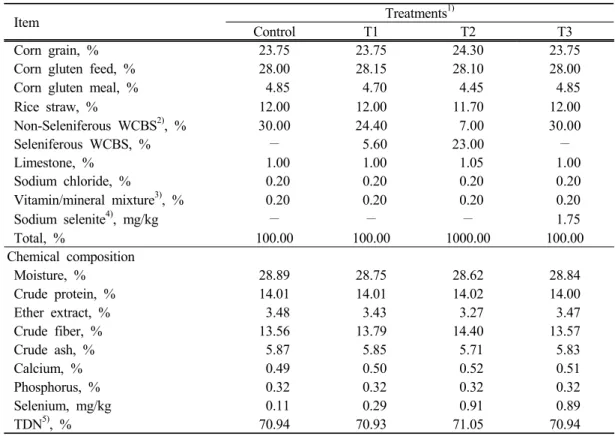
하도록 배합하였고, 사료배합비 및 화학적조성
은 Table 2에 나타내었다. 셀레늄함량이 다른
청보리 사일리지는 건물기준 30% 함유하도록
배합하였고, 배합된 실험사료는 개체별 사료급
이기를 통하여 오전 (07:00)과 오후 (17:00)로 나
누어 2회 자유 채식시켰으며, 물은 자동 급수
기를 이용하여 자유롭게 섭취할 수 있도록 하
였다 . 일일 사료섭취량은 1일 2회 급여량과 다
음날 아침 사료급여 전 잔여사료를 수거하여
그 차이에 의해 계산하였고, 체중은 30일마다
Table 3. Growth performances of growing Hanwoo steers fed diets containing increasing levels of seleniferous whole crop barley silage
Items Treatments
1)SEM
2)Control T1 T2 T3
Initial body weight, kg 209.2 208.2 207.2 210.8 41.29 Final body weight, kg 278.2 278.4 277.2 279.2 38.28 Daily dry matter intake, kg 8.43 8.42 8.43 8.42 0.510 Average daily gain, kg 0.76 0.78 0.78 0.76 0.091 Feed intake : gain 11.09 10.79 10.81 11.08 0.595
1)See Table 2, 2)Standard error of the mean.
측정하여 증체량을 기록하여 일당증체량을 구 하였다 . 사료요구율은 전 실험기간동안 사료섭 취량과 실험 종료 시의 증체량을 근거로 다음 과 같은 식 (사료요구율 = 사료섭취량/증체량) 의 식으로 산출하였다.
4. 시험사료 및 혈액분석
실험사료의 분석은 AOAC (1990) 방법에 따 라 분석하였고 , 혈액은 시험 개시 30일, 60일 후 및 시험 종료 시에 각각 경정맥에서 vacutainer로 10 ml의 혈액을 채취한 후, 원심분 리 (3,000 rpm/10분)하여 혈청을 분리하고, 분석 시까지 -80℃ 초저온 냉동고에 보관하였다.
분석방법은 Total protein은 Colorimetry (Modular PE, Hitachi, Japan), Albumin은 BCG Method (Modular analytics, Roche, Germany), Total lipid 는 비색법 (Photometer, Agilent 8453, Germany), Glucose, SGOT (Serum glutamic-oxaloacetic tran- saminase)와 SGPT (Serum glutamic-pyruvic tran- saminase), Cholesterol, Low-density lipoprotein cholesterol (LDL-cholesterol), Triglyceride는 자동 생화학 분석기 (ADVIA 1650, Bayer, Japan), ImmunoglobulinG (IgG)는 Nephelometry법(Nephelo- meter, Dade Behring, Germany), Selenium은 Atomic Absorption Spectrophotometry (AA800, Perkin- Elmer, Germany)에 의하여 실시하였다.
5. 통계분석
본 실험의 결과는 SAS package program (version 6.12, USA, 2009)의 GLM (general linear model)을 이용하여 분산분석하고, 처리군간 평 균비교는 Duncan 다중검정을 실시하였으며, 처 리군의 유의성은 5% (p<0.05) 수준에서 검정하 였다.
Ⅲ. 결과 및 고찰 1. 사료섭취량, 증체량 및 사료효율
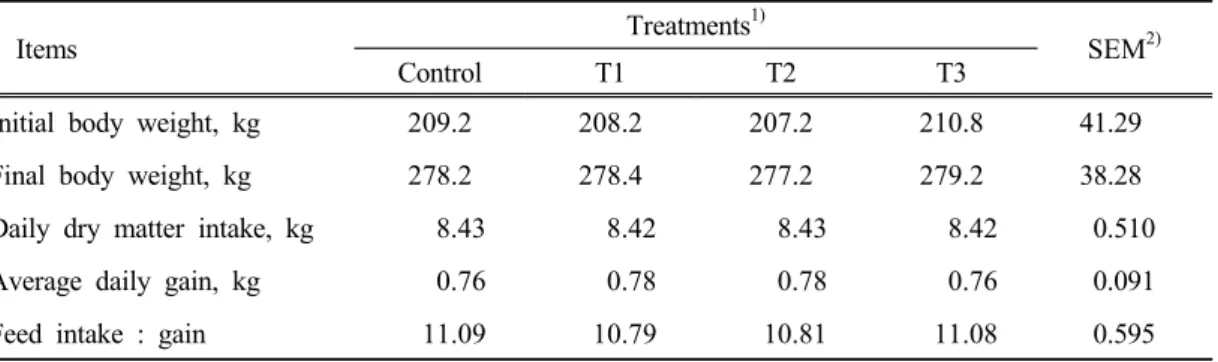
다양한 수준의 셀레늄함유 청보리 사일리지 및 무기셀레늄을 육성기 거세한우에 급여하였 을 때 , 사료섭취량, 증체량 및 사료효율은 Table 3에 나타내었다. 실험기간 중 일일 사료 섭취량은 8.42~8.43 kg로 나타났으나 처리구간 유의한 차이는 나타나지 않았다. 일당증체량은 대조구와 T3구가 0.76 kg, T1과 T2구가 0.78 kg 으로 나타났다 . 사료요구율은 10.79~11.09로 나 타나 사료내 셀레늄수준에 의한 차이는 나타나 지 않았다.
사료내 다양한 수준의 셀레늄이 건물섭취량
과 증체량에 미치는 영향은 각 축종별로 다양
한 연구결과가 보고되고 있는데 , 비육후기 거
세한우에게 셀레늄 수준을 0.1~0.9 ppm 급여
Table 4. Serum metabolic substances of growing Hanwoo steers fed diets containing increasing levels of seleniferous whole crop barley silage
Items Treatments
1)SEM
2)Control T1 T2 T3
Total protein, g/dl
d 30 6.54 6.38 6.66 6.50 0.33
d 60 6.64 6.86 7.04 7.14 0.63
d 90 6.44 6.86 6.68 6.74 0.48
Overall 6.54 6.70 6.79 6.79 0.50
Albumin, g/dl
d 30 3.44 3.38 3.36 3.42 0.16
d 60 3.48 3.46 3.46 3.46 0.24
d 90 3.52 3.34 3.50 3.30 0.18
Overall 3.48 3.39 3.44 3.39 0.19
Glucose, mg/dl
d 30 78.0 84.8 84.8 86.2 6.95
d 60 83.4 93.4 91.2 84.4 7.03
d 90 85.2
b92.6
a90.2
ab90.0
ab4.85 Overall 82.2
b90.3
a88.7
a86.9
ab6.69 Total lipid, mg/dl
d 30 270.4 254.0 264.4 245.2 35.60
d 60 287.6
a259.4
ab230.4
b233.8
b36.23 d 90 269.4
a247.6
ab204.0
b201.2
b39.77 Overall 275.8
a253.7
ab232.9
b226.7
b38.4
1)See Table 2, 2)Standard error of the mean
a, bMeans in a row with different superscripts are significantly different (p<0.05).
시 사료섭취량에 영향을 미치지 않았고 (Lee et al., 2006), 돼지의 경우에도 셀레늄 첨가 수준 이 증체량에 차이가 없다고 보고하였다 (Mahan et al., 1999; Lee et al., 2012). 셀레늄 급원이 다른 비교 시험에서도 육우 (Lawler et al., 2004), 면양 (Rock et al., 2001), 임신우 (Gunter et al., 2003) 등 처리구간 차이가 없었다고 보 고하였다. 이러한 결과는 축종에 관계없이 셀 레늄이 증체량에는 영향을 미치지 않는 것으로 생각되고, 본 시험에서도 선행 연구결과와 유 사한 양상을 보였다 .
2. 혈액성상
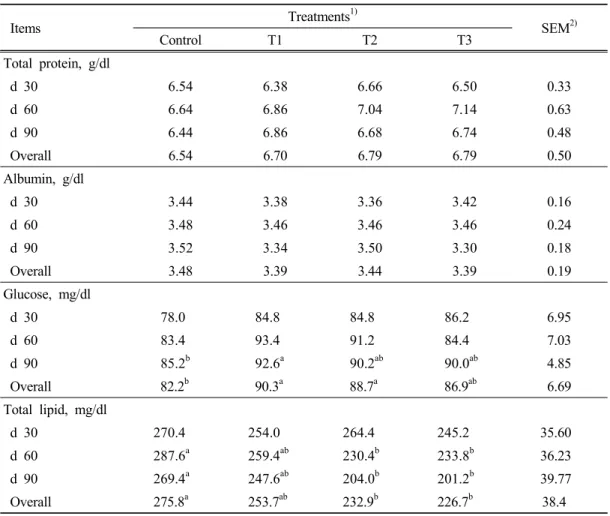
다양한 수준의 셀레늄함유 청보리사일리지와 무기셀레늄을 육성우에 급여하였을 때, 혈중 총단백질, 알부민, 포도당 및 총지질 농도에 미 치는 영향은 Table 4에 나타내었다.
혈중 총단백질 농도는 시험 전기간 동안 셀
레늄 급여구가 6.70~6.79 g/dl으로 대조구의
6.54 g/dl 보다는 높은 경향으로 나타났다. 혈중
알부민 농도는 대조구가 3.48 g/dl으로 셀레늄
급여구의 3.39~3.44 g/dl 보다는 높은 경향이었
지만 유의적 차이는 나타나지 않았다 . 혈중 포
도당농도는 대조구가 82.2 mg/dl으로 셀레늄이 각각 0.3과 0.9 ppm 함유된 T1과 T2구의 각각 90.3과 88.7 mg/dl 보다 유의하게 낮았다 (p<0.05). 혈중 총지질 농도는 사료내 셀레늄수 준이 증가할수록 유의하게 낮아져, T2구와 T3 구가 각각 232.9와 226.7 mg/dl으로 대조구의 275.8 mg/dl 보다 유의하게 낮았다 (p<0.05).
혈중 포도당은 동물의 에너지원으로 활용되 거나 지방원으로 합성되는 전구물질로 사육과 도살 방법 및 동물의 체조직 함량과 밀접한 관 계가 있다 . 본 시험에서는 대조구에 비하여 셀 레늄함유 청보리 사일리지를 급여한 T1과 T2 구의 포도당농도가 높게 나타났고, 이는 셀레 늄급여에 의한 체내 저장탄수화물 즉, 글리코 겐에 영향을 주어 포도당으로 분해되어 혈액으 로 용출되어 그 농도가 증가한 것으로 판단된 다 . 하지만, 본 연구에서의 셀레늄급여로 인한 혈중 포도당에 미치는 영향은 기존의 연구와 상이한 결과를 보여주었다. Dominguez-Vara 등 (2009)은 비육기의 면양에 셀레늄강화효모 및 크롬강화효모를 급여하였을 때 , 셀레늄의 급여 에 의해서는 혈중 포도당농도에 영향을 주지 않는다고 하였고, 혈중 포도당농도는 오히려 사료내 크롬함량에 의하여 당대사관련 호르몬 농도에 변화를 주어 혈중 포도당의 농도가 달 라진다고 하였으며 , Liu 등 (2006)은 쥐에 셀레 늄강화 맥아 (malt)를 급여하면 셀레늄수준이 증가함에 따라 혈중 포도당농도가 감소한다고 보고하였다. 혈중 총지질농도는 셀레늄의 급여 로 현저하게 감소하였고, 셀레늄의 화학적 형 태 보다는 셀레늄수준에 의하여 낮아지는 것으 로 판단된다 .
수준이 다른 셀레늄함유 청보리 사일리지와 무기셀레늄을 육성우에 급여하였을 때, 간기능 효소 (SGOT, SGPT), 콜레스테롤 및 중성지방에 미치는 영향은 Table 5에 나타난 바와 같다.
SGOT 및 SGPT는 주별 및 대조구와 셀레늄 급여구 간에 유의한 차이는 나타나지 않았다 . 혈중 총콜레스테롤농도는 셀레늄급여구가 129.0
~130.2 mg/dl으로 유의적 차이는 나타나지 않았 지만 , 대조구의 141.8 mg/dl 보다는 낮은 경향 으로 나타나 셀레늄 급여로 총콜레스테롤농도 가 낮아졌다 . LDL 콜레스테롤은 셀레늄급여구 가 23.0~23.3 mg/dl으로 대조구의 29.9 mg/dl 보 다 유의하게 낮았다 (p<0.05). 혈중 중성지방은 시험 30일 및 60일에는 사료내 셀레늄수준의 영향을 받지 않았으나, 시험 실시 90일에는 T2 구가 11.4 mg/dl으로 대조구의 20.6 mg/dl 보다 유의하게 낮았다 (p<0.05). 셀레늄은 필수미량원 소로 과잉 섭취 시 중독성을 나타낸다 . 중독의 증상은 간경변 등 간기능 장애로 나타나며 (Underwood, 1977; Jia et al., 2005), 혈중 SGOT 및 SGPT는 간기능 이상의 주된 지표이 다. 본 시험에서 사료내 유, 무기셀레늄을 각각 최대 0.9 ppm씩 급여 시에도 대조구와 차이가 나타나지 않아 독성수준은 아닌 것으로 판단되 며, 가축은 건물기준으로 0.1~0.5 ppm의 농도가 안전한 수준으로 알려져 있으며, 중독증세는 2~5 ppm에서 나타난다고 보고하여 (Oldfield, 1992;
Edmonson et al., 1993), 본 시험에서 급여한 셀 레늄수준은 셀레늄 독성을 나타내기까지에는 안전한 수준인 것으로 사료된다.
본 연구에서 셀레늄급여로 LDL-콜레스테롤 및 총지질 (Table 4)의 농도가 감소하였는데, Salonen 등 (1991)은 셀레늄이 지방과산화물 생 성을 억제하고 콜레스테롤 대사의 변화를 가져 와 지질 대사에 영향을 미친다고 보고하여 본 연구결과와 일치하였다. 또한, 사료에 셀레늄첨 가가 각종 다양한 동물의 지질 대사에 미치는 영향을 살펴보면 , 돼지에게 유기셀레늄을 급여 시 총지질과 콜레스테롤 함량이 감소하고 (Lee et al., 2012), 흰쥐에서도 콜레스테롤 함량이 감 소한다고 보고하였으며 (Jun and Choi, 2002), 셀레늄급여로 지질과 콜레스테롤 감소와 같은 지질대사를 개선하는 것으로 보여진다 .
다양한 수준의 셀레늄함유 청보리 사일리지
및 무기셀레늄을 육성기 거세한우에 급여하였
을 때, 혈중 면역글로불린 및 혈중 셀레늄농도
Table 5. Hepatic lesion enzymes and lipid metabolic intermediates in the serum of growing Hanwoo steers fed diets containing increasing levels of seleniferous whole crop barley silage
Item Treatments
1)SEM
5)Control T1 T2 T3
SGOT
2), U/ℓ
d 30 66.8 65.6 59.8 68.6 12.93
d 60 68.0 60.8 60.8 58.8 12.11
d 90 72.8 61.4 64.2 62.8 8.43
Overall 69.2 62.6 61.6 63.4 10.87
SGPT
3), U/ℓ
d 30 20.4 21.0 19.2 20.2 2.86
d 60 22.0 20.4 20.0 19.8 3.75
d 90 24.6 22.0 20.8 21.0 2.67
Overall 22.3 21.1 20.0 20.3 3.08
Total cholesterol, mg/dl
d 30 138.0 130.0 128.4 124.8 21.51
d 60 147.0 127.4 121.2 124.6 23.03
d 90 140.6 133.4 138.8 137.6 26.47
Overall 141.8 130.2 129.4 129.0 22.65
LDL cholesterol
4), mg/dl
d 30 32.8
a24.6
b23.8
b23.0
b5.56
d 60 29.6
a21.2
b21.4
b21.2
b4.80
d 90 27.2 23.2 24.0 25.6 5.40
Overall 29.9
a23.0
b23.1
b23.3
b5.20 Triglyceride, mg/dl
d 30 21.8 23.2 21.6 19.8 3.67
d 60 21.6 23.8 25.2 18.6 4.73
d 90 20.6
a17.6
ab11.4
b14.8
ab4.78
Overall 21.3 21.5 19.4 17.7 4.43
1)See Table 2
2)SGOT abbreviates serum glutamic-oxaloacetic transaminase
3)SGPT abbreviates serum glutamic-pyruvic transaminase
4)Low-density lipoprotein cholesterol
5)Standard error of the mean.
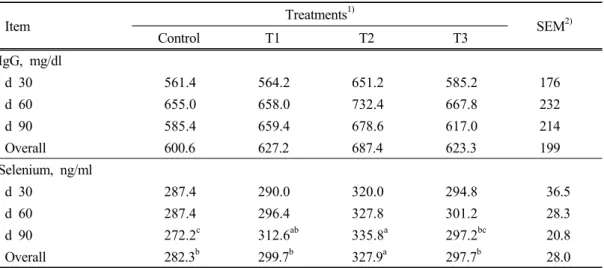
에 미치는 영향은 Table 6에 나타난 바와 같다.
혈중 면역글로불린은 대조구보다는 셀레늄함유 청보리사일리지 급여구가 다소 높은 경향이었
고, 청보리사일리지 급여구에서는 전 시험기간
동안 T2구가 가장 높았으나, 유의적인 차이는
나타나지 않았다 . 혈중 셀레늄농도에서는 대조
Table 6. Serum IgG and Se concentrations of growing Hanwoo steers fed diets containing increasing levels of seleniferous whole-crop barley silage
Item Treatments
1)SEM
2)Control T1 T2 T3
IgG, mg/dl
d 30 561.4 564.2 651.2 585.2 176
d 60 655.0 658.0 732.4 667.8 232
d 90 585.4 659.4 678.6 617.0 214
Overall 600.6 627.2 687.4 623.3 199
Selenium, ng/ml
d 30 287.4 290.0 320.0 294.8 36.5
d 60 287.4 296.4 327.8 301.2 28.3
d 90 272.2
c312.6
ab335.8
a297.2
bc20.8 Overall 282.3
b299.7
b327.9
a297.7
b28.0
1)See Table 2, 2)Standard error of the mean.
a, b, cMeans in a row with different superscripts are significantly different (p<0.05).
구가 282.3 ng/ml으로 가장 낮았고, T2구가 327.9 ng/ml으로 가장 높았다 (p<0.05).
하지만, T3구는 대조구와 유의한 차이가 나 타나지 않아 , 무기셀레늄이 반추위내 미생물에 의하여 상당량의 셀레늄이 환원되어 불용성 selenide를 생성하여 대부분의 셀레늄이 분으로 배설된 것으로 생각된다. 셀레늄의 체내 여러 작용 중 면역력 증강효과는 널리 알려져 있으 나 (Rayman, 2000; Miller et al., 2001; Arthur et al., 2003), 본 연구에서는 처리구내 IgG 농도의 변이가 심하여 셀레늄함유 청보리사일리지의 급여로 면역글로불린의 유의한 증가현상은 나 타나지 않은 것으로 사료된다. 이전의 연구보 고에 의하면, Awadeh 등 (1998)은 비육암소에 고농도의 셀레늄혼합물을 급여하면 , 혈청내 IgG 농도가 현저하게 증가한다고 하였고, Larsen 등 (1988)도 면양사료에 셀레늄을 보충 하였을 때, 면양의 항체반응이 향상될 뿐만 아 니라 , 혈청 내 IgG 농도가 대조구에 비하여 유 의하게 증가하였다고 보고하였다 .
셀레늄 형태에 따른 체내 흡수는 Gunter 등 (2003)에 의하면 무기셀레늄보다는 유기셀레늄
급여에 의하여 혈중 셀레늄농도가 더 증가하 고, Pehrson 등 (1989)의 보고에서도 유기셀레늄 이 무기셀레늄보다 1.8배 이용율이 높다고 보 고하였다 . 본 연구의 청보리 사일리지 내 존재 하는 셀레늄은 장관 내 흡수율이 셀레늄 수준 별로 증가하는 것으로 봐서 대부분의 셀레늄이 유기형태인 것으로 생각된다. 따라서, 본 연구 에서도 같은 셀레늄함량을 가지는 셀레늄함유 청보리사일리지구의 셀레늄이 무기셀레늄급여 구보다 혈중 셀레늄농도가 증가하는 것을 확인 할 수 있어 이전의 연구자와 일치된 결과를 보 여주었다.
Ⅳ. 요 약
본 연구는 다양한 수준의 셀레늄함유 청보리 사일리지를 육성기 거세한우에 급여 시 성장특 성 및 혈액성상에 미치는 영향을 조사하였다 . 시험은 육성기 거세한우 20두 (개시체중 208.8
± 17.9 kg)를 공시하였고, 처리구는 셀레늄수준
과 형태에 따라 4처리구 (셀레늄시비 및 비시비
청보리 사일리지이용 0.1 mg/kg 셀레늄 (대조
구 ), 0.3 mg/kg 셀레늄 (T1), 0.9 mg/kg 셀레늄 (T2) 및 무기셀레늄 0.9 mg/kg 셀레늄 (T3)로 나 누어 처리구당 5두씩 배치하여, 90일간 사양시 험을 실시하였다. 각 시험사료는 셀레늄함유 및 일반 청보리를 조합하여 배합비의 30%를 대체하였고 , 무기셀레늄구 (T3)는 대조구사료에 0.9 mg/kg의 셀레늄수준에 상응하는 양의 sodium selenite를 첨가하였다. 사료내 조단백질 및 에 너지함량은 처리구간 동일하였다. 사료 내 셀 레늄의 수준 및 급여형태에 따라 사료섭취량과 증체에는 영향을 미치지 않았고 , 혈중 포도당 농도는 대조구가 T1과 T2구 보다 유의하게 낮 았다 (p<0.05). 혈중 총지질농도는 셀레늄수준이 증가할수록 유의하게 낮아져, T2구와 T3구가 대조구 보다 유의하게 낮았다 (p<0.05). LDL-콜 레스테롤은 셀레늄급여구가 대조구보다 유의하 게 낮았다 (p<0.05). 혈중 중성지방 또한 T2구 가 대조구보다 유의하게 낮았다 (p<0.05). 혈중 면역글로불린농도는 셀레늄의 급여로 전반적으 로 상승하는 경향을 보였고, 사료 내 같은 셀 레늄수준에서 T3구보다는 T2구가 높은 양상을 나타내었다 . 혈중 셀레늄농도는 셀레늄함유 청 보리 급여수준이 높아짐에 따라 유의하게 증가 였으나 (p<0.05), T3구는 대조구와 유의한 차이 가 나타나지 않았다. 이상의 결과에서 육성한 우에 대한 셀레늄함유 청보리급여는 육성우의 당 및 지질대사에 관여하는 것으로 나타났고 , 특히 혈중 총지질 및 LDL-콜레스테롤의 농도 를 감소시켰다. 또한 무기셀레늄보다는 청보리 내 존재하는 셀레늄이 장관내에서 더 잘 흡수 되는 것으로 나타났고 , 이는 육성기 및 어린 성장단계에 있는 거세한우의 면역력을 향상시 키는데 도움이 될 수 있을 것으로 판단된다.
Ⅴ. 사 사
본 연구는 농촌진흥청 공동연구사업 수행결 과의 일부로 연구비 지원에 감사드립니다.
Ⅵ. 인 용 문 헌
1. A.O.A.C. 1990. Offical methods analysis.
Association of offical analytical chemists. 15th edition. Washington, D.C.
2. Arthur. J.R., F. Nicol and G.J. Beckett. 1993.
Selenium deficiency, thyroid hormone metabolism, and thyroid hormone deiodinases. Am. J. Clin.
Nutr. 57:236-239.
3. Arthur, J.R., R.C. McKenzie and G.J. Beckett.
2003. Selenium in the Immune system. J. Nutr., 133, 1457-1459.
4. Awadeh, F.T., R.L. Kincaid and K.A. Johnson.
1998. Effect of level and source of dietary selenium on concentrations of thyroid hormones and immunoglobulins in beef cows and calves. J.
Anim. Sci. 76:1204-1215.
5. Cai, X.J., E. Block, P.C. Uden, X. Zhang, B.D.
Quimby and J.J. Sullivan. 1995. Allium chemistry:
Identification of seleno-amino acids in ordinary and selenium-enriched garlic, onion and broccoli using gas chromatography with atomic emission detection. J. Agr. Food Chem. 43:1754-1757.
6. Clark, L.C., G.F. Jr, Combs, B.W. Turnbull, E.H.
Slate, D.K. Chalker, J. Chow, L.S. Davis, R.A.
Glover, G.F. Graham, E.G. Gross, A. Krongrad, J.L. Jr, A., Lesher, H.K. Park, B.B. Jr, Sanders, C.L. Smith and J.R. Taylor. 1996. Effects of selenium supplementation for cancer prevention in patients with carcinoma of the skin. JAMA.
276:1957-1963.
7. Dominguez-Vara, I.A., S.S. Gonzalez-Munoz, J.M.
Pinos-Rodriguez, J.L. Borquez-Gastelum, R.
Barcena-Gama, G. Mendoza-Martinez, L.E. Zapata, L.L. Landois-Palencia. 2009. Effects of feeding selenium-yeast and chromium-yeast to finishing lambs on growth, carcass characteristics, and blood hormones and metabolites. Anim. Feed Sci.
Technol. 152:42-49.
8. Edmonson, A.J., B.B. Morman and D. Suther.
1993. Survey of state veterinarians and state veterinary diagnostic laboratories for selenium deficiency and toxicosis in animals. J. Am. Vet.
Med. Assoc. 202:865-874.
9. Gunter, S.A., P.A. Beck and J.M. Philips. 2003.
Effects of supplementary selenium source on the performance and blood measurements in beef cows and their calves. J. Anim. Sci. 81:856-864.
10. Hidiroglou, M.D., P. Heanley and K.J. Jenkins.
1968. Metabolism of inorganic selenium in rumen bacteria. Can. J. Physiol. Pharm. 46: 229-232.
11. Jia, X., N. Li and J. Chen. 2005. A subchronic toxicity study of elemental Nano-Se in Sprague- Dawley rats. Life Sci. 76:1989-2003.
12. Jun, Y.S. and M.K. Choi. 2002. Effect of copper and selenium supplementation on lipid contents in rats. J. East Asian Soc. Dietary Life. 12:100-106.
13. Larsen, H.J. 1988. Influence of selenium on antibody production in sheep. Res. Vet. Sci.
54:4-12.
14. Lawler, T.L., J.B. Taylor, J.W. Finley and J.s.
Caton. 2004. Effect of supranutritional and organically bound selenium on performance, carcass characteristics, and selenium distribution in finishing beef streers. J. Anim. Sci. 82:1488-1493.
15. Lee, S.H., B.Y. Park, S.S. Lee, N.J. Choi, J.H.
Lee, J.M. Yeo, J.K. Ha, W.J. Maeng and W.Y.
Kim. 2006. Effects of spent composts of selenium- enriched mushroom and sodium selenite on plasma glutathione peroxidase activity and selenium deposition in finishing Hanwoo steers. Asian-Aust. J. Anim.
Sci. 19(7):984-991.
16. Lee, S.H., I.H. Jo, K.W. Kim, S. Hwangbo, O.K.
Han, T.H. Song, T.I. Park and I.B. Choi. 2012.
Influences of seleniferous whole crop barley supplement on growth performance and blood characteristics in growing pigs. J. Kor. Grassl.
Forage Sci. 32(1):39-48.
17. Liu, J.-G., H.-J. Zhao, Y.-J. Liu, and X.-L. Wang.
2006. Effect of selenium-enriched malt on hepatocarcinogenesis, paraneoplastic syndrome and the hormones regulating blood glucose in rats treated by diethylnitrosamine. Life Sciences 78:
2315-2321.
18. Mahan D.C, T.R. Cline and B. Richert. 1999.
Effects of dietary levels of selenium-enriched yeast and sodium selenite as selenium sources fed to growing-finishing pigs on performance, tissue selenium, serum glutathione peroxidase activity, carcass characteristics and loin quality. J Anim.
Sci. 77:2172-2179.
19. Miller, S., S.W. Walker, J.R. Arthur, F. Nicol, K.
Pickard, M.H. Lewin, A.F. Howie and G.J.
Beckett. 2001. Selenite protects human endothelial cells from oxidative damage and induces thioredoxin reductase. Clin. Sci. 100:543-550.
20. Oldfield, J.E. 1992. Risks and benefits in agricultural uses of selenium. Environ. Geochem.
Hlth. 14:81-86.
21. Ortman, K. and B. Pehrson. 1999. Effect of selenate as a feed supplement to dairy cows in comparison to selenite and selenium yeast. J.
Anim. Sci. 77:3365-3370.
22. Pehrson, B., M. Knutsson and M. Gyllensward.
1989. Glutahione peroxidase activity in heifers fed diets supplemented with organic and inorganic selenium compounds. Swed. J. Agric. Res.
19:53-56.
23. Rayman, M.P. 2000. The importance of selenium to human health. The Lancet 356:233-241.
24. Rock, M.J., R.L. Kincaid and G.E. Carstens.
2001. Effects of prenatal source and level of dietary selenium on passive immunity and thermometabolism of newborn lambs. Small Ruminant Res. 40:129-138.
25. Salonen, J.T., R. Salonen, K. Seppanen, M.
Kantola, S. Suntionen and H. Korpela. 1991.
Interaction of serum copper, selenium and low density lipoprotein cholesterol in atherogenesis, Br.
Med. J. 302:756-760.
26. SAS. 2009. User’s Guide Statistics. Statistical Analysis System Institute Inc. Cary. NC.
27. Thompson, J.N. and M.L. Scott. 1969. Role of selenium in the chick J. Nutr. 97:335-342.
28. Underwood, E.J. 1977. Trace element in human and animal nutrition. 4th ed. Academic Press, London., United Kingdom.
29. Wendel, A. 1989. Selenium in Biology and Medicine. Springer-Verlag, Berlin. pp3-325.
30. Wright, P.L. and Bell, M.C. 1966. Comparative metabolism of selenium and tellurium in sheep and swine. Am. J. Physiol. 211:6-10.
(Received May 30, 2012 / Accepted June 12, 2012)