* Corresponding author : Ik Hwan Jo, Department of Animal Resources, Daegu University, Gyeongsan 712-714, Korea. Tel: +82-53-850- 6725, Fax: +82-53-850-6729, E-mail: [email protected]
셀레늄 강화 청보리 사일리지 급여가 비육기 거세한우의 생산성, 혈액성상 및 도체특성과 조직 내 셀레늄 축적에 미치는 영향
황보순
1․조익환
1*․김국원
1․최창원
1․이성훈
21
대구대학교 동물자원학과,
2경상남도 축산진흥연구소
Effect of Seleniferous Whole Crop Barley Silage on Growth Performance, Blood and Carcass Characteristics, and Tissue Selenium Deposition in
Finishing Hanwoo Steers
Soon Hwangbo
1, Ik Hwan Jo
1*, Guk Won Kim
1, Chang Weon Choi
1and Sung Hoon Lee
21
Department of Animal Resources, Daegu University, Gyeongsan 712-714, Korea,
2
Gyeongsangnamdo Livestock Promotion Research Institute, Sancheong 666-962, Korea
ABSTRACT
This study was conducted to investigate the effects of feeding seleniferous whole crop barley silage (WCBS) on the growth performance, blood and carcass characteristics, and tissue selenium deposition infinishing Hanwoo steers. A total of 20 growing Hanwoo steers were selected and assigned to one of the following feed groups: control (0.1 ppm Se), T1 (0.3 ppm Se), T2 (0.9 ppm Se), and T3 (0.9 ppm of inorganic Se). Five steers were allocated to each treatment group, and the trial lasted for 90 days.
All experimental diets combined seleniferous and/or non-seleniferous WCBS up to a ratio of 30%. For the T3 diet, 0.9 ppm Se in the form of sodium selenite was added to the control diet. Dietary level and type of selenium did not affect feed intake and body weight gain. Blood total lipid and triglyceride concentrations were significantly (p<0.05) lower in the T2 group than in control. Blood immunoglobulin G concentration increased significantly (p<0.05) with increasing levels of dietary selenium;
concentrations were significantly (p<0.05) higher in T2 and T3 than in control. Blood selenium concentration was the highest (p<0.05) in T2. No significant difference was observed in dressing rate, ribeye area, marbling score, meat color and fat color.
Further, no association was found between levels and chemical form of dietary selenium and quality and quantity of meat. To the contrary, tissue selenium content in kidney, liver, and hind leg increased significantly (p<0.05) with increasing levels of selenium;
however, feeding inorganic selenium did not introduce a significant increase in tissue selenium content of finishing Hanwoo steers.
The results indicated that the selenium present in seleniferous WCBS was an effectively absorbable selenium source, suitable for increasing tissue selenium content in beef. Approximately 100 g of hind leg muscle from steers fed on the T2 diet met approximately 69% of the recommended daily selenium requirements.
(Key words : Seleniferous whole crop barley silage, Blood characteristics, Growth performance, Carcass characteristics, Finishing Hanwoo steers)
Ⅰ. 서 론
셀레늄은 1817년 스웨덴 화학자 베르첼리우스에 의하여 금속의 제련과정에서 처음으로 발견되었다 (Berzelius, 1817).
처음 발견된 이후로 동물에서 사망과 기형의 원인이 되는 원소로서 알려지면서, 중독성 광물질로 인식되었다(Moxon, 1937). 그러나 Schwarz and Foltz (1958)에 의해 셀레늄이
필수영양소로 흰쥐에서 간조직의 괴사를 예방하고 닭에서 삼출성 소질을 예방하는 것으로 나타났으며, 번식작용 (Harrison et al., 1984), 정자성상의 향상(Marin-Guzman et al., 2000), 면역작용(Stabel et al., 1989) 등과 같은 다양한 생리적 작용에 관여함이 밝혀졌다.
Rotruck et al. (1973)은 셀레늄이 세포 내 항산화 방어체
계에서 중요한 역할을 하는 glutathione peroxidase (GSH-Px)
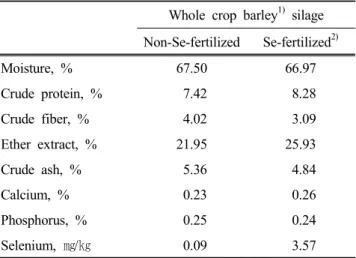
Table 1. Chemical composition of Se-fertilized and non-Se-fertilized whole crop barley silage on dry matter basis
Whole crop barley
1)silage Non-Se-fertilized Se-fertilized
2)Moisture, % 67.50 66.97 Crude protein, % 7.42 8.28 Crude fiber, % 4.02 3.09 Ether extract, % 21.95 25.93 Crude ash, % 5.36 4.84 Calcium, % 0.23 0.26 Phosphorus, % 0.25 0.24 Selenium, ㎎/㎏ 0.09 3.57
1)Nitrogen fertilizer for Se and non-Se-barley was applied in the form of urea at a rate of 150 kg N ha-1.
2)Sodium selenate as selenium fertilizer was applied at a rate of 120 g Se ha-1.
의 필수성분이며, Rayman (2000)은 셀레늄이 각종 질병에 관여하는 selenoprotein의 구성성분이라고 하여 셀레늄에 대 한 관심이 증대되었고, 음식물을 통한 셀레늄 섭취를 위해 이른바 Se-food system이 등장하게 되었다(Combs, 2001).
축산물은 현대인의 식생활에서 하루 셀레늄섭취량의 상 당히 높은 부분을 차지하고 있기 때문에(Holden et al., 1991; Oster, 1992), 축산물 내 기능성 필수원소인 셀레늄 침착을 위해 사료에 셀레늄급원을 배합하여 가축에 급여 시켜(Kelly and Power, 1995), 셀레늄 함량이 높은 셀레늄 강화 축산물을 생산하는 것은 건강에 관심이 많은 소비자 의 욕구에 부합되고 축산농가의 경제적 수익증대 및 침체 된 축산업에 활기를 주는 촉매제로서의 역할을 한다.
최근 많은 동물영양학자들이 셀레늄 강화 축산물에 대한 연구를 수행하게 되었고, 사료 내 셀레늄 첨가로 체내 조 직 내 셀레늄함량이 유의하게 증가되는 것으로 나타나고 있다 (Moksnes, 1983). 또한 근육조직 이외에 우유, 계란 등 (Pehrson et al., 1999)과 같은 기타 축산물에도 이행될 수 있다는 여러 연구 결과가 발표되었다.
한편, 축산물 내 셀레늄축적은 셀레늄의 화학적 형태 및 축종에 따라 그 이용율이 다르고(Surai, 2000), 일반적으로 단위 및 반추동물 모두 체내 셀레늄 축적효율은 무기셀레 늄형태보다 유기셀레늄형태가 높은 것으로 알려져 있다 (Lawler et al., 2004). 또한, 반추가축은 섭취한 셀레늄의 대부분은 반추위 미생물의 세포벽 물질의 구성성분으로 전 환되어 소장에서 다시 분해되어 흡수되므로 셀레늄의 전이 및 축적이 단위가축보다 효율성이 떨어진다고 보고하였으 며 (Jukola et al., 1996), 이로 인하여 반추동물 특히, 비육 우의 조직 내 셀레늄 침착에 관한 연구 자료는 거의 없는 실정이다.
따라서 본 연구에서는 다양한 수준의 셀레늄 강화 청보 리 사일리지 및 무기셀레늄을 비육기 거세한우에 급여하였 을 때, 생산성, 혈액성상, 도체형질 및 조직 내 셀레늄 축 적에 미치는 영향을 조사하여 비육기 거세한우에 대한 셀 레늄 강화 청보리 사일리지의 급여효과를 구명하기 위해 실시하였다.
Ⅱ. 재료 및 방법
1. 공시축 및 시험설계
시험에 이용된 공시축은 22~23개월 령의 비육기 거세한 우 20두(개시체중 567.5 ± 15 kg)를 공시하여 예비기간 10 일, 본시험기간 90일간 시험을 실시하였다. 시험설계는 셀
레늄 강화 청보리 사일리지의 배합수준 증가에 따라 사료 내 0.1 ppm Se (대조구), 0.3 ppm Se (T1), 0.9 ppm Se (T2) 및 무기셀레늄 0.9 ppm Se (T3) 급여구로 4처리를 나누어 처리구 군당 5두씩 완전임의 배치하여 실시하였다.
2. 청보리의 화학적 조성
시험에 사용된 두 종류의 청보리 사일리지(셀레늄 강화 및 셀레늄 무처리 관행 청보리 사일리지)는 황숙기에 총체 로 수확하여 사일리지를 담근 후, 각각 원료사료로 사용하 였고, 각 청보리 사일리지의 화학적 조성은 Table 1과 같 다. 셀레늄 강화 청보리의 재배는 일반청보리의 관행 재배 방법에 sodium selenate를 ha당 120 g의 셀레늄이 함유되도 록 시비하여 셀레늄 강화 청보리를 생산한 후, 사일리지로 제조하였다.
3. 시험사료 및 사양관리
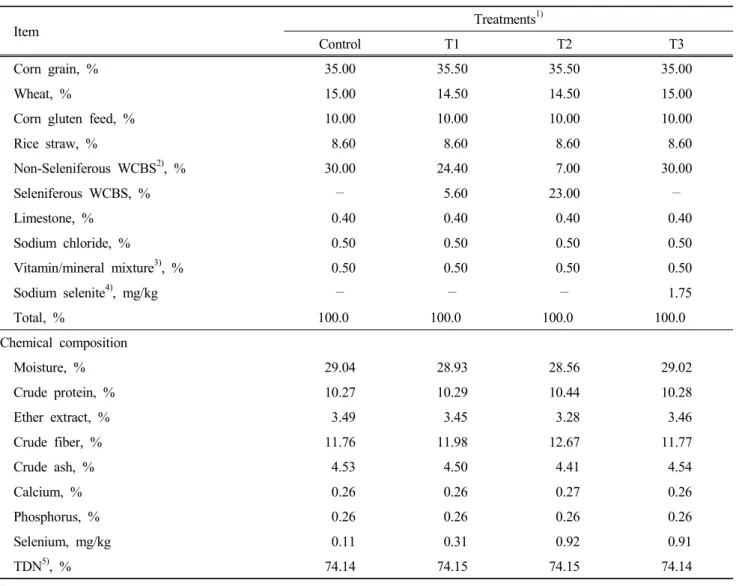
본 연구에 사용된 시험사료는 조단백질 및 가소화영양소 총량이 각각 건물기준으로 10% 및 74%를 만족하도록 배 합하였고, 사료 배합비 및 화학적조성은 Table 2와 같다.
셀레늄 함량이 다른 청보리 사일리지는 건물기준 30%
함유하도록 배합하였으며, 물은 자동 급수기를 이용하여
자유롭게 섭취할 수 있도록 하였다. 일일 사료섭취량은 1
Table 2. Ingredients and chemical composition of experimental diets on dry matter basis
Item Treatments
1)Control T1 T2 T3
Corn grain, % 35.00 35.50 35.50 35.00
Wheat, % 15.00 14.50 14.50 15.00
Corn gluten feed, % 10.00 10.00 10.00 10.00
Rice straw, % 8.60 8.60 8.60 8.60
Non-Seleniferous WCBS
2), % 30.00 24.40 7.00 30.00
Seleniferous WCBS, % - 5.60 23.00 -
Limestone, % 0.40 0.40 0.40 0.40
Sodium chloride, % 0.50 0.50 0.50 0.50 Vitamin/mineral mixture
3), % 0.50 0.50 0.50 0.50
Sodium selenite
4), mg/kg - - - 1.75
Total, % 100.0 100.0 100.0 100.0
Chemical composition
Moisture, % 29.04 28.93 28.56 29.02
Crude protein, % 10.27 10.29 10.44 10.28
Ether extract, % 3.49 3.45 3.28 3.46
Crude fiber, % 11.76 11.98 12.67 11.77
Crude ash, % 4.53 4.50 4.41 4.54
Calcium, % 0.26 0.26 0.27 0.26
Phosphorus, % 0.26 0.26 0.26 0.26
Selenium, mg/kg 0.11 0.31 0.92 0.91
TDN
5), % 74.14 74.15 74.15 74.14
1)Control : 0.1 mg Se/kg, T1 : 0.3 mg Se/kg, T2 : 0.9 mg Se/kg by combining seleniferous and/or non-seleniferous WCBS (control, T1 and T2), and T3 : Control + inorganic Se treatment as sodium selenenite (0.9 mg Se/kg).
2)WCBS is to abbreviate whole crop barley silage.
3)Consisted of Ca 15%, P 6.8%, Mg 7.0%, Na 7.8%, Zn 5,000 mg/kg, Mn 4,000 mg/kg, Cu 500 mg/kg, I 300 mg/kg, Co 20 mg/kg, Se 0 mg/kg, vitamin A 400,000 IU/kg, vitamin D3 75,000 IU/kg, and vitamin E 500 mg/kg.
4)Purchased from Sigma Korea.
5)Abbreviates total digestible nutrients (Calculated value).
일 2회 급여량과 다음날 아침 사료급여 전 잔여사료를 수 거하여 그 차이에 의해 계산하였고, 체중은 30일마다 측정 하여 증체량을 기록하여 일당증체량을 구하였다. 사료요구 율은 전 실험기간동안 사료섭취량과 실험 종료 시의 증체 량을 근거로 다음과 같은 식 (사료요구율 = 사료섭취량/증체 량)으로 산출하였다.
4. 시험사료, 혈액 및 도체분석
시험사료의 일반성분은 AOAC (1995) 방법에 따라 분석
하였다. 혈액은 전 두수를 시험종료 시에 각각 경정맥에서
vacutainer로 10 ml를 채혈 및 원심분리하여(3,000 rpm/10
분) -80℃에 보관 후 분석하였고, 총 단백질농도는 비색계
(Modular PE, Hitachi, Japan), albumin은 BCG법(Modular
analytics, Roche, Germany), 총지질농도는 비색법(Agilent
8453, Germany), 포도당, 혈청 GOT (serum glutamic-
oxaloacetic transaminase), 혈청 GPT (serum glutamic-
pyruvic transaminase), 콜레스테롤, 저밀도지방단백콜레스테
롤(LDL-cholesterol), 중성지방은 자동생화학분석기(ADVIA
1650, Bayer, Japan), IgG ( 면역글로불린G)는 Nephelometry
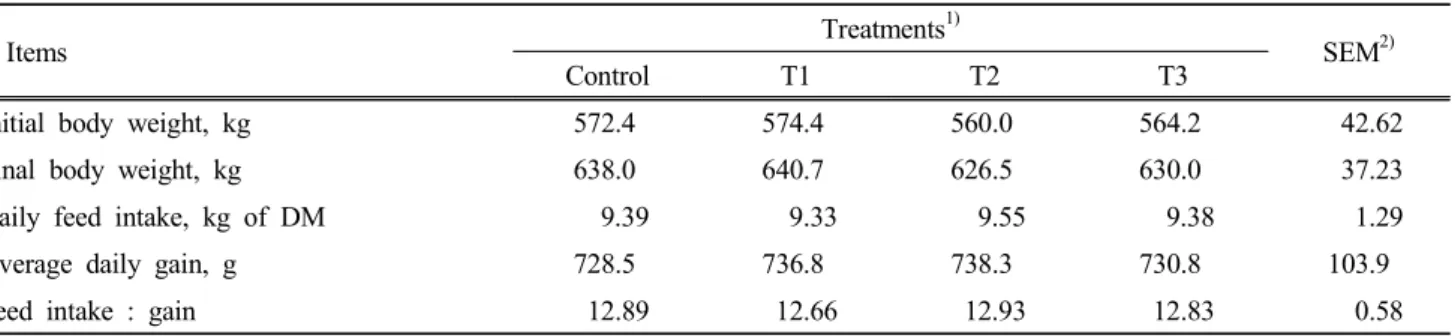
Table 3. Growth performances of finishing Hanwoo steers fed diets containing increasing levels of seleniferous whole crop barley silage
Items Treatments
1)SEM
2)Control T1 T2 T3
Initial body weight, kg 572.4 574.4 560.0 564.2 42.62 Final body weight, kg 638.0 640.7 626.5 630.0 37.23 Daily feed intake, kg of DM 9.39 9.33 9.55 9.38 1.29 Average daily gain, g 728.5 736.8 738.3 730.8 103.9 Feed intake : gain 12.89 12.66 12.93 12.83 0.58
1)See Table 2.
2)Standard error of the mean.
법(Nephelometer, Dade Behring, Germany), 혈중 셀레늄농 도는 원자흡수광도계(AA800, Perkin-Elmer, Germany)를 이 용하여 분석을 실시하였다.
시험 종료 후 즉시 도축된 공시동물의 등지방 두께는 축 산물품질평가원의 등급기준(KAPE, 2012)에 준하여 육류등 급판정사에 의하여 측정되었으며, 도체율은 생체중에 대한 도체중의 비율로 계산하였다.
5. 조직 내 셀레늄 함량조사
사양시험 종료 후, 모든 시험축은 도축장으로 운반되어 조직(신장, 간, 후지) 내 셀레늄함량을 조사하기 위하여 도 축 후, 바로 신장과 간을 적출하고, 각 장기에 대하여 100 g의 시료를 채취하여 분석에 이용하였고, 등급판정 후, 100 g의 후지를 채취하여 분석 시까지 -80℃ 냉동고에 보관하 였다. 채취된 시료는 식육절단용 칼을 사용하여 시료의 균 질화를 위하여 1 mm 이하로 미세하게 세절하여 셀레늄분 석에 사용하였고, 조직 내 셀레늄함량은 AOAC (1995) 방 법에 따라 분석하였다. 본 연구에서 골격근 내 셀레늄 함 량은 후지 내 함량을 조사하였는데, 일반적으로 셀레늄은 조직단백질과 비특이적으로 결합하여 존재하므로, 근내지 방이 많이 형성되는 등심부위는 상대적으로 셀레늄함량을 희석 및 과소평가시키므로, 적육함량이 높은 후지육을 선 택하여 분석하였다.
6. 통계처리
본 실험의 결과는 SAS package program (version 9.1, USA, 2009) 을 이용하여 사양성적, 혈액성상, 도체특성 및 조직 내 셀레늄함량은 GLM (general linear model)을 이용 하여 분산분석하고, 처리군간 평균비교는 Duncan 다중검정
을 실시하였다. 육질 및 육량등급은 빈도분석 후, 연관도 검정을 위하여 카이자승(X
2) 검정을 실시하였다. 본 연구의 유의성검정은 5% (p<.05) 수준에서 실시하였다.
Ⅲ. 결과 및 고찰
1. 사료섭취량, 증체량 및 사료요구율
다양한 수준의 셀레늄 강화 청보리 사일리지 및 무기셀 레늄을 비육기 거세한우에 급여하였을 때, 사료섭취량, 증 체량 및 사료요구율은 Table 3에 나타내었다.
시험개시 체중은 560~574 kg, 시험종료 체중은 626~640 kg으로 나타나 처리구간 유의한 차이는 나타나지 않았으 며, 일당증체량 또한 730 g 내외로 유의한 차이 없이 비슷 한 증체량을 보였다. 실험기간 중 일일 사료섭취량은 9.33~9.55 kg로 나타났으나 처리구간 차이가 나타나지 않았 으며, 사료요구율 또한 12.66~12.93으로 나타나 사료 내 셀 레늄 수준 및 급여형태에 의한 차이는 나타나지 않았다.
사료 내 셀레늄형태 및 다양한 수준의 셀레늄첨가가 사 료섭취량에 미치는 영향은 다양한 연구결과가 보고되고 있 는데, 임신우에 유, 무기셀레늄을 급여 시 처리구간에 따른 섭취량 차이는 없었다고 보고하였으며(Gunter, 2003), 면양 에 있어서도 셀레늄형태에 따라 사료섭취량의 차이는 나타 나지 않았다고 하였다 (Rock et al., 2001). Invancic and Weiss (2001) 은 착유우에 무기셀레늄수준을 증가하였을 때, 건물섭취량이 감소한다고 보고하여 본 시험과 다른 결과를 나타내었다.
셀레늄 급여가 가축 증체량에 미치는 연구에서, Lee et
al. (2004) 은 비육 거세한우에 셀레늄수준의 증가가 증체효
과에 어떠한 영향도 미치지 않았다고 하였으며, Awadeh et
al. (1998) 은 비육 암소에 무기셀레늄을 급여 시 대사 및 성
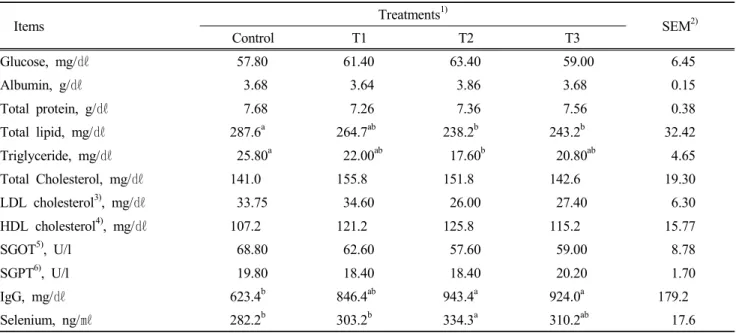
Table 4. Serum metabolic substances of finishing Hanwoo steers fed diets containing increasing levels of seleniferous whole crop barley silage
Items Treatments
1)SEM
2)Control T1 T2 T3
Glucose, mg/㎗ 57.80 61.40 63.40 59.00 6.45 Albumin, g/㎗ 3.68 3.64 3.86 3.68 0.15 Total protein, g/㎗ 7.68 7.26 7.36 7.56 0.38 Total lipid, mg/ ㎗ 287.6
a264.7
ab238.2
b243.2
b32.42 Triglyceride, mg/㎗ 25.80
a22.00
ab17.60
b20.80
ab4.65 Total Cholesterol, mg/ ㎗ 141.0 155.8 151.8 142.6 19.30 LDL cholesterol
3), mg/㎗ 33.75 34.60 26.00 27.40 6.30 HDL cholesterol
4), mg/ ㎗ 107.2 121.2 125.8 115.2 15.77 SGOT
5), U/l 68.80 62.60 57.60 59.00 8.78 SGPT
6), U/l 19.80 18.40 18.40 20.20 1.70
IgG, mg/㎗ 623.4
b846.4
ab943.4
a924.0
a179.2
Selenium, ng/㎖ 282.2
b303.2
b334.3
a310.2
ab17.6
1)See Table 2.
2)Standard error of the mean.
3)Low-density lipoprotein cholesterol.
4)High-density lipoprotein cholesterol is values obtained by subtracting LDL cholesterol from total cholesterol.
5)SGOT abbreviates serum glutamic-oxaloacetic transaminase.
6)SGPT abbreviates serum glutamic-pyruvic transaminase.
a,b Means in a same row with different superscripts are significantly different (p<0.05).
장발달에 관계하는 갑상선호르몬에 대하여 활성형호르몬 (T3) 으로의 전환은 증가시키나, 증체량에는 영향을 미치지 않았다고 보고하였고, 다른 연구자들도 육성기 거세한우에 셀레늄 강화 청보리 사일리지를 급여하였을 때, 증체량에 는 영향을 미치지 않았다고 보고하였다(Kim et al., 2012).
본 시험에서도 선행 연구결과와 유사한 양상을 보여 셀레 늄급여가 증체에는 영향을 미치지 않는 것으로 사료된다.
2. 혈액성상
다양한 수준의 셀레늄 강화 청보리 사일리지와 무기셀레 늄을 비육기 거세한우에 급여하였을 때, 혈액성상에 미치 는 영향은 Table 4에 나타내었다.
혈중 포도당함량과 알부민 및 총 단백질농도는 각각 57.8~63.4 mg/㎗, 3.64~3.86 g/㎗ 및 7.26~7.68 g/㎗의 범위로 나타나 시험구간 차이가 나타나지 않았으며, 혈중 총 지질 농도는 T2와 T3구가 각각 238.2와 243.2 mg/㎗으로 대조구 의 287.6 mg/㎗보다 유의하게 낮았다 (p<0.05). 혈중 중성지 방은 대조구가 25.8 mg/㎗으로 가장 높았고, T2구가 17.6 mg/㎗으로 가장 낮았다(p<0.05).
혈중 총 콜레스테롤과 LDL-콜레스테롤 및 HDL-콜레 스테롤은 시험구간 유의한 차이가 나타나지 않았다.
Dominguez-Vara et al. (2009)은 면양에 셀레늄을 급여하였 을 때, 혈중 중성지방, 콜레스테롤, 포도당, 요소 및 인슐린 농도에 영향을 미치지 않는다고 보고하여 본 연구 결과와 일치하였다.
SGOT와 SGPT는 처리구에 따른 차이는 나타나지 않았 다. 혈중 면역글로불린은 셀레늄 함유량이 많을수록 높게 나타나 T2와 T3구가 각각 943과 924 mg/㎗ 으로 대조구의 623 mg/ ㎗보다 유의하게 높았다(p<0.05). 혈중 셀레늄농도는 유기태 셀레늄을 0.9 ppm 급여한 T2구가 334 ng/㎖으로 대 조구의 282 ng/㎖보다 유의하게 높았다(p<0.05).
체내 지질은 대사과정 중 발생하는 활성산소종에 노출되
면 지질이 산화되어 체내에서 독성을 나타내는 지방과산화
물을 생성하게 되는데, 셀레늄은 이때 과산화물의 생성을
억제할 뿐만 아니라, 혈중 콜레스테롤수치를 낮춰, 체내 지
질대사에 직접적인 영향을 미치며(Salonen et al., 1988), 송
아지에 셀레늄 급여수준을 증가 시, 유의적으로 혈중 총
지질이 감소한다고 보고하였다(Kim et al., 2012). 본 시험
에서도 혈중 총 지질과 중성지질함량은 셀레늄 첨가수준이
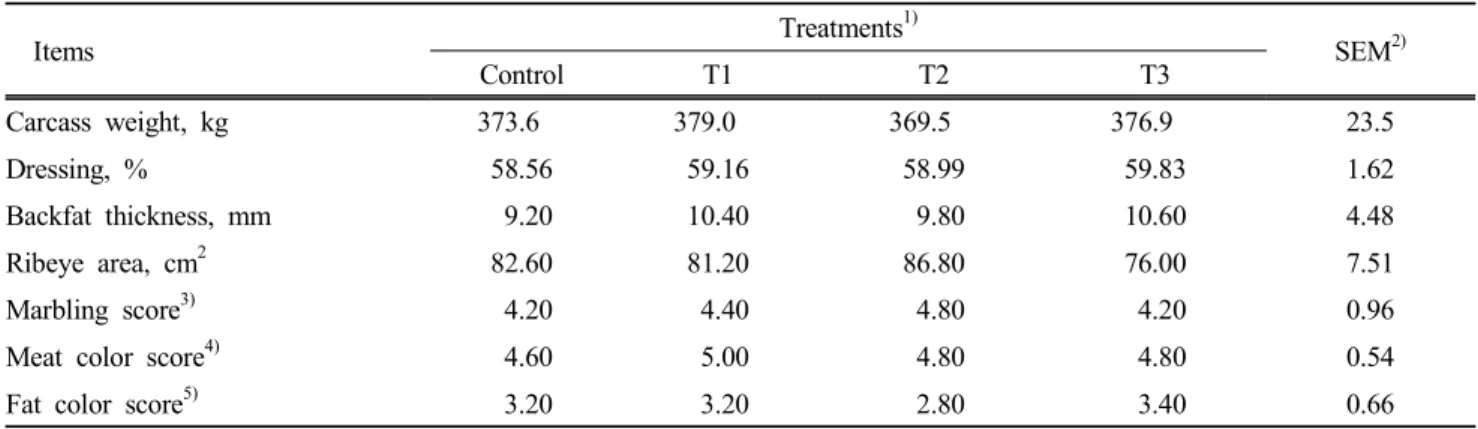
Table 5. Carcass traits of finishing Hanwoo steers fed diets containing increasing levels of seleniferous whole crop barley silage
Items Treatments
1)SEM
2)Control T1 T2 T3
Carcass weight, kg 373.6 379.0 369.5 376.9 23.5
Dressing, % 58.56 59.16 58.99 59.83 1.62
Backfat thickness, mm 9.20 10.40 9.80 10.60 4.48
Ribeye area, cm
282.60 81.20 86.80 76.00 7.51
Marbling score
3)4.20 4.40 4.80 4.20 0.96 Meat color score
4)4.60 5.00 4.80 4.80 0.54 Fat color score
5)3.20 3.20 2.80 3.40 0.66
1)See Table 2.
2)Standard error of the mean.
3)1 = least small and 7 = most abundant.
4)1 = brightest and 7 = darkest.
5)1 = white and 7 = brown.
높을수록 유의하게 감소하였으며, 총 콜레스테롤 및 LDL- 콜레스테롤 또한 낮은 경향으로 나타나, 셀레늄급여가 혈 중 지질대사를 개선시키는 것으로 보인다.
셀레늄은 체내에 항산화 작용을 하는 등 유익한 필수미 량원소이나 섭취량이 많으면 독성을 나타내는 중독성 물질 로 알려져 왔다(Wendel, 1989). 중독의 증상은 간 경변 등 간 기능 장애로 나타나며(Jia et al., 2005), 혈중 SGOT 및 SGPT 는 간 기능 이상의 주된 표적 지표이다. 일반적으로 가축에서는 독성수준이 3~40 ppm 정도이며(Salt Ins, 2001), NRC 사양표준(1983)에 의하면 전체 사료급여량에 따른 독 성수준은 반추가축의 경우, 젖소 3~5 ppm, 육우 8.5 ppm, 면양에서 3 ppm으로 규정하고 있다. 국내 사료관리법 시행 령에 따르면 배합사료에 첨가할 수 있는 셀레늄 허용범위 가 비육우 및 축우의 경우는 2 ppm으로 제시되어 있다 (Kim, 2000). 본 시험에서 사료 내 유기 및 무기셀레늄 각 각 0.9 ppm까지 급여하여도 혈중 GOT 및 GPT 수준이 대 조구와 유의한 차이가 나타나지 않아 사료 내 셀레늄 수준 이 안전할 뿐만 아니라, 독성수준이 아닌 것으로 판단된다.
본 시험에서 혈중 면역글로불린수준은 유기셀레늄(T2:
셀레늄 강화 청보리 사일리지) 및 무기셀레늄 첨가수준이 0.9 ppm 이상일 때 높게 나타나, 셀레늄을 급여 시 혈청 면 역글로불린농도가 증가하며(Awadeh et al., 1998), 항체반응 이 향상된다고 보고하여(Larsen and Tollersrud, 1981), 본 시험에서도 같은 결과를 보여, 셀레늄의 면역력 증강효과 를(Arthur et al., 1993) 확인할 수 있었다.
Lee et al. (2012)에 의하면 청보리에 존재하는 셀레늄은 장관 내 흡수율뿐만 아니라 축적율이 높은 유기셀레늄이
대부분이라고 보고하였으며, 셀레늄형태에 따른 체내 흡수 는 무기셀레늄보다는 유기셀레늄이 효율성이 높다고 보고 하여(Gunter et al., 2003; Kim et al., 2012), 본 시험에서도 유기셀레늄구 (T2: 셀레늄 강화 청보리 사일리지)가 가장 높아 선행 연구결과와 일치된 결과를 보여주었다.
3. 도체형질
다양한 수준의 셀레늄 강화 청보리 사일리지와 무기셀레 늄을 비육기 거세한우에 급여하였을때, 도체특성에 미치는 영향은 Table 5에 나타내었다.
사료 내 셀레늄 강화 청보리 사일리지의 급여로 도체중 과 도체율은 각각 369~379 kg과 58.6~59.8%의 범위로 처리 구간 유의적인 차이는 나타나지 않았으며, 배최장근은 대 조구가 82.6 cm
2, 셀레늄급여 시험구가 76~86.8 cm
2으로 처 리구간 차이가 없었다. 등지방두께, 근내지방도, 육색 및 지방색에서도 유의적인 차이가 나타나지 않았다.
셀레늄 급여수준과 급원(무기, 유기셀레늄)에 따른 도체 특성에 관한 보고에서, 셀레늄급원에 따라 Mahan et al.
(1999)은 도체특성에는 차이를 나타나지 않았다고 보고하 였으며, 셀레늄 급여수준에서도 한우의 도체특성에는 영향 을 미치지 않는다고 하였다 (Lee et al., 2004). 또한 Park et al. (2006) 은 유기, 무기 셀레늄 급여에 따라 등지방두께에 차이가 없었으며, 육색과 지방색에도 영향을 미치지 않는 다고 보고하여 셀레늄 급여수준과 급원에 따라 도체특성과 육질에는 영향을 미치지 않은 것으로 사료된다.
또한, 셀레늄 강화 청보리 급여수준 및 무기셀레늄 급여
Table 6. Frequency analysis for meat quality and quantity grades of finishing Hanwoo steers fed increasing levels of seleniferous whole crop barley
Item Treatments
1)X
2‐ value
Control T1 T2 T3
Quality grade
(1
+: 1 : 2 : 3) 0:3:2:0 1:2:2:0 1:2:1:1 1:2:2:0 4.7619
NSQuantity grade
(A : B : C) 1:3:1 0:3:2 0:3:2 1:2:2 2.7013
NS1)See Table 2.
NSNot significant (p>0.05).
Table 7. Tissue selenium contents of finishing Hanwoo steers fed diets containing increasing levels of seleniferous whole crop barley silage
Items Treatments
1)SEM
2)Control T1 T2 T3
Hind legs, ng/g 131.45
c212.21
b274.74
a153.78
c21.78 Liver, ng/g 418.38
b605.29
a646.84
a458.48
b56.81 Kidney, ng/g 582.64
b712.75
ab774.68
a679.67
ab86.80
1)See Table 2.
2)Standard error of the mean.
a,b,c
Means in a same row with different superscripts are significantly different (p<0.05).
에 따른 육질 및 육량등급의 빈도분석은 Table 6에 나타내 었다. 본 연구에서는 처리구간 공시동물수가 적어 결과를 단정하기는 어렵지만, 셀레늄 강화 청보리 급여수준 및 무 기셀레늄 급여가 육질 및 육량등급에는 영향을 미치지 않 는 것으로 나타났다.
O’Grady et al. (2001) 은 비육우에 0.3 ppm의 유기셀레늄 과 300 IU의 비타민 E를 55일 간 급여하여 쇠고기의 항산 화력 및 산화적 안정성을 조사한 결과, 항산화활력 및 산 화적 안정성에는 영향을 미치지 않는다고 보고하였고, 이 는 셀레늄이 부족되지 않은 상황에서 셀레늄을 추가 공급 하여도 육질 개선효과는 나타나지 않는다고 하였다. 또한, Lee et al. (2007)은 다양한 종류의 유기 및 무기셀레늄급원 을 거세한우에 16주간 급여하였을 때, 육질 및 육량에 유 의한 차이가 나타나지 않았다고 보고하였다.
4. 조직 내 셀레늄 함량
다양한 수준의 셀레늄 강화 청보리 사일리지와 무기셀레 늄을 비육기 거세한우에 급여하였을 때, 조직 내 셀레늄축 적에 미치는 영향은 Table 7과 같다.
후지에 함유된 셀레늄함량은 0.3 ppm급여구보다 0.9 ppm
급여구인 T2구가 274 ng/g로 유의하게 높았으며(p<0.05), 무기태 셀레늄을 0.9 ppm 급여한 T3구는 T1구보다 유의하 게 낮은 153 ng/g로 나타났다(p<0.05). 간에서의 셀레늄함량 은 후지보다 높은 함량을 보였으며, 처리구간의 차이는 후 지와 비슷한 경향을 보였다. 신장에서도 T2 구가 774 ng/g 로 대조구의 582 ng/g보다 유의하게 높게 나타났다 (p<0.05).
가축에 셀레늄급여에 따른 체내 축적량을 조사․연구한
결과, 실제로 셀레늄급여량을 증가 시 근육 내 함량이 유
의하게 증가하는 것으로 나타났으며(Moksnes, 1983),
Ekholm et al. (1991)은 사료 내 셀레늄 급여수준을 증가 시
체내 축적량이 직선적으로 증가한다고 보고하였다. 또한,
셀레늄급원에 따른 체내 축적시험에서 Mahan과 Parrett
(1996)은 근육조직 내 셀레늄농도가 무기보다 유기셀레늄
일 경우 유의하게 높아 유기셀레늄이 체내 축적에 효과적
이었다고 보고하였다. 본 시험에서도 같은 셀레늄함량 (0.9
ppm)이지만 무기셀레늄 시험구(T3)보다 셀레늄 강화 청보
리 사일리지구가(T2) 월등히 높은 축적율을 보여 앞선 실
험결과와 일치하여, 셀레늄 강화 청보리 사일리지 급여 시
셀레늄 강화 쇠고기생산이 가능한 것으로 판단된다.
Ⅳ. 요 약
본 연구는 다양한 수준의 셀레늄 강화 청보리 사일리지 와 무기셀레늄을 급여 시 비육기 거세한우의 생산성, 혈액 성상, 도체특성 및 조직 내 셀레늄 축적에 미치는 영향을 조사하였다. 시험은 거세비육우 20두를 공시하였고, 처리구 는 셀레늄 수준에 따라 0.1 ppm Se(대조구), 0.3 ppm Se (T1), 0.9 ppm Se (T2) 및 무기셀레늄 0.9 ppm Se (T3) 급 여구로 4처리를 나누어 처리구 구당 5두씩 완전임의 배치 하여 90일간 사양시험을 실시하였다. 각 시험사료는 셀레 늄 강화 및 셀레늄 무처리 관행 청보리 사일리지를 조합하 여 건물기준 30% 함유하도록 배합하였다. 실험사료 내에 셀레늄 강화수준은 사료섭취량과 증체에 영향을 미치지 않 았고, 혈중 총 지질과 중성지방농도는 대조구보다 T2구가 유의하게 낮았다(p<0.05). 혈중 면역글로불린은 셀레늄함유 량이 많을수록 높게 나타나 T2와 T3구가 대조구보다 유의 하게 높았다(p<0.05). 혈중 셀레늄농도는 유기태 셀레늄을 0.9 ppm 급여한 T2구가 가장 높았다(p<0.05). 도체율, 배최 장근, 등지방두께, 근내지방도, 육색 및 지방색은 셀레늄급 여로 인한 효과가 나타나지 않았다. 또한, 사료 내 셀레늄 수준 및 형태는 육질 및 육량등급 간에 관련성이 형성되지 않았다. 신장, 간장 및 후지 내 셀레늄 함량은 사료 내 셀 레늄 강화수준이 증가함에 따라 유의하게 직선적으로 증가 하였고(p<0.05), 무기셀레늄급여는 대조구와 유의한 차이가 나타나지 않아, 조직 내 셀레늄함량 증가에 도움이 되지 않았다(p>0.05). 이상의 결과에서 셀레늄 강화 청보리 사일 리지 내 존재하는 셀레늄은 조직 내 셀레늄함량을 증가시 키기에 유효한 셀레늄급원인 것으로 나타났고, 셀레늄 강 화 청보리 최고수준(0.9 ppm Se)으로 급여하여 생산된 한 우 후지육 100 g에 함유되어 있는 셀레늄은 성인기준 1일 최소 셀레늄 권장량(40 ㎍)의 약 69%를 충족시키는 것으로 조사되었다.
Ⅴ. 사 사
본 연구는 농촌진흥청 공동연구사업(과제번호: PJ907108042013) 의 지원에 의해 이루어진 것임.
Ⅵ. REFERENCES
Arthur, J.R., Nicol, F. and Beckett, G.J. 1993. Selenium deficiency, thyroid hormone metabolism, and thyroid hormone deiodinases.
The American journal of Clinical Nutrition. 57:236-239.
A.O.A.C. 1995. Official methods analysis. Association of Official Analytical Chemists. 15th edition. Washington, D.C.
Awadeh, F.T., Kincaid, R.L. and Johnson, K.A. 1998. Effect for level and source of dietary selenium on concentrations of thyroid hormones and immunoglobulins in beef cows and calves. Journal of Animal Science. 76:1204-1215.
Berzelius, J.J. 1817. Ann. Chim. Phys., Pairs, Serie 2:199-206.
Combs. G.F. 2001. Selenium in Global Food Systems. The British Journal of Nutrition. 85:517-547.
Dominguez-Vara, I.A., Gonzalez-Munoz, S.S., Pinos-Rodriguez, J.M., Borquez-Gastelum, J.L., Barcena-Gama, G.R., Mendoza-Martinez, L.E., Zapata, L.L. and Landois, P. 2009. Effects of feeding selenium-yeast and chromium-yeast to finishing lambs on growth, carcass characteristics, and blood hormones and metabolites.
Animal Feed Science and Technology. 152:42-49.
Ekholm, P., Varo, P., Aspila, P., Koivistoinen, P. and Syrjala-Qvist, L. 1991. Transport of feed swine to different tissues of bulls.
The British Journal of Nutrition. 66:49-55.
Gunter, S.A., Beck, P.A. and Philips, J.M. 2003. Effects of supplementary selenium source on the performance and blood measurements in beef cows and their calves. Journal of Animal Science. 81:856-864.
Harrison, J.H., Hancock, D.D. and Conrad, H.R. 1984. Vitamin E and selenium for reproduction of the dairy cow. Journal of Dairy Science. 67:123-132.
Holden, J., Gebhardt, R., Davis, C. and Lurie, D. 1991. A nationwide study of the selenium content and variability in white bread.
Journal of Food Composition and Analysis. 4:183-195.
Invancic, Jr. J. and Weiss, W.P. 2001. Effect of dietary sulfur and selenium concentrations on selenium balance of lactating Holstein cows. Journal of Dairy Science. 84:225-232.
Jia, X., Li, N. and Chen, J. 2005. A subchronic toxicity study of elemental Nano-Se in Sprague-Dawley rats. Life Science. 76:
1989-2003.
Jukola, E., Hakkarainen, J., Saloniemi, H. and Sankari, S. 1996.
Effect of selenium fertilization on selenium in feedstuffs and selenium, vitamin E, and Beta-carotene concentrations in blood of cattle. Journal of Dairy Science. 79:831-837.
KAPE. 2012. http://www.ekape.or.kr/accessed on June 30, 2012.
Kelly, M.P. and Power, R.F. 1995. Fractionation and identification of the major selenium compounds in selenized yeast. Journal of Dairy Science. 78:237 (Abstr.).
Kim, G.W., Jo, I.H., Hwangbo, S., Lee, S.H., Han, O.K., Park, T.I.
and Choi, I.B. 2012. Influences of feeding seleniferous whole crop barley silage on growth performance and blood characteristics in growing Hanwoo steers. Journal of The Korean Society of
Grassland and Forage Science. 32:135-148.
Kim, Y.Y. 2000. Differences in biological activity and metabolism of selenium due to its chemical form. Journal of Animal Science and Technology. (Kor.). 42:835-848.
Larsen, H.J. 1988. Influence of selenium on antibody production in sheep. Research in Veterinary Science. 54:4-12.
Lawler, T.L., Taylor, J.B., Finley, J.W. and Caton, J.S. 2004. Effect of supranutritional and organically bound selenium on performance, carcass characteristics, and selenium distribution in finishing beef streers. Journal of Animal Science. 82:1488-1493.
Lee, S.H., Jo, I.H., Kim, K W., Hwangbo, S., Han, O.K., Song, T.H., Park, T.I. and Choi, I.B. 2012. Influences of seleniferous whole crop barley supplement on growth performance and blood characteristics in growing pigs. Journal of The Korean Society of Grassland and Forage Science. 32:39-48.
Lee, S.H., Park, B.Y. and Kim, W.Y. 2004. Effects of spent composts of Se-enriched mushrooms on carcass characteristics, plasma GSH-Px activity, and Se deposition in finishing Hanwoo steers. Journal of Animal Science and Technology. (Kor.). 46:
799-810.
Lee, S.H., Park, B Y., Yeo, J.M., Lee, S.S., Lee, J.H., Ha, J.K. and Kim, W.Y. 2007. Effects of different selenium sources on performance, carcass characteristics, plasma glutathione peroxidase activity and selenium deposition in finishing Hanwoo steers.
Asian-Australasian Journal of Animal Science. 20:229-236.
Mahan, D.C. 1999. Organic selenium: using nature's model to redefine selenium supplementation for animals in biotechnology in the feed industry. Nottingham University Press, UK, pp.
523-535.
Mahan, D.C. and Parrett, N.A. 1996. Evaluating the efficacy of selenium-enriched yeast and sodium selenite on tissue selenium retention and serum glutathione peroxidase activity in grower and finisher swine. Journal of Animal Science. 74:2967-2974.
Marin-Guzman, J., Mahan, D.C. and Pate, J.L. 2000. Effect of dietary selenium and vitamin E on spermatogenic development in boars. Journal of Animal Science. 78:1537-1543.
Moksnes, K. 1983. Selenium deposition in tissues and eggs of laying hens given surplus of selenium as selenomethionine. Acta Veterinaria Scandinavica. 24:34-44.
Moxon, A.L. 1937. Alkali disease or selenium poisoning. In:
Agricultural Experiment Station Bulletin, South Dakota State College of Agriculture and Mechanic Arts. Brookings, South Dakota. Bulletin 311, pp. 3-87.
National Research Council (NRC). 1983. Subcommittee on selenium;
committee on animal nutrition; board of agriculture. selenium in nutrition. National academy press, Washington D.C.
O'Grady, M.N., Monahan, F.J., Fallon, R.J. and Allen, P. 2001.
Effects of dietary supplementation with vitamin E and organic selenium on the oxidative stability of beef. Journal of Animal Science. 79:2827-2834.
Oster, O. 1992. Zum Selenstatus in der Bundesrepublik Deutschland.
Univ.-Verl. Jena, BRD.
Park, B.Y., Cho, S.H., Seong, P.N., Hah, K.H., Lee, S.H., Hwang, I.H., Kim, D.H., Kim, W.Y., Lee, J.M. and Ahn, J.N. 2006.
Effect of selenium sources on meat quality of Hanwoo steers.
Journal of Animal Science and Technology. (Kor.). 48:603-610.
Pehrson, B., Ortman, K., Madjid, N. and Trafikowska, U. 1999. The influence of dietary selenium as selenium yeast or sodium selenite on the concentration of selenium in the milk of suckler cows and on the selenium status of their calves. Journal of Animal Science. 77:3371-3376.
Rayman, M.P. 2000. The importance of selenium to human health.
The Lancet. 356:233-241.
Rock, M.J., Kincaid, R.L. and Carstens, G.E. 2001. Effects of prenatal source and level of dietary selenium on passive immunity and thermometabolism of newborn lambs. Small Ruminant Research. 40:129-138.
Rotruck, J.T., Pope, A.L., Grather, H.F., Hafeman, D.G., Swanson, A.B. and Hoekstra, W.G. 1973. Selenium, biochemical role as a component of glutathione peroxidase. Science. 179:588-590.
Salonen, J.T., Salonen, R., Seppanen, K., Kantola, M., Parviainen, M., Alfthan, G., Maenpaa, P.H., Taskinen, E. and Rauramaa, R.
1988. Relationship of serum selenium and antioxidants to plasma lipoproteins, platelet aggregability and prevalent ischaemic heart disease in Eastern Finnish men. Atherosclerosis. 70:155-160.
Salt, Institute. 2001. Salt and trace minerals for livestock, poultry and other animals
SAS. 2009. SAS/STAT® User’s guide (Release 9.1 ed.). Statistics, SAS Inst, Inc., Cary, NC.
Schwarz, K. and Foltz, C.M. 1958. Factor 3 activity of selenium compounds. Journal of Biological Chemistry. 233: 245-251.
Stabel, J.R., Spears, J.W., Brown, Jr.,T.T. and Brake, J. 1989.
Selenium effects on glutathione peroxidase and the immune response of stressed calves challenged with pasteurella hemolytica. Journal of Animal Science. 67:557-564.
Surai, P.F. 2000. Organic selenium: benefits to animals and humans, a biochemist’s view. in: Proc. Alltech's 16th annual symposium.
Lyons, T.P., and Jacques, K.A. (Ed.) Biotechnology In the Feed industry, Nicholasville, KY, pp. 205.
Wendel, A. 1989. Selenium in biology and medicine. springer-verlag, Berlin. pp. 3-325.
(Received August 17, 2013/Revised November 22, 2013/Accepted November 25, 2013)