Geosciences Journal
Vol. 10, No. 1, p. 91−99, March 2006
Evaluation of hydrogeologic conditions for groundwater heat pumps:
analysis with data from national groundwater monitoring stations
ABSTRACT: Groundwater can be used as an alternative renewable and clean energy source for space heating and cooling. Hydrogeo- logic conditions of Korea were evaluated for application of ground- water heat pumps (GWHPs), especially for open-loop system.
Groundwater data obtained from the national groundwater moni- toring stations (NGMSs) were used for the purpose. Temperatures of shallow and deep groundwaters are between 1.2−25.8°C and their annual variations are mostly within 10°C. Especially the small amplitude of variation for deep groundwaters can facilitate design and maintenance of groundwater heat pumps. Groundwa- ter levels for shallow and deep wells are located at average 4.79−
6.07 m below ground surface. The shallow water levels are most promising for groundwater heat pumps, which reduces pumping costs. A large number of monitoring wells showed a good well yield exceeding a requirement for 3 RT heat pumps for small res- idential purposes but a limited application is expected for large commercial uses with the single well. Some proportions of shallow and deep groundwaters exhibited scaling and corrosion potentials in respect to hardness, pH, electrical conductivity, total dissolved solids, bicarbonate and chloride. Each relevant parameter was separately evaluated in this study but the parameters are closely correlated. Thus for more detailed and quantitative examination of water quality conditions for GWHPs, integrated and extensive chemical analysis of groundwaters are essentially required.
Key words: Groundwater temperature, hydraulic conductivity, heat pumps, open-loop, national groundwater monitoring stations, Korea 1. INTRODUCTION
Recently renewable energy sources are one of main inter- ests of environmental community and relevant governmen- tal authorities in Korea. Drastic increase in energy demands resulted in consumption of a large quantity of fossil fuels and their progressive depletion. The energy crisis urges the country to search and develop alternative energy sources and furthermore they should be environment-friendly. Effects of global warming mainly derived from CO
2emission are ubiquitous in the world. So reduction in emission of the greenhouse gases is inevitable (USEPA, 1993; Houghton et al., 1996). Emerging alternative energy sources include solar energy, wind power energy, biomass energy and ground source heat energy and the renewable energy sources become one of intensive and extensive R & D areas in the country (Lee
and Hahn, 2005).
The subsurface (ground) is a great reservoir of heat energy.
Unlike the air, it has very stable temperatures. Conse- quently, the ground is warmer than the ambient air in winter and cooler than the summer air. Ground source heat pump (GSHP) systems have become increasingly popular for both residential and commercial heating and cooling applications mainly due to their higher energy efficiency compared with conventional systems (Chiasson et al., 2000). In the winter, a geothermal heat pump transfers heat from the ground or groundwater to provide space heating and in the summer, the heat transfer process is reversed; the ground or ground- water absorbs heat from the living or working space and cools the air (DOE, 1999). There are two basic ground source heat pump systems: an earth coupled (closed-loop) type and a groundwater (open-loop) type. In the residential sectors, closed-loop GSHP tends to be installed in homes in the upper cost end of the market (Rafferty, 2000).
The open-loop GSHP, also known as groundwater heat pump (GWHP), typically depends upon groundwater to sup- ply or accept heat. Three types of commonly used open- loop systems are shown in Figure 1. Direct open-loop heat pumps are largely used for residential and small commer- cial applications (Rafferty, 2001). This system is most suit- ably applied where a chemically pure groundwater is available because the direct use of the groundwater can cause scaling, deposition of mineral precipitates in pipes, valves or heat exchangers (PDEP, 1996). The standing column systems are used in locations where groundwater wells do not pro- duce sufficient water for conventional open-loop system and where water quality is also good (Rafferty, 2001). The single well system can reduce initial costs of extra injection well installation (Lee and Hahn, 2005). The indirect open- loop systems generally involve a heat exchanger between the building loop and the groundwater, by which eliminates exposure of any building components to the groundwater (Rafferty, 2001). Details of the groundwater heat pumps including principles, system design, and well installation were described in Hahn et al. (2004).
Especially in the groundwater heat pumps, it is basically most important to obtain a plentiful amount of groundwater with a stable temperature (Koo et al., 2003). Therefore, the
Jin-Yong Lee*
Jong-Ho Won Jeong-Sang Hahn
GeoGreen21 Co., Ltd., 4th Floor, SEK Building, 1687-22, Bongchon6-dong, Gwanak-gu, Seoul 151-812, Korea Groundwater Investigation Section, Korea Water Resources Corporation, Daejeon 306-711, Korea Department of Earth System Sciences, Yonsei University, Seoul 120-749, Korea
*Corresponding author: [email protected]
groundwater supply well must yield enough water of good chemical quality to transport the required amount of heat (PDEP, 1996). In this point of view, this study evaluated groundwater conditions of this country using the hydrogeo- logic data obtained from the national groundwater monitor- ing stations (NGMSs). Lee and Hahn (2005) and Hahn et al.
(2004) intensively analyzed the groundwater temperature data from the NGMSs in consideration of the heat pump system. They analyzed distribution of groundwater temper- ature throughout half of the peninsular, classified patterns of groundwater temperature variation and clarified months of highest and lowest temperature occurrence. So in this study, other very important parameters such as water levels, hydraulic conductivity, well yield, hardness, electrical con- ductivity, and other general water qualities were extensively examined.
2. METHODS AND MATERIALS
Main parameters considered in the groundwater heat pump system design can be classified into two groups:
physical or hydrologic factors (groundwater temperatures, water levels, well yield, hydraulic conductivity) affecting system or energy efficiency (i.e., EER or COP) and chem- ical factors (groundwater chemistry) affecting maintenance or life span of the system by scaling, corrosion or both. In order to analyze general groundwater conditions for this purpose, data of the NGMSs were used.
KOWACO (Korea Water Resources Corporation), an affil- iated organization of the MOCT (Ministry of Construction and Transportation), is in charge of the establishment, oper- ation, and maintenance of the NGMSs (Lee et al., 2005).
The construction of the stations has been performed by step by step since 1995 (Fig. 2). By 2004, 293 stations were completed. Mostly for each monitoring station, two sepa- rate groundwater wells were newly installed (some of sta- tions have only single monitoring well). One well, with an average well depth of 11.7 m, is used to monitor shallow groundwater (alluvial aquifer) and the other, with an aver- age depth of 69.8 m, is used to monitor deep groundwater (bedrock aquifer) (Lee and Hahn, 2005). At each monitor- ing well, an integrated probe measuring water levels, water temperatures and electrical conductivity (EC) was installed.
Groundwater level, water temperature, and electrical con- ductivity are measured every 6 hours using the integrated probe and these data are stored in the data logger. The mea- sured groundwater data are automatically transmitted to a host server at KOWACO once a day at a designated time. In addition, periodic analyses of groundwater quality are per- formed twice per year for all the monitoring wells including analyses of general water chemistry during the well instal- lation. For maintenance of the facilities and the monitoring devices, a field inspection/maintenance team regularly visits each station at least 6 times per year. All the data obtained from the groundwater monitoring stations are managed by
Fig. 1. Open-loop groundwater heat pump systems. The figure was from Rafferty (2001). With kind permission of the Geo-Heat Cen- ter, Oregon Institute Technology.
Fig. 2. Locations of the national groundwater monitoring stations.
hydrogeologic conditions for groundwater heat pumps 93
the NGMN management system on the web. The data are safely stored in an Oracle DB at KOWACO. In this paper, groundwater data obtained from the 266 NGMSs (including 128 shallow monitoring wells and 236 deep monitoring wells) were analyzed and relevant hydrogeologic tests data gathered during the station installation were examined.
3. RESULTS AND DISCUSSION 3.1. Groundwater Temperature
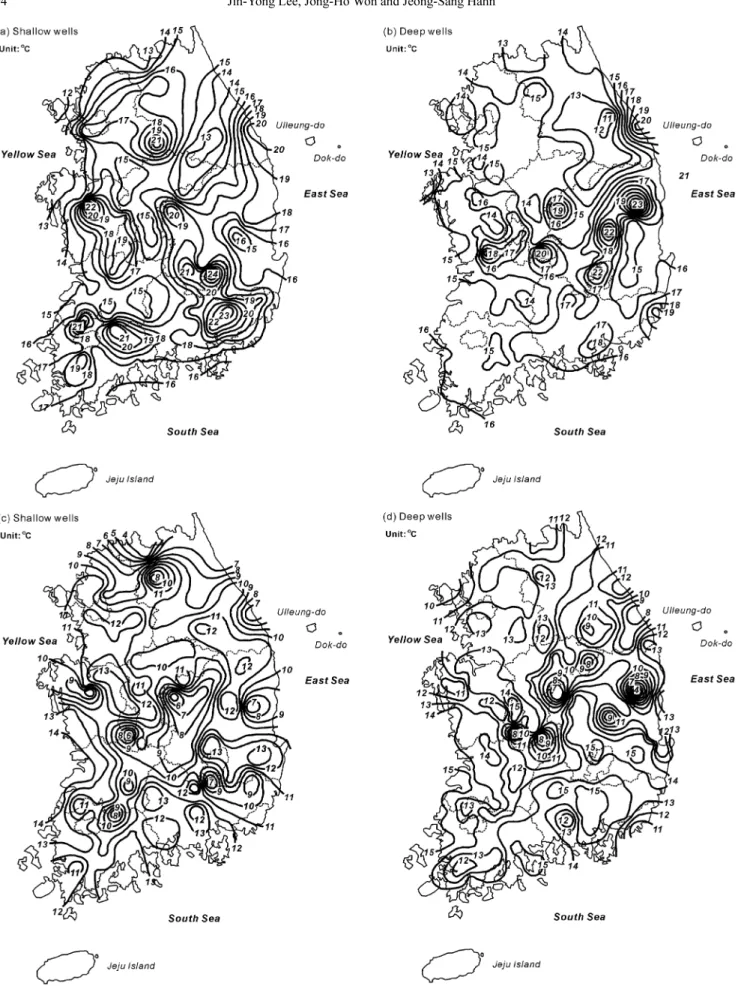
Figure 3 shows spatial distribution of maximum and min- imum groundwater temperatures for shallow and deep aqui- fers recorded during 1995-2003. The maximum groundwater temperatures ranged between 11.9 and 25.8
°C with a mean of 16.8
°C for shallow groundwaters (Fig. 3a) while they were between 9.9 and 25.6
°C with a mean of 15.3
°C for deep groundwaters (Fig. 3b). The highest groundwater tem- peratures were observed in Daegu metropolitan city, which is one of the hottest (highest air temperatures) areas in sum- mer in the country (Kim and Min, 2001). In general, ground- water temperatures in western half of the country were relatively lower than those in eastern half, which were mainly derived from higher air temperatures at the latter region due to high elevations topography (Taebaek mountains blocking cold winds in winter) and a warm current of the East Sea (Donghan Current; Min, 1979; Lee and Hahn, 2005).
The minimum groundwater temperatures for shallow groundwaters ranged from 3 to 16.1
°C (Fig. 3c) with a mean of 11.2
°C while they ranged from 1.2 to 16.9
°C with a mean of 12.9
°C for deep groundwaters (Fig. 3d). Except for the highest latitude areas (upper Gyeonggi province), the lowest groundwater temperatures occurred in Yeongyang, Gyeongbuk province. Maximum groundwater temperatures are mostly observed in coldest months (November-February) and min- imum temperatures occur in March-June, immediately before the hottest months (July-August). Phase differences com- pared with air temperatures wave are within 5 months (Lee and Hahn, 2005). The longer phase delays were generally related to thicker upper soils or lower water levels. The phase difference and amplitude attenuation occur during transport of air heat through upper soils or rocks, which depends on various subsurface properties such as soil density, specific heat, thermal conductivity, porosity, organic content and moisture content (Lee et al., 2000; Koo et al., 2003). The phase differences are quite a favorable to operation of GWHPs for space heating and cooling in the country.
Variations of groundwater temperatures are summarized in Table 1. Most of shallow wells (85.2%) showed rela- tively small temperature change within 10
°C. Only 14.8%
of the wells showed rather large variation greater than 10
°C (maximum variation=20.8
°C). In the deeper wells, stable groundwater temperatures were most prominent. Nearly all of the wells (97.4%) showed a variation within 10
°C while
2.6% exhibited a large variation over 10
°C. Compared with mean air temperature variation of over 30
°C for the same period in the country (half of the peninsular), these very sta- ble groundwater temperatures have an advantage for system design and maintenance of groundwater (ground source) heat pumps (Koo et al., 2003; Hahn et al., 2004; Lee and Hahn, 2005). Especially, the bedrock aquifers are most promising for groundwater heat pumps in respect to temperature sta- bility (Lee and Han, 2001; Lee and Hahn, 2005). Groundwa- ters with temperatures of 10
−20
°C are most suitable for open-loop groundwater heat pumps (Hahn et al., 2004).
3.2. Water Levels and Hydraulic Properties
Groundwater level is one of important parameters deter- mining efficiency (COP or EER) of GWHPs. The deeper is the groundwater level, the more power is need to extract the groundwater, thus which results in reducing the efficiency.
Actually pumping level (original static water level + pump- ing drawdown) instead of static groundwater level is most important and the pumping level is a function of pumping rate (Rafferty, 1998). In the open-loop system, a submers- ible pump of about 0.75 HP (horse power) is required to provide a groundwater enough for 1 RT (refrigeration ton or simply ton) heat pump in case pumping level is 60 m below ground surface (Hahn et al., 2004). When the pumping level is about 30 m (bgs), a pump of less than 0.56 HP is enough to complete the same purpose (Rafferty, 1998). Commonly 3 RT heat pump is necessary for space heating and cooling of a house with 4 peoples and 57 pyeongs (174 m
2). Higher groundwater levels (within 30 m) are most suitable for open-loop groundwater heat pumps or single well ground- water heat pumps (Heng and Rybach, 2005).
Mean groundwater levels (depths to water) for 2003 are presented in Figure 4. Groundwater levels for shallow wells were located at 1.29
−32.42 m below ground surface with a mean of 4.79 m (Table 2). The deepest mean water levels were observed at Jeongsun area, Kangwon province, which was derived from higher topographic elevation (EL=347.054 m).
Lower groundwater levels at other areas are mostly related to heavy groundwater withdrawals for various purposes (MOCT and KOWACO, 2004). The water levels of deep wells (depths to water but strictly speaking potentiometric surface if confined) ranged from 0.57 to 51.04 m with a mean of 6.07 m below ground surface. Also lowest water levels were observed at Jeongsun, Ulsan and Munan areas.
Interestingly most of lowest water levels were found at coastal areas of the country rather than at inner land areas.
Meanwhile, recently relevant authorities (MOCT and KOWACO) undertook a detailed investigation project revealing exact causes of large decline of the water levels for some of the areas and devising attenuation measures.
To supply enough and stable amounts of groundwaters,
hydraulic properties are very important. Transmissivity, hydrau-
Fig. 3. Distribution of maximum (a, b) and minimum (c, d) groundwater temperatures recorded during 1995-2003.
hydrogeologic conditions for groundwater heat pumps 95
lic conductivity and well yields for shallow and deep wells of NGMN are summarized in Table 3. Geometric mean of
transmissivity of shallow wells is two times larger than that of deep wells. And corresponding hydraulic conductivity shows much larger difference (15 times). Generally higher hydraulic conductivity (on the order of 10
−3cm/sec or higher) is favorable for successful and efficient functioning of the groundwater heat pumps (open-loop). Most of all, well yield is very important. For small residential purpose (3 RT), at least well yield of 16 m
3/day is required and in large (>50 tons) commercial GWHP systems, minimum well yield of 274 m
3/day is needed (Rafferty, 1998; Hahn et al., 2004). Well yields for shallow wells range 3.40
−1,440 m
3/day with a mean of 103.57 m
3/day (see Table 3). And 70.3% and 7.6%
of the well yields of shallow wells (single well) are greater
Table 1. Summary of groundwater temperatures variation (1995-2003).
Maximum-minimum Shallow wells Deep wells
Proportion Cumulative Proportion Cumulative
<2oC 16.4% 16.4% 53.4% 53.4%
2−4oC 26.6% 43.0% 28.8% 82.2%
4−6oC 17.2% 60.2% 11.4% 93.6%
6−8oC 16.4% 76.6% 13.4% 97.0%
8−10oC 18.6% 85.2% 10.4% 97.4%
>10oC 14.8% 100% 12.6% 100%
Fig. 4. Distribution of mean water levels (depth to water) of (a) shallow and (b) deep monitoring wells for 2003.
Table 2. Statistics of groundwater levels for shallow and deep monitoring wells.
Statistics Shallow wells (m, below
ground surface) Deep wells (m, below ground surface)
Number of data 127 232
Maximum 32.42 51.04
Minimum 1.29 0.57
Mean 4.79 6.07
Median 4.02 4.37
Standard deviation 3.29 6.30
than 16 274 m
3/day and 274 m
3/day, respectively. Well yields for deep wells are between 6 m
3/day and 2,931 m
3/day (mean=169.64 m
3/day). And 91.7% and 14.9% of single well yields are over 16 m
3/day and 274 m
3/day, respectively.
Thus most of single wells for both shallow and deep aqui- fers are suitable for groundwater heat pumps with small res- idential purposes but for large commercial purposes, single well has limited applications.
3.3. Water Chemistry
Open-loop groundwater heat pumps are susceptible to water quality induced problems (Rafferty, 2001) and cor-
rosion and scaling caused by unique chemistry of ground- waters, may lead to operating problems with equipment components exposed to flowing water and steam (Lund, 1996). Water quality is also a consideration for closed-loop ground source heat pumps and in the closed-loop system, the concern is not the main refrigerant to water heat exchanger but the desuperheater (Rafferty, 2000). Water quality com- ponents relevant to corrosion and scaling include hardness (as CaCO
3), pH, EC (electrical conductivity), TDS (total dissolved solids), chloride (Cl
−), and bicarbonate (HCO
3−) (Rafferty, 2000; Hahn et al., 2004).
Scaling problems may occur above levels of 100 mg/L hardness and become serious above 200 mg/L (Rafferty,
Table 3. Summary of transmissivity (T), hydraulic conductivity (K) and well yields of the monitoring wells in the national groundwater monitoring stations.
Parameters T (m2/day) K (cm/sec) Well yield (m3/day)
Shallow Deep Shallow Deep Shallow Deep
No. of data 128 236 128 236 118 228
Maximum 1,681 1,289 3.55×10⁻¹ 2.55×10⁻² 1,440 2,931
Minimum 0.12 0.08 1.88×10⁻⁵ 1.50×10⁻⁶ 3.40 6
Mean 67.20 24.96 1.26×10⁻² 6.81×10⁻⁴ 103.57 169.64
Geometric mean 7.08 3.32 1.25×10⁻³ 8.32×10⁻⁵ 41.80 89.56
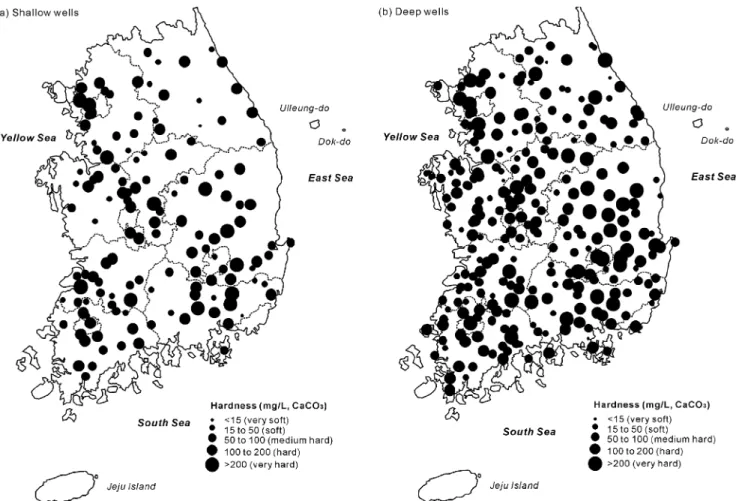
Fig. 5. Distribution of groundwater hardness (mg/L, CaCO3) for shallow and deep groundwaters.
hydrogeologic conditions for groundwater heat pumps 97
2000). Scaling generally increases with increasing calcium concentration, hardness, alkalinity, pH and groundwater temperature. Groundwater scaling potentials can be classi- fied according to hardness as low (< 100 mg/L), moderate (100
−200 mg/L), and high (> 200 mg/L) (Rafferty, 1999).
Figure 5 shows groundwater hardness for shallow and deep wells. Hardness of shallow wells ranged from 4 to 822 mg/L as CaCO
3(mean=115 mg/L). Of these, 54.9, 36.1, 9.0% are classified as low, moderate, and high scaling potentials, respectively. For deep wells, hardness is between 8 and 1,490 mg/L as CaCO
3(mean=127 mg/L), of which, 55.8, 32.1, and 12.1% involved low, moderate and high scaling potentials, respectively. Deep groundwaters showed slightly larger scal- ing potential than shallow groundwaters.
The pH values of most fresh groundwaters are in the
range of 5.0 and 9.0 (Hem, 1985). Scaling and corrosion problems are common at pH values above 8.0 and below 6.5, respectively (Hahn et al., 2004). The pHs of ground- waters in the country exhibited normal distributions (Fig. 6).
For shallow groundwaters, 11.95 and 11.2% showed pH values below 6.5 and above 8.0, respectively. And for deep groundwaters, pH values below 6.5 and above 8.0 account for 9.9 and 11.4% of total values, respectively. The abnor- mal pH values do not always accompany corrosion and scaling problems. However, they can affect long mainte- nance of the heat pump system. Because scaling or corro- sion is a slow process occurring over months or years, the slow erosion of the savings by the system may be imper- ceptible to the system user (Rafferty, 2000).
Electrical conductivity (EC) of fresh groundwaters ranges from 50 to 500
µS/cm. The ECs of groundwaters increase with dissolved constituents concentrations. Thus high EC (>500
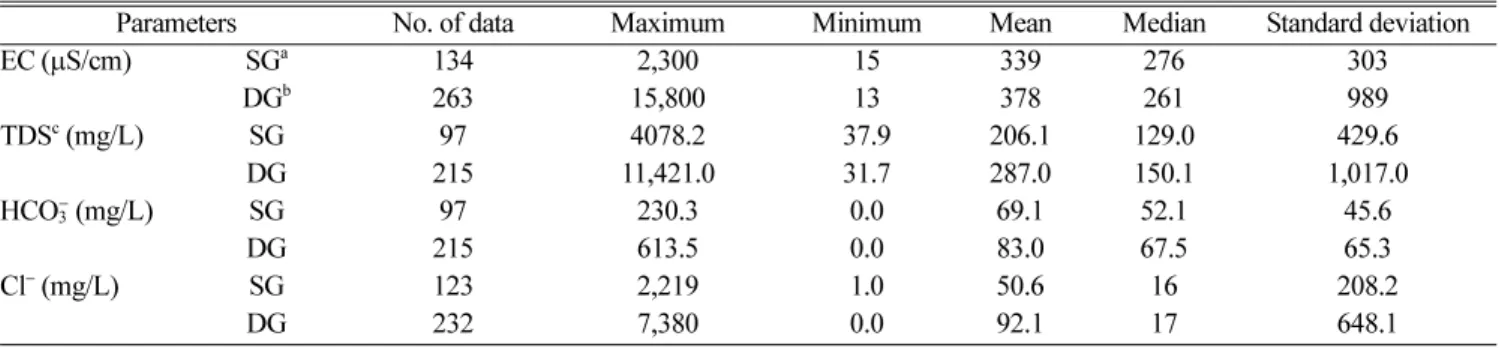
µS/cm) waters readily conduct the electrical currents and accelerate the corrosion, which increase maintenance costs of the heat pump systems. In this study, ECs of shal- low groundwaters ranged from 15 to 2,300
µS/cm with a mean of 339
µS/cm (Table 4). Most (88.8%) of the shallow groundwaters have EC values less than 500
µS/cm. The EC values of deep groundwaters ranged between 13 and 15,800
µ
S/cm (mean=378
µS/cm). Also a large proportion (86.3%) showed proper EC values (<500
µS/cm). Higher EC values directly related to levels of total dissolved solids (TDS).
TDS levels of groundwaters suitable for general purposes range between 200 and 1,000 mg/L. As TDS increases, water quality problems are more likely to occur. Detailed investigation of water chemistry is essentially required for groundwaters with high levels of TDS (>500 mg/L). TDSs above 500 mg/L may cause corrosion problems. Levels of TDS for shallow groundwaters are between 37.9 and 4078.2 mg/L while those for deep groundwaters range between 31.7 and 11,421.0 mg/L.
Only 4.1 and 4.2% of shallow and deep groundwaters exceeded TDS of 500 mg/L, respectively. Meanwhile TDS generally has a linear relationship with EC level (slope=0.45
−0.67). Also in this study, reasonable slope ranges were observed; 0.47 (r
2=0.84) for shallow groundwaters, and 0.60 (r
2=0.97) for deep groundwaters. It is known that higher slope is obtained for higher dissolved concentrations (Hem, 1985).
Alkalinity is a measure of the buffering capacity of water, or the capacity of bases to neutralize acids. In the range of normal groundwater chemistry, alkalinity is the result of the bicarbonate (HCO
3−) content of the groundwater (Rafferty, 2000). If alkalinity is too low, pH will be easily impacted and abrupt changes in pH can cause scaling or corrosion of metal equipment (AHP, 2001; Lund et al., 2003). But when the alkalinity is too high, the pH may drift upward, causing scale to form (AHP, 2001). Appropriate range of alkalinity is between 30 and 180 mg/L. Concentrations of bicarbonate (indicative of alkalinity) for shallow wells are between 0.0 and 230.3 mg/L (mean=69.1 mg/L). Of shallow groundwa-
Fig. 6. Distribution of pH values for shallow and deep groundwaters.
ters, 17.5% are out of the range. Levels of bicarbonate of deep groundwaters range from 0.0 to 613.5 mg/L (mean=83.0 mg/L) and 13.0% are out of the appropriate range.
High chloride concentrations may cause corrosion (Knipe and Rafferty, 1985). Chloride concentrations over 100 mg/L in groundwaters indicate a risk of corrosion in transport pipes. Concentrations of chloride for shallow wells are between 1.0 and 2,219 mg/L (mean=50.6 mg/L) while those for deep wells range between 0.0 and 7,380 mg/L (mean=92.1 mg/L).
Higher concentrations over 200 mg/L were mostly observed at coastal areas and are indicative of effects of seawater intrusion (Kim et al., 2003). Of chloride concentrations, 7.3% for shallow groundwaters and 5.6% for deep ground- waters exceeded 100 mg/L chloride.
4. SUMMARY AND CONCLUSION
In this study, hydrogeologic conditions of groundwaters of Korea were basically examined for application of GWHPs.
For theses purposes, groundwater data obtained from NGMN were used. From the various evaluations, some major con- clusions were drawn.
1. Temperatures of shallow and deep groundwaters are between 1.2
−25.8
°C and their annual variations are mostly within 10
°C. Especially the small amplitude of variation for deep groundwaters can facilitate design and maintenance of groundwater heat pumps.
2. Groundwater levels (depths to water for shallow and deep wells) are located at average 4.79
−6.07 m below ground surface. The shallow water levels are most suitable for groundwater heat pumps, which reduces pumping costs.
3. Large number of monitoring wells showed a good well yield exceeding a requirement for 3 RT heat pumps (for small residential purposes) but a limited application is expected for large commercial uses with the single well.
4. Some proportions of shallow and deep groundwaters exhibited scaling and corrosion potentials. Each relevant parameter was basically and separately evaluated in this study. But the parameters are closely correlated. Thus for
more detailed and quantitative examination of water quality conditions for GWHPs (e.g., Langelier Saturation Index and Ryznar Stability Index), integrated and extensive chem- ical analysis of groundwaters are essentially required.
ACKNOWLEDGEMENT: The authors wish to thank Prof. Chang- Eob Baag at Seoul National University and two anonymous reviewers for their critical and helpful comments improving the initial manuscript.
REFERENCES
AHP (Aquatherm Heat Pumps), 2001, Installation Manual: Swim- ming Pool and Spa Heat Pumps. AHP, Florida, 22 p.
Chiasson, A.D., Rees, S.J. and Spitler, J.D., 2000, A preliminary assessment of the effects of groundwater flow on closed-loop ground-source heat pump systems. ASHRAE Transactions, 106, 380−393.
DOE (Department of Energy), 1999, Renewable Energy Annual 1998: Issues and Trends. Office of Coal, Nuclear, Electric and Alternate Fuels, DOE/EIA (Energy Information Administration), Washington, DC., 1731 p.
Hahn, J.S., Hahn, G.S., Hahn, H.S. and Hahn, C., 2004, Geothermal Heat Pump, Heating and Cooling Systems. Hanrimwon, Seoul, Korea, 566 p. (in Korean)
Hem, J.D., 1985, Study and Interpretation of the Chemical Charac- teristics of Natural Water. Water-Supply Paper 2254, U.S. Geo- logical Survey, Washington, 263 p.
Heng, X.S. and Rybach, L., 2005, Development and application of a new, powerful groundwater heat pump system for space heating and cooling. World Geothermal Congress 2005, International Geo- thermal Association, Antalya, Turkey, p. 1−5.
Houghton, J.T., Meira Filho, L.G., Callander, B.A., Harris, N., Kat- tenberg, A. and Maskell, K., 1996, Climate Change 1995: Con- tribution of WGI to the Second Assessment Report of the Intergovernmental Panel on Climate Change. Cambridge Univer- sity Press, Cambridge, 572 p.
Kim, J.H., Yum, B.W., Kim, R.H., Koh, D.C., Cheong, T.J., Lee, J.H.
and Chang, H.W., 2003, Applications of cluster analysis for the hydrogeochemical factors of saline groundwater in Kimje, Korea.
Geosciences Journal, 7, 313−322.
Kim, S.Y. and Min, K.D., 2001, Effects of terrain and land-use on local circulation and temperature change at Taegu region in sum- mer. Journal of the Korean Meteorological Society, 37, 105−121
Table 4. Some water quality parameters related to scaling potential of groundwaters.
Parameters No. of data Maximum Minimum Mean Median Standard deviation
EC (µS/cm) SGa 134 2,300 15 339 276 303
DGb 263 15,800 13 378 261 989
TDSc (mg/L) SG 97 4078.2 37.9 206.1 129.0 429.6
DG 215 11,421.0 31.7 287.0 150.1 1,017.0
HCO3−(mg/L) SG 97 230.3 0.0 69.1 52.1 45.6
DG 215 613.5 0.0 83.0 67.5 65.3
Cl− (mg/L) SG 123 2,219 1.0 50.6 16 208.2
DG 232 7,380 0.0 92.1 17 648.1
aShallow groundwaters.
bDeep groundwaters.
cTotal dissolved solids calculated from water chemistry data.
hydrogeologic conditions for groundwater heat pumps 99 (in Korean with English abstract)
Knipe, E.C. and Rafferty, K.D., 1985, Corrosion in low-temperature geothermal applications. ASHRAE Transactions, 91, 81−91.
Koo, M.H., Kim, Y., Suh, M. and Suh, M.S., 2003, Estimating ther- mal diffusivity of soils in Korea using temperature time series data. Journal of the Geological Society of Korea, 39, 301−317.
(in Korean with English abstract)
Lee, C.K. and Han, U., 2001, Estimation of borehole temperature disturbed by drilling. Geosciences Journal, 5, 313−318.
Lee, C.K., Han, U. and Lee, S.W., 2000, Subsurface temperature per- turbation due to surface temperature fluctuation at a site in the northeastern Seoul area. Journal of the Geological Society of Korea, 36, 325−334. (in Korean with English abstract) Lee, J.Y. and Hahn, J.S., 2005, Characterization of groundwater tem-
perature obtained from the Korean national groundwater moni- toring stations: implications for heat pumps. Journal of Hydrology (revised).
Lee, J.Y., Yi, M.J., Yoo, Y.K., Ahn, K.H., Kim, G.B. and Won, J.H., 2005, A review of national groundwater monitoring network (NGMN) in Korea. Hydrological Processes (in press).
Lund, J.W., 1996, Direct heat utilization of geothermal resources.
GHC Bulletin, 17, 14−28.
Lund, J.W., Culver, G. and Lienau, P.J., 2003, Groundwater charac- teristics and corrosion problems associated with the use of geo- thermal water in Klamath Falls, Oregon. GHC Papers, Oregon Institute of Technology, 16 p.
Min, B.O., 1979, A study on the climatic type in Korea by the char- acteristics of temperature distribution. Journal of Korean Society of Oceanography, 3, 29−46. (in Korean with English abstract) MOCT (Ministry of Construction and Transportation) and KOWACO
(Korea Water Resources Corporation), 2004, An Annual Report on Groundwater Monitoring. 42000-58460-56-0013, MOCT and KOWACO, Daejon, Korea, 867 p. (in Korean)
PDEP (Pennsylvania Department of Environmental Protection), 1996, Ground Source Heat Pump Manual. Commonwealth of Pennsyl- vania, Harrisburg, PA, 52 p.
Rafferty, K.D., 1998, Well-pumping issues in commercial ground- water heat pump systems. ASHRAE Transactions, 104, 927−931.
Rafferty, K.D., 1999, Scaling in Geothermal Heat Pump Systems.
Geo-Heat Center, Klamath Falls, OR, 63 p.
Rafferty, K.D., 2000, Scaling in geothermal heat pump systems.
GHC Bulletin, 21, 11−15.
Rafferty, K.D., 2001, Design aspects of commercial open-loop heat pump systems. GHC Bulletin, 22, 16−24.
USEPA (United States Environmental Protection Agency), 1993, Space Conditioning: The Next Frontier-The Potential of Advanced Res- idential Space Heating Technologies for Reduction Pollution and Saving Customers Money. USEPA, Washington, 103 p.
Manuscript received July 22, 2005 Manuscript accepted January 11, 2006