473
전용문 *·기진석·고수연 ·김 련 ·류춘길
1
제주특별자치도 세계유산·한라산연구원,
2(주)GMC,
3한국동굴연구소,
4한국지질환경연구소
Characteristics and Implications of Lava Tubes from Geophysical Exploration in Jeju Island
Yongmun Jeon
1*, Jin Seok Ki
1, Su Yeon Koh
2, Lyoun Kim
3, and Choon Kil Ryu
41
World Heritage and Mt. Hallasan Research Institute, Jeju Special Self-Governing Provincial Government, Jeju 690-700, Republic of Korea
2
Geo Management Company GMC, Jeju 690-029 Republic of Korea
3
Cave Research Institute of Korea, Chuncheon 200-943, Republic of Korea
4
Korea Institute of Geological Environments, Busan 617-731 Republic of Korea
Received 2 September 2015; received in revised form 2 December 2015; accepted 4 December 2015
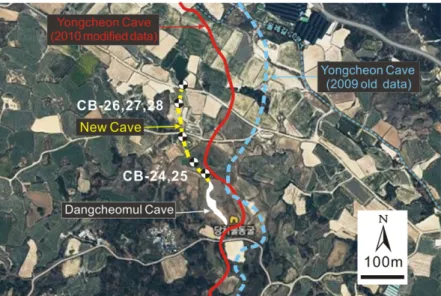
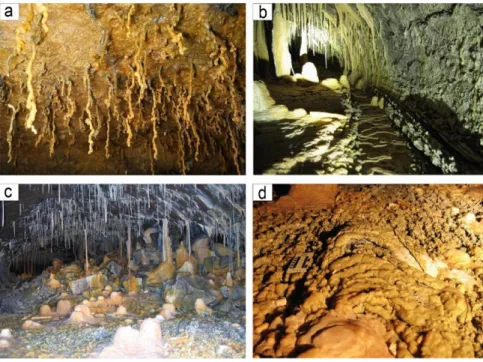
제주도에서 기존에 알려진 동굴 이외에 새로운 지하동굴의 존재를 확인하기 위해 제주시 구좌읍 일대에서 지구물리탐사(전기비저 항탐사, GPR탐사, ZHF탐사)를 실시하였다. 탐사결과 여러 지점에서 동굴로 추정되는 이상대가 발견되었고, 이상대의 위치와 규모가 일치하는 27개 지점을 선별하여 시추조사를 실시하였다. 그러나 예상과 달리 이상대의 대부분은 용암의 상하부에 형성된 클링커층이 거나 용암 사이에 협재된 고토양층이었으며, 5곳에서만 동굴이 발견되었다. 클링커층과 고토양층은 용암과 다른 암석의 물리적 특징 으로 인해 이상체로 반응한 것으로 해석된다. 한편 동굴이 확인된 5개 지점 중 2공은 기존에 알려진 용천동굴을 관통하였고, 3공에 서 새로운 동굴이 확인되었다. 용천동굴을 관통한 시추공은 시추당시 동굴의 존재가 확인되지 않았던 구간이었으나 용천동굴이 관통 됨에 따라 기존 측량도의 오류를 수정하였다. 한편 시추조사로 새롭게 발견된 석회장식 용암동굴은 길이가 약 180 m이며, 상류방향 으로 당처물동굴(약 110 m)과 연결되어 있다. 또한 동굴내부에는 용암곡석, 용암제방, 밧줄구조 등이 발달해 있으며, 탄산염 동굴생 성물로는 종유관, 종유석, 석순, 석주, 동굴산호 등이 잘 보존되어 있다. 특히 동굴에서 발견되는 탄산염 동굴생성물은 식물 뿌리를 따라 유입된 지표수에 의해 성장하여 독특한 형태를 띠게 된 것으로 추정된다.
주요어: 지구물리탐사, 용암동굴, 동굴생성물, 제주도, 용천동굴, 당처물동굴
Geophysical exploration using electric resistivity, ground penetrating radar (GPR), and impedance high-frequency (ZHF) sur- veys was conducted in Gujwa-eup, Jeju City, Jeju Island, an island in the Korea Strait, to confirm the existence of new caves near known caves. The exploration revealed a number of anomaly zones, presumed to be caves; 27 sites at suitable locations and depth ranges were selected for drilling and further surveys. However, contrary to predictions, most of the anomaly zones were clinker layers or paleosols intercalated with lavas. Only five boreholes intersected caves. The clinker layers and paleosols were possibly detected as anomalies owing to their different physical properties from the other rocks. Two of the five cave-finding boreholes penetrated Yongcheon Cave; a new cave was found at the other. The two boreholes that penetrated Yongcheon Cave were drilled in areas where the cave has not been previously reported, and thus helped correct an error in the cave distribution map. The cave newly discovered in this boring exploration is 180 m long, and it is connected to the upstream part of Dangcheomul Cave (110 m). The cave contains well-developed lava helictites, lava levees, and ropy structures; carbonate speleothems such as soda straws, stalagmites, columns, and curtain shawls are also well preserved. Notably, the unique shape of the carbonate speleothems is attributed to their growth in relation to the cavern water that flowed into the cave along plant roots.
Key words: geophysical exploration, lava tube, cave speleothem, Jeju Island, Yongcheon Cave, Dangcheomul Cave
*Corresponding author: [email protected]
ⓒ 2015, The Korean Society of Engineering Geology
This is an Open Access article distributed under the terms of the Creative Commons Attribution Non-Commercial License (http://creativecommons. org/
licenses/by-nc/3.0) which permits unrestricted non-commercial use, distribution, and reproduction in any medium, provided the original work is prop- erly cited.