Korean J. Soil Sci. Fert. 44(4), 597-599 (2011)
Nitrogen Fertilization on the Growth of Rape (Brassica napus L.) in Newly Reclaimed Land in Korea
Chang-Hyu Yang*, Taek-Kyum Kim, Sun Kim, Nam-Hyun Baek, Weon-Young Choi, Jang-Hee Lee, Jae-Hyeok Jung, Yong-Hwa Lee1, Si-Ju Kim2, and Kyeong-Bo Lee
Department of Rice and Winter Cereal Crop, NICS, RDA, Iksan 570-080, Korea
1Bioenergy Crop Research Center, NICS, RDA, Muan 534-833, Korea
2National Institute of Crop Science, RDA, Suwon 441-100, Korea
This study was conducted to find out the optimum nitrogen application rate for the stable production of rape in the newly reclaimed land located at Gangwhal region of Saemangum reclaimed land in which the soil is sandy loam (Munpo series). There were five treatments of nitrogen fertilization from zero to 60% increment based on the standard fertilization of 150 kg ha-1.The growth of rape (Sunmang) was not affected by salt content while soil salinity was increased at blossoming season of rape. Compared to yield of standard fertilization the yield and the content of oleic acid of rape were increased by 4~26% with the increasing additional nitrogen fertilizer. The results obtained from the growth and yield of rape in this study indicated that it was possible to cultivate rape in a newly reclaimed land if soil salinity was kept below 3 dS m-1.
Key words: Reclaimed land, Nitrogen fertilization, Rape, Yield
Received : July 18. 2011 Accepted : August 8. 2011
*Corresponding author : Phone: +82638402272 E-mail: [email protected]
Introduction
Although the reclaimed tidal land has been traditionally used for agricultural purpose during the period of food shortage before the 2000’s, the land-use plan of the Saemangeum reclaimed land will greatly share more with non-agricultural purpose than agricultural purpose by national development plan. However, the land use for agricultural purpose of the reclaimed land was also emphasized to be used for cultivation of cash crops instead of rice (RRI, 2006; Yoo and Park, 2004). RDA (2007) carried out the research project about development of plant industry in the reclaimed land.
Rapeseed (Brassica napus L.) is grown not only for the production of animal feed and vegetable oil for human consumption, but also the manufacture of biodiesel for powering motor vehicles. Rapeseed oil is the preferred oil stock for biodiesel production due to more oil per unit of land area as compared to other oil sources. Therefore, Korea is preparing and expansion plan of rapeseed cultivation through using a large reclaimed land and
abandoned land at winter season.
The main limitations for upland crop cultivation included high soil salinity, rising of water table in summer, frequent flooding, weakness of ridge formation, low fertility, etc.
(Knott, 1962; RRI, 2009; Sohn et al., 2010). Therefore, adaptability to soil salinity should be urgently studied for cultivation of rape in the Saemangeum reclaimed tidal land. This study was carried out to find out the optimum N rate for stable production of rapeseed at the Saemangeum reclaimed land (Munpo-series).
Materials and methods
The size of the individual experimental plot was 40 ㎡ (8 m × 5 m) with a randomized complete block design for the five treatments of nitrogen application rates from zero to 60% increment based on the standard fertilization of 150 kg ha-1.Application rates of phosphate and potassium as P2O5-K2O using phosphate and potassium sulfate were 80 and 80 kg ha-1. Rape (Sunmang variety) were sown in narrow strips. Table 1 shows the physical and chemical properties of soils before crop cultivation at the experiment site of the Saemangeum reclaimed land.
It showed alkaline- saline property with very low in Article
Chang-Hyu Yang et al.
598
Table 1. Physico-chemical properties of soil before experiment.
pH EC OM Avail. P2O5
Exch. Cation
CEC Soil texture
K Ca Mg Na
(1:5) dS m-1 g kg-1 mg kg-1 --- cmolc kg-1 --- cmolc kg-1
8.2 0.44 4.8 44 0.41 0.7 2.1 1.04 6.1 SL
Table 2. The changes of soil salinity by growth stage of rape.
Treatment Soil salinity
Bolting Blossoming Ripening Harvest
--- dS m-1 --- Standard
N-20%
N-40%
N-60%
N- 0%
0.39 0.49 0.52 0.52 0.47
0.77 0.88 0.79 1.39 0.66
1.27 1.27 1.56 1.21 0.40
0.26 0.39 0.72 1.43 0.26 Table 3. The growth and yields of rape in the newly reclaimed land.
Treatment Culm length
Ear
length Branch Pod No.
per spike
Pod length
Seed setting rate
1000 grain weight
Grain weight
Yield index
--- cm --- ea/hill ea cm % g Mg ha-1
Standard 101ab* 38b 5a 36b 6.2a 77.0b 4.2a 1.81ab 100
N-20% 107ab 43a 6a 40ab 6.4a 80.3ab 4.0a 1.88ab 104
N-40% 108ab 43a 6a 42ab 6.3a 80.5ab 4.1a 2.04a 113
N-60% 113a 43a 6a 45a 6.6a 82.3a 4.2a 2.29a 126
N- 0% 86b 34b 5a 34b 5.6b 69.5c 2.9b 1.48b 82
*Values with same letter in a column are not significantly different (Duncan test, p<0.05).
organic matter and cation exchange capacity, and very high exchangeable Magnesium and Sodium contents.
For characteristics of soil physical and chemical properties, the soil samples were collected from the each rape growth stage. The soil samples were measured for pH (1:5) and EC (1:5), organic matter (Tyurin method), phosphate (Lancaster method), and the exchangeable cations by 1N NH4OAc (ICP method), respectively (NIAST, 2000). Fatty acids contents of rapeseed were analyzed with Gas Chromatography (Agilent 6890, USA).
Growth and yield of rape investigation were carried out by the analysis standard of agricultural science and technology research (RDA, 2003).
Statistical analyses were conducted using SAS 9.2 software (SAS Institute, 2010). Fatty acid composition, yield components, and yield were analyzed by employing least significant difference (LSD) at a probability level of 5% for the comparison of means.
Results and discussions
Rape showed weak tolerant on salt (Sohn et al.,
2009). The yield of weak crop was reduced by 50% or greater exceeding 3~4 dS m-1 of soil salinity (Knott 1962).
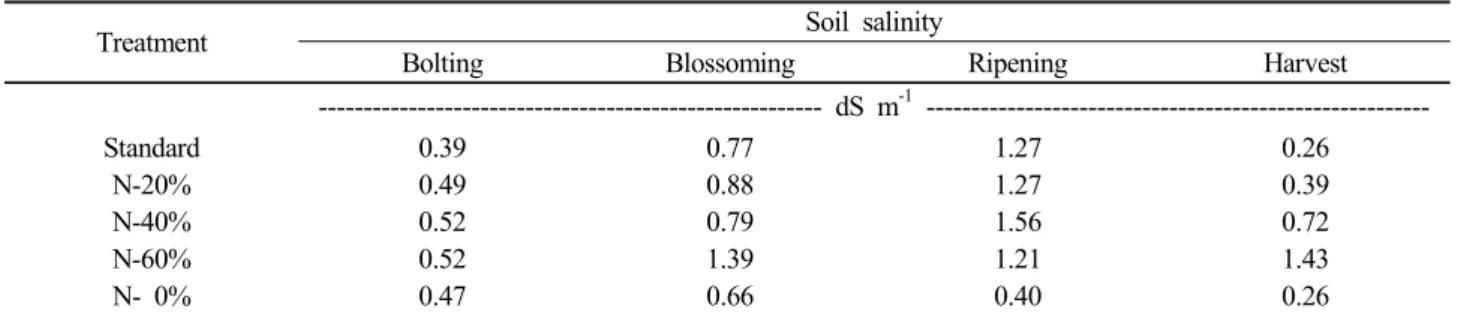
As shown in Table 2, soil salinity increased during flowering stage and ripening stage, and decreased at harvesting stage for all nitrogen levels. It was the highest 1.56 dS m-1 at the plot of 40% nitrogen level at ripening stage without any damage in crop yield.
Therefore, rape cultivation in reclaimed land may be possible as far as EC of soil was 3 dS m-1 or lower.
Stem, head, and pod length which significantly influenced seed yield as yield components were increased with increasing level of nitrogen, as well as increase in 13 and 26 percent for N-40% and N-60% than that the standard fertilization (Falk et al., 1994; Jang et al., 2002; Lefort-Buson and Dattee, 1982). Especially Kwon and Lim (1990) observed that pod number per spike played an important role on stability of yield in rapeseed cultivars.
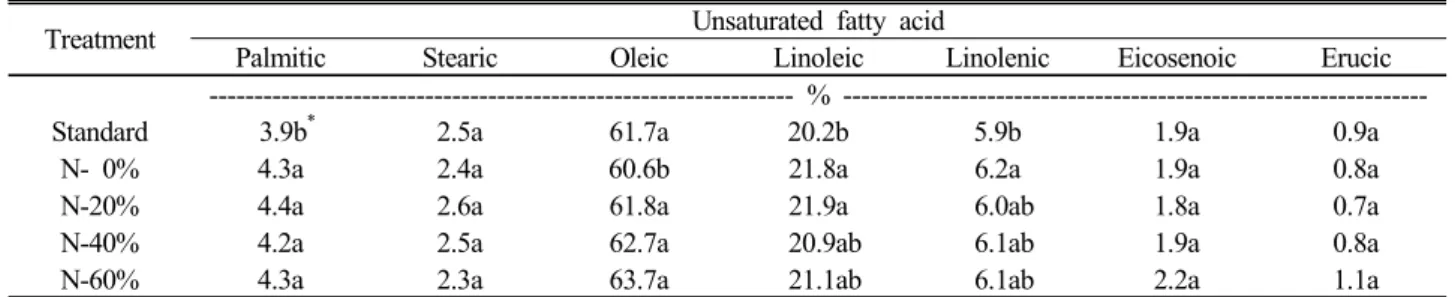
Fatty acid contents of rapeseed also increased with increasing level of nitrogen (Table 4). The amount of oleic and linoleic fatty acid also increased with increment of nitrogen application rate.
Nitrogen Fertilization on the Growth of Rape in a Reclaimed Land 599
Table 4. Fatty acid contents in rape seed depending on N application rates.
Treatment Unsaturated fatty acid
Palmitic Stearic Oleic Linoleic Linolenic Eicosenoic Erucic
--- % ---
Standard 3.9b* 2.5a 61.7a 20.2b 5.9b 1.9a 0.9a
N- 0% 4.3a 2.4a 60.6b 21.8a 6.2a 1.9a 0.8a
N-20% 4.4a 2.6a 61.8a 21.9a 6.0ab 1.8a 0.7a
N-40% 4.2a 2.5a 62.7a 20.9ab 6.1ab 1.9a 0.8a
N-60% 4.3a 2.3a 63.7a 21.1ab 6.1ab 2.2a 1.1a
*Values with same letter in a column are not significantly different (Duncan test, p<0.05).
Conclusion
Concerning the growth and yield of rape observed in this study, we found that it was possible to cultivate rape at newly reclaimed land if soil salinity was below 3 dS m-1. Increase in nitrogen application rate could result in rape yield and oleic acid content.
Acknowledgements
This work was carried out with the support of
“Cooperative Research Program for Agricultural Science
& Technology Development (Project No. PJ0064332010)”, Rural Development Administration, Republic of Korea.
References
Falk, K.C., G. Rakow, R.K. Downey, and D.T. Spurr. 1994.
Performance of intercultivar summer turnip rape hybrids in Saskatchewan. Can J. Plant Science. 74:441-445.
Jang, Y.S., C.W. Kim, I.H. Choi, Y.B. Oh, B.C. Jung, and S.T. Kim. 2002. Yield performance and local adaptability of rapeseed F1 hybrids. Korean J. Breed. 34:41-45.
Knott, J.E. 1962. Handbook for vegetable growers. pp. 44-45.
J. W. Wiley & Sons, Inc.
Kwon, B.S., J.I. Lee, S.K. Kim, and Y.A. Chee. 1984. Breeding for improvement of fatty acid composition in rapeseed Brassica napus L. ⅩⅥ. Effect of fertilizer level on the oil content and fatty acid composition of rapeseed. Korean J. Crop Sci.
29:198-202.
Kwon, B.S. and J.T. Lim. 1990. Analysis of stability for yield
and yield components in rapeseed varieties. Korean J. Breed.
22:20-27.
Lefort-Buson, M. and Y. Dattee. 1982. Genetic study of some agromic characters in winter oilseed rape (Brassia napus L).
Heterosis. Agronomie 2:315-322.
NIAST. 2000. Method of soil and plant analysis. Published by National Institute of Agricultural Science & Technology.
Suwon, Korea.
SAS. 2010. SAS system for windowTM, Release 9.2. SAS Institute, Cary, NC.
Sohn, Y.M., G.Y. Jeon, J.D. Song, J.H. Lee, and M.E. Park.
2009. Effect of soil salinity and flooding on plant growth and yield of rape-castor bean cropping system in the newly reclaimed tidal land of western seaside of Korea. Korean J.
Soil Sci. Fert 42:355-363.
Sohn, Y.M., J.D. Song, G.Y. Jeon, D.H. Kim, and M.E. Park.
2010. Effect of soil salinity and culturing condition on the maintenance of ridge and the growth of upland crops in the Saemangeum reclaimed tidal land. Korean J. Soil Sci. Fert 43:407-417.
RDA. 2003. Investigation and standard for agricultural experiment.
Published by Rural Development Administration. Suwon, Korea.
RDA. 2007. Studies on friendly environmental development for foundation of multiple agriculture in reclaimed land. Rural Development Administration.
RRI. 2006. Agricultural complex development for upland &
horicultural crops in the Saemangeum reclaimed farmland.
Res. Rpt. Rural Research Institute. p1-504. Korea Rural Community & Agriculture Corporation.
RRI. 2009. Operation of advanced agricultural experiment complex and field test. Res. Rpt. Rural Research Institute. pp.
1-217. Korea Rural Community & Agriculture Corporation.
Yoo, S.H. and M.E. Park. 2004. Proposal of land-use planing for agricultural use of the Saemangeum reclaimed land. J.
SOC. Agr. Res. on Reclaimed Lands 2:68-91.