Enzymatic Characterization of a Thermostable 4-α-Glucanotransferase from Thermotoga neapolitana
Kyoung-Hwa Choi
†, Ja Yeong Seo
†, Jieun Kim, and Jaeho Cha*
Department of Microbiology, Pusan National University, Busan, 609-735, Republic of Korea Received January 10, 2011 /Accepted January 31, 2011
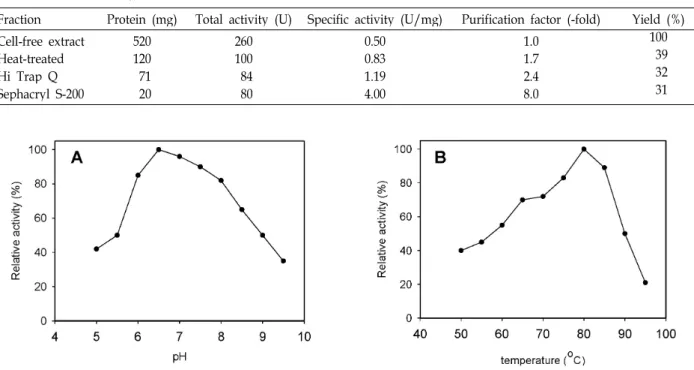
The gene encoding 4-α-glucanotransferase (mgtA) from Thermotoga neapolitana was cloned and ex- pressed in Escherichia coli in order to investigate whether this enzyme was capable of producing cyclo- amylose for industrial applications. MgtA was purified to homogeneity by HiTrap Q HP and Sephacryl S-200 HR column chromatographies. The size of the enzyme as determined by SDS-PAGE was about 52 kDa, which was in good agreement with its deduced molecular mass of 51.9 kDa. The optimal temperature and pH for the activity of the 4-α-glucanotransferase was found to be 85
oC and 6.5, respectively. The enzyme hydrolyzed the 1,4-α-glucosidic bonds in oligomeric 1,4-α-glucans and transferred oligosaccharides (maltotriose being the shortest one) to acceptor maltodextrins. However, the enzymes had no activity against pullulan, glycogen, and other di- or trioligosaccharides with rare types of α-bond. MgtA is distinguished from 4-α-glucanotransferase from Thermotoga maritima in that it can convert maltotriose into maltooligosaccharides. The treatment of glucoamylase after the reaction of MgtA with maltotriose, maltotetraose, maltopentaose, or maltohexaose as sole substrate revealed that MgtA yielded linear maltooligosaccharides instead of cycloamylose.
Key words : 4-α-Glucanotransferase, glycosyl hydrolase family 13, thermostability, Thermotoga neapolitana
*Corresponding author
*Tel:+82-51-510-2196, Fax:82-51-514-1778
*E-mail : [email protected]
†