• 검색 결과가 없습니다.

A Study on the Improvement of G-SEED through Analysis of the Previous Studies - Based on Apartment Houses

N/A
N/A
Protected

Academic year: 2021

Share "A Study on the Improvement of G-SEED through Analysis of the Previous Studies - Based on Apartment Houses"

Copied!
12
0
0

로드 중.... (전체 텍스트 보기)

전체 글

(1)

선행연구 분석을 통한 녹색건축 인증제의 개선방향에 관한 연구

- 공동주택 부문을 중심으로

A Study on the Improvement of G-SEED through Analysis of the Previous Studies

- Based on Apartment Houses

윤 요 선

*

류 수 훈

**

Yun, Yo Sun Ryu, Soo Hoon

This is an Open Access article distributed under the terms of the Creative Commons Attribution Non-Commercial License(http://creative commons.org/licenses/by-nc/3.0) which permits unrestricted non-commercial use, distribution, and reproduction in any medium, provided the original work is properly cited.

Abstract

Green Standard for Energy and Environmental Design (G-SEED) is evaluates the eco-friendliness of the building as an abjective means. Study in green building is made actively, and is being developed through constant revision. However, study results of green building have not been fully reflected in the standard.

Therefore, this study analyzes the previous studies about G-SEED and checks the reflection of requirements. This study will be a reference of future revision of G-SEED.

Score of items are divided into low and high score items. These items should be reflected appropriately in the standard through the score adjustment. Some requirements proposed in previous studies was reflected, while substantial requirements was not reflected. Proposed improvement requirements are classed as to establish specific standards, strengthen standards, propose a new evaluation method to existing items, and add new items.

키워드 : 녹색건축인증, 선행연구, 공동주택

Keywords : Green Standard for Energy and Environmental Design, Previous Studies, Apartment Houses

1. 서 론

1.1. 연구 배경 및 목적

친환경건축물 (Green Building)이란, 에너지 절약과 환경 보 전을 목표로 에너지 부하저감 , 고효율 에너지설비, 자원재활용, 환경공해 저감기술 등을 적용하여 자연친화적으로 설계 , 건설 하고 유지관리한 후 , 건물의 수명이 끝나 해체될 때까지도 환 경에 대한 피해가 최소화되도록 계획된 건물

1)

을 의미한다 .

1992년 브라질 리우에서의 UN 기후변화 협약 이후 전 세계적으로 기후변화 및 지구환경에 대한 관심이 높아지 면서 , 건설을 포함한 모든 산업분야에서 온실가스 감축을 위한 노력을 기울이고 있다 . 이에 따라 각 국가들은 녹색 건축물에 대한 인증 제도를 마련하여 운영하고 있다 .

또한 국내에서도 저탄소 녹색성장 기본법

2)

에 따라 자원절

* Dept. of Architecture Kongju National Univ. South Korea ([email protected])

** Corresponding author, Dept. of Architecture Kongju National Univ.

South Korea ([email protected])

This research was supported by Basic Science Research Program through the National Research Foundation of Korea(NRF) funded by the Ministry of Science, ICT and future Planning(2011-0011316)

약형이고 자연친화적인 건축물의 건축을 활성화하기 위해 2002년부터 녹색건축 인증

3)

이 시행되고 있다 . 이러한 인증제 도는 건축물의 친환경성을 평가하는 객관적인 수단이며 , 앞으 로 녹색 건축물이 나아가야 할 방향을 제시하는 역할을 한다 .

녹색건축 인증제는 2002년부터 공동주택에 대한 친환경 건축물 인증

4)

기준을 시작으로 , 현재 몇 차례의 개정을 거 쳐 공동주택 , 복합건축물(주거), 업무용 건축물, 학교시설, 판매시설 , 숙박시설, 소형주택, 기존공동주택, 기존 업무용 건축물 , 그 밖의 건축물, 복합건축물에 대한 인증이 시행 되고 있다 . 인증제가 시행됨에 따라 녹색건축 인증제에 대 한 연구가 활발히 이루어지고 있으며 , 개정을 통해 발전되 고 있다 . 하지만 인증제에 대한 연구 결과가 개정된 인증

1) 박상동(2009), 그린빌딩 건축계획, 기문당, p.32.

2) 녹색성장 기본법 제54조 : 정부는 에너지이용 효율 및 신·재생에너지의 사용비율이 높고 온실가스 배출을 최소화하는 건축물(녹색건축물)을 확 대하기 위하여 녹색건축물 등급제 등의 정책을 수립·시행하여야 한다.

3) 녹색건축물 조성지원법 제16조 : 국토교통부장관은 지속가능한 개발 의 실현과 자원절약형이고 자연친화적인 건축물의 건축을 유도하기 위하여 녹색건축 인증제를 시행한다. <개정 2013.3.23>

4) 「친환경건축물 인증기준」고시에 있는 운영기관에 대한 규정을 「녹 색건축물 조성지원법」의 시행으로 제도적인 위계를 맞추기 위해 근 거규정을 「녹색건축의 인증에 관한 규칙」으로 이관(2012. 11)함에 따라 본 논문에서는 ‘친환경건축물 인증’이란 용어 대신 ‘녹색건 축 인증’이란 용어를 사용하고자 한다.

Vol. 13, No. 5 Oct. 2013, pp31-42, pISSN 1598-3730, eISSN 2288-4823

http://dx.doi.org/10.12813/kieae.2013.13.5.031

(2)

제에 충분히 반영되지 못하고 있다 .

이에 본 연구는 기존 녹색건축 인증제에 대한 선행연구 를 분석하여 , 연구에서 제시된 문제점 및 개선점에 대해 개정된 녹색건축인증제에서의 반영정도를 확인한다 . 또한 이를 바탕으로 향후 국내 녹색건축인증제의 개선방향성의 참고자료로 활용하고자 한다 .

1.2. 연구 내용 및 범위

본 연구의 내용은 인증제에 대한 선행연구 분석을 통하여 , 평가 항목별 점수획득에 관한 연구를 분석하고 , 항목에 대한 문제점 및 개선 요구사항을 확인한다 . 그리고 개정된 인증 기준 비교를 통해 개선 요구사항의 반영정도를 분석한다 .

선행 연구의 범위는 2002년에서 2012년까지 국내 학술 지에 발표된 녹색건축물 인증에 관한 논문 및 기사를 선 행연구의 범위로 설정하며 , 건물의 용도는 가장 연구가 활 발히 진행되고 있는 공동주택을 대상으로 한다 . 또한 개정 된 녹색건축 인증제에 대한 기준은 2013년 6월에 개정된 인증기준을 의미한다 .

Study Directions

study of the G-SEED through analysis of previous studies (Apartment Houses)

Analysis of

Previous studies obtained score of items problems & improvement requirements of items

G-SEED check the reflection of requirements by comparing the revised G-SEED

Conclusion draw the conclusion from propose the improvement of G-SEED

Fig. 1. Research Flowchart

2. 녹색건축 인증제

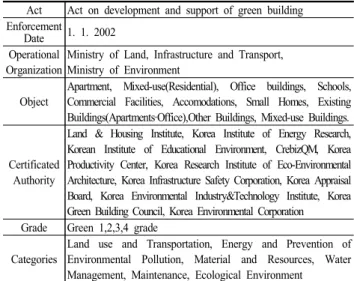
2.1. 녹색건축 인증제 개요

녹색건축 인증제는 2002년부터 공동주택에 대한 인증을 시작으로 현재 공동주택 , 복합건축물(주거), 업무용 건축 물 , 학교시설, 판매시설, 숙박시설, 소형주택, 기존공동주 택 , 기존 업무용 건축물, 그 밖의 건축물, 복합건축물에 대 한 인증이 시행되고 있다 . (Table 1 참조

5)

)

2013년 2월 ‘녹색건축물 조성지원법’을 개정·시행하면서 ‘친 환경 건축물 인증제 (건축법)’와 ‘주택성능등급 인정제(주택법)’

가 통합되어 ‘녹색건축 인증제’로 개정되었다. 또한 인증제의 브랜드 강화를 위해 영문명칭 (G-SEED

6)

)을 반영하였다.

녹색건축 인증제로 개정되면서 인증기관은 종전 4개 기 관에서 11개 기관으로 확대되었으며, 평가항목은 종전 9개 분야에서 유사 분류항목을 통합하여 7개 분야로 분류체계 가 재정립 되었다 .

5) 자료 : 녹색건축 인증기준 (국토교통부·환경부공고(2013.01.16.) 6) Green Standard for Energy and Environmental Design (공모를 통해

선정 '12.12)

Act Act on development and support of green building Enforcement

Date 1. 1. 2002 Operational

Organization

Ministry of Land, Infrastructure and Transport, Ministry of Environment

Object

Apartment, Mixed-use(Residential), Office buildings, Schools, Commercial Facilities, Accomodations, Small Homes, Existing Buildings(Apartments·Office),Other Buildings, Mixed-use Buildings.

Certificated Authority

Land & Housing Institute, Korea Institute of Energy Research, Korean Institute of Educational Environment, CrebizQM, Korea Productivity Center, Korea Research Institute of Eco-Environmental Architecture, Korea Infrastructure Safety Corporation, Korea Appraisal Board, Korea Environmental Industry&Technology Institute, Korea Green Building Council, Korea Environmental Corporation

Grade Green 1,2,3,4 grade Categories

Land use and Transportation, Energy and Prevention of Environmental Pollution, Material and Resources, Water Management, Maintenance, Ecological Environment

Table 1. G-SEED Outline

2.2. 녹색건축 인증제 개정 전·후 비교

공동주택 부문은 2002년 시행 이래로 2006년, 2010년, 2012년, 2013년 4차례 개정되었다. (Table 2 참조) 2006년 개정시에는 5개 부문(추가항목 포함)의 평가항목이 세분화 되어 9개 평가항목으로 구분되었고, 평가 및 가산항목 합 계점수가 136점으로 상향 조정되었다.

Date Revision Contents

2002.01.01 Enforcement of Green Building Certification Criteria (GBCC) (Apartment Houses)

2003.01.01 Enforcement of Office and Mixed-use(Residential) criteria 2005.03.01 Enforcement of Schools criteria

2006.04.11 Revision of Apartment Houses criteria

2006.09.01 Enforcement of Commercial Facilities and Accomodations criteria

2010.07.01

-Enforcement of Other Buildings and Mixed-use Buildings, -Strengthen Professionalism of Certification Institution, Improvement of the timing and process, Subdivision of the grade, Revision of the items, methods and standards

2012.07.01

-Combine G-SEED and Housing Performance Rating System -Acquire more than Green 2 grade obligatorily for the Public Office Buildings. (total floor area over 10,000㎡)

-Enforcement of Small Homes and Existing Buildings (Apartments Houses·Office) Criteria

2013.02.23

-Revision of Housing Performance sector

-Change Act, Expand the obligatory acquire of Public Buildings, Set the expiration date, Reestablish the Categories, -Change the Certification and Mark

Table 2. G-SEED Revision Contents

2010년 개정시에는 평가항목, 평가방법, 배점기준이 조정 됨에 따라 필수항목이 추가되었고 , 인증등급 산정시 가중치 를 부여하고 인증등급이 2등급에서 4등급으로 확대되었다.

2012년 개정시에는 공동주택의 친환경건축물 및 주택성

능등급 평가기준이 일원화되어 주택성능등급인정제 항목

이 대부분 유지관리 부문으로 삽입되었으나 2013년 개정

시 주택성능분야는 부문으로 분리되었다 . 공동주택 인증

평가항목 중 녹색건축 심사요소에 부합하지 않는 주택성

능분야 (11개 항목)은 인증 평가시 성능등급서에만 표시하

(3)

고 인증평가를 위한 배점을 부여하지 않으며 , 성능등급은 공동주택의 입주자 모집공고시 공동주택 인증심사기준에 따라 평가하여 단지별 최소등급을 ★에서 ★★★★로 표 시하도록 개정되었다 .

3. 녹색건축 인증제 평가 항목별 점수획득

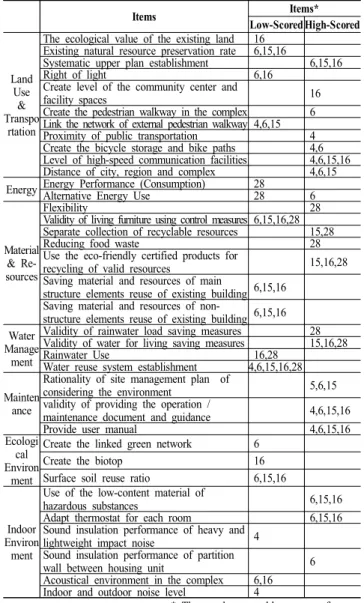
평가 항목별 특징에 따라서 Table 3과 같이 점수 획득 이 어려운 저득점 항목과 , 점수획득이 비교적 쉬운 고득점 항목으로 분류 할 수 있었다 . 이는 사례평가와 득점분석을 한 선행 연구의 결과 이다 . (2006년 인증기준)

Items Items*

Low-Scored High-Scored

Land Use

&

Transpo rtation

The ecological value of the existing land 16 Existing natural resource preservation rate 6,15,16

Systematic upper plan establishment 6,15,16

Right of light 6,16

Create level of the community center and

facility spaces 16

Create the pedestrian walkway in the complex 6 Link the network of external pedestrian walkway 4,6,15 Proximity of public transportation 4 Create the bicycle storage and bike paths 4,6 Level of high-speed communication facilities 4,6,15,16 Distance of city, region and complex 4,6,15 Energy Energy Performance (Consumption) 28

Alternative Energy Use 28 6

Material

& Re- sources

Flexibility 28

Validity of living furniture using control measures 6,15,16,28 Separate collection of recyclable resources 15,28

Reducing food waste 28

Use the eco-friendly certified products for

recycling of valid resources 15,16,28

Saving material and resources of main

structure elements reuse of existing building 6,15,16 Saving material and resources of non-

structure elements reuse of existing building 6,15,16 Water

Manage ment

Validity of rainwater load saving measures 28 Validity of water for living saving measures 15,16,28

Rainwater Use 16,28

Water reuse system establishment 4,6,15,16,28 Mainten

ance

Rationality of site management plan of

considering the environment 5,6,15

validity of providing the operation /

maintenance document and guidance 4,6,15,16

Provide user manual 4,6,15,16

Ecologi cal Environ

ment

Create the linked green network 6

Create the biotop 16

Surface soil reuse ratio 6,15,16

Indoor Environ ment

Use of the low-content material of

hazardous substances 6,15,16

Adapt thermostat for each room 6,15,16 Sound insulation performance of heavy and

lightweight impact noise 4

Sound insulation performance of partition

wall between housing unit 6

Acoustical environment in the complex 6,16 Indoor and outdoor noise level 4

* The number on table menas reference.

Table 3. Obtained Score of Item

3.1. 저득점 항목

점수획득이 어려운 저득점 항목에는 토지이용 및 교통 부문에서 기존자연자원 보존율 , 외부보행자 전용도로 네트 워크 연계여부 항목 등이 있었다 .

기존 자연자원 보존율 항목은 2010년 개정시 삭제되었

으며 , 외부보행자 전용도로 네트워크 연계여부 항목은 점 수가 상향 조정 ('10년 개정)되었고, 인정 범위가 확대되었다.

또한 2012년 개정시에는 산출기준이 보다 구체화 되었다.

재료 및 자원 부문에서는 생활용 가구재 사용억제 대책 의 타당성 , 기존 건축물의 주요구조부 재사용으로 재료 및 자원의 절약 , 기존 건축물의 비내력벽 재사용으로 재료 및 자원의 절약 항목이 있었다 . 생활용 가구재 사용억제 대책 의 타당성 항목은 2010년 개정시 점수가 상향조정 되었다.

기존 건축물의 재사용에 관한 항목은 2006년 신설되었으 며 , 리모델링시에만 평가하는 항목이기 때문에 점수획득이 어려운 것으로 판단된다 .

물순환관리 부문에서는 우수이용 , 중수도 설치 항목이 있었으며 중수도 설치 항목은 가장 많은 선행연구에서 점 수획득이 어려운 항목이었다 . 2010년 개정시 점수가 하향 조정 되었고 , 가산항목에서 평가항목으로 개정되었다. 또 한 수도법 시행규칙에서 규정하는 의무시설의 경우 +2%

를 만족할 경우 배점을 부여한다는 부분이 추가 되었다 . 유지관리 부문의 항목은 저득점 항목 보다는 고득점 항 목이라는 결과가 많았던 반면 , 생태환경 부문의 항목은 저 득점 항목이라는 결과가 많았다 . 생태환경 부문에서는 연계 된 녹지축 조성 , 비오톱 조성, 표토재활용 항목 등이 있었으 며 이중 표토재활용 항목은 2010년 개정시 삭제되었다.

3.2. 고득점 항목

점수 획득이 비교적 쉬운 고득점 항목에는 토지이용 및 교통부문에서 체계적 상위계획 수립 여부 , 초고속 정보통 신 설비의 수준 , 도시 중심 및 지역중심과 단지 중심 간의 거리 항목 등이 있었다 .

체계적 상위계획 수립 여부 항목과 초고속 정보통신 설 비의 수준 항목은 2010년 개정시 삭제되었는데, 변별력이 떨어져 점수 획득이 쉬운 항목이었기 때문인 것으로 판단 된다 . 하지만 도시 중심 및 지역중심과 단지 중심간의 거 리 항목은 산출기준의 구분만 개정되었다 .

재료 및 자원 부문에서는 유효자원 재활용을 위한 친환 경인증제품 사용여부 항목 등이 있었다 . 친환경 인증제품 의 사용수로 평가하던 방법에서 2010년 개정시 주된 건축 물에 사용하는 것과 , 외부공간에 사용하는 것에 가중치를 두어 산출기준을 강화하였으며 필수항목으로 개정되었다 . 또한 2012년 개정시에는 두 부분 모두에서 사용한 경우에 점수를 획득할 수 있도록 기준이 강화되었다 .

물순환관리 부문에서는 생활용 상수 절감 대책의 타당 성 항목이 있었다 . 이 항목은 2002년 기준 건물 대비 심사 대상 건물의 일일 1인당 상수 사용량 절감율에 따른 평가 에서 2006년 환경표지 인증을 얻은 제품의 적용여부에 따 라 평가하는 방법으로 개정되었으며 , 2010년 개정시 필수 항목으로 개정되었다 .

유지관리 부문은 환경을 고려한 현장관리계획의 합리성 ,

운영 /유지관리 문서 및 지침 제공의 타당성, 사용자 매뉴

얼 제공 항목모두가 고득점 항목이었다 . 환경을 고려한 현

장관리계획의 합리성 항목은 크게 개정된 것이 없었고 , 운

(4)

Items Improvement Requirements Check Requirements Reflection The ecological value of

the existing land

Required to mention of specific standards that ascertainable ecological conservation of the existing site [27] ○

Add standard('10) : Site of the low ecological value (development district of residential site, large-scale development business district, coast and wetland landfill)

Existing natural resource

preservation rate Required to maintain (Delete '10) [3] × -

Floor area ratio Need improvement and supplementation [34] ○ Delete('10) Right of light Suggest the appraisal criteria for the adjacent land

conditions [27] × Level 1-5 ► 1-4 ('12)

Create level of the community center and

facility spaces

Add specific contents for space (sort, scale, range)

[3,23,27] ○

-Whether to plan the community center facility ► Create level of the community center and facility spaces('12), / - Level 1-2 ► 1-4 -Add a standard('12) : community space area, residents' common space Quality evaluation rather than quantity evaluation [23] × Calculated based on the area

Create the bicycle storage and bike paths

Required to specific calculate standard (location) [3] × Level 1-2 ► 1-4, Strengthen standard('12) Adequate segregation of pedestrian and vehicle [29] ○ Add standard to calculate ('10)

Required to link with complex outside [29] × Bicycle can pass from complex doorway to bicycle storage.('10) Level of high-speed

communication facilities Exclude the items of low sustainable influence [35] ○ Delete('10) Table 4. Land Use and Transportation

영 /유지관리 문서 및 지침 제공의 타당성 항목은 2010년 개정시 필수항목으로 개정되고 , 배점은 3점에서 2점으로 감소하였지만 , 1급을 받기위한 항목 수는 5항목 이상에서 7항목 이상으로 강화되었다. 2012년 개정시에는 8항목 이 상으로 상향 조정되었으며 , 최소평점도 1.0점에서 1.2점으 로 강화되었다 . 또한 사용자매뉴얼 제공 항목은 2010년 개 정시 3점에서 1점으로 점수가 하향 조정되었고, 1급을 받 기위한 항목 수는 4항목 이상에서 5항목 이상으로 개정되 었다 . 그리고 2012년 개정시 6항목 이상 채택으로 강화되 었다 . 유지관리 부문은 변별력이 떨어져 점수획득이 쉽기 때문에 필수항목으로 설정하거나 배점을 하향조정하고 기 준을 강화한 것이라고 판단된다 .

실내환경 부문에서는 각종 유해물질 저함유 자재의 사 용 , 각 실별 자동 온도조절 장치 채택여부 항목 등이 있었 다 . 각종 유해물질 저함유 자재의 사용 항목은 2010년 개 정시 실내공기 오염물질 저방출 자재의 사용으로 바뀌었 고 , 필수항목으로 개정되었다. 또한 산출기준에 가구용 자 재까지 포함되어 기준이 강화되었다 . 2012년 개정시에는 최소평점 4점에서 4.8점으로 상향조정되었다. 각 실별 자동 온도조절 장치 채택여부 항목은 크게 개정된 것이 없었다 .

3.3. 소 결

사례평가와 득점분석을 한 선행 연구의 결과는 평가항 목별 특징에 따라 점수 획득이 어려운 저득점 항목과 , 획 득 점수가 높은 고득점 항목으로 구분 할 수 있었다 . 저득 점 항목의 경우 항목삭제 , 점수의 상향조정, 산출기준의 구체화 등으로 개정되었으며 고득점 항목의 경우 항목삭 제 , 점수의 하향조정, 기준 강화 등으로 개정되었다.

4. 녹색건축 인증제 평가 항목별 문제점·개선 요구사 항 및 반영여부
4.1. 토지이용 및 교통

토지이용 및 교통 부문은 2013년 현재 12개 항목으로 구성되어 있으며 , 항목별 총점은 18점, 가중치는 15로

2002년과 대비해 토지이용 및 교통의 평가 부문은 감소하 였으나 , 2010년 이후로는 항목 및 비율의 큰 변동이 없다.

‘기존 대지의 생태학적 가치’항목은 기존 대지의 생태학 적 보존 여부를 판단할 수 있는 구체적인 언급이 필요 [참 고문헌 27 ; 이하 번호]하다는 개선 요구사항이 있었다.

2010년 개정시 ‘택지개발지구 등 대규모 개발 사업지구, 해안 및 습지 매립지 등은 생태학적 가치가 낮은 대지에 해당하지 않음 ’으로 구체적으로 언급이 되었다.

‘기존 자연자원 보존율’ 항목은 시공시 현장에서의 변수 발생에 따라 계획이 변경되거나 , 단지의 입지환경에 따라 적용가능 여부가 다르나 , 보호가치가 높은 현장일수도 있 다는 문제점이 있었으며 , 이에 대한 개선방안으로는 2010 년 개정시 삭제되었지만 , 기존의 자연파괴를 최소화하기 위해서는 평가항목의 유지가 필요하다 [3]는 요구사항이 있 었다 . 하지만 2010년 삭제 이후 신설되지 않았다.

‘일조권 간섭방지 대책의 타당성’항목은 기존의 건축물 뿐 아니라 장래의 인접대지 건축물에 미칠 영향에 대해서 도 고려해야 하므로 인접대지 조건에 대한 평가기준을 제 시 [27]해야 한다는 요구사항은 반영되지 않았다.

‘커뮤니티 센터 및 시설공간의 조성수준’항목은 2012년 개정시 커뮤니티 센터 및 시설계획 여부 항목에서 명칭이 변경되었다 . 2010년 개정시 세대수에 따른 커뮤니티 센터 의 최소면적과 독립된 출입구 및 부대시설 (화장실)의 확보 에 대한 기준은 마련되었으나 , 커뮤니티센터 내 적용되는 공간에 대한 구체적인 기준이 없다 [3]는 문제점이 있었고, 이에 대해 제도적으로 평가기준에서 커뮤니티 센터에 적 용될 수 있는 공간의 종류 및 크기와 같은 구체적인내용 추가에 대한 요구 [3,23,27]가 있었다. 이는 2012년 개정시 반영되어 커뮤니티 공간면적 및 종류에 대한 기준이 추가 되었고 , 주민공동시설에 대한 설치 기준이 추가 되었다.

또한 양적 평가보다는 질적 평가가 우선되어야한다 [23]는 요구사항이 있었지만 , 여전히 면적에 대한 기준으로 커뮤 니티 센터 및 시설 ·공간계획 여부로 산출된다.

‘단지 내 자전거 보관소 및 자전거도로 설치여부’ 항목은

평가시 자전거보관소의 규모로 평가하고 있으며 , 위치에 대

한 기준은 ‘주동의 필로티 및 출입구 인접배치’ 외에 없다는

(5)

Improvement Requirements Check Requirements Reflection Suggest the new evaluation standards of land use and transportation [2]

Establish the public transportation system and improve the accessibility /

Development of appropriate density and secure infrastructure/ Site selection and conservation/

Create the pedestrian network / Create the safety environment in crime and disaster

× -

Space accessibility : suggest the evaluation standards through the simulation for the moving distance and assess in the complex [8] × - Required to minimize the impact on the external environment that occurs under construction [22] × - Minimize the development of existing ecological environment through the land reuse [25] × -

Required to specific land use plan and space creation of transportation [25] × -

Add items and supplementation : Heat island effect and light pollution reduction [32] × - Table 5. Land Use and Transportation

문제점 [3]이 있으며, 이에 개선 요구사항은 평가기준에서 자 전거보관소 규모 계산시 각 단지의 거주자특성을 고려한 규 모 산정이 필요하며 , 자전거 보관소 설치 위치와 관련하여 실용성과 거주자의 편의를 고려한 구체적인 산출기준 마련 이 요구 [3]가 있었지만, 산출기준만 강화되었을 뿐 거주자의 특성을 고려한 규모 산정에 대한 부분은 반영되지 않았다 .

또한 적절한 보차분리가 필요 [29]하다는 요구사항은 2010년 개정시 산출기준에 보행자도로와의 분리조치가 이 루어져야한다는 부분이 추가 되었지만 , 단지외부와의 연계 도 필요 [29]하다는 요구사항은 반영되지 않았다. 2010년 개정시 산출기준에 언급이 되었지만 단지 출입구에서 자 전거 보관소까지의 기준을 평가하는 내용이었다 .

이 외에도 대중교통 체계 확립 및 접근성재고 , 적정밀도 개발 및 기반시설 확보 , 부지 선택 및 보존, 보행자 네트워 크 형성 , 범죄와 재해에서 안전한 환경 조성의 새로운 평가 기준을 제시 [2]하는 연구가 있었지만 반영되지 않았다. 또한 공간 접근성 문제에서 시뮬레이션을 통한 단지에서 이동 거 리 및 접근이 양호한 위치를 선정하는 등의 평가기준을 제 시 [8], 공사 중에 발생되는 외부환경 영향을 최소화하기 위 한 노력 필요 [22], 토지의 재이용을 통한 기존 생태상의 전 개 최소화 [25], 구체적인 토지이용 관리계획과 교통통로 공 간 조성 방안요구 [25], 열섬효과 및 빛 오염물질 항목 추가 및 보완 [32]의 요구사항이 있었지만 반영되지 않았다.

4.2. 에너지 및 환경오염방지

에너지 및 환경오염방지 부문은 2006년에서 2012년 개 정시까지 에너지 부문과 환경오염 부문이 분리가 되어 있 었지만 , 2013년 개정시 에너지 및 환경오염 부문으로 통합 되었다 . 항목은 4개로 다른 부문에 비해 적지만, 점수는 총점 21점, 가중치 25로 가장 높다.

1) 에너지 성능

‘에너지 성능’ 항목은 2013년 현재 에너지성능지표검토 서와 건축물 에너지효율등급 산출결과 중에서 유리한 점 수로 적용하며 , 배점은 12점으로 인증제 항목 중 가장 높 은 점수 비율을 차지하고 있다 . 에너지 절약에 대한 높은 관심에 따라 많은 연구가 이루어지고 있었으며 , 또한 국외 인증제도인 ‘LEED’나 ‘CASBEE’의 에너지 평가방법을 도 입하거나 비교한 연구 [9,17,36,40]가 많이 있었다.

EPI

7)

산정 시 열관류율을 산정하여 평가하고 있지만 , 냉난방부하까지 산출하여야한다 [5]는 요구사항은 반영되지

않았다 . 또한 열관류율만으로는 에너지 사용량이 어느 정 도 될 것인지 판단하기 어렵지만 CASBEE처럼 건물의 냉 난방부하를 평가한다면 보다 효율적일 것 [12]이라는 요구 사항은 반영되지 않았다 .

필수항목으로 정해졌지만 ('10) EPI 평점평균 합계에서 저조한 점수를 받아도 최소기준이 만족하도록 되어 있어 이는 건물의 에너지 절약기준으로 미약하다는 문제점에 따라 실질적인 에너지효율성을 높이기 위해서는 평가기준 을 강화할 필요가 있다 [9]는 요구사항이 있었지만, 이 역 시 반영되지 않고 2012년 개정시 EPI 평점합계의 평균점 수 구분만 1-7급에서 1-4급으로 개정되었다.

전체 건물에너지 시뮬레이션을 통한 소비량 기준 필요 [17], EPI에 따른 단위면적당 소비량을 참고하는 방법과 더불어 LEED와 같이 전체 건물의 에너지 시뮬레이션을 통한 에너 지 소비량을 분석하는 요구 [17]가 있었지만 반영되지 않았다.

적정 창면적과 고효율 창호 사용에 따른 건물에너지 절감 율 증가를 고려하여 건물 개구부기준을 강화해야한다는 요구 [17]는 건축물의 에너지절약 설계기준 개정('13)됨에 따라 복 층유리 수준의 창호에서 로이복층유리 수준으로 강화되었다 .

EPI의 경우 개별평가방식을 통하여 에너지 성능을 평가 하고 있어 , 에너지 절약기술이 평가항목에 포함되지 않아 점수는 반영되지 않고 단순 평가가 어려운 복잡한 기술에 의한 에너지 절약 정도를 평가할 수 없다는 한계에 따라 총량평가방식

8)

을 함께 할 수 있도록 개선이 필요 [24]하다 는 요구가 있었지만 반영되지 않았다 .

에너지 소비량 항목은 하나의 항목으로 되어 있기 때문 에 세부적인 평가항목 및 구체적인 사항이 포함 [35,36,40]

되어야 한다는 연구가 있었지만 , 에너지에 대한 부분은 EPI 및 건축물 에너지 효율등급에 따라 평가됨에 따라 단 일 항목을 유지하고 있다 .

CASBEE처럼 에너지 전 과정을 평가[36]하거나, EPI에 의한 평가가 아닌 에너지 사용량에 의한 평가방법 도입 [40]이 필요하다는 요구사항이 있었지만 반영되지 않았다.

에너지 분야에 대해 강행규범으로 고려가 필요 [43]하다 는 요구는 2010년 개정시 필수항목으로 개정됨에 따라 반 영된 것으로 판단된다 .

이처럼 ‘에너지성능’ 항목에 대한 여러 문제점 및 개선 요구

7) 에너지성능지표 (Energy Performance Index)

8) 총량평가방식(Performance Path) : 디자인에 제안을 받지 않은 상태에

서 에너지의 총량을 만족시키는 것

(6)

Items Improvement Requirements Check Requirements Reflection

Energy Performan

ce

Calculating the EPI from heating and cooling loads [5] × -

Strengthen standard : to increase the substantive energy efficiency [9] × Level 1-7 ► 1-4 ('12)

Thermal transmittance : calculate the loads (CASBEE) [12] × -

Need the standard of consumption through the whole building energy

simulation [17] × -

Required to analysis of the specific energy consumption through the energy

simulation and EPI (refer to the consumption per unit area) (LEED) [17] × - Strengthen standard of the building openings considering increase the

saving rate of building energy by using the proper window area and high efficiency windows [17]

10-30% strengthen insulation standards to reduce energy consumption of heat and cooling energy (wall, roof, floor, window and door) Exterior wall insulation thickness (over 85㎜), Windows (pair glass level) ► Exterior wall insulation thickness (over 120㎜), Windows (low-e pair glass level) ('13)

Need improvement of EPI with Performance Path [24] × -

Subdivision of evaluation items and inclusion of details [35,36,40] × -

Life Cycle Assessment of energy (CASBEE : Building thermal loads, Natural

energy utilization, Efficiency in building service system, Efficient Operation) [36] × - Required to introduce the energy consumption evaluation methods, not a

EPI evaluation [40] × Apply a favorable score either EPI or the Building Energy

Efficiency Rating Evaluation Add items, Strengthen standards: commissioning, daylight equipment, etc.[40] × -

Need prerequisite item of Energy sector [43] ○ Energy Consumption(evaluation item) ► Energy Efficiency (prerequisite item) ('10)

New·

Renewable Energy

Raise the ratio of installation [3]

Strengthen standard [3, 33] △

Alternative Energy (additional item) ► New·Renewable Energy (evaluation item) ('10)

Strengthen standard('10) : installation ratio of new·renewable energy equipment(5~1%) / Level 1-5 ► 1-4 ('12)

CO

2

emission reduction

Energy consumption evaluation considering the life cycle [9] × ▷ Revision the evaluation methods

Evaluate by calculating either using the cogeneration system over 20%

of heating loads or CO

2

emission of energy source ('02-06) Evaluate the system that can reduce CO

2

emission whether to apply('10)

▷ Revision the calculation standard

2points : Responsible for more than 15% of thermal quantity (heating and hot water system) by using the cogeneration system. ('12) Propose the standard considering system life cycle (Operation and

maintenance phase of building life cycle account for the large portion of greenhouse gas emissions) [9]

× Education for the seriousness of environmental pollution by CO

2

[33] × Consider ways to reduce CO

2

emission through the cogeneration system [33] ×

Required to calculate the LCCO

2

base on the life cycle of building(CASBEE) [5] × - Required to additional consideration for the environmental pollution arise from buildings [7] × - Rise the score of Environmental pollution sector or subdivision of evaluation items [35] × - Table 6. Energy and Prevention of Environmental pollution

사항이 있었지만 대체로 개정시 반영되지 않았으며 , 에너지 절 약에 대한 부분이 점점 중요해짐에 따라 앞으로 개정되는 인 증제에서는 좀 더 선행연구의 내용이 반영되어야 할 것이다 .

2) 신·재생에너지 이용

‘신·재생에너지 이용’항목은 ‘대체에너지 이용’ 항목에서 2010년 개정시 명칭이 변경되었다. 이 항목은 대체에너지 시설의 설치여부 만으로도 평가점수 획득이 가능 ('06)하 여 , 최소기준만 적용되고 있다는 문제점[3]에 2010년 개정 시 난방 , 냉방, 전기설비용량 또는 급탕부하 합이(5~1%) 이상을 담당하는 수준의 시설을 설치한 경우 점수를 획득 할 수 있도록 평가기준이 강화 [33]되었으나, 비율 상향조 정이 필요하다는 요구사항 [3]이 있었다. 하지만 2012년 개 정시 산출기준의 구분만 1-4급으로 개정되었으며, 비율이 상향조정 되거나 평가기준이 강화되지 않았다 .

3) 이산화탄소 배출저감

‘이산화탄소 배출저감’항목은 2013년 개정시 환경오염방지 부문에서 에너지 및 환경오염 방지 부문으로 통합되었다 . 난 방부하의 20% 이상을 열병합발전의 배열을 이용하거나 사용 에너지원 및 이에 따른 이산화탄소 배출량을 산정하여 평가 하였지만 , 2010년 개정시 이산화탄소 배출을 저감시킬 수 있 는 시스템의 적용여부를 평가하는 방법으로 변경되었다 .

건물 운영 및 유지관리 단계가 전체 라이프사이클 중 온실가스 배출에 가장 많은 비중을 차지하고 있음을 고려 하여 시스템의 수명을 고려한 기준을 제시 [9] 하고, 라이 프사이클을 고려하여 에너지 소비를 평가가 필요 [9]하다는

요구사항이 있었지만 반영되지 않았다 .

또한 이산화탄소에 의한 환경오염의 심각성에 대한 교육 이 필요 [33]하며, 단지와 세대 내에서 열병합 발전 시스템을 통한 자가 발전으로 , 냉·난방시 발생하는 열로 인한 이산화 탄소의 배출량을 줄이는 방안을 강구 [33]해야 한다는 요구사 항이 있었지만 이러한 부분은 평가항목에 반영되지 않았다 .

4)환경오염방지

환경오염방지에 대한 다른 요구사항으로는 CASBEE처 럼 건물 전생애기준 LCCO

2

산출이 필요 [5], 건축물로 인 해 발생되는 환경오염에 대한 추가적인 고려 필요 [7], 환 경오염 부문의 점수 확대 또는 평가항목의 세분화 [35]와 같은 의견이 있었지만 반영되지 않았다 .

4.3. 재료 및 자원

재료 및 자원 부문은 6개 항목과 리모델링시에만 평가 하는 2개 가산항목 구성되어 있다.

‘재활용 생활폐기물 분리수거’항목은 보관시설계획에 대한 구체적인 추가설명이 필요 [27]하다는 요구가 있었다. 2010년 개정시 재활용 생활폐기물 보관시설과 분리수거용기의 설치 에 대한 기존 규정보다 구체적인 규정이 마련되었지만 , 이 보다 실제 공동주택 단지에서의 현실적인 분리수거 방법을 고려한 평가방법으로 전면적인 개정이 필요 [3]하다는 요구 사항이 있었다 . 하지만 2012년 개정시 반영되지 않았다.

‘음식물 쓰레기 저감’항목은 인증 평가시 음식물 쓰레기

전용수거를 위한 공간의 설치만으로 평가하도록 되어있어

(7)

Items Improvement Requirements Check Requirements Reflection Separate

collection of recyclable

waste

Required to revise the evaluation considering

actual method of separate collection [3] × -

Required to specific additional explanation

(storage facilities plan) [27] ○ Change the scale of the waste storage facilities : over 8㎡ per 150 units ('06) Closed space with door (over 8㎡ per 150 units) ('10)

Need additional consideration for the recycling

facilities and waste disposal facilities [33] × Not mentioned the recycling facilities and waste disposal facilities ('13)

Reducing food waste

Required standards for the collection container of a food waste and position of pick up space [3] △

▷ Revision the evaluation methods

Evaluate whether install the storage, equipment, food waste-disposal unit or not ('02) Evaluate the facilities for food waste separate collection and reduction plan ('06)

▷ Revision the contents (calculation standard level 2)

In case of preparation for food waste pickup area or installation of the reduction equipment per units ('06)

In case of preparation for food waste divided pickup area considering odor and aesthetic('10)

▷ Food waste pickup area should be made to the roof structure to cover the snow and rain ('10) Level 1-2 ► 1-4 ('12)

Evaluation whether to use the existing materials [5]

Reuse and use the recycable materials [41] △ Only evaluated when remodeling

Sustainable purchase environment management plan [25] × -

Efficient management plan of recyclable waste [25] × -

Measurement of material performance and monitoring [25] × -

Required to consider the items for the recycling : material

reuse, use of FSC certified wood [32] × -

Add items [41]

5-1. Building safety and longevity (add)

Plan development considering life cycle changes(move from 2-2) Validity of care the disabled and the elderly (move from 4-4) Module design (new) / Design for Disaster Prevention (new) Design for security (new)

5-2 The shape of building (add)

Harmony with the surrounding buildings (new) Secure of the buffer zone (new)

×

Validity of care the disabled and the elderly : Delete ('10) Module design : Not reflected

Design for Disaster Prevention and security : add 8. Housing Performance Harmony with the surrounding buildings, Secure of the buffer zone : Not reflected

Change Categories : Energy Resources and Environmental loads (Saving Resources) (2002) [42]

▷ Saving Resources Use the eco-friendly products

Validity of living furniture using control measures Apply eco-friendly construction methods and new technologies

▷ Diversity·Flexibility

Structure design with non-interfere of space flexibility Core and public facility space design

Whether to apply the infill components of space flexibility System controllability by location changes of space flexible components

×

Material and Resources (2013) 3.1.1 Flexibility

3.2.1 Validity of living furniture using control measures 3.3.1 Separate collection of recyclable resources 3.3.2 Reducing food waste

3.4.1 Use the eco-friendly certified products for recycling of valid resources 3.4.2 Display information of material carbon footprint

3.4.3 Saving material and resources of main structure elements reuse of existing building 3.4.4 Saving material and resources of non-structure elements reuse of existing building Table 7. Material and Resources

음식물 쓰레기 전용수거공간이나 수거용기에 대한 구체적 인 기준이 없다는 문제점 [3]이 있었다. 하지만 2012년 개 정시 산출기준 등급 및 내용에 관한 개정만 있었으며 , 위 치 등에 관한 기준은 반영되지 않았다 .

그 밖에 기존 자재의 재활용 여부도 함께 평가 [5], 재사용, 재활용 자재의 사용 [41]에 대한 요구사항이 있었지만 재활용 에 대해서는 리모델링시 평가하는 항목에만 반영될 뿐 , 평가 항목에서는 반영되지 않았다 . 또한 지속가능한 구매환경관리 방안 , 재활용 가능한 폐기물의 효율적인 관리 방안, 자원 성 능 측정과 모니터링 [25] 요구, 자재의 재이용, 공인된 목재의 이용 항목 등 재활용 부분에 관한 항목에 대한 고려가 필요 [32]하다는 요구사항이 있었지만 반영되지 않았다.

또한 기존의 평가범주를 바꾸어 ‘건물의 안전 및 장수명 화 ’, ‘건물의 형상’으로 새로운 항목을 추가하거나 이동하 는 제안 [41], ‘부하 자원의 절약’, ‘다양성·가변성’으로 변경 하는 제안 [42]이 있었지만 반영되지 않았다.

4.4. 물순환 관리

물순환 관리 부문은 4개 항목으로 구성되어 있으며,

2013년 개정시 수자원에서 물순환관리로 변경되었다. 2002 년부터 평가항목은 4개로 동일하며, 개정될 때 항목별 배 점이 약간씩 차이를 보였다 .

‘우수부하 절감대책의 타당성’항목은 평가기준에 제시되 어있지 않은 인공지반에 대한 산출기준을 제시가 필요 [27]

하다는 요구사항이 있었지만 반영되지 않았고 , 수자원 활 용측면에서 투수성 포장면의 설치 , 투수성 포장시설이 미 흡하게 나타나는 문제점에 따라 전반적인 개선이 요구 [33]

되었다 . 평가방법이 투수성 포장 면적 산출하는 방법에서 우수유출 저감시설의 연계면적 비율로 평가 (2010년 이후) 하는 방법으로 개정되었으므로 반영되었다고 판단된다 .

‘우수이용’항목은 2010년 개정시 우수사용량을 산출기 준으로 하던 것에서 우수저수조 용량의 평가로 개정되었지 만 우수 이용을 위한 시설에 대한 기준이 없어 평가기준에 서 우수저수조 용량의 평가 외에도 실제 이용할 수 있도록 여과장치 및 송수시설 등이 제대로 적용되었는지에 대한 평가가 필요 [3]하다는 요구사항이 있었지만, 2012년 개정시 산출기준의 등급의 변화만 있을 뿐 반영되지 않았다 .

‘중수도 설치’항목은 공동주택에 적용되는 중수도시설의

(8)

Items Improvement Requirements Check Requirements Reflection

Validity of rainwater load saving

measures

Add a standard to calculate for the artificial ground [27] × -

Required to improve : install the pervious pavement

in terms of water resources [33] ○

▷ Revision the evaluation methods

Evaluate whether to install the pervious pavement, rainwater cisterns or rainwater treatment systems (`02)

Evaluate the installation ratio of pervious paving area ('06)

Evaluate the linked area ratio of rainwater runoff reduction facilities ('10)

Pervious paving area ► Evaluate the linked area ratio of rainwater runoff reduction facilities ('10) Level 1-2 ► 1-4 (`12) / 3 points ► 4 points ('13)

Rainwater Use

Required to evaluate the application of filtering

equipment and water-conveyance equipment [3] × 2 points ► 3 points ('10) / Level 1-3 ► 1-4 (Strengthen standard) ('12) 3 points ► 4 points ('13)

Waste water reuse system

Required to review the need of the evaluation item

(effectiveness of sustainable effects of the water reuse system)[3] × Additional Item (4 points) ► Evaluation Item (3 points) ('10) Table 8. Water Management

Items Improvement Requirements Check Requirements Reflection

Validity of providing the operation/maintenance document and guidance

Include the contents of certification

obligatorily in the items [3] × Evaluation item (3points) ► Prerequisite item (2points) : strengthen standard('10) level 1-2 ► 1-4 ('12)

Add evaluation items [5] ○ New items('12) : Ease of repair (Private space, Public space), Inclusive design, Home-network, Security safety, Fire protection, Refuge safety

Required to consider the maintenance ('12 : enhance portion) [13] ○ Move to categories of housing performance('13) : Inclusive design, Home-network, Security safety, Fire protection, Refuge safety

Need the systematic management system and program [33] × -

Obligation of building commissioning [11, 25] × -

Measurement and verification of actual data by monitoring [11, 25] × -

Feedback system for optimal environmental performance [11, 25] × -

Add items economics-related items

(Life cycle cost, Construction cost, Maintenance cost) [40] × -

Table 9. Maintenance

친환경 효과에 대한 실효성을 기준으로 평가항목의 필요성 에 대한 재검토가 필요 [3]하다는 요구가 있었다. 하지만 중 수도 설치 항목은 2010년 개정시 가산항목(4점)에서 평가항 목 (3점)으로 개정되었지만, 산출기준은 개정되지 않았다.

4.5. 유지관리

유지관리 부문은 2013년 현재 5개 항목으로 구성되어 있 으며 , 이 중 수리용이성 항목은 2012년 개정시 추가되었다.

‘운영/유지관리 문서 및 지침 제공의 타당성’ 항목은 2010년 개정시 평가항목에서 필수항목으로 개정되었으며, 평가 기준이 강화되었다 . 하지만 친환경인증과 관련된 정 보의 부족으로 친환경요소의 관리가 적절히 이루어지지 못한다는 문제 [3]에 친환경인증에 대한 내용을 필수로 포 함할 필요가 있다는 요구사항 [3]이 있었지만 산출기준에서 지침 제공 항목에 친환경인증에 대한 내용은 없었다 .

2012년 개정시 친환경건축물인증제도와 주택성능등급이 통합되면서 유지관리에 대한 비중이 에너지부문보다 2배정 도 높아진다는 문제점 [13]이 있었다. 그러나 2013년 개정시 사회적 약자의 배려 , 홈네트워크, 방범안전, 화재소방, 파난 안전 항목이 주택성능분야 부문으로 이동하면서 유지관리 항목의 배점에 대한 문제점이 개선되었다 .

평가항목이 보충이 필요 [5]하다는 요구사항에 대해서는 2012년 개정시 수리용이성에 전용부분, 공용부분 2개 항목 이 추가되었다 . 그러나 체계적인 관리시스템 및 프로그램 필요 [33], 건물 커미셔닝 의무화[11,25], 모니터링에 의한 실제 데이터 측정 및 확인 [11,25], 최적 환경성능을 위한 피드백 시스템 필요 [11,25], 경제성 항목을 추가하여 생애

주기 비용 , 시공비용, 유지관리 비용 평가[40]에 대한 요구 사항 및 제안이 있었지만 이는 반영되지 않았다 .

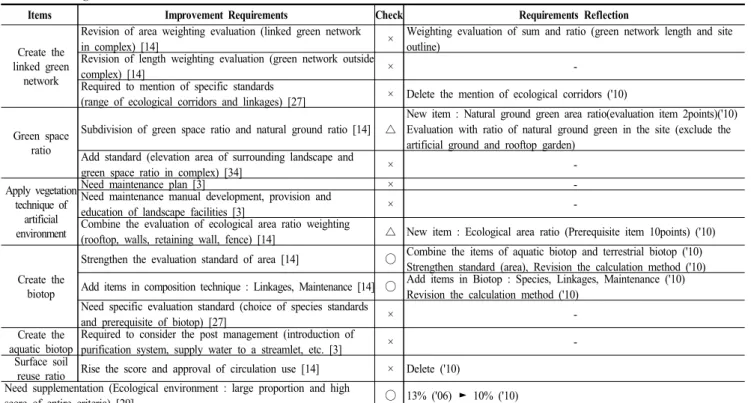
4.6. 생태환경

생태환경 부문은 현재 4개 항목으로 구성 되어 있으며, 2010년 개정시 항목 변경(6개→4개) 및 기준에 대한 변경 이 이루어졌고 이후의 개정에서는 큰 개정사항이 없었다 .

‘연계된 녹지축 조성’ 항목은 단지내부 연속된 녹지축은 면적 가중치 평가로 변경 [14]해야 한다는 요구사항이 있었지 만 , 개정이후에도 여전히 녹지축 길이와 대지 외곽길이의 합 과 비율에 대한 가중치로 평가하고 있다 . 또한 단지 외부 녹 지와의 연계성은 길이 가중치로 평가로 변경 [14]해야 한다는 요구사항도 개정되지 않았다 . 생태통로로 인정되는 범위 및 연계성 평가기준에 대한 구체적인 언급이 필요 [27]하다는 요 구사항에 대해서는 2010년 개정시 단지외부 녹지와의 연계 성 정도구분에서 생태통로에 대한 언급을 삭제하였다 .

‘녹지공간률’ 항목은 2010년 개정시 삭제되었으나 자연 지반녹지율 , 생태면적률 항목에서 녹지에 대한 부분을 평 가하고 있었다 . 단지 내 녹지공간률 뿐만 아니라 주변 경 관녹지의 입면면적을 연계한 평가기준이 필요 [34]하다는 요구사항은 개정 이후에도 주변 경관녹지에 대한 평가보 다는 외부공간 및 건물 외피의 면적을 평가하는 생태면적 률 항목을 보았을 때 이는 반영되었다고 보기가 어렵다 .

‘인공 환경 녹화기법 적용여부’ 항목은 관리자에게 친환

경요소의 적절한 유지관리 방법에 대한 정보가 제공되지

않으며 계획 및 시공시 거주 중에 발생할 수 있는 이용 및

유지관리 문제에 대한 고려가 부족하다는 문제점이 있었다 .

(9)

Items Improvement Requirements Check Requirements Reflection

Create the linked green

network

Revision of area weighting evaluation (linked green network

in complex) [14] × Weighting evaluation of sum and ratio (green network length and site outline)

Revision of length weighting evaluation (green network outside

complex) [14] × -

Required to mention of specific standards

(range of ecological corridors and linkages) [27] × Delete the mention of ecological corridors ('10)

Green space ratio

Subdivision of green space ratio and natural ground ratio [14] △

New item : Natural ground green area ratio(evaluation item 2points)('10) Evaluation with ratio of natural ground green in the site (exclude the artificial ground and rooftop garden)

Add standard (elevation area of surrounding landscape and

green space ratio in complex) [34] × -

Apply vegetation technique of

artificial environment

Need maintenance plan [3] × -

Need maintenance manual development, provision and

education of landscape facilities [3] × -

Combine the evaluation of ecological area ratio weighting

(rooftop, walls, retaining wall, fence) [14] △ New item : Ecological area ratio (Prerequisite item 10points) ('10)

Create the biotop

Strengthen the evaluation standard of area [14] ○ Combine the items of aquatic biotop and terrestrial biotop ('10) Strengthen standard (area), Revision the calculation method ('10) Add items in composition technique : Linkages, Maintenance [14] ○ Add items in Biotop : Species, Linkages, Maintenance ('10)

Revision the calculation method ('10) Need specific evaluation standard (choice of species standards

and prerequisite of biotop) [27] × -

Create the aquatic biotop

Required to consider the post management (introduction of

purification system, supply water to a streamlet, etc. [3] × -

Surface soil

reuse ratio Rise the score and approval of circulation use [14] × Delete ('10) Need supplementation (Ecological environment : large proportion and high

score of entire criteria) [29] ○ 13% ('06) ► 10% ('10)

Table 10. Ecological Environment

이의 개선방안으로 친환경요소의 지속성 향상을 위한 유지관리 계획이 필요 [3], 조경시설의 유지관리에 대한 매 뉴얼 개발 및 제공과 교육이 필요 [3]하다는 요구가 있었지 만 생태환경의 유지관리 부분은 반영되지 않았다 . 생태면적 율 공간유형과 동일항목은 생태면적률 가중치에 의한 평가 로 통합 [14]되어야 한다는 요구사항은 2010년 생태면적률 항목이 신설됨으로 어느 정도 반영되었다고 볼 수 있다 .

‘비오톱 조성’항목은 수생비오톱 조성 항목과 육생비오톱 조성 항목이 결합되어 비오톱 조성이라는 항목으로 변경되 면서 평가기준이 상향 [14]되고, 생물종, 연계, 유지관리 항목 이 추가 [14]됨으로 비오톱 조성 요구사항이 반영되었지만 사후관리가 필요 [3]하다는 부분은 반영되지 않았다('10).

‘표토 재활용율’ 항목은 평가배점 상향 및 타단지 타지 역 순환 활용도 인정 [14]해야 한다는 요구사항이 있었지만 2010년 개정시 삭제되었다.

또한 생태환경 부문에 대해서는 전체에서 차지하는 비 중이 크고 총점에 많은 영향을 미치므로 생태환경 부분에 대한 보완이 필요 [29]하다는 요구사항이 있었다. 2006년 13%(6개항목, 18점)를 차지했었지만, 2010년 개정시 가중 치가 10%(4개 항목 18점)으로 변경되어 생태환경 부문이 전체에서 차지하는 비중이 감소하였다고 볼 수 있다 .

4.7. 실내환경

실내환경 부문은 공기 , 온열, 음, 빛환경에 대한 10개 항 목으로 구성되어 있으며 , 2010년과 2011년 개정시 몇 개 항목이 추가되었다 . 또한 항목 총점은 28점, 가중치 20으 로 에너지 및 환경오염 부문 다음으로 높다 .

‘휘발성 유기물질 저방출 자재의 사용’ 항목은 유해물질

저함유 자재의 사용 (`06), 실내공기오염물질 저방출 자재의 사용 (`10)항목으로 개정되었다. 이 항목은 평가기준이 모호 하여 마감재가 적용되는 부위로 나누어 평가하여 마감재에 따라 점수를 획득하되 100% 사용하는 경우에만 배점을 획 득할 수 있게 조정이 필요 [21]하다는 요구가 있었다. 2010년 개정시 유해물질 저방출 자재는 해당부의 표면적의 최소 70% 이상 적용할 때 점수를 획득 할 수 있는 것으로 기준 이 강화되었지만 , 100% 사용하는 경우에는 미치지 못했다.

개정된 기준은 적용부위 및 자재에 따라 평가하며 , 유해 화학물질 방출량이 환경표지인증 획득기준 또는 그에 준하 는 기준에 적합한 경우에 대하여 평가하고 있다 . 이는 적용 범위를 구체화하고 배점 기준을 엄격하게 규정할 필요 [31]

가 있다는 요구사항을 다소 반영한 것으로 판단된다 .

‘건축자재로부터 배출되는 그 밖에 유해물질 억제’항목 과 ‘실내 자동온도 조절장치 체택여부’ 항목은 기준에 준 하는 결과증명을 시뮬레이션으로 보여줄 것을 제안 [1]하는 요구가 있었지만 , 건축자재로부터 배출되는 그 밖에 유해 물질 억제 항목은 2013년 개정시 삭제되었고, 실내 자동온 도 조절장치 채택 여부 항목은 크게 개정되지 않았다 .

‘자연환기성능 확보여부’항목은 2011년 개정시 ‘자연통풍 확보 여부 ’항목으로 변경되었으며 기준이 강화되었다. 또한

‘단위세대 환기성능 확보여부’ 항목이 추가 되었으며 환기 횟수 및 환기설비 설치여부에 따라 평가한다 . 이는 자연환 기성능을 단순한 면적 비율이 아닌 법정 자연환기 횟수를 만족시키는 평가기준 마련이 필요 [8]하다는 제안이 반영 되 었다고 판단된다 . 자연환기 부문에서 공간의 깊이를 고려한 항목과 , 시뮬레이션을 통한 환기의 결과를 요구하는 항목을 추가해야한다는 요구사항이 있었지만 반영되지 않았다 .

‘세대 내 일조확보율’ 항목은 6시간동안 최소 2시간의 연속

(10)

Items Improvement Requirements Check Requirements Reflection

Use of low volatile organic compound

emitting materials (2002)

Scoring depend on the finishes and when

using the 100% [21] △ Use of the low-content material of hazardous substances : evaluation item (6 points) ('06) Scoring depend on the finishes : finishing materials, adhesive, interior materials Low-emitting materials : apply at least 30% of the surface area

Use the low-emitting materials of indoor air pollutants : prerequisite item (6points, minimum 4.0 points) ('10)

Low-emitting materials : apply at least 70% of the surface area (strengthen standard) Use the low-emitting products of indoor air pollutants : prerequisite item (6points, minimum 4.8 points) ('12)

Specify a range of application and

strengthen standards [31] ○

Restriction of other hazardous substances emitting from materials

Proposed simulation evaluation [1] × Add item : check whether to use ('10) Delete ('13)

(Natural ventilation performance)

Secure the Natural ventilation

Add standard : using the number of natural ventilation based on act (0.7ACH), not a area ratio [8]

Secure the natural ventilation ('11) / 10~15% (level 1-2) ► 10~16% (level 1-4) ('11) Secure the ventilation performance per units (evaluation items 3points) : check the installation of ventilation system ('11)

Add item considering the depth of space[38] × -

Add item : requirements of the result of

ventilation through the simulation [38] × -

Adapt thermostat for

each room Proposed simulation evaluation [1] × Level 1-3 ► 1-4 ('11) Secure rate of

daylight in units

evaluation of the unit rate (secure daylight) + consideration of optimal daylight rate + secure the views through windows [41]

×

Evaluation of the unit rate(%) : continuous daylight at least 2 hours during 6 hours

► calculate the each direction weight on distance between buildings and window area ratio ('11)

Validity of care the

disabled and the elderly Apply specific and diversity standard [21] × Delete ('10) Air environment : use the performance standard indicator

(main-certification) [37] × -

Light environment : evaluate with UDI (evaluate considering

quality and quantity of daylight) [18] × -

Light environment : add standard of daylight (quality and quantity evaluation,

propose the minimum and maximum value of indoor illumination [20] × -

Light environment : add item of lighting control using the daylight system [26] × - Introduction of landscape management evaluation standard (Create a

visual openness) [10] × -

Right of light : evaluate on the indoor environment sector, rise the score [21] × Right of light : evaluate the land use and transportation sector

Use the high efficiency energy and manage [25] × -

Control and monitoring of indoor environment system [25] × -

Rise the score : thermal and light environment : [38] × -

Add items [5], Quality of lighting [26], Secure visible views [41]

Interior illuminance, glare consideration [41]

Secure visual privacy from the outside [41]

Indoor and outdoor noise level for the traffic noise, Toilet plumbing noise ('10) Secure the ventilation performance of units ('11)

Sound insulation performance of heavy and lightweight impact noise ('11) Table 11. Indoor Environment

일조를 받는 세대율 (%)평가에서 2011년 개정시 채광창 면적 및 인동간격에 따른 방위별 가중치를 계산하는 방법으로 개 정되었다 . 일조를 받는 세대율 평가와 동시에 최적의 일조율 을 위한 고려와 창을 통한 시각 환경 확보가 동시에 이루어 질 수 있는 요소가 개선 [38]되어야 한다는 제안이 있었지만, 개정된 내용은 세대율 평가에서 채광률을 평가하는 방법으로 개정되었기 때문에 반영되었다고 보기 어렵다 .

그 밖에 공기환경 부문에서는 제도의 운영상 예비인증 시 친환경 건축자재 적용여부 및 환기시스템 적용 등에 따라 등급이 설정되어 운영되고 있으나 , 향후 본인증시에 는 성능기준지표를 사용함으로써 거주자 측면에서 실질적 인 성능등급으로 인지될 수 있도록 제도화가 필요 [37]하다 는 요구사항이 있었지만 반영되지 않았다 .

빛환경 부문에서는 국내 인증제에서는 평가하고 있지 않은 자연채광에 대한 요구사항이 많이 있었다 . UDI

9)

평가를 통해 자연광의 양과 질을 평가 [18], 새로운 자연채광에 대한 기준 마련 [20], 자연채광 장치를 이용한 조명 제어 관련 항목 추가 [26]와 같은 요구사항이 있었지만 반영되지 않았다.

또한 시각적 개방감을 창출하기 위한 경관관리 평가기 준 도입 [10], 일조권 간섭방지 대책의 타당성 항목을 실내 9) Useful Daylight Illuminance

환경 부문에서 평가 및 배점 상향조정 [21], 고효율적인 에 너지 사용과 쾌적한 환경을 위한 관리방안 [25], 실내환경 시스템의 제어와 모니터링 방안 [25], 열환경 및 빛환경 배 점 상향조정 [38]의 요구사항은 반영되지 않았다.

평가항목을 보충 [5]해야 한다는 요구사항에 있어서는 2010 년 개정시 교통소음에 대한 실내 ·외소음도, 화장실 급배수 소음 항목이 추가되었고 , 2011년 개정시 단위세대의 환기성 능 확보여부가 추가되었으며 , 층간경계 바닥의 바닥 충격음 차단성능 항목이 경량 충격음 차단성능과 중량 충격음 차단 성능으로 분리되었다 . 하지만 조명의 질에 대한 항목[26], 실 내의 전반조도 , 눈부심에 대한 고려[41], 외부상황 파악 가능 한 조망의 확보 [41], 외부로부터 시각적 프라이버시 확보[41]

의 항목 신설에 대한 요구는 반영되지 않았다 .

4.8. 주택성능분야

주택성능분야는 2012년 친환경건축물 인증제와 주택성

능등급이 일원화되면서 주택성능등급인증제 항목 대부분이

유지관리 부문으로 삽입되었으나 , 2013년 개정시 주택성능

분야 부문으로 분리되었다 . 2013년 인증기준에서는 11개

항목으로 구성되어있으며 예비인증 평가시 성능등급표시에

만 적용하고 인증평가를 위한 배점은 부여하지 않고 있다 .

수치

Fig.  1.  Research  Flowchart
Table  3.  Obtained  Score  of  Item
Table  9.  Maintenance 친환경 효과에 대한 실효성을 기준으로 평가항목의 필요성에 대한 재검토가 필요[3]하다는 요구가 있었다. 하지만 중수도 설치 항목은  2010년 개정시 가산항목(4점)에서 평가항목(3점)으로 개정되었지만, 산출기준은 개정되지 않았다.4.5
Table  10.  Ecological  Environment

참조

관련 문서

The study expounds the differences in the rearing attitudes between Yanbian and Korean mothers and Jeju-do mothers through the comparative analysis of

Injury is a burden on athletes, but the rehabilitation exercise of this study suggests that the improvement of knee muscle function and knee function

The purpose of this study is to investigate the effects on elementary school students' academic English improvement, interest, and self-confidence through the

A Study on the Development of Ship’s Ballast Water A Study on the Development of Ship’s Ballast Water A Study on the Development of Ship’s Ballast Water A Study on the

A A A A Study Study Study Study Analysis Analysis Analysis Analysis of of of of the the the the J. Bach, a representative composer in Baroque period. Composed

A Study on the Temperature Dependent for Reliability Improvement of SMPS for LED Lamp.. 2017

This study was to do a comparative analysis on kinematic differences and differences in muscle activity between the skilled and the unskilled in windsurfing

근래에 연구되는 격자형 모델은 각 경계범위에서 각기 다른 변수의 영향을 정확 하게 산출하지 못하고 있으나 , 수용모델링을 병행하는 경우 높은 정확도를 추정할