• 검색 결과가 없습니다.

Study on the Evolution pattern of Tea Industry Service Mode: Focusing on the Needs of Each Generation in GuangXi, China

N/A
N/A
Protected

Academic year: 2021

Share "Study on the Evolution pattern of Tea Industry Service Mode: Focusing on the Needs of Each Generation in GuangXi, China"

Copied!
10
0
0

로드 중.... (전체 텍스트 보기)

전체 글

(1)

Study on the Evolution pattern of Tea Industry Service Mode:

Focusing on the Needs of Each Generation in GuangXi, China

Li Ping

1

, Wansok Jang

2

, Yonghwan Pan

3*

1

Ph.D, Dept. of Experience Design, Techno Design, Kookmin University.

2

Professor, College of Communication, Qingdao Univ. of Science & Tech.

3

Professor, Dept. of Experience Design, Techno Design, Kookmin University.

차 산업 서비스 모델의 변천 패턴에 대한 연구 - 중국 광시 지역 세대별 니즈를 중심으로

리핑

1

, 장완석

2

, 반영환

3*

1

국민대학교 테크노디자인전문대학원 박사,

2

청도과기대 커뮤니케이션대 교수,

3

국민대학교 테크노전문대학원 교수

Abstract Since 2020, the GuangXi government of China has focused on the deep integration of tea industry with leisure and cultural tourism, popular science education, health care and elderly care industries. Among the output value targets of the tertiary industry, the GuangXi government plans to achieve 25 billion yuan, and the tea industry is developing rapidly. Through questionnaire survey, field research and interview, this paper studies the differences of demand behavior and selection attributes of tea products among consumers in different years, and finally studies the evolution pattern of service mode of tea industry in GuangXi. The results show that there are obvious differences in life and work style, shopping habits, service design, user experience, social needs and personality needs of each generation consumers in different years. Based on the analysis of demand and behavior habits of tea products, the evolution pattern of service mode of tea industry in GuangXi is studied. Based on the above results, according to the differences of consumers' choice of tea products in different years, the service mode of tea industry in GuangXi is improved The development of tea industry in service design, user experience level is worthy of in-depth attention.

Key Words : GuangXi Tea industry, Generation needs, service model, evolution pattern, UX;

요 약 2020년부터 중국 광시 지방정부는 차 산업과 레저 문화 관광, 과학 보급 교육, 양생 양로 등 산업의 심층 융합에 주목하고 있다. 또한 차 산업이 빠르게 발전하고 있어 3차 산업 생산 목표치를 250억 위안으로 계획하였다.

본 연구는 세대별 소비자에 대한 설문조사, 현지조사, 전문가 인터뷰 등을 통하여 차에 대한 니즈와 선택의 차이에 대해 분석하여 광시 차 산업 서비스 모델의 변화 패턴을 연구하였다. 연구 결과에 따르면, 소비자는 세대별로 생활 방식, 쇼핑 습관, 서비스 디자인, 사용자 경험, 사회적 니즈, 개인적 니즈에서 뚜렷한 차이가 있다. 이에 차 제품에 대한 니즈와 행동 패턴을 분석하고 광시 차 산업 서비스 모델의 패턴 변화에 근거해보면, 세대별 소비자의 차 선택의 차이가 차 제품의 수요, 행동 패턴에 유의미한 차이와 패턴 변화를 발견할 수 있다. 끝으로 차 산업의 발전을 위한 서비스 디자인, 사용자 경험 모델 개발의 필요성을 주목하고 있다.

주제어 : 광시 차 산업, 세대별 니즈, 서비스 모델, 변화 패턴, 사용자 경험;

*Corresponding Author : Yonghwan Pan([email protected]) Received April 19, 2021

Accepted June 20, 2021 Revised April 22, 2021

Published June 28, 2021

(2)

1. Introduction

1.1 The research background and purpose In the people-oriented concept, the current huge market demand of China's service industry indicates that China's user experience design industry has great potential, and the concept of user experience design and the application of experience design are playing an increasingly important role in daily human life. According to the current situation of the development of tea agriculture in Guangxi, Guangxi, as an important tea planting and processing area in southern China, Guangxi has a large tea planting area, including 49 counties (districts) of 13 cities were planted tea, according to statistics, in 2017, GuangXi tea garden area is more than 70000 mu, the production is more than 60000 tons, GuangXi as the main tea production areas of China, tea industry plays an important role in China[1-3].

As the important tea-producing areas, the brand awareness of the tea industry in GuangXi, tea production and sales data in GuangXi are worrying,according to statistics, in 2014 published by the Chinese tea area public brand value ranking in the top, only 3 of GuangXi area public brand, in 2014 the top 100 Chinese tea enterprise product brand value, only 4 tea enterprises in GuangXi for[4,5]. In order to promote the development of tea industry in GuangXi, in consumer demand for tea product behavior and select properties on the related basic research needs to be done, especially for consumer's age, different layers of different s preference analysis, in the ways of tea products use, choice of space, do detailed analysis, therefore, this research to consumers, differents behavior of tea products demand and select properties are studied, the user experience design of tea industry in GuangXi to promote tea products, tea and related product marketing to pro.

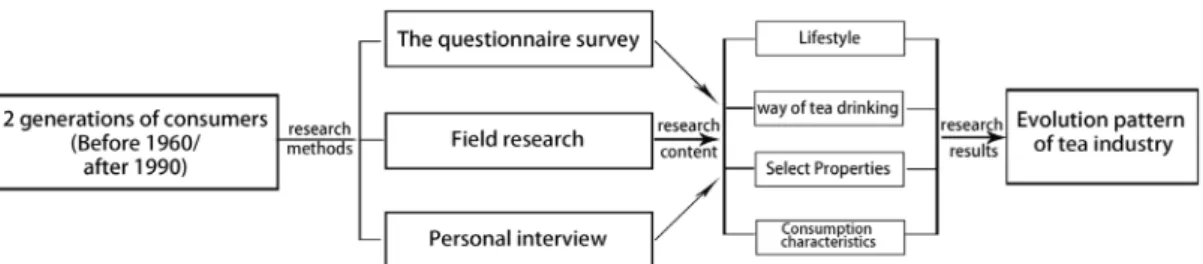
1.2 Research methods and composition The methods of this study are questionnaire survey, field study and personal interview. The respondents are mainly from 14 cities in GuangXi region of China, and the people born before 1990 and 1960. In order to understand the differences of the respondents' demand behavior and selection attributes for the tea industry, a questionnaire was prepared based on the previous research and preliminary research, and the self-registration questionnaire survey method was adopted. Field research: conducted field investigation and research on 13 tea industrial parks in GuangXi. The whole research lasted for 30 days, and special interviews were carried out, mainly in the form of audio recording, video recording and interview. The paper is organized as follows. Firstly, the background and purpose of the research are described. Secondly, the theoretical consideration of the lifestyle, tea drinking style, consumer demand behavior, these are the basis of the study. Thirdly, the research model and research problem are put forward, and the research method and process are described. Fourthly, the research results are analyzed and discussed. Fifthly, the conclusion is described.

2. Theoretical background 2.1 Life style

GuangXi is inhabited by many ethnic groups.

There are 12 ethnic groups that live for

generations, including Zhuang, Han, Yao, Miao,

Dong, Mulam, Maonan, Hui, Beijing, Yi, Shui and

Gelao. In addition, there are 44 other ethnic

groups such as Manchu, Mongolian, Korean, Bai,

Tibetan, Li and Tujia. As of December 2016,

GuangXi's permanent resident population was

45.379 million, among which 21.8532 million

were ethnic minorities, accounting for 45.17% of

(3)

the total permanent resident population of GuangXi[6-9]. In GuangXi province, there are some of the longevity of the township, local residents have a traditional drink camellia, drink and residents of the traditional social life style, experts GongCheng yao autonomous county of GuangXi, SanJiang dong autonomous county, such as area, the residents were investigated, and found that residents of camellia tea polyphenol content in nutrients up to 100 mg / 100 ml, sodium ion content of 327.00 mg / 100 g. The dietary salt intake of residents in oil tea area is 12g/d, much higher than the average level of GuangXi 8.7g/d, but the prevalence of diabetes is 1.4%, and the rate of dyslipide mia is 24.9%, both lower than the average level of GuangXi.

Drinking oil tea is beneficial to health[10-13].

Divided according to age characteristics, can be divided into the modern social life style, the traditional way of life, 45.17% of the ethnic minorities in GuangXi is still the continuation of the traditional way of social life, in the life continue the tradition of drinking tea, drink camellia, lifestyle and minority nationality, ethnic way of drinking tea, drink camellia also vary. The rest of the population will integrate into the modern life style and slowly accept the changes brought by new things, such as coffee, milk tea and so on.

2.2 Drinking tea way

The ancient and modern ways of drinking tea have great changes. The most primitive way of drinking tea started from soup, and then developed into boiling tea, frying tea, ordering tea and brewing tea. Tea can be drunk everywhere in life. In modern times, with the change of tea production, a variety of tea products appeared in the way of tea drinking, and the consequent changes in the way of tea drinking echoed the work and life of human beings. Therefore, different forms of tea drinking have emerged. Pure drinking: when making tea

soup, the original tea is injected with water to get the true fragrance and pure taste of tea, such as green tea and black tea, etc. Mixing: after making tea, add a variety of condiments, such as green tea milk, matcha milk, brown sugar milk tea, etc. Drink green tea, black tea, scented tea, oolong tea drinking method, etc, being equipped with by tea set, the requirements of the water, put in the amount of tea, soaking time and so on are varied from tea, tea such as oolong tea drinks in the recommended or, deserve to go up small cup, boiling water for brewing for many times, successive makeovers, the fragrance of different brewing times have different performance. Boiling and drinking: most of the tea types with boiling and drinking methods are compressed tea, such as boiling milk tea and oil tea. Ready-to-drink: Instant tea and liquid tea, the main feature is no tea residue, such as canned tea can be ready to drink[14-16]. With the evolution of the tea industry and the emergence of the diversification of tea products, the way of tea drinking is also changing. In the traditional social life style of GuangXi, under the influence of people's life, work and social interaction, people continue to accept new ways of tea drinking, and people's way of tea drinking is also changing constantly.

2.3 Consumer demand

In the consumption of tea products,

consumers focus on brand, function, price and

experience in demand. Demand behavior reflect

the two ways of online and offline consumption,

based on taobao, cooperation with China is

facing the whole country network consumer

survey data, based on the theory of consumer

decision process model, basic attribute and

comparative analysis our country network

consumers purchase behavior characteristic,

found that China's online consumers focus on

product features, specifications and prices, and

commodity prices bear ability and gender, age,

(4)

Table 1. Research model

obvious relationship;

The quality of goods and services is the most important factor affecting consumers' repeated purchase, and the influence of other factors varies greatly with age. Makeup and care products may become the top three categories, while tea products in food category are not in the list of hot sales. The data analysis based on the survey of tea purchase forms shows that in order to meet the consumer demand for tea products, consumers prefer to buy tea in physical stores[17].

3. Study design

3.1 Research problem and research model In order to understand the life style and tea drinking style of the respondents, and take the elements of life style as the standard, this study studies the differences in the demand behavior and choice attributes of tea products between two consumers of different ages, and put forward research model. The problems studied according to the model are as follows: Firstly, the demand behavior of consumers of different ages is different; Secondly, the tea drinking habits of consumers of different ages are different.

Thirdly, different age groups of consumers have different living habits. Fourthly, different ages is different Table 1.

3.2 Research dimension and questionnaire composition

For different ages, this study mainly on consumer age level classification, born in 1990 years and 1960 years ago people as main the consumption behavior of consumers of research object, to carry out the preference analysis, in the tea products selection and use, the choice of tools, space, ways of shopping, services, analysis of the survey, through the investigation content, get relevant data, the consumers of two ages, the differences in traditional and modern way of life, way of drinking tea, select properties, behavior analysis, and finally summed up the different s consumer demand for tea product behavior and select properties differentiation, Forming an analysis of social, fashion, personality and experience dimensions.

3.3 The research methods

This study adopts two methods: questionnaire survey and field study. Questionnaire survey is a self-filled questionnaire made by Questionnaire Star. Questionnaire is distributed through mobile phone and data is collected in the background.

The first test questionnaire will be issued in May 2020. After the revision and adjustment of the questionnaire, the formal questionnaire will be issued in July. The questionnaire distribution cycle lasts for 7 days. Field research scope is GuangXi in China, the research object is:

Zhaoping Nanshan Tea Sea Tea Garden, SanJiang

(5)

NO Name Position Interview satisfaction 1 Li Tingyu

Manager of Tea Industry Company

"Planting area, varieties, present situation, satisfied with the work, the tourists to participate in the tea garden planting experience interactive situation, etc.

☑□ ☑□

2 Tan Shuifeng ☑□

3 Huang Jinrui ☑□

4 He Shiming ☑□

5 Zhou Ruxi ☑□ ☑□

6 Meng Yinfeng ☑□ ☑□ ☑□

7 Mo Xuehua

Tea product production and processing technician

"Whether tea products production and processing present situation, types, species are on the increase, production etc.

☑□

8 Liu Chusheng Tea Industry Researcher

The "tea of the trace element selenium content, the new element, health tea, such as the present situation of the ecological agriculture. ☑□

9 Yang Songjv Tea

plantation professional technician

"Tea product sales, the number of tourists, tourists' satisfaction, before and after the outbreak of influencing factors, etc.

☑□ ☑□

10 Ou wenke ✖□

11 Wei xugui ☑□

12 Luo Zhengping Government administrator s of tea industry

Government support tea farmers, the investment of manpower and money policy, effect, etc.

☑□

13 Wei Zhisen ☑□

14 Liao Fuquan ☑□

Table 2. Specialist interview research

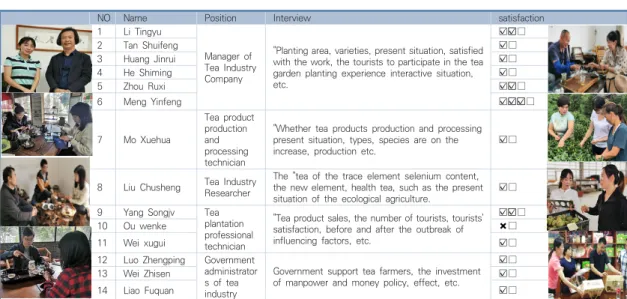
Gao You tea garden tea tea garden, general feng tea group, GongCheng camellia town, GuiLin tea science institute, flat cliff tea garden, tea garden, NanNing, yangshuo QiXian peak brick tea city, GuiPing XiShan tea garden, fructus momordicae characteristic town demonstration base, yong fu f-fook herbal tea co, LTD. Production and processing base, your port gangbei GuiXin tea plantations, HengXian jasmine tea plantations, has carried on the field research to 13 tea industrial park and specialist interview, the whole operation lasted for 30 days, the main use of audio, video, interview form Table 2.

3.4 Research data analysis methods

The data collected in this study were analyzed results by SPSS software. The contents of the analysis were as follows:1.Understand the demographic characteristics of the respondents, divide and compare the age levels, and conduct frequency analysis;2.Understand the respondents' demand behavior for tea products, and conduct factor analysis; 3.Cluster analysis and cluster analysis were conducted to understand the selection attributes of tea products by surveyors;

4. Understand the consumer demand of the

respondents and conduct factor analysis;5.

Conduct field research and special person interview for analysis; Finally, a summary and descriptive analysis is made on the survey data, and the evolution pattern of service mode is analyzed to obtain the research results Table 3.

4. Research results

4.1 Characteristics of consumers in different ages

Through the survey, the demographic characteristics of 225 respondents were analyzed, and the following analysis results were obtained.

First, in terms of the age group of respondents,

69 people were born after 1990 (aged 20-29),

accounting for 30.7%, and 59 people were born

before 1960 (aged over 50), accounting for

26.2%. Among them, people aged 20-29 years old

(born after 1990) are mainly defined as young

years old (born before 1960), who are defined as

old people in this study. Second, the gender of

the people in this study, followed by people over

50 respondents: 137 females, accounting for

60.9%, and 88 males, accounting for 39.1%.

(6)

NO Research object Interaction

points Time Tea garden

area (Unit: Mu)

Annual output (unit: kg)

Number of tourists received (unit:person)

Income satisfa-

ction The problem

1 Sanjiang GaoYou tea garden 4 2019/7 3000 1300 30000 ☑□ Products less

2 Yangshuo Seven Immortals Peak

Tea Garden 2 2019/10 1450 680 35000 ☑□ ☑□ Products less

3 ZhaopingNanshan Tea Sea Tea

Garden 2 2020/8 2000 800 12000 ✖□ Few tourists

4 Teagarden of Guilin tea industry

research institute 3 2020/8 800 450 20000 ☑□ Products less

5 PingleCounty Stone Cliff Tea

Garden 2 2020/10 850 430 800 ✖□ Few tourists

6 Maojian TeaGarden in Qin Tang 2 2020/11 1300 650 600 ☑□ Products less /

Few tourists 7 Guiping Xishan TeaFactory Tea

Garden 2 2020/12 900 520 25000 ✖□ Few tourists

8 Jiangjunfeng TeaGroup 1 2020/10 1670 1500 15000 ✖□ Few tourists

9 Gongcheng oiltea town 3 2020/12 1100 600 40000 ☑□ Bad

experience 10 Luohan fruit characteristic town demonstration base 2 2020/12 1350 700 5000 ✖□ Bad

experience

11 NanningGolden Brick Tea City 3 2020/12 0 2000 50000 ☑□ ☑□ Bad

service 12 Yongfu fu fu luohanfruit co., LTD. Production and processing base 0 2020/12 0 1800 0 ✖□ No tourists

13 HengxianJasmine Tea Garden 3 2020/12 1400 1000 25000 ☑□ ☑□ Products less /

Bad service Table 3. Key issues of field research project

Thirdly, from the perspective of the occupation of the respondents, the respondents in this survey are mainly public servants (22.2%), teachers (22.7%) Table 3. Key issues of field research project and enterprise managers (17.8%), while others include retirees, workers and farmers. The demographic characteristics of respondents. (N = 225%) 4.2 Tea product type selection

Among the results of this survey on tea drinking methods, 1. When choosing drinks, most respondents chose tea products (tea/milk tea, etc., accounting for 58.67%), plain boiled water/mineral water (56%), followed by milk drinks (25.78%). 2.

The main types of tea in the survey are black tea (59.11%) and green tea (54.67%). 3. Camellia oil is the most commonly eaten tea products containing tea ingredients among the respondents (accounting for 61.33%), and it is a kind of tea drinking in GuangXi, China (a regionalized eating habit in GuangXi). 4. The research subjects usually drink tea from ordinary cups (44.89%), and relatively speaking, the research subjects have no special

requirements on tea utensils (utensils).

4.3 Need behavior difference

The survey results of the demand behavior of tea products are shown below: 1. In the choice of tea drinking environment, home (67.11%) and work environment (53.78%) are the two main demand choices, followed by some offline physical stores such as tea shops (40%). 2. In terms of the difference in time demand, it is mainly the tea break time at work (60.44%), the party time with friends (52.44%), the other time is the morning and noon time (36.44%), and the time when going shopping or shopping (28.89%). 3. Most people drink tea with people they are close to, such as77.33% of the respondents have used products containing tea. Toothpaste containing tea is the most commonly used product (accounting for friends (73.33%) and parents/family (46.67%). 4.

57.78%), because toothpaste is a necessity in our

daily life, followed by beauty products containing

tea (accounting for 23.11%) and shampoo (30.67%)

Table 4.

(7)

Research

content(Demand) Factor1(%) Factor2(%) Factor3(%)

Environment Home

(67.11%)

In the work

(53.78%) Tea shop(40%)

Time Tea break

(60.44%) Party

(52.44%) Morning/Mid-aft ernoon (36.44%) Companion Good friend

(73.33%)

Working partners (44.89%)

Family (46.67%) Tea products Toothpaste

(57.78%) Shampoo

(30.67%) Skin products (23.11%) Tea demand

(target: parents)

Green tea

(50.67%) Black tea

(35.11%) Others (22.22%) Tea demand

(target: young people)

Black tea

(59.11%) Green tea (54.67%)

Green (oolong) tea (24.99%)

Beverage demand

Milk tea type drink (58.67%)

Water (56%)

Fruit and vegetable juice(27.11%) Table 4. Consumer demand behavior differences

Research

content(Demand) Factor1(%) Factor1(%) Factor1(%) Consumption

patterns (online) Not used

(60.44%) Once a

month(16%) Once a week(9.33%) Shopping time No queue

(32.89%)

Wait within 10 minutes (31.11%)

Morning/Mid- afternoon (36.44%) Online shopping

prevention Not used (54.22%)

App shopping (take-out) (29.78%)

Brand app(17.78%) Tea product

demand Toothpaste

(57.78%) Shampoo

(30.67%) Skin products (23.11%) Use of tea

products Self use

(81.49%) Gift (50.36%) Visit gifts(29.5%) User experience

selection

Vision and taste (88.29%)

Price comparison experience (60.43%)

Cultural experience(40.

29%) Offline shopping

demand

Taste experience (34.67%)

Tactile experience(3 2.44%)

Not required (28.89%) Table 5. Differences of consumers' choice attributes

4.4 Selection attribute difference

The tea product selection properties investigation results are shown below: on tea consumption time, one-third of the people don't want to line up shopping (32.89%), time also is not willing to pay, willing to wait for the time about one third of people in 10 minutes (31.11%), merchants can improve efficiency in the product production, reduce the waiting time of consumers. 2. Attribute of shopping mode and frequency of tea products: in online shopping, 60.44% of the respondents did not participate in online shopping, and the frequency of monthly (16%)/weekly (9.33%) shopping was low. 3. As for the choice of shopping channels of tea products, takeout (shopping on APP) is the most (29.78%), but 54.22% of the people have not bought tea products online; 61.78% of consumers choose to buy tea products in physical stores. 4. Among the purposes of purchasing tea products, most of them are for their own use (88.49%), followed by givers and friends (50.36%), and given to non-local guests as local specialties Table 5.

4.5 Analysis of Evolution Pattern

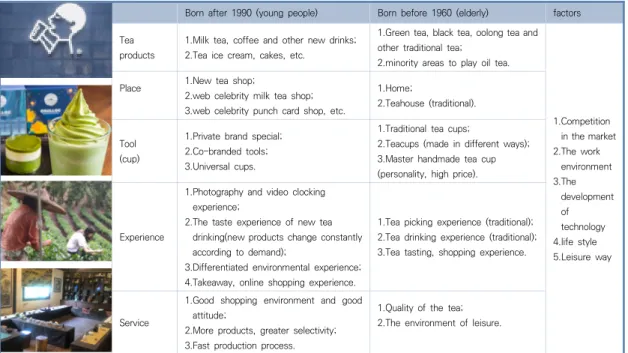
Field research and interviews: 1. Conducted field research on 13 tea industrial parks in Guang Xi; 2. In the interview, professional technicians of tea plantation planting, technicians of tea product production and processing, researchers of tea industry, managers of tea industry companies and government administrators of tea industry were interviewed and given feedback on the service design mode of tea industry.

Tea-plant professional technician: old people more attention of se-enriched tea products, attention to intake of trace element, more and more attention to health; Young people pay less attention. Technician in the production of tea:

the elderly demand for tea products tend to be

more traditional, more requirements for the tea

category; Young people have more demands for

varieties and types of products, and the output of

products containing tea elements is increasing

year by year, such as skin care products, food

and new tea drinks containing tea elements. Tea

industry researchers: the elderly have more

(8)

Born after 1990 (young people) Born before 1960 (elderly) factors Tea

products

1.Milk tea, coffee and other new drinks;

2.Tea ice cream, cakes, etc.

1.Green tea, black tea, oolong tea and other traditional tea;

2.minority areas to play oil tea.

1.Competition in the market 2.The work

environment 3.The

development of technology 4.life style 5.Leisure way Place 1.New tea shop;

2.web celebrity milk tea shop;

3.web celebrity punch card shop, etc.

1.Home;

2.Teahouse (traditional).

Tool (cup)

1.Private brand special;

2.Co-branded tools;

3.Universal cups.

1.Traditional tea cups;

2.Teacups (made in different ways);

3.Master handmade tea cup (personality, high price).

Experience

1.Photography and video clocking experience;

2.The taste experience of new tea drinking(new products change constantly according to demand);

3.Differentiated environmental experience;

4.Takeaway, online shopping experience.

1.Tea picking experience (traditional);

2.Tea drinking experience (traditional);

3.Tea tasting, shopping experience.

Service

1.Good shopping environment and good attitude;

2.More products, greater selectivity;

3.Fast production process.

1.Quality of the tea;

2.The environment of leisure.

Table 6. Evolution pattern of service mode of tea industry

leisure time and greater demand for tea culture tourism experience, especially in the international tourist city of GuiLin, NanNing, capital of GuangXi, and the tea tourism culture of Dong nationality in Sanjiang, Liuzhou. The elderly are more in pursuit of diversity and comfort of service and experience. Due to the influence of work and economic factors, young people have less demand for tea travel culture. Tea industry company manager: the elderly more, sleeve mountain terrain, GuangXi tour tea cultural sites away from the downtown, the elderly travel not convenient, is one of the important factors affecting tea tour experience, tour the tea culture must study experience programs and services for the elderly, to research deeply into increased capital investment; The majority of young people accompany the elderly to participate in the cultural experience of the tea tour. For young tourists, more services and experiences that young people pay attention to, such as new tea drinks, refreshments and tea meals, should be added. Government regulators

of tea industry: increasing the government's money and services, consumer demand is different, all ages need to in-depth research, the tea garden road repair and service improvements, such as the elderly protection measures and add more services and project experience Table 6.

5. Conclusion

This study investigated the differents consumer

demand for tea product behavior and select

properties, according to a 225 survey data of

feedback, 13 the results of field investigations

and 14 specialist interview, analyzed the two age

groups preference, in the tea products use,

select, manners of shopping to do investigation

and analysis, through the investigation content,

get relevant data, Finally, the evolution pattern

of tea industry service mode was studied. First of

all, young people born after 1990 and old people

born before 1960, the main objects of this study,

tea product demand behavior has three factors:

(9)

life factor, work factor, shopping habit factor;

There are a large proportion of ethnic minorities in GuangXi, and the unique product types and customs of each ethnic group are different.

There is ethnic differentiation, which has an impact on life and work factors. Shopping habits are also related according to the behavior habits of consumers of different ages. Second, there are three factors in the attribute level of tea product selection: Experience demand, social demand and individuality demand, according to the different consumer demand for tea products, tea industry businesses in improving selectivity factor, industry sales of "tea product experience",

"product output efficiency", and "tea product research and development" in terms of improving the selective factors of industrial sales methods.

Analyze the different needs and behavior habits of consumers in different ages for tea products, and make more differentiated experience methods that reflect ethnic characteristics. Third, young people and old people should form greater rules and differences in tea products, places of use, tool selection and service mode. This study is of great significance to promote the development of user experience design for the tea industry in GuangXi and provide better basic information for the marketing of tea products in GuangXi.

REFERENCES

[1] L. Ruijing. (2019). Consumer online behavior research, Guide consumption , (000)012 , 169-170.

[2] J. Jianxuan & J. Wenfeng. (2018). Discussion on the Development Status and Countermeasures of Guangxi Tea Industry. Public Science and Technology , 20(30) , 67-68.

[3] M. HuaiHong. (2016). the tea industry development present situation and countermeasures of sustainable development in GuangXi. Journal of southern agriculture. 47(06) , 1051-1056.

[4] H. I. Kuo, C. C. Chen, W. C. Tseng, L. F. Ju & B. W.

Huang. (2008). Assessing impacts of SARS and avian flu on international tourism demand to Asia. Tourism Management, 29(5) , 917-928.

[5] Y. Yue. (2008). Chun common tea . Shanghai : people's publishing house. ISBN:9787208077584.

[6] Y. J. fan. (2008. January). When in Rome, do as the Romans do tea prophet China's ethnic minorities and hakka tea culture. Xiamen university press . ISBN:9787561530627.

[7] Y. Chao & F. Zhiping. (2016). Optimal Allocation of Service Elements Considering Customer Choice Behavior. Journal of Northeast University (Natural Science Edition ), 37(06) , 904-907.

[8] X. Yong. (2017. August). Study on the acceptability factors of consumers' online purchase of tea products. Proceedings of the 7th International Conference on Information Communication and Management. (pp. 122-126).

[9] C. Meimei & D. Pingjun. (2017. September). The Characteristics of Online Consumer Behavior in China. China Circulation Economy, 80-85.

[10] W. Jin. (2018. January). Application of reference group influence mode in tea consumption behavior.

Fujian Tea, 274-275.

[11] X. Min. (2018. March). Analysis on personalized consumption behavior of tea products in wechat business era. Fujian Tea, 52.

[12] G. Yaling. (2009. January). Evolution of tea drinking style. College of Horticulture, Dujian Agriculture and Forestry University, 34-36.

[13] H. Yuxia & D. Meng. (2017. May). Research on Integrated Development of Tea Tourism Industry in Ethnic Regions from the Perspective of Whole Tourism - A Case Study of Longsheng Ethnic Ethnic Autonomous County in Guangxi. Tourism Forum , 120-128.

[14] Y. Xuyang. (2018). A Discussion on China's Tourism Development - China's Tourism Development Strategy in the New Era. Tourism Journal, 1-3.

[15] D. Xuefeng. (2018). Help deepen reform in an all-round way - the core strategy of tourism in the new era. Tourism Journal , 12-13.

[16] Z. Xi & H. Fei. (2018). Research on General Strategy Process of Service Design. Packaging Engineering , 42-47.

[17] L. Yaya. (2017). Thoughts and Suggestions on the

Development of Agro-Eco-tourism. Journal of

Agricultural Engineering , 162, 191-192.

(10)

리 핑(Li Ping) [정회원]

․ 2005년 9월 : 광시사범대 시각디자인 과 (학사)

․ 2009년 9월 : 광시사범대학 미술학과 (석사)

․ 2019년 3월 ~ 현재 : 국민대학교 테크 노디자인 전문대학원(박사)

․ 관심분야 : UX, AI, 서비스 디자인

․ E-Mail : [email protected]

장 완 석(WanSok Jang) [정회원]

․ 1997년 2월 : 성균관대학교 한국철학 과(학사)

․ 2000년 6월 : Wuhan Univ. 미학과 (석사)

․ 2004년12월 : Wuhan Univ. 미학과 (박사)

․ 2020년 12월 ~ 현재 : 칭다오과기대 (QUST) 커뮤니케이션대학 교수

․ 관심분야 : 사용자 경험, 서비스 디자인

․ E-Mail : [email protected]

반 영 환(Yonghwan Pan) [종신회원]

․ 1991년 2월 : 한국과학기술원 산업공 학과(공학사)

․ 1993년 2월 : 한국과학기술원 인간공 학(공학석사)

․ 1999년 8월 : 한국과학기술원 인간공 학(공학박사)

․ 2006년 9월 ~ 현재 : 국민대학교 테크 노디자인전문대학원 교수

․ 관심분야 : 인터랙션 디자인, 사용자경험(UX)

․ E-Mail : [email protected]

수치

Table  1.  Research  model
Table  2.  Specialist  interview  research
Table  6.  Evolution  pattern  of  service  mode  of  tea  industry

참조

관련 문서

This study is based on the fact that demand for housing has been under the influence of change of population structure... people live in

This thesis is the study of natural images seen through the sensible eyes of a researcher, more specifically focusing on the contemplation of nature

At last, the paper comparative study on South Korea and China consumer's overseas travel pattern and travel behavior and predict the South Korea's and

In particular, the Basic Electric Power Supply and Demand Plan shows only the generation of low and intermediate level radioactive wastes in units of 10 years,

Although specifically compared in the acts, this study has the limit of being explored focusing on the legislation. Therefore, in the future, resear- chers have to study

출처 : IAEA 발표 자료(Comprehensive inspection exercise at bulk handling facilities, “U-235 Enrichment measurements by gamma-ray spectroscopy”) 13.  Uranium

1 John Owen, Justification by Faith Alone, in The Works of John Owen, ed. John Bolt, trans. Scott Clark, "Do This and Live: Christ's Active Obedience as the

In this study, the different codes were compared and analyzed for the research on decontamination and decommissioning waste generation by using the codes