*Corresponding author: Young Gyu Phee, Tel: 053-819-1590, Fax: 053-819-1208, E-mail: [email protected] Faculty of Health Science, Daegu Haany University. 1 Hannydae-ro, Gyeongsan-si, Gyeongbuk 38610 Received: December 15, 2015, Revised: December 20, 2015, Accepted: December 23, 2015
This is an Open-Access article distributed under the terms of the Creative Commons Attribution Non-Commercial
License(http://creativecommons.org/licenses/by-nc/3.0) which permits unrestricted non-commercial use, distribution, and reproduction in http://dx.doi.org/10.15269/JKSOEH.2015.25.4.584
토공사 현장에서 발생하는 공기 중 석영의 노출 평가
성은창1ㆍ배혜정1ㆍ정종현2ㆍ피영규2*
1대구한의대학교 산업보건연구소, 2대구한의대학교 보건학부
Exposure Assessment of Airborne Quartz from Earthwork Sites
Eun Chang Sung1·Hye Jeong Bae1·Jong-Hyoen Jung2·Young Gyu Phee2*
1Institute for Industrial Health, Daegu Haany University
2Faculty of Health Science, Daegu Haany University
ABSTRACT
Objectives: The purpose of this study was to evaluate quartz concentrations in airborne total and respirable dusts.
Materials: Respirable dust samples were collected using a 10 mm aluminum cyclone equipped with a 37 mm5 ㎛ pore size PVC filter. Total dust samples were collected with a three stage cassette from three work sections at earthwork sites located in the South Chungcheong-do Province area.
Results: The geometric means of quartz concentrations were 0.008 ㎎/㎥ and 0.004 ㎎/㎥ in total dust and respirable dust, respectively.
The geometric means of quartz contents analyzed by FTIR were 3.74% in total dust and 3.16% in respirable dust. The geometric mean of quartz concentrations and contents in secondary blasting operations were higher than those in other operations.
Conclusions: Given that secondary blasting operations had higher quartz concentrations, there is a need to reduce respirable dust, such as through wet operations.
Key words: concentration, earthwork, quartz
I. 서 론
최근 들어 건설업은 재개발과 재건축, 대형건물의 신축공사, 도로공사 등과 같은 건설공사의 증가로 인 해 비산분진 등에 대한 문제가 흔하게 대두되고 있 다(Yu, 2002). 특히 건설현장 중 비산분진이 가장 많 이 발생하는 공사는 토사를 굴착하고 운반하는 작업 이 이루어지는 부지조성공사와 토공사이다(Yu et al., 2004). 이 중 토공사는 건설공사에 있어 가장 기본적 인 작업인 흙파기, 흙막이, 운반, 되메우기 등의 과정 을 통하여 지하구조물 등을 구축하기 위한 공사이며, 가장 먼저 시행되는 공정은 굴착공사이다(Han et al., 2003). 미국 직업안전보건청(Occupational Safety and
Health Administration, OSHA)에 따르면 굴착공사 시 흙을 깎고 작업환경에 따라 돌을 발파하게 되는데 콘크리트 또는 이와 유사한 물질을 분쇄, 드릴링, 연 삭 및 절단공정에 근로자들은 결정형 규산에 노출될 수 있다고 보고하고 있다(OSHA, 2009).
이러한 결정형 규산 중 가장 대표적인 물질인 석영 이 함유된 호흡성분진에 노출될 경우 진폐증의 한 종 류인 규폐증이 발생되며(Weber & Banks, 1994;
Hogan, 1995), 악성종양 및 만성폐쇄성 폐질환, 자가 면역 질환 등도 유발 가능성이 있다(MoEL, 2005). 이 에 국제암연구기구(International Agency for Research on Cancer, IARC)에서는 석영 등을 포함한 결정형 규 산 동형이성체를 인체 발암물질(Group 1)로 분류하고
있으며(IARC, 1997), 미국 산업위생전문가 협의회 (American Conference of Governmental Industrial Hygienist, ACGIH)에서도 인체 발암의심물질(A2)로 구분하고, 석영의 노출기준을 호흡성분진으로서 0.025 ㎎/㎥로 권고하고 있다(ACGIH, 2015). 우리나 라도 현재 석영을 호흡성분진으로 사람에게 충분한 발암성 증거가 있는 물질인 발암성 1A로 분류하고 있으며 노출기준은 ACGIH보다 다소 높은 0.05 ㎎/㎥
로 제시하고 있다(MoEL, 2013b).
한편, 미국에서는 석영 등 결정형 규산의 노출로 인한 사망자 10% 정도가 건설업 종사 근로자로 알 려져 있다(KOSHA, 2010). 최근에는 우리나라 건설 업에서도 진폐증이 발생되고 있는데 2011년에는 52 명, 2012년에는 60명이 직업병자로 보고된 바 있다 (MoEL, 2012; MoEL, 2013a).
이런 이유로 외국의 경우 건설현장의 시멘트 분진 에 대한 개인 노출평가(Peters et al., 2009), 건설공사 현장에서의 결정형 규산의 노출 수준(Radnoff et al., 2014) 등 다양한 연구가 진행되어져 왔다(Mieke et al., 2001; Woskie et al., 2002). 그러나 국내에서 석영 의 노출수준과 관련된 연구는 1980년대부터 주 대상 이 석탄 광업이었으며(Choi et al., 1987, Song & Lee, 1994), 제조업의 경우 주물, 요업, 시멘트 및 콘크리 트 등 여러 사업장을 대상으로 노출평가가 수행되었 다(Jeoung et al., 1995; Phee et al., 1997; Kim et al., 1998; Kim et al., 1999; Bae et al., 2013).
그러나 석영에 노출되는 건설업 근로자가 다수임 에도 불구하고 공사 진행에 따라 작업공정 종류와 장소가 수시로 변화되는 업종의 특성상 국내에서는 토공사 현장에서 발생하는 공기 중 석영에 대한 노 출평가는 아직 수행된 바 없다.
따라서 본 연구는 토공사 현장에서 발생하는 분진 과 석영의 노출수준을 파악하여 근로자의 건강보호 와 적절한 관리방안을 마련하기 위한 기초자료를 제 공하는데 목적이 있다.
Ⅱ. 대상 및 방법
1. 연구 대상
본 연구는 2014년 8월부터 10월까지 세종시에 위 치한 건설현장의 토공사 3개의 작업 구간을 대상으
로 하였으며, 현장에서는 발파 전 천공 작업, 운반 작업 그리고 소할 작업이 진행되고 있었다. 천공 작 업장에는 천공기 1대와 작업을 감독, 보조하는 근로 자가 배치되어 있었고, 운반은 굴삭기, 덤프트럭이 작업을 수행하고 있었으며, 소할 작업은 브레이커 1 대로 공사가 진행되고 있었다.
2. 연구 방법
1) 공기 중 분진의 채취
총분진은 미국 국립산업안전보건연구원(National Institute of Occupational Safety & Health, NIOSH)의 0500 공정시험법을 활용하여 PVC 여과지(Poly Vinyl Chloride, SKC, USA, 직경 37 mm, 공극 5 ㎛)를 3단 카세트(3-piece cassette) 홀더에 장착하여 채취하였고 (NIOSH, 1994), 호흡성분진은 NIOSH 0600 공정시험 법에 따라 PVC 여과지를 2단 카세트에 담아 알루미 늄 사이클론(Aluminum cyclone, SKC, USA)에 장착 하여 사용하였다(NIOSH, 1998). 고유량 펌프(GilAir- 3RC, Gilian, USA)에 3단 카세트 및 사이클론을 연결 하여 작업공정에서 근로자의 작업 위치로부터 최대 한 가까운 지점을 선정하여 작업시간 동안 분진을 채 취하였다. 시료 채취 시 유량은 총분진 2 ℓ/min, 호흡 성분진 2.5 ℓ/min 이었고, 측정 전·후에는 건식유량 보정계(Defender 510, BIOS, USA)로 유량을 확인하 여 평균값을 활용하였다.
2) 시료의 분석
(1) 분진의 중량 분석
총분진 및 호흡성분진이 채취된 여과지의 중량은 시 료 채취 전·후 데시게이터(OH-3S, AS ONE, Japan)에서 24시간 이상 건조시켜 수분을 제거한 후 정확도 0.01
㎎의 전자저울(CPA225D, Sartorius, Germany)을 이용 하여 3회 이상 칭량한 후 평균값을 사용하였다.
(2) 분진 중 석영의 분석
석영의 분석은 NIOSH의 7602 방법을 가급적 준용하 였다(NIOSH, 2003). 미국표준과학연구소(National Institute of Standard & Technology, NIST)의 표준물질(Standard Reference Material, SRM) 1878a(Respirable quartz, NIST, USA)와 KBr(160-8010, PIKE, USA)를 혼합하여 펠렛(Pellet)화 하였고 7개 농도수준으로 검량선을 작
Process N* Total dust Respirable dust
GM†(GSD‡) Mean±S.D.§ Min Max GM(GSD) Mean±S.D. Min Max
Boring 3 0.356(1.488) 0.374±0.130 0.226 0.469 0.191(3.301) 0.279±0.244 0.052 0.537 Carrying 4 0.132(2.656) 0.174±0.119 0.035 0.286 0.091(1.748) 0.102±0.054 0.046 0.172 Secondary blasting 2 0.197(1.133) 0.198±0.025 0.181 0.216 0.132(1.413) 0.136±0.046 0.103 0.169 Total 9 0.201(2.188) 0.246±0.137 0.035 0.469 0.127(2.177) 0.169±0.153 0.046 0.537
*N : Number of samples †GM : Geometric Mean
‡GSD : Geometric Standard Deviation §S.D. : Standard Deviation
Table 2. Quartz concentrations in airborne dusts by process (Unit : ㎍/㎥)
Process N* Total dust Respirable dust
GM†(GSD‡) Mean±S.D.§ Min Max GM(GSD) Mean±S.D. Min Max
Boring 3 0.009(1.416) 0.010±0.004 0.007 0.014 0.005(2.473) 0.007±0.006 0.002 0.013 Carrying 4 0.005(3.403) 0.007±0.005 0.001 0.012 0.003(2.753) 0.003±0.001 0.001 0.006 Secondary blasting 2 0.013(1.566) 0.013±0.006 0.009 0.017 0.007(1.042) 0.007±0.001 0.007 0.007 Total 27 0.008(2.439) 0.009±0.005 0.001 0.017 0.004(2.416) 0.005±0.004 0.001 0.013
Table 1. Airborne dust concentrations by process (Unit : ㎍/㎥)
성하였다. PVC 여과지는 도가니에 넣어 뚜껑을 덮은 후 회화로에서 650℃로 2시간 동안 필터 내 유기물을 회화시킨 후, KBr 200 ㎎을 막자사발을 사용하여 시료 와 혼합하였다. 혼합된 시료를 13 ㎜ die를 사용하여 펠렛을 만들어 FTIR(Cary 640, Agilent, USA)로 1500
㎝-1~400 ㎝-1까지 주사하였고, 799 ㎝-1에서 석영의 흡 광도를 측정하였다.
3. 자료의 분석
조사한 자료들의 통계분석은 SPSS(Version 20.0K, USA) 프로그램을 사용하였다. 공기 중 총분진, 호흡 성분진 및 석영 농도는 Sapiro-Wilk의 정규성 검정결 과 대수정규분포를 보여 기하평균과 기하표준편차로 제시하였고, 참고적으로 산술평균과 표준편차도 수 록하였다. 또한, 토공사 현장 내의 공정별 총분진, 호 흡성분진, 석영 농도 및 석영함유량을 비교하기 위하 여 Kruskal-Wallis 검정을 실시하였으며, 석영 농도에 영향을 미치는 요인을 파악하기 위하여 다중회귀분 석을 수행하였다.
Ⅲ. 연구결과
1. 토공사 현장의 일반적 특성
토공사 현장 내 분진을 채취한 공정은 천공 3공정,
운반 4공정, 소할 2공정이었다. 조사기간 동안 파악한 현장온도는 평균 21.5℃(범위 17.5℃∼30℃)이었으며, 상대 습도는 평균 54.2%(범위 35%∼71%)로 나타났다.
2. 총분진 및 호흡성분진의 농도
토공사 현장에서 발생한 공기 중 총분진 기하평균 농도는 0.201 mg/㎥이었으며, 공정별로는 천공공정 0.356 mg/㎥, 운반공정 0.132 mg/㎥ 및 소할공정 0.197 mg/㎥로 천공공정이 운반공정과 소할공정에 비해 높게 나타났으나 통계적으로 유의한 차이는 없 었다(Table 1). 또한, 공기 중 호흡성분진 농도는 기 하평균 0.127 mg/㎥이었으며, 공정별로는 천공공정 0.191 mg/㎥, 운반공정 0.091 mg/㎥ 및 소할공정에서 0.132 mg/㎥로 천공공정이 가장 높은 농도를 보였지 만 역시 통계적 유의성은 없었다.
3. 분진 중 석영의 농도
토공사 현장에서의 총분진 중 석영농도 분석결과 기하평균은 0.008 mg/㎥이었으며, 공정별로는 천공 공정(0.009 mg/㎥) 및 운반공정(0.005 mg/㎥)에 비해 소할공정이 0.013 mg/㎥로 가장 높았지만 유의한 차 이는 없었다(Table 2). 호흡성분진 중 석영의 기하평 균 농도는 0.005 mg/㎥이었고, 공정별로는 천공공정 이 0.007 mg/㎥, 운반공정 0.003 mg/㎥, 소할공정에
Process N* Total dust Respirable dust
GM**(GSD†) Mean±S.D.‡ Min Max GM(GSD) Mean±S.D. Min Max
Boring 3 2.645(1.310) 2.707±0.670 1.936 3.176 2.629(2.624) 3.357±2.218 0.868 5.130 Carrying 4 3.709(4.025) 7.063±8.729 0.667 19.941 2.827(3.152) 4.575±5.196 0.739 12.253 Secondary blasting 2 6.350(1.770) 6.875±3.727 4.244 9.507 5.225(1.470) 5.420±2.037 3.982 6.856 Total 9 3.735(2.584) 5.569±5.919 0.667 19.941 3.163(2.484) 4.357±3.543 0.739 12.253
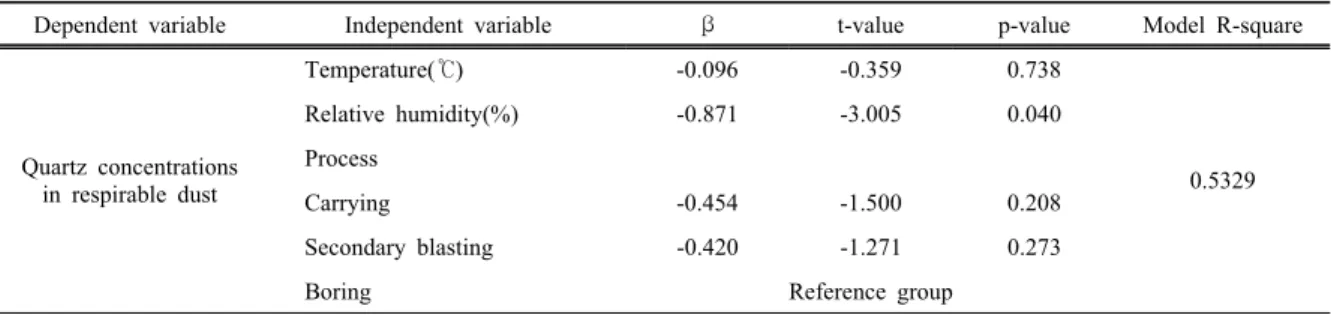
Table 4. Factors affecting the quartz concentration in respirable dusts
Dependent variable Independent variable β t-value p-value Model R-square
Quartz concentrations in respirable dust
Temperature(℃) -0.096 -0.359 0.738
0.5329
Relative humidity(%) -0.871 -3.005 0.040
Process
Carrying -0.454 -1.500 0.208
Secondary blasting -0.420 -1.271 0.273
Boring Reference group
Table 3. Quartz contents in dusts analyzed by FTIR (Unit : %)
서는 0.007 mg/㎥로 큰 차이를 보이지 않았다.
4. 분진 중 석영의 함유량
채취한 총분진 시료의 석영함유량은 기하평균 3.735%이었고, 공정별 석염함유량은 천공공정이 2.645%, 운반공정이 3.709%, 소할공정에서 6.350%로 확인되었으며, 소할공정이 다른 두 공정에 비해 1.5 배 이상 높은 함유량을 보였으나 통계적으로 유의한 차이는 없었다(Table 3). 호흡성분진 중 석영함유량 의 기하평균은 3.163%으로 나타났다. 공정별로 구분 하면 천공공정이 2.629%, 운반공정은 2.827%, 소할 공정에서는 5.225%로 나타났다. 역시 소할 공정이 천공공정과 운반공정보다 높게 나타났으나 통계적 유의성은 없었다.
5. 호흡성 석영 농도에 영향을 미치는 요인
호흡성분진 중 석영 농도에 영향을 미치는 요인을 파악하기 위하여 독립변수로 온도, 습도, 공정을, 종 속변수를 석영 농도로 설정하여 다중회귀분석을 실 시한 결과는 Table 4와 같다. 그 결과 온도와 공정은 영향 요인이 아니었고, 상대 습도가 호흡성분진 중 석영 농도에 영향을 미치는 것으로 확인되었다 (p<0.05).
Ⅳ. 고 찰
석영이 함유된 분진은 석재가공, 주물, 요업, 벽돌, 유리제조 등의 제조업과 광업에서 주로 발생된다는 것은 이미 알려져 있는게 사실이다(Balaan & Banks, 1995; Smith, 1992; Kelly, 1995; IARC, 1997). 그러나 NiJ et al.(2002)은 건설현장에서도 충분히 석영에 노 출될 수 있으며, 건설 근로자들이 규폐증에 대한 잠 재적인 위험이 있는 것으로 보고하였다. 건설업의 경 우 석영이 함유된 분진이 도로 절삭, 콘크리트의 연 마 및 가공, 절단 등 다양한 공정에서 발생되고 있으 며(Rapport et al., 2003), NIOSH는 미국에서 170만 명 이상의 노동자들이 석영에 노출 될 것으로 추정 하였고, 그 중 대부분이 건설현장에 종사하는 근로자 로 판단하였다(Oliver & McMahill, 2006). 우리나라 는 1960년대까지 대부분의 진폐증이 광업 종사 근로 자들에게서 발생되었으나, 최근에는 제조업뿐만 아 니라 건설업 근로자들에게도 적지 않게 발생되고 있 다(Jang et al., 2004). 그럼에도 건설업의 특성상 공 사기간이 다양하고, 종사 근로자의 잦은 변동 및 작 업시간이 불규칙할 뿐만 아니라 현장 접근이 용이하 지 않다는 이유로 우리나라에서는 건설업 종사자를 대상으로 한 노출평가가 거의 이루어지고 있지 않다.
본 연구는 건설공사에 있어 기초인 토공사에서 발 생하는 공기 중 분진 및 석영에 대한 노출평가를 실 시하였다. 토공사의 경우 자연 그대로 있는 다양한 종류의 암석, 흙, 모래 등을 대상으로 다양한 공정을 통해 작업이 이루어지기 때문에 많은 양의 분진이 발생될 것으로 예측하였다. 이런 이유로 본 연구에서 는 호흡성분진뿐만 아니라 총분진도 채취하였고, 각 각 석영의 농도와 함유량을 파악하였다. 그 결과 총 분진의 기하평균 농도는 0.2007 mg/㎥, 천공공정 0.356 mg/㎥으로 나타났다. 이는 농도 수준을 직접 비교하기에 다소 무리는 있지만 천공공정과 유사한 건설업의 햄머드릴 작업 시 기하평균 농도를 3.22 mg/㎥로 제시한 Jang et al.(2004)의 결과에 비해서는 상당한 낮은 수준이었다. 이러한 이유는 햄머드릴의 경우 근로자의 호흡기에 직접적으로 분진이 노출되 며, 토공사의 천공공정의 경우 작업시간이 짧고 근로 자가 작업 시 상주하고 있지 않은 점과 간헐적인 살 수작업으로 인한 분진저감 등으로 인해 차이가 발생 된 것으로 판단된다. 또한, 공기 중 호흡성분진 농도 는 0.1267 mg/㎥로 확인되었으며, 역시 동종 공사의 분진에 대한 노출수준에 대한 연구가 없어 그 결과 를 직접적으로 비교할 수는 없었지만, Lee(2012)의 건설업 석재 시공 작업을 대상으로 한 연구결과 호 흡성분진의 농도 0.118 mg/㎥와는 유사한 수준으로 나타났다.
현재 우리나라 석영의 노출기준은 호흡성분진으로 0.05 mg/㎥이며, 본 연구결과 호흡성분진 중 석영의 농 도는 0.004 mg/㎥로 나타났다. 이는 Woskie et al.(2002) 이 조사한 외국의 고속도로 건설작업에서 호흡성분진 중 석영농도 0.026 mg/㎥, Mieke et al.(2001)이 건설업 을 직종별로 구분하여 분석한 견출공(0.7 mg/㎥), 조적 공(0.04 mg/㎥) 및 타설공(1.1 mg/㎥)보다 상대적으로 낮은 수준이었다. 이러한 이유로 건설업은 다양한 작 업 및 직종별에 따라 분진 노출수준 차이가 상당하고, 본 연구는 농도가 다소 낮게 포집되는 지역시료 채취방 법을 사용하였기 때문으로 생각된다. 또한, 토공사의 경우 작업에 따라 순간적으로 과도한 분진의 노출이 있고, 그 후 대부분은 간접적으로 노출되는 특성에 의 한 차이로 추정된다. 또한, 총분진과 호흡성분진 중 석 영의 함유량은 각각 기하평균 3.73%와 3.16%로 큰 차 이를 보이지는 않았다. Bae et al.(2013)이 보고한 콘크
리트 취급사업장 호흡성분진 중 석영함유량 4.31%에 비해서는 낮은 수준을 보였는데 이러한 이유는 콘크리 트사업장인 경우 석영이 다량 함유된 모래 및 골재와 혼합하여 사용하기 때문에 본 연구결과보다 높게 나타 난 것으로 생각된다. 그리고 토공사 현장에서 호흡성 분진 중 석영농도에 영향을 미치는 요인으로는 습도가 낮을수록 석영이 높게 평가 되었다. Kim et al.(2014)의 연구결과 석재 가공업에서도 습도가 석영농도에 영향 요인이라는 점을 감안할 때 업종이 다르더라도 분진 발생을 감소시키기 위해서는 적절한 살수작업을 통한 습도조절이 필요한 것으로 사료된다.
본 연구는 연구 대상 수의 제한으로 토공사현장을 대표하기에는 다소 무리가 있으며 현장접근이 상당 히 어려워 보다 다양한 공정에서 노출평가가 수행되 지 못하였다. 또한, 개인노출평가가 이루어지지 못해 실제 노출수준이 다소 낮게 평가되었을 가능성이 높 다. 그러나 현재까지 국내에서 보고되지 않았던 토공 사 현장에서 석영의 노출수준 등을 제시함으로서 동 종 업종 근로자들의 건강보호를 위한 기초자료로 활 용될 수 있을 것으로 판단된다.
Ⅴ. 결 론
본 연구는 2014년 8월부터 10월까지 충청남도 지 역에서 진행되는 토공사 현장 3개 작업구간을 대상 으로 작업 중 발생하는 분진과 석영의 노출실태를 파악하였다. 그 결과 총분진의 기하평균 농도는 0.2001 ㎎/㎥, 호흡성분진은 0.127 ㎎/㎥이었으며, 총 분진 중 석영의 기하평균 농도는 0.008 ㎎/㎥, 호흡성 분진 중 석영의 농도는 0.0040 ㎎/㎥이었다. 공정별로 는 소할공정이 천공공정 및 운반공정에 비해 석영농 도 및 함유량이 1.5배 이상 높은 것으로 나타났다.
호흡성분진 중 석영농도에 영향을 미치는 요인은 습 도로 나타나 외부 토공사 작업이라 할지라도 농도 저감을 위해서는 적절한 살수작업 등을 통하여 적정 한 습도관리가 요구된다.
References
American Conference of Governmental Industrial Hygienists, 2015 threshold limit values for chemical substances and physical agents and biological
exposure indices. ACGIH.; 2015. p. 32
Bae HJ, Jung JJ, Phee YG. Analysis of quartz concentrations by FTIR-DOF and FTIR-Transfer method in concrete manufacturing industries. J Korean Soc Occup Environ Hyg 2013;23(2):75-83 Balaan MR, Banks DE. Silicosis, In : Rom WN,
Environmental and occupational medicine 2nd Ed, New York; USA.; 1995. p. 254
Choi HC, Chun YH, Yoon YN, Kim HJ. Quartz concentration and respirable dust of coal mines in Taeback and Kangneung areas. J Prev Med 1987;
20(2):261-269
Han JS, Son KS, Park GB, Han KB. Construction safety engineering. 2003. p. 32
Hogan TJ. Particulates. In : Fundamentals of industrial hygiene, 4th ed, by B.A. Plog, Itasca, Illinois, National Safety Council, 1995. p.15-178
International Agency for Research on Cancer. IARC monographs on the evaluation of the carcinogenic risks to humans: silica, some silicates, coal dust and para-aramid fibrils. Vol 68. Lyon, France: World Health Organization, IARC.; 1997. p. 49, 51
Jang BK, Lee JH, Park JA, Chio YN, Lee IJ. Assessment of airborne dust emission in the working processes among the construction Industry. Soonchunhyang J Nat Sci 2004;10(2):193-199
Jeoung JY, Lee YG, Jang SM, Shin YC. Particle size distribution and exposure level to airborne dust in ferrous foundries. 10th Anniversary symposium of graduate school of public health. Seoul; Seoul National University Press; 1995. p. 172-186
Kelly RJ. Particulates. In: Plog BA, Ed, Fundamentals of industrial hygiene, 5th Ed, Illinois; National Safety Council,; 1995. p. 169-174
Kim HW, Phee YG, Roh YM, Won JI. Analysis of quartz contents by XRD and FTIR in respirable dust from various manufacturing industries Part 1-Foundry. J Korean Soc Occup Environ Hyg 1998;8(1):50-66 Kim HW, Phee YG, Roh YM, Won JI. Analysis of quartz
contents by XRD and FTIR in respirable dust from various manufacturing industries Part 2-Ceramics, stone, concrete, glass and briquets, etc. J Korean Soc Occup Environ Hyg 1999;9(1):99-111
Kim SH, Bae HJ, Jung JJ, Phee YG. Particl size-related dust and quartz concentration of stone grinding operations.
J Korean Soc Occup Environ Hyg 2014;24(4):
462-470
Korea Occupational Safety & Health Agency(KOSHA).
Management of health effects by hazard factor, 2010.
p. 2-4
Lee YL. Assessment of crystalline silica exposures of stone works in the construction industry. Graduate school of public health. Seoul; The Catholic University of Korea Press. 2012. p. 11-12
Mieke EG. Lumens L, Ton S. Determinants of exposure to respirable quartz dust in the construction industry.
Ann Occup Hyg 2001;45(7):585-595
Ministry of Employment and Labor(MoEL). Silicates. In : 2005 Guide for industrial health of hazardous materials. Ministry of Employment and Labor.; 2005.
p. 135
Ministry of Employment and Labor(MoEL). 2011 Industrial accident. Ministry of Employment and Labor.; 2012. p. 12-19
Ministry of Employment and Labor(MoEL). 2012 Industrial accident. Ministry of Employment and Labor.; 2013a. p. 27
Ministry of Employment and Labor(MoEL). Exposure limits for chemical substances and physical agents (MoEL Public Notice No. 2013-38).; 2013b. p. 27 National Institute for Occupational Safety and Health
(NIOSH). Particulates not otherwise regulated, respirable 0600, In manual of analytical methods, 4th ed, NIOSH, 1998. p. 1-3
National Institute for Occupational Safety and Health (NIOSH). Particulates not otherwise regulated, total 0500, In manual of analytical methods, 4th ed, NIOSH, 1994. p. 1-4
National Institute for Occupational Safety and Health (NIOSH). Silica, Crystalline by IR: Method 7602, In manual of analytical methods, 4th ed, NIOSH, 2003. p.
1-5
Nij ET, Borm P, Hohr D, Heederik D. Pneumoconiosis and exposure to quartz-containing dust in the construction industry. Ann Occup Hyg 2002;46:71-75
Occupational Safety and Health Administration(OSHA).
Controlling silica exposures in construction, OSHA 3362-05. Washington, D.C. 2009. p. 3-7
Oliver LC, McMahill HM. Airway disease in highway and tunnel construction workers exposed to silica. Am J of Ind Med 2006;49:983-996
Peters S, Thomassen Y, Fechter-Rink E, Kromhout H.
Personal exposure to inhalable cement dust among construction workers. J Physics 2009;151:1-5 Phee YG, Roh YM, Lee KM, Kim HY, Kim YW et al.
Analysis of quartz content and particle size distribution of airborne dust from selected foundry operations. J Korean Soc Occup Environ Hyg 1997;
7(2):196-208
Radnoff D, Todor MS, Beach J. Occupational exposure to
crystalline silica at alberta work sites. J Occup &
Environ Hyg 2014;11(9):557-570
Rappaport SM, Mark G, Pam S, Robert FH. Excessive exposure to silica in the US construction industry.
Ann Occup Hyg 2003;47:111-122
Smith DK. Evaluation of the detectability and quantification of respirable crystalline silica by X-ray powder diffraction methods. Department of geoscience and material research laboratory. The Pensylvania State University Press.; 1992. p. 1-5
Song SW, Lee KM. Exposure concentrations of respirable coal dust and silica contents by work processes in coal mines. J Korean Soc Occup Environ Hyg 1994;33(4):
153-161
Weber SL, Banks DE. Silicosis. In : Rosenstock, Cullen MR editors. Textbook of clinical occupational and environmental medicine. by W.B. Saunders Company, 1994. p. 254
Woskie SR, Kalil A, Bell D, Virji MA. Exposure to quartz, diesel, dust, and welding fumes during heavy and highway construction. AIHA J 2002;63:447-457 Yu HJ. A study on the characteristics of dust scattering in
construction field. Graduate school of industry.
Jeonla; Wonkwang University Press; 2002. p. 1 Yu HJ, Han KY, Kwak KS, Kim JS, Yang KY. A study on
the actual condition and effect of dust scattering in construction field. J Korea Inst Build Const 2004;
4(4):109-115