I. 서 론
2018년 산업재해(Industrial accident) 발생현황 자료 (MoEL, 2019a)에 따르면 전체 재해자 수는 102,305 명으로 전년도 동기 대비 12,457명 (13.9%) 증가되었 으며, 사망자 수는 2,142명으로 전년도 동기 대비 185 명(9.5%) 증가되었다. 이중 사고 재해자 수는 90,832명
으로 전년도 동기 대비 10,167명(12.6%) 증가되었고, 질병 재해자 수는 11,473명으로 전년도 동기 대비 2,290명(24.9%) 증가하였으며, 사고 사망자 수는 971 명으로 전년도 동기 대비 7명(0.7%) 증가하였다(MoEL, 2019a). Zhao et al.(2018)의 연구 자료에 의하면 2006년부터 2017년까지 12년 동안 중국에서 발생한 3,974건의 유해화학물질사고(Hazardous chemical
https://doi.org/10.15269/JKSOEH.2020.30.1.39
화학물질의 누출과 피부접촉에 의한 재해자 및 사고사망자 발생현황 조사
이권섭*ㆍ최현성ㆍ이하영ㆍ신경민ㆍ최흥구ㆍ이인섭 한국산업안전보건공단 산업안전보건연구원
Investigation of the Occurrence of Industrial Accidents and Accidental Deaths by Chemical Leakage and Skin Contact
Kwon Seob Lee*ㆍHyun Sung ChoiㆍHa Young LeeㆍKyung Min ShinㆍHeung Koo ChoiㆍIn Seop Lee Occupational Safety & Health Research Institute, Korea Occupational Safety & Health Agency
ABSTRACT
Objectives: We investigated the status of accidents and deaths caused by chemical leakage and skin contact in Korea. The purpose of this study was to produce and provide technical reference data for the efficient management of accidents and the rational management of accidental chemicals.
Methods: Accidents and deaths caused by chemical leakage and skin contact in industry were investigated.
Based on 68 accident reports related to chemical leakage and skin contact, the causes of accidental deaths were analyzed. In addition, we investigated the chemical substances and articles that caused these accidents and deaths. Based on the results of the investigation, the causes of accidents caused by chemical leakage and skin contact were identified and practical management measures for the chemicals were suggested.
Results and Conclusions: In 2018, 372 people suffered from chemical leaks and skin contact, up by 123 (about 49.4%) from the previous year. The number of accident deaths was 14, an increase of five (about 55.6%) from the previous year. In the last three years (2016-2018), 91 chemical substances and article groups were involved in accidents caused by chemical leakage and skin contact. There were 16 chemical substance and article groups involved in accidental deaths. There were ten cases of accidents involving two or more casualties due to chemical leakage and skin contact, and 23 deaths occurred. Most of these accidental deaths were caused by subcontractor workers outsourcing risks. Therefore, there is an apparent need to strengthen the responsibility for safety and health among subcontractors.
Key words: chemical leakage and skin contact, chemical management, hazardous chemical accidents(HCA), industrial accidents
*Corresponding author: Kwon Seob Lee, Tel: 042-869-8541, Email: [email protected]
Chemicals Research Bureau, Occupational Safety & Health Research Institute, KOSHA, 339-30, Exporo Yuseong-Gu, Daejeon 34122
Received: January 28, 2020, Revised: February 17, 2020, Accepted: March 10, 2020
Kwon Seob Lee https://orcid.org/0000-0001-5453-4620 Hyun Sung Choi https://orcid.org/0000-0003-0936-759X Ha Young Lee https://orcid.org/0000-0002-7617-9428 Kyung Min Shin https://orcid.org/0000-0002-8495-6039 Heung Koo Choi https://orcid.org/0000-0002-6696-4131 In Seop Lee https://orcid.org/0000-0001-5209-4350 This is an Open-Access article distributed under the terms of the Creative Commons Attribution Non-Commercial License (http://creativecommons.org/licenses/by-nc/3.0) which permits unrestricted non-commercial use, distribution, and reproduction in any
accidents, HCA)로 인하여 모두 5,203명이 사망자가 발생하였으며, 평균적으로 하루에 1명 이상의 사상자 사고가 발생하고 있었다.
산업재해보상보험법에 의거 근로복지공단으로부터 직업성 피부질환(occupational skin disease)에 의한 산업재해로 요양승인을 받은 질병자는 지난 10년간 (2007~2016년) 222명으로 동 기간 내 전체 업무상질 병자(75,134명)의 0.30%를 차지한다(Kwon et al., 2018). 산업재해에 대한 통계는 각국마다 산출기준이 달라 절대적인 비교가 곤란하지만, 2015년 기준 국제 노동기구(International Labour Organization, ILO) 에 보고된 통계자료에 따르면 사고 사망자 수는 멕시코, 터키, 일본에 이어 4번째로 많으며, 노동자 10만 명당 사고 사망자 수는 멕시코, 터키에 이어 3번째로 높게 나타나고 있다(MoEL, 2019a).
정부에서는 대통령 신년사(‘18.1.10)를 통해 ‘22년까 지 자살예방, 교통사고, 산업안전 등 3대 분야 사망 절 반 줄이기를 목표로 『국민생명 지키기 3대 프로젝트』추 진을 발표하였다. 고용노동부와 한국산업안전보건공단 (이하 안전보건공단)에서는 고위험 분야 집중관리와 안 전우선 문화 확산을 위한 산업재해 사망사고 감소대책 을 적극적으로 추진하여 2022년까지 사고사망 만인율 을 0.27‱까지 낮추는 사업전략을 수립하여 범정부적 으로 추진하고 있다. 산재사고사망 감소를 위한 국정홍 보와 현장 특화 타깃팅 사업 전개를 통해 권한과 책임 있는 자가 모든 안전을 책임지는 분위기 조성하고 있다.
이와 관련하여 안전보건공단(Korea Occupational Safety and Health Agency, KOSHA)에서는 2019년 사고사망자 수 100명 감소를 위한 특단의 『사고사망 감소 100일 긴급대책』의 추진 등으로 사업역량을 집중 하고 있다.
2018년도 화학물질의 누출(leakage)과 피부접촉 (skin contact)에 의한 재해자는 372명으로 전년 동기 대비 123명(약 49.4%)이 증가하였으며, 사고사망자는 14명으로 전년 동기 대비 5명(약 55.6%)이 증가한 수 준이었다. 2018년을 기준으로 한 화학물질의 누출과 피부접촉에 의한 재해자 및 사고사망자는 전체 재해자 및 사고사망자의 증가와 비교하여 그 증가 수준이 매우 높은 수준으로 지속적인 관심과 산업재해 감소를 위한 대책의 시행 및 관리가 필요하였다. 그동안 국내에서 수 행된 화학물질의 누출과 피부접촉에 관한 연구는 Kwon et al.(2018)의 “화학물질 피부접촉에 의한 피부
독성 유해성 분류에 관한 고찰”과 Lim et al.(2000)의
“액상용제의 피부흡수와 증기상 용제의 전신폭로에 의 한 흡수연구” 및 Kim et al.(1997)의 “유기용제의 피부 흡수 연구“ 등으로 화학물질의 누출과 피부접촉에 의한 사고사망 감소 등의 사고재해 관리와 직접적인 관련성 이 낮은 제한적인 수준의 연구내용이었다. 따라서 본 연 구에서는 산업현장에서의 화학물질의 누출과 피부접촉 에 의한 재해자 수 및 사고 사망자 수 현황을 조사하고, 재해 발생원인과 재해자 및 사고사망자 발생 화학물질 의 분석을 통한 합리적 관리방안을 제시하고자 하였다.
연구결과는 화학물질의 누출과 피부접촉에 의한 사고사 망 감소 등의 사고재해 관리를 위한 실행력 강화 및 재 해발생 화학물질의 합리적 관리 등에 활용될 수 있을 것으로 기대한다.
Ⅱ. 연구 대상 및 방법
1. 화학물질의 누출과 피부접촉에 의한 재해자 및 사고 사망자 발생 현황
최근 5년(2014년~2018년) 동안 발생된 화학물질의 누출과 피부접촉에 의한 재해자 및 사고사망자 발생현황 등의 산업재해 발생현황 자료(MoEL, 2019a)를 조사하 여 분석하였다. 세부적인 조사 자료는 안전보건공단의 산업재해기초통계(전산) 자료(나누리 ERP –연구⋅통계 – 재해통계 자료)를 활용하였다(KOSHA, 2019b).
산업재해현황의 통계 분석은 최근 5년간(2014~2018 년) 화학물질의 누출과 피부접촉에 의한 재해자 수, 최근 5년간(2014~2018년) 화학물질의 누출과 피부접촉에 의 한 사망자 수, 최근 5년간 (2014~2016년) 화학물질의 누출과 피부 접촉에 의한 재해자 및 사망자 수 변동 현황 등의 내용을 중심으로 확인하였다.
2. 화학물질의 누출과 피부접촉으로 2인 이상 사고사망 자가 발생한 중대재해 현황
최근 5년(2014년~2018년) 동안 발생된 화학물질의 누출과 피부접촉에 의한 사고사망자 발생현황 중에서 2 인 이상의 작업 근로자 사고사망자가 발생한 10건의 중 대재해에 대한 발생실태 및 사고사망자 발생원인 화학 물질 등에 대하여 상세하게 조사하여 분석하였다. 조사 자료는 안전보건공단의 산업재해기초통계(전산) 자료 (나누리 ERP –연구⋅통계 – 재해통계 자료)를 활용하였 다(KOSHA, 2019b).
3. 안전보건공단 재해발생보고서에 의한 사고사망 재해 발생원인 등의 조사
최근 5년(2014년~2018년) 동안 발생된 화학물질의 누출과 피부접촉에 의한 사고사망자 발생현황 중에서 안전보건공단의 재해발생보고서가 있는 68건의 사례를 중심으로 사고사망 재해의 발생 원인을 조사하고 분석 하였다(KOSHA, 2019a). 주요 조사내용은 재해개요, 재해원인 화학물질, 재해발생원인, 산업안전보건법(이하 산안법) 및 산업안전보건기준에 관한 규칙 제3편 보건 기준 등의 미 준수에 따른 원인(1. 작업장 안전보건관리 미흡, 2. 작업환경 시설 및 설비 관리 미흡, 3. 작업방법 의 준수관리 미실시 및 미흡, 4. 물질안전보건자료 및 경고표지 비치⋅게시 미흡, 5. 근로자 안전보건교육 미 실시, 6. 개인보호구에 대한 관리의 미흡, 7. 국소배기 장치 등의 설비관리 미흡)분류, 재해예방대책 등이다.
4. 화학물질의 누출과 피부접촉에 의한 재해자 및 사고 사망자 발생 화학물질의 조사
최근 3년(2016년~2018년) 동안 발생된 화학물질의 누출과 피부접촉에 의한 재해자 및 사고사망자 발생 현 황의 조사 자료인 안전보건공단의 산업재해기초통계(전 산) 자료(나누리 ERP –연구⋅통계 – 재해통계 자료)를 활용하여(KOSHA, 2019b), 재해자 및 사고사망자 발생 에 기인한 화학물질(substance) 및 화학제품군(article) 에 대하여 조사하였다. 재해자 및 사고사망자 발생에 기 인한 화학물질 및 화학제품군에 대한 상세 분석으로 재 해가 10건 이상 발생한 화학물질 및 화학제품군, 재해 자가 9건 이하 5건 이상으로 발생한 화학물질 및 화학 제품군 등으로 분리하여 조사하였다.
Ⅲ. 결 과
1. 화학물질의 누출과 피부접촉에 의한 재해자 및 사고 사망자 발생 현황
최근 5년(2014년~2018년) 동안 발생된 화학물질의 누출과 피부접촉에 의한 재해자의 발생현황은 Figure 1과 같다.
그 결과 화학물질의 누출과 피부접촉에 의한 재해자 는 1,536명으로 조사되었다. 2014년부터 2017년까지 는 재해자가 감소하는 경향(320명 → 249명) 이었으나, 2018년의 경우 372명의 재해자가 발생되어 2017년을
Figure 1. The number of industrial accidents by chemical leakage and skin contact in the last 5 years(2014
~ 2018)
Figure 2. The number of accident deaths by chemical leakage and skin contact in the last 5 years(2014 ~ 2018)
기준으로 한 247명 대비 123명이 증가(약 49.4%)한 수 준이었다. 화학물질의 누출과 피부접촉에 의한 재해자 1,536명의 노출 경로별로는 산⋅알카리류 등의 피부접 촉(1,202명, 78.3%) > 유해가스 및 유기화합물 등의 흡 입(275명, 17.9%) > 방동제 등의 화학물질 섭취(59명, 3.9%) 순으로 조사되었다.최근 5년(2014년~2018년) 동안 발생된 화학물질의 누출과 피부접촉에 의한 사고사망자 발생현황은 Figure 2와 같다.
그 결과 화학물질의 누출과 피부접촉에 의한 사고사 망자는 69명으로 조사되었다. 2015년부터 2017년까지 는 사고사망자가 감소하는 경향(17명 → 9명(약 64.3%
감소) 이었으나, 2018년의 경우 14명의 사고사망자가 발생되어 2017년을 기준으로 한 9명 대비 5명이 증가 (약 55.6%)한 수준이었다. 화학물질의 누출과 피부접촉 에 의한 사고사망자 69명의 노출 경로별로는 유해가스 및 유기화합물 등의 흡입(55명, 79.7%) > 산⋅알카리류 등의 피부접촉(9명, 133%) > 방동제 등의 화학물질 섭 취(5명, 7.3%) 순으로 조사되었다. 노출 경로별 사고사 망자의 발생 현황은 Figure 1에 의한 화학물질의 누출 과 피부접촉에 의한 재해자의 노출경로별 발생 현황과 큰 차이가 있었다.
2. 화학물질의 누출과 피부접촉으로 2인 이상 사고사망 자가 발생한 중대재해 현황
최근 5년(2014년~2018년) 동안 발생된 화학물질의 누출과 피부접촉으로 인하여 2인 이상의 작업 근로자 사고사망자가 발생한 10건의 중대재해 발생 현황은
Table 1과 같다.
최근 5년(2014년~2018년) 동안 발생된 화학물질의 누출과 피부접촉으로 2인 이상의 사고사망자가 발생한 원인 화학물질은 Table 2와 같다.
최근 5년(2014년~2018년) 동안 발생된 화학물질의 누출과 피부접촉에 의한 2인 이상 사고사망자가 발생한 원인 화학물질 중에서 carbon monoxide(4건, 8명), nitrogen gas(2건, 7명) 등은 중독(poisoning) 및 누출 에 의한 질식재해(asphyxia accident)로 다수의 사망자 를 발생한 화학물질이다. ammonia), trichloroethylene (TCE), sulfuric acid, carbon dioxide 등은 각각 2인 이상 사고사망자가 1건씩 발생한 화학물질이다.
3. 안전보건공단 재해발생보고서에 의한 사고사망 재해 발생원인 등의 조사
최근 5년(2014년~2018년) 동안 발생된 화학물질의
No. Workplace Chemical
substance Accident overview Death workers
(Persons) Date of accident 1
K-Construction Apartment Construction
Site
Carbon dioxide (lignite)
Lignite was burned for concrete curing while performing the mold work on the PIT floor of the excellent construction site of the apartment construction site. Two workers died of asphyxiation from carbon monoxide from lignite
2 2013/12/31
2 Y-Marine Ammonia Ammonia used as a refrigeration refrigerant leaked from a ship under repair of a tuna fishing vessel(1,474
tons). Two workers died of asphyxiation in ammonia. 2 2014/07/31 3 A-Construction Carbon
dioxide (lignite)
Two workers died of suffocation on carbon monoxide while recharging lignite fuel to lignite stoves for the thermal insulation of concrete at the construction site and performing internal temperature measurements.
2 2014/12/15
4 D-Construction Nitrogen gas
During the construction work related to the replacement of control cables for Shin-Kori Nuclear Power Nos. 3 and 4, two workers died of asphyxiation in nitrogen gas in the valve room of the opening removal. In addition, one of the managers who visited the victims died of suffocation from nitrogen gas.
3 2014/12/26
5 B-Company Trichloroethyl ene
A colleague found out that two workers who were cleaning the inside of a metal washing tank containing trichloroethylene fell down in the washing tank and sent it to the hospital through 119.
2 2015/06/02
6 W-Water Pipe Mechanic
Carbon dioxide (Internal combustion
engin)
Three workers operated the submersible pump to drain the water inside the underground water pipe at the replacement site of the old water pipe of the Kumgang Basin. Two workers died due to suffocation from harmful gases such as carbon monoxide from internal combustion engines.
2 2015/09/23
Table 1. The current status of accidental deaths to two or more worker by chemical leakage and skin contact in the last 5 years
누출과 피부접촉에 의한 사고사망자 발생현황 중에서 안전보건공단의 재해발생보고서가 있는 68건의 사례 (KOSHA, 2019a)를 중심으로 148건의 사고사망 재해 의 발생 원인에 대한 분석 결과는 Table 3과 같다.
산안법 및 산업안전보건기준에 관한 규칙 제3편 보건 기준 등의 미 준수 내용에 대한 원인별 대분류 내용으 로 1. 작업장 안전보건관리 미흡(66건, 44.6%), 2. 작업 환경 시설 및 설비 관리 미흡(36건, 24.3%), 5. 근로자 안전보건교육 미실시(19건, 12.8%), 6. 개인보호구의
관리 미흡(14건, 9.5%), 3. 작업방법의 준수관리 미실시 및 미흡(5건, 3.3%) 및 4. 물질안전보건자료 및 경고표 지 비치⋅게시 미흡(5건, 3.3%), 7. 국소배기장치 등의 설비관리 미흡(3건, 2%)) 등의 순으로 확인되었다. 1.
작업장 안전보건관리 미흡에 대한 주요내용은 작업현장 관리감독 및 관리체계 미흡(19건, 12.8%), 밀폐 공간 산소 및 유해가스 농도의 측정(15건, 10.1%), 비상조치 및 대피용 기구의 비치 미흡(13건, 8.8%), 밀폐 공간 작 업 프로그램의 수립⋅시행 미흡(8건, 5.4%) 등이었다.
No. Workplace Chemical
substance Accident overview Death workers
(Persons) Date of accident
7 K-Zinc
Manufacturing Sulfuric acid
This is a death accident caused by two workers overturning sulfuric acid when sulfuric acid was released while the bolts of the manhole cover were being dismantled during the repair work of the zinc smelting construction site.
2 2016/06/28
8 T-Construction Partner
Carbon dioxide (Coconut Charcoal)
Two workers from subcontractors performed replacement work of coconut charcoal stove for curing of concrete insulation at the basement construction site of newly built urban residential house. Two workers died of asphyxiation in carbon monoxide while working.
2 2017/12/16
9 P-Steel Nitrogen gas
Nitrogen gas was introduced into the tower while working inside the tower to replenish the fillers in the steelworks oxygen plant. Four workers who were working inside the tower were suffocated by nitrogen gas and collapsed to the hospital.
4 2018/01/25
10 S-Electronic Carbon dioxide
Three workers in the process of replacing fire extinguishing agents were suffocated by gasoline
dioxide. Two of these workers died. 2 2018/09/04
Table 2. The current status of chemicals caused to two or more accidental deaths by chemical leakage and skin contact in the last 5 years
No. Chemical substance Types of Accidents No. of Accidents No. of worker deaths
Total - 10 23
1 Carbon monoxide
(630-08-0) Poisoning
Asphyxiated 4 8
2 Ammonia
(7664-41-7) Leakage
Asphyxiated 1 2
3 Nitrogen gas
(7727-37-9) Leakage
Asphyxiated 2 7
4 Trichloroethylene
(79-01-6) Poisoning 1 2
5 Sulfuric acid
(7664-93-9) Leakage
Skin contact 1 2
6 Carbon dioxide
(124-38-9) Leakage
Asphyxiated 1 2
Table 1. Continued
Large category of causes accidents
No. of investigation
(Case, %) Subcategory of investigation contents that cause accidents No. of investigation
(Case, %)
1. Insufficient safety and health
management in the workplace 66 (44.6%)
1-1. Insufficient management supervision and
management system for the workplace 19(12.8%) 1-2. Lack of establishment and implementation of
confined space work program 8(5.4%)
1-3. Insufficient implementation of risk assessment 5(3.4%) 1-4. Failure to prohibit entry into confined spaces 3(2.0%) 1-5. Insufficient emergency measures and evacuation
equipment 13(8.8%)
1-6. Insufficient measurement of oxygen and harmful gas
concentrations in confined spaces 15(10.1%) 1-7. Insufficient safety and health management system
for subcontractors 2(1.4%)
1-8. Insufficient worker health care such as medical
examination 1(0.7%)
2. Insufficient management of work environment facilities and equipment
(24.3%) 36
2-1. Insufficient corrosion protection measures for
storage containers 4(2.7%)
2-2. Insufficient measures to prevent leakage 5(3.4%) 2-3. Lack of installation and management of alarm
facilities 1(0.7%)
2-4. Insufficient installation of emergency shutoff device 0(0.0%) 2-5. Insufficient ventilation before and after confined
space work 12(8.1%)
2-6. Insufficient management of handling chemicals 4(2.7%) 2-7. Insufficient management of handling facilities for
chemicals 9(6.1%)
2-8. Inappropriate use of facilities and equipment 1(0.7%) 3. Non-compliance and lack of
working method 5
(3.3%)
3-1. Non-compliance with work rules 5(3.4%) 3-2. Non-compliance with working method in tank 0(0.0%) 3-3. Failure to prepare for an accident 0(0.0%) 4. Lack of provision and posting of
MSDS and warning signs 5
(3.3%) 4. Lack of provision and posting of MSDS and warning
signs 5(3.4%)
5. Failure to provide safety and
health education for workers 19
(12.8%) 5. Failure to provide safety and health education for
workers 10(12.8%)
6. Lack of care for personal
protective equipment 14
(9.5%)
6-1. Non-wearing and incompatibility of personal
protective equipment 8(5.4%)
6-2. Not providing personal protective equipment 6(4.1%) 7. Insufficient facility management
such as local exhaust system 3 (2%)
7-1. No installation of ventilation equipment such as local
exhaust and air conditioning facilities 2(1.4%) 7-2. Inappropriate ventilation equipment such as local
exhaust and air conditioning equipment 1(0.7%) Table 3. The results of analysis of the causes to accidental deaths caused by chemical leakage and skin contact in the last 5
years
2. 작업환경 시설 및 설비 관리 미흡에 대한 주요내용 은 밀폐 공간 작업 전⋅후 환기 미흡(12건, 8.1%), 화학 물질 취급시설 관리 미흡(9건, 6.1%), 누출의 방지조치 미흡(5건, 3.4%) 등이었다.
4. 화학물질의 누출과 피부접촉에 의한 재해자 및 사고 사망자 발생 화학물질의 조사
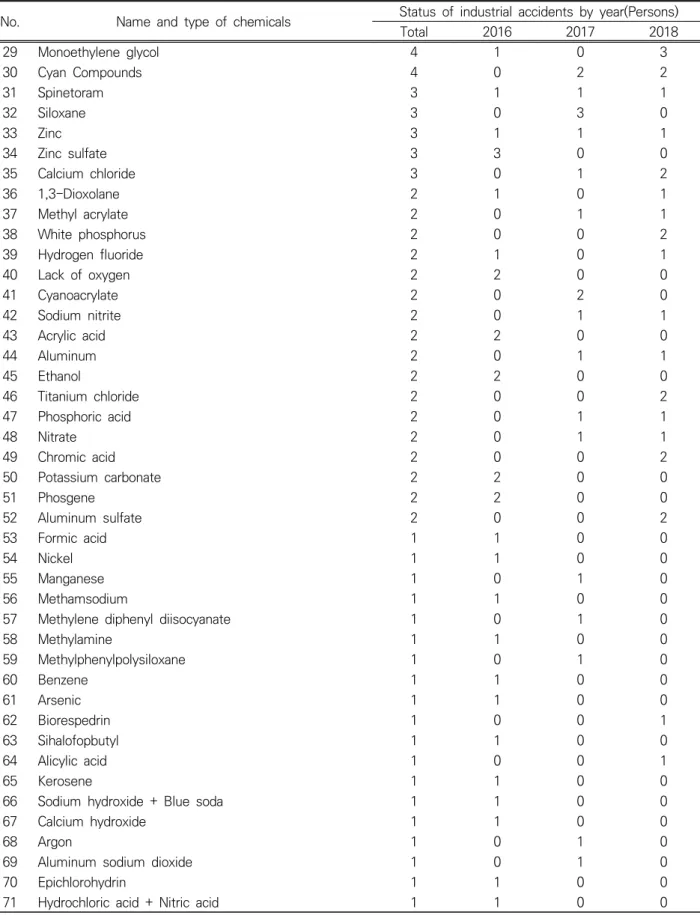
최근 3년(2016년~2018년) 동안 화학물질의 누출과 피부접촉에 의한 재해자가 발생한 화학물질의 조사 결 과는 Table 4와 같다.
그 내용으로 화학물질의 누출과 피부접촉에 의한 재
해자가 발생한 화학물질(substance) 및 화학제품군 (mixture and articles)은 모두 91종이다. 이중에서 10건 이상의 재해가 발생한 화학물질은 10종이며, sodium hydroxide(115건), cement(107건), sulfuric acid(43건), carbon monoxide(,41건), nitric acid (29건), acetic acid(17건), sodium hypochlorite(16 건), hydrochloric acid(13건), methyl ethyl ketone (12건), hydrogen sulfide(10건) 등의 순으로 재해가 많이 발생하고 있었다. 또한 재해자가 10건 이상 발생 하고 있는 화학제품군은 상세정보가 부족한 화학물질 및 화학제품(161건), 분류되지 않은 세정, 소독 및 광택
No. Name and type of chemicals Status of industrial accidents by year(Persons)
Total 2016 2017 2018
Total 917 296 249 372
1 Substances and articles without detailed information 161 49 43 69
2 Unclassified cleaning, disinfection and varnishes 120 49 37 34
3 Sodium hydroxide 115 36 39 40
4 Cement 107 34 21 52
5 Sulfuric acid 43 15 15 13
6 Carbon monoxide 41 6 9 26
7 Nitric acid 29 11 10 8
8 Unclassified paint, varnish, etc. 18 6 2 10
9 Acetic acid 17 1 5 11
10 Sodium hypochlorite 16 4 10 2
11 Unclassified solvents, thinners, etc. 16 6 1 9
12 Hydrochloric acid 13 2 5 6
13 Methyl ethyl ketone 12 3 4 5
14 Alkalis without detailed information 11 4 2 5
15 Hydrogen sulfide 10 5 0 5
16 Methyl chloride 9 0 0 9
17 Fluoride 9 3 3 3
18 Potassium hydroxide 9 1 3 5
19 Acids without detailed information 9 2 6 1
20 Chlorine 8 0 4 4
21 Methanol 7 5 1 1
22 Carbon dioxide 7 2 0 5
23 lignite 6 6 0 0
24 Ammonia 6 2 2 2
25 Nitrogen 6 1 0 5
26 Ammonium phosphate 5 4 0 1
27 Phenol 5 2 1 2
28 Hydrogen peroxide 4 1 2 1
Table 4. The results of investigation of chemicals to caused industrial accidents by chemical leakage and skin contact
(2016-2018)
No. Name and type of chemicals Status of industrial accidents by year(Persons)
Total 2016 2017 2018
29 Monoethylene glycol 4 1 0 3
30 Cyan Compounds 4 0 2 2
31 Spinetoram 3 1 1 1
32 Siloxane 3 0 3 0
33 Zinc 3 1 1 1
34 Zinc sulfate 3 3 0 0
35 Calcium chloride 3 0 1 2
36 1,3-Dioxolane 2 1 0 1
37 Methyl acrylate 2 0 1 1
38 White phosphorus 2 0 0 2
39 Hydrogen fluoride 2 1 0 1
40 Lack of oxygen 2 2 0 0
41 Cyanoacrylate 2 0 2 0
42 Sodium nitrite 2 0 1 1
43 Acrylic acid 2 2 0 0
44 Aluminum 2 0 1 1
45 Ethanol 2 2 0 0
46 Titanium chloride 2 0 0 2
47 Phosphoric acid 2 0 1 1
48 Nitrate 2 0 1 1
49 Chromic acid 2 0 0 2
50 Potassium carbonate 2 2 0 0
51 Phosgene 2 2 0 0
52 Aluminum sulfate 2 0 0 2
53 Formic acid 1 1 0 0
54 Nickel 1 1 0 0
55 Manganese 1 0 1 0
56 Methamsodium 1 1 0 0
57 Methylene diphenyl diisocyanate 1 0 1 0
58 Methylamine 1 1 0 0
59 Methylphenylpolysiloxane 1 0 1 0
60 Benzene 1 1 0 0
61 Arsenic 1 1 0 0
62 Biorespedrin 1 0 0 1
63 Sihalofopbutyl 1 1 0 0
64 Alicylic acid 1 0 0 1
65 Kerosene 1 1 0 0
66 Sodium hydroxide + Blue soda 1 1 0 0
67 Calcium hydroxide 1 1 0 0
68 Argon 1 0 1 0
69 Aluminum sodium dioxide 1 0 1 0
70 Epichlorohydrin 1 1 0 0
71 Hydrochloric acid + Nitric acid 1 1 0 0
Table 4. Continued
No. Name and type of chemicals Status of industrial accidents by year(Persons)
Total 2016 2017 2018
72 Sulfuric acid + Hdrochloric acid 3 1 1 1
73 Zinc Chloride + Calcium Chloride 1 0 0 1
74 Iron chloride 1 1 0 0
75 Iodine 1 0 0 1
76 Isopropyl alcohol 1 1 0 0
77 Nitric acid + Alcohol 1 0 1 0
78 Potassium Nitrate 1 0 1 0
79 Nitride 1 1 0 0
80 Kaunava wax 1 0 0 1
81 Chloroform + Acetic Acid 1 0 0 1
82 Hydrogen carbonate 1 1 0 0
83 Calcium carbonate 1 0 0 1
84 Toluene 1 1 0 0
85 Triethanolamine 1 0 0 1
86 Trifluoroacetic acid 1 0 0 1
87 Paraffin 1 0 1 0
88 Formaldehyde 1 0 0 1
89 Pyrethroid 1 0 0 1
90 Sulfuric acid + Fluorine 1 0 0 1
91 Sulfuric acid + Nitric acid 1 0 0 1
Table 5. The results of investigation of chemicals to caused accident deaths by chemical leakage and skin contact(2016-2018) No. Name and type of chemicals Status of accident deaths by year(Persons)
Total 2016 2017 2018
Total 36 13 9 14
1 Carbon monoxide 6 2 1 3
2 Nitrogen 6 1 0 5
3 Substances and articles lacking detailed information 4 1 2 1
4 Sulfuric acid 3 3 0 0
5 Lack of oxygen 2 2 0 0
6 Cyan Compounds 2 0 1 1
7 Sodium nitrite 2 0 1 1
8 Carbon dioxide 2 0 0 2
9 Hydrogen sulfide 2 2 0 0
10 Sodium hydroxide 1 0 1 0
11 Argon 1 0 1 0
12 Chromic acid 1 0 0 1
13 Toluene 1 1 0 0
14 Paraffin 1 0 1 0
15 Phosgene 1 1 0 0
16 Unclassified cleaners, disinfectants and varnishes 1 0 1 0
Table 4. Continued
제(120건), 분류되지 않은 페인트, 니스 등(18건), 분류 되지 않은 용제 및 희석제 등(16건), 상세정보가 부족한 산⋅알칼리류(11건) 등이었다. 그리고 재해자가 9건 이 하 5건 이상으로 발생한 화학물질 및 화학제품군은 Methyl chloride, Fluoride, Potassium hydroxide, Chlorine, Methanol, carbon dioxide 등 12종이었다.
최근 3년(2016년~2018년) 동안 화학물질의 누출과 피부접촉에 의한 사고사망자가 발생한 화학물질의 조사 결과는 Table 5와 같다.
구체적으로 화학물질의 누출과 피부접촉에 의한 사고 사망자가 발생한 사례는 모두 36건으로 조사되었으며, 화학물질 및 화학제품군은 모두 16종이었다. 이중에서 2건 이상의 사망재해가 발생한 화학물질은 carbon monoxide(6건), nitrogen(6건), sulfuric acid(3건), lack of oxygen(2건), cyan compounds(2건), sodium nitrite(2건), carbon dioxide(2건), hydrogen sulfide (2건) 등 8종의 화학물질이었다. 또한 2건 이상의 사고 사망자가 발생한 화학제품군으로 상세정보가 부족한 화 학물질 및 화학제품(4건)이 있었다.
Ⅳ. 고 찰
화학 산업의 발전과 함께 화학물질의 사용이 비약적 으로 증가하여 전 세계적으로 1억6천만종 이상의 화학 물질이 개발되어진 것으로 알려져 있다(ACS, 2019).
현재 전 세계적으로 유통되고 있는 화학물질의 수는 20 만여 종에 이르며, 매년 3천여 종의 새로운 화학물질이 개발되어 상품화 되고 있고, 향후에도 화학 산업의 지속 적인 성장이 예상되고 있다(MoE, 2019). 국내에서도 4 만5천 종 이상의 화학물질이 기존화학물질로 등록되어 유통되었거나 사용되고 있으며(Park et al., 2015; Lee et al., 2016), 매년 2천 여 종의 화학물질이 새로이 국 내시장에 진입되는 등 화학물질의 사용이 꾸준히 증가 하고 있다(MoE, 2019). 유해화학물질은 대부분 독성 및 확산성이 강해 사고로 인한 유출시 대규모 인명 및 재산피해를 유발하고, 주변 환경을 황폐화시킬 수 있어 다양한 화학물질에 대한 신속한 안전관리 대응이 중요 한 과제이다(Lee et al., 2016; MoE, 2019). 급속한 경제 발전 시대에 유해화학물질 사고의 특성도 급격히 변화하고 있어 이 분야에 대한 지속적인 연구가 매우 중요하다(Zhao et al., 2018).
화학물질의 누출과 피부접촉에 의한 사고사망자 발생
현장에 대한 안전보건공단의 재해발생보고서 68건의 사례(KOSHA, 2019a), 148건의 사고사망 재해의 발생 원인을 산안법 및 산업안전보건기준에 관한 규칙 제3편 보건기준 등의 미 준수 내용에 대한 원인별 사례로 분 류한 조사의 내용은 화학물질의 누출과 피부접촉에 의 한 사고사망 감소 및 중상해 사고재해 관리를 통한 동 종재해 예방관리의 실행력 강화를 위한 산업체 전파와 관계자 교육용 기술자료 등으로 활용할 가치가 있다고 판단되었다, 화학물질의 누출과 피부접촉에 의한 사고 사망 감소 및 중상해 사고재해 관리를 통한 동종재해 예방관리의 실행력 강화를 위해서는 재해자 및 사고사 망자 발생 화학물질(재해자 : 91개 화학물질 및 화학제 품, 사고사망자 : 16개 화학물질 및 화학제품)의 관리가 필요하며, 특별히 사고사망 재해가 많이 발생되고 있는 업종과 발생원인 화학물질에 대한 우선적인 집중적 관 리가 요구된다. 고용노동부 및 안전보건공단에서 현재 시행 중인 사고사망 감소를 위한 질식 3대 위험영역 집 중관리, 유해화학물질 취급 사업장 등에 대한 재해발생 사업장 적시기술지도, 소규모 사업장 화학사고 예방 기 술지원 등의 사업과 연계되어 실효성 있는 산재예방감 소의 사업이 실시될 수 있도록 해당 화학물질을 관리할 필요가 있다.
최근 5년(2014년~2018년) 동안 화학물질의 누출과 피부접촉에 의한 2인 이상 사고사망자가 발생한 재해는 모두 10건의 사례가 조사되었으며, 모두 23명의 사망 자가 발생하였다. 재해가 발생된 작업현장은 건설업(5 건)의 콘크리트 양생을 위하여 피워둔 갈탄에 의한 일 산화탄소 중독 질식재해(3건), 원자력발전소 건설현장의 제어케이블 교체관련 밸브룸 밀폐 공간 질소가스 질식 재해(1건) 등이었다. 제조업(4건)의 경우 금속 세척조 내부 청소작업 중 Trichloroethylene 중독사고 재해(1 건), 강산성물질 취급 설비 맨홀 해체작업 중 황산 누출 에 접촉사고 재해(1건), 산소공장 타워 내부 충진재 보 충작업 중 밀폐 공간 내 질소가스 내부 유입으로 인한 누출 질식재해(1건), 소방 소화제 교체 작업 중이던 작 업근로자의 이산화타소 누출 질식재해(1건) 등이었다.
이러한 사고사망자 발생 재해의 대부분이 ‘위험의 외주 화’에 의한 하청업체 작업 근로자에게서 발생되고 있어 도급을 주는 원청업체의 안전보건책임을 강화할 필요가 있다(Lee, 2019). 이와 관련하여 현재 시행되고 있는 산안법 시행령 제51조의 강산성 화학물질(불산, 염산, 질산, 황산 등) 중심의 도급승인 대상 화학물질의 범위
에 화학물질의 누출과 피부접촉에 의한 중독 및 질식사 고 발생빈도가 높은 화학물질(질소, 이르곤, 이산화탄 소, 트리클로로에틸렌 등)을 취급하는 밀폐작업 공간과 세척조 작업 등이 포함될 수 있도록 개선할 필요가 있 다(Lee, 2019).
Ⅴ. 결 론
2018년도 화학물질의 누출과 피부접촉에 의한 재해 자는 372명으로 전년 동기 대비 123명(약 49.4%)이 증 가하였으며, 사고사망자는 14명으로 전년 동기 대비 5 명(약 55.6%)이 증가한 수준이었다. 2018년을 기준으 로 한 화학물질의 누출과 피부접촉에 의한 재해자 및 사고사망자는 전체 재해자 및 사고사망자의 증가와 비 교하여 그 증가 수준이 매우 높은 수준으로 지속적인 관심과 산업재해 감소를 위한 대책의 시행 및 관리가 필요하였다. 지난 3년(2016년~2018년) 동안 화학물질 의 누출과 피부접촉에 의한 재해자가 발생한 화학물질 및 화학제품군은 모두 91종이며, 사고사망자가 발생한 화학물질 및 화학제품군은 모두 16종이었다.
산업현장에서의 화학물질의 누출과 피부접촉에 의한 사고사망 감소 등의 사고재해 관리는 산업재해 예방적 관점에서 매우 중요한 문제이다. 사고 사망자 재해 발생 원인의 개선을 위한 산업현장에 대한 실행력 강화와 재 해자 및 사고사망자 발생 화학물질의 합리적 관리는 선 택이 아니라 반드시 이행해야 할 책임의 문제이다. 화학 물질의 누출과 피부접촉에 의한 2인 이상 사고사망자가 발생한 재해 사례 10건의 조사결과 23명의 사망자가 발생하였다. 이들 사고사망 재해사례의 대부분은 ‘위험 의 외주화’에 의한 하청업체 작업 근로자에게서 발생되 고 있어 도급을 주는 원청업체의 안전보건책임을 강화 할 필요가 있으며, 산안법 시행령 제51조의 도급승인 대상 화학물질의 범위를 확대할 필요가 있다.
References
ACS(American Chemical Society). CHEMLIST(Regulated chemicals). 2019.10. Avalilable from: URL:http://
www.cas.org/index.html
Kim HY. Chung YH, Jeong JH, Sur GS, Moon YH. Study on the skin absorption of the organic solvents. J Korean Soc Occup Environ Hyg 1997: 7(2): 279-28
Kwon BH, Jo JH, Lee DH. A Review on the Classification of Skin Toxicity Hazards Due to Skin Contact with Chemical Substances. J Korean Soc Occup Environ Hyg 2018: 28(2): 175-189
Lee KS. Main contents and tasks of contract approval system to eradicate outsourcing of risk. Occupational Safety and Health Research Institute(OSHRI) Safety and Health Issue Report 2019(1); 24-31. 2019.
Lee KS, Jo JH. Examination and Suggestions on Introducing and Administering Confidential Information Review on Material Safety Data Sheets.
J Korean Soc Occup Environ Hyg 2018: 28(1): 91-99 Lee KS, Lee HJ, Hong MK. A study on the application
status to trade secret of GHS MSDSs distributed in the workplaces and its improvement measures. J Korean Soc Occup Environ Hyg 2016;26(3):293-300 Lim CH, Kim HY, Jang DH. Absorption study by skin
absorption of liquid solvent and whole body exposure of vapor solvent. Occupational Safety and Health Research Institute(OSHRI) Research Report (2000-33-158). 2000.
Korea Occupational Safety and Health Agency(KOSHA).
Accident Occurrence Report at Workplaces Accidental Deaths from 2014 to 2018. 2019a.
Korea Occupational Safety and Health Agency(KOSHA).
Industrial accident basic statistics(computerized) data. 2019b. 10. Available from: http://eip.kosha.
or.kr/jsp/main/frame.jsp-Industrial accident statistics Ministry of Employment and Labor(MoEL). Occurrence of
industrial accidents in 2018. 2019a.
Ministry of Employment and Labor(MoEL). Occupational Safety and Health Act(Enforcement Decree, Enforcement Regulations, and Rules on Occupational Safety and Health Standards). 2019b.
Ministry Of Environment(MoE). 2019 White paper of environment. p. 252-273. 2019.
Park JH, Ham SH, Kim SJ, Lee KS, Ha KC. Study on the chemical management - 1. chemical characteristics and occupational exposure limits under occupational safety and health act of Korea. J Korean Soc Occup Environ Hyg 2015;25(1): 45-57
Zhao LJ, Qian Y, Hu QM, Jiang R, Li M, Wang X. An Analysis of Hazardous Chemical Accidents in China between 2006 and 2017. Sustainability 2018;10(8):
2935
<저자정보>
이권섭(선임연구위원), 최현성(연구원), 이하영(연구원), 신경민(연구원), 최흥구(소장), 이인섭(실장)