1. 서 론
2012년 세계보건기구(WHO, World Health Organi- zation)는 전 세계 사망자 중 약 8분의 1인 700만 명이
* Corresponding author.
Tel : +82-(0)42-868-5864, E-mail : [email protected] https://doi.org/10.5572/KOSAE.2018.34.2.331 p-ISSN 1598-7132, e-ISSN 2383-5346
유해대기오염물질 중
14
종의 휘발성유기화합물1
차 표준가스개발(1 μmol/mol
수준)
Development of Primary Standard Gas Mixtures of
Fourteen Volatile Organic Compounds in Hazardous Air Pollutants for Accurate Ambient Measurements in Korea (at 1 μmol/mol Levels)
강지환1),2)·김용두1),2)·김미언1)·이진홍2)·이상일1),3),*
1)한국표준과학연구원 가스분석표준센터, 2)충남대학교 환경공학과,
3)과학기술연합대학원대학교(UST) 측정과학과
(2018년 1월 11일 접수, 2018년 2월 19일 수정, 2018년 2월 23일 채택)
Ji Hwan Kang1),2), Young Doo Kim1),2), Mi Eon Kim1), Jinhong Lee2) and Sangil Lee1),3),*
1)Center for Gas Analysis, Korea Research Institute of Standards and Science
2)Department of Environmental Engineering, Chungnam National University
3)Science of Measurement, University of Science and Technology (Received 11 January 2018, revised 19 February 2018, accepted 23 February 2018)
Abstract
Hazardous air pollutants(HAPs) in the atmosphere are regulated as major air pollutants in Korea by the Air Pol lution Control Act. In order to manage and control HAPs, accurate standards, which are traceable to the International System of Units(SI), are required. In this study, primary standard gas mixtures(PSMs) of volatile organic compounds(VOCs) which are specified as HAPs were developed at 1μmol/mol levels. The selected fourteen VOCs include Benzene, Toluene, Ethylbenzene, m-Xylene, Styrene, o-Xylene, Chloroform, 1,1,2-Trichloroethane, Trichlo roethylene, Tetrachloroethylene, 1,1-Dichloroethane, Carbon tetrachloride, 1,3-Butadiene, and Dichlorome thane. The HAPs PSMs were gravimetrically prepared in aluminum cylinders and their consistency was verified within the relative expanded uncertainty of 0.71%(k=2). Potential adsorption loss onto the internal surface of cylinders was estimated by cylinder- to-cylinder division method. No adsorption loss was observed within the uncer ainty of 0.53%. The long-term stability of the HAPs PSMs was evaluated comparing with freshly prepared HAPs PSMs. The HAPs PSMs were stable for one year within the uncertainty of 0.38%. The final uncertainty of the PSMs was determined by combining the preparation uncertainty, verification uncertainty, and stability uncertainty. Finally, traceable and stable HAPs PSMs at 1μmol/mol levels were developed with the uncertainty of less than 0.76% in high-pressure aluminum cylinders.
Key words : HAPs, Calibration standard, Primary standard gas mixture, VOCs
대기오염과 관련되어 사망했다는 보고서를 발표했다 (WHO, 2014). 이런 막대한 인명피해를 일으키는 주요 대기오염물질로는 환경정책기본법에서 아황산가스, 일 산화탄소, 이산화질소, 오존, 벤젠, 그리고 납 등이다 (Korea MOE, 2017a). 이처럼 환경정책법령에서 규제 하고 있는 물질 외에도 다양한 유해화학물질들이 있으 며, 이들에 대한 관리 역시 필요하다(NIER, 2012). 유 해대기오염물질(HAPs, Hazardous Air Pollutants)들은 물질 특성으로 인해 대기 중에서 다양한 독성형태로 변형되며(Kelly et al., 1994), 대기 중에서 미량만으로 도 독성, 발암성, 또는 생체축적 등의 문제를 일으켜 인 간 및 동·식물에 악영향을 줄 수 있다(Suh et al., 2000). 휘발성유기화합물(VOC; Volatile Organic Com- pounds)은 HAPs의 주요 성분 중 하나로써(Caldwell et al., 1998), 자동차 및 제조 시설 등의 다양한 배출원에 서 배출되고 있다(Özkaynak et al., 2008). 우리나라에 서는 HAPs 중 VOCs 연간 배출량이 약 38만 톤으로 보고되었고(Hong et al., 2003), 미국에서는 연간 약 1,830만 톤이 배출되는 것으로 보고되었다(US EPA, 2015). 아울러 우리나라의 대기 중 VOCs의 농도는 약 0.06nmol/mol에서 19.2nmol/mol 수준으로 측정되었 고(Kim, 2006), HAPs의 대기 농도는 약 2.45nmol/mol 에서 41.1nmol/mol 수준으로 측정되었다(Ahn et al., 2006). 이러한 배경농도를 추정하기 위해 모니터링과 보편화된 방법이 확립되어야 하지만 HAPs 중 VOCs 의 측정 방법과 신뢰성은 완전하게 정립되지 않은 상 태이다(Seo et al., 2011).
한편 HAPs를 줄이기 위해 나라별로 법령으로 정의 하고 이를 규제하고 있다. 우리나라에서 HAPs의 정의 는 대기환경보전법에서 ‘특정대기유해물질’로 사람의 건강, 재산이나 동식물의 생육에 직접 또는 간접적으 로 위해를 줄 우려가 있는 대기오염물질로서 환경부령 으로 정한 것을 말한다(Korea MOE, 2017b). 미국의 경우 Clean Air Act-Section 112(b)에서 암의 유발과 같이 사람의 건강에 심각한 악영향을 끼치거나 생태계 손상을 유발하는 것으로 의심되는 오염물질로 정의하 며, 187종의 HAPs를 규제하고 있다(US EPA, 2011).
또한 경제협력개발기구(OECD, Organization for Eco- nomic Cooperation and Development)에서는 동식물이 나 인간의 건강에 위해를 주는 독성 등을 가진 대기 중 미량의 가스상 또는 입자상 오염물질로 정의하고 있다
(OECD, 1999). 우리나라 환경부에서는 대기 중으로 직접 배출되는 대기오염물질을 관리하기 위해 대기환 경보전법 규정에 따라 유해대기오염물질측정망을 2011년 설치하였고, HAPs 비산배출시설 관리제도를 2015년부터 시행하였다. 유해대기오염물질측정망은 도시지역, 산업단지 및 배경농도 지역에서 HAPs 중 중 금속을 제외한 성분을 대상으로 운영된다. HAPs 중 대 기 농도 수준, 독성 및 발암성 등의 인체 유해도와 측 정 용이성 등을 검토하여 VOCs 중 14종과 PAHs (Polycyclic Aromatic Hydrocarbon) 중 7종이 선정되었 다. VOCs 14종은 Benzene, Toluene, Ethylbenzene, m-Xylene, Styrene, o-Xylene, Chloroform, 1,1,1-Tri- chloroethane, Trichloroethylene, Tetrachloroethylene, 1,1-Dichloroethane, Carbon tetrachloride, 1,3-Butadi- ene, 그리고 Dichloromethane이다. 이러한 VOCs를 실 험실에서 측정하기 위해서는 고농도의 혼합표준물질 을 nmol/mol 수준으로 테들러 주머니에 희석하여 사용 해야 하며(Korea MOE, 2016), 이 과정은 상대법을 이 용하는 분석법의 특성상 분석정확도에 오차를 수반할 수 있기 때문에 대기 중 농도 수준인 수 nmol/mol에서 의 유효한 표준가스의 필요성이 요구되고 있다. 이러 한 실제 대기 중 농도 수준의 표준가스의 사용은 분석 자가 테들러 주머니에 고농도의 혼합표준가스를 희석 할 때 발생될 수 있는 불확도 요인을 제거하여 측정의 소급성 확보 및 분석 결과의 신뢰성을 향상시킬 수 있 다. 따라서 본 연구에서는 HAPs 중 VOCs 14종에 대한 수 nmol/mol 수준의 표준가스의 개발을 위한 기초연구 로써 중량법(ISO 6142-1, 2015)을 적용하여 1μmol/
mol 수준의 표준가스를 개발하고자 하였다. 이를 위해 원료시약의 불순물 분석, 표준가스의 제조일치성, 실린 더의 단기 및 장기 안정성 평가를 통하여 인증표준물 질을 개발하였다.
2. 실험 방법
2.1 시약 및 재료
2.1.1 원료 시약 및 바탕가스
1,1,1-Trichloroethane은 우리나라에서 판매가 금지 된 시약이므로 1,1,2-Trichloroethane(98%)(Tokyo Chemical Industry, Japan)으로 대체하여 표준물질 제
조에 사용하였다. 1,1,2-Trichloroethane을 제외한 13종 원료 시약은 순도가 99%(Sigma Aldrich, USA) 이상인 것을 사용하였으며, 바탕가스로는 초고순도질소 99.9999%(덕양가스, Korea)를 사용하였다. 표준가스 제조 시 바탕가스가 정화장치(SP600-203FV, SAES Pure Gas, USA)를 통과하도록 하여 VOCs 및 H2O 등 의 불순물이 100pmol/mol 이하 수준으로 제거된 상태 에서 주입될 수 있도록 하였다.
2.1.2 실린더 및 전자 저울
실린더는 알루미늄 실린더로써 내부부피가 10L인 실린더(Luxfer, United Kingdom)와 내부부피가 6L인 실린더(Luxfer, Australia)를 사용하였다. 실린더의 질 량은 최대용량이 26.1kg이고 분해능이 1mg인 전자저 울(XP-26003L, Mettler-Toledo, Switzerland)을 사용하 여 측정하였으며, 측정 전에 10kg의 표준분동(Mettler- Toledo, E2급)으로 저울을 교정하였다. 원료시약의 질 량은 최대용량이 205g이고 분해능이 0.01mg인 화학 저울(AT201, Mettler-Toledo, Switzerland)을 사용하여 측정하였다.
2.2 원료시약의 순도분석
원료시약의 순도분석은 불꽃이온화 검출기가 장착 된 기체크로마토그래프 기기(GC/FID; gas chromato- graph/flame ionization detector, 7890B Agilent, USA) 와 수분분석기(831 KF Coulometer, Metrohm, Swiss) 를 사용하여 수행하였다. GC/FID는 automatic liquid sampler(G4513A, Agilent, USA)에 의하여 각 원료시 약 0.2μL가 온도 200℃, split ratio 100:1로 설정된 주 입구로 도입되었다. 주입된 원료시약 내 성분들은 운 반기체인 헬륨에 의하여 1mL/min의 유속으로 승온 조건의 오븐(40℃(20min)→30℃/min(75℃, 30min)
→10℃/min(200℃, 5min))에 설치된 모세관 컬럼 (DB-WAX, 60m×320μm×0.5μm, Agilent, USA)을 통과하면서 분리된 후, 250℃로 가열된 검출기에서 검 출되었다. 아래 식(1)을 이용하여 동일한 조건에서 각 원료시약에 대하여 4회의 반복 분석을 수행하였다.
N
xpurity=1- ∑ xi (1)
i=1
여기서, N은 혼합물 속에 존재하는 불순물 성분의 수 이며, xi는 분석에 의해 검출된 불순물 i의 몰분율이다.
2.3 혼합표준가스의 제조
표준가스 제조 전, 실린더 내부에 존재할 수 있는 미 량 수분 및 기타 오염물질을 제거하기 위하여 실린더 를 60℃로 가열하면서 터보 펌프로 약 1.33×10⁻³ Pa (1×10⁻⁵ torr)까지 24시간 동안 진공 배기하였다. 또한 실린더 외부에서 먼지와 같은 이물질을 제거함으로써 질량측정에 영향을 줄 수 있는 요인들을 최소화하였 다. 실린더 질량측정 시에는 주위 환경에 따른 변화량 을 보정하기 위해 보정 실린더(tare cylinder)와 함께 질량을 측정하였다. 1 μmol/mol HAPs 혼합표준가스는 그림 1과 같이 성분별 특성에 따라서 네 부분으로 나 누어 중량법으로 제조하였다(Part 1: Benzene, Toluene, Ethylbenzene, m-Xylene, Styrene, o-Xylene / Part 2:
Chloroform, 1,1,2-Trichloroethane, Trichloroethylene, Tetrachloroethylene, 1,1-Dichloroethane, Carbon tetra- chloride / Part 3: 1,3-Butadiene / Part 4: Dichlorometh- ane).
먼저 주사기를 이용한 미세중량법으로 방향족탄화 수소 6종(Benzene, Toluene, Ethylbenzene, m-Xylene, Styrene, o-Xylene)의 시약을 7mL 용량의 실험용 유리 병에 혼합하였다. 이후 실린더에 약 190μL의 제조된 혼합물을 실린지를 이용하여 주입하고 고순도 질소를 주입하여 10μmol/mol 표준가스를 제조하였다. 동일한 방법으로 염화탄화수소 6종(Chloroform, 1,1,2-Tri- chloroethane, Trichloroethylene, Tetrachloroethylene, 1,1-Dichloroethane, Carbon tetrachloride)을 약 230μL 으로 10μmol/mol 표준가스를 제조하였다. 1,3-Butadi- ene은 상온에서 가스 상태이므로 중량법을 이용한 원 료가스 약 8g을 고순도 질소로 희석하여 5,000μmol/
mol 표준가스를 6L 실린더에 일차적으로 제조하였다.
이후 약 13g의 5,000μmol/mol을 2차 희석하여 100 μmol/mol 표준가스를 제조하였다. 마지막으로 Dichlo- romethane은 다른 성분에 비해 높은 증기압을 가지고 있으므로 약 290μL의 Dichloromethane 단일 성분으로 100μmol/mol 표준가스를 제조하였다. 각 Part별로 실 린더 4병의 제조일치성을 확인하기 위하여 제조된 표 준가스를 GC/FID(7890B, Agilent, USA)에서 비교 분 석하여 제조일치성을 확인하였다. 제조일치성이 확인 된 각 고농도 표준가스를 실린더에 주입 후 고순도 질 소로 희석하여 1μmol/mol HAPs 혼합표준가스를 4병 의 실린더에 제조하였다.
2.4 HAPs 1μmol/mol 표준가스 제조일치성 분석 방법
HAPs 1μmol/mol 표준가스의 제조일치성을 확인하 기 위하여 각 실린더에 제조한 표준가스를 GC/FID (7890B, Agilent, USA)에서 비교 분석하였다. 가스성분 이 분석기기에 주입되기 전에 흡착 손실될 가능성을 최소화하기 위하여 표준가스가 통과하는 연결관은 불 활성 성분으로 코팅된 관(Sulfinert® coating, Swage- lok, USA)을 사용하였고, 전 구간을 열선으로 감싸서 약 50℃의 온도를 유지하였다. 분석 수행 시 기기 드리 프트를 보정하기 위하여 기준 실린더 A(Cylinder No.
D500821)를 다른 실린더들(B(D500817), C(D500 759), D(D500762))의 분석 전과 후에 분석하였다(분 석순서: A-B-A-C-A-D-A). 표준가스는 6-포트 밸브가 연결된 5mL(Sulfinert®coating) sample loop에 포집된 후, 온도 200℃, split ratio 1:1 조건의 GC/FID 주입구 에 주입되었다. 운반가스인 헬륨의 유량은 GC-FID 유 량 프로그램을 이용하여 15.5mL/min(39.5min)→1 mL/min, 10.8mL/min으로 설정하였다. Column은 DB- VRX(60m×320μm×1.8μm, Agilent, USA)와 DB- 624(60m×320μm×1.8μm, Agilent, USA)를 직렬로 연결하여 사용하였다. Column이 설치된 오븐 온도는
40℃(22min)→20℃/min(55℃, 18min)→50℃/min (100℃, 13.5min)으로 설정하였으며, 가스성분이 검출 되는 검출기 온도는 250℃로 설정하였다. 일반적인 column 사용 유량은 50m×320μm 조건에서 1.35mL/
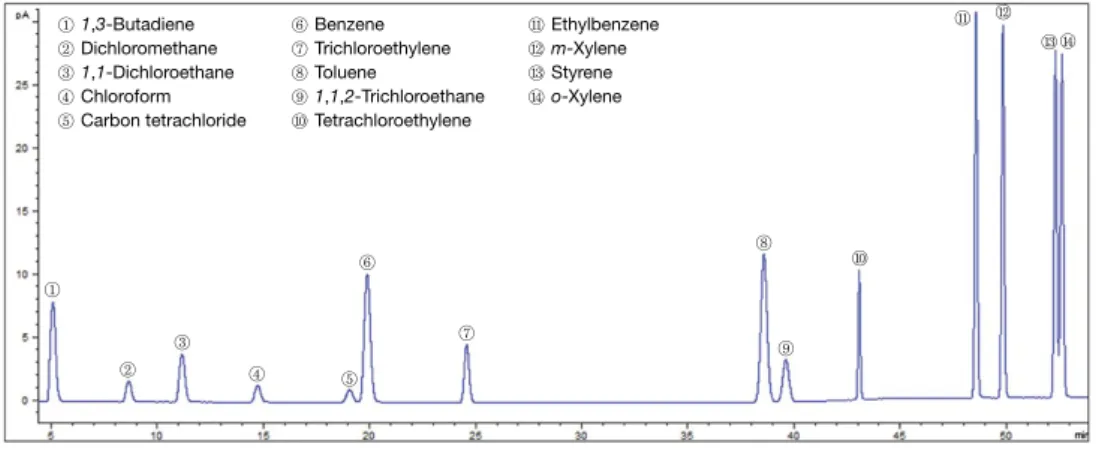
min으로 권장한다(Mcnair and Miller, 2009). 하지만, 표준가스 성분 14종을 한 가지 분석조건으로 한번에 분석하는 동시에 분석시간을 60분 이하로 단축하기 위 해 일반적인 운반가스 유량보다 큰 15mL/min으로 분 석하였다. 분석결과 크로마토그램은 그림 2와 같다. 표 준가스 제조는 ISO(6142-1)에 의해 중량법으로 주입된 가스 질량을 측정하여 표준가스 몰분율(농도)과 몰분율 불확도를 결정하였다. 제조일치성 평가는 GC 분석을 통해 4병의 실린더 중 1병을 기준 실린더로 하였으며, 나머지 3병과의 ratio 차이(sample cylinder sensitivity/
reference cylinder sensitivity)로 불확도를 평가하여 일 치성을 확인하였다.
2.5 HAPs 1μmol/mol 혼합표준가스 흡착손실 (단기안정성) 확인 방법
HAPs 1μmol/mol 혼합표준가스가 실린더 내면에서 흡착에 의한 손실이 있는지 평가하기 위하여 분배실험 을 수행하였다(Lee et al., 2017). 이를 위하여 앞서 제 Fig. 1. Preparation of a 1 μmol/mol primary standard gas mixtures of HAPs.
Benzene Toluene Ethylbenzene m-Xylene Styrene o-Xylene
Benzene, Toluene, Ethylbenzene, m-Xylene Styrene, o-Xylene, Chloroform, 1,1,2-Trichloroethane,
Trichloroethylene, Tetrachloroethylene 1,1-Dichloroethane, Carbontetrachloride 1,3-Butadiene, Dichloromethane
Vial Vial Chloroform
1,1,2-Trichloroethane Trichloroethylene Tetrachloroethylene 1,1-Dichloroethane Carbontetrachloride
1,3-Butadiene 5,000μmol/mol
1,3-Butadiene 100μmol/mol
Dichloromethane 100μmol/mol
HAPs 1μmol/mol
10μmol/mol 10μmol/mol
조한 4병의 혼합표준가스 실린더 중 1병의 실린더 (mother cylinder, D500759)와 진공 배기된 새 실린더 (daughter cylinder, D500758)를 “T”자 형의 코팅된 관 (Sulfinert® coating)으로 연결하였다. 이때, 관 내부를 고순도 질소가스로 퍼지(purge)하고 50℃로 가열하면 서 2회에서 3회 반복하여 진공 배기를 수행하였다. 이 후 mother cylinder 내 표준가스로 관을 퍼지한 후 “T”
자 형 관에 부착된 밸브를 천천히 열어 mother cylin- der 내 표준가스를 daughter cylinder로 분배하였다. 분 배가 완료된 두 실린더는 혼합장치를 이용하여 3시간 동안 혼합하였다. 분석 전 실린더 표면이 실험실 온도 와 같도록 유지하기 위해 실험실에 하루 동안 방치하 여 GC/FID를 이용하여 흡착에 의한 농도변화를 확인 하였다. 분석은 A(mother cylinder)-B(daughter cylin- der)-A(mother cylinder) 순으로 진행하였다.
2.6 HAPs 1μmol/mol 혼합표준가스 장기안정성 확인 방법
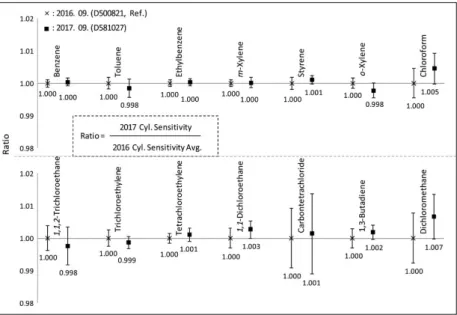
2016년 9월 10일과 2017년 9월 7일에 각각 제조한 HAPs 1μmol/mol 혼합표준가스를 같은 조건에서 비교 분석하여 알루미늄 실린더에서 14종 성분들의 1년 장 기안정성을 확인하였다. 분석은 A(2016 cylinder)-B (2017 cylinder)-A(2016 cylinder) 순서로 진행하였다.
2.7 몰분율 평가 방법
표준가스 내 각 성분의 몰분율(mol fraction, mol/
mol)은 각 성분의 순도와 중량법에 의한 질량측정결과
로부터 결정된다. 혼합가스의 몰분율은 표준가스 제조 절차서(ISO 6142-1, 2015)를 활용하여 식 2와 같이 표 현된다.
P A=1 n
i=1
xi,A×mA
(
---)
xi,A×Mi
∑ ∑
P n
A=1 i=1
mA
(
---)
xi,A×Mi
∑ ∑
xi= (2)
여기서, xi는 최종혼합물 중 성분 i의 몰분율이며, P는 가스의 총 개수, n은 최종혼합물 중의 성분의 총수 mA
는 질량측정에 의해 결정된 가스의 질량, MA는 성분 i 의 분자량, xi,A는 가스 A 중의 성분 i의 몰분율이다.
2.8 불확도 평가 방법
중량법 제조 불확도 평가는 GUM Workbench Pro (version 2.3.6.141, Metrodata GmbH, Germany)프로그 램을 사용하여 수행하였다. 또한 측정 불확도 평가는 ISO 6142-1과 JCGM 100:2008(JCGM 100, 2008)에 따라서 식(3)과 같이 수행하였다.
u(xprep.)= u2(xgrav.)+u2(xveri.)+u2(xstab.) (3)
여기서, u(xprep.)는 제조 불확도, u(xgrav.)는 중량법 불확 도, u(xveri.)는 내부일치성 불확도, u(xstab.)는 안정성 불 확도이다.
u(xgrav.)= u2(xpurity)+u2(xweighing) (4)
Fig. 2. Chromatogram of 1μmol/mol HAPs.
① 1,3-Butadiene ⑥ Benzene ⑪ Ethylbenzene
② Dichloromethane ⑦ Trichloroethylene ⑫ m-Xylene
③ 1,1-Dichloroethane ⑧ Toluene ⑬ Styrene
④ Chloroform ⑨ 1,1,2-Trichloroethane ⑭ o-Xylene
⑤ Carbon tetrachloride ⑩ Tetrachloroethylene
①
⑨
②
⑩
③
⑪
④
⑫
⑤
⑬
⑥
⑭
⑦
⑧
식(4)와 같이 중량법 불확도(u(xgrav.))는 원료시약 및 바탕가스의 순도분석 불확도(u(xpurity))와 표준가스 제 조 시의 질량측정 불확도(u(xweighing))가 합성되었다. 원 료시약의 순도분석은 4회 반복 분석한 결과 중 첫 번 째 결과를 제외한 나머지 3회 분석 결과를 직사각형 분포로 불확도를 평가하였다. 바탕가스의 순도분석은 초고순도질소 측정한 결과값들을 직사각형 분포로 불 확도를 평가하였다. 질량측정 불확도는 측정한 질량측 정 횟수(n)의 표준편차를 으로 나누어 표준 불확도 로 평가하였다.
u(xveri.)= u2(xanal. repeatability)+u2(xanal. reproducibility) (5) 또한 식(5)와 같이 내부일치성 불확도(u(xveri.))는 분석 반복성 불확도(u(xanal. repeatability))와 분석재현성 불확도
(u(xanal. reproducibility))로부터 합성되었다. 여기서 분석 반복
성 불확도는 반복 분석하여 나온 불확도를 합성하였 다. 분석재현성 불확도는 각 실린더들 간의 분석 값 차 이에 대한 분포를 표준 불확도로 평가하였다.
u(xstab.)= u2(xshort term stability)+u2(xlong term stability) (6) 마지막으로 식(6)과 같이 안정성 불확도(u(xstab.))는 단 기안정성 불확도(u(xshort term stability))와 장기안정성 불확
도(u(xlong term stability))를 합성하였다. 단기안정성 불확도
는 직사각형 분포로 mother 실린더와 daughter 실린더 의 차이를 2를 나누고 으로 나누어 주었다. 장기안 정성 불확도는 단기안정성 불확도와 동일하게 직사각 형 분포로 기준실린더(2016년)와 샘플실린더(2017년) 간의 차이가 합성되었다.
3. 실험 결과 및 고찰
3.1 시약의 순도분석 평가 결과
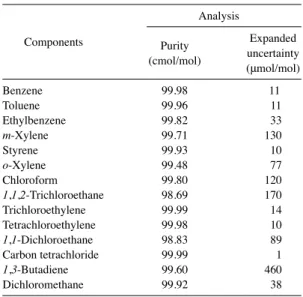
시약의 순도분석은 GC/FID와 수분분석기를 이용하 여 4회 반복 분석한 결과 중 첫 번째 결과를 제외한 나 머지 3회 분석의 결과를 이용하여 각 성분의 순도를 평가하였다. 시약의 탄화수소 순도분석 결과는 표 1과 같이 성분별로 98.7에서 99.9cmol/mol(%mol/mol)로 확인되었다. 여기서 확장불확도는 시약을 3회 분석하 여 얻어진 분석 반복성 불확도로 최대 460μmol/mol로
평가되었다.
3.2 HAPs 고농도 표준가스의 내부일치성 평가 결과
각 Part별 고농도 방향족탄화수소 6종과 염화탄화수 소 6종, 1,3-Butadiene, Dichloromethane의 실린더 4병 의 내부일치성 결과는 그림 3과 같다. 그림에서 불확도 는 내부일치성 불확도와 중량법 불확도를 합성한 것이 며, 모든 실린더가 불확도 범위에서 일치하는 것을 확 인하였다.
3.3 HAPs 1μmol/mol 혼합표준가스의 내부일치성 평가 결과
4개의 알루미늄실린더에서 제조일치성 불확도는 중 량법 불확도와 내부일치성 불확도를 합성하였다. 그 결 과 상대확장 불확도는 Benzene 0.08%, Toluene 0.33%, Ethylbenzene 0.26%, m-Xylene 0.17%, Styrene 0.28%, o-Xylene 0.38%, Chloroform 0.19%, 1,1,2-Trichloro- ethane 0.20%, Trichloroethylene 0.04%, Tetrachloro- ethylene 0.11%, 1,1-Dichloroethane 0.17%, Carbon tet- rachloride 0.26%, 1,3-Butadiene 0.17%, 그리고 Dich- loromethane 0.42%로 4병 모두 해당 불확도 범위 내에 서 일치한 것을 확인하였다.
Table 1. Purity analysis results of HAPs. The main impuri- ties are hydrocarbon impurities and water impuri- ties.
Components
Analysis Purity (cmol/mol)
Expanded uncertainty (μmol/mol)
Benzene 99.98 11
Toluene 99.96 11
Ethylbenzene 99.82 33
m-Xylene 99.71 130
Styrene 99.93 10
o-Xylene 99.48 77
Chloroform 99.80 120
1,1,2-Trichloroethane 98.69 170
Trichloroethylene 99.99 14
Tetrachloroethylene 99.98 10
1,1-Dichloroethane 98.83 89
Carbon tetrachloride 99.99 1
1,3-Butadiene 99.60 460
Dichloromethane 99.92 38
Fig. 3. Internal consistency of premixtures(Part 1: Benzene, Toluene, Ethylbenzene, m-Xylene, Styrene, o-Xylene/Part 2: Chloroform, 1,1,2-Trichloroethane, Trichloroethylene, Tetrachloroethylene, 1,1-Dichloroethane, Carbon tetra- chloride / Part 3: 1,3-Butadiene / Part 4: Dichloromethane).
Fig. 4. Adsorption loss test of the 1μmol/mol HAPs primary standard gas mixtures in a cylinder. All ratios of 14 compo- nents were consistent within the uncertainties (k=2).
Fig. 6. Verification results of 1μmol/mol HAPs primary standard gas mixtures (k=2).
Fig. 5. 1-year long term stability results of 1μmol/mol HAPs primary standard gas mixtures. Gravimetric uncertainty and verification uncertainty were combined(k=2). The results in 2016 and 2017 were consistent each other.
3.4 HAPs 1μmol/mol 혼합표준가스의 실린더 내면(실린더 내부표면) 흡착손실
(단기안정성) 평가 결과
실린더 내 표준가스의 실린더 내면 흡착손실 평가 결과를 mother 실린더 대비 daughter 실린더의 GC/
FID 응답값(GC/FID 피크 면적)의 비로 그림 4에 나타 냈었다. 그림에서 오차막대는 불확도를 표현한 것으로 모든 성분이 불확도 내에서 일치한 것으로 보아 실린 더 내부 표면에서의 흡착에 의한 표준가스 성분의 손 실은 없음을 확인하였다. 아울러 sensitivity는 평균 피 크면적에서 몰분율을 나눈 값이다.
3.5 HAPs 1μmol/mol 혼합표준가스의 장기안정성 평가 결과
새롭게 제조한 표준가스와 1년 전에 제조한 표준가 스의 GC/FID 감도 차이를 비교하여 알루미늄 실린더
에서 HAPs 1μmol/mol 표준가스의 장기안정성을 평가 하였다. 그림 5에 나타낸 것과 같이 14성분 모두 불확 도 범위 내에서 일치하였다. 이로부터 알루미늄 실린 더에서 모든 성분들이 1년 동안 안정하였음을 확인하 였다.
3.6 HAPs 1μmol/mol 혼합표준가스의 제조일치성 평가 결과
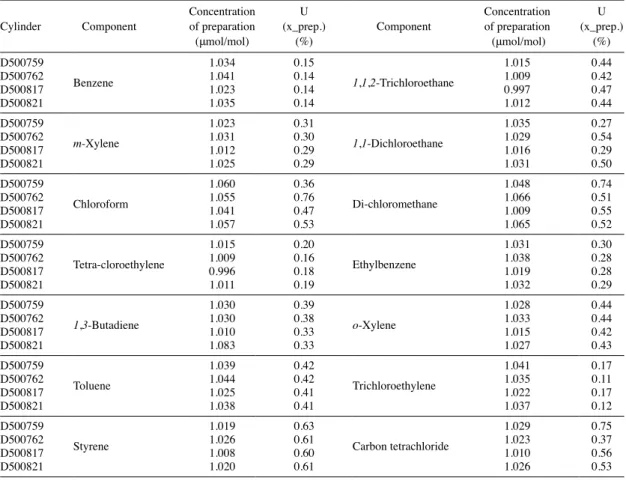
HAPs 혼합표준가스의 최종 불확도는 GUM Work- bench Pro를 사용하여 신뢰수준 95%(k=2)으로 평가 하였다. 그림 6에 각 성분별로 4병의 실린더 간 내부일 치성을 나타내었으며, 확장불확도를 오차막대로 표시 하였다. 제조일치성 결과는 표 2와 같으며, 이로부터 제조된 4병의 실린더에서 모든 성분들이 불확도 범위 내에서 일치하는 것을 확인하였다.
Table 2. Mole fractions and uncertainties of 1μmol/mol HAPs. (k=2)
Cylinder Component Concentration of preparation (μmol/mol)
(x_prep.) U
(%) Component Concentration
of preparation (μmol/mol)
(x_prep.) U (%) D500759
D500762 D500817 D500821
Benzene
1.034 1.041 1.023 1.035
0.150.14 0.140.14
1,1,2-Trichloroethane
1.015 1.009 0.997 1.012
0.440.42 0.470.44 D500759
D500762 D500817 D500821
m-Xylene
1.023 1.031 1.012 1.025
0.310.30 0.290.29
1,1-Dichloroethane
1.035 1.029 1.016 1.031
0.270.54 0.290.50 D500759
D500762 D500817 D500821
Chloroform
1.060 1.055 1.041 1.057
0.360.76 0.470.53
Di-chloromethane
1.048 1.066 1.009 1.065
0.740.51 0.550.52 D500759
D500762 D500817 D500821
Tetra-cloroethylene
1.015 1.009 0.996 1.011
0.200.16 0.180.19
Ethylbenzene
1.031 1.038 1.019 1.032
0.300.28 0.280.29 D500759
D500762 D500817 D500821
1,3-Butadiene
1.030 1.030 1.010 1.083
0.390.38 0.330.33
o-Xylene
1.028 1.033 1.015 1.027
0.440.44 0.420.43 D500759
D500762 D500817 D500821
Toluene
1.039 1.044 1.025 1.038
0.420.42 0.410.41
Trichloroethylene
1.041 1.035 1.022 1.037
0.170.11 0.170.12 D500759
D500762 D500817 D500821
Styrene
1.019 1.026 1.008 1.020
0.630.61 0.600.61
Carbon tetrachloride
1.029 1.023 1.010 1.026
0.750.37 0.560.53
4. 결 론
본 연구에서는 중량법을 이용하여 알루미늄 고압실 린더에 4부분으로 나뉘어 고농도 표준가스를 제조하 였다. 이후 각 고농도 표준가스들의 중량법 제조일치 성을 확인하였으며, 최종적으로 HAPs(14종)를 1 μmol/mol 수준으로 혼합 제조하였다. 혼합표준가스의 몰분율과 불확도는 ISO 6142-1과 JCGM 100:2008을 이용하여 성분의 순도 정보와 중량법 정보에 의하여 결정되었다. 알루미늄 실린더 내 혼합표준가스의 안정 도는 실린더 내부표면에서의 흡착 손실을 평가한 단기 안정도 평가와 1년간 실린더 내에서의 안정도를 평가 하는 장기안정도 평가로 수행되었다. 그 결과, 14 성분 모두 불확도 범위 내에서 알루미늄 실린더 내부 표면 에서 흡착손실이 없었고 1년 동안 알루미늄 실린더 내 에서 안정하였다. HAPs 중 14종 VOCs 1μmol/mol 표 준가스의 불확도 평가를 위해 중량법 불확도, 내부일 치성 불확도, 그리고 내부안정성 불확도 등을 평가한 결과, 상대확장 불확도는 최대 0.76%(k=2) 미만이었 다.
본 연구에서는 소급성 있는 HAPs 1μmol/mol 표준 가스를 개발함으로써 대기 중 HAPs의 정확한 측정을 위한 토대를 마련하였다. 개발 완료된 HAPs 1μmol/
mol는 대기 중 HAPs 측정을 위한 1차 표준가스로써 활용 및 보급될 예정이며 이로부터 측정 소급성을 도 모하고자 한다. 대기 중 HAPs는 nmol/mol 수준으로 존재하므로 현재 유해대기물질측정망 자동연속측정방 법에서는 표준가스를 희석하여 활용하고 있다. 추후 연구를 통하여 추가적인 희석 과정 없이 활용할 수 있 는 nmol/mol 수준 표준가스를 개발함으로써 희석과정 에서 발생할 수 있는 불확도 요소를 최소화하고 측정 의 신뢰성을 향상시키고자 한다.
감사의 글
본 연구는 국가과학기술연구회에 [대기환경 측정표 준 기술개발(17011010)]과 환경부 사업의 [휴대용 유 해화학물질 측정장치용 DB 및 성능평가 기술개발 (17301006)] 사업의 연구비 지원으로 수행된 연구 결 과입니다.
References
Ahn, J.Y., Kim, C.S., Jung, B.R., Ok, G.(2006) Formation and Safety Supervision of Hazardous Air Pollutants (HAPs) by Combustion of Firecracker, Journal of Korean Society for Environmental Analysis, 9(3), 151-163.(in Korean with English abstract) Caldwell, J.C., Woodruff, T.J., Morello-Frosch, R., Axelrad,
D.A.(1998) Application of health information to hazardous air pollutants modeled in EPA’s Cumula- tive Exposure Project, Toxicology and Industrial Health, 14(3), 429-454.
Hong, J.H., Lee, S.J., Cha, J.S., Lee, D.G., Seok, K.S., Kim, D.G., Park, J.H., Lee, S.B.(2003) Development of Management System of Hazardous Air Pollutants Emission(I), National Institute of Environmental, http://webbook.me.go.kr/DLi-File/NIER/06/092 136.pdf. Accessed on 2018.03.31.
International Organization for Standardization(ISO 6142-1) (2015) Gas analysis - Preparation of calibration gas mixtures-Part 1: Gravimetric method for Class I mixtures, http://www.iso.org/iso/home/store/cata- logue_tc/catalogue_detail.htm?csnumber=59631.
Accessed on 2017.10.26
Joint Committee for Guides in Metrology(JCGM 100)(2008) JCGM 100:2008-Evaluation of measurement data- Guide to the expression of uncertainty in measure- ment, https://www.bipm.org/utils/common/docu- ments/jcgm/JCGM_100_2008_E.pdf. Accessed on 2018.03.31.
Kelly, T.J., Mukund, R., Spicer, C.W., Pollack, A.J.(1994) Concentrations and transformations of hazardous air pollutants, Environmental Science & Technolo- gy, 28(8), 378A-387A.
Kim, J.C.(2006) Trends and control technologies of volatile organic compound, Journal of Korean Society for Atmospheric Environment, 22(6), 743-757.(in Korean with English abstract)
Korea Ministry of Environment(Korea MOE)(2016) Air Pollu- tion Monitoring Network Installation and Operation Guidelines, p41, http://webbook.me.go.kr/DLi-File/
NIER/09/021/5618154.pdf. Accessed on 2018.03.
31.
Korea Ministry of Environment(Korea MOE)(2017a) Enforce- ment rule of Clean Air Conservation Act, http://
www.law.go.kr/lsEfInfoP.do?lsiSeq=202475#. Acce- ssed on 2018.03.31.
Korea Ministry of Environment(Korea MOE)(2017b) Enforce- ment rule of Clean Air Conservation Act, Enforce- ment Regulations of the Atmospheric Environment Conservation Act Chapter 1 Section 2-9, http://www.
law.go.kr/LSW/LsiJoLinkP.do?docType=JO&lsNm
=%EB%8C%80%EA%B8%B0%ED%99%98%EA
%B2%BD%EB%B3%B4%EC%A0%84%EB%B2
%95&joNo=000700000&languageType=KO&par as=1#. Accessed on 2018.03.31.
Lee, S., Kim, M.E., Oh, S.H., Kim, J.S.(2017) Determination of physical adsorption loss of primary standard gas mixtures in cylinders using cylinder-to-cylinder divi- sion, Metrologia, 54, L26-L33.
McNair, H.M., Miller, J.M.(2009) Basic Gas Chromatogra- phy, 2nd Ed., John Wiley & Sons Inc., U.S.A., 224 pp.
National Institute of Environmental Research(NIER)(2012) Study on establishment of management strategy for hazardous air pollutants(HAPs) in urban areas, NIER-SP2012-090, 186 pp, http://webbook.me.go.
kr/DLi-File/NIER/06/016/5549955.pdf. Accessed on 2018.03.31.
Organization for Economic Cooperation and Development (OECD)(1999) ADVANCED AIR QUALITY INDICATORS AND REPORTING, p107, ENV/
EPOC/PPC(99)9/FINAL, http://www.oecd.org/offi- cialdocuments/publicdisplaydocumentpdf/?doclangu age=en&cote=env/epoc/ppc(99)9/final. Accessed on 2018.03.31.
Özkaynak, H., Palma, T., Touma, J.S., Thurman, J.(2008) Mod-
eling population exposures to outdoor sources of hazardous air pollutants, Journal of Exposure Sci- ence and Environmental Epidemiology, 18(1), 45-58.
Seo, Y.K., Chung, S.H., Baek, S.O.(2011) Current Status and Prospective of Hazardous VOC in Ambient Air, Journal of Korean Society for Atmospheric Envi- ronment, 27(6), 734-745.(in Korean with English abstract)
Suh, H.H., Bahadori, T., Vallarino, J., Spengler, J.D.(2000) Cri- teria Air Pollutants and Toxic Air Pollutants, Envi- ronmental Health Perspectives, 108(4), 625-633.
U.S. Environmental Protection Agency(US EPA)(2011) An Overview of Methods for EPA’s National-Scale Air Toxics Assessment. Office of Air Quality, Planning, and Standards, https://www.epa.gov/sites/produc- tion/files/2015-10/documents/2005-nata-tmd.pdf.
Accessed on 2018.03.31.
U.S. Environmental Protection Agency(US EPA)(2015) 2011 National Emissions Inventory, Version 2, technical support document, p24, https://www.epa.gov/sites/
production/files/2015-10/documents/nei2011v2_
tsd_14aug2015.pdf. Accessed on 2018.03.31.
World Health Organization(WHO)(2014) 7 million premature deaths annually linked to air pollution. WHO Media Centre : news release. World Health Organization.
2014d Available. http://www.who.int/mediacentre/
news/releases/2014/air-pollution/en/, Accessed on 2017.10.26