• 검색 결과가 없습니다.

Novel Flexible Supercapacitors Fabricated by Simple Integration of Electrodes, Binders, and Electrolytes into Glass Fibre Separators

N/A
N/A
Protected

Academic year: 2021

Share "Novel Flexible Supercapacitors Fabricated by Simple Integration of Electrodes, Binders, and Electrolytes into Glass Fibre Separators"

Copied!
8
0
0

로드 중.... (전체 텍스트 보기)

전체 글

(1)

Vol. 17, No. 4, 2014, 237-244

http://dx.doi.org/10.5229/JKES.2014.17.4.237

− 237 −

Novel Flexible Supercapacitors Fabricated by Simple Integration of Electrodes, Binders, and Electrolytes into Glass Fibre Separators

Joung Eun Yoo

1

and Joonho Bae

2

*

1

Department of Chemical Engineering, University of Texas at Austin, Austin, TX 78712, USA

2

Department of Nano-physics, Gachon University, Seongnam-si, Gyeonggi-do, 461-701, Republic of Korea (Received November 3, 2014 : Revised November 18, 2014 : Accepted November 19, 2014)

Abstracts : We report novel and simple structure of supercapacitors fabricated by using flexible glass fibre separators as templates. This method does not require separate electrodes, binders and high pressure/temperature to build the supercapacitor unit cells as required by the conven- tional technology. The supercapacitors were fabricated by drop-casting solution mixtures of car- bonaceous active materials/gel electrolytes onto two sides of glass fibre separators. Two carbonaceous materials (nanoscaled activated carbons, multi-walled carbon nanotubes) were investigated as electrode materials. The electrochemical measurements reveal that the separator- based supercapacitors using ACs successfully demonstrated significant mass specific capacitance (22.3 F g

1

) and energy density (9.7 Wh kg

1

), indicating this method can be useful in fabri- cating flexible, wearable and stretchable energy storage devices in more straightforward and cost-effective way than current technology.

Keywords : supercapacitors, activated carbons, carbon nanotubes, glass fiber filters, bending tests

1. Introduction

Supercapacitors or ultracapacitors are next-genera- tion energy storage devices in which charging and discharging process takes place at the electric dou- ble layers formed on electrodes. Since the superca- pacitors store and release the electrical energy via electrostatic way with high capacitance propor- tional to the surface area of nano-structured elec- trodes, they demonstrated extremely high specific capacitances and energy density compared to the conventional dielectric capacitors.

1-4)

. Moreover, their high power density could enable us to replace the lithium ion batteries with supercapacitors in the future applications which require high power rat- ings.

5,6)

Due to the recent progress in electronics and microelectronics, there have been numerous reports on device structures, electrode materials and electro- lytes of supercapacitors or batteries which could fit

the flexible, wearable and stretchable electronics.

7-13)

However, in spite of recent progresses, conventional supercapacitors and batteries are still bulky, heavily relying on the rigid substrates and processing tech- nology to circumvent the current trend toward lighter and thinner electronics.

14-16)

The conventional unit cell of supercapacitor is comprised of two electrodes prepared by pressing electrodes materials (mainly activated carbons or carbon-based materials) with a binder at high pres- sure and high temperature such as 500 kg cm

−2

and 420

o

C.

17)

Two electrodes then are sandwiched together with a polymer-based separator. The elec- trodes, electrolytes and separators of the supercapac- itors are kept under again high pressure such as 16 kg cm

−2

.

17)

Hence, the conventional process to fabricate supercapacitor cell requires high pressures and heating process, which could hinder employ- ment of flexible, wearable, and textile-based sub- strates for the next-generation electronics. Moreover, simpler processing techniques are preferred for fab- ricating high efficiency supercapacitors to reduce their manufacturing costs.

*E-mail: [email protected]

(2)

been several reports on new device structures and fabricating methods of supercapacitors. For instance, Hu et al., demonstrated integration of electrodes and separators into commercial papers to build the supercapacitors using carbon nanotubes as electrodes materials.

13)

Integration of electrodes, separators and electrolytes into nano-composite units were also reported

18)

in the literature.

In this report, we demonstrate an efficient and facile strategy to build supercapacitor unit cells without using electrodes and any processes requir- ing high temperature and pressure. This new method doesn’t need to use any electrodes. Instead, the device structure utilizes only separators. The electrodes are eliminated and formed inside the sep- arators by diffusion of electrodes materials and electrolytes inside the separators. Most of the recent demonstration of the integrations of electrodes, sep- arators and electrolytes utilized carbon nanotubes or similar types of carbonaceous materials. These novel carbon materials are generally expensive. In this work, we investigated possibility of using acti- vated carbons (ACs) as electrode materials for our separator-based supercapacitors. The ACs are cur- rently employed as main electrode materials for the commercial supercapacitors due to their high sur- face area, wide spectrum of pore structures and cheap price. As a control, we also fabricated the supercapacitors using multi-walled carbon nano- tubes (CNTs) as the electrode materials via the same method as that from ACs.

2. Experimental Details

The PVA/H

3

PO

4

gel electrolyte was formed by dissolving poly(vinyl alcohol) (PVA) powder (10 g) with water (100 mL) and phosphoric acid (10 g)

19)

at 120

o

C. PVA (Aldrich) was >99% purity with MW of 85000-124000. The gel electrolyte (10 g) was then mixed with 30 mg of AC powder (Duk- san, Korea) using magnetic stirring for 1 h. For control, MWCNT powder (NC 7000, Nanocyl) was dispersed in the gel electrolyte at the same concen- tration as the solution mixture of ACs in the gel electrolyte. All the chem icals were used as received.

measured using TriStar II (Micrometrics) by the adsorption of N

2

at 77 K. Specimens were degassed at 200

o

C for 2 h before the adsorption.

To fabricate two-electrode test cells with each materials (ACs, CNTs), the mixed slurries contain- ing PVA, H

3

PO

4

and ACs or CNTs were drop- casted on the front and back side of a Whatman GF/D glass microfibre filter. The filters or separa- tors of the supercapacitors are typically about 1 cm

2

in area. The copper wires are attached on two sides of the prepared separators by using a silver epoxy for the electrochemical measurements. A potentiostat (Princeton Applied Research Versastat 4) was used to perform the electrochemical mea- surements. To examine the surface morphology of ACs and CNTs, a field emission scanning electron microscopy (JEOL) was employed with typical operation voltage of 5 kV.

3. Results and Discussion

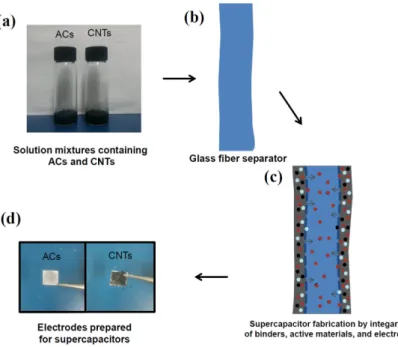
The flow process to fabricate the separator-based supercapacitors is presented in Fig. 1. The solution mixture of active materials and PVA/H

3

PO

4

gel electrolyte was prepared as described in the experi- mental section above. The solution mixture of ACs and PVA/H

3

PO

4

is shown in Fig. 1a (left vial). It is seen that the ACs are dispersed uniformly in PVA/H

3

PO

4

gel electrolyte without precipitation. As a control, we prepared the solution mixture of CNTs dispersed in PVA/H

3

PO

4

electrolyte at the same concentration as the solution containing ACs.

The picture of the solution containing CNTs also shows well-dispersed solution (right vial in Fig. 2a).

These prepared solutions of ACs and CNTs then

are drop-casted on the front and back sides of a

glass fibre filter (Whatman) (Fig. 1b). Convention-

ally, the glass fibre filters have been used as sepa-

rators in supercapacitors in many works reported in

literature.

20,21)

In our fabrication method, the glass

fibre filters serve as main flexible templates as well

as separators. Instead of sandwitching two elec-

trodes with a separator, the supercapacitor cell

assembly is accomplished by coating only one solu-

tion mixture on two sides of the separators. The

solution in the glass fibre filters will diffuse in the

(3)

filter pores after the solution is coated, resulting in transport of electrolyte ions contained in the solu- tion. The electrode materials (ACs or CNTs) in the solution also form the electric double layers at their interface between the electrolytes. The polymers or PVA will prevent the electrical contact between the electrode materials while allowing for ion transport of the electrolytes.

19)

Drop-casting of the solution mixture eliminates further processes for electrode formation and pressurizing as is seen in the con- ventional process of supercapacitor fabrication.

Figure 2 shows SEM images of ACs and CNTs dispersed on Si substrates. For this examination on the surface morphology of ACs and CNTs, each powders of ACs and CNTs were dispersed in ace- tone with sonication subsequently drop-casted on Si substrates. After drying the acetone, the SEM mea- surements were performed. Fig. 1a and its inset show thick agglomeration of ACs formed on Si with an irregular form. Fig. 2b shows SEM image of CNTs dispersed on Si. It is seen that the CNTs

can form interwoven structures or networks of bun- dles of nanotubes on substrates.

The cyclic voltammetry (CV) responses of the

two electrode materials (ACs, CNTs) are shown in

Fig. 3(a) at a scan rate of 50 mV s

−1

. The electro-

lyte used is PVA/H

3

PO

4

gel electrolyte. The CV

curve from ACs shows clearly asymmetric shape,

which is not found in box-shape CVs from ideal

supercapacitors using carbonaceous electrodes. The

reason for non-ideal shaped CV from our superca-

pacitors using ACs is currently not clear. How-

ever, similar CVs from carbonaceous electrode

materials with non-ideal shape were reported in the

literature. For instance, CV from CNT electrodes in

literature showed a peak at 0.35 V, which can be

attributed to pseudocapacitance originated from oxy-

gen containing functional group in the CNTs.

22,23)

In

the literature, the departure of shape of CVs from

the ideal shape generally is attributed to the impuri-

ties, functional groups on electrodes, and unopti-

mized conductivity of the cells.

23)

The reason for

Fig. 1. A flow process to fabricate flexible supercapacitors fabricated by integration of electrodes, electrolytes, and

binders into a glass fibre separator. (a) A photo of prepared solution mixtures containing ACs (left vial) and CNTs (right

vial). Both mixtures are dispersed in PVA/H

3

PO

4

gel electrolyte. (b) A blank glass fibre filter that is used as separator. (c)

The glass fibre filter whose front and back side was coated with the solution mixtures. White, black, and red circles

represent PVA, ACs (or CNTs), and electrolyte ions from H

3

PO

4

, respectively in the solution mixture. After the drop-

casting, the ions (red circles) diffuse into the separator to form a supercapacitor cell. (d) Photos of the resultant

supercapacitor cells.

(4)

the significant departure from ideal box like CV curve is attributed to non-uniform distribution of electrolyte ions present inside the glass fibre separa- tor. For our supercapacitors, the electrolyte (H

3

PO

4

) is mixed with carbon materials and PVAs, and their mixture is drop-casted on front and back side of a separator.

The CV curves at three different scan rates (100,

pacitors in Fig. 3(b). For ideal supercacitors, the cu rr ent s ten d to inc re ase a s the sc a n r ate s increased. However, our ACs-based supercapcitors showed almost constant level of currents when the scan rate increased up to 100 mV s

−1

. This behav- iour resulted in the low capacitance retention of the supercapacitor cell. In Fig. 3(c), the capacitance retention of the ACs-based supercapacitor is shown.

It is seen that the cell retained 56% and 40% of the initial capacitance at scan rates of 50 and 100 mVs

−1

, respectively. In general, the ions of electrolytes are required to enter the electrode’s sur- face as fast as possible to maintain the capaci- tance at higher scan rates. This requirement results in high demand of bigger pores in the electrodes.

24)

Our results of capacitance retention suggest that pore size distribution needs to be improved to enhance the retention of ACs-based supercapaci- tors. The investigations for improving the retention are currently in progress.

The specific capacitances can be obtained from the CV curves using the equation:

25,26,27)

where C

m

, m, S, V

1

, V

2

, and Q are the mass spe- cific capacitance, the mass of the active materials in the cell, scan rate, upper and lower limit of the potential window, and the charge stored in the capacitors. The charge Q can be obtained by the voltammetric discharge integrated over the potential window.

25)

In our works, the maximum charges measured by the potentiostat are used to determine the charge Q. The above equation reveals that the

Cm Q

S V (

1

– V

2

)m ---

= Fig. 2. (a) SEM image of ACs dispersed on Si substrate.

Scale bar 100 µ m. Inset higher magnification SEM image of the ACs with the scale bar of 5 µ m. (b) SEM image of CNTs dispersed on Si substrates. Scale bar 100 µ m. Inset higher magnification SEM image of the CNTs with the scale bar of 20 µ m.

Fig. 3. (a) CV plots of the supercapacitors using the solution mixtures containing ACs and CNTs. The scan rate is

50 mV s

1

. (b) CV curves at three different scan rates (100, 50, 20 mV s

1

) are plotted for ACs-based supercapacitors. (c)

The capacitance retention of the ACs-based supercapacitor at the different scan rates.

(5)

mass specific capacitances of our separator-based supercapacitors using ACs and CNTs in the gel electrolyte are 22.3 and 3.6 Fg

−1

, respectively. The scan rates are 20 mVs

−1

.

This value of specific capacitance particularly from ACs-based supercapacitors is comparable to those reported in the literature. For example, ACs- based supercapacitors using the conventional meth- ods and binders were reported to exhibit about 20 Fg

−1

.

28)

In contrast, when compared to recently reported ones from carbonaceous materials such as graphenes-based supercapacitors exhibiting 160 - 220 Fg

−1

, our supercapacitors need further optimiza- tion.

29,30)

The previous works on the graphenes sug- gest that tailoring micro- or nano-structures of our ACs or active materials/binders/electrolyte solutions could enhance the specific capacitance.

Figure 4 shows the results of the galvanostatic charge-discharge measurement on the separator-based supercapacitors using ACs and CNTs. The applied currents are 0.08 mA while the potential range is between 0 and +0.5 V. Both active materials in the plot demonstrate symmetry of the charging and dis- charging behaviour, indicating good capacitive char- acteristics. The typical triangular shapes evident in the curves also suggest that the capacitive behav- iour of the supercapacitors is originated from the effective ion adsorption at the interface of electro- lytes and the active materials.

The coulombic efficiencies of the supercapacitors were calculated to test their capacity to retain charges.

31)

The coulombic efficiency ( η ) is calcu-

lated according to the equation, η = ∆ t

d

/ ∆ t

c

, where

∆ t

d

and ∆ t

c

are discharging and charging time.

32, 33)

The coulombic efficiencies of the supercapacitors from ACs and CNTs are determined to be 52%

(ACs) and 63% (CNTs). The coulombic efficiencies of ACs and CNTs-based supercapacitors are lower than those from other supercapacitors fabricated by conventional method using binders and pressing the electrodes with high pressure. For example, manga- nese oxide/activated carbon capacitors were reported to show the coulombic efficiency of up to 97%.

32)

The low coulombic efficiency of our supercapacitors is evident in the charging-discharging plot showing short discharging time compared to the charging time. It indicates that the charges stored in the capacitors are discharged faster than charging process.

These poor charge-retaining capacities of our separa- tor-based supercapacitors are currently attributed to the absence of charge collectors (metal substrates) which are available in the conventional two-elec- trode-supercapacitors. Our separator-based supercapaci- tors employed silver paste attachments of electrodes on the two sides of the supercapacitors without any current collectors. This absence of current collectors may be responsible for the low coulombic efficiency.

Works are in progress to improve the coulombic effi- ciency of separator-based supercapacitors.

Figure 5 shows stability characteristics of the ACs-based supercapacitors. In Fig. 5(a), galvano- static charge-discharge measurements were per- formed on the supercapacitor for 500 cycles at the current density of 0.09 mA. This result demonstrates reliable and stable charging and discharging charac- teristics of supercapacitors using our novel fabrica- tion method. To test mechanical stability and flexibility of the supercapacitors, mechanical bend- ing test was also conducted on the ACs-based supercapacitors. The supercapacitor was bent at the angle from 0 to 95

o

, and the ratio (C/C

0

) of capac- itance (C) to initial capacitance (C

0

) was calcu- lated (Fig. 5(b)). It is seen that the capacitance rather increases at the bending angle of 20-65

o

. After the bending angle of 65°, the capacitance is observed to be in the trend of decreasing. The surge or increase of the capacitance at the angle range (20-65

o

) may have been caused by increase of pressure on the electrodes, resulting in the Fig. 4. Galvanostatic charge-discharge curves from the

supercapacitors using the solution mixtures containing

ACs and CNTs.

(6)

increase of electrolyte transport in the glass fibre filter. When the capacitor was released from the bending, we found the significant decrease of the capacitance ( C/C

0

= 60%) compared to the original capacitance (C

0

). The capacitance change is 40%.

This bending tests suggest that significant damage has occurred to the supercapacitor cell after 95

o

.

The device characteristics and materials properties of the supercapacitors are presented in Table 1. To evaluate their performance as energy storage devices, the energy density (E) of the supercapaci- tors are calculated by using E = 0.5 C V

2

, where V is the potential difference in the CV curve, and Cm is the mass specific capacitance of the superca- pacitor. Using the equation above, the maximum energy densities of ACs and CNTs-based superca- pacitors are determined to be 9.7 and 2.9 Wh kg

−1

, respectively. These values are comparable to the energy densities of carbon-based supercapacitors reported in the literature. For example, An et al., reported the maximum energy density of superca- pacitor using single-walled CNTs as 7 Wh kg

−1

.

34)

The higher mass specific capacitance and energy density of ACs-based supercapacitors is attributed to their higher surface area compared to CNTs. Fig. 5 shows N

2

adsorption isotherms from ACs and

CNTs performed at 77 K. As is seen in Fig. 5, ACs exhibited higher gas adsorption capacity than CNTs, therefore resulting in the higher BET surface area. The surface areas of ACs and CNTs are mea- sured to be 1012.4 and 223.7 m

2

g

−1

, respectively, resulting in the higher electrochemical perfor- mances of the supercapacitors from ACs as com- pared to those from CNTs.

4. Conclusion

In summary, novel integration of the electrodes, binders and electrolytes into separators were suc- Fig. 5. Stability tests performed on the ACs based supercapacitors. (a) Galvanostatic charge-discharge measurements performed for 500 cycles. (b) Evolution of the mass specific capacitances during the mechanical bending test.

Fig. 6. N

2

adsorption isotherms of ACs and CNTs.

Table 1. Summary of the supercapacitor cells using ACs and CNTs as electrode materials

Specimens BET Surface Area (m

2

g

1

)

Weight of Active Materials

(mg)

Mass Specific Capacitance, Cm

(Fg

1

)

Coulombic Efficiency

(%)

Energy Density, E (W h kg

1

) Acticated Catbons

(ACs) 1012.4 0.22 22.3 52 9.7

Carbon Nanotubes 223.7 0.13 3.6 63 2.9

(7)

cessfully demonstrated to fabricate supercapacitors using ACs and CNTs as active electrode materials.

The simple structure of supercapacitors by using flexible glass fibre separators as templates is found to be useful in eliminating separate electrodes, binders and high pressure/temperature which are typical in the current supercapacitor fabrication process. The electro- chemical measurements on the supercapacitors from ACs and CNTs using this method reveal that the supercapacitors using ACs successfully demonstrated significant mass specific capacitance (22.3 Fg

−1

) and energy density (9.7 Wh kg

−1

). Our method could pro- vide useful strategy to realize fully flexible, wear- able and stretchable energy storage devices by simpler and more cost-effective ways than conven- tional technology.

Acknowledgments

This research was supported by Basic Science Research Program through the National Research Foundation of Korea (NRF) funded by the Ministry of Science, ICT & Future Planning (2013R1A1A 1008436).

References

1. J. R. McDonough, J. W. Choi, Y. Yang, F. L. Manita, Y.

Zhang Y, and Y. Cui, “Carbon nanofiber supercapacitors with large areal capacitances”, Appl. Phys. Lett., 95, 243109 (2009).

2. P. Chen, G. Shen, S. Sukcharoenchoke, and C. Zhou,

“Flexible and transparent supercapacitor based on In

2

O

3

nanowire/carbon nanotube heterogeneous films”, Appl.

Phys. Lett., 94, 043113 (2009).

3. U. Chung, C. Elissalde, S. Mornet, M. Maglione, and C.

Estournes, “Controlling internal barrier in low loss BaTiO

3

supercapacitors”, Appl. Phys. Lett., 94, 072903 (2009).

4. X. Wu, L. Jiang, F. Cao, Y. Guo, and Wan, “LiFePO

4

Nanoparticles Embedded in a Nanoporous Carbon Matrix: Superior Cathode Material for Electrochemical Energy-Storage Devices”, Adv. Mater., 21, 2710 (2009).

5. K. Hung, C. Masarapu, T. Ko, and B. Wei, “Wide-tem- perature range operation supercapacitors from nanostruc- tured activated carbon fabric”, J. Power Sources, 193, 944 (2009).

6. D. Stoller, S. Park, Y. Zhu, J. An, and R. S. Ruoff,

“Graphene-Based Ultracapacitors”, Nano Lett., 8, 3498 (2008).

7. J. Bae, M. K. Song, Y. J. Park, J. M. Kim, M. Liu M,

and Z. L. Wang, “Fibre super capacitors made of nanow- ire-fibre hybrid structures for wearable/flexible energy storage”, Angew. Chem. Int. Ed., 50, 1 (2011).

8. J. Bae J, Y. J. Park, M. Lee, S. N. Cha, Y. J. Choi, C. S.

Lee, J. M. Kim, and Z. L. Wang, “Single-fibre-based hybridization of energy converters and storage units using Graphene as electrodes”, Adv. Mater., 23, 3446 (2011).

9. L. Hu, N. Liu, M. Eskilsson, G. Zheng, J. McDonough, M. Wagberg, and Cui Y, “Silicon-Conductive Nanopaper for Li-Ion Batteries”, Nano Energy, 2, 138 (2013).

10. T. Hu, X. Sun, H. Sun, M. Yu, F. Lu, C. Liu, and J. Lian,

“Flexible free-standing graphene-TiO

2

hybrid paper for use as lithium ion battery anode materials”, Carbon, 51, 322 (2012).

11. X. Zhang, Z. Lin, B. Chen, S. Sharma, C. P. Wong, Z.

Zhang, and Y. Deng, “Solid-state, flexible, high strength paper-based supercapacitors”. J. Mater. Chem., 1, 5835 (2009).

12. S. Hu, R. Rajamani, and X. Xu, “Flexible solid-state paper based carbon nanotube supercapacitor”, Appl.

Phys. Lett. 100, 104103 (2012).

13. L. Hu, W. Hui, and Y. Cui, “Printed energy storage devices by integration of electrodes and separators into single sheets of paper” Appl. Phys. Lett. 96, 183502 (2010).

14. D. Pech, M. Brunet, H. Durou, P. Huang, V. Mochalin, Y.

Gogotsi, P. Taberna, and P. Simon, “Ultrahigh-power micrometre-sized supercapacitors based on onion-like carbon”, Nature Nanotech. 5, 651 (2010).

15. A. Kiebele, M. Kaempgen, and G. Gruner, “Printed Energy and Power Storage: Batteries and Supercapaci- tors”, Nanotech. Law Bus., 5, 7 (2008).

16. Z. Fan, Z. Chu, F. Wang, C. Zhang, L. Chen, Y. Tang, and D. Zou, “Wire-shaped flexible dye-sensitized solar cells”, Adv. Mater., 20, 592 (2008).

17. A. L. M. Reddy, and S. Ramaprabhu, “Nanocrystalline metal oxides dispersed multiwalled carbon nanotubes as supercapacitor electrodes”, J. Phys. Chem. C, 111, 7727 (2007).

18. V. L .Pushparaj, M. M. Shaijumon, A. Kumar, S. Murug- esan, L. Ci, R. J. Vajtai, O. Linhardt, and P. M. Ajayan,

“Flexible energy storage devices based on nanocomposite paper”, Proc. Nat. Acad. Sci., 104, 13574 (2007).

19. M. Kaempgen, C. K. Chan, J. Ma, Y. Cui, and G. Gruner

“Printable thin film supercapacitors using single-walled carbon nanotubes”, Nano Letters 9, 1872 (2009).

20. J. Kim, C. S. Lee, J. H. Han, H.W. Cho, and J. Bae J

“Supercapacitors using gel electrolytes and thin multi- walled carbon nanotube films spray-deposited on ITO substrates”, Electrochem. Solid-State Lett. 14, A56 (2011).

21. Z. Chen. V. Augustyn, J. Wen, Y. Zhang, M. Shen, B.

Dunn, and Y. Lu “High-performance supercapacitors

based on intertwined CNT/V

2

O

5

nanowire nanocompos-

ites”. Adv. Mater., 23, 791 (2011).

(8)

supercapacitors”, Appl. Phys. Lett., 90, 264104 (2007).

23. J. N. Barisci, G. G. Wallace, and R. H. Baughman, “Elec- trochemical studies of single-wall carbon nanotubes in aqueous solutions” J. Electroanal. Chem., 488, 92 (2000).

24. C. Vix-Guterl, E. Frackowiak, K. Jurewicz, M. Friebe, J.

Parmentier and F. Beguin, “Electrochemical energy stor- age in ordered porous carbon materials”, Carbon, 43, 1293 (2005).

25. D. Pech, M. Brunet, H. Durou, P. Huang, V. Mochalin, Y.

Gogotsi, P.-L. Taberna, and P. Simon, “Ultrahigh-power micrometre-sized supercapacitors based on onion-like carbon”, Nature Nanotech., 5, 651 (2010).

26. T. Y. Kim, H. W. Lee, M., D. R. Stoller, C. W. Bielawski, R. S. Ruoff, and K. S. Suh, “High-Performance Superca- pacitors Based on Poly(ionic liquid)-Modified Graphene Electrodes”, ACS Nano, 5, 436 (2011).

27. B. G. Choi, Y. S. Huh, and W. H. Hong, “Electrochemical characterization of porous graphene film for supercapac- itor electrode”, Korean Chem. Eng. Res., 50, 754 (2012).

28. C. Schüttera, C. Ramirez-Castroa, M. Oljacab, S. Passe- rinic, M. Wintera, and A. Balducci, “Activated Carbon, Carbon Blacks and Graphene Based Nanoplatelets as Active Materials for Electrochemical Double Layer Capacitors: A Comparative Study ”, J. Electrochem. Soc.

Zhang, Q.-Q. Kong,M.-Z. Wang, Y.-G. Yang, R. Caia, and D. S. Su, “Macroporous ‘bubble’ graphene film via template-directed ordered-assembly for high rate superca- pacitorsw”, Chem. Commun., 48, 7149 (2012).

30. Z. Bo, W. Zhu , W. Ma , Z. Wen, X. Shuai, J. Chen, J.

Yan , Z. Wang , K. Cen , and X. Feng, “Vertically Ori- ented Graphene Bridging Active-Layer/Current-Collector Interface for Ultrahigh Rate Supercapacitors”, Adv.

Mater., 25, 5799 (2013).

31. S. Mallika, and R. S. Kumar, “Review on ultracapacitor- battery interface for energy management system” Intern.

J. Engin. Tech., 3, 37 (2011).

32. V. Khomenko, E. Raymundo-Pinero, and F. Beguin,

“Optimisation of an asymmetric manganese oxide/acti- vated carbon capacitor working at 2V in aqueous medium”, J. Power Sources, 153, 183 (2006).

33. R. I. Jafri, A. K. Mishraa, S. Ramaprabhu, “Polyaniline–

MnO

2

nanotube hybrid nanocomposite as supercapacitor electrode material in acidic electrolyte”, J. Mater. Chem., 21, 17601 (2011).

34. K. H. An, W. S. Kim, Y. S. Park, Y. C. Choi, S. M. Lee, D. C. Chung, D. J. Bae, S. C. Lim, and Y. H. Lee,

“Supercapacitors using single-walled carbon nanotube

electrodes” Adv. Mater., 13, 497 (2001).

수치

Figure 2 shows SEM images of ACs and CNTs dispersed on Si substrates. For this examination on the surface morphology of ACs and CNTs, each powders of ACs and CNTs were dispersed in  ace-tone with sonication subsequently drop-casted on Si substrates
Fig. 3. (a) CV plots of the supercapacitors using the solution mixtures containing ACs and CNTs
Figure 4 shows the results of the galvanostatic charge-discharge measurement on the separator-based supercapacitors using ACs and CNTs
Table 1. Summary of the supercapacitor cells using ACs and CNTs as electrode materials

참조

관련 문서

There is well-rounded education based on the personality in the pursuit of the alternative school; for example, the study of ‘mind’ represents in the Won-buddhism, which

In order to get the feature of pedestrian, a block-by-block histogram is created using the direction of the gradient based on HOG (Histogram of

Also, in order to estimate the consequentially colliding relations of the benefits and cost of using location based services, perceived value, security

In general, commercial LIBs use ~10 m sized spherical anode (graphite) and cathode (e.g., lithium cobalt oxide, lithium iron phosphate, and lithium nickel cobalt

ECG is a valuable noninvasive diagnostic method for detection of NSTE-ACS. In addition, it has a important role in the management of NSTE-ACS such as

The purpose of this study is to develop and apply a program that can develop and expand SW-based AI education by proving the effectiveness of

Moreover, it describes how this education should be oriented with referring to studies and literature based on the understanding of reading book

Transformed –log 10 p of SNPs from the logistic regression model of association with dementia based on the additive model in male subjects.. P-value on the left Y-axis is