─ 22 ─ ISSN: 2288-1115(Print), 2288-1123(Online)
ⓒ The Korean Society of Limnology. All rights reserved.
This is an open-access article distributed under the terms of the Creative Commons Attribution Non-Commercial License(http://creativecommons.org/licenses/by-nc/3.0/), which permits unrestricted non-commercial use, distribution, and reproduction in any medium, provide the original work is properly cited.
서 론
가막만은 남해안 중앙에 위치한 반폐쇄성 해역으로 남 북방향은 약 15km, 동서방향은 약 9km이며, 평균수심은 약 6.8m 정도의 낮은 수심으로 외부환경 영향을 크게 받
Manuscript received 10 November 2015, revised 25 January 2016, revision accepted 22 February 2016
* Corresponding author: Tel: +82-61-659-7148, Fax: +82-61-659-7149, E-mail: [email protected], [email protected]
사육환경에 따른 이매패류 (Crassostrea gigas,
Mytilus galloprovincialis)의 외부형질 성장과 Heat Shock Protein 70 유전자 발현
김원석·박기연·김종규·곽인실* 전남대학교 해양기술학부
Expression of the Heat Shock Protein 70 Gene and External Developmental Traits of Two Bivalvia Species, Crassostrea gigas and Mytilus galloprovincialis, under Aquaculture Environments. Kim, Won-Seok(0000-0003-3368-3891), Kiyun Park(0000-0003-2965-6970), Jong Kyu Kim(0000-0002-5383-8865) and Ihn-Sil Kwak*(0000-0002-1010-3965)(Department of Fisheries and Ocean Science, Chonnam National Unversity, Yeosu 59626, Korea)
Abstract Environmental changes exert harmful effects on organisms inhabiting coastal regions. These changes are also associated with reduced production in aquaculture farms. In this study, we investigated internal and external responses of two Bivalvia species(Crassostrea gigas and Mytilus galloprovincialis) in Gamak Bay under stressful environmental conditions in aquaculture farms. We investigated external responses such as weight, size, and environment exposure time, and analyzed the expression of the HSP70 gene. C. gigas HSP70 gene expression level was significantly high in the C3 aquaculture farm site, but the weight and size of C.
gigas were high in the C2 aquaculture farm site. The response of C. gigas HSP70 mRNA was associated with the environmental exposure time in each aquaculture farm. Expression of M. galloprovincialis HSP70 gene was found to be significantly higher in the M2 aquaculture farm site than in the M1 site, whereas the weight of M. galloprovincialis was observed to be higher in the M1 site. The size and environmental exposure time of M. galloprovincialis were similar between M1 and M2 sites. In addition, HSP70 sequences of C. gigas and M.
galloprovincialis showed high similarity with that of another marine species. According to our results, there were differences in internal responses following environmental stress in aquaculture farms, with respect to HSP70 gene expression. The results suggest that the HSP70 gene is a useful molecular indicator for monitoring stress responses in Bivalvia species in the field.
Key words: Crassostrea gigas, Mytilus galloprovincialis, heat shock protein 70, Gamak Bay, aquaculture environment
는 해역이다(Lee and Cho, 1990). 가막만 북서쪽은 도시화 및 인구증가가 많은 지역으로 생활폐수의 유입이 잦으며, 반 폐쇄적 지형으로 생태환경이 지속적으로 오염되고 있 다(Lee et al., 2005). 가막만에 대한 기존 연구는 다모류 군 집특성(Yoon et al., 2007), 수온 및 염분변화와 해수교환 특성(Kim et al., 2012), 모자반 군락지의 어류군집 종조성 과 계절변화(Yoon et al., 2011)에 대한 연구 등 이화학적, 생물학적 연구가 진행되었다.
이매패류는 전 세계 양식산업에서 부가가치가 높은 생 물로 여과를 통한 먹이 섭식, 낮은 이동성과 긴 생활사로 해양 오염지표종으로 활용되고 있다(Schintu et al., 2008;
Husmann et al., 2012). 특히, 굴과 담치는 ‘Mussel Watch Programs’를 통해 전 세계적인 해양 오염 지표생물로 확 인되었다(Zhang et al., 2011; Wang et al., 2012; Wei et al., 2014). 이매패류를 대상으로 한 해양오염 연구로 바지락 (Ruditapes philippinarum)의 중금속 체내 축적량 및 산화 스트레스 관련 연구, 지중해담치(Mytilus galloprovincialis) 에 축적된 미세플라스틱 소재의 위험성, 중금속에 장기간 노출된 홍콩굴(Crassostrea hangkongensis) 아가미의 중금 속 축적 증가 등이 보고되었다(Luo et al., 2014; Carlo et al., 2015; Ji et al., 2015).
열충격단백질(Heat shock proteins, HSPs)은 세포 내 열 충격으로 인해 합성되는 단백질로 단백질 폴딩, 응집, 운 반 등의 항상성 유지와 산화적 스트레스에 대한 방어기능 에 관여하는 것으로 잘 알려져 있다(Limón-Pacheco and Gonsebatt, 2009; Kalmar and Greensmith, 2009). HSPs 유 전자 발현의 연구는 게, 깔따구, 물고기, 달팽이 등 다양 한 생물에서 보고되어 외부요인에 대한 생물의 세포적, 생리적 반응을 밝히기 위한 분자마커로 활용되고 있다 (Labreuche et al., 2006; Verlecar et al., 2007; Park et al., 2009; Park and Kwak, 2013; Lu et al., 2014; Mizrahi et al., 2015; Ricketts et al., 2015). Heat Shock Protein 70(HSP 70)은 HSPs 중 단백질의 접합에 기여하는 중요한 샤페론 단백질(Chaperones)로 유전자 발현 차이를 통하여 환경스 트레스를 살펴보는 지표유전자로 활용된다. 중금속 영향 과 식물 염분내성과 같은 다양한 스트레스 요인으로 인한 HSP 70 유전자 변화에 대한 연구가 이루어졌다(Bierkens, 2000; Augustine et al., 2015; Basile et al., 2015).
가막만 패류양식 산업은 1970년대 초반 양식기술의 개 발과 함께 생산량이 증가하였지만, 최근 수온 상승, 주변의 도시화, 양식장의 밀집 등 여러 환경적 변화로 인해 집단폐 사가 발생하여 생산량이 감소하고 있다. 가막만에 서식하 는 이매패류인 굴, 담치, 피조개 등에 대한 성장과 생식 등 양식과 관련이 있는 생물학적 반응과 조직학적 변화 연구
는 보고되었으나(Kim et al., 2009; Shin et al., 2012; Jeon et al., 2013), 유전자 발현에 관한 연구는 거의 없는 실정이다.
본 연구에서는 가막만에 서식하는 이매패류인 참굴 (Crassostrea gigas)과 지중해담치(Mytilus galloprovin- cialis)를 대상으로 HSPs 중 HSP 70 유전자의 염기서 열 정보를 확보하고 현장서식 이매패류의 HSP 70 유전 자의 발현을 비교하고자 하였다. 이를 위해, 가막만에 서 채집한 C. gigas와 M. galloprovincilais의 HSP 70 아 미노산과 nucleotide sequence를 분석하여 서로 다른 종 간 계통진화적 연관성을 살펴보았다. 또한, C. gigas와 M.
galloprovincialis의 각장과 각고, 양식장에서 노출된 기간 을 조사하고 HSP 70 유전자 발현을 분석하였다. HSP 유전 자 발현은 다양한 해양 환경조건에 서식하는 생물의 생리 적 반응을 판단할 수 있는 지표 유전자로서 해양환경 모니 터링에 활용할 수 있을 것이다.
재료 및 방법
1. 실험 생물
실험 생물로 이용한 C. gigas와 M. galloprovincialis는 전라남도 여수시 소호동과 화양면에서 수집하였다(Fig. 1).
채집한 C. gigas와 M. galloprovincialis는 살아있는 상태로 실험실로 운반 후, 3개체의 체중량, 각장과 각고를 측정한 후, 아가미 조직을 추출하여 액체 질소 고정 후에 -80℃
에서 보관하였다.
2. RNA 추출 및 cDNA 합성
TRIzol® Regent(Life technologies, USA)를 이용하여 C.
gigas와 M. galloprovincialis 각각 3 개체 아가미에서 Total RNA를 추출하였으며 total RNA 내 Genomic DNA는 Re- combinant DNase I(Takara, Japan)를 처리하여 제거하였 다. RNA정량을 위해 GeneQuant 1300(GE Healthcare, UK) 과 nuclease free water를 이용하여 농도조정하였으며 RNA 순도측정은 GeneQuant를 사용하여 RNA quality check (260/280=1.91)를 진행한 후 1.2% 아가로즈 젤을 통해 확 인하였다. C. gigas와 M. galloprovincialis에서 추출한 아가 미의 total RNA와 PrimerScriptTM 1st strand cDNA Synthe- sis Kit(Takara, Japan)를 사용하여 Nikapitiya et al.(2014) 에 따라 cDNA를 합성하였다 합성과정은 1.0 μg의 RNA, 10.0μL의 reaction mixture, 1.0μL의 Oligo dT Primer(50 μM), 1.0μL의 dNTP mixture(10mM)과 nuclease free water 를 사용하여 65℃에서 5분 배양 후에 얼음 위에서 4.0μL
의 5x primerScript buffer, 0.5μL의 RNase inhibitor(20 units), 1.0μL의 PrimerScript RTase(200 units), 4.5μL의 RNase free water를 혼합하여 42℃에서 1시간, 95℃에서 5 분 배양하였다. 합성된 cDNA는 -20℃에서 보관하였다.
3. Real-time RT-PCR을 통한 유전자 증폭
Real-time RT-PCR을 실시하여 각 양식장에서 수집된 C.
gigas와 M. galloprovincialis 아가미의 HSP 70 유전자 발
현을 각각 3반복하여 측정하였다. 이를 위해, NCBI에서 C.
gigas와 M. galloprovincialis의 HSP70 nucleotide sequence 를 검색하여 primer을 제작하였으며, 유전자 발현의 상대적 비교를 위해 Actin을 internal control로 설정하였다(Table 1). Real-time PCR을 위해 각 종의 HSP 70 정방향 및 역 방향 primer를 각각 0.5μL, Accuprep®2x Greenstar qPCR Master Mix(Bioneer, Koera) 10.0μL, cDNA 3μL를 넣은 후에 DEPC-treated water를 주입하여 전체 양을 20.0μL 으로 정량하였다. 유전자 증폭은 ExicyclerTM96(Bioneer, Korea)을 사용하여 95℃에서 10분간 1회, 95℃에서 15초, 60℃에서 45초 주기로 40회 반복하였다. 각 primer의 발 현 효율은 E=10(-1/slope)-1(E=efficiency)를 통해 계산하 였으며 PCR 효율은 85% 이상을 나타내었다. 증폭된 결과 는 ExicyclerTM96 real time system software(version 3.54.8) 를 사용하여 확인하였으며, 발현된 Ct 값은 2-ΔΔCt method 로 상대적 발현을 비교하였다.
4. HSP 70 유전자의 계통진화적 분석
C. gigas와 M. galloprovincialis HSP 70 유전자의 계통학 적 연관성을 확인하기 위해 GeneBank CLUSTALX version 1.8을 이용하여 아미노산(659AA) 수준에서 다른 종들의 HSP 70 유전자를 검색 확인하였다. 다중배열은 GeneDoc (ver 2.6.001)을 사용하여 나타내었으며, 계통수분석은 Mega version 6(Tamura et al., 2013) neighbor-joining 알고리즘 을 이용하고, bootstrap은 1,000으로 설정하여 분석하였다.
5. 통계적 자료분석
C. gigas와 M. galloprovincialis 각장과 각고, 유전자 발 현 결과에 대해 분산분석(ANOVA, α=0.05)을 실시하고, 모든 데이터는 평균±분산 값으로 표시하였다. 각 데이터 들의 유의적 차이를 비교하기 위해 SPSS 12.0KO(SPSS Inc., Chicago, IL, USA)를 이용하여 Tukey’s test로 분석하 고 통계적 유의수준(P<0.05)으로 검정하였다.
Fig. 1. Sample locations in Gamak Bay(M1: 34°42′28.66″N, 127°
40′25.42″E, M2: 34°42′26.95″N, 127°42′40.94″E, C1:
34°39′01.43″N, 127°42′52.75″E, C2: 34°39′57.11″N, 127°42′ 03.75″E, C3: 34°38′45.56″N, 127°38′57.78″E).
127°40′ 127°45′
34°45′
34°40′
34°35′
Table 1. Real-time RT-PCR primers for HSP70 and Actin gene of Crassostrea gigas and Mytilus galloprovincialis.
Species Gene Primer sequence(5′-3′) Amplification size(bp) Accession number Crassostrea gigas Actin F
Actin R HSP70 F HSP70 R
GAGCAAGAGAGGTATCCTCACCC TTACGGATATCGACATCAC CCTGTGTTGGAGTATTCCAGCA CAAAGTCTTCACCACCCAAGTG
677 642
AF026063 AF144646 Mytilus galloprovincialis Actin F
Actin R HSP70 F HSP70 R
GGGAGTCATGGTTGGTATGG GCCTCAGTCAGAAGGAGGG GCCACAAAAGATGGGGTTT TGAGCGAACTTCGAACAATG
200 198
AF157491 AB180908
결 과
1. C. gigas와 M. galloprovincialis의 HSP 70 계통진화 분석
C. gigas와 M. galloprovincialis의 HSP 70 nucleotide sequ ence 분석을 통해 종 간 서열차이를 확인하였다(Fig.
2). C. gigas와 M. galloprovincialis HSP 70의 아미노산 유 사성은 홍콩굴(Crassostrea ariakensis), 꼬막(Tegillarca granosa), 진주조개(Pteria penguin) 등 다양한 생물종 과 96% 이상의 높은 상동성을 나타내었다(Fig. 2A). 계통 진화 분석 결과, C. gigas HSP 70은 넓적굴, 홍콩굴, 진주 조개의 HSP 70과 함께 클러스트를 이루었다. 그러나, M.
galloprovincialis HSP 70은 C. gigas HSP 70과는 다른 클 러스트로 분석되어졌다.
2. 양식장 사육기간에 따른 C. gigas 체중량, 각장과 각고 양식장별 C. gigas의 각장과 각고, 양식장 사육기간을 측 정하였다(Fig. 3). 체중량은 C2 양식장의 C. gigas가 133.42 g(±32.89g)으로 가장 높게 나타났으며, C1과 C3 양식장 은 21.42g(±1.7g)으로 같았다(Fig. 3A). C2 양식장의 C.
gigas 각고(Carapace height) 10.23cm(±1.37cm), 각장 (Carapace length) 5.87cm(±0.97cm)가 가장 높게 나타났 으며, C3는 각고 6.87cm(±0.51cm), 각장 3.03cm(±0.06 cm)로 C2 양식장에 비해 상대적으로 낮은 값을 나타내었 Fig. 2. Phylogenetic analysis of the heat shock protein 70(HSP70) gene in Crassostrea gigas and Mytilus galloprovincialis. A: Multiple
sequence alignment of the deduced C. gigas HSP70 with the sequences of other species. B: Phylogenetic tree of the HSP70 gene constructed via neighbor-joining analysis(bootstrap value 1,000). Numbers at the nodes represent the percentage bootstrap values.
The GenBank accession numbers for HSP70 gene sequences are C. gigas(AAD31042); C. ariakensis(AAO41703); T. granosa (AFH66950); A. farreri(AAO38780); P. fucata(BAL52328); P. penguin(ABJ97377); P. viridis(ABJ98722); S. virgatus(BAS29643);
M. coruscus(AGY56119); M. galloprovincialis(CAH04109); A. ipsilon(AEG78288); X. cnigrum(AGQ50302); S. inferens (AIZ00749); L. humile(XP012235802); P. vicina(AGF33487); P. solenopsis(AIL52740); M. musculus(NP112442); C. lupus famil
iaris(XP005619707); H. sapiens(NP006588).
(A)
(B)
다. C1 양식장은 각고 5.33cm(±0.29cm), 각장 3.5cm(±
0.17cm)로 전체 양식장 중 가장 낮은 값을 나타내었다 (Fig. 3B). C. gigas 양식장 중 생물적 크기는 C2가 통계적 으로 유의한 수준으로(P<0.05) C1보다 큰 것으로 나타났 으며 C1과 C3는 비슷한 것으로 확인되었다. C. gigas의 양 식장 사육기간은 C3가 13개월로 길었으며, C2와 C1이 각 각 7개월, 3개월로 확인되었다(Table 2).
3. 양식장 사육기간에 따른 M. galloprovincialis 체중량, 각장과 각고
양식장에 따른 M. galloprovincialis의 각장과 각고, 양식 장 사육기간을 측정하였다(Fig. 4). 체중량은 M1 양식장 M.
galloprovincialis가 29.56 g(±3.81g)으로 나타나 M2 양식
장 21.44g(±3.52g)에 비해 통계적으로 유의한 수준으로 (P<0.05) 상대적으로 높게 나타났다(Fig. 4A). M1 양식장 M. galloprovincialis가 각고 6.90cm(±0.36cm), 각장 3.33 cm(±0.29cm)로 나타났으며, M2 양식장에서는 각고 6.77 cm(±0.15cm), 각장 3.50cm(±0.2cm)로 M1 양식장과 별 반 차이가 없었다(Fig. 4B). M. galloprovincialis 양식장 중 생물적 크기는 차이가 크지 않으나 체중량은 M1이 높게
160 140 120 100 80 60 40 20 0
12 10 8 6 4 2 0
Carapace length Carapace height
Weight(g) Range(cm)
C1 C2 C3 Site
C1 C2 C3 Site
(A) (B)**
*
*
*
Fig. 3. Weight, carapace length, and carapace breadth of Crassostrea gigas in each rearing farm. An asterisk indicates statistically signifi- cant difference, *P<0.05 and **P<0.01 compared with the C1 value group.
35 30 25 20 15 10 5 0
8 6 4 2 0
Carapace length Carapace height
Weight(g) Range(cm)
(A) (B)
*
Fig. 4. Weight, carapace length, and carapace breadth of Mytilus galloprovincialis in each rearing farm. An asterisk indicates statistically significant difference, *P<0.05 compared with the M2 value group.
M1 M2 Site
M1 M2 Site
Table 2. Growth period of Crassostrea gigas and Mytilus gallopro
vincialis in the Gamak Bay rearing farm. (Unit: month) Growth period
Site C1 C2 C3 M1 M2
Period 3 7 13 12 12
나타남을 확인하였으며, 환경사육기간은 M1, M2 모두 12 개월로 동일하였다(Table 2).
4. C. gigas와 M. galloprovincialis의 HSP 70 유전자 발현
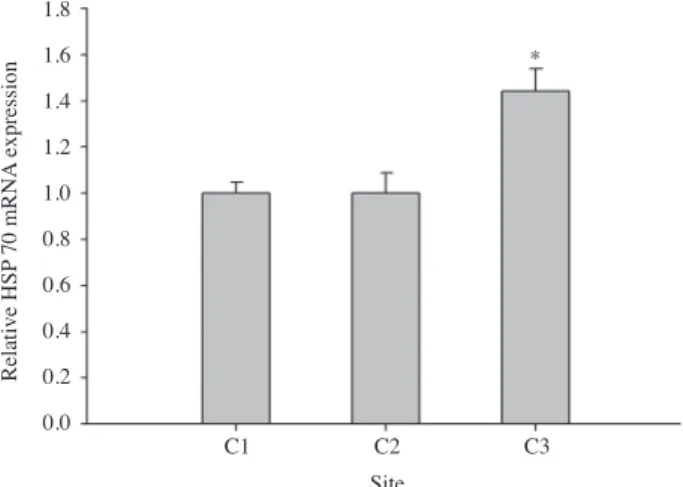
환경적이거나 생리적인 스트레스가 반영되는 특징을 지 닌 C. gigas와 M. galloprovincialis의 HSP 70 유전자 발현 을 사육장별로 측정하였다. C. gigas HSP 70 발현량은 C3 양식장이 통계적으로 유의하게 가장 높은 발현량을 나타 내었으며(P<0.05), C2 양식장과 C1 양식장은 유사한 발
현량이 측정되었다(Fig. 5). M. galloprovincialis HSP 70 발 현량은 M2 양식장에서 발현량이 높게 나타났다(Fig. 6).
고 찰
어장양식의 증가와 노후화는 주변 해역을 지속적으로 오염시키며 해양환경에 변화를 가져오고 있다. 가막만의 어장양식 또한 양식장의 밀집화, 주변의 도시화, 퇴적층 에 쌓이는 유기물 오염 등으로 매년 생산성이 감소하고 있 다(Kim et al., 2009). 환경오염으로 인해 생물이 받은 영 향에 관한 연구로는 오염지표생물인 깔따구(Chironomus plumosus) 체내의 중금속 축적에 따른 여러 지표 유전자의 발현, TBT(Tributyltin)와 PFOS(Perfluorooctane sulfonate) 독성 노출에 의한 게와 이매패류의 외형적 및 내부적 변 화 등이 알려졌다(Park et al., 2012; Kim et al., 2014, 2015;
Lezcano et al., 2015). 환경의 급격한 변화는 다양한 경로 로 생물의 생리적 기작에 영향을 주어 성장과 생존에 관여 하여 양식생물의 생산량 감소로 이어지기도 한다. 그럼에 도 환경 영향에 따른 생물의 생리적 영향을 객관적으로 제 시할 수 있는 분자지표를 개발하거나 적용한 연구는 매우 희소한 실정이다.
HSP 70유전자는 HSP 유전자 중 환경변화 스트레스 에 민감하고, 세포의 성장과 억제에 대해 빠른 분자적 반 응을 나타내어 스트레스 지표유전자로서 많은 생물을 대 상으로 연구되고 있다(Feder and Hofmann, 1999). 그러 나, 염분이나 온도와 같은 다양한 환경변화에 따른 유전자 발현 연구는 최근에 이루어진 상태이며(Park and Kwak, 2014; Nikapitiya et al., 2014, 2015), 야외에서 조사된 생 물의 HSP 70 유전자 발현을 확인한 연구도 매우 드물 다(Kim et al., 2015). 본 연구에서 이용한 C. gigas와 M.
galloprovincialis는 외부적 변화와 이화학적 연구(Devos et al., 2015)가 일부 알려져 있으나 최근에 개발 적용될 수 있는 생리 관련 유전자에 대한 연구는 이루어지지 않아 연 구가 필요한 실정이다.
본 연구는 가막만에서 채집한 C. gigas와 M. gallo- provincialis의 양식장 사육기간을 조사하고, 체중량, 각장 과 각고를 비교한 후, HSP 70 유전자 발현분석을 하였다.
양식장 사육기간에 따른 C. gigas의 체중량과 각장, 각고 를 확인해 본 결과, C2의 체중량과 각장, 각고가 가장 크 게 나타났으며, C1과 C3는 비슷한 수준으로 나타남을 확 인할 수 있었다(Fig. 3). 양식장 사육기간은 C3가 13개월 로 가장 길었으며, C2가 6개월, C1이 3개월로 확인되었 다. M. galloprovincialis 체중량은 M1이 많았지만, 각장
C1 C2 C3 Site
1.8 1.6 1.4 1.2 1.0 0.8 0.6 0.4 0.2 0.0
Relative HSP 70 mRNA expression
*
Fig. 5. Expression of heat shock protein 70(HSP70) gene in gills of Crassostrea gigas. The data are expressed as the mean±
SD. An asterisk indicates statistically significant difference,
*P<0.05 compared with the C1 value(C1=1) group.
1.6 1.4 1.2 1.0 0.8 0.6 0.4 0.2 0.0
Relative HSP 70 mRNA expression
*
Fig. 6. Expression of heat shock protein 70(HSP70) gene in gills of Mytilus galloprovincialis. The data are expressed as the mean±SD. An asterisk indicates statistically significant difference, *P<0.05 compared with the M1 value(M1=1) group.
M1 M2 Site
과 각고는 M1, M2가 유사하였다. 또한, 양식장 사육기간 도 M1, M2가 모두 12개월로 같았다. 따라서 C. gigas와 M.
galloprovincialis의 체중량, 각장과 각고는 양식장 사육기 간에 따라 비례하지 않음을 볼 수 있었으며, 서로 다른 서 식환경에서의 외부적 요인이 성장에 영향을 준 것으로 볼 수 있다. 체중량, 각장, 각고 등의 외부적 형질은 생물에 게 미치는 직접적인 영향을 쉽게 파악할 수 있는 유용한 특징들이 될 수 있다(Yevich and Yevich, 1994; Kim and Powell, 2009). 최근에는 진주조개(Pinctada fucata), 대복 (Gomphina veneriformis) 등의 이매패류를 대상으로 온도, 염분, 화학물질과 같은 다양한 환경 요인으로부터 유발되 는 생물의 구조적 형태 변화에 대한 연구가 진행되고 있다 (Park et al., 2012; Knowles et al., 2014; Li et al., 2015).
본 연구에서는 외부적 형태 변화로는 판단하기 어려운 내부적 스트레스 영향을 파악하기 위해 HSP 70의 유전자 발현을 측정하였다. HSP 70 발현을 살펴본 결과, C. gigas 는 C3 양식장이 가장 높았으며 C1과 C2는 유사한 발현량 을 보였으며, M. galloprovincialis는 M2가 M1에 비해 상 대적으로 발현량이 높았다. 즉, C3 양식장의 C. gigas와 M2 양식장의 M. galloprovincialis는 양식장 사육에 따른 내부적 스트레스가 가장 높았던 것으로 볼 수 있다. 다른 연구 예로, 온도와 Cu2+, malachite green에 노출된 홍콩굴 (Crassostrea hongkongensis) HSP 70 유전자가 크게 발현 되었다고 보고되었으며(Zhang and Zhang, 2012), 암모니 아에 노출된 가시복어(Takifugu obscurus)의 HSP 70과 90 유전자가 발현량이 증가되었다고 알려졌다(Cheng et al., 2015; Xu et al., 2015).
가막만에서 채집한 C. gigas의 체중량, 각장과 각고를 비교하면, C2 양식장이 가장 높은 값을 나타내었다. 그러 나, C. gigas HSP 70 유전자 발현은 사육기간이 13개월 로 가장 길었던 C3 양식장에서 가장 높게 나타났다. 이 는 C. gigas의 체중량, 각장과 각고과 같은 외부적 형질로 는 판단하기 어려운 내부적 스트레스 정도를 HSP 70 유 전자 발현 분석을 통해 확인할 수 있음을 보여주었다. M.
galloprovincialis의 체중량, 각장과 각고를 비교하면 큰 차 이가 나타나지 않았으나 HSP 70 유전자 발현은 M2 양식 장에서 통계적으로 유의한 수준으로(P<0.05) 높게 나타 났다. 양식장 사육 기간은 동일하나 양식장 환경의 차이에 따라 생물이 받은 내부적 스트레스에 차이가 있음을 HSP 70 유전자 분석을 통해서 알 수 있었다.
본 연구에서는 가막만에 서식하는 C. gigas와 M. gallo- provincialis의 환경에 따른 내부적 스트레스 정도를 분석 하고자 양식장 사육기간에 따른 체중량, 각장과 각고를 조 사하고, HSP 70의 계통학적 분석 및 유전자 발현을 측정하
였다. C. gigas HSP 70 유전자 발현은 사육기간이 길었으 나 체중량이 상대적으로 낮았던 C3 양식장에서 가장 높았 으며, M. galloprovincialis의 경우는 사육기간과 각장과 각 고는 비슷하지만 체중량과 HSP 70 발현 차이가 있었다. 따 라서 HSP 70 유전자 발현은 생물의 내부적 스트레스 정도 를 파악할 수 있는 지표 유전자로서의 가능성을 보여주었 다고 할 것이다.
적 요
연안의 다양한 환경변화는 서식 생물에 영향을 미치고, 양식장의 생산량 감소와 연결되고 있는 추세이다. 본 연구 에서는 가막만의 대표적인 양식종인 패류 C. gigas와 M.
galloprovincialis의 서식환경에 따른 스트레스 정도를 파 악하고자 하였다. 이를 위해, 각 종의 체중량, 각장과 각 고, 양식장 사육기간을 조사하고, 각 종의 계통학적 HSP 70 sequence를 비교한 후, 각 종의 HSP 70 유전자 발현 을 분석하였다. 그 결과, C. gigas의 체중량, 각장과 각고 는 C2 양식장이 높게 나타났으나, 양식장 환경 사육기간 과 HSP 70 유전자 발현은 C3 양식장이 가장 높았다. M.
galloprovincialis는 M1 양식장의 체중량이 높게 나타났으 며 각장과 각고, 사육기간은 M2와 유사하였으나, HSP 70 유전자 발현은 M2 양식장이 통계적으로 유의한 수준으로 높게 나타났다. 그리고 C. gigas와 M. galloprovincialis의 HSP 70 sequence 분석을 통해서 다른 해양 종들과 높은 유 사성이 있음을 확인하였다. 이 결과는 서식환경에 따라 생 물의 외부적 형질뿐만 아니라 내부적 스트레스를 HSP 70 유전자 발현을 통하여 파악할 수 있으며 HSP 70은 외부환 경 스트레스를 평가하는 지표 유전자로서 활용할 수 있을 것이다.
사 사
이 논문은 한국연구재단 기초연구사업의 지원을 받아 수행된 연구임(NRF-2013-R1A2A2A-01004914)
REfEREncES
Augustine, S.M., J.A. Narayan, D.P. Syamaladevi, C. Appunu, M. Chakravarthi, V. Ravichandran and M. Subramonian.
2015. Erianthus arundinaceus HSP70(EaHSP70) overex-
pression increases drought and salinity tolerance in sugar- cane(Saccharum spp. Hybrid). Plant Science 232: 23-34.
Basile, A., S. Sorbo, M. Lentini, D. Castiglia, P. Cianciullo, B.
Conte, S. Loppi and S. Esposito. 2015. Effects of heavy metals on ultrastructure and HSP 70 induction in Lemna minor L. exposed to water along the Sarno River, Italy.
Ecotoxicology and Environmental Safety 114: 93-101.
Bierkens, J.P.E.G. 2000. Application and pitfalls of stress-pro- teins in biomonitoring. Toxicology 153: 61-72.
Carlo, G.A., G. Stefania, M. Massimo, B. Maura, F. Daniele, d’E.
Giuseppe, P. Marianna, B. Luca and R. Francesco. 2015.
Pollutants bioavailability and toxicology risk from micro- plastics to marine mussels. Environmental Pollution 198:
211-222.
Cheng, C.H., F.F. Yang, R.Z. Ling, S.A. Liao, Y.T. Miao, C.X.
Ye and A.L. Wang. 2015. Effects of ammonia exposure on apoptosis, oxidative stress and immune response in pufferfish(Takifugu obscurus). Aquatic Toxicology 164:
61-71.
Devos, A., L.J. Dallas, C. Voiseux, C. Lecomte-pradines, A.N.
Jha and B. Fievet. 2015. Assessment of growth, genotoxic responses and expression of stress related genes in the Pa- cific oyster Crassostrea gigas following chronic exposure to ionizing radiation. Marine Pollution Bulletin 95: 688- Feder, M.E. and G.E. Hofmann. 1999. Heat-shock proteins, mo-698.
lecular chaperones, and the stress response: evolutionary and ecological physiology. Annual Review of Physiology 61: 243-282.
Husmann, G., D. Abele, D. Monien, P. Monien, M. Kriews and E.E.R. Philipp. 2012. The influence of sedimentation on metal accumulation and cellular oxidative stress markers in the Antarctic bivalve Laternula elliptica. Estuarine, Coastal and Shelf Science 111: 48-59.
Jeon, M.A., J.C. Kang and J.S. Lee. 2013. Concentration of heavy metal and alteration of reproductive and histologi- cal biomarker of Mytilus galloprovincialis in Gamak bay of the southern coast of Korea. The Korean Journal of Malacology 29: 33-41.
Ji, C., L. Cao and F. Li. 2015. Toxicological evaluation of two pedigrees of clam Ruditapes philippinarum as bioindi- cators of heavy metal contaminants using metabolomics.
European Jornal of PharmacologyEnvironmental Toxi
cology and Pharmacology Section 39: 545-554.
Kalmar, B. and L. Greensmith. 2009. Induction of heat shock proteins for protection against oxidative stress. Advanced Drug Delivery Reviews 61: 310-318.
Kim, B.K., M.O. Lee and S.J. Park. 2012. Characteristics of water temperature and salinity variations, and seawater exchange in Gamak bay. JKOSME 15: 101-110.
Kim, C.W., E.O. Kim, H.D. Jeong, C.G. Jung, M.W. Park and S.G. Son. 2009. Variation of body composition and sur- vival rate according to spawning of pacific oyster,(Cras
sostrea gigas) in Gamak bay. Korean Journal of Fisheries and Aquatic Science 42: 481-486.
Kim, W.S., K. Park, C. Nikapitiya and I.S. Kwak. 2014. Eco- toxicological end-points on intertidal mud crab, Macro
phthalmus japonicus, following PFOS(Perfluorooctane sulfonate) exposure. Korean Journal of Environmental Biology 32: 311-318.
Kim, W.S., R. Kim, C. Nikapitiya, K. Park and I.S. Kwak. 2015.
The molecular biomarker genes expression of rearing species Chironomus riparious and field species Chirono
mus plumosus exposure to heavy metals. Korean Journal of Ecology and Environment 48: 86-94.
Kim, Y. and E.N. Powell. 2009. Effects of climate variability on interannual variation in parasites, pathologies, and phys- iological attributes of bivalves from the U.S. East, Gulf, and West Coasts. Environmental Bioindicators 4: 67-96.
Knowles, G., J. Handlinger, B. Jones and N. Moltschaniws- kyj. 2014. Hemolymph chemistry and histopathological changes in Pacific oyster(Crassostresa gigas) in response to low salinity stress. Journal of Invertebrate Pathology 121: 78-84.
Labreuche, Y., C. Lambert, P. Soudant, V. Boulo, A. Huvet and J.L. Nicolas. 2006. Cellular and molecular hemocyte re- sponses of the pacific oyster, Crassostrea gigas, following bacterial infection with vibrio aestuanianus strain 01/32.
Microbes and Infection 8: 2715-2724.
Lee, K.H. and K.D. Cho. 1990. Distribution of the temperature and salinity in Kamak Bay. Korean Journal of Fisheries and Aquatic Sciences 23: 25-39.
Lee, M.O., B.K. Kim, S.J. Park and J.K. Kim. 2005. Marine environment of Gamak Bay by field observations and numerical experiments. Journal of the Korean Socety for Marine Environmental Engineerning 11: 109-114.
Lezcano, A.H., M.L.R. Quiroga, A.L. Liberoff and S.V.D. Mo- len. 2015. Marine pollution effects on the southern surf crab Ovalipes trimaculatus(Crustacea: Brachyura: Poly- biidae) in Patagonia Argentina. Marine Pollution Bulletin 91: 524-529.
Li, S., Y. Liu, C. Liu, J. Huang, G. Zheng, L. Xie and R. Zhang.
2015. Morphology and classification of hemocytes in Pinctada fucata and their responses to ocean acidification and warming. Fish and Shellfish Immunology 45: 194- Limon-Pacheco, J. and M.E. Gonsebatt. 2009. The role of an-202.
tioxidants and antioxidant-related enzymes in protective responses to environmentally induced oxidative stress.
Mutation Research/Genetic Toxicology and Environmen
tal Mutagenesis 674: 137-147.
Lu, R.C., M.S. Tan, H. Hwang, A.M. Xie, J.T. Yu and L. Tan.
2014. Heat shock protein 70 in Alzheimer’s disease.
Biomed Research International 435203.
Luo, L., C. Ke, X. Guo, B. Shi and M. Huang. 2014. Metal accumulation and differentially expressed proteins in gill
of oyster(Crassostrea hongkongensis) exposed to long- term heavy metal-contaminated estuary. Fish and Shell
fish Immunology 38: 318-329.
Mizrahi, T., S. Goldenberg, J. Heller and Z. Arad. 2015. Natu- ral variation in resistance to desiccation and heat shock protein expression in the land snail Theba pisana along a climate gradient. Physiological and Biochemical Zoology 88: 66-80.
Nikapitiya, C., W.S. Kim, K. Park and I.S. Kwak. 2014. Identi- fication of potential markers and sensitive tissues for low or high salinity stress in an intertidal mud crab(Macroph
thalmus japonicus). Fish and Shellfish Immunology 41:
407-416.
Nikapitiya, C., W.S. Kim, K. Park, J. Kim, M.O. Lee and I.S.
Kwak. 2015. Chitinase gene reponses and tissue sensitiv- ity in an intertidal mud crab(Macrophthalmus japonicus) following low or high salinity stress. Cell Stress and Cha
perones 20: 517-526.
Park, K. and I.S. Kwak. 2013. Expression of stress response HSP70 gene in Asian paddle crabs, Charybdis japonica, exposure to endocrine disrupting chemicals, bisphenol-A (BPA) and 4-nonylpheonl(NP). Ocean Science Journal 48: 207-214.
Park, K. and I.S. Kwak. 2014. The effect of temperature gradi- ents on endocrine signaling and antioxidant gene expres- sion during Chironomus riparious development. Science of the Total Environment 470-471: 1003-1011.
Park, K., H.W. Bang, J. Park and I.S. Kwak. 2009. Ecotoxico- logical multilevel-evaluation of the effects of fenbenda- zole exposure to Chironomus riparious larvae. Chemo
sphere 77: 359-367.
Park, K., R. Kim, J.J. Park, H.C. Shin, J.S. Lee, H.S. Cho, Y.G.
Lee, J.K. Kim and I.S. Kwak. 2012. Ecotoxicological evaluation of tributyltin toxicity to the equilateral venus clam, Gomphina veneriformis. Fish and Shellfish Immu
nology 32: 426-433.
Ricketts, C.D., W.R. Bates and S.D. Reid. 2015. The effects of acute waterborne exposure to sublethal concentrations of molybdenum on the stress response in rainbow trout, On
corhynchus mykiss. Plos one 10: e0115334.
Schintu, M., L. Durante, A. Maccioni, P. Meloni, S. Degetto and A. Contu. 2008. Measurement of environmental trace- metal levels in Mediterranean coastal areas with trans- planted mussels and DGT techniques. Marine Pollution Bulletin 57: 832-837.
Shin, Y.K., J.H. Im, M.H. Son and E.O. Kim. 2012. Seasonal variation in biochemical composition and gonadal devel-
opment of ark shell, Scapharca broughtonii form Gamag bay of Southern coast, Korea. The Korean Journal of Malacology 28: 73-79.
Tamura, K., G. Stecher, D. Peterson, A. Filipski and S. Kumar.
2013. MEGA6: molecular evolutionary genetics analysis version 6.0. Molecular Biology and Evolution 30: 2725- 2729.
Verlecar, X.N., K.B. Jena and G.B.N. Chainy. 2007. Biochem- ical markers of oxidative stress in perna biridis exposed to mercury and temperature. ChemicoBiological Interac
tions 167: 219-226.
Wang, Q., L. Zhangm, L. Zhao, L. You and H. Wu. 2012. Two goose-type lysozymes in Mytilus galloprovincialis: pos- sible function diversification and adaptive evolution. Plos one 7: e45148.
Wei, L., Q. Wang, H. Wu, G. Ji and J. Zhao. 2014. Proteomic and metabolomics responses of Pacific oyster Crassostrea gigas to elevated pCO2 exposure. Journal of Proteomics 112: 83-94.
Xu, D., L. Sun, S. Liu, L. Zhang and H. Yang. 2015. Histolog- ical ultrastructural and heat shock protein 70(HSP70) responses to heat stress in the sea cucumber Apostichopus japonicus. Fish and Shellfish Immunology 45: 321-326.
Yevich, P.P. and C.A. Yevich. 1994. Use of histopathology in biomonitoring marine bivalves. In: Kramer, K.J.M.(ed.), Biomonitoring of Coastal Waters and Estuaries. CRC. pp.
179-204.
Yoon, H., Y.K. An and S. Choi. 2011. Species composition and seasonal variation of fish assemblages in Sargassum bed in Gamak bay, Korea. Journal of the Korean Society of Marine Environment & Safety 77: 15-21.
Yoon, S.P., R.H. Jung, S.S. Kim, J.S. Lee, J.S. Park, W.C. Lee and W.J. Choi. 2007. Characteristics of benthic environ- ment and polychaete communities of Gamak bay, Korea.
The Sea 12: 287-304.
Zhang, L., X. Liu, L. Chen, L. You, D. Pei, M. Cong, J. Zhao, G.
Li, D. Liu, J. Yu and H. Wu. 2011. Transcriptional regula- tion of selenium-dependent glutathione peroxidase from Venerupis philippinarum in response to pathogen and contaminants challenge. Fish and Shellfish Immunology 31: 831-837.
Zhang, Z. and Q. Zhang. 2012. Molecular cloning, characteri- zation and expression of heat shock protein 70 gene from the oyster Crassostrea hongkongensis responding to ther- mal stress and exposure Cu2+ and malachite green. Gene 497: 172-180.