INTRODUCTION
A starting-point in the water system is the organic matter production through photosynthe- sis by autotrophic producers. The organic mat- ters produced by phytoplanktons would be the forcing energy in the freshwater ecosystem and food sources for heterotrophic organisms. Such organic matters are considered as autochthonous as well as allochthonous matters from basins (Choi, 1994; Shin et al., 1996). In this sense, the primary productivity and photosynthetic activity have been a considerable interest in the ecology of phytoplankton. Once nutrients are provided from the surroundings in adequate supply to support the maximum photosynthesis, irradiance availability may be a dominant factor regulating
the primary productivity (Harris, 1978). Actually, total productivity by phytoplankton can be pri- marily the function of the algal biomass and irra- diance availability.
Estuarine area of the Nakdong River, which is composed of three rivers (Nakdong, Seonakdong and Joman River), had algal blooms after the construction of the river barrage. Phytoplankton have abundantly occurred throughout a year, and monospecific algae such as Microcystis aerug- inosa and Stephanodiscus hantzschii f. tenuis have bloomed in summer and in cold seasons, respectively (Cho and Shin, 1998). It has been known that Seonakdong River is one of the most fertile waters in Korea as shown in high algal productivity (Kim et al., 1996). The Seonakdong River is a estuarine tributary of the Nakdong River and a river-like lake with watergates in
─
─ 57 ─ ─
Primary Productivity of Phytoplankton in the Shallow and Hypertrophic River (Seonakdong River)
Jeon, Seung- -Il and Kyung- - Je Cho*
(Nakdong River Environmental Research Center, Inje University, Gimhae 621-749, Korea)
서낙동강에서 식물플랑크톤의 1차 생산성.
전승일∙조경제* ( 인제대학교 낙동강환경연구센터 )
서낙동강에서 14
C
법으로1996
년1
월부터10
월까지 식물플랑크톤의1
차 생산성을 측정하였다.
서 낙동강은 수심이 얕고,
국내 호수와 하천 중에서 가장 수질오염이 심한 곳으로 진광층의 깊이는1.4 ~2.1 m
범위였다.
식물플랑크톤의chl -a
농도는67 ~894 µg L
-1범위였고, 8
월에는chl -a
농도가 크게 증가하였다.
최대 물질생산성은 수표면~0.4 m
깊이에서 나타났으며2.1~4.3 mg C mg chl-a
-1hr
-1범위였다.
광합성(P) -
광(I)
의 관계에서 식물플랑크톤의 광합성 저해는 높은 고광에서 현저히 저해되었으나Microcystis
가 대발생한 기간에는 광저해 현상이 나타나지 않았다. Chl-a
당 식물플 랑크톤의1
차 생산성은 입사 광에너지의 양에 비례하였으며 면적 당1
차 생산성은chl -a
현존량과 직선적으로 비례하여 식물플랑크톤의1
차 생산성은 결과적으로 생물량과 광의 함수였다.
과거 자 료를 수집한 결과,
낙동강 하구 지역에서 식물플랑크톤의 생산성은 하구둑 건설(1987
년)
이후 해가 감에 따라 점진적으로 증가하여 이 지역의 부영양화 현상을 반영하였다.
식물플랑크톤의 연 생산 성 개념에서 평균10 µg chl -a L
-1의 생물량 증가는30 mg C m
-2day
-1의 단위면적 당 생산성 증가 를 가져왔다.
Key words : phytoplankton, primary productivity, eutrophication, photoinhibition
* Corresponding Author: Tel: 055) 320-3216, Fax: 055) 334-7092, E-mail: [email protected]
the river mouth to protect the intrusion of saline water for the agricultural irrigation. Seonakdong River passes through the agricultural delta plains and rice field. The agricultural waters have been pumped from the Seonakdong River and the most irrigated waters drained into the Joman River. Diverse pollution sources such as cities and industrial zone are scattered around the river. The productivity of phytoplankton was measured at the vicinity of Gimhae Bridge in the upper zone of the river.
As productive waters with high cultural eutro- phication, the primary production in the Nak- dong River has been an important theme for the freshwater ecology. The study on the algal flora and primary production of phytoplankton were already conducted in the past for the environ- mental impact assessment (EIA) on the estuarine barrage construction and civil works (Hong et al., 1984, 1985, 1986, 1987). After then, phytoplank- ton production was carried out to evaluate the eutrophication trend after the construction (Lee et al., 1994; Cho et al., 1995) and to assess the allochthonous contribution of organic matter pro- duced by phytoplankton (Choi, 1994). The overall objective of this research was to determine the photosynthetic activity and primary production of phytoplankton in the Seonakdong River, and some patterns of the primary production in the estuarine freshwaters of the Nakdong River.
MATERIALS AND METHODS
Four liter water was collected from the selected depth using a Van Dorn sampler. The half water was used to measure production and chlorophyll -a concentrations and the other half to observe phytoplankton under microscope. Water temper- ature, pH, DO and underwater irradiance were measured in field when river water was collected to conduct
14C isotope methods. NaH
14CO
3solu- tion of 1 mL was spiked into 50 mL river water of 3 light and 1 dark bottle. The bottles were incu- bated at the corresponding depth (surface, 0.1 m, 0.2 m, 0.4 m, 0.6 m, 0.8 m, 1.0 m and 1.5 m) during 3 hours (11:00~14:00). After in situ incubation, materials were preserved with formalin and passed into membrane filters. The filters were dissolved in 5 mL scintillation cocktail solution to measure the
14C activity of algal cells with scin- tillation counter (Packard Tri-Carb 2000CA). In
addition, photosynthesis of natural and cultured Microcystis aeruginosa was measured by oxygen method using oxygen monitor (CBI-D) in addi- tion to the
14C isotope measurements.
Aerial and underwater irradiance (PAR, photo- synthetic active radiation) were continuously monitored with quantum sensor (Li-Cor 192SB, Li-Cor 190SA), recorder (Yokogawa 3057) and data logger (Li-Cor 1000) during the measure- ment. Alkalinity was measured by Gran titration method (Wetzel and Likens, 1991) using 0.1 N HCl solution. Phytoplankton chlorophyll-a con- centrations were determined with the ethanol boiling extraction of Nusch (1980).
RESULTS AND DISCUSSION
Six measurements were conducted at the upper region of the Seonakdong River in 1996. Environ- mental parameters of the river water are pre- sented in Table 1. Dissolved oxygen (DO) of the surface water had 120~270% saturation range to show the hypersaturation, while hypoxic con- ditions below 2.0 mg L
-1were kept in the bottom waters in January and August. Alkalinity ranged from 94 mg L
-1to 171 mg L
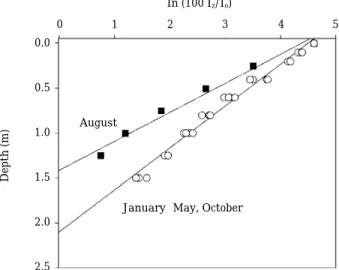
-1throughout the sea- son. Incident irradiance at 1.5 m depth ranged from 3% to 5% of the surface irradiance. The penetration depth of irradiance was very shallow in the time of Microcystis blooming in August to reach 6% of surface irradiance at 0.5 m depth.
Fig. 1. Irradiance under the water and euphotic depth. I
0and I
zrefer to irradiance of surface and corres- ponding depth (z), respectively.
In (100 Iz/ Io)
0 1 2 3 4 5
August
January-May, October 0.0
-0.5
-1.0
-1.5
-2.0
-2.5
Depth (m)
Euphotic depth was 1.4 m in August and 2.1 m in the remaining season except August (Fig. 1).
Diatom Stephanodiscus hatzschii f. tenuis and its relatives predominated over the lower parts of the Nakdong and Seonakdong River from Jan- uary to March, and cryptomonad Rhodomonas minuta partially bloomed with Stephanodiscus diatoms in late March. Chlorophycean algae gradually increased after May and other diatom flora succeeded Stephanonodiscus species. Fila- mentous diatoms such as Aulacoseira ambigua and A. granulata etc, and chlorophyceans occurr- ed in May and October and diverse algal species or assemblages constituted the phytoplankton to have the highest diversity in a year. In August after the rainy season, Microcystis and other cyanobacteria explosively bloomed and occasion- ally made floating scums on the surface water.
Algal blooms were observed in winter and sum- mer as Stephanodiscus persistent blooms in cold season and Micrcocystis outbreaks in the warm season in 1996.
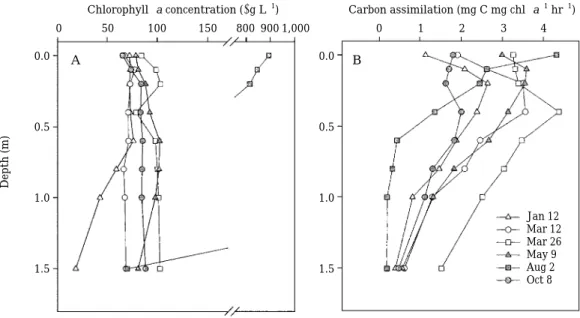
The variations of chlorophyll-a along the water depth profile were presented in Fig. 2A. Surface chlorophyll-a concentration ranged from 67 µ g L
-1to 85 µ g L
-1except the data of August. The concentration in August was 894 µ g L
-1. Phyto- plankton biomass was kept within a constant range through the season except August. Althou- gh distribution of chlorophyll-a along the depth profiles showed little variations, chlorophyll-a increase was observed in the middle depth (from 79 µ g L
-1at surface to 102 µ g L
-1at 06~0.8 m depth) in May and significant decrease was de- tected in the bottom waters in January and Au- gust.
Table 1. Water temperature (� C), pH, alkalinity (mg CaCO
3L
-1), DO (mg O
2L
-1), conductivity (mS cm
-1) and extinction coefficients (k m
-1) of irradiance in the Seonakdong River, 1996.
Date╲Item Temperature pH Alkalinity DO
Conductivity k
╲Depth (m) 0 1.0 0 1.0 0 1.0 0 1.0
Jan. 12 3.6 4.3 8.6 7.4 148 109 16.2 3.0 1.07 2.0
Mar. 12 6.9 6.9 7.8 7.9 127 132 14.8 14.0 1.14 2.0
Mar. 26 9.4 9.3 7.9 8.0 155 159 16.8 15.5 1.04 2.2
May 9 19.2 19.0 7.7 8.4 160 158 13.2 12.6 1.03 2.3
Aug. 2 32.3 30.1 8.8 7.8 171 155 19.7 1.5 0.65 3.9
Oct. 16 19.9 18.3 8.6 8.2 94 96 12.1 11.8 - 3.0
Fig. 2. Depth profiles of chlorophyll-a concentrations (A) and in situ primary productivity per unit chlorophyll-a and for an hour (B) in 1996.
Chlorophyll-a concentration (µg L-1) 0 50 100 150 800 900 1,000
A B
Jan 12 Mar 12 Mar 26 May 9 Aug 2 Oct 8 0.0
-0.5
-1.0
-1.5
Depth (m)
0.0
-0.5
-1.0
-1.5
Carbon assimilation (mg C mg chl-a-1hr-1) 0 1 2 3 4
Measurements of photosynthesis in the closed bottles, which were exposed at the depth in the water column, showed consistently generalized patterns to depict primary productivity (P)- dep- th (D) curves. Fig. 2 showed typical patterns of depth profiles in relation to irradiance pene- tration and algal biomass. In the P-D curves, three components-light-limited zone of the bot- tom parts of the curves, light-saturation or max- imum photosynthesis (P
max) and light-inhibition zone of photosynthesis depression near the sur- face-are recognizable. Specific productivity at surface was 1.1~4.3 mg C mg chl-a
-1hr
-1range and P
maxin the P-D curves ranged from 2.1 mg C mg chl-a
-1hr
-1to 4.4 mg C mg chl-a
-1hr
-1. P
maxoccurred 0.1~0.4 m depth except August, while P
maxin August was observed in the most upper surface to show no photosynthetic inhibi- tion. As this measurements were carried out in the middle parts of a day under cloudless day, interference with irradiance was excluded.
Productivity-depth profiles of Fig. 2B were transformed to productivity-irradiance (P-I)
curves as Fig. 3. Algal photosynthetic inhibition occurred from 400 µ mol m
-2s
-1to 1,000 µ mol m
-2s
-1irradiance. Photoinhibition was evident dur- ing the periods when diatom Stephanodiscus was predominated, while cyanobacteria Microcystis did not show the photoinhibition. Photosynthetic inhibition was not clear in May and October when chlorophyceans and diatoms Aulacoseira are dominant.
Photosynthetic activity using the natural asse- mblages and unialgal cultures of Microcystis aeruginosa collected from the Seonakdong River was measured under the controlled temperature and irradiance in the laboratory to clarify algal photoinhibition and P-I relationship (Fig. 4). In contrast to inhibition of cultured M. aeruginosa above 400 µ mol m
-2s
-1, natural Microcystis assemlages did not show any photoinhibition and showed gradual increases of photosynthesis with the increase of irradiance (fluorescence lamp).
The adaptation of Microcystis to low and high irradiance could be classified into two types by P-I curves of laboratory incubation. Unialgal M.
Fig. 3. Productivity (P)-irradiance (I) curves and photosynthetic photoinhibition of phytoplankton in the Seonakdong River in 1996.
0 250 500 750 1,000 Irradiance (µmol m-2s-1)
0 250 500 750 1,000 1,250 1,500 Irradiance (µmol m-2s-1) 5
4 3 2 1 0
Jan 12
Mar 26
Aug 2
Mar 12
May 9
Oct 16 Specific primary productivity (mg C mg chl-a-1hr-1)
5 4 3 2 1 0 5 4 3 2 1 0 5 4 3 2 1 0 5
4 3 2 1 0 5 4 3 2 1 0
aeruginosa cultured in laboratory adapted well to the low irradiance, while natural Microcystis assemblages tolerated high irradance above 1,100 µ mol m
-2s
-1. Photoinhibition of natural phyto- plankton has long been a well known phenome- non which has been observed in both freshwaters and marine waters over the world, and usually occurred above 200 µ mol m
-2s
-1irradiance (Har- ris, 1978). The prominent factor is known to be ultraviolet radiations, which have directly effect on the photochemical reaction of photosynthesis and organic structures of cells (Reynolds, 1984).
The mechanisms are not well at all understood in despite of the clear photoinhibition in algal photosynthesis.
Photosynthesis of phytoplankton may be influ- enced by other factors such as temperature, car- bon source and nutrient supply. Specific produc- tivity showed little variations through the season, considering 1.8~2.3 of the temperature quotient (Q
10) range (Harris, 1978) and wide range of ambient water temperature (from 3.6~32.3� C) (Fig. 3). Productivity data along the depth pro- files were integrated to determine the aerial pri- mary production of water column (Fig. 5). Aerial phytoplanktonic productivity except in August (1,518 mg C m
-2hr
-1) were from 155 mg C m
-2hr
-1to 470 mg C m
-2hr
-1to show narrow range.
Daily primary productions were determined from P-I curves of Fig. 3 and chlorophyll-a con- centration profile. Daily productions in January, March, May, August and October were 2.3 g C m
-2day
-1, 2.3~6.9 g C m
-2day
-1, 10.0 g C m
-2day
-1, 18.1 g C m
-2day
-1and 2.0 g C m
-2day
-1, respectively. Daily Production gradually increas- ed from January to August. From the daily pro- ductions and their extrapolation, annual primary production as carbon assimilation was estimated in the upper area of the Seonakdong River. Annu- al primary production was estimated as 1,314 g C m
-2yr
-1.
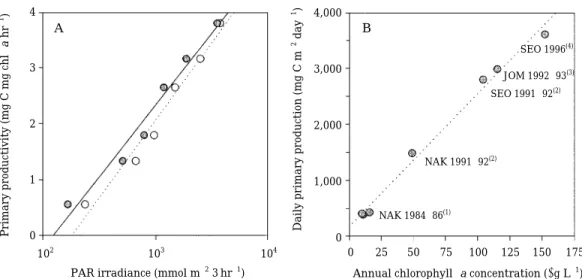
Phytoplankton productions would primarily be under the influence of phytoplankton standing crops, irradiance and nutrient availability. In our study, specific productivity were linearly correlated with total irradiance received during the measurement in field (Fig. 6A). Primary pro- ductivity of phytoplankton could be estimated from the function of irradiance intensity and chlorophyll-a standing crops. However, in the long-term records of primary productivity, limi- tation of biologically available phosphorus has been the major factor responsible for increase of both primary productivity and phytoplankton (Berman et al., 1995). Over the world, variables related to solar energy have a greater influence on production than ones related to nutrient fac- tors (Brylinsky and Mann, 1973).
Primary production data measured by
14C me- thod in the past were collected to clarify the eu- trophication trend in this freshwater zone (Fig.
6B). Daily productions were intuitively deter- mined by using the specific productivity, chloro- phyll-a concentration and day length, and by successive integration of depth assimilation pro- file. Primary production of phytoplankton has
Fig. 4. P-I curves and productivity of Microcystis aerugi-
nosa collected in field and cultured in laboratory.Fig. 5. Seasonal variations of mean chlorophyll-a concen- tration and aerial production of phytoplankton in the Seonakdong River.
J F M A M J J A S O N
1996 4
3
2
1
0
0 200 400 600 800 1,000 1,200 PAR irradiance (µmol m-2s-1)
Microcystis collected in field Microcystis unialgal-cultured in lab
Specific primary productivity (mg C mg chl-a-1hr-1)
1400 1200 1000 800 600 400 200
0
Productivity Chlorophyll-a
1000
800
600
400
200
0
Aerial primary productivity (mg C m-2hr-1) Mean Chlorophyll-aconcentration (µg L-1)
been measured from 1984 in the estuary of the Nakdong River for the environmental and ecolog- ical assessment. Cultural eutrophication showed a linear increase after the construction of estuar- ine dams (Fig. 6B). Chlorophyll-a concentration absolutely reflects the phytoplankton production and average 10 µ g chl-a L
-1increase correspond- ed to phytoplanktonic production acceleration of 30 mg C m
-2day
-1. Primary productivity of phy- toplankton in this freshwaters may play roles to guide and actually circumscribe the extent of the energy flow and food chain in the ecosystem as a source of the autochthonous organic matters. In spite of the shallow depth below 2.0 m, the grow- th of benthic algae on the bottom was completely inhibited with the highly turbid water in the Seonakdong River. A lot of the autochthonous organic matters in this river would be derived from the planktonic algae rather than the benth- ic algae. Autochthonous organic matters from phytoplankton accounted for 55% of total loads and their contribution was higher than the allo- chthonous origin in the Nakdong River (Choi, 1994). In addition, from the relationship between chlorophyll-a and BOD, percentage of autoch- thonous organic matter in total BOD exceeded 50% in the downstream of the Nakdong River (Shin et al., 1996). As a result, the control of the phytoplankton growth or production would be the primary way to improve the water quality in this river.
ABSTRACT
Primary productivity of phytoplankton was measured by
14C method from January to Octo- ber of 1996 in Seonakdong River. This river was a highly productive freshwater showing the euphotic depth of 1.4 m in August and 2.1 m in the remaining season. Chlorophyll-a concentra- tions of phytoplankton ranged from 67 µ g L
-1to 894 µg L
-1and showed the great increase in Au- gust. Maximum specific productivity was 2.1~
4.3 mg C mg chl-a
-1hr
-1and occurred above 0.4 m depth. In photosynthesis-irradiance relation, photoinhibition or photosynthetic suppression of phytoplankton occurred clearly in the cold sea- sons, while phytoplankton (mainly Microcystis aeruginosa and its relatives) in August did not show any symptom of the photosynthetic inhibi- tion against the high irradiance. The specific productivity of phytoplankton was eventually dependant upon incident irradiance to show the linear correlation with received irradiance in field, and the areal productivity of phytoplankton upon chlorophyll-a standing crops. In the down- stream of the Nakdong River, phytoplankton productions have linearly increased since the estuarine barrage construction to reflect the gra- dual eutrophication in the estuarine area. Aver- age chlorophyll-a increase of 10 µ g chl-a L
-1absolutely corresponded to the primary produc-
Fig. 6. Primary production as a linear function of total received irradiance (A) and interannual trends of phytoplankton production in the freshwaters of the Nakdong River Estuary (B). NAK: Nakdong River, SEO: Seonakdong River, JOM: Joman River. (1) Hong et al., 1984, 1985, 1986, 1987, (2) Lee et al., 1994, (3) Cho et al., 1995, (4) The present study.
102 103 104
PAR irradiance (mmol m-23 hr-1)
0 25 50 75 100 125 150 175 Annual chlorophyll-a concentration (µg L-1) 4
3
2
1
0
4,000
3,000
2,000
1,000
-1Primary productivity (mg C mg chl-ahr) -2-1Daily primary production (mg C mday) 0
NAK 1984-86(1) NAK 1991-92(2)
SEO 1991-92(2) JOM 1992-93(3)
SEO 1996(4)