INTRODUCTION
Water quality problem in Korean lakes receiv- ed much attention in 1990s. In general water qu- ality deterioration is attributed to the excessive input of nutrients mostly from non-point sources like forests, livestock, agricultural runoff, and fish farms. In East Asian Monsoon region the in- puts of nutrients from the watershed during the rainy seasons are much higher than those of dry seasons. Total phosphorus concentrations which are the major factor that controls eutrophication of lakes (Schindler and Fee, 1974; Bloesch et al., 1977) have been used for the estimation of troph- ic state, and biomass prediction of phytoplankton (Stauffer, 1985). Phosphorus loading during the
rainy season in large artificial lakes in Korea were 70-80% of the total loading (Heo et al., 1992; Lee et al., 1993; Kim et al., 1997; Heo et al, 1998).
Watershed of Lake Andong includes two cities (Taebaek and Andong) and three counties (Bong- hwa, Yeongyang and Uljin). Agriculture and sm- all-scale livestock farming are the main econo- mic activity in the watershed of Lake Andong.
Many coal mines were active during the past de- cade in Taebak and Bonghwa area, but now they are almost abandoned. Currently, only four coal mines are in operation. The Sukpo refinery was a major factory, which produces zinc and sulfate, in the upper watershed. In the 1980s, many aqua cultures were started in most of the lakes of Kor- ea and it reached its peak in the mid of 1990s.
* Corresponding Author: Tel: 033) 570-6573, Fax: 033) 574-7262, E-mail: [email protected]
─
─ 249 ──
Long- - term Variations of Trophic State and Phosphorus Loading in Lake Andong, Korea
Heo, Woo-
-Myung*, Sangyong Kwon and Bomchul Kim
1(Dept. of Environmental Engineering, Samcheok National University, Samcheok 245-711, Korea,
1Dept. of Environmental Science, Kangwon National University, Chunchon, 200-701, Korea)
The variation of trophic state was measured in a reservoir (Lake Andong, Korea) from 1993 to 2000. Phosphorus loading from the watershed was estimated by measuring total phosphorus concentration in the main inflowing stream (the Nakdong River). Phosphorus discharge from the pen-type fish farms was estimated from the amount of fish feed and the rate of phosphorus excretion per feed weight.
The transparency in summer was about 2.0 m in 1993 and 1994, but it decreased to about 1.2 m in 1997 and 1998, and recovered to about 2.3 m in 1999 and 2000. TP increased from 11-30 mgP/m3in 1993 to 18-42 mgP/m3in 1998, but recovered to 8-13 mgP/m3in 2000, whereas TN decreased slightly from 1.81-2.96 mgN/L in 1993 to 1.17- 1.80 mgN/L in 2000. TN/TP ratios decreased from 82-281 in 1993 to 21-143 in 1998, but again increased to 101-209 in 2000 due to the decrease of TP. The average chlorophyll-a concentration in growing season was in the range of 4.8-16.2 mg/m3 from 1993 to 1997, but it decreased to 3.7-5.2 mg/m3after 1998. Trophic State Index had shown a gradual increase until 1996, and since then it has declined. The major cause of the trophic state recovery is thought to be the removal of fish farms in April 1998.
Key words : Lake Andong, trophic state, phosphorus loading, fish farm.
But since then, their sizes and number have de- creased due to the removal and closures by the government and local agencies. In many artifici- al lakes in Korea, the phosphorus loadings from fish farms were estimated to exceed the loading from the watershed (Kim et al., 1993).
Lake Andong, a warm monomicitic lake, is lo- cated in the upper Nakdong River with surface area of 51.5 km
2. The average water volume in the reservoir is 587×10
6m
3with a yearly avera- ge water inflow of 827.3×10
6m
3. The mean dep- th is about 19.4 m, and the mean width is 1.2 km.
The length of main axis is 43.5 km, and the hyd- raulic retention time is 1.33 yr. It has a total dra- inage area of 1,584 km
2. Total population in the watershed is 96,396 persons. The urban area in drainage basin is 142 km
2; and the paddy and dry field area is 256 km
2. The ratio of drainage area to lake area is 3 : 1. The annual precipitation rate is 1,076 mm/yr. BOD, SS, TN and TP loading from the watershed were estimated to be 16,211, 20,822, 3,256 and 642 kg/day, respectively (KOWACO, 1996). Lake Andong has many facets of function. It not only supplies water to Andong city and nearby regions, but also contribute to maintaining adequate water level and reducing water pollution of the Nakdong River in dry sea- sons. Although, Lake Andong is a very important part of the Nakdong River system, few research has been performed in this lake.
In this study, trophic state parameters were surveyed in Lake Andong. Turbidity, Secchi disc transparency (SD), phosphorus, nitrogen and chl- orophyll-a concentration were measured at dam site from 1993 to 2000. Phosphorus loading from the watershed was estimated by measuring total phosphorus concentration in the main inflowing stream. The main objective of this study was to assess long term change of trophic state and the relationship with the change of fish farms.
MATERIALS AND METHODS
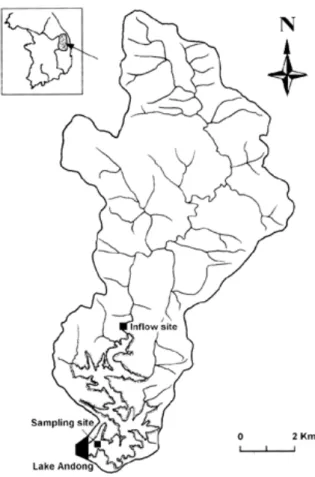
The water samples were collected at the dam site and the inflowing stream, on a monthly ba- sis, through out July 1993 to December 2000, by using PVC Van Dorn sampler at different depths of 0-45 m as well as at the bottom layer (Fig 1).
Samples collected were filtered with GF/C filter papers in the lab. The filter papers were kept fro- zen, and homogenized at the time of chlorophyll-
a analysis. Lorenzen (1967) method was used to
calculate chlorophyll-a concentration. Filtered water was then used to calculate dissolved nitro- gen and phosphorus. TP was determined accord- ing to Standard methods (APHA, 1992), employ- ing persulfate digestion and ascorbic acid meth- od. TN was determined by cadmium reduction method after persulfate digestion, using flow injection autoanlyzer (BRAN±LUEBBE, Auto Analyzer3). Temperature and turbidity was mea- sured with a multiprobe meter (YSI, 6000). Tro- phic State Index (TSI) was calculated according to Carlson (1977).
RESULTS AND DISCUSSION
Ecosystem of Lake Andong had been adversely affected by the excess discharge of phosphorus from the watershed and floating pen-type fish farms. Total area of fish farm pens was 55,555 m
2in 1996 (KOWACO, 1996). However, all fish farms were removed by April 1998. Phosphorus
Fig. 1. Map showing the watershed and sampling sites.
concentration was usually low in the Nakdong River, because heavily-vegetated forests (area 1,325 km
2) occupy the watershed and has mode- rate topsoil erosion. But high phosphorus concen- tration was observed in rainy seasons, from July to September every year.
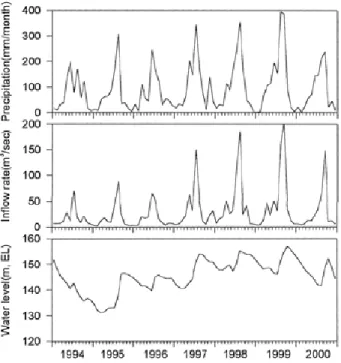
The monthly average of precipitation rate, in- flow rate, and the water level of Lake Andong
were also taken into account as an important hydrological parameter (Fig 2). High inflow rate of 1,633 m
3/s and 1,720 m
3/s were observed in 3
rdAugust and 24
thSeptember, 1999, respectively.
The highest monthly average inflow of 200 m
3/s was observed in September, 1999. The monthly average rainfall was about 92 mm, with yearly average of 1,100 mm. In March 1995, the surface elevation reached its lowest level of 130 m, and the highest water level was recorded in Septem- ber 1998 with the elevation of 160 m. The water level fluctuation range was of about 30 m throu- ghout the period of study.
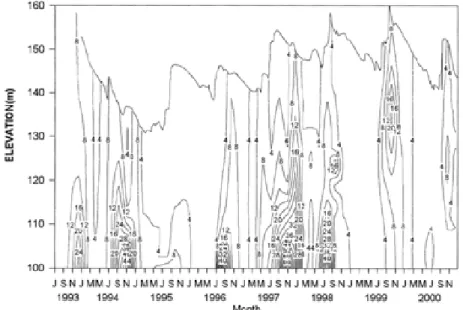
Highest turbidity was 45.7 NTU in the inter- mediate layers in August 1998 (Fig. 3). Turbid water contained more phosphorus than clear wa- ter, both in dissolved and particulate form. In Lake Soyang, storm runoff flowed into the metal- imnioin, and resulted in the increase of nutrient concentration in the epilimnion during autumn turnover (Heo et al., 1998). Tanaka and Tsuda’s (1996) reported that in Lake Biwa, Japan, the turbidity in the intermediate layer increased to its peak in August and September in 1993 after three typhoons passed during that period.
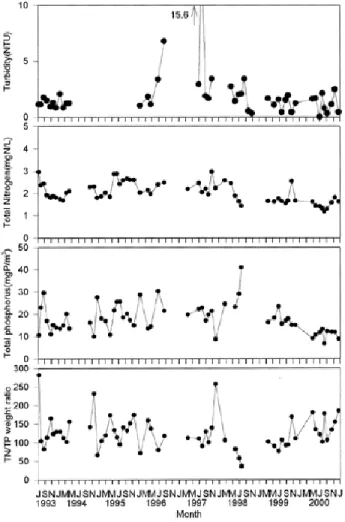
The turbidity, TN, TP and TN/TP weight ratio were measured and their averages were calculat- ed from the surface to 5 m depths, so that the impact on the lake ecosystem could be assessed.
Higher turbidity was observed in August 1996 (6.8 NTU) and July 1997 (15.6 NTU), respective- ly. The average TP concentration in growing sea-
Fig. 2. The monthly variations of precipitation, inflow rate and water level.
Fig. 3. The isopleths of turbidity (NTU) in Lake Andong.
sons (from May to October) increased from 18.2 mgP/m
3in 1993 to 31.0 mgP/m
3in 1998, but dec- reased to 17.8 mgP/m
3in 1999 and further down to 11.0 mgP/m
3in 2000. According to the lake classification based on the TP (Forsberg and Ryd- ing, 1980), trophic state in Lake Andong can be classified as mesotrophic (15-25 mgP/m
3) to eut- rophic (¤25 mgP/m
3) and again back to oligotro- phic (⁄15 mgP/m
3) according to the change of TP. The average TN concentration in growing se- ason was in the range of 2.28-2.67 mgN/L until 1997, without much yearly variation, but decrea- sed to 1.80-1.37 mgN/L during 1998 to 2000. TN/
TP weight ratio decreased from 82-281 in 1993 to 21-143 in 1998, but again increased to 101- 209 in 2000 due to the decrease of TP (Fig 4).
Most of the lakes in Korea have been reported to have an average TN/TP weight ratio in the range of 40-160 (Kim et al., 1997).
DIP and nitrate-nitrogen concentration of the epilimnion were in the range of 0.3-15.1 mgP/m
3and 0.8-2.1 mgN/L, respectively from 1993-2000.
The DIP showed some fluctuations, but total ph- osphorus concentration exhibited less variation.
The DIP in the epilimnion, which is utilized by algae, bacteria and macrophytes for their grow- th, sometimes exhibited a decline during algal blooms. The nitrate-nitrogen concentration sho- wed a slight gradual decrease throughout the st- udy period. The nitrate-nitrogen yearly average concentration was about 1.5 mgN/L. It was high- er than that in Lake Soyang that has similar wa- tershed characteristic with Lake Andong, where the yearly average concentration of nitrate was about 0.6 mgN/L (Heo and Kim, 1997).
The average chlorophyll-a concentration in growing season was in the range of 4.8-16.2 mg/
m
3from 1993 to 1997, but it decreased to 3.7-5.2 mg/m
3after 1998. Higher chlorophyll-a concen-
Fig. 4. The monthly variations of total nitrogen (TN), to- tal phosphorus (TP) and TN/TP weight ratio in La- ke Andong (average of 0, 2, 5m).
Fig. 5. The monthly variations of DIP, NO3-N, SD and chlorophyll-a concentration (average of 0, 2, 5 m)
trations were observed in the period, which coin- cided with the high turbidity. Lake Okjong has an average chlorophyll-a of 2.4-18.7 mg/m
3(Kim
et al., 1997). According to the US EPA (1976) gui-delines for lake classification on the basis of chlo- rophyll-a Lake Andong was eutrophic (¤10 mg/
m
3) in 1994, 1996 and 1997, but it became an oli- gotrophic (⁄5 mg/m
3) lake after 1998.
Minimum Secchi disc transparency in summer was about 2.0 m in 1993, but it decreased to abo- ut 1.2 m in 1997 and 1998 due to water blooms, but recovered to about 2.3 m in 1999 and 2000.
The average Secchi disc transparency in growing season decreased from 2.5 m in 1993 to 1.7 m in 1997, but recovered to 2.5-2.9 m in 1998 to 2000 (Fig. 5). The increase in Secchi disc depth is th- ought to be due to the removal of fish farms and reduced nutrients loading from fish farms, which resulted in reduced phytoplankton biomass. In Lake Soyang, water blooms caused Secchi disc depth to decrease to less than 2 m (Heo, 1993).
Secchi disc depth range of lake Andong was in the similar range as in other lakes, such as 1.4- 4.0 m Lake Okjong (Kim et al., 1997), 1.5-4.0 m Lake Hapchon (Kim et al., 1998) and 0.8-3.5 m Lake Jinyang (Kim et al., 1999).
TP during the winter turnover was 20 mgP/m
3throughout the lake from 1994 to 1999, but it decreased to 10 mgP/m
3in 2000, which can be attributed to the removal of fish farms. The hyp- olimnion showed higher concentrations after the winter turnover than other seasons. The highest
concentration was recorded as 55.7 mgP/m
3in August 1999 and in October 1999. Also TP was higher (36-217 mgP/m
3) in the metalimnion (Fig.
6). TP and DIP increased in the intermediate layer following rainfall. Turbidity was higher in the intermediate layers in the August 1999 just after heavy rain event, but the turbidity decreas- ed in October 1999, which may be due to the set- tlement of the particulate matters and discharge of turbid intermediate layer through the dam outlet.
DIP concentration showed a similar trend to TP. DIP concentration during the winter turnov- er was about 4 mgP/m
3(Fig. 7). The TN during winter turnover was in the range of 1.6-2.0 mgN /L. The TN in the epilimnion ws in the range of 1.4-3.9 mgN/L (Fig. 8). TN did not show signifi- cant correlation with the inflow rate.
The yearly averages of TSI (Chl), TSI (TP), and TDI (SD) were calculated only for the growing seasons (May-October) to assess the change of trophic state. The TSI showed a gradual increase till 1996 and began to decline since then, which can be attributed to the decline of phophorus loa- ding that started in 1997 May by the gradual removal of fish farms (KOWACO, 1996). The TSI was 53 in 1993 and 49 in 2000. Changes of TSI in Lake Andong also proved that it was on the process of recovery (Table 1).
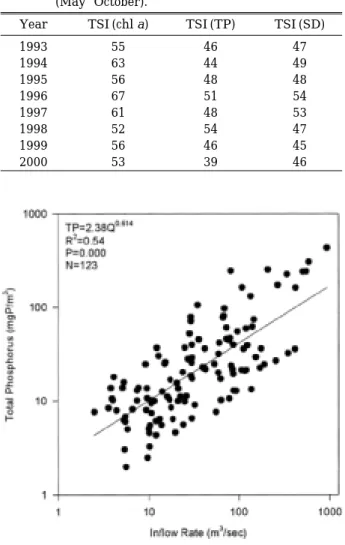
The relationship of the inflow rate (Q) of the Nakdong River vs. TP showed a positive correla- tion with a coefficient (R
2) of 0.54 (Fig. 9). The
Fig. 6. The isopleths of total phosphorus concentration (mgP/m3) in Lake Andong.
empirical relationship, TP = 2.38Q
0.61, was devel- oped by the continuous monitoring of inflow rate and plotting the values of TP with respect to it.
Therefore, TP could be predicted with the above equation as a function of inflow rate, which was highly valid and reliable in this study (r
2= 0.54, p⁄0.001, n = 123).
The average TP loading from the watershed was estimated to be 64 tP/yr. The TP loading from the watershed in 1994, 1995, 1996, 1997,
1998, 1999 and 2000 were 28.9, 29.6, 20.7, 64.9, 93.4, 153.1 and 60.1 tP/year respectively. The high TP loading in 1999 was due to the highest inflow rate in September 1999. TP loading in the rainy season, July to September was about 70%
of total annual phosphorus loading. It was repor- ted that the first flush in the first rain event con- tributed the largest proportion to annual TP loa- ding of the rainy season in Lake Dalbang, while other subsequent rainfalls did not show high nu-
Fig. 7. The isopleths of dissolved inorganic phosphorus concentration (mgP/m3) in Lake Andong.
Fig. 8. The isopleths of TN concentration (mgN/L) in Lake Andong.
trient concentration. Heo et al. (1999) reported Phosphorus discharge of fish farm was estimated from the amount of fish feed applied annually and the unit rate of phosphorus excretion per feed weight (Kim et al., 1993). The phosphorus loading from the fish farms was 56 tP/yr. With the removal of fish farms in April 1998, the lake is becoming oligotrophic, and the trophic state is on the gradual process of recovery.
REFERENCES
APHA. 1992. Standard methods for the examination of water and wastewater. 18th Ed., American Public Health association, Washington. DC, 1081
pp.
Bloesch, J.P., P. Stadelman and H. Bührer. 1977. Pri- mary production and sedimentation in the eupho- tic zone of two Swiss lakes. Limnol. Oceanogr. 22:
511-526.
Carlson, R.E. 1977. A trophic state index for lakes.
Limnol. Oceanogr. 22: 361-369.
Forsberg, C. and S.O. Ryding. 1980. Eutrophication parameters and trophic state indices in 30 Swedi- sh waste-receving lakes. Arch fur Hydrobiol. 89:
189-207.
Heo, W.M., B. Kim, T.S. Ahn and K.J. Jong. 1992.
Phosphorus loading from watershed and fishfarms into Lake Soyang and the phosphorus budget. Kor.
J. Limnol. 25: 207-214.
Heo, W.M. 1993. A Study of the Eutrophication and the Cyanobacterial Bloom in Lake Soyang. Ph.D thesis. Kangwon National University.
Heo, W.M. and B. Kim. 1997. The change in N/P ratio with eutrophication and cyanobacterial blooms in Lake Soyang, Korea. Verh. Internat. Verein. Lim- nol. 26: 491-495.
Heo, W.M., B. Kim, Y. Kim and K.S. Choi. 1998. Sto- rm runoff of phosphorus from nonpoint sources in- to Lake Soyang and transportation of turbid wa- termass within the lake. Kor. J. Limnol. 31: 1-8.
Heo, W.M., B. Kim and Y. Kim. 1999. The variation of phosphorus concentration and phosphorus load- ing to storm runoff from watershed of Lake Dal- bang. Kor. J. Limnol. 32: 43-48.
Kim, B., W.M. Heo, M.S. Jun and J.H. Kim. 1993.
Phosphorus discharge from carp culture as a func- tion of phosphorus content in feeds. J. KSWQ. 9:
114-121.
KOWACO. 1996. An annual report of management of Lake Andong.
Kim, B., J.H. Park, B.J. Lim, W.M. Heo, G.S. Hwang, K.S. Choi and K.S. Chae. 1997. The Limnological Survey of Major Reservoirs in Korea (1): Lake Ok- jong. Kor. J. Limnol. 30: 431-453.
Kim, B., J.H. Park, G. Hwang and K. Choi. 1997.
Eutrophication of Large Freshwater Ecosystem in Korea. Kor. J. Limnol. 30: 512-517.
Kim, B., J.H. Park, B.J. Lim, W.M. Heo, G.S. Hwang, K.S. Choi and K.S. Chae. 1998. The limnological survey of major lakes in Korea (2): Lake Hapchon.
Kor. J. Limnol. 31: 312-327.
Kim, B., J.H. Park, W.M. Heo, B.J. Lim, G.S. Hwang, K.S. Choi and K.S. Chae. 1999. The Limnological Survey of Major Lakes in Korea (3): Lake Jinyang.
Kor. J. Limnol. 32: 111-126.
Lee, K.J., W.M. Heo and B.C. Kim. 1993. Phosphorus loading from watershed and fishfarms into Lake Daechung and the phosphorus budget. J. KSWQ 9: 139-144.
Lorenzen, C.J. 1967. Determination of chlorophyll and pheo-pigments: Spectrophotometric equation.
Limnol. Ocenogr. 12: 343-346.
Table 1. Trophic state indices (TSI) of Lake Andong. TSI was calculated from the average of warm season (May-October).
Year TSI (chl a) TSI (TP) TSI (SD)
1993 55 46 47
1994 63 44 49
1995 56 48 48
1996 67 51 54
1997 61 48 53
1998 52 54 47
1999 56 46 45
2000 53 39 46
Fig. 9. Plot of inf low rate vs. total phosphorus in the infl- owing water, the Nakdong River.
Schindler, D.W. and E.J. Fee. 1974. Experimental Lakes Area: Whole lake experiments in eutrophi- cation. J. Fish. Res. Bd. Can. 31: 973-953.
Stauffer, R.E. 1985. Relationships between phospho- rus loading and trophic state in calcareous lakes of southeast Wisconsin. Limnol. Oceanogr. 30:
123-145.
Tanaka, Y. and R. Tsuda. 1996. Daily f luctuations in thermal stratification, chlorophyll a, turbidity and
dssolved oxygen concentration in Lake Biwa. Jpn.
J. Limnol. 57: 377-393.
U. S. EPA. 1976. Water Quality Criteria Research of the U. S. Environmental Protection Agency, Pro- ceeding of an EPA Sponsord Symposium, EPA- 600 (3-76-079): 185.
(Received 12 Oct. 2002, Manuscript accepted 5 Dec. 2002)
⁄ ¤
안동호의 장기간의 영양상태와 인부하량
허 우 명*∙권 상 용∙김 범 철 (삼척대학교 환경공학과, 강원대학교 환경과학과)
안동호에서 1993년부터 2000년까지 영양상태와 인부하량의 장기적인 변화를 조사하였다. 조사항 목은 탁도, 수온, 투명도, 인, 질소 및 엽록소a농도 등이며, 댐 앞지점에서 월 1회 조사하였다. 유역 으로부터의 인부하량은 주 유입수에서 주1회 혹은 우기시 수시로 조사된 자료와 유입수량으로부 터 산출하였다. 양어장으로부터의 인부하량은 사료공급량과 원단위로부터 산출하였다. 여름에 최소 투명도 값이1993년과 1994년에는 약2 m 정도이었으나, 1998년에는 약 1 m를 보였다. 표층의 총 인 농도는1993년에 11-30 mgP/m3에서 1998년에는18-42 mgP/m3으로 약간 증가하였다. 그러나 2000년에는8-13 mgP/m3으로 회복되었다. 표층의 총질소는1993년에 1.81-2.96 mgN/L에서 2000 년에는1.17-1.80 mgN/L로 약간 감소하였다. TN/TP 비는 1993년에 82-281이었으나 1998년에는 21-143로 감소하였다. 그러나2000년에는TP의 감소에 따라 101-209로 다시 증가하였다. 여름에 엽록소 a농도는 1993년부터 1997년까지 4.8-16.2 mg/m3의 범위를 보였으나 1998년 이후에는 3.7-5.2 mg/m3으로 다소 감소되었다. 안동호의 영양상태는 1996년까지 점차적으로 증가되어왔으 나 그 이후 감소되고 있는 것으로 나타났다. 영양상태 회복의 주요 요인은1998년4월에 양어장의 철거에 따른 것으로 판단된다.