† Associate Professor, School of Civil Engineering, Chungbuk National University (Corresponding Author : [email protected])
바이오폴리머를 포함한 모래지반의 흙-습윤 특성곡선 연구
Soil-Water Characteristic Curve of Sandy Soils Containing Biopolymer Solution
정 종 원† Jongwon Jung
Received: August 14th, 2018; Revised: August 30th, 2018; Accepted: September 28th, 2018
ABSTRACT : Soil-water characteristic curve, which is called soil retention curve, is required to explore water flows in unsaturated soils, relative permeability of water in multi-phase fluids flow, and change to stiffness and volume of soils. Thus, the understanding of soil-water characteristic curves of soils help us explore the behavior of soils inclduing fluids. Biopolymers are environmental-friendly materials, which can be completely degraded by microbes and have been believed not to affect the nature. Thus, various biopolymers such as deacetylated power, polyethylene oxide, xanthan gum, alginic acid sodium salt, and polyacrylic acid have been studies for the application to soil remediation, soil improvement, and enhanced oil recovery. PAA (polyacrylic acid) is one of biopolymers, which have shown a great effect in enhanced oil recovery as well as soil remediation because of the improvement of water-flood performance by mobility control. The study on soil-water characteristic curves of sandy soils containing PAA (polyacrylic acid) has been conducted through experimentations and theoretical models. The results show that both capillary entry pressure and residual water saturation dramatically increase according to the increased concentration of PAA (polyacrylic acid). Also, soil-water characteristic curves by theoretical models are quite well consistent with the results by experimental studies. Thus, soil-water characteristic curves of sandy soils containing biopolymers such as PAA (polyacrylic acid) can be estimated using fitting parameters for the theoretical model.
Keywords : Soil-water characteristic curves, Biopolymers, Polyacrylic acid, Capillary entry pressure, Residual saturation
요 지 : 흙-습윤 특성곡선은 불포화토에서 물의 흐름, 다상유체에서의 상대투수계수, 그리고 흙의 강성 및 부피 변화를 이해하는 데 필수적이다. 바이오폴리머는 미생물에 완전 분해가 가능한 자연에 무해한 친환경 물질이다. 따라서, 치토산, 폴리에틸렌 옥사이 드, 잔탄검, 알지네이트염 및 폴리아크릴산 등과 같은 바이오폴리머가 지반복원, 지반성능향상 및 오일생산증진을 위해 연구되어왔 다. 폴리아크릴산(polyacrylic acid)은 바이오폴리머의 일종으로, 유체의 흐름 특성 향상을 통하여 오일생산증진 및 지반복원 등의 분야에서 우수한 성능을 보여왔다. 따라서, 본 연구에서는 폴리아크릴산(polyacrylic acid)을 포함한 모래의 흙-습윤 특성곡선의 이해 하기 위해서 실내시험을 수행하고, 이론적 모델의 매개변수 변화를 연구하였다. 그 결과, 폴리아크릴산(polyacrylic acid)의 농도가 증가함에 따라, 포화된 모래에 주입되는 공기의 주입 모세관압력이 증가함을 보이고, 높은 모세관압력에서의 잔류 함수비 역시 증가 하고 있음을 보였다. 또한, 이론식 모델의 매개변수를 구하였으며, 이를 활용한 흙-습윤 특성곡선이 실내 실험 결과와 잘 일치하고 있음을 보였다. 따라서, 이론적 모델의 매개변수를 알고 있으면, 본 연구에서 활용된 폴리아크릴산(polyacrylic acid)이외의 바이오폴 리머를 포함한 모래 지반의 흙-습윤 특성곡선이 예측이 가능함을 설명하였다.
주요어 : 흙-습윤 특성곡선, 바이오폴리머, 폴리아크릴산, 잔류 함수비, 모세관압력 Journal of the Korean Geo-Environmental Society
19(10): 21~26. (October 2018) http://www.kges.or.kr
ISSN 1598-0820 DOI https://doi.org/10.14481/jkges.2018.19.10.21
1. 서 론
바이오폴리머는 바이오매스를 원료로 하여 만들어진다.
이는 미생물에 의해 물과 이산화탄소로 완전히 분해되기 때 문에, 자연에 무해한 친환경 물질로 여겨지고 있다. 치토산 (85% deacetylated power), 폴리에틸렌 옥사이드(polyethylene oxide), 잔탄검(xanthan gum), 알지네이트 염(alginic acid sodium salt) 및 폴리아크릴산(polyacrylic acid) 등이 현재
많이 연구되고 있는 바이오폴리머의 일종이다(Cao, 2016).
바이오폴리머 용액은 점성 및 전단 저항력이 높기 때문 에, 다양한 분야에 활용되어 왔다. 예를 들어, 오일 등으로 인해 오염된 지반의 복원(Martin et al., 1996; Yen et al., 1996; Stewart & Fogler, 2001), 지반의 투수계수 저하 및 전단강도 증가(Yang et al., 1993; Karimi, 1997; Momeni et al., 1999), 및 지반 내에 존재하는 석유채산성 증진(Needham
& Doe, 1987; Chang, 1978; McCool et al., 1991; Vossoughi
Table 1. Concentration of polyacrylic acid solution
No. 1 2 3 4
Concentration
[g/L] 0 2.5 5.0 7.5
Fig. 1. Chemical composition structure of polyacrylic acid
Fig. 2. Experimental setup for soil-water characteristic curve test
& Buller, 1991; Eggert et al., 1992; Hoefner et al., 1992;
Hejri et al., 1993; Liang et al., 1995; Al-Sarji et al., 1999) 등에 활용된다. 이러한 바이오폴리머의 특성은 모래지반의 흙-습윤 특성 곡선(Soil-Water Characteristic Curve, SWCC) 에 크게 영향을 줄 것으로 기대되지만, 이에 대한 연구는 부족한 실정이다.
흙-습윤 특성곡선(SWCC)은 지반의 습윤 함유능력(Brady
& Weil, 2010), 상대투수계수(Assoluline, 2001; Campbell, 1974;
Fischer & Celia, 1999; Mualem, 1986; Vogel & Cislerova, 1988), 지반의 강도(Fredlund et al., 1996; Oberg & Sallfors, 1997; Vanapalli et al., 1996) 및 지반의 강성(Delage et al., 1998; Gens & Alonso, 1992; Pedarla et al., 2012)과 연관성 을 가지는 지반의 특성을 나타낸다. 따라서, 흙-습윤 특성곡 선(SWCC)의 이해는 지반의 거동을 이해하는 데 크게 도움 이 될 것으로 기대된다.
흙-습윤 특성곡선(SWCC)은 지반의 함수비(Sw) 및 모관 흡수력(Pc)의 관계로서 표현된다. 여기서 모관흡수력(Pc)은 간극수압(Pw)과 간극공기압(Pair)간의 압력 차이를 일컫는다.
이를 나타내는 다양한 이론 모델 중 van Genuchten(1980) 모델이 가장 유명하고, 이론 모델은 다음과 같다:
(1) 여기서, Sw, Sr, Pc, Po는 각각 함수비, 잔류함수비, 모관흡 수력, 공기주입 모관흡수력을 나타낸다. 또한, m은 이론 모 델의 매개변수를 나타낸다.
본 연구에서는 친환경 물질인 다양한 바이오폴리머를 포 함한 모래의 흙-습윤 특성곡선(SWCC)을 실내시험을 통하 여 구하고, 가장 대표적인 이론적 모델인 van Genuchten (1980) 모델의 매개변수(m)를 구하여 실내시험의 결과와 비 교하고자 한다.
2. 실험방법
2.1 실험 재료
Fig. 1은 폴리아크릴산(polyacrylic acid)의 화학구조를 나 타낸다. 폴리아크릴산(polyacrylic acid)은 에틸렌(ethylene) 과 가솔린(gasoline)의 부수적인 생산물인 프로핀(propene)으 로부터 얻어지는 물질로 고분자 합성물(~1,000,000 g/mol) 의 일종이다. 본 연구에 사용된 폴리아크릴산(polyacrylic acid)의 농도는 Table 1에 나타난다.
2.2 실험 절차
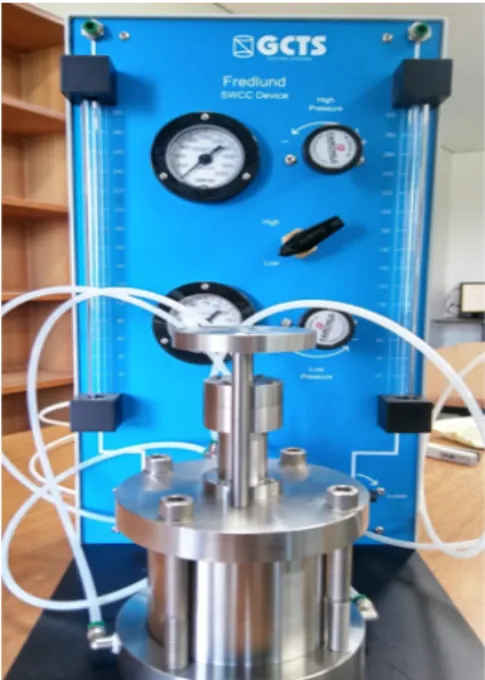
Fig. 2는 본 연구에서 활용된 실험 장비를 보여 준다 (GCTS, USA). 미국 GCTS에 제작된 장비는 흙-습윤 특성곡선(SWCC) 을 구하기에 최적화된 실험 장비로써, 흙을 채우는 셀(cell) 과 압력을 가해주고 흙에서 배출되는 물의 양을 측정하는 콘트롤패널(control pannel)로 이뤄져 있다.
셀(cell)은 내경 71mm, 높이 50mm이고, 셀(cell) 안에 직 경 62mm, 높이 26mm의 링과 세라믹 스톤이 각각 놓여진 다. 압력조절장치(regulator)로 모관흡수력을 증가시키면서 압력측정기(pressure gage)로 모관흡수력을 측정한다. 또한, 콘트롤패널(control pannel)에 부착된 투명한 관(tube)으로 시료에서 유출되는 물 또는 폴리아크릴산(polyacrylic acid)
Fig. 3. Soil-water characteristic curves at various polyacrylic acid concentrations
Table 2. Residual saturation (Sr) and capillary air entry pressure (Po) at various polyacrylic acid concentrations
Concentration [g/L] 0 2.5 5.0 7.5
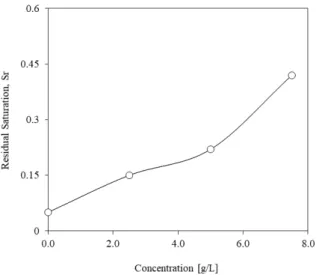
Residual saturation (Sr) [%] 5 15 22 42 Capillary air-entry pressure (Po) [kPa] 2.8 7.5 12.5 21.5
Table 3. Fitting parameters of SWCCs
Concentration [g/L] 0 2.5 5.0 7.5
m 0.92 0.92 0.95 0.89
R2 0.990 0.991 0.989 0.990
용액의 양을 측정한다. 유출된 양의 측정은 시료에 남아있 는 함수비를 계산하기 위해 사용된다.
실험 방법은 다음과 같다. 먼저, 셀(cell)안에 시료를 담을 링을 놓는다. 링에 물 또는 폴리아크릴산(polyacrylic acid) 용 액을 1/5 정도 채우고, 모래 시료를 넣는다. 이는 시료를 완전 포화하기 위한 방법이다. 5번의 반복적인 용액 및 시료의 주 입을 통해, 완전 포화된 시료를 준비하도록 한다. 시료의 공 극률(n)은 0.381로 측정된다. 셀(cell)을 closed system으로 유 지한 뒤, 압력조절장치(regulator) 및 압력측정기(pressure gage) 를 활용하여 시료의 모관흡수력(Pc)을 증가시킨다. 이때, 시 료에서 흘러나오는 물 또는 폴리아크릴산(polyacrylic acid) 용액의 양을 콘트롤패널(control pannel)에 붙어있는 투명한 관(tube)을 활용하여 측정한다. 단계적으로 모관흡수력(Pc) 을 증가시키고 각 단계에서 유출되는 물 또는 폴리아크릴산 (polyacrylic acid) 용액의 양 측정을 반복한다. 실험은 모관 흡수력(Pc)의 증가에도 불구하고, 더 이상 물 또는 폴리아크 릴산(polyacrylic acid) 용액이 나오지 않을 때까지 진행한 다. 이때, 모래 시료에 남아 있는 용액의 양을 잔류 포화도 (residual saturation)라 부른다.
3. 실험결과
3.1 흙-습윤 특성곡선
Fig. 3은 4개의 다른 폴리아크릴산(polyacrylic acid) 용 액 농도(0, 2.5, 5, 7.5g/L)에서의 흙-습윤 특성곡선(SWCC) 을 나타낸다. 실험결과는 3개의 뚜렷한 영역을 나타내고 있 다. (1) 모세관 포화영역(capillary saturation zone)은 완전 포화된 상태에서 공기주입 모관흡수력(Po)(air entry pressure) 이 관찰되는 범위까지를 나타낸다. 공기주입 모관흡수력(Po)
(air entry pressure)에 도달할 때까지 함수비(Sw)는 100%를 나타내고, 그 이후 약간의 감소가 발생하기 시작한다. (2) 공 기주입 모관흡수력(Po)(air entry pressure) 이후, 함수비(Sw) 는 급격하게 감소한다. 이 영역은 함수비(Sw)가 잔류 함수 비(Sr)(residual saturation)에 도달할 때까지를 일컫는다. (3) 잔류 함수비(Sr)(residual saturation) 영역에서 물 또는 폴리 아크릴산(polyacrylic acid) 용액은 흙 속에 거의 남아 있지 않는다.
또한, 실험결과는 폴리아크릴산(polyacrylic acid) 용액의 농도가 커질수록, (a) 흙-습윤 특성 곡선(SWCC)은 같은 함 수비(Sw)의 조건에서 높은 모관흡수력(Pc)을 가지고, (b) 잔 류 함수비(Sr)는 증가하고, (c) 공기주입 모관흡수력(Po)(air entry pressure)은 증가하고, 그리고 (d) 함수비(Sw)의 변화 에 따른 모관흡수력(Pc)의 변화는 크게 나타난다. 이러한 결 과는 높은 농도의 폴리아크릴산(polyacrylic acid) 용액을 포 함한 모래 지반은 물을 함유할 수 있는 능력이 크게 나타남 을 의미한다. 따라서, 폴리아크릴산(polyacrylic acid) 용액 을 활용하여 모래 지반의 습윤 저장 능력을 향상 시킬 수 있다고 기대한다.
3.2 실험 및 이론식 모델의 비교
Fig. 4는 본 연구에서의 실험 결과 및 van Genuchten (1980) 이론식 모델의 결과를 보여주고 있다. 측정된 모관흡 수력(Pc)과 함수비(Sw)를 토대로 비선형 최소제곱법(nonlinear least squares analysis)을 적용하여 van Genuchten(1980) 이 론식의 불포화 관련 계수인 m을 산정하였다. Table 3은 불 포화 관련 계수인 m값과 최소제곱법의 신뢰도를 나타내는 결정계수(coefficient of determination, R2)를 나타낸다. m은 폴리아크릴산(polyacrylic acid) 용액 농도에 크게 상관없이 비슷한 값을 나타내고 있다. 또한, 모든 조건에서 결정계수 (coefficient of determination, R2)가 매우 높게 나타났다. 따 라서, 폴리아크릴산(polyacrylic acid) 용액을 포함한 지반의
Fig. 4. Comparison of experimental results with theoretical solutions for soil-water characteristic curves
Fig. 5. The change of capillary entry pressure according to the increased polyacrylic acid concentrations
공기주입 모관흡수력(Po)(air entry pressure)을 알고 있으면, 본 연구에서 구한 불포화 관련 계수인 m을 사용하여, 폴리 아크릴산(polyacrylic acid) 용액을 포함한 모래 지반의 흙- 습윤 특성 곡선(SWCC)의 예측이 가능하리라 기대된다.
또한, 폴리아크릴산(polyacrylic acid) 용액의 농도가 커 질수록, 잔류 함수비(Sr)(residual saturation)가 증가하는 것 을 본 연구에서 사용된 이론식을 통해서도 확인할 수 있다 (Fig. 4).
3.3 공기주입 모관흡수력(Po)(capillary air entry pressure)
Fig. 5는 폴리아크릴산(polyacrylic acid) 용액의 농도가 증 가할수록, 공기주입 모관흡수력(Po)(capillary air entry pressure) 이 증가하고 있음을 나타낸다. 예를 들어, 폴리아크릴산 (polyacrylic acid) 용액의 농도 7.5g/L을 포함한 지반에서의 공기주입 모관흡수력(Po)은 21.5kPa로써, 물을 포함한 지반 의 경우(2.8kPa)보다 8배 정도까지 증가했음을 확인할 수 있다(Table 2). 이는, 폴리아크릴산(polyacrylic acid) 용액을 포함한 모래 지반에 공기가 쉽게 주입되기 어려움을 의미한
다. 폴리아크릴산(polyacrylic acid) 용액은 높은 점성 및 흙 표면에 부착되려는 특성을 지니고 있다(Cao, 2016). 이러 한 폴리아크릴산(polyacrylic acid) 용액특성은 농도가 증가 할수록 지반의 공기주입 모관흡수력(Po)을 증가시킨 것으로 판단된다. 따라서, 폴리아크릴산(polyacrylic acid) 용액을 활용
하여 모래 지반의 습윤 저장 능력을 향상 시킬 수 있다고 기대된다.
3.4 잔류 함수비(Sr)(residual saturation)
Fig. 6은 폴리아크릴산(polyacrylic acid) 용액의 농도가 증가할수록, 모래 지반에 남아있는 잔류 함수비(Sr)(residual saturation)가 증가하고 있음을 보이고 있다. 폴리아크릴산 (polyacrylic acid) 용액의 높은 점성 및 흙 표면에 부착되려 는 특성이 높은 잔류 함수비(Sr)의 원인이 된 것으로 판단된 다. 이러한 결과는 폴리아크릴산(polyacrylic acid) 용액을 포함한 모래 지반은 물을 함유할 수 있는 능력이 크게 나타 남을 의미한다. 따라서, 폴리아크릴산(polyacrylic acid) 용 액을 활용하여 모래 지반의 습윤 저장 능력을 향상 시킬 수 있다.
Fig. 6. The change of residual saturation according to the increased polyacrylic acid concentrations
4. 결 론
폴리아크릴산(polyacrylic acid)은 물과 이산화탄소로 완 전히 분해되기 때문에, 자연에 무해한 친환경 물질로 여겨 지고 있다. 따라서 폴리아크릴산(polyacrylic acid) 용액을 활용하여 지반을 보강하는 공법은 자연환경 보전 및 지반의 특성 향상이라는 두 가지 목표를 동시에 이룰 수 있을 것으 로 기대된다. 또한, 지반의 함수비(Sw) 및 모관흡수력(Pc)의 관계로써 표현되는 흙-습윤 특성곡선(SWCC)은 지반의 습 윤 함유능력, 상대투수계수, 지반의 강도 및 지반의 강성과 연관성을 가지는 지반의 특성을 나타낸다. 따라서, 흙-습윤 특성곡선(SWCC)의 이해는 지반의 거동을 이해하는데 크 게 도움이 될 것으로 기대된다.
본 연구에서는 폴리아크릴산(polyacrylic acid) 용액을 포 함한 모래 지반의 흙-습윤 특성곡선(SWCC)에 대한 실내시 험 및 이론적 모델을 활용하여 연구하였다. 연구 결과는 다 음과 같다.
(1) 폴리아크릴산(polyacrylic acid) 용액 농도에 상관없이 모든 흙-습윤 특성곡선(SWCC)은 3개의 뚜렷한 영역을 나타낸다. 모세관 포화영역(capillary saturation zone), 공 기주입 모관흡수력(Po)(capillary air entry pressure)에서 잔류 함수비(Sr)(residual saturation)까지의 영역, 잔류 함 수비(Sr)(residual saturation) 영역을 일컫는다.
(2) 폴리아크릴산(polyacrylic acid) 용액의 농도가 커질수 록, 흙-습윤 특성곡선(SWCC)의 기울기는 커진다. 이는 모관흡수력(Po)이 증가함에도 불구하고, 모래 지반의 공 극에 잔류하려는 폴리아크릴산(polyacrylic acid) 용액 의 특성을 나타낸다.
(3) 폴리아크릴산(polyacrylic acid) 용액의 농도가 커질수록, 공기주입 모관흡수력(Po)(capillary air entry pressure) 및 잔류 함수비(Sr)(residual saturation)는 증가한다. 이와 더 불어, 모든 영역에서 동일한 함수비(Sw) 조건에서 모관 흡수력(Pc)(capillary pressure)은 폴리아크릴산(polyacrylic acid) 용액의 농도가 커질수록 증가한다. 폴리아크릴산 (polyacrylic acid) 용액의 높은 점성 및 흙 표면 부착력 이 모관흡수력(Pc)(capillary pressure)의 증가에 영향을 끼쳤다.
(4) van Genuchten (1980) 이론식 모델 및 실험 결과에 의 한 흙-습윤 특성곡선은 비슷한 값을 보이고 있다. 불포 화 관련 계수인 m은 폴리아크릴산(polyacrylic acid) 용 액 농도에 크게 상관없이 비슷한 값을 나타내고 있고, 모든 조건에서 결정계수(coefficient of determination, R2)가 매우 높게 나타났다.
감사의 글
본 연구는 행정안전부 극한 재난대응 기반기술개발사업 의 연구비 지원(2018-MOIS31-009)에 의해 수행되었습니다.
References
1. Al-Sarji, H. H., Grattoni, C. A., Dawe, R. A. and Zimmerman, R. W. (1999), Pore-scale study of the flow of oil and water through polymer gels, Paper presented at the 1999 SPE Annual Technical Conference and Exhibition, Houston, pp. 3~6.
2. Assouline, S. (2001), A model for soil relative hydraulic conductivity based on the water retention characteristic curve, Water Resources Research, Vol. 37, No. 2, pp. 265~271.
3. Brady, N. C. and Weil, R. R. (2010), Elements of the Nature and Properties of Soils; Pearson Prentice Hall: Upper Saddle River, NJ, USA.
4. Campbell, G. S. (1974), A simple method for determining unsaturated conductivity from moisture retention data, Soil Science, Vol. 117, No. 6, pp. 311~314.
5. Cao, C. S. (2016), Engineering behavior and characteristic of water-soluble polymers: implication on soil remediation and enhanced oil recovery, Sustainability, Research 2016-08, pp.
1~16.
6. Chang, H. L. (1978), Polymer flooding technology-yesterday, today, and tomorrow, Journal of Paint Technology, Research 1978-8, pp. 1113~1128.
7. Delage, P., Howat, M. D. and Cui, Y. J. (1998), The relationship between suction and swelling properties in a heacily compacted unsaturated clay, EngineeringGeology, Vol. 50, No. 1~2.
8. Eggert, Jr., Willhite, R. W. and Green, G. P. (1992), Experimental measurement of the persistebce of permeability reduction in porous media treated with xanthan/Cr(III) gel systems, SPE Reservoir Engineering, Research 1992-2, pp. 29~35.
9. Fischer, U. and Celia, M. A. (1999), Prediction of relative and absolute permeabilities for gas and water from soil water retention curves using a pore-scale network model, Water Resources Research, Vol. 35, No. 4, pp. 1089~1100.
10. Fredlund, D. G., Xing, A., Fredlund, M. D. and Barbour, S. L.
(1996), The relationship of the unsaturated soil shear strength to the soil-water characteristic curve, Canadian Geotechnical Journal, Vol. 33, No. 3, pp. 440~448.
11. Gens, A. and Alonso, E. E. (1992), A framework for the behaviour of unsaturated expansive clays, Canadian Geotechnical Journal, Vol. 29, No. 6, pp. 1013~1032.
12. Hejri, S., Jousset, F., Green, D. W., McCool, C. S. and Willhite, G. P. (1993). Permeability reduction by a xanthan/chromium(III) system in porous media, SPE Reservoir Engineering, Research 1993-11, pp. 299~304.
13. Hoefner, M. L., Seetharam, R. V., Shu, P. and Phelps, C. H.
(1992), Selective penetration of boipolymer profile-control gels:
experiment and model, Journal of Petroleum Science and Engineering 7, pp. 53~66.
14. Karimi, S. (1997), A study of geotechnical applications of biopolymer treated soils with an emphasis on silt, PhD Thesis, Civil Engineering Department, University of Southern California, Los Angeles, CA.
15. Liang, J. T., Sun, H. and Seright, R. S. (1995), Why do gels reduce water permeability more than oil permeability, SPE Reservoir Engineering, Research 1995-11, pp. 282~285.
16. Martin, G. R., Yen, T. F. and Karimi, S. (1996), Application of biopolymer technology in silty soil matrices to form impervious barriers, In: Jaksa, M. B., Kaggwa W. S., Cameron, D. A. (Eds.),
Proceedings of 7th Australia New Zealand Conference on Geomechanics, International Association of Engineering Geology and International Society for Rock Mechanics, Australia, pp.
814~819.
17. McCool, C.S., Green, D.W. and Willhite, G.P. (1991), Per- meability reduction mechanisms involved in in-situ gelation of a polyacrylamide/chromium(VI)/thiourea system. SPE Reservoir Engineering, Research 1991-2, pp. 77~83.
18. Momeni, D., Kamel, R., Martin, G. R. and Yen, T. F. (1999), Potential use of biopolymer grouts for liquefaction mitigation, In: Leeson, A. and Alleman. B. C. (Eds.), Phytoremediation and Innovative Strategies for Specialized Remedial Applications, Vol. 5 (6), Battelle Press, Columbus, OH, pp. 175~180.
19. Mualem, Y. (1986), Hydraulic conductivity of unsaturated soils:
prediction and formulas, Agronomy, Vol. 9, pp. 799~823.
20. Needham, R. B. and Doe, P. H. (1987), Polymer flooding review, Journal of Petroleum Technology, Research 1987-12, pp. 1503~
1506.
21. Oberg, A. L. and Sallfors, G. (1997), Determination of shear strength parameters of unsaturated silts and sands based on the water retention curve, Geotechnical Testing Journal, Vol. 20, No. 1, pp. 40~48.
22. Pedarla, A., Puppala, A. J., Hoyos, L. R., Vanapalli, S. K. and Zapata, C. (2012), Unsaturated soils: research and applications, Vol. 1, Springer, Berlin, Germany.
23. Stewart, T. L. and Fogler, H. S. (2001), Biomass plug develop- ment and propagation in porous media, Biotechnology and Bioengineering, Research 2001-02-05, pp. 353~363.
24. Vanapalli, S. K., Fredlund, D. G., Pufahl, D. E. and Clifton, A. W. (1996), Model for the prediction of shear strength with respect to soil suction, Canadian Geotechnical Journal, Vol.
33, No. 3, pp. 379~392.
25. Van Genuchten, M. T. (1980), A closed-form equation for predicting the hydraulic conductivity of uasaturated soils, Soil Science Society of America Journal, Vol. 44, pp. 892~898.
26. Vogel, T. and Cislerova, M. (1988), On the reliability of unsaturated hydraulic conductivity calculated from the moisture retention curve, Transport in Porous Media, Vol. 3, No. 1, pp.
1~15.
27. Vossoughi, S. and Buller, C. S. (1991), Permeability modification by in-situ gelation with a newly discovered biopolymer, SPE Reservoir Engineering, Research 1991-11, pp. 485~489.
28. Yang, I. C. -Y., Li, Y., Park, J. K. and Yen, T. F. (1993), The use of slimeforming bacteria to enhance the strength of the soil matrix, In: Premizic, E. T. and Woodhead, A. (Eds.), Microbial Enhanced Oil Recovery Recent Advances, Elsevier, Amsterdam, pp. 89~96.
29. Yen, T. F., Yang, I. C. Y., Karimi, S. and Martin, G. R. (1996), Biopolymers for geotechnical applications, Reprinted from: The North American Water and Environment Congress, American Society of Civil Engineers, Reston, VA, pp. 6.