Abstract
BACKGROUND: The carbon (C) isotope ratio (δ
13C) of dissolved organic C (DOC) is an indicator of water pollution source. In this study, the potential use of two pre-treatments for the δ
13C analysis, alkaline persulfate oxidation coupled with carbonate precipitation (precipitation) and freeze drying (drying), were compared to suggest a more feasible pre-treatment method.
METHODS AND RESULTS: Two reference materials with different δ
13C values were used for the experiments;
chemical grade glucose (-12.0±0.02 ) and pig manure ‰
compost extract (-23.3±0.04 ). In the precipitation ‰ method, the measured δ
13C values were consistently lower than the theoretically calculated values as dissolved CO
2could not be removed due to the alkaline property of the reagents and the dissolution of air CO
2into the alkaline solution. The drying method also resulted in more negative δ
13C than the calculated δ
13C; however, the difference was systematic (3.9±0.3 ) and there was a strong correlation ( ‰ δ
13
C
calculated=0.87×δ
13C
measured-0.624, r
2=0.98) between the calculated and measured δ
13C. Calibration of δ
13C using the relationship between the calculated and the measured δ
13C values produced reliable and accurate δ
13C values.
CONCLUSION:Our results suggest that the drying method is more accurate pre-treatment method to minimize the influence of air CO
2compared to the precipitation method for the determination of δ
13C of DOC.
*Corresponding author: Woo-Jung Choi Phone: +82-62-530-2153; Fax: +82-62-530-2159;
E-mail: [email protected]
Korean J Environ Agric. 2017;36(2):113-118. Korean Online ISSN: 2233-4173
Published online 2017 June 14. https://doi.org/10.5338/KJEA.2017.36.2.12 Print ISSN: 1225-3537
용존유기탄소의 δ 13 C 분석시 고형화 전처리 방법 비교 알칼린 : 과황산칼륨산화 탄산침전과 동결건조 -
전병준1, 박현진1, 최우정1*, 박용세2, 이상모2, 윤광식1
1전남대학교 지역 바이오시스템공학과,⋅ 2서울대학교 농생명과학공동기기원
Comparison of Solidification Pre-treatment Methods for the Determination of δ
13C of Dissolved Organic Carbon: Alkaline Persulfate Oxidation-Carbonate Precipitation vs . Freeze Drying
Byeong-Jun Jeon
1, Hyun-Jin Park
1, Woo-Jung Choi
1*, Yong-Se Park
2, Sang-Mo Lee
2and Kwang-Sik Yoon
1(
1Department of Rural & Biosystems Engineering, Chonnam National University, Gwangju 61186, Korea,
2
National Instrumentation Center for Environmental Management, Seoul National University, Seoul 08826, Korea)
Received: 25 April 2017 / Revised: 2 June 2017 / Accepted: 7 June 2017 Copyright ⓒ 2017 The Korean Society of Environmental Agriculture
This is an Open-Access article distributed under the terms of the Creative Commons Attribution Non-Commercial License (http://creativecommons.org/licenses/by-nc/3.0) which permits unrestricted non-commercial use, distribution, and reproduction in any medium, provided the original work is properly cited.
ORCID
Byeong-Jun Jeon
http://orcid.org/0000-0002-0738-3150 Hyun-Jin Park
http://orcid.org/0000-0002-2642-5723 Woo-Jung Choi
http://orcid.org/0000-0002-2009-8207 Yong-Se Park
http://orcid.og/0000-0002-5059-7154 Sang-Mo Lee
http://orcid.org/0000-0002-8661-6847 Kwang-Sik Yoon
http://orcid.org/0000-0003-4996-2860
113
Research Article Open Access
Key words: Carbon isotope ratio, Dissolved organic carbon, Freeze drying, Stable isotope ratio mass spectrometer, Strontium carbonate precipitation
서 론
용존유기탄소 (DOC, Dissolved Organic Carbon) 는 토 양과 수계와 같은 자연생태계에 존재하는 총유기탄소의 극히 일부분만 차지하고 있지만 이동성과 생물학적 유효도가 높아 , 수질오염 이해에서 중요하게 고려되는 지표이다(Tu et al., 토양을 비롯한 다양한 오염원에 존재하는 는 강
2011). DOC
우 사상시 수계로 유출되어 생물학적 산소 요구량과 화학적 산소 요구량을 증가시키는 요인이 된다(Yoo et al ., 2012).
따라서 농촌 지역 수계의 수질 관리를 위해서 , DOC 농도뿐 만 아니라 , DOC 의 오염원 규명에 대한 요구가 증가하고 있 다(Zhou et al ., 2006). 하지만 농촌지역은 농경지이외에도 , 축산 산림 생활하수 등 다양한 비점오염원이 산재해 있어 , , 오염원과 오염물질 유출 경로가 복잡하기 때문에 수질 오염 원 규명이 쉽지 않다(Ongley et al ., 2010; Sun et al ., 2012).
농촌지역 수질 오염원 규명을 위해서는 탄소와 질소를 포 함한 다종의 원소 함량과 그 동위원소비 등 다양한 수질 화학 지표 사용이 권장되고 있다(Choi et al ., 2017). 다양한 수질 화학 지표 중 탄소동위원소비(
13C/
12C, δ
13C 로 표시되며 단 위는 ‰ ) 는 수질 오염원 규명에서 가축분뇨에 의한 오염원 지표로 사용될 수 있는데 이는 가축 사양시 , C4 식물인 옥수 수 첨가 사료가 사용되어 가축분뇨 또는 퇴비의 δ
13C 이 타 오염원과 상이하기 때문이다(Yanagi et al ., 2012). 일반적으 로 C4 사료 예를 들면 옥수수 ( , -11.2 , ‰ 실버그래스 -13.0 ) ‰ 의 δ
13C 은 C3 사료 티모시 건초 ( -29.1 , ‰ 밀 -25.3 ) ‰ 보다 높 기 때문에(Yanagi et al ., 2012), C4 사료 급여시 발생 분뇨 의 δ
13C (-12.6 ) ‰ 도 C3 사료 급여 분뇨의 δ
13C (-26.8 ) ‰ 보 다 높다(Dungait et al ., 2010). 하지만 농촌 지역에서 분뇨 , 또는 퇴비로 부터의 오염물질 유출은 고상의 형태보다는 강 우시 용존 형태로 발생하기 때문에 δ
13C 을 활용한 오염원 평 가를 위해서는 DOC 의 δ
13C 분석이 필요하다 .
의
DOC δ
13C 분석 기술이 발전함에 따라 총유기탄소분석기 와 안정동위원소비질량분석기
(TOC analyzer) (Stable Isotope 를 결합한 방
Ratio Mass Spectrometer, SIRMS) 법도 개발 되고 있으나(Kirkels et al ., 2014), 아직까지 대중적으로 활 용되고 있지 못하다 . DOC 의 δ
13C 분석을 위한 전통적 방 법은 DOC 를 강산 또는 알칼리과황산으로 분해시켜 발생 한 CO
2를 Gas Chromatography (GC)-SIRMS 로 분석하는 것인데(van Geldern et al ., 2013; Yu et al ., 2015), 이 방 법 역시 현재 가장 널리 이용되는 원소분석기(Elemental
와 결합된 에 적용하기에 한계가 있다
Analyzer) EA-SIRMS .
따라서 다수의 연구는 수용액상 시료를 가열 건조 , (50 6 ∼
하여 고체 분말형태로 만든 후 를 이용하여
0 ) ℃ EA-SIRMS
의
DOC δ
13C 를 분석한다 (Parker et al ., 2010; Tu et al .,
하지만 가열 건조시 시료 중 손실이 있을 수
2011). , DOC
있어 동결건조 방법이 권장되고 있다 , (Amiotte-Suchet et al ., 2007; Lambert et al ., 2011). 이와 같은 동결건조 방법 의 장점에도 불구하고 동결건조 전처리에 의한 , δ
13C 분석 방 법의 정확도 등 분석 결과의 신뢰도에 대한 연구 결과가 제시 되지 않아 해당 방법에 대한 확신이 부족한 상황이다.
의 고체 시료화의 또 다른 방법은 과황산칼륨 분해 DOC
시 생성된 CO
2를 알칼리성 조건에서 포집하고 SrCl
2와 반응 시켜서 최종적으로 SrCO
3침전물을 형성하는 것이다(Harris et al ., 1997). SrCO
3침전법은 현재 용존무기탄소(DIC, 분석시 사용되고 있지만 Dissolved Inorganic Carbon)
(Parker et al ., 2010; van Geldern et al ., 2013), DOC 의 δ
13C 분석에는 널리 이용되고 있지 않다 따라서 본 연구는 . ,
의
DOC δ
13C 분석시 사용할 수 있는 가지 전처리방법인 동 2 결건조법과 과황산칼륨 산화-SrCO
3침전법의 효과를 비교 검토하여 EA-SIRMS 를 이용한 DOC 의 δ
13C 분석 방법을 제안하고자 수행되었다.
재료 및 방법
표준 물질
글루코스 (Glucose) 와 돈분퇴비 침출액을 표준 물질로 사 용하여 과황산칼륨 산화-SrCO
3침전법과 동결 건조법을 이 용한 DOC 의 δ
13C 분석법을 비교하였다 글루코스는 시약급 . 을 구입하였으며 돈분퇴비 침출액은 시중에 유통되는 돈분퇴 , 비와 증류수를 1:10 으로 혼합진탕한 후 여과액 약 500 mL 를 동결건조하여 분말 시료를 확보하였다 글루코스 분말과 돈분 . 퇴비 침출액 분말시료의 탄소동위원소비(
13C/
12C) 는 EA- 로 SIRMS (IsoPrime-EA, Micromass, Manchester, UK)
반복 분석하여
10 δ
13C 값으로 표현하였다 .
δ
13C ( ) = [(R ‰
S-R
R)/R
R]×1000 (1)
R
S와 R
R은 각각 시료와 표준물질의 탄소동위원소비인데, 표준물질은 Vienna-Pee Dee Belemnite (CaCO
3) 로서 탄소 동위원소비는 0.0112372
13C atom % 이다 (Choi and Lee,
글루코스와 퇴비침출액의
2012). δ
13C 은 각각 -12.0±0.02‰
과 -23.3±0.04 ‰ 이었다 .
과황산칼륨 산화-SrCO
3침전 후 δ
13C 분석 방법 과황산칼륨 산화-SrCO
3침전법 전처리에 의한 δ
13C 분석 의 정확도를 검토하기 위해 1) 동일한 δ
13C (12.0±0.02 ) ‰ 의 글루코스 용액 (10 mg C/L) 을 다양한 수준 (0, 5, 10, 20, 30
시료 코드
mL; : G
0, G
5, G
10, G
20, G
30) 으로 전처리하여
함량 에 따른 과황산칼륨
DOC (0, 0.05, 0.1, 0.2, 0.3 mg C)
산화-SrCO
3침전법 전처리의 δ
13C 분석 결과를 검토하였고
2) δ
13C 이 상이한 글루코스와 퇴비침출액 분말을 가지 비율 6
로
혼합하여 제조한 용액(10 mg C/L) 을 이용하여 DOC 의
δ
13C 이 상이한 조건에서 과황산칼륨 산화-SrCO
3침전법 전 처리에 의한 δ
13C 분석 정확도를 평가하였다 ( Table 1). 시료 분해에 사용한 알칼린 과황산칼륨 용액은 0.185 M K
2S
2O
8과
용액을 혼합하여 제조하였으며
0.42 M NaOH (Cabrera
분해에 의해 발생한 and Beare, 1993), DOC CO
32-침전을 위해 2 N SrCl
2를 사용하였다(Harris et al ., 1997).
용량의 병에 정해진 시료와 알칼린 과황산 50 mL septa
칼륨 용액 10 mL (Cabrera and Beare, 1993), 그리고 2 N SrCl
22 mL 을 넣고 바이얼을 밀폐 시킨 후 고압멸균기를 이 용하여 121 ℃ 에서 30 분간 산화시켰다 산화액을 원심분리하 . 여 상등액을 제거하고 침전물(SrCO
3) 을 회수하여 65℃ 에서 건조시킨 분말을 주석캡슐에 담고 연소촉매제 , V
2O
35 mg 을 첨가한 후 상기의 방법으로 δ
13C 을 분석하였다 실험은 반 . 3 복 하였다.
글루코스와 퇴비침출액 분말 혼합 시료의 δ
13C 은 동위원 소질량수지 (Isotope mass balance) 를 이용하여 계산하였다 (Nitschelm et al ., 1997).
δ
13C
glucose+compost=[(δ
13C
glucose×C
glucose+(δ
13C
compost×C
compost)]/C
glucose+compost(2)
δ
13C
glucose+compost, δ
13C
glucose, δ
13C
compost는 각각 글루코스
와 퇴비침출액 분말 혼합시료 글루코스 퇴비침출액 , ,
분말의 δ
13C 이고 , C
glucose, C
compost, C
glucose+compost는 각각 이들의 탄소 함량이다.
동결건조 후 δ
13C 분석 방법
과황산칼륨 산화-SrCO
3침전법 전처리에서 사용한 글루 코스 퇴비침출액 분말 혼합 용액 - (Table 1) 과 동일한 시료를 동결건조하였다 동결건조 전에 황산으로 용액의 . pH 를 이 2 하로 낮추어 DIC 를 제거하고 최종 건조물의 증량을 위해 , K
2SO
4100 mg 을 넣었다 동결건조 시료에 대해서 상기의 . 방법으로 δ
13C 을 분석하였다 실험은 반복 하였다 . 3 .
통계 분석
분석 결과의 등분산성 (Homogeneity of variance) 과 정
규 분포성 (Normality of distribution) 은 각각 Levene’s
와 로 검정하였는데 모든 자료가 통
test Shapiro-Wilk’s test ,
계 분석에 요구되는 등분산성과 정규 분포성을 만족시켰다. δ
13
C 이론값 또는 계산 값 에 대한 측정 값의 정확성은 두 값 ( ) 사이에 차이가 없다는 귀무가설에 대한 ANOVA 로 평가하였 다 필요할 경우 이론값과 측정값의 상관관계에 대해 회귀분 . 석을 실시하였다 과황산칼륨산화 . -SrCO
3침전법과 동결건조 법에 의해 측정된 δ
13C 차이는 F-test 로 검증하였다 모든 통 . 계분석은 SPSS 18.0 (SPSS Inc. Chicago, USA) 로 유의 확 률 95% ( =0.05) α 수준에서 수행하였다 .
결과 및 고찰
과황산칼륨 산화-SrCO
3침전 후 δ
13C 분석 결과 글루코스 용액을 대상으로 과황산칼륨 산화-SrCO
3침전 에 의해 분석한 δ
13C 은 -23.8 -17.4 ∼ ‰ ( 평균 -19.9 ) ‰ 로 표 준값 (-12.0 ) ‰ 과 큰 차이를 보였다 (Fig. 1). 또한 글루코스와 ,
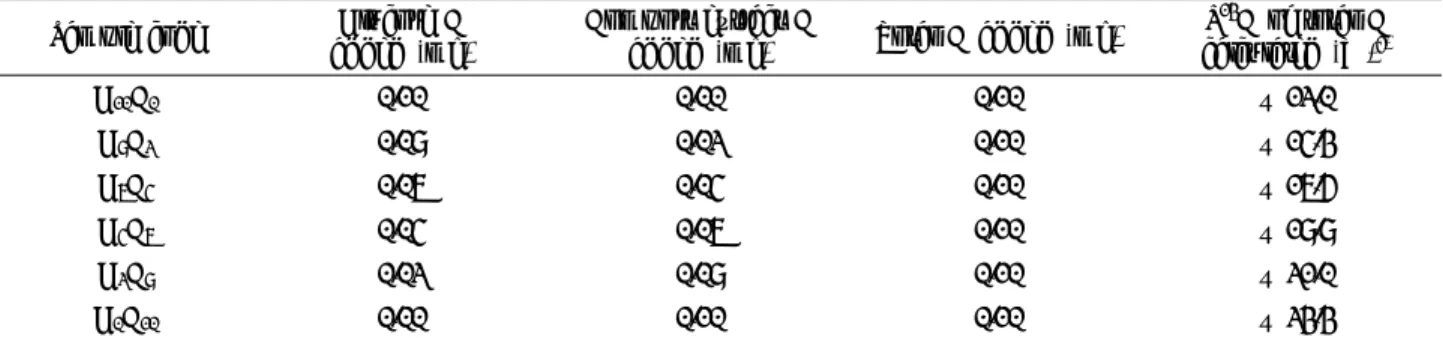
Sample code Glucose Cadded (mg)
Compost extract C
added (mg) Total C added (mg) δ13C of total C calculated ( )‰a)
G10C0 0.10 0.00 0.10 ╶12.0
G8C2 0.08 0.02 0.10 ╶14.3
G6C4 0.06 0.04 0.10 ╶16.5
G4C6 0.04 0.06 0.10 ╶18.8
G2C8 0.02 0.08 0.10 ╶21.0
G0C10 0.00 0.10 0.10 ╶23.3
a) The 13C was calculated using isotope mass balance equation.δ
Table 1. Experimental settings for the pre-treatment of glucose samples using alkaline persulfate oxidation method and freeze-drying method
Fig. 1. The δ13C of glucose samples processed with alkaline persulfate digestion coupled with SrCO3
precipitation. 0, 5, 10, 20, and 30 mL of glucose solution (10 mg C/L) were used for sample codes, G0, G5, G10, G20, and G30, respectively.
Reference is glucose of which δ13C was directly measured with EA-SIRMS. Vertical bars are standard errors of the means (n=3). All measured δ13C for G0 G30 differ from the∼ δ13C of reference (
P
<0.001).퇴비침출액 분말혼합용액을 대상으로 한 실험에서도 이론값 은 -23.2 -12.0 ∼ ‰ 이었지만 분석값은 , -22.6 -20.0 ∼ ‰ 로 큰 차이가 있었다( Fig. 2). 따라서 일부 시료 , (Fig. 2 의 C
0C
10) 를 제외하고 과황산칼륨 산화 , -SrCO
3침전에 의해 분석된 δ
13C 은 이론값보다 낮았다.
일반적으로 용액 중 DOC 의 δ
13C 분석을 위해서는 용액 의 pH 를 2.0 이하로 낮추어 DIC 를 CO
2의 형태로 제거한 후 실험을 진행한다(Yu et al ., 2015). 하지만 과황산칼륨 산화 , -SrCO
3침전 방법에서는 DOC 산화에 의해 생성된 CO
2를 포집하기 위해 알칼리 조건에서 진행하여야하기 때문에 반응 전에 존재하였던 DIC 제거가 불가능하다 따라서 본 실험에 . , 서는 시료 조제 및 시험 과정 중에 공기 중 CO
2가 알칼리과 황산칼륨 용액에 용해되어 실험 오차를 일으킨 것으로 판단 된다(Harris et al ., 1997). 인위적인 오염원과 원거리에 위치 한 자연 상태 지점의 대기 CO
2의 δ
13C 는 현재 일반적으로
약 -10 ‰ 로 계산되지만 실험실과 같은 폐쇄적 공간에서는 사 , 람의 호흡에 의해 공기 중 CO
2의 δ
13C 이 -20‰ 정도로 낮아 질 수 있다 (Choi and Lee, 2012). 본 실험에서는 글루코스 를 첨가하지 않은 조건에서 측정된 δ
13C 이 -23.8‰ 이었는데
이는 앞의 설명과 상응한다
(Fig. 1), .
Harris et al . (1997) 은 CO
32-와 SrCl
2를 반응시켜 생성된 SrCO
3침전물을 대상으로 EA-SIRMS 로 직접 δ
13C 을 분석 한 결과와 SrCO
3침전물을 산성화시켜 발생한 CO
2에 대하 여 측정한 δ
13C 을 비교한 결과 그 값이 모두 , -13.6‰ 로 차이 가 없었기 때문에 SrCO
3침전물을 이용하여 CO
2의 δ
13C 을 정확하게 분석할 수 있다고 하였다 하지만 본 실험과 같이 . , 알칼리성 조건에서 CO
2를 SrCl
2와 반응시켜 형성된 SrCO
3에 대해서 δ
13C 를 분석한 결과는 CO
2의 δ
13C 값과 차이를 보였다 따라서 과황산칼륨 산화 . , -SrCO
3침전에 의해 분석한 δ
13C 은 알칼리성이라는 매질의 특성상 DOC 분석에 활용되 기 어려운 것으로 판단된다.
동결건조 후 δ
13C 분석 결과
동결건조 후 분석한 δ
13C 은 -26.7 -16.1 ∼ ‰ 로 과황산칼륨 산화-SrCO
3침전법으로 분석한 δ
13C (-23.8 -17.4 ) ∼ ‰ 와 차 이가 있었으며 과황산칼륨 산화 , -SrCO
3침전법과 유사하게 이론값 (-23.3 -12.0 ) ∼ ‰ 보다 낮았다 (Fig. 3). 하지만 측정값 , 과 이론값의 회귀 분석 결과에 의하면 결정계수(r
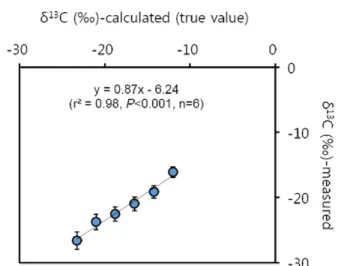
2) 가 0.98 로 매우 높았고 (Fig. 4), 측정값과 이론값의 차이가 3.9±0.3‰ 로 일정한 편이어서 동결건조 방법은 보정이 가능한 계통오차 에 의해 그 값이 이론값과 달라지는 것으 (Systematic error)
로 판단되었다 따라서 직선회귀식 . , (Fig. 4) 을 이용하거나 측 정값과 이론값의 차이 (3.9±0.3 ) ‰ 를 보정할 경우 이론값에 근사한 보정 δ
13C 을 구할 수 있었다 (Fig. 5).
많은 연구에서 동결건조로 DOC 를 전처리하여 δ
13C 을 분 석하고 있으나(Amiotte-Suchet et al ., 2007; Lambert et
Fig. 2. The δ13C of glucose+compost-extract mixed samplescalculated with isotope mass balance equation (calculated) and processed with alkaline persulfate digestion coupled with SrCO3 precipitation (measured). Sample codes are provided in Table 1.
Vertical bars are standard errors of the means (n=
3). All measured δ13C differ from the calculated δ13C (
P
<0.001).Fig. 3. The δ13C of glucose+compost-extract mixed samples calculated with isotope mass balance equation (calculated) and processed with freeze drying (measured). Sample codes are provided in Table 1.
Vertical bars are standard errors of the means (n=
3). All measured δ13C differ from the calculated δ13C (
P
<0.001).Fig. 4. Regression analysis between the δ13C calculated (true value) and measured for freeze drying pre-treatment using data shown in Fig. 3. Vertical bars are standard errors of the means (n=3).
al ., 2011), 동결건조 전처리 방법에 의한 δ
13C 분석의 정확도 에 대한 연구 결과가 제시된 바 없다 본 연구 결과는 동결건 . 조에 의해 D OC 의 δ
13C 에 규칙적인 변이가 발생할 수 있으 며, δ
13C 을 정확하게 분석하기 위해서는 표준시료를 활용하 여 해당 방법의 정확도를 검정하고 필요할 경우 보정할 필요 가 있음을 제시한다.
요 약
의
DOC δ
13C 은 수질 오염원 규명에 활용할 수 있는 매우 유용한 지표이다 본 연구에서는 안정성동위원소비 질량분석 . 기 (EA-SIRMS) 를 이용하여 DOC 의 δ
13C 을 분석할 때 사용 하는 두 가지 전처리방법 과황산칼륨산화 ( -SrCO
3침전법과 동 결건조법 의 정확도를 비교 평가하였다 표준물질로는 글루코 ) . 스(δ
13C; -12.0±0.02 ) ‰ 와 돈분퇴비 침출액 건조분말 ( δ
13C;
을 사용하였다 과황산칼륨산화
-23.3±0.04 ) ‰ . -SrCO
3침전법 에서는 용액의 알칼리성에 의해 DIC 제거가 어렵고 공기 중 CO
2의 영향에 의해 시료가 오염되어 분석결과의 정확도가 매우 낮았다 반면 동결건조법은 산 첨가에 의해 . , DIC 제거 가 가능하였고 측정값과 이론값의 상관관계가 매우 높아 실 , 험조건별로 표준물질을 이용하여 측정값을 이론값에 근접하 게 보정할 수 있는 것으로 나타났다 따라서 . , EA-SIRMS 를 이용하여 DOC 의 δ
13C 분석시 동결건조법으로 시료를 전처 리하면 분석결과의 정확도를 증대시킬 수 있을 것으로 판단 된다.
Acknowledgement
This research was financially supported by a grant
from the Yeongsan and Sumjin River Watershed Management Committee, Ministry of Environment, Republic of Korea.
References
Amiotte-suchet, P., Linglois, N., Leveque, J., & Andreux, F. (2007).
13C composition of dissolved ogranic carbon in upland forested catchments of the morvan mountains (France): Influence of coniferous and deciduous vegetation. Journal of Hydrology, 335(3&4), 354-363.
Cabrera, M. L., & Beare, M. H. (1993). Alkaline persulfate oxidation for determining total nitrogen in microbial biomass extracts. Soil Science Society of America Journal, 57(4), 1007-1012.
Choi, W. J., Kwak, J. H., Lim, S. S., Park, H. J., Chang, S.
X., Lee, S. M., Arshad, M. A., Yun, S. I., & Kim, H. Y.
(2017). Synthetic fertilizer and livestock manure differently affect δ
15N in the agricultural landscape: A review. Agriculture Ecosystems & Environment, 237(1), 1-15.
Choi, W. J., & Lee, K. H. (2012). A short overview on linking annual tree ring carbon isotopes to historical changes in atmospheric environment. Forest Science &
Technology, 8(2), 61-66.
Dungait, J. A. J., Bol, R., Lopez-Capel, E., Bull, I. D., Chadwick, D., Amelung, W., Granger, S. J., Manning, D. A. C., & Evershed, R. P. (2010). Applications of stable isotope ratio masss spectrometry in cattle dung carbon cycling studies. Rapid Communications in Mass Spectrometry, 24(5), 495-500.
Harris, D., Porter, L. K., & Paul, E. A. (1997). Continuous flow isotope ratio mass spectrometry of carbon dioxide trapped as strontium carbonate. Communications in Soil Science and Plant Analysis, 28(9&10), 747-757.
Kirkels, F. M. S. A., Cerli, C., Federherr, E., Gao, J., Kalbitz, K. (2014). A novel high-temperature combustion based system for stable isotope analysis of dissolved organic carbon in aqueous samples. Ⅱ : optimization and assessment of analytical performance. Rapid Communications in Mass Spectrometry, 28(23), 2574- 2586.
Lambert, T., Pierson-Wickmann A. C., Gruau, G., Thibault, J. N., & Jaffrezic, A. (2011). Carbon isotopes as tracers of dissolved organic carbon sources and water pathways in headwater catchments. Journal of Hydrology, 402(3&4), 228-238.
Nitschelm, J. J., Lüscher, A., Hartwig, U. A., & van Kessel, C. (1997). Using stable isotopes to determine
Fig. 5. Regression analysis between the δ13C calculated(true value) and calibrated using the regression equation in Fig. 4 (Calibration 1) and using the difference (3.9 ) between the calculated and‰ measured δ13C for freeze drying pre-treatment.
Vertical bars are standard errors of the means (n=3).