34
전업주부의 양육 부담과 우울감이 수면의 질에 미치는 영향:
가계수입의 조절된 매개효과 검증
The Influence of the Burden of Nurturing and
Depression on Sleep Quality in Female Full-Time Homemakers : The Moderated Mediating Effect of Monthly Income
전민정1
·
정나래1,3·
황태영2,3,4Min-Jeong Jeon,
1Na-Rae Jeong,
1,3Tae-Young Hwang
2,3,4▒
ABSTRACT
Objectives: This study investigated sleep quality in female full-time homemakers and evaluated the relationship of sleep dis- turbance with psychological and socio-environmental factors.
Methods: This cross-sectional study adopted a structured survey and sequential recruitment method for randomized partici- pation of community-dwelling full-time female homemakers. Sleep quality and mental health were measured using the Korean version of the Pittsburgh Sleep Quality Index (K-PSQI), Korean version of the Beck Depression Inventory-II (K-BDI-II), Kore- an version of the Beck Anxiety Inventory (K-BAI), and Korean version of the Beck Hopelessness Scale (K-BHS). The will- ingness-to-pay (WTP) method was selected to measure the self-evaluated monetary value of household service work. The relationship among the main relevant factors was statistically analyzed through a mediation model.
Results: A total of 166 participants were analyzed and classified having poor versus good sleep quality (poor : 24.1%, n = 40 ; good : 75.9%, n = 126 ; cut-off point = 9 on the K-PSQI). Significant between-group differences were observed in mental health status (K-BDI-II, p < 0.001 ; K-BAI, p < 0.001 ; K-BHS, p = 0.003). The moderated mediation model was verified, indi- cating that depression may mediate the association between nurturing burden and sleep disturbance. The path from nurtur- ing burden to depression may be moderated by average monthly household income.
Conclusion: A relatively high portion of full-time female homemakers may suffer from sleep disturbance and interactions be- tween psychological and socio-environmental factors might determine sleep quality, suggesting the need for public health policies targeting improvement of sleep quality and mental health among full-time homemakers. Sleep Medicine and Psycho- physiology 2021;28(1):34-42
Key words: Cross-sectional·Female·Full-time homemaker·Mediation model·Mental health·Sleep quality.
Sleep Medicine and Psychophysiology ...
수면·정신생리 28(1): 34-42, 2021
원 저
https://doi.org/10.14401/KASMED.2021.28.1.34
...
Received: February 7, 2021 / Revised: June 14, 2021 / Accepted: June 14, 2021 This research was supported by the grant of Insan Research Fund for Psychiatry (2017).
1용인정신병원 임상심리학과
Department of Clinical Psychology, Medical Foundation Yong-In Mental Hospital, Yongin, Korea
2용인정신병원 정신건강의학과
Department of Psychiatry, Medical Foundation Yong-In Mental Hospital, Yongin, Korea
3용인정신병원 정신재활 및 지역사회정신의학 WHO 협력 센터
WHO Collaborating Centre for Psychosocial Rehabilitation and Community Mental Health, Yong-In Mental Hospital, Yongin, Korea
4용인 정신건강복지센터·용인 자살예방센터
Yong-In Mental Health Welfare Center·Yong-In Suicide Prevention Center, Yongin, Korea
Corresponding author: Tae-Young Hwang, Department of Psychiatry, Medical Foundation Yong-In Mental Hospital, 940 Jungbu-daero, Gi- heung-gu, Yongin 17089, Korea
Tel: 031) 288-0208, Fax: 031) 288-0107, E-mail: [email protected]
35
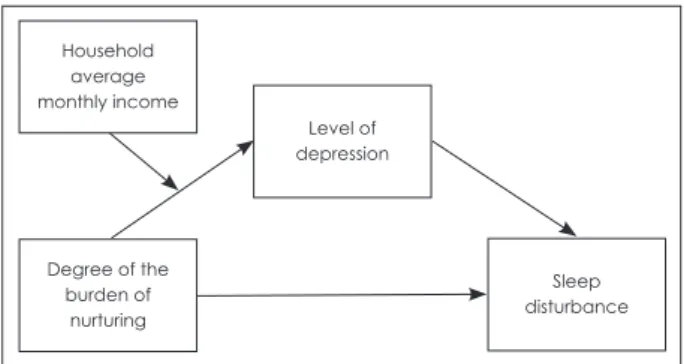
Figure 1. Basic hypothesis in this study. The hypothesis is simpli- fied as follows : monthly income may moderate the association between the burdens of nurturing and depression and then de- pression may mediate the association between the burdens of nurturing and sleep disturbance.
Introduction
Sleep quality is important in the perspective of the main- tenance of mental health, considering that sleep distur- bance is prevalent and included as one of the main symp- toms in the diagnostic criteria of many psychiatric disorders (American Psychiatry Association 2013). In general, sleep disturbance may be one of the first signs of mental distress and may frequently accompany or be bi-directionally related to common mental health problems, i.e., depression, anxiety, and psychosis on sleep quality has been empirically estab- lished (Alvaro et al. 2013 ; Cerolini et al. 2016 ; Gillin 1998 ; Papadimitriou and Linkowski 2005). Especially, sleep com- plaints are the most frequent clinical manifestation in pa- tients with depression and sleep disturbance such as insom- nia or hypersomnia has been considered one of the main symptoms of depression (Tsuno and Besset 2005). Also, in- somnia may be epidemiologically a prospective risk factor for depression (Ford and Kamerow 1989 ; Gillin 1998 ; Mor- phy et al. 2007), and depression is associated with altered sleep architecture, i.e., decrease in slow-wave sleep (SWS) production and disturbed rapid eye movement (REM) sleep regulation (Palagini et al. 2013). Accordingly, each phenom- enon of depression and sleep abnormality has been found entangled, implicating close clinical relationships, and shared complex neural substrates.
Meanwhile, a large body of research indicated several risk factors of sleep disturbance : female gender, advanced age, and stressful life events (American Psychiatry Associa- tion 2013). In particular, previous researches manifested that the prevalence of sleep disturbance is consistently high in women, suggesting increased vulnerability to poor sleep quality due to the impact of biological and socio-environ- mental factors ; frequent hormonal changes due to pregnancy or menopause which are experienced in midlife of a woman aged from 30 to 50 years (Blümel et al. 2012 ; Weyerer and Dilling 1991), and lack of time to rest and spare in daily life, stressful life events and labor for caring of family members (Arber et al. 2009 ; Basner et al. 2007 ; Chen and Kawachi 2005). Accordingly, it may be assumed that the full-time fe- male homemakers are at high risk for sleep disturbance and poor mental health.
It has been also increasingly reported in previous studies that sleep quality is associated with demographic and socio- economic factors. A substantial portion of sleep complaints by women in unemployment status might be explained by other sociodemographic factors including marital status, ed- ucation level, and monthly income (Grandner et al. 2010).
Individuals in the lower socioeconomic status (SES) gener-
ally tend to show less sleep duration and/or lower sleep quality (Gellis et al. 2005), which is compatible with the re- sult that more complaints of insomnia in the lower SES group were significantly manifested as compared to the higher SES group (Ford and Kamerow 1989 ; Karacan et al.
1976). Overall, these findings may indicate that plausible role of the demographic and socioeconomic factors should be considered in analyzing the relationship between mental health and sleep quality.
According to the Report on the time use survey (2019) and the Household Production Satellite Account (2019) published by National Statistical Office, full-time female homemakers spent an average of 5 hours and 41 minutes a day for house- hold service work, contributing 47.2% of total unpaid house- hold service work which is equivalent to 24.3% of nominal Gross Domestic Product (GDP) (Korea Statistical Informa- tion Service 2019). Thus, full-time female homemakers play a pivotal role in the maintenance of our society, taking charge of nurturing of children, care of family members, and man- agement of problems within a family, etc. Nevertheless, soci- etal recognition of full-time homemakers’ labor value and so- cial treatment of full-time homemakers have not yet been properly established in our society (Chang and Woo 2017 ; Moon 1994). Full-time female homemakers are likely to be exposed to persistent stress due to overburden of domestic labor and repetitive daily routines, leading to be vulnerable to mental health problems and poor quality of sleep.
The first purpose of this study, in the perspective of pub- lic health, was to investigate the level of sleep quality and mental health status in the community-dwelling full-time fe- male homemakers as a target group for community mental health services. In the perspective of integration of sleep quality-related factors in full-time female homemakers, a moderated mediation model was proposed, whereby as a secondary purpose, this study aimed at verifying the simpli-
Household average monthly income
Level of depression
Sleep disturbance Degree of the
burden of nurturing
36
fied hypothesis that depression would mediate the associa- tion between the burdens of nurturing and sleep disturbance and then the path from the burdens of nurturing to depres- sion would be moderated by monthly income (Figure 1).
Methods
1. Study design and overview
This research was a cross-sectional public health study us- ing a structured survey method and sequential recruitment method for randomized participation of subjects and was conducted through surveyors who had received collective education and training in advance. This study was approved by the local Institutional Review Board (IRB No. 3-124474- A-N-01) and informed consent was obtained before partic- ipation from individual participants.
2. Participants
A total of 180 participants aged 19 to 50 were recruited on community-dwelling women working as full-time home- makers in a large city with a population of more than 600,000 people. Participants were living in Jeonbuk Province and re- cruited through an announcement in the online website for female homemakers. The survey was conducted in an annu- al event hold by the online community for homemakers. A full-time homemaker was defined as follows : 1) a person who has been in charge of household service works for at least one year before participating in the research, and 2) who has not engaged in other occupational activity. The exclusion criteria were as follows : 1) a person who has been hospital- ized for mental illness other than depression, 2) a person who has an excessive drinking problem or has been diagnosed with alcohol use disorder, 3) a person with a severe internal or neurological problem that requires inpatient treatment.
The sample size was determined to be 180 using G*Power Analysis software program (Erdfelder et al. 1996), for which effect size of 0.15 for the regression analysis, two-tailed signif- icance level (α) of 0.05, power (1-β) of 0.95, and drop-out rate of 10% were applied due to the absence of prior research.
3. Composition of structured questionnaire
Structured self-reporting questionnaire was composed of general sociodemographic items, items related to willingness- to-pay method for monetary valuation of household service work, and standardized scales for the assessment of mental health.
Sociodemographic items include age, educational level, average household monthly income, smoking status, alcohol consumption status, number of children in the family, level
of social activity, and level of physical exercise, and were as- sessed with 5-point Likert scale. The degree of bond with the husband and the degree of burden of nurturing were also included and measured using a visual analogue scale (VAS, range : 0 to 10).
4. Willingness-to-pay method
In this study, self-willingness-to-pay (Self-WTP) was adopt- ed for self-evaluation of maximum monetary value of house- hold service work of individual full-time female homemaker and was presented as an auxiliary indicator of the mental health status and the level of self-esteem of a full-time female homemaker.
Willingness-to-pay (WTP) method was originally intro- duced for the cost-benefit analysis (CBA) in the field of phar- macoeconomics through monetary valuation of health bene- fits of new healthcare intervention (Bala et al. 1999). To date, WTP method has been expanded to various areas, such as decision-making on medical practice due to the burden of disease or public health policy decisions based on a monetary assessment of the quality-adjusted life-year (QALY) (Augustin et al. 2018 ; Bobinac et al. 2010). In the area of mental health, WTP method is also used to determine preferences related to mental health and to develop mental health policy (Daltio and Attux 2017).
5. Instruments for the assessment of mental health
1) Korean version of Pittsburgh Sleep Quality Index (K-PSQI) (Buysse et al. 1989 ; Sohn et al. 2012)
This validated scale is an 18-item questionnaire and is used to measure habitual sleep quality over the past month.
It is comprised of 7 subscales assessing habitual duration of sleep, nocturnal sleep disturbances, sleep latency, sleep qual- ity, daytime dysfunction, sleep medication usage, and sleep efficiency. Each subscale has a possible score of between 0-3, with an overall global score of 0-21, with higher scores reflecting poorer sleep quality. Based on the Korean version of PSQI, the present study used the established cutoff of a score of ≥ 9 as poor sleep quality.
2) The Korean version of Glasgow Sleep Effort Scale (K-GSES) (Broomfield and Espie 2005 ; Kim et al. 2014)
This validated measure is composed of 7 self-report items
on a Likert scale, assessing the extent to which individuals
engage in effortful attempts to sleep. Higher scores indicate
greater sleep effort.
37
3) Korean version of Beck Depression Inventory-II(K-BDI-II) (Beck et al. 1996 ; Lim et al. 2011)
This 21-item self-report validated scale was conducted to measure depressed mood. Each item is rated from 0 to 3, pos- sible total score range of 0 to 63, with higher score indicating severe depressive symptoms. According to the summed score, severity is divided into four levels ; score range of 0 to 13, nor- mal ; score range of 14 to 19, mild ; score range of 20 to 28, moderate ; score range of 29 to 63, severe.
4) Korean version of Beck Anxiety Inventory (K-BAI) (Beck and Steer 1990 ; Yook and Kim 1997)
This validated scale is the most widely used measure of anxiety severity in different clinical populations. This 21- item self-report questionnaire is comprised of 3 subscales as- sessing cognitive, emotional, and somatic domain. Each sub- scale has a possible score range of 0 to 3 with a total score of 0-63, and higher total score indicates severe level of anxiety.
Severity is divided into four levels ; 0 to 7, normal ; 8 to 15 ; mild, 16 to 25 ; moderate, 26 or higher ; severe.
5) Korean version of Beck Hopelessness Scale (K-BHS) (Beck et al. 1988 ; Kim et al. 2015)
This scale includes 20 true-false items that assess a general tendency toward pessimism and negative expectancies. Se- verity is divided into four levels ; score range of 0 to 3, normal ; score range of 4 to 8, mild ; score range of 9 to 14, moderate ; score range of 15 or higher, severe.
6) Korean version of Rosenberg Self-Esteem Scale (RSES) (Goldsmith 1986 ; Bae et al. 2014)
This 10-item Likert scale questionnaire is a widely used self-report instrument developed and validated for evaluat- ing individual global self-esteem. The sum of these scores may range from 10 to 40 ; higher scores indicate higher self- esteem.
6. Data analysis
Frequency analysis, descriptive statistical analysis, and independent samples t-test were conducted to identify de- mographic characteristics of participants in this study and to select variables that significantly reveal differences between good and poor sleep quality groups. And then, to examine the overall tendency of the variables and check whether the variables meet the assumption of normal distribution, skew- ness and kurtosis were analyzed. For those variables that did not meet the criteria, stabilization process was carried out using methods such as eliminating extreme values (i.e., high- er than 2SD) and correction of missing values.
As a step to verify the hypothesis presented in Figure 1, to determine whether the effect of the burden of nurturing in full-time female homemakers on the sleep disturbance was mediated by depression, first, the four-step procedure was fol- lowed for regression analysis (Baron and Kenny 1986). The significance of the effect was verified by using the bootstrap technique to calculate the 95% confidence interval for indi- rect effect, and then to determine whether 0 was included within the interval. At last, the moderated mediation effect was verified using the PROCESS Macro Model 7. The boot- strapping method to test the significance of the effects was used to obtain robust standard errors for parameter estima- tion (Hayes 2017).
SPSS 18.0 (SPSS Inc., Chicago, IL, USA) was used for the statistical analyses. All tests were considered statistically sig- nificant if the two-sided p value is < 0.05.
Results
1. Sociodemographic characteristics of all participants
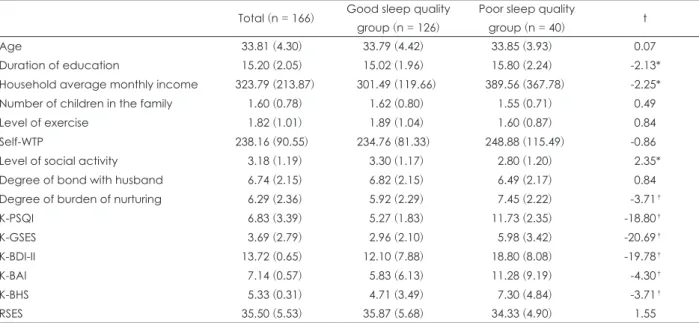
Of a total of 180 participants, 166 were eligible for enroll- ment and analysis. The mean (SD) age and duration of edu- cation was 33.81 (4.30) years and 15.20 (2.05) years, respec- tively. The average household monthly income was 323.79 (213.87) (unit : 10
4KRW) with relatively broad range. In the mean of Self-WTP as maximum monthly monetary compen- sation, 238.16 (unit : 10
4KRW), which was nearly 1.8 times minimum monthly wage for 2017. Also, in the degree of bur- den of nurturing, 6.29 (2.36) in the VAS score manifested relatively negative result. The other sociodemographic char- acteristics and the general mental health status of all partic- ipants are shown in Table 1.
2. Comparisons between good and poor sleep quality groups
To identify variables that may significantly affect the sleep
disturbance or sleep quality, a total of 166 participants were
divided into two groups of good and poor sleep quality based
on the total score on K-PSQI (Sleep quality cut-off point on
K-PSQI : ≤ 8 for good ; ≥ 9 for poor). As a result, 24.1% of
those analyzed were found to belong to poor sleep quality
group. Table 1 shows the results of between-group compara-
tive analyses on sociodemographic items and each mental
health status, in which independent student t-test was con-
ducted to examine the significant difference. Significant dif-
ferences were manifested on each scale reflecting mental
health status (K-PSQI, p < 0.001 ; K-GSES, p < 0.001 ; K-BDI-
II, p < 0.001 ; K-BAI, p < 0.001 ; K-BHS, p = 0.001). Signifi-
cant differences were also shown in the level of social activi-
38
ty (t = 2.35, p = 0.020), duration of education (t = -2.13, p = 0.035), household average monthly income (t = -2.25, p = 0.026), and degree of burden of nurturing (t = -3.71, p <
0.001). However, there were no significant differences in age, number of children in the family, level of exercise, degree of bond with husband, Self-WTP, and RSES (p > 0.05). Also, the differences between the two groups in the distribution of
the severity of mental health status are shown in Figure 2.
3. Association between main variables
1) Mediation models
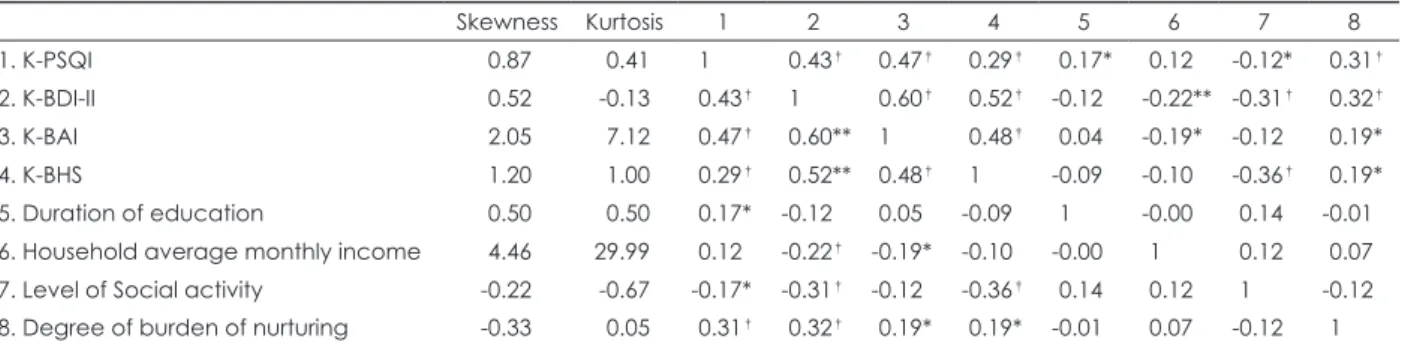
Prior to the mediation analysis, skewness, kurtosis, and Pearson bivariate correlations among variables were analyzed
Table 1. Comparisons between good and poor sleep quality group in sociodemographic characteristics and mental health indicators Total (n = 166) Good sleep quality
group (n = 126)
Poor sleep quality
group (n = 40) t
Age 33.81 (4.30) 33.79 (4.42) 33.85 (3.93) 0.07
Duration of education 15.20 (2.05) 15.02 (1.96) 15.80 (2.24) -2.13*
Household average monthly income 323.79 (213.87) 301.49 (119.66) 389.56 (367.78) -2.25*
Number of children in the family 1.60 (0.78) 1.62 (0.80) 1.55 (0.71) 0.49
Level of exercise 1.82 (1.01) 1.89 (1.04) 1.60 (0.87) 0.84
Self-WTP 238.16 (90.55) 234.76 (81.33) 248.88 (115.49) -0.86
Level of social activity 3.18 (1.19) 3.30 (1.17) 2.80 (1.20) 2.35*
Degree of bond with husband 6.74 (2.15) 6.82 (2.15) 6.49 (2.17) 0.84
Degree of burden of nurturing 6.29 (2.36) 5.92 (2.29) 7.45 (2.22) -3.71†
K-PSQI 6.83 (3.39) 5.27 (1.83) 11.73 (2.35) -18.80†
K-GSES 3.69 (2.79) 2.96 (2.10) 5.98 (3.42) -20.69†
K-BDI-II 13.72 (0.65) 12.10 (7.88) 18.80 (8.08) -19.78†
K-BAI 7.14 (0.57) 5.83 (6.13) 11.28 (9.19) -4.30†
K-BHS 5.33 (0.31) 4.71 (3.49) 7.30 (4.84) -3.71†
RSES 35.50 (5.53) 35.87 (5.68) 34.33 (4.90) 1.55
* : Indicates p < 0.05, † : Indicates p < 0.01. K-BAI : Korean version of Beck Anxiety Inventory, K-BDI-II : Korean versions of Beck De- pression Inventory-II, K-BHS : Korean version of Beck Hopelessness Scale, K-GSES : Korean version of Glasgow Sleep Effort Scale, K- PSQI : Korean version of Pittsburg Sleep Quality Index, RSES : Rosenberg Self-Esteem Scale, Self-WTP : Self-Willingness-to-pay (maxi- mum monetary valuation of household service work of individual full-time homemaker)
100 90 80 70 60 50 40 30 20 10 0
K-BDI-II K-BAI K-BHS K-BDI-II K-BAI K-BHS
Good sleep quality group Poor sleep quality group
The severity
(%
)
*
*
*
Severe Moderate Mild Normal
Figure 2. Between-group differenc- es in the distribution of the severity on each scale of depression (K-BDI- II), anxiety (K-BAI), and hopeless- ness (K-BHS). The histograms in the figure show that as well as the nor- mal level, all the severity levels on each scale were appearing in each group. The proportion of all severity levels was higher in poor sleep quality group than in good sleep quality group. The significant differences were manifested on K- BDI-II scale for depression level and on K-BAI scale for anxiety lev- el. * : Indicates p < 0.01. K-BAI : Korean version of Beck Anxiety In- ventory, K-BHS : Korean version of Beck Hopelessness Scale, K-BDI-II : Korean versions of Beck Depres- sion Inventory-II.
39 to examine the assumption of normal distribution and an
overall tendency of the data (Table 2). Based on the criteria of normal distribution by Curran et al., (Curran et al. 1996) the scores on the K-BAI and household average monthly in- come showed excessively high value of skewness and kur- tosis (i.e., higher than 2 and 7, respectively). These variables were considered not to meet the assumption of normality, and the extreme values (i.e., higher than 2SD) were elimi- nated and Expectation Maximization (EM) algorithm was conducted to manage missing data, accordingly. As a result, total 164 participants were included for the final analysis (127 in good sleep quality group ; 37 in poor sleep quality group).
To determine whether the effects of the burden of nurtur- ing in full-time female homemakers on the sleep distur- bance were mediated by depression, the four-step procedure to set up mediation effect was followed (Baron and Kenny 1986). The first step (model 1) showed that the burden of nurturing significantly predicted poor quality of sleep (i.e., higher total score on the K-PSQI), and the second step (mod- el 2) suggested that degree of burden of nurturing significant- ly predicted increased depression. In the next step to exam- ine the effect of moderate variable on dependent variable with the effect of the independent variable controlled (mod- el 3), both the burden of nurturing and the score on K-BDI- II for depression significantly manifested positive predic- tion on poor sleep quality. The multiple effect size estimates are shown in Table 3. At last, the bootstrap method showed
that the indirect effect from the burden of nurturing to poor sleep quality via depression was also significant [point esti- mate = 0.0006 ; S.E. = 0.0004 ; 95% CIs (-0.0015, -0.0001)], indicating that depression mediates the negative association between the burden of nurturing and sleep disturbance.
2) Moderated mediation
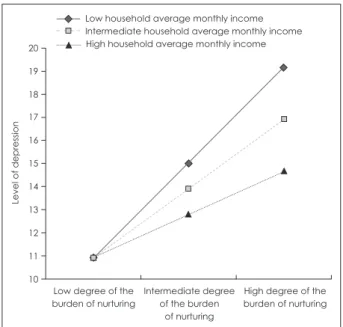
Subsequently, moderated mediation was tested using a bootstrapping procedure following model 7, in which mod- eration of the path between the independent variable and mediator was evaluated (Hayes 2017). Whether or not the association between the burden of nurturing and depression is moderated by household average monthly income within the mediational path models was examined. The result showed that household average monthly income moderates the indirect effect of the burden of nurturing on sleep distur- bance through depression [point estimate = -0.0006, S.E. = 0.0004, 95% CIs (-0.0015, -0.0001)], indicating that depres- sion has a higher indirect effect when household average monthly income is low than when it is high. Furthermore, the conditional indirect effect of the burden of nurturing on sleep disturbance via depression at the three levels of house- hold average monthly income was investigated : low level be- low 1-SD of the mean, intermediate level around the mean, and high level above 1-SD of the mean. The results in Figure 3 shows that the conditional indirect effect was significant at the low [point estimate = 0.2866, S.E. = 0.0841, 95% CIs (0.14, 0.47)], the intermediate [point estimate = 0.2250, S.E. =
Table 2. Skewness, kurtosis, and correlations between main variables
Skewness Kurtosis 1 2 3 4 5 6 7 8
1. K-PSQI 0.87 0.41 1 0.43† 0.47† 0.29† 0.17* 0.12 -0.12* 0.31†
2. K-BDI-II 0.52 -0.13 0.43† 1 0.60† 0.52† -0.12 -0.22** -0.31† 0.32†
3. K-BAI 2.05 7.12 0.47† 0.60** 1 0.48† 0.04 -0.19* -0.12 0.19*
4. K-BHS 1.20 1.00 0.29† 0.52** 0.48† 1 -0.09 -0.10 -0.36† 0.19*
5. Duration of education 0.50 0.50 0.17* -0.12 0.05 -0.09 1 -0.00 0.14 -0.01
6. Household average monthly income 4.46 29.99 0.12 -0.22† -0.19* -0.10 -0.00 1 0.12 0.07 7. Level of Social activity -0.22 -0.67 -0.17* -0.31† -0.12 -0.36† 0.14 0.12 1 -0.12 8. Degree of burden of nurturing -0.33 0.05 0.31† 0.32† 0.19* 0.19* -0.01 0.07 -0.12 1
* : Indicates p < 0.05, † : Indicates p < 0.01. K-BAI : Korean version of Beck Anxiety Inventory, K-BDI-II : Korean versions of Beck Depression Inventory-II, K-BHS : Korean version of Beck Hopelessness Scale, K-PSQI : Korean version of Pittsburg Sleep Quality Index Table 3. Verification of the mediation effect of depression on sleep disturbance
Model IV DV
Non-standardized coefficient
Standardized
coefficient t R2
B S.E. β
Stage 1 (IV→MV) Burden of nurturing Depression 1.228 0.262 0.346 4.694* 0.120
Stage 2 (IV→DV) Burden of nurturing Sleep disturbance 0.094 0.020 0.348 4.731* 0.121 Stage 3 (IV, MV→DV) Burden of nurturing Sleep disturbance 0.064 0.020 0.237 3.180* 0.213
Depression 0.025 0.006 0.322 4.321*
* : Indicates p < 0.01. DV : dependent variable, IV : independent variable, MV : moderation variable
40
0.0629, 95% CIs (0.11, 0.36)], and the high level [point esti- mate = 0.1635, S.E. = 0.0594, 95% CIs (-0.05, 0.28)] of house- hold average monthly income. These findings manifested statistically significant moderated mediation effects, impli- cating that within the mediation model, the positive associa- tion of the burden of nurturing and depression was stronger in the lower level of household average monthly income than in the higher level of household average monthly income.
Discussion
The present study investigated the status of sleep quality as a representative indicator of the well-being of life and the mental health in community-dwelling full-time female home- makers, and aimed at verifying, through the mediation mod- el, the relationship between the main relevant factors that af- fect sleep quality.
The findings of this cross-sectional study showed that 24.1%
of participants were in a state of poor sleep quality over the past month, suggesting that sleep disturbance may be rela- tively prevalent in full-time female homemakers. Also, it is noteworthy that although the total score on K-PSQI higher than 8 points was regarded as poor sleep quality in this study as proposed in the previous study conducted by Sohn and colleagues (Sohn et al. 2012), more than 70% of the total sample (n = 121) would have been classified as poor sleep quality group with the cut-off score, i.e., higher than 5 points,
of original version of PSQI used (Buysse et al. 1989). Thus, considering that this study targeted a specific group of rela- tively young women in a stressful situation, it would be im- plicated that full-time female homemakers are a group vul- nerable to sleep disturbance and mental health problems.
Meanwhile, according to the results of the survey on men- tal health indicators, i.e., depression, anxiety, and hopeless- ness, the rates of participants with complaints of mental health problems were generally high, showing about 45% on depression (K-BDI-II ≥ 14), near 40% on anxiety (K-BAI ≥ 8), and about 60% on hopelessness (K-BHS ≥ 4), respec- tively. Furthermore, the comparative analyses between the poor and the good sleep quality groups manifested signifi- cant differences in the distribution of the scores on each scale, indicating close clinical relationships between mental health problem and sleep problem in full-time female home- makers. In particular, the difference between the two groups was more pronounced on the scale of depression, implicat- ing the closer relationship of depression among the mental health indicators with the sleep quality, which is consistent with the findings in the previous studies reporting the strong interaction between sleep disturbance and depression (Al- Abri 2015 ; Ford and Kamerow 1989 ; Gillin 1998 ; Kahn et al. 2013 ; Tsuno et al. 2005). Accordingly, in the perspective of the role of a psychological factor, the impact of depression as the main mental health indicator on sleep quality was further verified in the mediation model.
On the other hand, no significant between-group differ- ences were manifested on Self-WTP and RSES as a direct or indirect indicator of self-esteem, which suggest on a cross- sectional basis that the professional identity as a full-time homemaker may remain stable and the perceived role of a full-time homemaker itself may not be a factor negatively af- fecting the quality of sleep. It would be necessary, however, to further study the impact of prolonged exposure to the role as a full-time homemaker in stressful situations on self-esteem.
Besides the impact of mental health indicators as a psy- chological factor, between-group analyses showed the signif- icant relationship of poor sleep quality with several sociode- mographic and environmental factors, such as duration of education, household average monthly income, level of so- cial activity and the burden of nurturing. Unlike in the gen- eral population (Patel et al. 2010), however, high household average monthly income and long duration of education in full-time female homemakers were found to be inversely re- lated to sleep quality. These results in this study seem suffi- ciently plausible, in that for women with high level of income and educational background, working as a full-time home- maker could be a psychological distress because of high op-
20 19 18 17 16 15 14 13 12 11
10 Low degree of the burden of nurturing
High degree of the burden of nurturing Intermediate degree
of the burden of nurturing Low household average monthly income Intermediate household average monthly income High household average monthly income
Level of depression
Figure 3. The association between the burden of nurturing and depression by the level of household average monthly income.
The positive association of the burden of nurturing and depres- sion was stronger among lower level of household average monthly income than among higher level. Low, intermediate and high household average monthly income indicates 2 mil- lion, 3 million, 4 million in KRW, respectively.
41 portunity costs (Raymo et al. 2015). It is suggested, also, that
among these factors, the burden of nurturing may be more closely related to poor sleep quality, as generally accepted and reported as a main psychological distress in women (Bird 1997). According, the burden of nurturing as a basic activity and the household average monthly income as an important environmental factor were further verified in the mediation model.
According to the results of the verification of the media- tion model which was composed of the burden of nurturing, household average monthly income, depression, and sleep quality as presented in Figure 1, it was significantly manifest- ed that depression would mediate the association between the burden of nurturing and sleep disturbance in full-time female homemakers, supporting the hypothetical explana- tion that the increased burden of nurturing may positively affect the level of depression and then the elevated level of de- pression may exacerbate the quality of sleep in full-time fe- male homemakers. In this process, also, the moderating ef- fect of household average monthly income has been proven significant, indicating that the aggravation of depression would be more pronounced in the lower level of household average monthly income. Overall, each psychological and socio-environmental factor, and the interaction between both factors through the moderating and mediating process might play an important role in the determination of sleep quality of individual full-time female homemaker.
The results of these above-mentioned verifications have several health policy implications relating to public health intervention to improve the quality of sleep in full-time fe- male homemakers ; reduction of the burden of nurturing , increase in household income or adequate national compen- sation for unpaid household service work, early detection of depression, and direct treatment support for sleep problem in full-time female homemakers, for which a comprehensive and integrated approach in the field of community mental health services may be necessary with the legal and institu- tional readjustment and enforcement (Swiebel 1999).
This study has several limitations. First, it is necessary to consider that the score on VAS for the degree of the burden of nurturing without standardized objective assessment was used in this study. The burden of nurturing is a result of var- ious and complex factors (e.g., caregiver’s attitude towards parenting, characteristic and temperament of the child, exis- tence of assistant caregivers), therefore future studies should consider using validated measures such as Parental Stress Scale (Berry and Jones 1995) to control and manage such factors. Also, other factors such as duration of the sleep and socio-environmental stress factors could be a confounding
variable affecting sleep disturbance among homemakers, therefore should be included in the future study. Second, there may be some selection bias of the sample, because women aged 19 to 50 living in urban settings and using specific online websites were recruited in this study. The representativeness of samples in this study would be acceptable, however, con- sidering that women account for about 75% of unpaid house- hold service works ; women in their 30s are the most com- mon at near 30% and women under the age of 50 account for about 60% of unpaid household service works ; the propor- tion of urban population is more than 90% (Korea Statistical Information Service 2019). Third, the cross-sectional study design and statistical verification method through the me- diation model in this study may have relatively limited as- pects to the solid establishment of the causal relationship be- tween variables, although it is possible to evaluate the health status of a specific group quickly and efficiently. Thus, fur- ther study with the prospective design based on the cohort of full-time female homemakers may be necessary to replicate and extend the findings in this study. Finally, in this study, the assessment of sleep quality was performed using the val- idated and standardized scale (K-PSQI) based on subjective recollection instead of objective evaluation using a polysom- nography. Although subjective sleep quality may have a me- diating effect on negative emotional response (Grove et al.
2020), however, experience sampling methodology (ESM) or ecological momentary assessment (EMA) could be alter- natively recommended for more objective and real-time data collection in the future study (Trull and Ebner-Priemer 2009).
R
EFERENCESAl-Abri MA. Sleep deprivation and depression: a bi-directional as- sociation. Sultan Qaboos Univ Med J 2015;15:e4.
Alvaro PK, Roberts RM, Harris JK. A systematic review assessing bidirectionality between sleep disturbances, anxiety, and de- pression. Sleep 2013;36:1059-1068.
Arber S, Bote M, Meadows R. Gender and socio-economic pattern- ing of self-reported sleep problems in Britain. Soc Sci Med 2009;
68:281-289.
American Psychiatric Association. Diagnostic and Statistical Manual of mental disorders (DSM-5®), American Psychiatric Pub;2013 Augustin M, Blome C, Forschner A, Gutzmer R, Hauschild A,
Heinzerling L, et al. Willingness to pay for a cure of low-risk melanoma patients in Germany. PloS One 2018;13:e0197780.
Bae HN, Choi SW, Yu JC, Lee JS. Reliability and validity of the Korean version of the Rosenberg Self-esteem Scale (K-RSES) in adult. Mood Emot 2014;12:43-49.
Bala MV, Mauskopf JA, Wood LL. Willingness to pay as a mea- sure of health benefits. Pharmacoeconomics 1999;15:9-18.
Baron RM, Kenny DA. The moderator–mediator variable distinc- tion in social psychological research: conceptual, strategic, and statistical considerations. J Pers Soc Psychol 1986;51:1173.
Basner M, Fomberstein KM, Razavi FM, Banks S, William JH, Rosa
42
RR, et al. American time use survey: sleep time and its relation- ship to waking activities. Sleep 2007;30:1085-1095.
Beck AT, Steer RA. Manual for the beck anxiety inventory. San Antonio, TX: Psychological Corporation;1990
Beck AT, Steer RA, Brown GK. Beck Depression Inventory-II. San Antonio 1996;78:490-498.
Beck AT, Steer RA, Pompili M. BHS, Beck Hopelessness Scale:
Manual, Psychological corporation San Antonio, TX;1988 Berry JO, Jones WH. The Parental Stress Scale: initial psychometric
evidence. J Soc Pers Relat 1995;12:463-472.
Bird CE. Gender differences in the social and economic burdens of parenting and psychological distress. J Marriage Fam 1997:809- Blümel JE, Cano A, Mezones-Holguín E, Barón G, Bencosme A, 823.
Benítez Z, et al. A multinational study of sleep disorders dur- ing female mid-life. Maturitas 2012;72:359-366.
Bobinac A, Van Exel N, Rutten FF, Brouwer WB. Willingness to pay for a quality-adjusted life-year: The individual perspective.
Value in Health 2010;13:1046-1055.
Broomfield NM, Espie CA. Towards a valid, reliable measure of sleep effort. J Sleep Res 2005;14:401-407.
Buysse DJ, Reynolds CF, Monk TH, Berman SR, Kupfer DJ. The Pittsburgh Sleep Quality Index: a new instrument for psychiat- ric practice and research. Psychiatry Res 1989;28:193-213.
Cerolini S, Ballesio A, Lombardo C. Emotional experience, pres- ence and severity of insomnia and depressive symptoms: an ecological study of their effects on sleep quality. Ment Health Fam Med 2016;12:282-287.
Chang I, Woo H. Difference in housework hours between married women and men and their influence factors. Women Stud 2017;
95:41-72.
Chen YY, Kawachi I, Subramanian S, Acevedo-Garcia D, Lee YJ.
Can social factors explain sex differences in insomnia? Find- ings from a national survey in taiwan. J Epidemiol Community Health 2005;59:488-494.
Curran PJ, West SG, Finch JF. The robustness of test statistics to nonnormality and specification error in confirmatory factor analysis. Psychol Methods 1996;1:16.
Daltio CS, Attux C, Ferraz MB. Willingness to pay in caregivers of patients affected by schizophrenia. J Mental Health Policy Econ 2017;20:3-10.
Erdfelder E, Faul F, Buchner A. Gpower: a general power analysis program. Behav Res Methods Instrum Comput 1996;28:1-11.
Ford DE, Kamerow DB. Epidemiologic study of sleep disturbances and psychiatric disorders: an opportunity for prevention? JAMA 1989;262:1479-1484.
Gellis LA, Lichstein KL, Scarinci IC, Durrence HH, Taylor DJ, Bush AJ, et al. Socioeconomic status and insomnia. J Abnorm Psy- chol 2005;114:111.
Gillin J. Are sleep disturbances risk factors for anxiety, depressive and addictive disorders? Acta Psychiatr Scand 1998;98:39-43.
Goldsmith RE. Dimensionality of the Rosenberg Self-Esteem Scale.
J Soc Behav Pers 1986;1:253.
Grandner MA, Patel NP, Gehrman PR, Xie D, Sha D, Weaver T, et al. Who gets the best sleep? Ethnic and socioeconomic factors related to sleep complaints. Sleep Med 2010;11:470-478.
Grove JL, Smith TW, Carlson SE, Bryan CJ, Crowell SE, Cza- jkowski L, et al. Prospective association between suicide cog-
nitions and emotional responses to a laboratory stressor: the mediating role of nightly subjective sleep quality. J Affect Dis- ord 2020;265:77-84.
Hayes AF. Introduction to mediation, moderation, and conditional process analysis: a regression-based approach, Guilford publi- cations;2017.
Kahn M, Sheppes G, Sadeh A. Sleep and emotions: bidirectional links and underlying mechanisms. Int J Psychophysiol 2013;89:
218-228.
Karacan I, Thornby JI, Anch M, Holzer CE, Warheit GJ, Schwab JJ, et al. Prevalence of sleep disturbance in a primarily urban Florida County. Soc Sci Med 1976;10:239-244.
Kim S, Lee EH, Hwang ST, Hong SH, Lee K, Kim JH. Reliability and validity of the Korean version of the Beck Hopelessness Scale. J Korean Neuropsychiatr Assoc 2015;54:84-90.
Lim SY, Lee EJ, Jeong SW, Kim HC, Jeong CH, Jeon TY, et al. The validation study of Beck Depression Sacale 2 in Korean ver- sion. Anxiety and Mood 2011;7:48-53.
Kim MK, Kwon JH, Koo HJ, Han JK. Validation of Korean version of glasgow sleep effort scale (GSES). Cogn Behav Ther Kor 2014;14:319-337.
Morphy H, Dunn KM, Lewis M, Boardman HF, Croft PR. Epide- miology of insomnia: a longitudinal study in a uk population.
Sleep 2007;30:274-280.
Palagini L, Baglioni C, Ciapparelli A, Gemignani A, Riemann D.
REM sleep dysregulation in depression: state of the art. Sleep Med Rev 2013;17:377-390.
Papadimitriou GN, Linkowski P. Sleep disturbance in anxiety disor- ders. Int Rev Psychiatry 2005;17:229-236.
Patel NP, Grandner MA, Xie D, Branas CC, Gooneratne N. “Sleep disparity” in the population: poor sleep quality is strongly as- sociated with poverty and ethnicity. BMC Public Health 2010;
10:475.
Raymo JM, Musick K, Iwasawa M. Gender equity, opportunity costs of parenthood, and educational differences in unintended first births: insights from japan. Popul Res Policy Rev 2015;34:
179-199.
Moon SJ. The benefit and cost of full-time housewife occupation.
Fam Environ Res 1994;32:15-28.
Sohn SI, Kim DH, Lee MY, Cho YW. The reliability and validity of the Korean version of the Pittsburgh Sleep Quality Index.
Sleep Breath 2012;16:803-812.
Swiebel J. Unpaid work and policy-making: towards a broader per- spective of work and employment, United Nations, Department of Economic and Social Affairs;1999.
Trull TJ, Ebner-Priemer UW. Using experience sampling methods/
ecological momentary assessment (ESM/EMA) in clinical as- sessment and clinical research: introduction to the special sec- tion;2009.
Tsuno N, Besset A, Ritchie K. Sleep and depression. J Clin Psychi- atry 2005;66:1254-1269.
Weyerer S, Dilling H. Prevalence and treatment of insomnia in the community: results from the upper bavarian field study. Sleep 1991;14:392-398.
Yook S, Kim Z. A clinical study on the Korean version of Beck Anxiety Inventory: comparative study of patient and non-pa- tient. Korean J Clin Psychol 1997;16:185-197.