보관 온도 및 기간에 따른 청심연자음 전탕액의 지표성분과 약리 활성 변화에 관한 연구
유새롬
#
, 하혜경, 이나리, 신현규, 서창섭*
한국한의학연구원 K-herb연구단
A Study on Change of Marker Compounds and Biological Activity in
Chungsimyeonja-eum Decoction Depending on A Storage Temperature and Periods
Sae-Rom Yoo # , Hyekyung Ha, Nari Lee, Hyeun-Kyoo Shin, Chang-Seob Seo *
K-herb Research Center, Korea Institute of Oriental Medicine, Daejeon 34054, Republic of Korea
ABSTRACT
Objectives : Chungsimyeonja-eum (CSYJE; Qingxinlianzi-yin in Chinese; Seishinrenshi-in in Japanese), a traditional herbal medicine, has been used for treating mouth dryness, hyperuresis. This study was designed to determine preservation period of CSYJE. We investigated the stability and biological activity of CSYJE depending on the preservation temperature and periods.
Methods : CSYJE decoction was preserved for 0-6 or 12 months at room temperature (RT, 23±1℃) or refrigeration (4℃). To evaluate the stability of CSYJE decoction, pH and dissolved solids content were measured. High-performance liquid chromatography (HPLC) analysis was performed to determine marker compounds―liquiritin apioside, liquiritin, baicalin, wogonoside, and glycyrrhizin―in CSYJE. To determine anti-inflammatory effect of CSYJE, prostaglandin E
2(PGE
2) was measured in LPS-stimulated RAW 264.7 macrophages.
Results : Both at RT and 4℃, pH was decreased depending on the preservation periods. There was no changes in dissolved solids content depending on the preservation temperature and periods. Both at RT and 4℃, the contents of liquiritin apioside and liquiritin were slightly increased at 1 month of storage. The level of baicalin was decreased time-dependently and the disappearance rate at RT is larger than at 4℃. CSYJE inhibited PGE
2production in LPS- stimulated RAW 264.7 cells and maintained inhibitory effect by 12 months both at RT and 4℃.
Conclusions : Based on the disappearance rate of the baicalin in CSYJE, the preservation period is recommended within 8 months for RT and 12 months for 4℃.
1)
Key words : Chungsimyeonja-eum, HPLC, anti-inflammation, storage, temperature
Ⅰ. 서 론
한방의료 시장은 해마다 증가 추세를 보이며, 한방의 약제비 및 외래 투약 일수 또한 상승세를 보이고 있다
1). 한약은 여러 가지 약재를 혼합해 수용성 용매로 추출한 탕제가 가장 많이 사용된다. 일반적으로 탕제는 고온에서 레토르트 파우치에 포장
되어 공급되며, 포장재로부터 탕제로 이행된 phthalate 9종의 양은 극미량이었고 중금속은 검출되지 않아 안전성에는 문제가 없는 것으로 확인되었다
2). 의료기관에서는 이렇게 제조된 탕 제를 실온이나 저온에서 보관하고 단기간에 복용할 것을 권장 하고 있다. 그러나 정확한 보관 온도나 기간에 대한 기준은
*Corresponding author : Chang-Seob Seo, K-herb Research Center, Korea Institute of Oriental Medicine.
·Tel : +82-42-868-9361 ·Fax : +82-42-864-2120 ·E-mail : [email protected]
#First author : Sae-Rom Yoo, K-herb Research Center, Korea Institute of Oriental Medicine.
·Tel : +82-42-868-9632 ·Fax : +82-42-864-2120 ·E-mail : [email protected] ·Received : 10 April 2017 ·Revised : 16 May 2017 ·Accepted : 15 July 2017
없는 상태이고, 안정성이 낮은 화합물을 포함하는 경우, 보관 방법이나 시간에 따라 약효가 변할 수 있어 그에 대한 연구가 필요하다.
청심연자음(淸心蓮子飮, Chungsimyeonja-eum, Qingxinlianzi-yin, Seishinrenshi-in)은 송대 태평혜민화 제국방(太平惠民和劑局方)에 처음 기재된 처방으로 총 9종의 한약-연자, 적복령, 인삼, 황기, 황금, 차전자, 맥문동, 지골피, 감초-으로 구성되어 있다. 이 처방은 격소(膈消)로 인해 나타 나는 구건번갈 (口乾煩渴)이나 심화상염 (心火上炎), 소변임삽 (小便淋澁) 등에 폭넓게 사용됐으며, 전임상 및 임상 연구에 서도 내당능 장애
3)에 효과가 있는 것으로 보고되었다. 본 연 구에서는 청심연자음 전탕액의 보관 기간 및 온도 변화에 따른 지표 성분 함량을 측정하고 약리 활성을 평가하여 전탕액의 보관 기간을 설정하고자 하였다.
Ⅱ. 재료 및 방법
1. 시약 및 기기
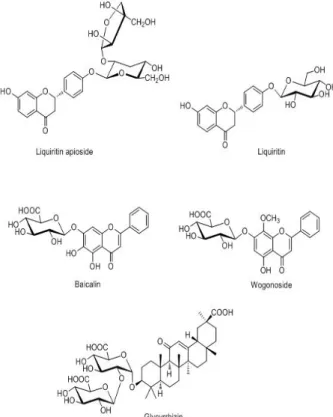
Liquiritin, baicalin 및 glycyrrhizin은 Wako Pure Chemical (Osaka, Japan)에서 구입하였으며, liquiritin apioside와 wogonoside는 Shanghai Sunny Biotech (Shanghai, China)와 Biopurify Phytochemicals (Chengdu, China)에서 순도 98.0% 이상의 표준품을 구입하여 사용하였다 (Fig. 1). 표준품과 시료의 용해 및 HPLC 분석을 위한 distilled water, acetonitrile 및 methanol은 HPLC급으로 J.T. Baker (Phillipsburg, NJ, USA)로부터 구입하였으며, formic acid는 Merck KGaA (Darmastadt, Germany)에서 특급시약을 구입하였다. 청심연자음 전탕액 중 주요 성분의 함량분석을 위해 사용된 고성능 액체 크로마토그래피 (high-performance liquid chromatography, HPLC)는 solvent delivery unit (LC-20AT), online degasser (DGU-20A3), column oven (CTO-20A), auto sample injector (SIL-20AC) 및 photodiode array (PDA) detector (SPD-M20A)로 구성된 Shimadzu Prominence LC-20A series (Kyoto, Japan)를 사용하였으며, 측정된 데이터는 LCSolution software (version 1.24, SP1)를 이용하여 분석 하였다. 가용성 고형분의 함량은 Atago사의 Pal-α 디지털굴 절계 (Tokyo, Japan), pH는 Metrohm사의 692 pH/Ion meter (Herisau, Switzerland), 전탕액 제조는 경서기계산 업의 초고속 진공 저온 농축 추출기(Cosmos 660, Incheon, Korea) 및 포장은 자유 조절 롤 포장기 (MH 205 Tower, Kyungseo machine, Korea)를 사용하였다. 사용된 레토르트 파우치의 포장재 외층은 폴리에틸렌, 내층은 폴리프로필렌 재 질로 이루어져 있다. Fetal bovine serum (FBS), Dulbecco's modified Eagle's medium (DMEM), penicillin-streptomycin
(P/S)은 Gibco BRL (Carlsbad, CA, USA)에서 구입하여 세포 배양에 사용하였다. 세포 독성을 측정하기 위해 사용 된 cell counting kit (CCK)-8은 Dojindo (Kumamoto, Japan)에서 구입하였다.
Figure 1. Chemical Structure of the Five Marker Compounds in Chungsimyeonja-eum
2. 추출물 조제 및 보관
청심연자음을 구성하는 9종의 원료 한약은 광명당제약
(Ulsan, Korea)에서 규격품을 구입하였으며, 각 구성 한약의
표본 (2012-KE43-1 ∼ KE43-9)은 한국한의학연구원 K-herb
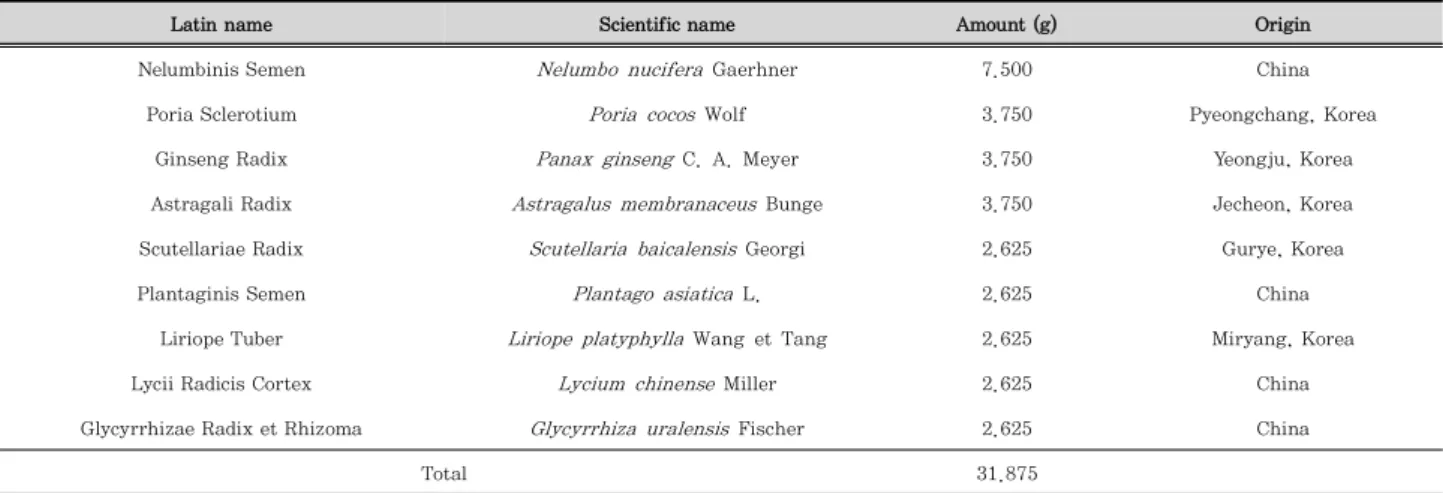
연구단에 보관하였다. 9종의 한약을 Table 1과 같이 배합 (약
3000 g; 31.875 g × 94.1)하여 약 10배수의 물을 넣어 초
고속 진공 저온 농축 추출기를 이용하여 추출하였다. 추출액은
표준체 (No. 270 53 ㎛, Chung Gye Sang Gong Sa, Seoul,
Korea)를 이용하여 여과 후 포장하였다. 위와 같은 방법으로
조제된 각각 3개의 lot 별 전탕팩을 상온 (23±1℃)과 냉장
(4℃)에 각각 보관하면서 pH, 가용성 고형분 및 성분분석 실
험에 사용하였다. 항염증 활성 평가를 위하여 각 해당 기간에
실온 및 냉장 보관된 파우치를 개봉하여 동결건조 후 분말화
했다. 이를 PBS에 100 ㎎/㎖의 농도로 용해시킨 후 0.2 ㎛
syringe filter (ADVANTEC, Toyo Roshi Kaisha, Japan)를
이용하여 여과 후 실험에 사용하였다. 청심연자음 추출 분말의
수득율은 19.4% 였다.
Latin name Scientific name Amount (g) Origin
Nelumbinis Semen Nelumbo nucifera Gaerhner 7.500 China
Poria Sclerotium Poria cocos Wolf 3.750 Pyeongchang, Korea
Ginseng Radix Panax ginseng C. A. Meyer 3.750 Yeongju, Korea
Astragali Radix Astragalus membranaceus Bunge 3.750 Jecheon, Korea
Scutellariae Radix Scutellaria baicalensis Georgi 2.625 Gurye, Korea
Plantaginis Semen Plantago asiatica L. 2.625 China
Liriope Tuber Liriope platyphylla Wang et Tang 2.625 Miryang, Korea
Lycii Radicis Cortex Lycium chinense Miller 2.625 China
Glycyrrhizae Radix et Rhizoma Glycyrrhiza uralensis Fischer 2.625 China
Total 31.875
Table 1.Composition of Chungsimyeonja-eum
3. pH 및 가용성 고형분 측정
조제된 청심연자음 전탕팩을 상온과 냉장에서 보관하면서 기간에 따라 pH (accumet AB150, Fisher Scientific, Pittsburgh, PA,USA)와 가용성 고형분(Refractometer PAL-α, ATAGO Co., LTD, Japan)의 함량을 측정하였다.
4. HPLC 분석
HPLC-PDA를 사용하여 청심연자음 중 주요 성분인 liquiritin apioside, liquiritin, baicalin, wogonoside 및 glycyrrhizin 등 5종에 대하여 보관방법 및 기간에 따라 함량 분석을 실시하고 비교하였다. 주요 성분의 분리는 Waters의 SunFire C18 칼럼 (250 × 4.6 ㎜, 5 ㎛, Milford, MA, USA)을 이용하여 분리하였으며, 칼럼은 40℃로 유지하였다. 다음과 같은 기울기 용매 조건으로 흘려주었다; 10-60% B (0-30분), 60-100% B (30-40분), 100% B (40-45분), 100-10% B (45-50분) 및 10% B (50-60분). 유속은 분당 1.0 ㎖의 속 도로 흘려주었으며 주입량은 10 ㎕였다. 함량분석을 위해 조 제된 전탕액 2.5 ㎖을 정확히 취하여 물을 이용하여 10 ㎖로 한 후 HPLC 측정 전에 0.2 ㎛ syringe filter (PALL Life Sciences, Ann Arbor, MI, USA)로 여과 한 후 측정하였다.
5. RAW 264.7 세포에서의 PGE 2 분비량 측정
1) 세포 배양마우스 유래 RAW264.7 세포주는 American Type Culture Collection (Rockville, MD, USA)에서 분양받아 사 용하였다. 세포는 5.5% FBS 및 1% P/S를 첨가한 DMEM 배 지를 사용하여 37℃, 5% CO
2조건에서 배양하였다.
2) 세포 독성 평가
96 well plate에 3×10
3cell/well씩 분주하여 18시간 동안 배양한 후, 청심연자음 추출물을 농도별로 처리하여 24시간 동안 배양하였다. 배양 후 CCK-8 용액을 처리하고, 450 ㎚
에서 흡광도(microplate reader Benchmark Plus, Bio-Rad.
MN, USA)를 측정하였다. 세포 생존율은 아래 식에 의해 계 산해 그 값을 산출하였다.
세포 생존율 (%)
= (측정값 비교군의 평균) / (측정값 대조군의 평균) × 100
3) RAW 264.7 세포에서의 PGE
2
분비량 측정48 well plate에 2.5×10
5cell/well씩 분주하여 18시간 동안 배양한 후, LPS (1 ㎍/㎖)를 처리하기 전 청심연자음 추 출물을 농도별로 4시간 전 처리하였다. 배양 20시간 후, 상등 액을 수거해 세포에서 분비된 prostaglandin E
2(PGE
2) 양을 마우스 enzyme-linked immunosorbent assay (ELISA) kit를 이용해 제조사의 방법에 따라 측정하였다.
6. 통계 처리
모든 데이터는 평균±표준오차로 표시하였다. SYSTAT 13.0 (Systat Software Inc. Chicago, USA)을 이용하여 일 원배치 분산분석으로 그룹간의 유의성을 검정하였으며, 사후 검정은 Bonferroni 검정법을 적용하여 P-value가 0.05 미만 일 경우 유의한 것으로 판정하였다.
Ⅲ. 결 과
1. pH 및 가용성 고형분 함량 측정
청심연자음의 최초 pH는 5.53으로 나타났으며, 보관방법
및 기간에 따른 pH를 측정한 결과 상온에서는 5.53-5.09,
냉장에서는 5.60-5.31로 보관 기간이 길어질수록 pH는 낮
아지는 것으로 나타났다 (Table 2). 가용성 고형분의 함량은
최초 3.60 브릭스로 측정되었으며, 상온 및 냉장에서 보관 기
간에 따라 3.0-3.3 브릭스로 최초 측정치와 비교하여 감소하
였으나 보관 온도에 따른 차이는 없는 것으로 나타났다
(Table 2).
Factor Storage method
Period (month)
0 1 2 3 4 5 6 12
pH
Room temperature 5.53±0.003 5.45±0.001 5.48±0.003 5.33±0.001 5.28±0.004 5.27±0.002 5.25±0.004 5.09±0.003 Refrigeration 5.53±0.003 5.54±0.001 5.59±0.003 5.48±0.001 5.43±0.002 5.43±0.001 5.44±0.001 5.32±0.003
Bx%
Room temperature 3.6±0.03 3.1±0.01 3.1±0.01 3.1±0.02 3.1±0.01 3.1±0.01 3.1±0.03 3.3±0.04
Refrigeration 3.6±0.03 3.2±0.01 3.2±0.02 3.0±0.02 3.1±0.02 3.1±0.02 3.1±0.02 3.3±0.02
All data were expressed as mean±SEM, which measured in triplicate at least three independent experiments.
Table 2. pH and Soluble Solid Content (°Bx) of Chungsimyeonja-eum by Storage Methods and Periods
2. 청심연자음 중 주요 성분의 함량 분석
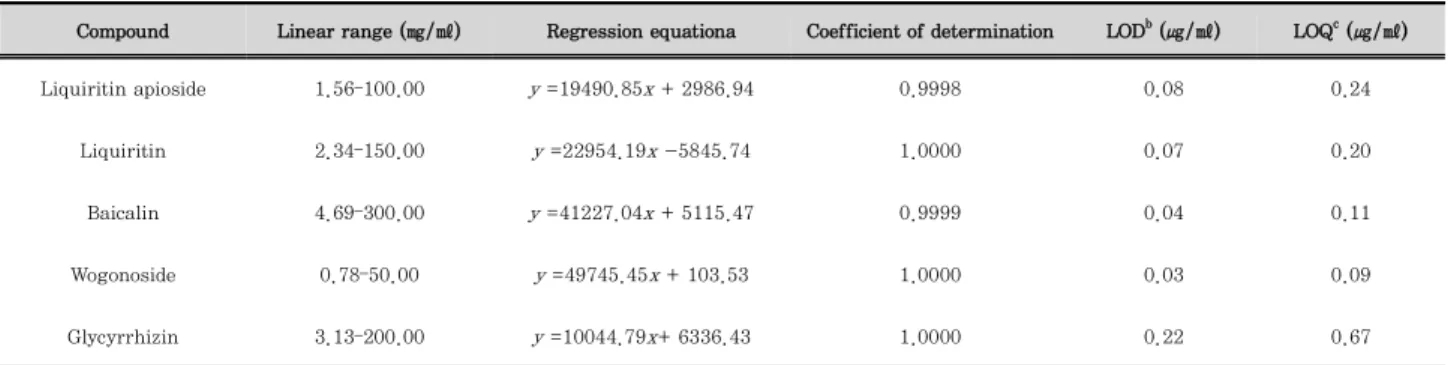
HPLC를 이용하여 확립된 분석법을 이용하여 청심연자음 중 liquiritin apioside, liquiritin, baicalin, wogonoside 및 glycyrrhizin 등 5가지 주요 성분의 함량을 분석하였다. 그 결과 5종의 성분은 분리능 1.46 이상으로 30분 이내에 양호 한 분리가 이루어졌으며 (Table 3), 이들 성분에 대한 검량선 작성 결과 상관계수가 0.9998 이상으로 양호한 직선성을 나타 냈다 (Table 4). 또한 liquiritin apioside, liquiritin, baicalin, wogonoside 및 glycyrrhizin 등 5가지 주요 성분의 머무름 시간은 각각 13.86, 14.26, 20.00, 23.18 및 28.51분에서 각각 검출되었다 (Figure 2). 설정된 분석법을 이용하여 청심
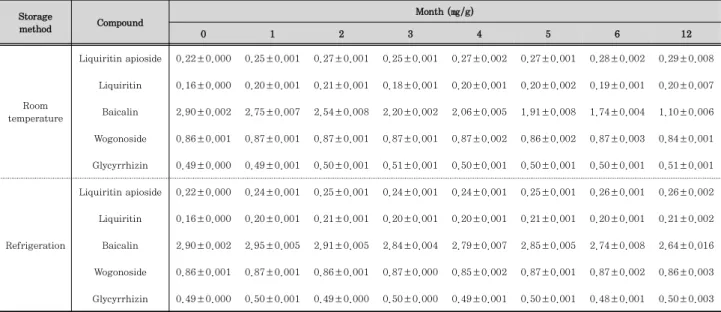
연자음 전탕액에서 liquiritin apioside, liquiritin, baicalin, wogonoside 및 glycyrrhizin의 보관 기간에 따른 함량 분석 결과 상온에서는 0.22-0.29, 0.16-0.21, 1.10-2.90, 0.84-0.87 및 0.49-0.51 ㎎/g으로 나타났으며 (Table 5), 냉장에서는 0.22-0.26, 0.16-0.21, 2.64-2.90, 0.85-0.87 및 0.48-0.50 ㎎/g으로 나타났다 (Table 5). 이 중 liquiritin apioside과 liquiritin은 상온과 냉장 모두에서 보관 기간이 길어질수록 함량이 증가했으나, baicalin은 상온과 냉장 모두 에서 보관 기간이 길어질수록 함량이 감소하는 것으로 나타났다.
Wogonoside와 glycyrrhizin은 보관 온도 및 기간에 따른 큰 변화가 없었다.
Compound Capacity factor ( k´ ) Separation factor ( α ) Number of theoretical plates ( N ) Resolution ( Rs ) Tailing factor ( Tf )
Liquiritin apioside 3.95 1.04 47021 1.46 1.166
Liquiritin 4.09 1.04 39309 1.46 1.100
Baicalin 6.14 1.18 30445 7.65 1.079
Wogonoside 7.27 1.18 61920 7.65 1.066
Glycyrrhizin 9.32 1.27 62271 13.06 0.934
Table 3. System Suitability of the Five Marker Compounds
Compound Linear range (㎎/㎖) Regression equationa Coefficient of determination LOD
b(㎍/㎖) LOQ
c(㎍/㎖)
Liquiritin apioside 1.56–100.00 y =19490.85 x + 2986.94 0.9998 0.08 0.24
Liquiritin 2.34–150.00 y =22954.19 x -5845.74 1.0000 0.07 0.20
Baicalin 4.69–300.00 y =41227.04 x + 5115.47 0.9999 0.04 0.11
Wogonoside 0.78–50.00 y =49745.45 x + 103.53 1.0000 0.03 0.09
Glycyrrhizin 3.13–200.00 y =10044.79 x + 6336.43 1.0000 0.22 0.67
ay : peak area (mAU) of compounds; x : concentration (㎍/㎖) of compounds.
bLOD = 3.3σ × S.
cLOQ = 10σ × S.
σ is the standard deviation of the blank response and Sis the slope of the calibration curve
Table 4. Regression Equations, linearity, limit of detection (LOD)s and limit of quantification (LOQ)s of the Five Marker Compounds
Storage
method Compound
Month (㎎/g)
0 1 2 3 4 5 6 12
Room temperature
Liquiritin apioside 0.22±0.000 0.25±0.001 0.27±0.001 0.25±0.001 0.27±0.002 0.27±0.001 0.28±0.002 0.29±0.008 Liquiritin 0.16±0.000 0.20±0.001 0.21±0.001 0.18±0.001 0.20±0.001 0.20±0.002 0.19±0.001 0.20±0.007 Baicalin 2.90±0.002 2.75±0.007 2.54±0.008 2.20±0.002 2.06±0.005 1.91±0.008 1.74±0.004 1.10±0.006 Wogonoside 0.86±0.001 0.87±0.001 0.87±0.001 0.87±0.001 0.87±0.002 0.86±0.002 0.87±0.003 0.84±0.001 Glycyrrhizin 0.49±0.000 0.49±0.001 0.50±0.001 0.51±0.001 0.50±0.001 0.50±0.001 0.50±0.001 0.51±0.001
Refrigeration
Liquiritin apioside 0.22±0.000 0.24±0.001 0.25±0.001 0.24±0.001 0.24±0.001 0.25±0.001 0.26±0.001 0.26±0.002 Liquiritin 0.16±0.000 0.20±0.001 0.21±0.001 0.20±0.001 0.20±0.001 0.21±0.001 0.20±0.001 0.21±0.002 Baicalin 2.90±0.002 2.95±0.005 2.91±0.005 2.84±0.004 2.79±0.007 2.85±0.005 2.74±0.008 2.64±0.016 Wogonoside 0.86±0.001 0.87±0.001 0.86±0.001 0.87±0.000 0.85±0.002 0.87±0.001 0.87±0.002 0.86±0.003
Glycyrrhizin 0.49±0.000 0.50±0.001 0.49±0.000 0.50±0.000 0.49±0.001 0.50±0.001 0.48±0.001 0.50±0.003
All data were expressed as mean±SEM, which measured in triplicate in at least three independent experiments.
Table 5. Content of the Five Marker Compounds in Chungsimyeonja-eum by Storage Periods
Figure 2. Typical HPLC Chromatogram of Standard Solution (A) and Chungsimyeonja-eum Decoction (B) at UV wavelength 254 (I) and 275 (II) nm. Liquiritin apioside (1), liquiritin (2), baicalin (3), wogonoside (4), and glycyrrhizin (5)
3. RAW 264.7 세포에서의 PGE 2 분비량 측정
보관 기간별 청심연자음의 항염증 효능을 평가하기에 앞서 RAW264.7 세포에서 청심연자음의 세포 독성을 확인한 결과, 250 ㎍/㎖ 이하의 농도에서 세포 독성이 관찰되지 않았다 (data not shown). 이후 세포 독성이 나타나지 않는 농도 범 위에서 실험을 진행하였다. RAW264.7 세포에 LPS 처리 후 PGE
2분비량이 유의적으로 증가하였으나 (P<0.001), 양성대 조군인 indomethacin을 처리한 군과 청심연자음을 처리한 군에서 분비량이 유의적으로 감소하였다 (P<0.001) (Figure 3).
이후 전탕팩을 상온 또는 냉장에서 각각 1-6, 12개월 동안 보관한 후 동일한 방법으로 실험을 진행하였고, 두 조건 모두 12개월까지 청심연자음에 의해 PGE
2분비가 억제됨을 확인 하였다. PGE
2분비 억제에 대한 청심연자음 전탕액의 IC
50값은 0개월 차에서 8.42±1.74 ㎍/㎖로 계산되었다. 이후 IC
50값의 증감은 있었으나 추세선을 보았을 때, 12개월동안 IC
50값의
큰 변화는 없었고 상온보다 냉장에서 그 변화 폭이 작았다 (Figure 4).
Figure 4. Changes of IC50 value for PGE2 inhibition according to Preservation Temperature and Periods of CSYJE. Results are presented as mean ± SEM.
Figure 3. Inhibitory Effect of CSYJE on PGE2 Production in LPS-stimulated RAW264.7Cells Depending on Preservation Temperature and Periods. Results are presented as mean±SEM.***p <0.001 compared to the LPS treated cells. LPS; lipopolysaccharide
Ⅳ. 고 찰
한약은 주로 액상 형태인 탕제가 레토르트 파우치에 포장 된 전탕팩 형태로 공급되고 있다. 반하사심탕, 곽향정기산 등 다양한 탕제 전탕팩의 보관 기간 또는 보관 온도에 따른 지표 성분이나 약리학적 효능 변화에 대한 연구가 보고된 바 있다.
진 등의 연구에 따르면 반하사심탕
4)과 곽향정기산
5)은 2개월 이내 섭취할 것을 권장하고 있다. 서 등의 연구에서는 장기보 존시험 및 가속시험을 통해 전탕팩의 주요 성분 변화를 분석해 보중익기탕
6)의 유통기한은 23개월로, 쌍화탕
7)의 유통기한은 14~72개월로 각각 유통기한을 예측하였다. 또한 평위산 전 탕팩은 6개월 이내
8), 연교패독산 전탕팩은 9일 이내
9), 냉장
보관한 인진호탕 전탕팩은 10일 이내에서 약리적 효능이 유 지됨이 각각 보고되었다
10). 이처럼 탕제의 종류에 따라 생리 활성 물질의 차이가 있어 유통기한 또한 다를 수 있다. 이에 본 연구에서는 청심연자음 전탕팩의 보관 및 유통 기한 설정을 위한 과학적 근거를 제시하고자, 청심연자음 전탕팩을 상온 또는 냉장에서 0-6 및 12개월간 보관한 후 각각 기간별 지표 성분의 변화와 약리 효능 변화를 측정하였다.
청심연자음 전탕액의 pH는 보관 기간이 길어질수록 pH가 낮아졌으며 냉장보다 상온에서 pH 변화폭이 컸다. 가용성 고 형분의 함량은 보관 방법에 따른 차이는 없었고, 0개월 차와 비교하여 0.1~0.5의 증감이 있었으나 측정기기의 정확도가
±0.2% 임을 감안해 큰 변화는 없는 것으로 판단된다.
Baicalin은 청심연자음 구성 약재인 황금의 지표성분으로 전탕액 내에서 가장 많이 검출되었다. Baicalin 함량은 보관 기간이 길어질수록 감소했으며, 냉장보관보다 상온보관에서 감소폭이 컸다. 12개월 차의 baicalin 함량은 0개월 차보다 냉장에서 평균 9.29%, 상온에서 62.17%가 각각 감소하여 전 탕팩의 실온 보관에서 baicalin의 최초 함량 대비 1/2 수준으로 감소한 기간 (반감기)은 8.28개월로 나타났다. Baicalin은 pH 4.28에서 안정하고, 산성환경 (pH 2-4.5) 및 저온 (<
4℃)에서 안정성이 높다고 보고되었다
11,12). 전탕액의 pH는 냉장보다 상온에서 더 감소했으나, 그 차이는 크지 않다. 따 라서 pH보다 온도에 더 큰 영향을 받아 상온에서 baicalin 함 량이 더 감소한 것으로 추정된다. 또 다른 성분인 liquritin apioside의 12개월 차의 함량은 0개월 차보다 냉장에서 평균 16.58%, 상온에서 32.44% 각각 증가하여 냉장 보관이 실온 보관보다 더 안정적인 것으로 판단되었다. 타 연구에 의하면, 탕제 속 liquritin은 보관 기간이 증가할수록 그 함량이 감소 하거나
4,7), 함량에 큰 변화가 없었다
6,13). 청심연자음 속 liquritin의 함량은 0개월 차와 비교하여 1개월 차에 실온 및 냉장 보관에서 각각 20.25% 및 21.36% 증가하였으나 이후 큰 변화는 없었다.
염증(inflammation)은 병원균이나 자극원에 의한 조직 손 상을 보호하기 위한 체내 면역 반응으로, prostaglandin (PG), cytokine, nitric oxide 등 다양한 염증 매개 물질이 염증 반 응에 관여한다. PG 중 가장 잘 알려진 PGE
2는 T 세포 조절에 관여하며 Th1 type의 면역 반응을 저해하고 Th2-type 면역 반응을 향상한다. 또한, 활성화된 대식세포에서 분비되는 tumor necrosis factor-α (TNF-α), IL-1β 등의 cytokine의 분비를 억제해 면역 반응을 조절하는 데 중요한 인자이다
14,15). 이전 연구에 따르면 청심연자음의 지표 성분인 liquiritin apioside, liquiritin, baicalin, wogonoside 및 glycyrrhizin 모두 항염증 효능이 있다고 보고된바 있다
16-19). 이에 본 연구 에서는 LPS로 염증반응을 유도한 RAW264.7 세포에서 청심 연자음 추출물을 처리한 후, 12개월까지 보관 시 PGE
2생성을 억제 효능을 확인했다. 보관 방법에 따른 PGE
2억제에 대한 IC
50값을 산출한 결과 0개월 차와 비교하여 증감폭이 실온 보관 에서는 -3.61 내지 3.73 ㎍/㎖, 냉장보관에서는 -3.39 내지 1.03 ㎍/㎖로 실온보다 냉장에서의 효능 변화가 적었으나 12 개월까지 PGE
2생성 저해 효능이 유지되고 있어 유의적인 차 이는 없었다.
Ⅴ. 결 론
본 연구는 상온 및 냉장에서 보관한 청심연자음 전탕액의 지표 성분 함량 및 약리 활성 변화를 평가하였다. 청심연자음 전탕액의 항염증 활성은 12개월까지 상온 및 냉장 보관에서 모두 유지되었다. 전탕액 내 가장 많이 검출된 지표 성분인 baicalin의 함량은 상온보관 시 반감기가 약 8개월로 나타났다.
성분의 소실률을 기준으로 한 청심연자음의 보관 기간은 실온의
경우 8개월, 냉장보관의 경우 12개월로 판단된다. 이 결과는 청심연자음 전탕팩의 유통 기한 설정을 위한 기초 자료로 이 용될 것으로 사료된다.
감사의 말씀
본 연구는 한국한의학연구원에서 지원하는 '한약처방의 과 학적 근거기반 구축사업 (K17251)'에 의해 수행되었으며 이 에 감사드립니다.
References