― 527 ―
*Corresponding author. E-mail: [email protected]
솔수염하늘소와 북방수염하늘소의 섭식과 산란행동을 통한 소나무재선충의 이탈
김동수ㆍ이상명ㆍ허혜순ㆍ박남창ㆍ박정규1*
국립산림과학원 남부산림연구소, 1경상대학교 농업생명과학대학 응용생물학과
Escape of Pine Wood Nematode, Bursaphelenchus xylophilus , through Feeding and Oviposition Behavior of Monochamus alternatus and M.
saltuarius (Coleoptera: Cerambycidae) Adults
Dong Soo Kim, Sang Myeong Lee, He Soon Huh, Nam Chang Park and Chung Gyoo PARK1*
Southern Forest Research Center, Korea Forest Research Institute, Jinju 660-300, Republic of Korea
1Department of Applied Biology/ Institute of Agriculture & Life Science (BK21 Program of Graduate School), Gyeongsang National University, Jinju 660-701, Republic of Korea
ABSTRACT : This study was performed to investigate the escape of pine wood nematode (PWN), Bursaphelenchus xylophilus, from two vector species (Monochamus alternatus and M. saltuarius) through oviposition and feeding behavior. First, we checked number of PWNs escaped from M. alternatus emerged from three different cases of pine logs. In case A, healthy pine trees were cut into logs and left in pine forest infected with PWN. In case B, healthy pine trees were cut into logs, left in large screen cage, and let them oviposited by M. alternatus emerged from pine trees infested with PWN. In case C, pine trees which were harboring M. alternatus were cut into logs, and PWN was inoculated artificially.
The M. alternatus adults emerged from the above three cases of pine logs were checked in the next year to know how many PWN they were harboring in their bodies. The percentages of M. alternatus harboring PWN (18.3 and 15.6%, respectively) and number of nematodes per vector (5,713.1±9,248.3 and 2,034.1±4,746.8 PWNs, respectively) in case A and B logs are similar to each other. However, the percentage and the number in case C (38.3% and 20,083.1±32,188.3 PWNs) were higher than those of case A and B. Among 52 M. alternatus adults harboring PWN from all the three cases, 20 adults (38.5%) were harboring more than 5,000 PWNs per beetle. And these 20 adults were harboring 97.9%
of the total PWNs in 52 adults. Second, we checked the daily escape of PWNs from M. alternatus and M. saltuarius collected at pine forest infested with PWN. The PWN escaped from their vector body for 34.9±12.4 days for M. alternatus, and for 23.9±16.2 days for M. saltuarius, reaching at peak escape during the 2nd week of emergence of the two vector species. A 44.5 and 47.2% to the total PWNs escaped from vector body within 2 weeks of vector emergence for M. alternatus and M. saltuarius, respectively. The number of PWNs escaped from each vector was 3,570.6±5,189.2 and 1,556.2±1,710.3 for M. alternatus and M. saltuarius, respectively.
KEY WORDS : Pine tree, Pine wilt disease, Nematode, Long-horned beetle
초 록 : 본 연구에서는 소나무재선충병 매개충의 소나무재선충 보유 정도와 산란 및 섭식행동을 통한 전파에 대하여 조사하였다. 첫째, 세 가지 종류의 벌채목으로부터 우화 탈출하는 솔수염하늘소 의 소나무재선충 보유 정도를 조사하였다. ㉮의 경우는 건전한 소나무를 벌채하여 감염림 내에 방
치한 것이고, ㉯의 경우는 감염목에서 우화 탈출한 솔수염하늘소를 건전한 벌채목에 산란시켰을 경 우이며, ㉰의 경우는 솔수염하늘소는 서식하고 있으나 소나무재선충은 보유하지 않은 소나무를 벌 채하고 소나무재선충을 인공적으로 접종한 경우이다. 세 경우 모두 이듬해에 벌채목으로부터 우화 탈출하는 솔수염하늘소의 소나무재선충 보유율과 보유수를 조사하였다. ㉮와 ㉯의 경우 소나무재선 충 보유율은 각각 18.3%와 15.6%이었고, 보유한 소나무재선충 수는 각각 5,713.1±9,248.3마리와 2,034.1±4,746.8마리로서 차이가 없었다. 그러나 인공적으로 소나무재선충을 접종한 ㉰의 경우에는 소나무재선충 보유율과 보유수가 각각 38.3%와 20,083.1±32,188.3마리로서 다른 두 경우에 비해 높 은 경향이었다. 한편, 소나무재선충 보유수를 조사한 세 경우 전체 52마리의 솔수염하늘소 중에서 20마리(38.5%)가 5,000마리 이상의 소나무재선충을 보유하고 있었고, 이들 20마리가 보유한 소나무 재선충이 전체 소나무재선충의 97.9%를 차지하였다. 둘째, 야외의 소나무재선충 감염림에서 채취한 소나무로부터 우화한 솔수염하늘소와 북방수염하늘소의 섭식 과정 중에 이들로부터 이탈하는 소나 무재선충의 수를 조사하였다. 소나무재선충이 솔수염하늘소와 북방수염하늘소 몸으로부터 이탈한 일수는 각각 34.9±12.4일과 23.9±16.2일이었고, 우화 후 2주째에 가장 많이 탈출하였다. 우화 후 2 주 이내에 탈출한 소나무재선충의 비율은 솔수염하늘소의 경우는 44.5%, 북방수염하늘소의 경우에 는 47.2%이었으며, 매개충 한 마리당 이탈하는 소나무재선충의 수는 각각 3,570.6±5,189.2 마리와 1,556.2±1,710.3 마리이었다.
검색어 : 소나무, 소나무재선충병, 선충, 하늘소
소나무는 우리나라 산림면적의 23.5%로 구성되어 있 으며 산림으로서의 가치뿐만 아니라 문화적으로도 중 요한 위치를 차지하고 있음에도 불구하고 산림병해충 으로 많은 피해를 받아왔다. 그 대표적인 예로 솔잎혹 파리와 솔껍질깍지벌레가 오랜 기간 동안 피해를 주고 있다. 또한 소나무재선충병은 1988년 부산 금정산에서 처음 발생한 이래 매년 피해 면적이 증가하여 2008년 말에는 11개 시․도의 57개 시․군․구에서 발생하여 피해 를 주고 있는 실정이다(KFRI, 2008).
소나무재선충(Bursaphelenchus xylophilus(Steiner and Buhrer))은 소나무속(Pinus) 뿐만 아니라 전나무속(Abies), 가문비나무속(Picea), 잎갈나무속(Larix)의 일부 수종과 Douglas-fir, Himalayan cedar 등도 가해하는 것으로 알 려져 있다(Mamiya 1983; Kobayashi et al., 1984). 소나 무재선충은 미국, 캐나다, 멕시코 등 북미대륙 토착종으 로(Steiner and Buhrer, 1934; Knowles et al., 1983;
Dwinell, 1993) 미국 내 자생 수종들은 대부분 저항성 을 나타내어 큰 피해가 없으나 이 선충이 원산지에서 다른 나라로 유입될 경우 이 선충에 감염된 소나무는 모두 죽는다. 또한 감염 후 3개월 이내에 죽기 때문에 지구상의 그 어떤 산림병해충보다 무서운 병으로 산림 에 심각한 피해를 주고 있다. 그 대표적인 예로 일본에 서 1900년대 초반부터 소나무에 피해가 나타나기 시작 하여 점차 확산되면서 현재는 소나무와 해송이 거의 전
멸 상태가 되고 있다(Mamiya, 1988; Kishi 1995). 이러 한 소나무재선충은 스스로 다른 나무로 이동할 수 있는 능력이 없어 매개충인 솔수염하늘소를 매개체로 하여 이동한다.
소나무재선충을 옮겨주는 매개충은 현재까지 Mono- chamus속에 속하는 하늘소류로서 우리나라와 일본, 중 국, 대만에서는 솔수염하늘소(Kishi 1995, Mamiya and Enda, 1972), 북미지역에서는 M. carolinensis, M. mutator, M. scutellatus, M. titillator(Linit, 1988), 포르투갈은 M.
galloprovincialis(Sousa et al., 2001)가 중요한 매개체 로서 알려져 있다. 한편 일본의 동북지방의 한랭한 지 역에서는 북방수염하늘소(M. saltuarius)도 소나무재선 충을 매개하는 것으로 알려져 있으며(Sato et al., 1987), 최근에는 국내에서도 잣나무림에서 소나무재선충병이 발생하였는데 이를 매개하는 곤충이 북방수염하늘소로 밝혀졌다(KFRI, 2007).
감염목 내에서 솔수염하늘소 성충은 몸에 소나무재선 충을 보유한 상태로 우화 탈출한다. 우화한 성충은 성 적 성숙과 생존을 위하여 건전한 소나무 가지를 섭식하 게 되는데, 이때 생기는 상처를 통해 소나무재선충이 건전 한 나무로 옮겨진다(Mamiya and Enda, 1972; Morimoto and Iwasaki, 1972; Wingfield and Blanchette, 1983;
Edwards & Linit, 1992). 또한 쇠약목이나 고사목, 벌채 목에는 솔수염하늘소의 산란처를 통하여 소나무재선충
이 옮겨진다는 보고도 있다(Linit, 1988).
소나무재선충병의 효과적인 방제를 위해서는 매개충 인 솔수염하늘소에 대한 연구 뿐 만 아니라 매개충을 통한 소나무재선충의 전파 동태에 관한 연구도 반드시 이루어져야 한다. 그러나 지금까지 매개충의 산란 행동 과 관련하여 소나무재선충이 매개충으로부터 탈출하는 동태에 관한 정량적인 평가가 이루어진 바가 없었다.
따라서 본 연구에서는 소나무재선충 매개충의 산란 및 섭식행동을 통해서 소나무재선충이 얼마나 전파되 는지를 연구하였다. 즉, 솔수염하늘소의 산란을 통한 소 나무재선충의 전파에 대해서는, 소나무로부터 우화 탈 출하는 솔수염하늘소의 소나무재선충 보유 정도를 세 가지 경우로 가정하여 조사하였다. 즉, 건전한 소나무를 시기별로 벌채하여 소나무재선충병 피해 임내에 방치 했을 경우와, 건전한 소나무를 벌채하여 야외 우화상 내에 산란이목으로 설치했을 경우, 솔수염하늘소는 서 식하지만 소나무재선충병에 감염되지 않은 소나무에 소나무재선충을 인공 접종하였을 경우에 그 소나무로 부터 우화 탈출하는 솔수염하늘소 성충이 소나무재선 충을 얼마나 보유하고 있는지를 조사하였다. 그리고 북 방수염하늘소 성충의 섭식을 통한 소나무재선충의 전 파에 대해서는 솔수염하늘소와 비교하여 조사하였다.
즉, 감염목으로부터 우화 탈출하는 매개충이 소나무재 선충을 전파하는 개체의 비율, 일생동안 섭식 과정 중 에 소나무재선충이 매개충으로부터 탈출하는 일 수 및 밀도를 조사하였다.
이러한 연구는 우리나라에서 소나무재선충의 매개충 인 솔수염하늘소와 북방수염하늘소를 효과적으로 방제 함으로써 소나무재선충병의 확산을 저지하기 위한 기 초 연구자료로 활용하고자 수행하였다.
재료 및 방법
솔수염하늘소의 산란행동을 통한 소나무재선충의 이탈 정도
건전한 소나무를 시기별로 벌채하여 소나무재선충병 피해 임내에 방치했을 경우: 경남 진주시 정촌면 예하 리 소나무재선충병 피해지 내에서 2007년 5월에서 10 월까지 매월 초에 건전한 해송(흉고직경 16~18 cm)을 3본씩 벌채한 후 길이 80 cm 크기로 절단하여 주변에 서 서식하는 솔수염하늘소가 벌채목에 산란할 수 있도
록 10월 말까지 일정기간 동안 임내에 방치한 산란이목 을 10월 말에 야외 우화상(4×2×2.5 m)으로 옮겨 적재 하였다. 이듬해인 2008년 5월부터 7월까지 산란이목으 로부터 우화 탈출하는 솔수염하늘소 성충을 채집하여 암 수를 구분하였다. 채집한 성충은 마쇄하여 Baermman funnel 법으로 소나무재선충을 분리한 후 해부현미경 (Olympus SZX9, Japan) 하에서 분리된 소나무재선충 의 수를 조사하였다. 실험에 사용한 암컷과 수컷의 수 는 각각 31마리와 29마리이었다.
소나무재선충병에 감염된 소나무에서 우화 탈출한 솔 수염하늘소를 건전한 소나무에 산란시켰을 경우: 경남 진주시 금산면 소나무재선충병 피해지 인근의 소나무 림에서 2007년 6월 초에 건전한 해송(흉고직경 10~14 cm) 10본을 벌채한 후 80 cm 간격으로 절단하여 산란 이목으로 사용하였다. 산란이목을 솔수염하늘소 먹이용 해송가지와 함께 야외 우화상(4×2×2.5 m)에 넣고, 소나 무재선충병에 감염되어 고사한 나무에서 우화 탈출한 솔수염하늘소 50쌍을 우화상에 방사하여 산란을 유도 하였다. 이듬해인 2008년에 우화상의 산란이목에서 우 화 탈출하는 솔수염하늘소 성충을 채집하여 마쇄한 후 Baermman funnel 법으로 소나무재선충을 분리한 후 해 부현미경(Olympus SZX9, Japan) 하에서 분리된 소나 무재선충의 수를 조사하였다. 실험에 사용한 암컷과 수 컷의 수는 각각 38마리와 26마리이었다.
솔수염하늘소는 서식하지만 소나무재선충병에 감염 되지 않은 소나무에 소나무재선충을 인공 접종하였을 경우: 2007년 경남 고성군 교사리의 소나무 간벌지에서 솔수염하늘소는 서식하고 있으나 소나무재선충에는 감 염되지 않은 소나무 고사목을 벌채하여 길이 80 cm 길 이로 절단한 후 간이 우화상에 넣어 두었다. 솔수염하 늘소의 유충이 용화하는 시기(2008년 4월 5일, 20일)에 유충 침입공 주변에 직경 7 mm 크기의 구멍을 뚫고 솜 을 채운 다음 실내에서 계대 배양한 소나무재선충을 약 3,000마리(현탁액 0.5 ml)를 접종하였다. 소나무재선충 을 접종한 후 우화 탈출하는 솔수염하늘소 성충을 채집 하여 마쇄한 후 Baermman funnel 법으로 소나무재선충 을 분리한 후 해부현미경(Olympus SZX9, Japan) 하에 서 분리된 소나무재선충의 수를 조사하였다. 실험에 사 용한 암컷과 수컷의 수는 각각 45마리와 36마리이었 다.
Table 1. Number of pine wood nematodes (PWN), Bursaphelenchus xylophilus extracted from Monochamus alternatus adults emerged from three types of pine logs which were infected with the nematodes by three different methods
Pine logs No. of adults examined % of M. alternatus adult with PWN
No. of PWNs per M. alternatus
mean ± SD max. min.
In pine forest infested with PWN*
Female (n=31) 19.4 6,428.1 ± 8,846.1 24,533 61
Male (n=29) 17.2 4,855.1 ± 9,639.2 24,133 13
Total (n=60) 18.3 5,713.1 ± 9,248.3 24,533 13
Oviposited by M. alternatus in large screen cage**
Female (n=38) 15.8 500.1 ± 717.2 2,093 61
Male (n=26) 15.4 4,335.3 ± 6,836.1 16,160 51
Total (n=64) 15.6 2,034.1 ± 4,746.8 16,160 51
Inoculated with PWN***
Female (n=45) 35.6 22,544.0 ± 32,828.5 128,700 85
Male (n=36) 41.7 17,457.0 ± 31,278.4 94,507 56
Total (n=81) 38.3 20,083.1 ± 32,188.3 128,700 56
***Healthy pine trees were cut into logs and left in pine forest infected with PWN.
***Healthy pine trees were cut into logs, left in large screen cage, and let them oviposited by M. alternatus emerged from pine trees infested with PWN.
***Pine trees which were harboring M. alternatus were cut into logs, and PWN was inoculated artificially. The M. alternatus adults emerged from the above three types of pine logs were checked in the next year to know how many PWNs. they were harboring in their bodies.
매개충의 섭식행동 과정에서 매개충으로부터 소나무 재선충이 이탈하는 정도
솔수염하늘소: 2007년 11월 초순에 경남 진주시 금산 면 일대의 소나무재선충병 피해임지 내에서 솔수염하 늘소 유충이 서식하고 있는 소나무 고사목을 벌채하여 진주시 가좌동에 위치한 야외 우화상에 적재하였다. 이 듬해 우화 탈출하는 솔수염하늘소 성충 40마리를 채집 하여 실험에 이용하였다.
북방수염하늘소: 2008년 1월 중순에 경기도 광주시 초원읍의 재선충병 피해 잣나무림 내에서 고사된 잣나 무를 벌채하여 1m 길이로 조제한 후 진주시 가좌동에 위치한 야외 우화상에 적재하여 이듬해 우화 탈출하는 북방수염하늘소 성충 36 마리를 채집하여 조사하였다.
소나무재선충 이탈수 조사: 소나무재선충의 이탈 수 는 매개충이 섭식을 시작하여 수명이 다할 때까지 조사 하였다. 소나무재선충병 피해목에서 갓 우화 탈출하여 후식을 시작하지 않은 매개충(솔수염하늘소 또는 북방 수염하늘소)을 insect breeding dish(직경 10 cm× 높이 4 cm, SPL) 바닥에 여과지(Whatman No.1) 1장을 깔고 해송 신초와 함께 솔수염하늘소와 북방수염하늘소 성 충을 암수 구분 없이 한 마리씩 처리하였다. 매일 오전 에 신선한 해송 신초와 여과지로 교환해 주었다. 매개 충이 후식한 해송 신초와 여과지는 Baermman funnel 법으로 소나무재선충을 분리하여 그 수를 조사하였다.
결과 및 고찰
솔수염하늘소의 산란행동을 통한 소나무재선충의 전파
세 가지의 다른 방법으로 소나무재선충을 감염시킨 벌채목으로부터 우화 탈출하는 솔수염하늘소 성충이 보유하고 있는 소나무재선충 수를 조사한 결과는 Table 1과 같다. 소나무재선충병 피해임지 내에서 건전한 해 송을 매월 벌채하여 방치함으로써 솔수염하늘소가 자 연적으로 산란하여 이듬해 우화 탈출한 솔수염하늘소 성충의 소나무재선충 보유율은 18.3%였으며, 성충 1마 리당 평균 5,713.1±9,248.3마리, 최대 24,533마리, 최소 13마리의 소나무재선충을 보유하고 있었다. 건전한 해 송을 벌채하여 사육상 안에 넣고, 감염목에서 우화한 솔수염하늘소가 산란할 수 있도록 유도한 후 이듬해 이 들로부터 우화 탈출하는 솔수염하늘소 성충의 소나무 재선충 보유율은 15.6%로 평균 2,034.1±4,746.8마리, 최대 16,160마리, 최소 51마리의 소나무재선충을 보유 하였다. 본 실험에서 야외 사육상 내 산란이목을 설치 하고 충분하게 섭식할 수 있도록 해송 가지를 공급하였 지만 솔수염하늘소 성충이 공급된 해송가지 뿐만 아니 라 산란이목의 얇은 수피를 가해한 흔적도 발견되었다. 이는 후식 초기에는 솔수염하늘소가 1~2년생 가지를 선호하였고 시간경과와 함께 다년생가지로 옮겨간다는 보고(Kishi, 1995)와 비슷하였다. 이 과정에서 솔수염하
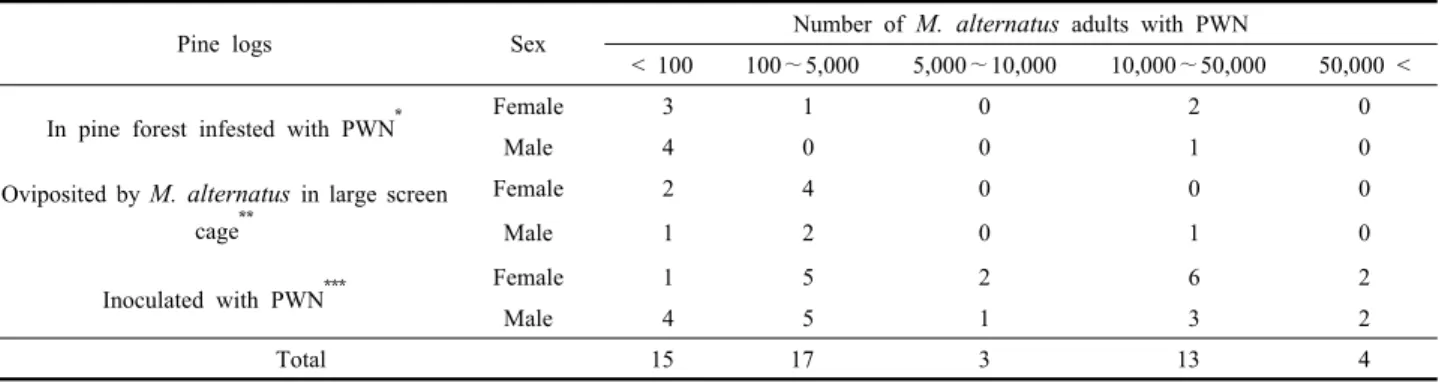
Table 2. Frequency distribution of number of M. alternatus adults harboring different numbers of PWN extracted from the beetles emerged from three different types of pine logs
Pine logs Sex Number of M. alternatus adults with PWN
< 100 100∼5,000 5,000∼10,000 10,000∼50,000 50,000 <
In pine forest infested with PWN* Female 3 1 0 2 0
Male 4 0 0 1 0
Oviposited by M. alternatus in large screen cage**
Female 2 4 0 0 0
Male 1 2 0 1 0
Inoculated with PWN*** Female 1 5 2 6 2
Male 4 5 1 3 2
Total 15 17 3 13 4
*, **, ***See footnotes of Table 1.
늘소가 보유한 소나무재선충이 산란목으로 전파되었을 것으로 생각된다. 따라서 매개충의 소나무재선충 전파 능력은 후식행동 뿐만 아니라 산란행동 과정에서도 소 나무재선충을 전파 할 가능성이 있을 것으로 판단된다.
한편, 솔수염하늘소가 서식하고는 있으나 소나무재선충 에 감염되지 않은 소나무를 잘라 소나무재선충을 인공 접종하였을 때 이듬해에 우화 탈출하는 솔수염하늘소 의 소나무재선충 보유수를 조사한 결과, 소나무재선충 보유율은 38.3%였고, 평균 20,083.1±32,188.3 마리, 최대 128,700마리, 최소 56마리를 보유하였다. Kishi(1995) 는 조사지역에 따라 차이는 있었지만 솔수염하늘소 한 마리의 소나무재선충 최고 보유수는 298,000마리라고 하 였다. 한편, 솔수염하늘소와 소나무 고사율과의 관계에 서 고사율이 높은 지역에서는 선충보유수가 많다는 보 고(Enda, 1972a)가 있는 반면 일정한 관계가 없다는 보 고도 있다(Takeda et al., 1976).
본 실험에서 인공적으로 소나무재선충을 접종한 소나 무에서 우화 탈출한 솔수염하늘소의 소나무재선충 보 유수는 다른 두 가지 경우(건전한 소나무를 벌채하여 감염림 내에 방치한 경우와 감염목에서 우화 탈출한 솔 수염하늘소를 건전한 벌채목에 접종했을 경우)의 소나 무재선충 보유수보다 많았으나 통계적 차이는 없었으 며, 암수 간 소나무재선충 보유수에도 차이가 없었다 (df=46,5; F=0.99; P=0.432).
Table 2는 세 가지 유형으로 감염된 벌채목으로부터 우화 탈출한 솔수염하늘소가 보유한 소나무재선충 수의 빈도 분포를 나타낸 결과이다. 소나무재선충을 5,000마 리 이상을 보유하고 우화 탈출한 솔수염하늘소(20마리) 는 전체 솔수염하늘소(52마리)의 38.5%였다. 벌채목의 유형별로 5,000마리 이상의 소나무재선충을 보유한 솔
수염하늘소의 비율을 보면, 자연 산란목에서 37.5%(3 마리)였고, 강제 산란목에서는 11.1%(1마리), 소나무재 선충 인공 접종목에서는 51.6%(16마리)이었다. Hosoda et al.(1974)은 500마리의 솔수염하늘소을 조사한 결과 1,000마리 이상의 소나무재선충 보유한 20% 정도의 하 늘소가 전체 소나무재선충의 93%를 보유하였다고 하 였다. 본 연구 결과에서도 5,000마리 이상의 소나무재 선충을 보유한 38.5%의 솔수염하늘소가 전체 소나무재 선충의 97.7%를 보유하고 있었다. Kobayashi(1975)는 선충을 다량으로 보유한 소수의 하늘소 즉 소수의 ‘재 선충을 지닌 하늘소’와 다수의 ‘재선충을 지니지 않는 하늘소’의 비율이 소나무 고사에 중요하다고 지적하였다.
매개충의 섭식행동 과정에서 매개충으로부터 소나무 재선충이 이탈하는 정도
솔수염하늘소와 북방수염하늘소 성충의 섭식행동을 통하여 소나무재선충이 매개충의 충체로부터 이탈되는 수를 조사한 결과는 Table 3과 같다. 솔수염하늘소의 경우 72일간 조사를 하였는데, 처리 후 1일째부터 소나 무재선충이 이탈하였다. 소나무재선충이 솔수염하늘소 성충으로부터 이탈한 일수는 평균 34.9일, 최소 18일에 서 최대 59일 간이었고, 매개충 한 마리당 이탈한 선충 의 수는 3,570.6±5,189.2마리로서 매개충 개체 간 변이 가 컸다.
북방수염하늘소의 경우 총 58일의 조사 기간 중에서 처리 1일째부터 소나무재선충이 탈출하기 시작하여 평 균 23.9일, 최소 8일에서 최대 51일간 이었고, 이탈한 선충의 수는 1,556.2±1,710.3마리이었다.
상기 실험에서 매개충의 몸으로부터 이탈하는 소나무
Table 3. Escape of PWN from vectors, M. alternatus and M. saltuarius adults
Vector Days of
observation
Longevity (days, mean±SD)
Date of PWN escape from vector after vector
emergence
No. days
(mean±SD) that PWN escaped from vectors (min.~max.)
No. PWNs escaped from a vector (mean±SD) M. alternatus
(n=10)* 72 53.8 ± 14.8 1st ~ 8th 34.9 ± 12.4
(18~59) 3,570.6 ± 5,189.2 M. saltuarius
(n=9)* 58 35.7 ± 18.8 1st ~ 5th 23.9 ± 16.2
(8~51) 1,556.2 ± 1,710.3
*Numbers in parenthesis mean the number of vectors harboring PWN among 40 M. alternatus and 36 M. saltuarius adults.
M. alternatus M. saltuarius
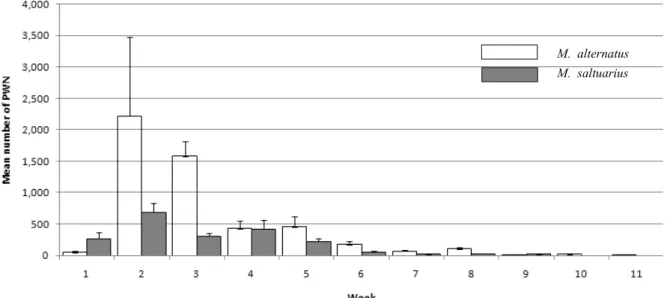
Fig. 1. The weekly number (Mean±SD) of PWN escaped from per vector of two species during experiment period.
재선충의 수를 처리 후 주별로 재정리한 결과는 Fig. 1 과 같다. 솔수염하늘소의 경우 처리 후 2~3주째에 많 이 이탈하는 것을 알 수 있었다. 처리 2주일째에는 평균 2,220.1마리, 3주일째에는 평균 1,578.6마리가 검출 되 었지만 4주부터는 그 수가 현저히 떨어지는 것을 알 수 있다. 북방수염하늘소 경우에는 처리 5주째까지는 평균 265.6~683.9마리가 검출되었지만, 6주째부터는 이탈 되는 소나무재선충이 거의 없었다. 이러한 실험 결과는, 소나무재선충이 매개충으로부터 이탈하는 수는 솔수염 하늘소가 우화 탈출한지 2~3주 간이 최고이며 그 이후 로는 줄어들고 4~5주간 까지는 거의 없다는 보고(Enda, 1972b; Mineo, 1975; Hosoda and Kobayashi, 1978)와 일치한다. 또한 솔수염하늘소 성충이 우화 탈출한지 1 주일 이내에 후식한 소나무 묘목은 거의 고사하지 않고, 우화 탈출 후 3주일이 된 성충이 후식한 소나무 묘목이 가장 잘 죽는다고 하는 실험 결과(Mineo and Kontani, 1975)를 뒷받침한다고 생각된다. 소나무재선충의 이탈 시기와 병원성의 관계보다는 이 시기에 가장 많은 소나
무재선충이 이탈하기 때문에 소나무 묘목을 많이 고사 시키는 것으로 생각된다. 상기의 연구 결과는, 우리나라 에서 솔수염하늘소는 5월 15일을 전후하여 우화 탈출 하기 시작하고, 50% 우화일은 6월 중순경이라는 보고 (Kim et al., 2003)와 연관하여 중요한 결과라고 생각된다.
본 논문에서는 소나무재선충병 감염림 내에서 소나무 를 벌채하여 방치하면 그 벌채목에 솔수염하늘소가 산 란하고, 이듬해에 소나무재선충을 보유한 채 우화함으 로써 소나무재선충병을 전파할 수 있음을 명확히 하였 다. 또한 어떤 소나무가 소나무재선충병에 감염되지 않 았더라도 그 나무속에 솔수염하늘소가 존재하고 다른 매개충의 섭식이나 산란에 의해 소나무재선충이 자연 접종된다면, 이듬해에 그 나무로부터 우화 탈출하는 성 충은 소나무재선충을 보유함으로써 이 병을 전파시킬 수 있음을 밝혔다. 또한, 소나무재선충 감염목으로부터 우화하는 솔수염하늘소나 북방수염하늘소의 섭식과정 에서 이들 매개충으로부터 소나무재선충이 탈출하는 시기를 밝힘으로써, 매개충을 통한 소나무재선충의 전
파 기작을 좀 더 이해할 수 있게 되었다.
그러나 솔수염하늘소나 북방수염하늘소가 감염목으 로부터 우화 탈출 한 후 생존 기간 동안 건전한 소나무 를 어느 정도 섭식하는지, 즉 이들 매개충의 섭식행동 에 관한 정량적인 연구가 이루어진다면 소나무재선충 병의 전파 억제를 위한 방법 강구에 도움이 될 것으로 생각된다. 또한, 이들 매개충이 건전목, 쇠약목 또는 고 사목에 산란하는 과정에서 소나무재선충을 얼마나 전 파시킬 수 있는지에 대한 연구도 이루어져야 할 것으로 생각된다.
Literature Cited
Dwinell, L.D. 1993. First report of the pine wood nematode (Bursaphelenchus xylophilus) in Mexico. Plant Dis. 69: 440.
Edwards, O.R. and M.J. Linit. 1992. Transmission of Bursa- phelenchus xylophilus through oviposition wounds of Mono- chamus carolinensis (Coleoptera: Cerambycidae). J. Nematol.
24: 133-139.
Enda, N. 1972a. Insect vectors of the pine wood nematode and the number of nematodes in the insect vectors. Trans. Ann. Mtg.
Kanto. Br. Jpn. For. Soc. 24: 31.
Enda, N. 1972b. Removing dauer larvae of Bursaphelenchus lignicolus from the body of Monochamus alternatus. Trans.
Ann. Mtg. Kanto. Br. Jpn. For. Soc. 24: 32.
Hosoda, R., M. Okuda, A. Taketani and K. Kobayashi. 1974.
Number of pine wood nematodes extracted from the pine sawyer adults emerged from dead pine trees in pine forest on a cold winter. Trans. Mtg. Jpn. For. Soc. 85: 231-233.
Hosoda, R. and K. Kobayashi. 1978. Drop-off procedures of the pine wood nematode from the pine sawyer (II), Trans. Ann.
Mtg. Kanto. Br. Jpn. For. Soc. 29: 131-133.
KFRI. 2007. Damage characteristics and control strategies of pinewood nematode, Bursaphelenchus xylophilus in Korean white pine forest. pp 1-12. Korea Forest Research Institute, Seoul.
KFRI. 2008. Annual report on forest pests monitoring in 2008.
Korea Forest Research Institute, Seoul. 565 pp.
Kim, D.S., S.M. Lee, Y.J. Chung, K.S. Choi, Y.S. Moon and C.G.
Park. 2003. Emergence ecology of Japanese pine sawyer, Monochamus alternatus (Coleoptera: Cerambycidae), a vector of pinewood nematode, Bursaphelenchus xylophilus . Korean J.
Appl. Entomol. 42: 307-313.
Kishi, Y. 1995. The pine wood nematode and the Japanese pine sawyer. Thomas Company Ltd, Tokyo, Japan. 302 pp.
Knowles, K., Y. Beaublen, M.J. Wingfield, F.A. Baker and D.W.
French. 1983. The pinewood nematode new in Canada. Forestry Chronicle 59: 40.
Kobayashi, K. 1975. Relationship between the degree of the mortality of pine trees and the number of Monochamus alternatus.
Forest Pest 24: 206-208.
Kobayashi, F., A. Yamane and T. Ikeda. 1984. The Japanese pine sawyer beetle as the vector of pine wilt disease. Annu. Rev.
Entomol. 29: 115-135.
Linit, M.J. 1988. Nematode-vector relationship in the pine wilt disease system. J. Nematol. 20: 227-235.
Mamiya, Y. and N. Enda. 1972. Transmission of Bursaphelenchus lignicolus (Nematoda: Aphelenchoididae) by Monochamus alternatus (Coleoptera: Cerambycidae). Nematologica 18: 159-162.
Mamiya, Y. 1983. Pathology of the pine wilt disease caused by Bursaphelenchus lignicolus. Annu. Rev. Phytopathol. 21:
201-220.
Mamiya, Y. 1988. History of pine wilt disease in Japan. J. Nematol.
20: 219-226.
Mineo, K. 1975. Drop-off of pine wood nematodes from the pine sawyer and their invasion of pine trees. Trans. Ann. Mt. Kansai Br. Jpn. For. Soc. 26: 275-278.
Mineo, K. and S. Kontani. 1975. On the vertical movement in the trunk of pine trees inoculated PWN. Annu. Phytophathol.
Soc. Jpn. 41: 92.
Morimoto, K. and A. Iwasaki. 1972. Role of Monochamus alternatus (Coleoptera: Cerambycidae) as a vector of Bursaphelenchus lignicolus (Nematoda: Aphelenchoididae). J. Jpn. For. Soc. 54:
177-183.
Sato, H., T. Sakuyama and M. Kobayashi. 1987. Transmission of Bursaphelenchus xylophilus (Steiner et Buhrer) (Nematoda, Aphelen- choididae) by Monochamus saltuarius (Gebler) (Coleoptera, Ceram- bycidae). J. Jpn. For. Soc. 69: 492-496.
Sousa, E., M.A. Bravo, J. Pires, P. Naves, A.C. Penas, L.
Bonifacio and M.M. Mota. 2001. Bursaphelenchus xylophilus (Nematoda; Aphelenchoididae) associated with Monochamus galloprovincialis (Coleoptera; Cerambycidae) in Portugal.
Nematol. 3: 89-91.
Steiner, G. and E.M. Buhrer. 1934. Aphelenchoides xylophilus n.
sp., a nematode associated with blue stain and other fungi in timber. J. Agric. Res. 48: 949-951.
Takeda, J., N. Ido and K. Kobayashi. 1976. Difference in number of pine wood nematodes carried by newly-emerged adults of Monochamus alternatus Hope from different location. Trans.
Mtg. Jpn. For. Soc. 87: 251-252.
Wingfield, M.J. and R.B. Blanchette. 1983. The pine-wood nematode, Bursaphelenchus xylophilus, in Minnesota and Wisconsin:
insect associates and transmission studies. Can. J. For. Res. 13:
1068-1076.
(Received for publication November 11 2009;
revised December 8 2009; accepted December 11 2009)