503 Kor. J. Hort. Sci. Technol. 29(5), October 2011 Kor. J. Hort. Sci. Technol. 29(5):503-506, 2011
A New Hybrid, Dark Pink Spotted Type Phalaenopsis ‘Pink Marble’
Mi Seon Kim
1*, Young Ran Lee
1, Hye Kyung Rhee
1, Sang Kun Park
1, Hak Ki Shin
1, Hyang Young Jung
1, and Jin Hee Lim
21
Floriculture Research Division, National Institute of Horticultural & Herbal Science, Suwon 441-440, Korea
2
Plant Engineering Research Institute, Sejong University, Seoul 143-747, Korea
Abstract. A new hybrid, Phalaenopsis ‘Pink Marble’ was made by the National Institute of Horticultural and Herbal Science, Rural Development Administration, in 2005. This hybrid was selected from self-crossed progenies of P. ‘21-1’ (collected number) in 1999. In 2001, one line was selected based on the aspects such as flower color, leaf shape, flower stalk, and vigorous growth. Trials were conducted from 2003 to 2005 for evaluation and selection of this cultivar. ‘Pink Marble’ had a medium flowering habit and a dark pink spot (RHS, RPN74B) on white petal and sepal when fully opened. The number of flowers on each peduncle was 7.5, and flower diameter was 52.3 cm. The general impression of petals and sepals is a plate shape.
The thick sepal could extend the long flowering time. The average length of leaf and peduncle were 16.5 cm and 6.8 cm, respectively. It had a half-erect leaf form, and was a fast-growing cultivar. This hybrid is relatively easy to clone.
Additional key words: breeding, cross, hybridization
*Corresponding author: [email protected]
※ Received 7 June 2011; Accepted 20 July 2011. An application was filed for variety protection of ‘Pink Marble’ at Korea Seed & Variety Service (Grant number 2898). This variety has been cultivated in Phalaenopsis farm from 2009. Requests for increasing of PLBs for research purposes may be addressed to Mi-Seon Kim ([email protected]).
Introduction
Phalaenopsis, an epiphytic genus, has been noted for its beautiful and extremely long-lasting flowers, which are produced on a graceful arching or dropping flower spike.
The species is found over a wide area extending from India to New Guinea. By far the largest concentration in cultivation comes from the Philippines and neighboring islands. This genus has 62 species (Christenson, 2001) and is a monopodial plant, as it grows as a single stem without pseudobulbs. The inflorescence emerges from the leaf rosette (Wilma and Brian, 2001).
Since early 1990, Phalaenopsis has become an important commodity in the domestic and the international markets.
It has become the top potted orchid plant in the world flower market and is likely to remain so for the foreseeable future (Tang and Chen, 2007). Also, Phalaenopsis the most popular potted plant in Korea’s floriculture industry, with 21 million pots produced in 2009 (MIFAF, 2010).
The popularity of Phalaenopsis naturally led to the creation of many artificial hybrids. The first hybrid was created in 1875 when John Seden at Veitch and Son’s
Nursery in England crossed P. amabilis (L.) Bl. with P.
equestris Rchb. (Griesbach, 2002). The present and future trends in Phalaenopsis breeding have been in combining the various groups to form more diverse and unusual crosses.
In recent years, the potted varieties with small but plentiful flowers have become a new market trend. Accordingly, since 1993 our breeding research has also focused on breeding small and medium-sized varieties. Thus far, 16 varieties have been released in National Institute of Horticultural and Herbal Science (NIHHS), Rural Development Administration (RDA), Suwon; ten of these (Kim et al., 2007, 2008, 2009; Lee et al., 2006, 2008) were registered with Korea Seed & Variety Service (KSVS) to protect the breeders’ right. In addition, various registered varieties, including ‘Pink Marble’, have been produced commercially by private seedling companies to supply to farmers since 2008. The cultivated area of domestic hybrids has been increasing gradually since 2008, but it is still quite small, at about 1.5 ha. The hybrids commonly produced in Korea are imported from China and Taiwan.
The high payment required to buy hybrid seedlings has
imposed a heavy burden on farmers. Recently, both the RDA
and private Phalenopsis breeders have bred their own
504 Kor. J. Hort. Sci. Technol. 29(5), October 2011
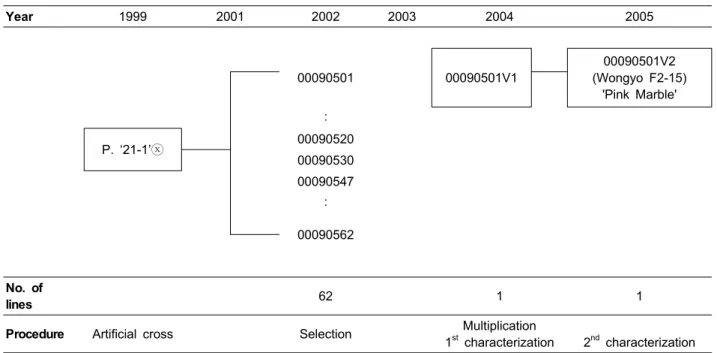
Year 1999 2001 2002 2003 2004 2005
00090501 00090501V1
00090501V2 (Wongyo F2-15)
'Pink Marble'
:
P. ‘21-1’ⓧ 00090520
00090530 00090547
: 00090562
No. of
lines 62 1 1
Procedure Artificial cross Selection Multiplication
1st characterization 2nd characterization Fig. 1. Pedigree diagram of ‘Pink Marble’.
Table 1. Morphological characteristics of a new Phalaenopsis ‘Pink Marble’.
Cultivar Flower
Leaf attitude Leaf color Fragrancez Color (Lip)y Shape
Pink Marble WN155B (RPN74B) Plate Half- straight Green (G137A) None
Orange Dream GY1D (RP71A) Plate Half-straight Green (G137B) Light
zThe Royal Horticultural Society (RHS, 2001) color chart.
varieties. For this reason, we expect to develop many quality varieties that can competitive in the global market.
The aims of breeding for the potted Phalaenopsis were to improve the size and color of the flowers, as well as other characteristics such as, longevity, stalk length, leaf shape, ease of cultivation, disease resistance and so on (Tang and Chen, 2007).
This hybrid was made with the objective of combining the good quality flower color and vigorous growth of P.
‘21-1’. The Phalaenopsis ‘Pink Marble’ has the spotted color pattern of a dark pink flower, is a medium sized plant with curved flower shape and was developed and released to satisfy domestic and export consumers.
Origin
A new cultivar, P. ‘Pink Marble’, was originated from a self crossing of P. ‘21-1’ (Fig. 1). The self-crossing P.
‘21-1’, a medium-sized plant and pink flower with a pink spot and stripe on petal and sepal (Table 1) was conducted at NIHHS, Suwon in 1999.
Matured seeds were harvested in five months after pollination. In late August 2000, immature embryos were
aseptically cultured on Hyponex medium and the sixty-two seedlings with leaf length 5-7 cm were transplanted to a greenhouse in 2001. In 2003, one line (‘00090501V
2’) was selected for their features such as flower color, leaf attitude, and vigorous growth. The 1
stand 2
ndcharacteristic trials were conducted at the experimental field of NIHHS from 2003 to 2005. After that, ‘00090501V
2’ was finally selected and named ‘Wongyo F
2-12’. This line (‘Wongyo F
2-12’) had uniformity and excellent characteristics. After a second characteristics test the selected line was named ‘Pink Marble’
(Fig. 2).
Phalaenopsis ‘Orange Dream’, a breeding line of NIHHS with an orange stripe on petal and sepal was used as a control variety.
The evaluation of characteristics was investigated according to the manual for agricultural investigation (RDA, 1995), and the guidelines for the conducting tests for distinctness, uniformity and stability for Phalaenopsis (KSVS, 2004).
Flower color was expressed by using the color chart (RHS,
2001), and preference was surveyed when a Phalaenopsis
to consumers at NIHHS in 2005.
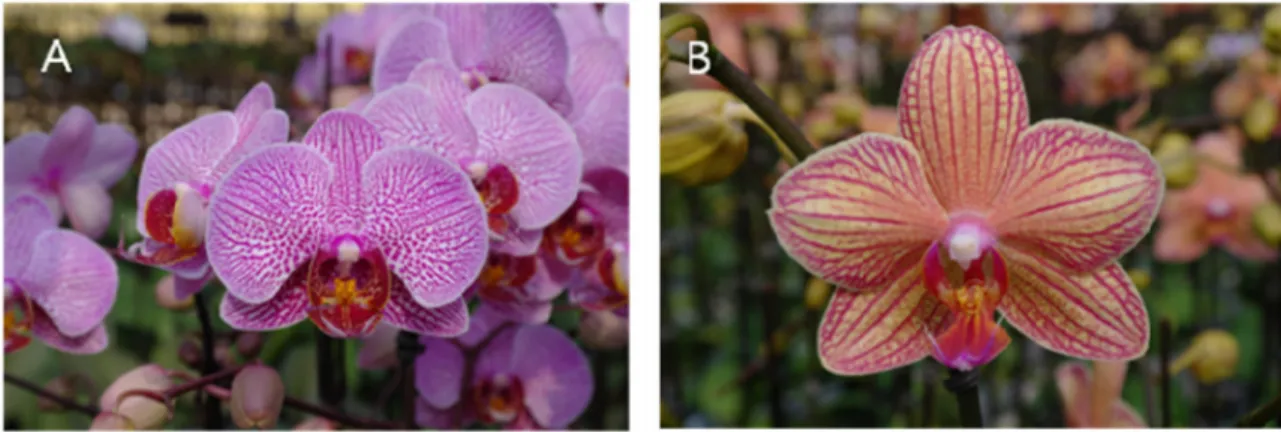
505 Kor. J. Hort. Sci. Technol. 29(5), October 2011 Fig. 2. Flower characteristics of a new Phalaenopsis ‘Pink Marble’ (A) and control P. ‘Orange Dream’ (B).
Table 2. Morphological characteristics of a new Phalaenopsis ‘Pink Marble’.
Cultivar
Flower
Length of flower stalk(cm)
No. of flowers/
Flower stalk
Preferencez
Required time (months) for induction of flower stalky
Leaf
Growth rate
Required days for inducing flower bud
Propagati on ability Width/Length (%)
(cm)
Length (cm)
Width (cm) Pink
Marble 5.7 ± 0.7/ 6.2 ± 0.4 52.3 ± 4.9 7.5 ± 2.0 3.8 ± 0.8x 2 16.5 ± 2.8 7.2 ± 0.9 Good 80 70 Orange
Dream 6.5 ± 0.9 / 5.0 ± 0.6 45.7 ± 5.2 6.0 ± 1.7 3.6 ± 0.7 2 12.2 ± 2.4 6.5 ± 1.4 Good 85 70
zPreference evaluation was taken Phalaenopsis exhibition held at NHRI in 2005. Poor (1)-Excellent (5).
yThe temperature for inducing of flower stalk were 18-20℃
xMean ± standard error of 20 plants.
Description and Performance
Plant‘Pink Marble’ is a sturdy, medium-sized plant with a semi-erect leaf attitude. At flowering time, when it was treated sufficiently with low temperature (18-20℃, about 2 months), this hybrid had the characteristic of branched flower-stalk in 10 cm diameter pots. The average leaf length was 16.5 cm from base of leaf. However the leaf width of this hybrid was somewhat wide compared to ‘Orange Dream’
(Table 2). ‘Pink Marble’ was easy to flower in year-rounded production, and was vigorous in growth. In addition, this hybrid a high propagation ability and showed a very low variation rate in vitro and vivo.
Flower
The predominant flower color of this hybrid when fully open was dark pink spot (RHS, RPN74B) on a white base color (WN155B, petal and sepal) with a red lip (RP59A).
The main flower color of this hybrid was different from
‘Orange Dream’ with an orange stripe color (GY1D) as a control hybrid. The flower shape of ‘Pink Marble’ was the same as the plate type of ‘Orange Dream’. This hybrid had a somewhat thick petal and sepal compared to the control hybrid, and its pot life was about 10days longer than that
of the control hybrid. The general appearance of the petals and sepals was spreading, and the arrangement of petals was touching. At 5.7 cm, the diameter of the flowers of ‘Pink Marble’ was narrower than that of ‘Orange Dream’, at 6.5 cm. It averages 7.5 flowers per flower stalk when the plant is cultivated for 3 months in a green-house.
‘Pink Marble’, a medium-sized flower, had a special color with a dark pink spot and thick sepal, which gives greater longevity to the opened flower.
The control of flowering of this hybrid didn’t require a special technique under general culture condition (Ichihashi and Mii, 2006). Also, the required period and temperature for inducing of flower stalk in this hybrid were about 2 months and 18-20℃ respectively. From after showing of floral bud, culture temperature was gradually heated to 25℃
for 20 days to enhance flower opening. The best aspects of this hybrid were its vigorous growth and high PLB formation ability.
Accordingly, it is recommended to plant ‘Pink Marble’
as an alternative to ‘P. 21-1’. The results of our survey showed that farmers preferred ‘Pink Marble’. We also expect that the value of this hybrid will grow commercially in the domestic and export markets (Table 2).
‘Pink Marble’ was the eighth potted Phalaenopsis cultivar
506 Kor. J. Hort. Sci. Technol. 29(5), October 2011
named by NIHHS. It followed the release of ‘Pink Dream’
(Lee et al., 2006), ‘White Angel’ (Kim et al., 2007), ‘Yellow Marble’ (Kim et al., 2008), ‘Yellow Dream’ (Kim et al., 2009), and other varieties.
Literature Cited
Christenson, E.A. 2001. Phalaenopsis a monograph. Timber Press, Portland, Oregon, U.S.A.
Griesbach, R.J. 2002. Development of Phalaenopsis orchids for mass-market, p. 458-465. In: J. Janick and A. Whipkey (eds.). Trends in new crops and new uses. ASHS Press, Alexandria, VA.
Ichihashi, S. and M. Mii. 2006. Phalaenopsis culture and production. Seibundo Shinkosha Press, Tokyo, Japan.
Kim, M.S., H.R. Cho, H.K. Rhee, J.H. Lim, Y.R. Lee, and H.K.
Shin. 2008. A new Phalaenopsis hybrid ‘Yellow Marble’
with a yellow flower color and red spot on petal and sepal.
Kor. J. Hort. Sci. Technol. 26 (Suppl. II):86-89.
Kim, M.S., Y.R. Lee, H.K. Rhee, J.H. Lim, S.K. Park, H.K.
Shin, and I.J. Choi. 2009. Breeding of small type and yellow colored Phalaenopsis ‘Yellow Dream’. Kor. J. Breed. Sci.
41:145-148.
Kim, M.S., Y.R. Lee, H.R. Cho, H.K. Rhee, J.H. Lim, and H.K.
Shin. 2007. A new Phalaenopsis hybrid, ‘White Angel’ with
white petals and red rip. Kor. J. Breed. 39:387-388.
Korea Seed & Variety Service (KSVS). 2004. Guidelines of characteristics for application and registration of new varieties in Phalaenopsis (P. Blume). p. 1-58. Anyang, Korea.
Lee, Y.R., M.S. Kim, H.K. Shin, H.K. Rhee, C.S. Bang, Y.J.
Kim, and J.Y. Kim. 2008. Breeding of a new Phalaenopsis cultivar ‘Ice Princess’ with pure white Flower. Kor. J. Hort.
Sci. Technol. 26 (Suppl. II): 94-96.
Lee, Y.R., M.S. Kim, J.Y. Kim, and M.I. Jeong. 2006. A new Phalaenopsis cultivar, ‘Pink Dream’ with dark pink flower.
Kor. J. Breed. Sci. 38:195-196.
Ministry for Food, Agriculture, Forestry and Fisheries (MIFAFF).
2010. The present condition of cultivation of flowers. MIFAFF, Gwacheon, Korea
Rural Development Administration (RDA). 2003. Manual for Agricultural Investigation. RDA, Suwon, Korea.
Steven, A.F. 2008. Moth Orchids: The complete guide to Phalaenopsis. Timber Press Inc., Portland, Oregon.
Tang, C.Y. and W.H. Chen. 2007. Breeding and development of new varieties in Phalaenopsis, p. 1-22. In: W.H. Chen and H.H. Chen (eds.). Orchid biotechnology. World Scientific, Singapore.
The Royal Horticultural Society (RHS). 2001. The royal horticultural society’s color chart. RHS, London.
Wilma, R. and R. Brian. 2001. The gardener’s guide to growing orchids. Timber Press, Portland, Oregon, U.S.A.