• 검색 결과가 없습니다.

The Relationship of Pelvic Pressure and Irradiation of the PNF Upper Arm Pattern in the Sitting Position with an Elastic Band -A Randomized Control Trial-

N/A
N/A
Protected

Academic year: 2021

Share "The Relationship of Pelvic Pressure and Irradiation of the PNF Upper Arm Pattern in the Sitting Position with an Elastic Band -A Randomized Control Trial-"

Copied!
9
0
0

로드 중.... (전체 텍스트 보기)

전체 글

(1)

| Abstract |

Purpose: This study evaluated the relationship between pelvic pressure and irradiation of the proprioceptive neuromuscular facilitation (PNF) upper arm pattern exercises with an elastic band while in a sitting position.

Methods: Fourteen subjects with asymptomatic pelvic pressure participated in this study. Pelvic pressure was measured using a Gaitview® system while sitting and performing PNF bilateral upper arm patterns. Resistance strength was provided by the blue elastic band. The statistical significance of the results was evaluated using a repeated one-way ANOVA and the independent t-test.

The Bonferroni method was used for the post-hoc test.

Results: The results revealed a significant change in the pelvic pressure when performing the PNF arm pattern. The average resistance pressure on the pelvis, with the elastic band, significantly increased after the initial sitting position (F=3.91, 3.92;

p<0.05). No significant pelvic pressure changes were noted for each PNF upper arm pattern (p>0.05).

Conclusion: The results of this study showed a positive relationship between pelvic pressure and the irradiation of PNF upper arm pattern exercises with resistance in the sitting position.

Key Words: Irradiation, PNF arm pattern, Pelvic pressure.

†Corresponding Author : Jung-Hoon Lee ([email protected])

Original Article Open Access

앉은 자세에서 탄력밴드를 이용한 PNF 팔 패턴의 방산효과가 골반의 압력에 미치는 영향

양재만⋅여고은⋅김동욱

1

⋅이정훈

2†1)

영도병원 물리치료실 ,

1

휴병원 물리치료실,

2

동의대학교 물리치료학과

The Relationship of Pelvic Pressure and Irradiation of the PNF Upper Arm Pattern in the Sitting Position with an Elastic Band

-A Randomized Control Trial-

Jae-Man Yang, P.T., M.S.⋅Go-Eun Yeo, P.T., B.S.⋅

Dong-Wook Kim, P.T., B.S.

1

⋅Jung-Hoon Lee, P.T., Ph.D

2†

Department of Physical Therapy, Young-Do General Hospital

1

Department of Physical Therapy, Hu-Hospital

2
Department of Physical Therapy, Dong-Eui University

Received: August 7, 2019 / Revised: September 27, 2019 / Accepted: October 1, 2019

ⓒ 2019 Journal of Korea Proprioceptive Neuromuscular Facilitation Association

This is an Open Access article distributed under the terms of the Creative Commons Attribution Non-Commercial License

(http://creativecommons.org/licenses/by-nc/3.0) which permits unrestricted non-commercial use, distribution, and reproduction

in any medium, provided the original work is properly cited.

(2)

422 | PNF and Movement Vol. 17, No. 3

Ⅰ. 서 론

고유 수용성 신경근 촉진법(proprioceptive neuromuscular facilitation, PNF)의 치료 방법들 중 운동 기능 향상과 근력 증진을 위하여 사용되는 방산 (irradiation)은 인체의 한 부분에서 일어나는 근육 활동 이 연결된 근육을 따라 다른 부위의 근육으로 반응이 증가되거나 확산되는 근육 활동의 현상으로, 한쪽의 근 수축을 통하여 반대쪽 근육의 근력과 관절의 안정 성을 증진시키는데 영향을 미치는 현상이다(Caroll et al., 2006; Lee & Caroll, 2007). 정상적인 PNF 팔 패턴의 움직임은 협력관계가 있는 몸통 근육과 함께 이루어 지고, PNF 팔 패턴 움직임 동안 적절한 저항은 방산의 효과를 증대시키며, 팔과 연결된 다른 부위 근육들을 강화하기 위해 사용한다(Alter et al., 2014; Keiner et al., 2014; Markovic & Pavle, 2010). 이러한 PNF의 방산 의 효과는 한쪽 근육의 다양한 움직임을 수행하는 동 안 반대쪽 근육 활동을 촉진시키는 치료적 도구(tool) 로 많이 사용되고 있다(Kim et al., 2011).

일상생활 동작 중 인체의 팔 또는 다리가 움직임을 수행(달리기, 공차기, 던지기 등)하는 동안 몸통 및 골반 부위에서 일어나는 가장 주된 역할은 몸의 올바 른 균형(orientation)과 안정성(stability)을 유지하는 것 이다(Rocchi, 2002; Shumway-Cook & Woollacoatt, 2001; Winters & Crago, 2000). 또한 PNF 패턴과 같은 고유의 나선상의 움직임은 해당 근육의 고유수용성감 각을 촉진시켜 인접한 다른 근육들의 근력 증진을 간 접적으로 증진시킨다(Choi, 2013). 몸통과 골반 부위에 서 올바른 균형과 안정성을 유지하는 동안 뭇갈래근 (multifidus)과 배가로근(transversus abdominis)은 몸통 및 골반 부위의 다른 근육들 보다 가장 먼저 수축하여 올바른 균형과 안정성을 증가시킨다(Hodges &

Gandevia, 2000).

Kim 등(2016)은 PNF 팔 패턴과 방산의 효과를 비교 하기 위한 다양한 자세들(바로 누운 자세, 앉은 자세, 옆으로 누운 자세)중 배바깥빗근(external oblique abdominal muscle)과 배안쪽빗근(internal oblique

abdominal muscle)의 근 활성도는 앉은 자세에서 가장 유의하게 증가하였다고 하였다. 또한 Urbin 등(2015) 은 근전도(electromyogram, EMG)를 이용하여 뇌졸중 환자들에게 비 마비성 상지 근육의 고도 저항 운동이 교차 훈련의 효과로 마비성 (반대쪽) 근육에서 유의한 근 활성도 증가를 확인하였으며, Nikolaos 등(2007)은 한쪽 다리의 PNF 패턴이 반대쪽 다리 무릎 폄 근의 유의한 근력 증가를 보고하였다. Park과 Lee (2016)는 PNF 다리 패턴의 교차 훈련의 효과가 반대쪽 중간 볼기근 근 활성도 증가에 유의함을 보고하였으며, Yoo 등(2013)의 연구에서는 PNF 패턴을 통한 교차 훈련 시 반대쪽 근육의 근 활성도 향상 및 촉진은 배 안의 공동 수축 (abdominal hollowing)을 통하여 이루어 진다고 보고하였다.

그러나 PNF 팔 패턴의 적용 시 몸통 근육들의 근 수축을 통하여 골반의 압력 변화를 비교한 연구는 미 흡하였다. 그러므로 본 연구의 목적은 앉은 자세에서 PNF 팔 패턴을 이용한 교차 훈련이 골반 압력 변화에 미치는 영향에 대해서 알아보고자 하였다.

Ⅱ. 연구 방법

1. 연구 대상

연구 대상자는 본 연구에 동의한 Y병원에 근무하고 본 연구에 동의하는 정상 건강인 남 , 녀 14명을 대상으 로 실시하였다.

연구 대상자 수 선정 기준은 G*Power 3.1(G*Power,

Universität of düsseldorf, Germany) 을 이용하여

repeated one-way ANOVA, 유의수준 0.05, 검정역 0.8,

효과크기 0.7로 설정한 결과 연구 대상자 수는 12명이

산출되었으나, 탈락률 20%를 고려하여 총 18명을 모

집하였다. 모집인원 중 총 4명이(과체중으로 인한 장

비 미 인식) 스크리닝 과정에서 제외되어 14명이 본

실험에 참여하였다(Fig. 1). 연구 대상자 한 명당 총

5가지의 실험(No pattern with non theraband, D 1 flexion

(3)

pattern with theraband, D 1 extension pattern with theraband, D 2 flexion pattern with theraband, D 2 extension pattern with theraband)을 단일 눈가림으로 무 작위로 실시하기 위해 대상자에게 무작위 순서가 적 혀있는 봉투를 선택하게 하도록 하여 실시 하였다.

또한 연구결과에 영향을 줄 수 있는 근골격계 및 심혈관계의 질환이 있는 자 , 신경학적 손상(팔이나 복 부, 골반, 허리 부위)으로 통증 또는 질환이 있는 자, 과체중으로 장비 미 인식의 자는 본 연구에서 제외하 였다.

2. 측정방법 및 도구

1) 골반 압력 측정장비

대상자들의 골반 압력 변화를 측정하기 위하여 게

이트-뷰(gait-view)(AFA-50, alFOOTs, Korea)를 사용하 였으며, 본 장비는 해외 기준인 FCC (federal communications commission) 및 CE (conformite europeenne)에 인증된 의료기기이다(Nam, 2018).

2) PNF 팔 패턴의 수행

대상자들은 압력 센서가 장착된 게이트 -뷰 판 위에

허리를 곧게 펴고 바로 앉은 자세로 에서 PNF 팔 패턴

4가지를 각각 무작위로 실시하였다. PNF 팔 패턴 4가

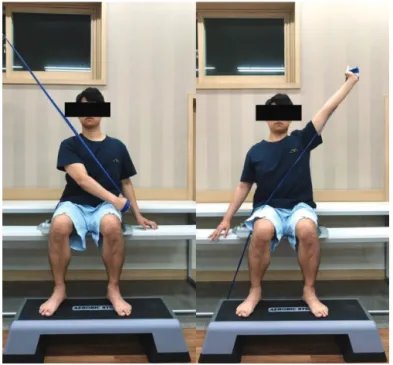
지은 Diagonal 1 굽힘(flexion) 패턴(D 1 flexion pattern)

은 어깨관절 굽힘(flexion)-모음(adduction)-가쪽돌림

(external rotation)(Fig. 2A), Diagonal 1 폄(extension)

패턴(D 1 extension pattern)은 폄(extension)-벌림

(abduction)-안쪽돌림(internal rotation)(Fig. 2B),

Diagonal 2 굽힘(flexion) 패턴(D 2 flexion pattern)은 어

Fig. 1. Study flow diagram.

(4)

424 | PNF and Movement Vol. 17, No. 3

깨관절 굽힘(flexion)-벌림(abduction)-가쪽돌림(external rotation)(Fig. 2C), Diagonal 2 폄(extension) 패턴(D 2 extension pattern)은 어깨관절 폄(extension)-모음 (adduction)-안쪽돌림(internal rotation)(Fig. 2D)으로 끝 나는 패턴으로 구성이 되어있었다(Knott M & Voss D, 1968). 본 연구의 측정 전에 보조 실험자는 대상자들 에게 PNF 팔 패턴의 4가지 움직임들을 패턴 수행의 시작과 끝 방향을 3분간 교육 하였고, 실험 중에는 실험 전 교육한 패턴을 수행하면서 마지막 끝 범위에 서 10초간 유지하도록 하여 골반 압력 변화에 대한 결과 값을 측정하였다. 실험을 마친 후에는 3분간의 휴식을 통제하였으며 , 한 명의 연구 대상자에게 4가지 움직임을 수행했으므로 전체 실험 시간은 25분이 소 요되었다.

3) PNF 팔 패턴 적용 시 저항

패턴 적용 시 저항의 도구로서 파랑색(blue [extra heavy]) 탄력밴드(theraband

resistance bands, akton, USA)를 사용하였으며(Lister et al., 2007), 길이는 각 대상자들의 다리 길이(큰 돌기에서 바닥까지)에 따라 각각 다르게 재단하였다(Dexter W et al., 2011).

4) PNF 팔 패턴 적용의 속도 제어

대상자들에게 각 패턴 수행 속도를 일관되게 통제 하기 위하여 청각적인 신호(‘똑’, ‘딱’)를 사용하는 컴 퓨터용 전자메트로놈(Zetronome ver 1.0, park, Korea) 장치를 사용하였다(Lee & Kim, 2014). 대상자들은 패 턴 적용을 알리는 측정자의 ‘시작’ 구령에 맞추어 양쪽 팔에 탄력밴드를 잡고 사전에 연습한 패턴 움직임을 동시에 적용하였고 10초간 유지하였다.

골반 압력을 측정 시 대상자의 발바닥, 무릎, 골반 이 틀어지지 않도록 하기 위하여 발바닥을 지면 (발판) 에 붙이고 누르게 하여 초기 무릎과 엉덩관절의 각도 를 90도가 되도록 통제 하였으며, 각 대상자는 반복 측정으로 인한 근 피로의 영향을 최소화하기 위하여 각 패턴을 수행하기 전 3분간의 휴식 시간을 주었다 (Fig. 3).

3. 자료분석

본 연구에서 자료 분석 프로그램은 SPSS 21.0 for

Windows 프로그램을 이용하였다. 실험 전과 후의 압

력 변화 결과는 repeated one-way ANOVA 통계 분석

방법으로 분석하였으며, bonferroni 검사법으로 사후

검정하였다. 또한 각 패턴 수행 동안 왼쪽과 오른쪽

Fig. 2. Proprioceptive neuromuscular facilitation (PNF) arm pattern.

(5)

평균 골반 압력의 차이는 independent t-test 방법으로 분석하였다. 통계학적 유의 수준은 0.05로 하였다.

Ⅲ. 연구결과

1. 대상자의 일반적 특성

대상자는 오른쪽 팔이 우세 팔인 남자 4명, 여자 10명 총 14명으로 대상자의 일반적 특성은 다음과 같 다(Table 1).

Characteristics Mean±SD

Age (years) 29.85±4.98

Height (㎝) 170±7.97

Weight (㎏) 63.28±14.03

Table 1. General characteristics of subjects (n=14)

2. 탄력밴드를 이용한 양쪽 팔 패턴 적용 시 평균 골반 압력의 변화

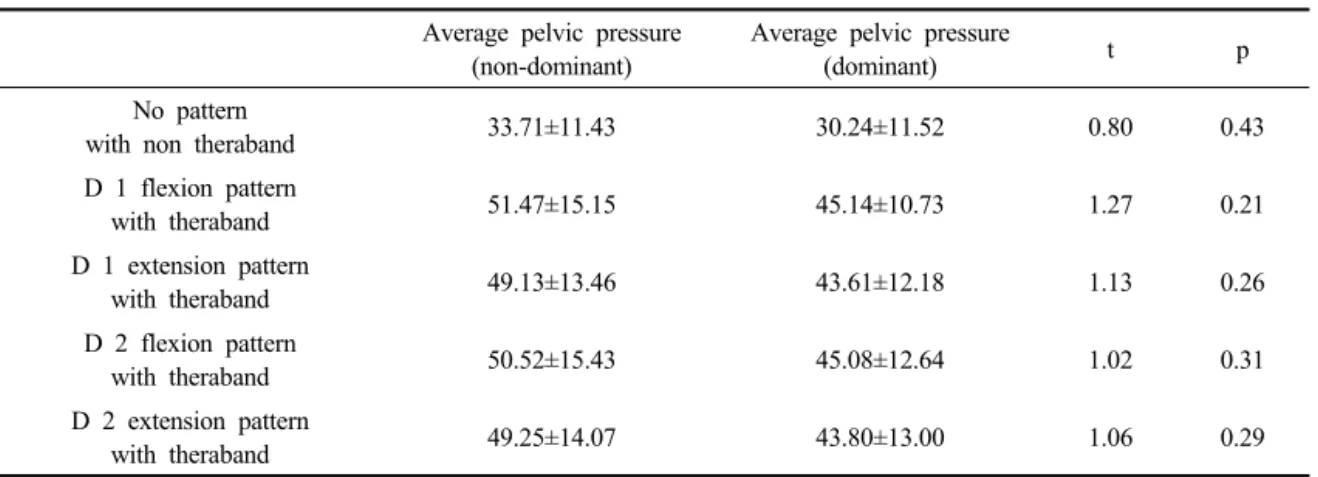
탄력밴드를 이용하여 서로 다른 방법의 4가지 PNF 팔 패턴을 양쪽 팔에서 동시에 적용 하였을 때 바로 앉은 자세에서 우세 쪽의 초기 골반 압력 값은 No pattern with non theraband (30.24±11.52)에서 D 1 flexion pattern with theraband (45.14±10.73), D 1 extension pattern with thera band (43.61±12.18), D 2 flexion pattern with theraband (45.08±12.64), D 2 extension pattern with theraband (43.80±13.00)으로 각각 유의하게 증가하였 으며(p<0.05)(Table 2), 바로 앉은 자세에서 비 우세 쪽의 초기 골반 압력 값은 No pattern with non theraband (33.71±11.43)에서 D 1 flexion pattern with theraband (51.47±15.15), D 1 extension pattern with theraband (49.13±13.46), D 2 flexion pattern with theraband (50.52±15.43), D 2 extension pattern with theraband (49.25±14.07)으로 각각 유의하게 증가하였다(p<

0.05)(Table 2). 그러나 패턴 적용 방법 간의 평균 골반 압력 변화의 유의한 차이는 없었다(p>0.05)(Fig. 4).

Fig. 3. PNF arm pattern with theraband using a gait-view.

(6)

426 | PNF and Movement Vol. 17, No. 3

3. 우세 쪽과 비 우세 쪽 평균 골반 압력의 차이

PNF 팔 패턴 동안 우세 쪽과 비 우세 쪽의 평균 골반 압력의 차이는 없었다(p>0.05)(Table 3).

Ⅳ. 고 찰

본 연구 결과 바로 앉은 자세에서 PNF 팔 패턴을 수행하는 동안 우세 쪽과 비 우세 쪽 골반 압력은 초기 골반 압력에 비하여 양쪽에서 모두 유의하게 증가하 였다. 그러나 각 패턴 방법 간의 골반 압력의 차이는 없었으며 , 각 패턴을 적용하는 동안 우세 쪽과 비 우세

쪽의 골반 압력 차이 또한 없었다.

PNF 패턴을 이용한 방산의 효과에 대한 많은 연구 들 중 Bemben와 Murphy (2001)의 연구에서는 정상인 들을 대상으로 한쪽 근육의 저항 운동 시 반대쪽 동일 근육에 대한 근 수축을 측정한 결과 반대쪽 근육에서 도 근 수축이 함께 증가한다고 보고하였으며, Lee 등 (2009)의 연구결과에서는 뇌졸중 환자들에게 한쪽 다 리에 PNF 패턴을 적용하였을 때 방산의 효과를 통하 여 양쪽 팔 같은 근육에서 근 활성도가 유의하게 증가 하였다고 보고하였다 . 또한 Yoo 등(2013)의 연구결과 에서는 한쪽 발에서의 PNF 패턴의 적용은 몸통에서 근 수축이 일어나는 방산의 효과를 통해 반대쪽 다리 의 근 활성도가 증가된다고 보고하였으며, Kim 등 Fig. 4. Comparison of the difference pelvic pressure for each PNF arm pattern.

No pattern with non theraband

D 1 flexion pattern with

theraband

D 1 extension pattern with

theraband

D 2 flexion pattern with

theraband

D 2 extension pattern with

theraband

F p

Average pelvic pressure

Non-Dominant 33.71±11.43 51.47±15.15 49.13±13.46 50.52±15.43 49.25±14.07 3.91 0.01*

Dominant 30.24±11.52 45.14±10.73 43.61±12.18 45.08±12.64 43.80±13.00 3.92 0.01*

Note. The values are Mean±SD, * Statistically significant with p<0.05.

Table 2. Comparison of pelvic pressure on sitting with PNF arm pattern (unit: Kpa)

(7)

(2011)의 연구결과에서는 한쪽 다리의 엉덩관절에서 시행한 등속성 운동은 반대쪽 다리에서 한발로 서있 는 동안(one-leg standing) 균형 유지 능력이 개선되었 으며 그 결과는 방산의 효과라고 보고 하였다. Kibler 등(2006)은 팔과 다리에서의 움직임(달리기, 공차기, 던지기 등)을 동반한 스포츠 활동을 하는 동안 골반에 서는 안정성과 움직임을 조절하기 위한 연관된 근육 들의 근 활성도가 증가한다고 보고하였다. Winters와 Crago (2000)의 연구결과에서는 팔과 다리가 운동을 하는 동안 골반 근육들은 무게중심을 조절하고 올바 른 자세나 위치를 조절하는 근 수축을 한다고 보고하 였다. 이러한 이전 연구 결과들은 본 연구에서 나타난 PNF 팔 패턴 적용 시 몸통에서의 근 수축을 통한 골반 압력이 유의하게 증가한 방산의 효과를 뒷받침할 수 있을 것이다. 또한 무게 중심의 변화와 올바른 자세 조절을 위하여 골반에서 일어나는 근 수축은 팔과 다 리가 운동을 하는 동안 항상 같이 움직이며 , 앉은 자세 에서 팔의 운동 수행의 변화에 따라 골반에서 압력 증가의 결과는 골반에서 무게 중심을 유지하고 균형 을 조절하려는 근 수축의 결과라고 생각된다.

Kim 등(2016)이 연구한 다양한 자세 변화에 따른 PNF 패턴이 체간 근육 활성도에 미치는 영향의 연구 결과들에서는 PNF 팔 패턴 적용 시 앉은 자세에서 배바깥빗근(external oblique) 과 배속빗근(internal

oblique)의 근 활성도가 가장 높게 나타났다고 하였다.

또한 Yoo 등(2013)의 연구결과에서는 PNF 다리 패턴 의 적용 시 배 안쪽에서의 공동 수축(abdominal hollowing)을 통해 배가로근(Transverse abdominis)과 등허리근막(thoracolumbar fascia)의 활성화 증가와 배 안쪽 내부 압력을 상승시켜 척추와 다리이음뼈 (pelvic girdle)을 더욱 견고하게 고정하고 심부 안정화를 촉진 시켜 자세 균형 유지에 영향을 미친다고 하였다.

Gong (2015)이 연구한 PNF 패턴 프로그램을 이용한 동적 운동의 효과가 복부 근육 두께 변화에 대한 결과 에서는 팔 , 다리에서 동적인 PNF 패턴의 연습은 배바 깥빗근, 배속빗근, 배가로근 모두 근육 두께의 변화가 유의하게 증가하였다고 하였으며, 이러한 복근의 두 께 변화는 체간의 안정화 (trunk stabilization)와 자세 균형 조절(postural alignment)에 효과를 준다고 보고하 였다 . 또한 Herrington과 Davies (2005)의 연구결과에서 는 PNF와 같은 패턴 근육 운동으로 강화된 배가로근 이나 골반 근육은 체간의 안정성을 증가시킨다고 보 고하였다. 이러한 근력 강화 운동으로 인한 힘의 전달 및 이동 , 근육 두께 변화에 관하여 Myers (2014)는 인체 근육의 움직임은 상체(upper body)에서 하체(lower body)까지 근막(facia)이라는 근육 사슬(muscle chain) 의 구조물로 연결되어 있으며, 몸통 심부 근육들의 근 수축은 안정성을 제공하고 팔과 다리에 힘을 전달 Average pelvic pressure

(non-dominant)

Average pelvic pressure

(dominant) t p

No pattern

with non theraband 33.71±11.43 30.24±11.52 0.80 0.43

D 1 flexion pattern

with theraband 51.47±15.15 45.14±10.73 1.27 0.21

D 1 extension pattern

with theraband 49.13±13.46 43.61±12.18 1.13 0.26

D 2 flexion pattern

with theraband 50.52±15.43 45.08±12.64 1.02 0.31

D 2 extension pattern

with theraband 49.25±14.07 43.80±13.00 1.06 0.29

Note. The values are Mean±SD, * Statistically significant with p<0.05.

Table 3. Differences in dominant and non-dominant average pelvic pressures (unit: Kpa)

(8)

428 | PNF and Movement Vol. 17, No. 3

하는 움직임을 일으키는데 영향을 미친다고 하였다.

Kim (2014) 등의 연구결과에서는 배가로근과 배속 빗근의 두께 증가 변화는 골반저(vaginal)근육의 압력 이 유의하게 증가 하였으며, 이러한 결과는 복근의 강화 운동을 통해 골반저근육 강화 운동 프로그램에 활용할 수 있다고 보고하였다. 또한 Sapsford (2001) 등의 연구결과에서는 골반아래 근육은 배가로근과 함 께 수축하며, 두 근육이 함께 같이 수축함으로서 더 강한 골반 근육 강화를 이룰 수 있다고 하였다.

따라서 본 연구결과에서 나타난 앉은 자세에서 PNF 팔 패턴의 적용 시 골반 압력 증가의 결과는 팔에 서 몸통 하부까지 연결된 근육들이 방산의 효과를 통 해 몸통과 골반의 안정화에 영향을 주는 복부 근육들 의 근 수축 (두께 변화 등)과 근 활성도 증가에 영향을 주어 골반 부위에서 안정점과 고정점을 확보하려는 균형 조절의 활동의 결과라고 생각된다.

그러나 본 연구의 제한점은 연구 대상자가 적고, PNF 많은 패턴 중 팔 패턴 만을 적용 하였을 때의 결과만 측정하였으며 , PNF 팔 패턴 적용 후 골반 압력 증가가 얼마나 지속되는지에 대한 연구를 하지 않았 다. 또한 건강한 일반인을 대상으로 하였기 때문에 뇌졸중 환자나 중추신경계 환자들에게 까지 일반화하 기에는 무리가 있으므로 향후 뇌졸중 환자 및 중추신 경계 환자들을 대상으로도 본 연구의 제한점을 보완 한 추가적인 연구가 필요할 것이다.

Ⅴ. 결 론

본 연구 결과를 바탕으로 앉은 자세에서 PNF 팔 패턴을 적용 시 방산의 효과를 이용하여 복부와 골반 근육의 강화를 통해 나타난 골반 부위의 압력 증가 현상은 임상에 뇌졸중 환자에게 앉은 자세에서 신체 의 안정화와 자세 균형을 조절하는 능력을 최대한 이 끌어 내는 치료적 중재법을 적용하기 위한 기초자료 로 사용되기를 제안한다.

References

Adler SS, Beckers D, Buck M. PNF in practice: an illustrated guid, 4th ed. Berlin. Springer-Verlag. 2014.

Bemben MG, Murphy RE. Age related neural adaptation following short term resistance training in women.

Journal of Sports Medicine Physical Fitness.

2001;41(3):291-299.

Carroll TJ, Herbert RD, Munn J, et al. Contralateral effects of unilateral strength training: evidence and possible mechanisms. Journal of Applied Physiology. 2006;

101(5):1514-1522.

Choi YK, Nam CW, Lee JH, et al. The effects of taping prior to PNF treatment on lower extremity proprioception of hemiplegic patients. Journal of physical therapy science. 2013;25(9):1119-1122.

Dexter W, Nancy T, Susan K. Electromyographic activity of scapular muscles during diagonal patterns using elastic resistance and free weights. The International Journal of Sports Physical Therapy. 2011;6(4):322-332.

Gong WT. The effects of dynamic exercise utilizing PNF patterns on abdominal muscle thickness in healthy adults. Journal of physical therapy science. 2015;

27(6):1933-1936.

Herrington L, Davies R. The influence of Pilates training on the ability to contract the transversus abdominis muscle in asymptomatic individuals. Journal of bodywork and movement therapies. 2005;9(1):52-57.

Hodges PW, Grandevia SC. Activation of the human diaphragm during a repetitive postural task. The Journal of Physiology. 2000;522(1):165-175.

Keiner M, Sander A, Wirth K, et al. Long-term strength training effects on change-of-direction sprint performance.

Journal of Strength and Conditioning. 2014;28(1):

223-231.

Kibler WB, Press J, Sciascia A. The role core stability in

athletic function. Sports Medicine. 2006;36(3): 189-98.

(9)

Kim BI, Hwang-Bo G, Kim HR. Comparison of abdominal muscle thickness with vaginal pressure changes in healthy women. Journal of Physical Therapy Science.

2104;26(3):427-430.

Kim K, Cha YJ, Fell DW. The effect of contralateral training:

influence of unilateral isokinetic exercise on one-legged standing balance of the contralateral lower extremity in adults. Gait & Posture. 2011;34(1):

103-106.

Kim KH, Youn HJ, Park SH, et al. The effect of PNF patterns on trunk muscle activity according to position changes.

Journal of Korea Proprioceptive Neuromuscular Facilitation Association. 2016;14(1):1-6.

Kim YH, Kim EJ, Gong WT. The effects of trunk stability exercise using PNF on the functional reach test and muscle activities of stroke patients. Journal of Physical Therapy Science. 2011;23(5):699-702.

Lee KJ, Kim TH. Wheelchair-based new millennium health gymnastics: muscle activity and upper limbs coordination by elbow exercise velocity. Journal of the Korean Society of Physical Medicine. 2014;9(2):

161-170.

Lee M, Caroll TJ. Cross education: possible mechanisms for the contra lateral effects of unilateral resistance training. Sports Medicine. 2007;37(1):1-14.

Lee MK, Kim JM, Kim WH. The effects of proprioceptive neuromuscular facilitation leg patterns on the muscle activation of biceps and triceps in stroke patients.

Journal of the Korean Society of Physical Therapy.

2009;21(1):1-7.

Lister JL, Del Rossi G, Ma F, et al. Scapular stabilizer activity during bodyblade®, cuff weights and thera-band®

use. Journal of Sport Rehabilitation. 2007;16(1):

50-67.

Markovic G, Pavle M. Neuro-musculoskeletal and performance adaptations to lower-extremity plyometric training.

Sports Medicine. 2010;40(10):859-895.

Myers T. Anatomy trains, 3rd ed. London. Churchill Livingstone. 2014.

Nam SB. Effects of pelvic alignment on foot pressure, weight distribution ratio, and postural alignment. Silla University. Dissertation of Master’s Degree. 2018.

Nikolaos D, Kofotolis N, Kellis E. Cross-training effects of a proprioceptive neuromuscular facilitation exercise programme on knee musculature. Physical Therapy in Sport. 2007;8(3):109-116.

Park IS, Lee SY. Effect of proprioceptive neuromuscular facilitation leg patterns on activity of gluteus medius at opposite side. Journal of Korea Proprioceptive Neuromuscular Facilitation Association. 2016;14(3):

195-202.

Rocchi L, Chiari L, Horak FB. Effects of deep brain stimulation and levodopa on postural sway in Parkinson’s disease.

Journal of Neurology, Neurosurgery & Psychiatry.

2002;73(3):267-274.

Sapsford RR, Hodges PW, Richardson C, et al. Co-activation of the abdominal and pelvic floor muscles during voluntary exercises. Neurourol Urodyn. 2001;20(1):

31-42.

Shumway-Cook A, Woollacott MH. Motor conrol: theory and practical approach, 2nd ed. Philadelphia. Lippincott Williams and Wilkins. 2001.

Urbin MA, Harris-Love ML, Carter AR, et al. High-intensity, unilateral resistance training of a non-paretic muscle group increases active range of motion in a severely paretic upper extremity muscle group after stroke.

Frontiers in neurology. 2015;6(1):119.

Winters JM, Crago PE. Biomechanics and neural control of posture and movement. New York. Springer. 2000.

Yoo B, Park H, Heo K, et al. The effects of abdominal hollowing

in lower-limb PNF pattern training on the activation

of contralateral muscles. Journal of Physical Therapy

Science. 2013;25(10):1335-1338.

수치

Table 1. General characteristics of subjects    (n=14)
Table 2. Comparison of pelvic pressure on sitting with PNF arm pattern        (unit: Kpa)
Table 3. Differences in dominant and non-dominant average pelvic pressures        (unit: Kpa)

참조

관련 문서

The purpose of this study was to analyze the relations between the leader-member exchange relationship, job satisfaction, and organizational citizenship behavior of sports

The purpose of this study is to verify whether The mediating effects of planned happenstance skills on the relationship between perceived social support

Objective: The purpose of this study was to investigate the relationship between the awareness of death and the ethical attitude to Do-Not-Resuscitate (DNR) among some

The purpose of this study is to analyze the relationship between dance performances, which is a part of social contribution activities of local governments,

Purpose: The aim of this study is to identify the relationship between knowledge and awareness of radiation department students and their intent in

The purpose of this study is to examine the relationship among marketing mix factors, motivation for watching, relationship quality, and consumption

Objective: The purpose of this study is to investigate the relationship between employee satisfaction and patient safety and quality improvement after compulsory certification

The purpose of this study was to analyze the impaction pattern of the impacted mandibular third molar and the relationship with the inferior alveolar nerve