Effect of Different Air Hole Diameters of the Inspiratory Muscle Trainer on the Rating of Perceived Exertion and Inspiratory
Muscle Activity during Breathing Exercise
Shin Areum, PT
1· Kim Kisong, PT, Ph.D
2ǂ1
Applied Kinesiology and Ergonomic Technology Laboratory, Dept of Physical Therapy, Graduate School of Yonsei University, Student
2ǂ
Dept of Physical therapy, College of Life and Health Science, Hoseo University, Professor
Abstract
Purpose : This study aims to investigate the rating of perceived exertion (RPE) and muscle activity of the inspiratory primary and accessory muscle during breathing exercise with different air hole diameters of the inspiratory muscle trainer (IMT).
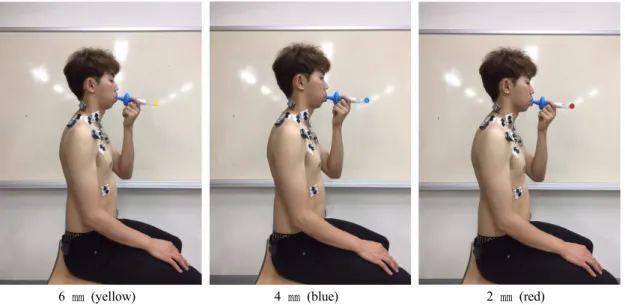
Methods : The Borg’s scale and surface electromyography (EMG) was used to collect data of the RPE and muscle activity of the inspiratory primary the external intercostal (EI) and diaphragm (DIA) and accessory muscles anterior scalene (AS), sternocleidomastoid (SCM), pectoralis major (PM), and upper trapezius (UT) muscles during breathing exercise with different air hole diameters (6 ㎜, 4 ㎜, and 2 ㎜) of the IMT in healthy young male subjects.
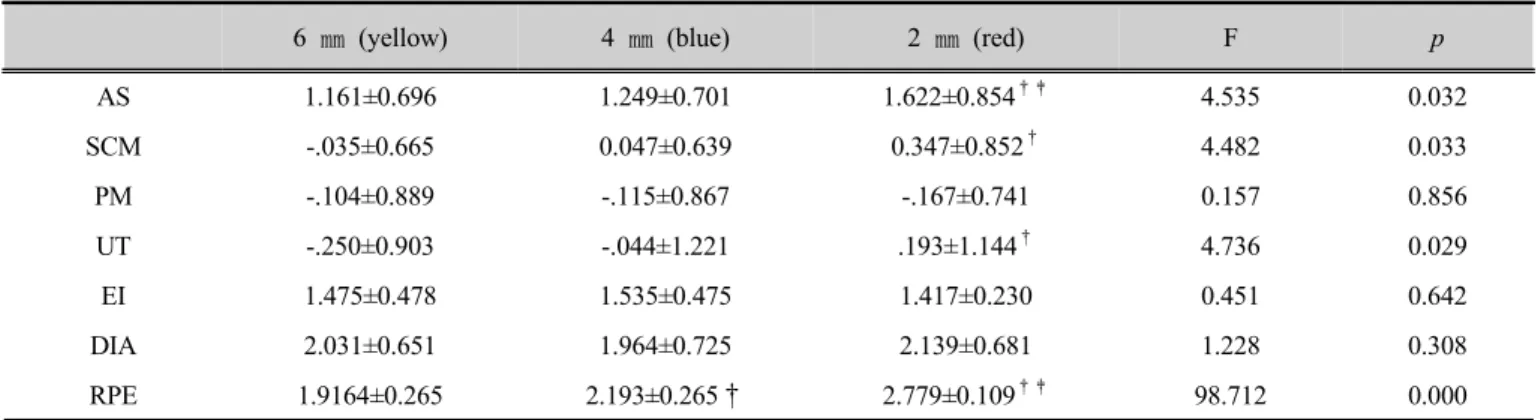
Results : The RPE and muscle activities of the AS, SCM, and UT are increased significantly in accordance to the decreasing diameter of air hole of air tip in IMT. However, there are no differences in the muscle activities of the PM, EI, and DIA based on differences of diameters of air hole of air tip in IMT.
Conclusion : The smaller the diametr of IMT air-hole, RPE and muscle activities of AS, SCM and UT were increased. Therefore, further study would be necessary to investigate the proper intensity and relaxation posture for the exercise protocol to strengthen the inspiratory primary muscles.
Key Words : different diameters of air tip of inspiratory muscle trainer, inspiratory primary and accessory muscle, muscle activity, rating of perceived exertion
ǂ
Corresponding author : Kim Kisong, [email protected]
2)