․투고일: 2018.03.15, 심사일: 2018.06.29, 게재확정일: 2018.06.28
․Corresponding author: Chang-hyeong Lee Dept. of Internal Medicine, School of Medicine, Catholic University of Daegu, 3056-6 Daemyeong 4-dong, Nam-gu, Daegu, Korea
TEL: +82-53-650-4050 FAX: +82-53-628-4050 E-mail: [email protected]
Pilot Study: Effects of Acupuncture on the Muscle Cramps of Liver Cirrhosis Patients
Seung-mo Kim1, Min-ah Kwak1, Jeong-hyun Joo1, Kyung-soon Kim1, Im-hee Shin2, Chang-hyeong Lee3
1Dept. of Internal Medicine, College of Korean Medicine, Daegu Haany University
2Dept. of Medical Statistics, School of Medicine, Catholic University of Daegu
3Dept. of Internal Medicine, School of Medicine, Catholic University of Daegu
Pilot Study: Effects of Acupuncture on the Muscle Cramps of Liver Cirrhosis Patients
Seung-mo Kim1, Min-ah Kwak1, Jeong-hyun Joo1, Kyung-soon Kim1, Im-hee Shin2, Chang-hyeong Lee3
1Dept. of Internal Medicine, College of Korean Medicine, Daegu Haany University
2Dept. of Medical Statistics, School of Medicine, Catholic University of Daegu
3Dept. of Internal Medicine, School of Medicine, Catholic University of Daegu
ABSTRACT
Objective:
The purpose of this clinical trial is to examine the efficacy and safety of electroacupuncture on liver cirrhosis patients suffering from muscle cramps.
Methods:
A total of 14 liver cirrhosis patients with muscle cramps were treated by electroacupuncture three times a week for four weeks (12 times total). The electrical stimulation was a frequency of 100 Hz. Evaluation of the muscle cramps was measured by a questionnaire of subjective symptoms. The patients’ condition was evaluated four times over a period of eight weeks. We also assessed the deterioration of liver disease using the Child-Pugh score and blood tests.
Results:
This study proves that four weeks of electroacupuncture treatment is effective in reducing the frequency of muscle cramps and that the effects of electroacupuncture treatment lasted during another four-week follow-up period after treatment.
Conclusions:
This study suggests that electroacupuncture treatment is beneficial for improving muscle cramps in liver cirrhosis patients (p=0.000). Electroacupuncture is thought to be a safe treatment for liver cirrhosis patients with muscle cramps without contributing to the worsening of liver function. Further study with a larger sample size is needed to confirm our findings.
Key words:
liver cirrhosis, muscle cramp, electroacupuncture
Ⅰ. Introduction
Muscle cramps mean involuntary muscle contractions
including pain. Muscle cramp is not life-threatening, but affects the patients’ quality of life. It is a condition that normally occurs relatively in liver cirrhosis patients and recognized as a side effect of diuretics
1.
The aetiology of chronic liver disease is variable.
Over 70% of people with chronic liver disease
report painful muscle cramps and a causal relation
ship rather than a simple association has been
described
2,3.
Since 1986 Konokoff’s report, muscle cramps began to be accepted into the neuromuscular symptoms of liver cirrhosis
4. After that, researches on the treatment and related factors of muscle cramps
5,6were being accomplished in various ways.
The quinine drug family helps to treat symptoms of muscle cramps, but it is unapproved because of serious side effects
7. Another treatment including antiepileptics, calcium channel blockers, and various vitamins, minerals supplements have been studied to treat symptoms of muscle cramps and research shows some are not helpful or have adverse effects such as lightheadedness, nausea, and diarrhea
6,7.
The electroacupuncture therapy is a treatment that gives the electrical stimulation utilizing a variety of voltage and frequency to the needle, gives a strong stimulus than a simple acupuncture therapy. In the domestic study showed electroacupuncture is alleviating on many diseases such as pain
8,9, stroke
10, erectile dysfunction
11, nausea and vomiting
12, depression
13, gastric motility
14, obesity
15etc. Electroacupuncture treatment has been reported to be effective in muscle spasticity and cramps of stroke patients
16and protective effect in rat with CCl
4-induced liver injury
17.
Therefore, electroacupuncture treatment has been thought to be effective on muscle cramps of liver cirrhosis patients, this study was designed to evaluate the effects of electroacupuncture treatment for the patients who complain muscle cramps diagnosed of liver cirrhosis.
Ⅱ. Methods
1. Participant recruitment
Sixteen participants were enrolled in the clinical trial between July 4, 2013 and December 31, 2013.
Participants were informed of the purpose, method, anticipated adverse dangers and discomforts, disclosure of personal information, compensation, and right to discontinue the clinical trial. All patients signed an agreement to enter at one's own will. This study was approved by the Institutional Review Board of Daegu Catholic University Hospital (approved number : MBCR-13-009). Participants were recruited via a recruitment notice on the web site or a poster. The required sample size was estimated to be a total 14 participants, considering a drop-out rate of 20%.
2. Inclusion and Exclusion Criteria
Inclusion criteria were as follows: participants (1) age 18 years or over who complain of muscle cramps was diagnosed of cirrhosis and the frequency of true cramps was at least once a week, regardless of part of cramps; (2) serum bilirubin lever 3 mg/dL or lower; (3) serum aspartate aminotransferase (AST), alanine aminotransferase (ALT) 100 IU/L or lower; (4) serum creatinine 1.5 mg/dL or lower;
(5) international normalized ratio (INR) 1.5 or lower. The participants were able to follow-up for the duration of the study, accord with the washout criteria (muscle cramps induce or inhibit drugs a week administered limit) and agreed to keep the restriction rule during the study.
Exclusion criteria were as follows: participants
(1) have disease associated with muscle cramps,
such as diabetes mellitus, vascular occlusive disease,
peripheral neuropathy, phlebitis syndrome and thyroid
disease; and (2) neutropenia (absolute neutrophill
count 500/mm
3or less) and (3) moderate or severe
thrombocytopenia (platelet count 50,000/mm
3less)
and (4) worsening liver cancer symptom such as
fever, aggravation of liver function, abdominal aortic
aneurysms, venous thrombosis and (5) inappropriate in this study confirmed by researchers and (6) childbearing age (Urine HGC positive).
3. Intervention
The study protocol involved total 8 weeks, 4 weeks of treatment with 3 acupuncture sessions per week after screening and 4 weeks from the final acupuncture evaluated the efficacy.
Acupuncture was applied at 9 acupuncture points:
GV20, EX-HN3 and bilaterally at 7 points including LI11, LI10, LI4, ST36, LR3, KI6 and BL62. The all needles were inserted 25 mm into the skin and the electrical stimulation was put on the ST36 and LR3 points with a frequency of 100 Hz. The acupuncture needles used were sterile, disposable stainless steel needles (0.20×40 mm; Dongbang Acupuncture Inc., Chungcheongnam-do, Korea), and total of 16 needles were used.
4. Outcome measurements
All participants completed the self-report of muscle cramps questionnaire six times (screening, V5, V8, V11, V14, V15) during 8 weeks. The questionnaire of muscle cramps occurrence frequency included ‘more than once a day’, ‘less than once a day~more than once a week’, ‘less than a once a week~more than once a month’, ‘less than once a month’, ‘none’.
5. Safety evaluation
To evaluate the safety of acupuncture, body temperature, blood pressure, pulse and body weight of the participants were checked at each visit.
Child-Pugh scores and biochemistry tests (Total Bilirubin, AST, ALT, Albumin, blood urea nitrogen (BUN), creatinine (Cr), INR) were performed at visit 1, 14, 15 for patients. Adverse events were
examined by the investigator at each visit.
To check for aggravation of liver cirrhosis, patients were checked of hepatic coma, hepatorenal syndrome, hemorrhage from rupture of esophageal and gastric varices, infection/sepsis, spontaneous peritonitis, and liver function failure. For patients with aggravated liver cirrhosis, the investigator decided whether to discontinue the trial and hospitalization.
Compliance was calculated from the attendance rate of more than 80%, and any participant absent for 5 consecutive appointments was regarded as a drop-out. Participants were told to immediately report any adverse events between visits. Any abnormal condition following acupuncture was to be investigated in relation to the clinical trial and followed-up.
6. Statistical analysis
The statistical methods used were based on Statistics Guidelines for Clinical Trials (KFDA, 2000).
The data was analyzed using per pro approaches.
Statistical analyses were carried out using the program SPSS Win Ver 19.0. Repeated measure ANOVA analysis was used to analyze the frequency of muscle cramps, and significance was set as p=0.05.
Ⅲ. Results
1. Baseline characteristics
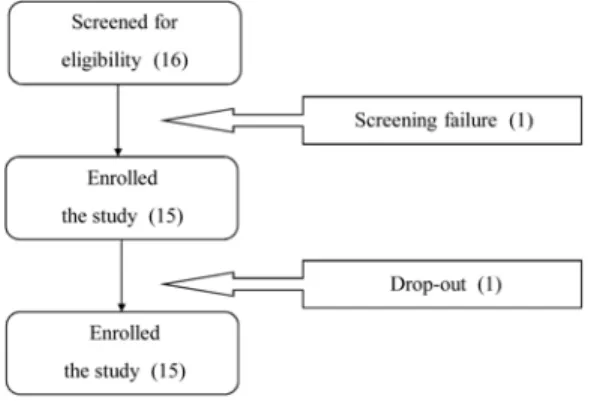
Sixteen patients were screened for eligibility, one of them was screening failure and other one dropped-out, so fourteen patients completed the study. Except the LC-A009 who had only twice acupuncture treatment and dropped-out, all patients have shown over 90%
compliance (Fig. 1).
Fourteen completed participants consisted of 4
men and 10 women patients, the mean age was
59.64 years old (Table 1).
Fig. 1. Study flow chart.
Variable n (%) or mean (S.D.)
Sex, n (%) Male 4 (28.6)
Female 10 (71.4)
Age, mean (S.D.) 59.64 (6.428) Table 1. Baseline Characteristics of Patients
2. Frequency of muscle cramp
All participants completed the self-report of muscle cramps questionnaire 6 times (screening, V5, V8, V11, V14, V15) during the study.
Looking at the change of muscle cramps occurrence frequency in the questionnaire, the number of patients have occurred ‘more than once a day’ or ‘less than once a day~more than once a week’ has reduced to 14, 8, 4, 2 and the proportion of patients has decreased 100, 57.1, 28.6, 14.3%. The number of patients have occurred ‘none’ or ‘less than once a week~more than once a month’ or ‘less than once a month’ has increased 0, 6, 10, 12 and the proportion of patients has increased 0, 42.9, 71.4, 85.7%.
The electroacupuncture treatment is effective in reducing the frequency of muscle cramps (p=0.000) (Table 2).
Muscle cramps occurrence frequency, n(%)
Total n (100%)
‘none' or ‘less than once a week~more than once a month' or 'less than once
a month'
‘more than once a day' or ‘more than once a week~less than once a day'
Screening 0 (0) 14 (100) 14
Visit 8 6 (42.9) 8 (57.1) 14
Visit 14 10 (71.4) 4 (28.6) 14
Visit 15 12 (85.7) 2 (14.3) 14
χ
2(p-value) 21.000
†(0.000)* -
* : statistically significant with p<0.05
†: result of Friedman by contrast
Table 2. Change of Muscle Cramps Occurrence Frequency
3. Safety
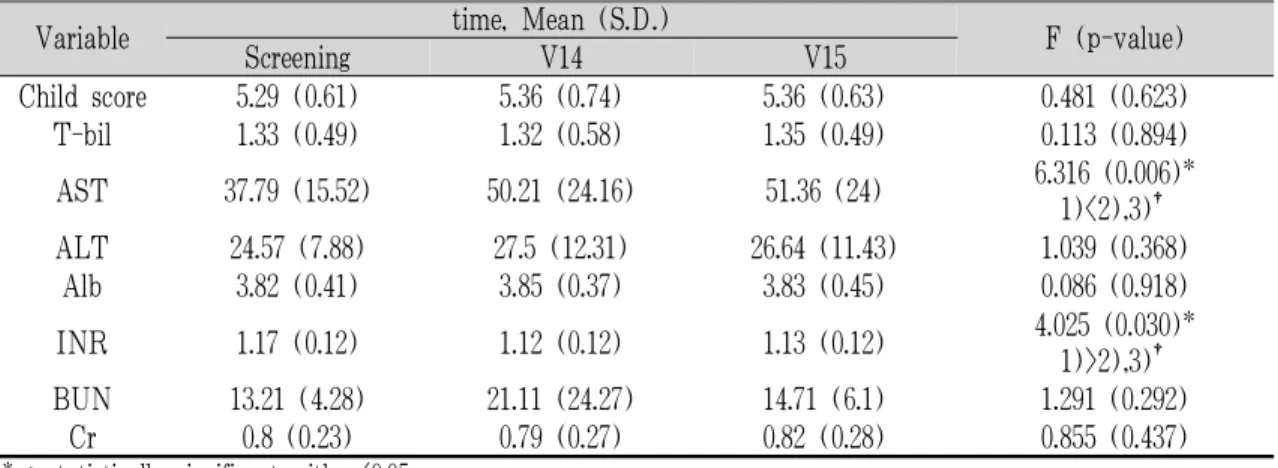
To evaluate the safety of acupuncture, we performed liver function tests (Table 3). There were no significant differences in T-Bilirubin, AST, ALT, Albumin, BUN, Cr, INR (Table 3). Furthermore, aggravation of liver cirrhosis and primary complications (hepatic encephalopathy,
hepato-renal syndrome, esophageal/gastric varices bleeding, infection/sepsis, spontaneous peritonitis) were not observed. All patients showed good compliance.
Adverse events were checked every visit during the
course of trial, and no adverse events were observed
in the course of study in any of the fourteen patients.
Variable time, Mean (S.D.)
F (p-value)
Screening V14 V15
Child score 5.29 (0.61) 5.36 (0.74) 5.36 (0.63) 0.481 (0.623)
T-bil 1.33 (0.49) 1.32 (0.58) 1.35 (0.49) 0.113 (0.894)
AST 37.79 (15.52) 50.21 (24.16) 51.36 (24) 6.316 (0.006)*
1)<2),3)
†ALT 24.57 (7.88) 27.5 (12.31) 26.64 (11.43) 1.039 (0.368)
Alb 3.82 (0.41) 3.85 (0.37) 3.83 (0.45) 0.086 (0.918)
INR 1.17 (0.12) 1.12 (0.12) 1.13 (0.12) 4.025 (0.030)*
1)>2),3)
†BUN 13.21 (4.28) 21.11 (24.27) 14.71 (6.1) 1.291 (0.292)
Cr 0.8 (0.23) 0.79 (0.27) 0.82 (0.28) 0.855 (0.437)
* : statistically significant with p<0.05
†: multiple comparison result by contrast T-bil : total bilirubin
AST : aspartate aminotransferase ALT : alanine aminotransferase Alb : albumin
INR : international normalized ratio BUN : blood urea nitrogen Cr : creatinine
Table 3. Mean Change of Child Score and Blood Composition
Ⅳ. Discussion
Acupuncture and electroacupunture are somewhat effective treatment for liver cirrhosis patients experiencing muscle cramps and that would help improving the quality of life. So this study is a clinical trial to demonstrate the effect of electroacupuncture treatment for liver cirrhosis with muscle cramps.
Sixteen patients were screened for eligibility, one of them was screening failure and other one dropped-out, so fourteen patients completed the study.
This study proves the during 4 weeks of electroacupuncture treatment is effective in reducing the frequency of muscle cramps and the effects of acupuncture treatment also lasting during 4 weeks follow-up period (Fig. 2).
Fig. 2. Change of muscle cramps occurrence frequency.
The electroacupuncture therapy is a treatment
that gives the electrical stimulation utilizing a variety
of voltage and frequency to the needle, give a strong
stimulus than a simple acupuncture therapy and studies of electroacupuncture have been made on a wide range of diseases
8-15.
Some studies show that electroacupuncture is effective way to treat diseases, especially muscle cramps caused by spinal cord injury
16undergoing hemodialysis
17and Heo
18et al. reported the effect of electroacupuncture at Yanglingquan (GB34) on CCl
4-induced liver damage in rats.
The acupuncture points used in this study were selected based on previous studies
19-23. 16 acupuncture points are located in lower limbs and arms, which occur muscle cramps frequently. As acupuncture location, extremities are effective on the relieving pain, calming and activating cerebral blood-flow.
Each acupoints has the following effects. Both LI4 and LR3
19points, namely ‘four gates’, are clinically used in stress-related symptoms by regulating the flow of blood and qi. The LI4 is the main acupoint of the qi and the LR3 is the other main acupoint
of blood. In addition, LR3 acupoint is in the liver meridian and has effects on the hepatitis, cholecystisis and convulsion of epilepsy caused by liver diseases.
GV20
20acupoint located the highest position of our body so it can boosting up our yang-qi. GV20 has effects on dementia, insomnia, epilepsy and mental diseases. EX-HN3
21point has a calming effects such as insomnia, headache and vertigo. This two acupoints located in our head and increases the head blood circulation, thus could treat head diseases. KI6 and BL62
22acupoints ,which are located on the ankle joint, could balance our yin and yang-qi and treat our sleep disorders. ST36, LI10 and LI11 acupoints are located on the limbs, which occur muscle cramps frequently. ST36
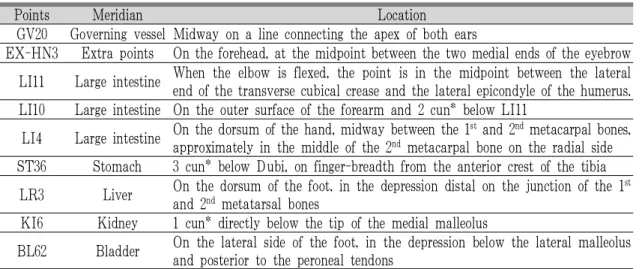
23is the main acupoint of gastro- intestinal diseases and strengthening the body’s resistance and restoring our vital energy. LI10 and LI11 are located on the upper extremities so they are used on numbness, pain and motor impairment of the hand (Table 4).
Points Meridian Location
GV20 Governing vessel Midway on a line connecting the apex of both ears
EX-HN3 Extra points On the forehead, at the midpoint between the two medial ends of the eyebrow LI11 Large intestine When the elbow is flexed, the point is in the midpoint between the lateral
end of the transverse cubical crease and the lateral epicondyle of the humerus.
LI10 Large intestine On the outer surface of the forearm and 2 cun* below LI11
LI4 Large intestine On the dorsum of the hand, midway between the 1
stand 2
ndmetacarpal bones, approximately in the middle of the 2
ndmetacarpal bone on the radial side ST36 Stomach 3 cun* below Dubi, on finger-breadth from the anterior crest of the tibia
LR3 Liver On the dorsum of the foot, in the depression distal on the junction of the 1
stand 2
ndmetatarsal bones
KI6 Kidney 1 cun* directly below the tip of the medial malleolus
BL62 Bladder On the lateral side of the foot, in the depression below the lateral malleolus and posterior to the peroneal tendons
* : A cun is an acupuncture measurement unit that is equivalent to the width to the participant’s thumb at the distal phalanx.