• 검색 결과가 없습니다.

Whole Life Performance Bid Evaluation in the Korean Public Sector

N/A
N/A
Protected

Academic year: 2021

Share "Whole Life Performance Bid Evaluation in the Korean Public Sector"

Copied!
19
0
0

로드 중.... (전체 텍스트 보기)

전체 글

(1)

pISSN 1598-2033 eISSN 2233-5706

Journal of the Korea Institute of Building Construction, Vol. 12, No. 6

http://dx.doi.org/10.5345/JKIBC.2012.12.6.682 www.jkibc.org

Whole Life Performance Bid Evaluation in the Korean Public Sector

Park, Kenneth Sungho

1

Lim, Hyoung-Chul

2*1)

School of Engineering & Applied Science, Aston University, Aston Triangle, Birmingham, B4 7ET, UK

1

School of Architecture, Changwon National University, #9 Sarim-dong, Uichang-gu, Changwon, Gyeongnam, Korea

2

Abstract

Over the last several years, Korea has increasingly adopted design-build for public construction projects. There is a much greater awareness of the need to change to a system based on ‘Value for Money’, which is high on the government's agenda. A whole life performance bid evaluation model is proposed to aid decision makers in the selection of a design-builder. This is based on the integration of a framework using an analytic hierarchy process, as the bid awarding system is being changed from one based on the lowest price to one based on best value over the life-cycle. Key criteria such as whole life cost, service life planning and design quality are important through the key stages of the evaluation process. The model uses a systematic and holistic approach, which enables the public sector client to make better decisions in design-builder selection, which will deliver whole life benefits based on long-term cost-effectiveness.

Keywords : analytic hierarchy process (AHP), bid evaluation, design-build (D-B), whole life performance

1. Introduction

The Global Construction 2020 report [1] predicts that the global construction market will grow by 67%, from US$7.2 trillion today to US$12trillion by 2020, contributing 8% to 10% of the global Gross Domestic Product (GDP). The Republic of Korea (hereinafter referred to as ‘Korea’) is no exception to this trend. Producing more than 9% of the GDP of Korea, which is approximately 2% of the total output of the global construction industry in 2010, the construction industry has played an important role in the development of the Korean economy over several decades [2].

Received : October 5, 2012

Revision received : October 18, 2012 Accepted : October 22, 2012

* Corresponding author: Lim, Hyoung-Chul

[Tel: 82-55-213-3803, E-mail: [email protected]]

ⓒ2012 The Korea Institute of Building Construction, All rights reserved.

Since Korea joined the World Trade Organization

(WTO) in 1995, it has faced a rapidly changing

environment in the process of globalization and

internationalization and public clients have become

increasingly concerned with the cost of capital for

construction projects. Korea has increasingly

adopted design-build for public construction

projects, and this approach gained an increased

market share in the last few years in providing

better value for money [3] as it offers a number of

various advantages including a single point of

responsibility between client and the design-build

entity, innovative solutions, time, cost savings and

more [4,5,6]. In the history of the design-build

approach, the selection of an appropriate

design-builder has been considered as a key

success factor of a D-B project. Many researchers

agree that the main success criteria can be defined

in terms of time, cost, and quality [6,7,8] and bid

price is the main determinant in design-build

(2)

selection. However, since the regulations mandated design-builder selection on a low price basis in 2001, and the lowest bid awarding system has expanded [9], the profitability of D-B has decreased.

Traditionally, awarding a construction contract based solely on the lowest price can result in problems such as cost over-runs, delays and poor performance [10,11,12]. Despite a huge increase in the complexity of projects and clients ’ needs over the last two decades, the criteria for bid evaluation based on a lowest price have hardly changed [13].

In recent years, the construction industry has broadly acknowledged the benefits of whole life cost in assessing costs of projects, facilities and equipment before any commitment is made. It has become much more important as long-term building owners and clients start to demand evidence of their likely costs of ownership with value, performance and quality improvement as key objectives, rather than just competition on price [14].

Since the first D-B project in 1977, the bid evaluation and awarding systems have been consistently developed and modified (more than seven times) in order to adopt design-build appropriately for the Korean construction industry [9]. Lee and Lee [15] stated that the need to change a system based on ‘Value for Money’ and

‘Best Value’ in Korea is accelerating ‘systematic’

changes in the construction industry. So far, however, there has been little discussion about systematic bid appraisal on the basis of the whole life. This research will focus on a rational and systematic tool to evaluate and select a more suitable design-builder for public clients in Korea which have shown an increased interest in bid evaluation based on whole life performance.

2. Research approach and methods

In practice, bid decisions are usually made in a largely subjective manner [16]. Therefore, there are many different procedures the client could adopt to elicit such a valued function by using particular approaches to questioning and scoring in the elicitation of the decision maker ’s values.

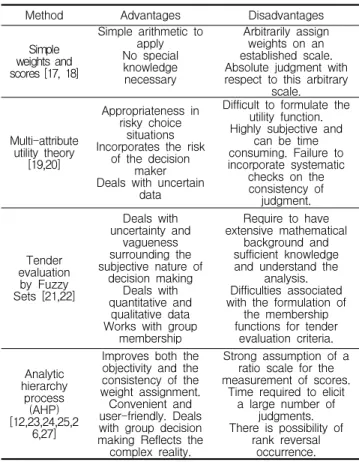
Previous studies have proposed different methods for contractor selection. To name a few of them:

simple weights and score model by Holt et al. [17]

and Korman et al. [18]; multi-attribute model by Diekmann [19] and Hatush and Skitmore [20]; a fuzzy bid evaluation model by Nguyen [21] and Singh and Tiong [22]; and analytic hierarchy process (AHP) for contractor selection by Belton [23], Mustafa and Ryan [24], Fong and Choi [25], Al-Harbi [26] Mahdi, Riley et al. [12] and Topcu [27] as seen in Tables 1 and 2.

Table 1. Comparison of evaluation methods

Method Advantages Disadvantages

Simple weights and scores [17, 18]

Simple arithmetic to apply No special knowledge necessary

Arbitrarily assign weights on an established scale.

Absolute judgment with respect to this arbitrary

scale.

Multi-attribute utility theory

[19,20]

Appropriateness in risky choice

situations Incorporates the risk

of the decision maker Deals with uncertain

data

Difficult to formulate the utility function.

Highly subjective and can be time consuming. Failure to incorporate systematic

checks on the consistency of

judgment.

Tender evaluation

by Fuzzy Sets [21,22]

Deals with uncertainty and

vagueness surrounding the subjective nature of

decision making Deals with quantitative and

qualitative data Works with group

membership

Require to have extensive mathematical

background and sufficient knowledge and understand the

analysis.

Difficulties associated with the formulation of

the membership functions for tender

evaluation criteria.

Analytic hierarchy

process (AHP) [12,23,24,25,2

6,27]

Improves both the objectivity and the consistency of the weight assignment.

Convenient and user-friendly. Deals with group decision making Reflects the complex reality.

Strong assumption of a ratio scale for the measurement of scores.

Time required to elicit a large number of

judgments.

There is possibility of rank reversal

occurrence.

(3)

Method Main Criteria Holt et al.

[17] Simple weights and scores

Project specific factors Bid Price Korman et al. [18] Simple weights

and scores

Schedule, Design, Construction, Quality

Bid Price Diekmann [19] Multi-attribute

utility theory

Management Capability Bid Price

Hatush and

Skitmore [20] Multi-attribute utility theory

Financial soundness, Technical ability,

Management capabilities, Safety,

Reputation Bid Price Nguyen [21] Fuzzy Set Theory Experience,

Performance Bid Price Singh and Tiong

[22] Fuzzy Set Theory Past performance, Performance potential

Bid Price

Fong and Choi

[25] Analytic Hierarchy Process (AHP)

Financial capability, Past performance,

Past experience, Resource, Past relationship, Safety

Bid Price Mustafa and

Ryan [24] Analytic Hierarchy Process (AHP)

Technical Bid Price

Fong and Choi

[25] Analytic Hierarchy Process (AHP)

Financial capability, Past performance,

Past experience, Resource, Past relationship, Safety

Bid Price Table 2. Comparisons between methods and criteria

However, previous models or methodologies are generally used either for pre-qualification or final evaluation for a general contractor using a traditional procurement method. In addition, they do not represent and evaluate bidders based on whole life costs, and none of them are suitable for Korea ’s current design-build bid evaluation and awarding system, nor do they support a comparative analysis of bid options to aid a public sector client in making a better decision during the bid evaluation. To improve this situation, further methods for D-B are being sought for current processes, as previous models are generally

used either for pre-qualification or final evaluation for a general contractor using a traditional procurement method.

More recently, literature has emerged that an analytic hierarchy process (AHP) is identified as the most widely known example of the group consensus variety, and the AHP based model has become a valid decision-making tool for many researchers [12,25,26,27,28], as it enables the decision-maker to aggregate individual judgments in a group into a single representative judgment for the entire group. In using AHP for whole life performance bid evaluation in this research, the criteria from different dimensions and the priority from different evaluators of different positions are synthesized to select a design-builder. AHP is also handy for calculating priority indices by a simple set of matrices in popular spreadsheet software.

However, drawbacks and limitations still exist.

Dyer [29] pointed out that the ‘rank reversal’

phenomenon may occur in ranking alternatives, and the pairwise comparisons are restricted to 1 to 9 scales, which necessarily imposes inconsistency of responses [30]. Addressing these points, many researchers have stated that AHP principles and scale have a solid theoretical and practical basis.

For example, Saaty and Vargas [31] demonstrated

how ‘rank reversal’ is normal, and when the

judgments in the AHP are consistent and an

alternative is irrelevant, it cannot cause rank

reversal. Vargas [32] observed that in the AHP,

every alternative that can be compared with other

alternatives can be called relevant in that

terminology. Moreover, rank reversal can be

avoided through the absolute measurement of

alternatives, and the pairwise comparisons enabled

by a full understanding of the criteria will

guarantee the proper use of AHP, and forecasts

obtained from holistic judgment represent an

obvious benchmark [30,31].

(4)

Date Main Points of bid evaluation / awarding system

Oct 2007

~ Present

‐ Elaboration on D‐B evaluation and awarding baseline

‐ Consideration of specialty and responsibility for bid evaluation

‐ Activation of design evaluation forum

‐ Promotion of fairness and transparency for design evaluation

: increase size of design advisory committee from 10 to 15 members

Dec 2004

~ Oct 2007

‐ Compulsory design review document by public officer

‐ Requirement enforcement of a bid evaluation committee member Aug 2003

~ Dec 2004

‐ Focus on design evaluation professionalism in terms of fairness

‐ Change individual evaluation by specialty to comprehensive evaluation, Reduce bidding fee

to attract medium‐sized firms to D‐B

Aug 1995

~ Aug 2003

‐ bid evaluation on scheme design à selection of one bidder with highest total score (scheme design score + construction performance capability + bid price) à detailed

design by bidder à evaluation of detailed design by committee à bid award (if detailed

design is passed by the committee)

May 1992

~ Jul 1995

‐ selection of one bidder for detailed design with total highest score (total score = total construction cost / scheme design score) à detailed design by this bidder à evaluation of

detailed design by committee à bid award

Apr 1983

~ Apr 1992

‐ short list of 5 lowest bidders by total score (total score = bid price / scheme design scores) à detailed design by these bidders à

evaluation of detailed design by committee à the lowest bid award (total score = bid price /

detailed design scores) Apr 1977

~ Apr 1983

‐ short list of 5 lowest bidders by total construction cost à technical bid evaluation à the lowest bid award by total construction

costs Apr 1975

~ Mar 1977

‐ short list of bidders: more than 85% of estimated bid price à technical bid evaluation

of bidder nearest to the average price of these bidders à bid award Table 3. History of bid evaluation and awarding systems

From these points of view, the pair-wise comparison of AHP is the best available and practical methodology for bottom-up group decisions of bid evaluation. It also allows the construction of a group choice from individual choices by improving both the objectivity and the consistency of the weight assignment.

Furthermore, the Ministry of Strategy and Finance

in Korea has used AHP for the preliminary feasibility study of public construction and development projects since 1999, as it allows the decision-maker to measure the consistency of their judgments and uses an analytic procedure to process these judgments.

2.1 Bid evaluation and criteria of Design-Build in Korea Since the first D-B project in 1977, the bid evaluation and awarding system have been consistently developed and modified in order to adopt design-build in a manner appropriate to the Korean construction industry [9]. Table 3 describes how bid evaluation and awarding systems have changed.

Before the bid evaluation, potential bidders are qualified according to a pre-qualification evaluation. A chief of division or a contract officer evaluates their performance records, technology, management and creditability according to the qualification criteria determined by the Minister of Strategy and Finance of Korea. After a pre-qualification evaluation, the six short-listed bidders are evaluated by their construction performance capability, scheme design and bid price according to the qualification criteria, and the qualified bidder with the highest score for the detailed design is awarded. However, bid evaluation and awarding systems were revised by the enforcement ordinances of the ‘Act on Contracts to Which the State is a Party ’ in October 2007 because previously the construction performance capability and bid price were not evaluated distinctively, making the design score the decisive criterion [33].

2.2 Hypothetical Example Applied : A Questionnaire Survey

There are two propositions for this research: (1)

Whole life appraisal has become an accepted

(5)

methodology to evaluate WLC; (2) There is the need for Korea to adopt a WLC approach in the selection process of a successful bidder for D-B.

Thus, the focus of this paper is on the integration of whole life cost into the evaluation of D-B in Korea, and a bid evaluation process of a D-B project based on whole life performance against cost, time and quality.

A hypothetical bidding decision-making scenario is used to demonstrate the ideas presented in this research. A simplified example of a project and bidders is used; the project description is as follows.

Project name : D Project ‘A’ Block

Client : Seoul Metropolitan Government Location : Seoul, Korea

Land Area : 41,645.52 m 2 Building Area : 419,760.40 m 2

Size : 11F, Basement 5F, 4,065 shops Project Budget : US$ 486 Million

(Estimated initial capital price) Estimated WLC: US$ 15 Billion

Project Periods : 22 months Life expectancy : 30 years Discount rate : 3.5%

This project was used as an example based on three assumptions: (1) A potential bidder is requested to submit the bid price based on whole life costs; (2) Six bidders are to bid for this project; (3) All bidders are already qualified according to the pre-qualification evaluation. The hypothetical bidders are asked to input data based on their subjective evaluation and aspiration levels.

An example of which bidders wish to be selected is presented in Appendix A.

As all clients of D-B in Korea are public sector clients, a questionnaire survey was conducted with major public sector construction procurers of

Design-Build in Korea, encompassing 376 D-B projects, 26.5% of the total of 1,418 public mega projects occurring between 2003 and 2006. All of the respondents to the questionnaire have been involved in major public sector projects in Korea at one of the following four levels: (1) central and local government; (2) educational authorities; (3) public corporation; and (4) various public organizations.

The survey was used to determine public sector clients ’ understanding of whole life costs and prioritize the key and sub-criteria in the hierarchy for design-builder selection. These priorities were incorporated into a WLP bid evaluation. Sixty questionnaires were sent out to the public sector clients after sixty project and cost managers for D-B in Korea were determined as appropriate survey targets after checking some eligibility requirements, despite there being an initial goal of 80 participants in the public sector. Eighteen completed questionnaires were returned but only 15 replies were valid – a response rate of 25%. All respondents had been in the Korean construction industry for between 5 years and 25 years, with a mean period of 13.4 years. They have been involved in the decision making process of contractor selection, including for major design-build projects, and their practical experience and involvement indicated that the relative importance of each criterion collected from the survey can be considered reasonably reliable and realistic.

3. Whole life performance bid evaluation model

A modified process map of the life cycle costing

stages for design-build from the Standardized

Method of Life Cycle Costing for Construction

(6)

Procurement (SMLCC) was adopted, as this process map is distinguishable by the public client and design-builder to clarify its role, and generalizes whole life costing stages to define input, output, control and mechanism at each stage (Park and Flanagan 2009) (See Appendix B).

The proposed WLP bid evaluation model comprises three central stages on WLC pre-tender evaluation (C3) and WLC tender evaluation process (C4) on the process map in Appendix B: (1) WLP pre-bid evaluation stage (C3); (2) One Bidder selection stage for detailed design (C3); and (3) WLP bid evaluation stage of the selected Bidder (C4).

This research focuses on three evaluations and the integration of the proposed stages (WLP pre-bid and bid evaluation stages) and the existing stage (one Bidder selection stage) to produce a single desirable and practical process for selecting a design-builder.

3.1 WLP bid evaluation stage 1: WLP pre-bid Evaluation Stage

The analytic hierarchy process, first introduced by Saaty in 1980, is a theory of measurement through pairwise comparisons and relies on the judgments of experts to derive priority scales [34].

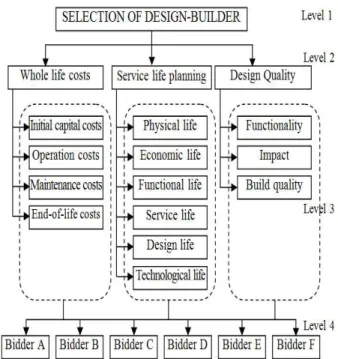
As described in Figure 1, the hierarchy structure, the first phase of the AHP-based WLP pre-bid evaluation, is the first step that involves definition of the goal, which is to select a design-builder, and adjustment of the solution. As the main focus of attention in any construction project is usually its final cost, completion time and level of quality, the relevant criteria for D-B in Korea are taken into account, enabling the client to select a design-builder who performs and completes a project satisfactorily. To achieve this, both qualitative and quantitative analysis of bid proposals are considered, and qualitative

approaches are mostly governed by client requirements of time, cost, and quality, with various client-preferred combinations such as the relative importance of “cost versus time” and “time versus quality ”.

Figure 1. Hierarchy for design-builder selection

The results of previous research [35] support the traditional key criteria of time, cost, and quality as important for project performance and meeting clients ’ needs. To select the most capable design-builder, the three criteria are established at level 2: whole life cost (WLC) for cost, service life planning for time, and design quality for quality [36,37,38].

Key criteria such as whole life cost for ‘bid price, ’ service life planning for ‘time,’ and design quality ‘quality’ at level 2, were adopted with sub-criteria which can be set according to various client preferred combinations through the survey.

Only the decision factors relevant to the project

under discussion are determined as evaluation

criteria and grouped into sets at the various

(7)

hierarchy levels. In this research, the overall objective of WLP bid evaluation is to select the most capable design-builder, with the selection being broken up into a hierarchy, a process that can be iterated until there is a consensus on the ideal level and sub-criteria for a specific project.

For example, ‘Design quality’ has the sub-criterion of functionality (how useful the facility is in achieving its purpose), impact (how well the facility creates a sense of place) and build quality (performance of the completed facility), as design quality is critical for the success of a design-build and incorporates the key requirements of the clients and business, functionality, whole-life value in relation to maintenance, management, flexibility, and environmental impact [37,38]. In Figure 1, the overall objective of ‘selecting the most capable design-builder ’ lies at the top of the hierarchy, and the three criteria are whole life cost, service life planning, and design quality.

These criteria were broken down into sub-criteria at level 3, providing a total of 13 ‘criteria’ through iterative workshops with ten academics and ten professional practitioners.

In the next phase, pairwise comparison is used to systematically determine the relative importance of criteria at each level of the hierarchy using a nine-point scale (1: Equal importance – 9:

Absolute importance), and the principal eigenvector computed from these pairwise comparisons becomes the vector of priorities when normalized. Before accepting the eigenvector as the weight, or importance, of a specific criterion relative to all other criteria, a consistency check should be carried out to ensure that these weights reflect the full information contained in the pairwise comparison matrix so that the judgment is acceptable.

For WLP evaluation using AHP, there are 17 pairwise comparison matrices in all, including one

for the main criteria of level 2 with respect to level 1 ‘selection of design-builder’; three for the sub-criteria of level 3, the first of which is for the sub-criteria under ‘whole life cost’: initial capital costs, operation costs, maintenance costs and end-of-life costs; the second of which is for the sub-criteria under ‘service life planning,’ and the third of which is for the sub-criteria under

‘design quality’. There are 13 comparison matrices for the six bidders with respect to all criteria at level 3. The pairwise comparison and the priority of each criterion in level 2 and 3 are obtained through fifteen completed questionnaires to establish the relative importance of each criterion in the AHP. The questionnaire survey was synthesized, respondents ’ judgments determined the relative importance of criteria, geometric mean was calculated to aggregate the evaluation of different respondents involved in the decision process, and local and global priorities on criteria were computed (see Appendix C). The input of an evaluation committee, like the central construction technology committee (CCTC) or design advisory committee (DAC) in Korea, is solicited to determine the extent to which each bidder satisfies each criterion.

Bidders A, B, C, D, E, and F are compared with respect to each criterion. There are thirteen criteria in total in the hierarchy so that this comparison is repeated for the remaining criteria.

The pairwise comparisons are hypothetical, and are

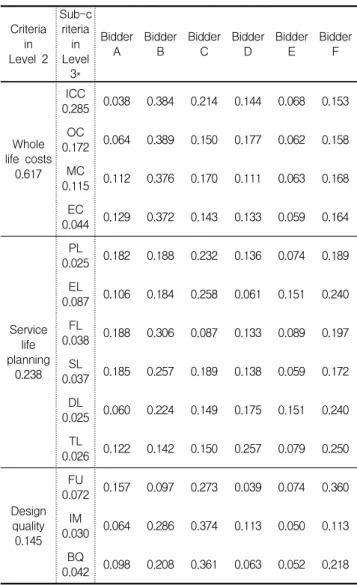
shown in Appendix D. Table 4 shows the relative

priority of each criterion for selection of a

design-builder, and the scores of the six bidders

by criterion type. Results obtained from the

pairwise comparisons and scores of the six bidders

are aggregated to produce a quantitative measure

for WLP pre-bid evaluation.

(8)

Criteria Level 2 in

Sub-c riteria Level in 3*

Bidder A Bidder

B Bidder C Bidder

D Bidder E Bidder

F

Whole life costs

0.617

0.285 0.038 ICC 0.384 0.214 0.144 0.068 0.153

0.172 0.064 OC 0.389 0.150 0.177 0.062 0.158

0.115 0.112 MC 0.376 0.170 0.111 0.063 0.168

0.044 0.129 EC 0.372 0.143 0.133 0.059 0.164

Service planning life

0.238

0.025 0.182 PL 0.188 0.232 0.136 0.074 0.189

0.087 0.106 EL 0.184 0.258 0.061 0.151 0.240

0.038 0.188 FL 0.306 0.087 0.133 0.089 0.197

0.037 0.185 SL 0.257 0.189 0.138 0.059 0.172

0.025 0.060 DL 0.224 0.149 0.175 0.151 0.240

0.026 0.122 TL 0.142 0.150 0.257 0.079 0.250

Design quality 0.145

FU

0.072 0.157 0.097 0.273 0.039 0.074 0.360 0.030 0.064 IM 0.286 0.374 0.113 0.050 0.113

0.042 0.098 BQ 0.208 0.361 0.063 0.052 0.218 Table 4. Global priorities and final overall prioritization

* Global priority (criteria x sub-criteria)

The total AHP score obtained for each bidder represents its relative value with respect to all selection criteria in the hierarchy. Table 5 illustrates the final overall score of the six bidders. These scores sum to 1, and can also be expressed in the ideal form by dividing each score by the highest bidder, 0.312 for Bidder B, as shown in Table 5. These idealized scores provide the proportionate value of the other bidders against the top bidder. For example, Bidder C is about 65.8% as good as Bidder B. The six bidders are shortlisted and ranked by relative AHP scores or idealized scores as the WLC pre-bid evaluation.

The order of bidder scores is Bidder B, C, F, D, A and E (from best to worst). Bidder B has the highest score of 0.312, and is thus considered the best in this illustration.

Table 5. Final results shown as relative and idealized scores Bidder Relative

scores Idealized

scores Rank for

shortlist

Bidder A 0.090 0.290 5

Bidder B 0.312 1.000 1

Bidder C 0.205 0.658 2

Bidder D 0.129 0.414 4

Bidder E 0.075 0.242 6

Bidder F 0.188 0.603 3

3.2 WLP bid evaluation stage 2: One Bidder Selection Stage

Once bidders are shortlisted, the second stage is to select one bidder out of six shortlisted bidders.

In the current selection process, the design score was a decisive criterion with a bid price, and the selection of one bidder for detailed design in this research has followed the same framework.

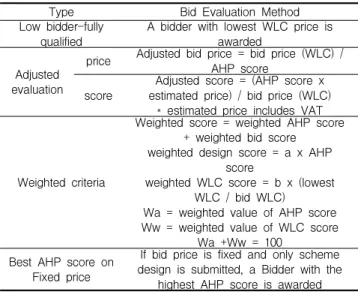
However, the evaluation of each bidder is performed by weighting its bid price based on whole life costs and the AHP relative scores from the results of WLP pre-bid evaluation, instead of the bid price based on initial capital costs and the design score. At the second stage, one bidder out of the six is selected using one of the following four methods. Table 6 illustrates the modified bid evaluation for the detailed design.

One of the four methods in Table 6 can be chosen for use in making a better decision based on the project requirements and characteristics.

For example, the low-bidder-fully-qualified

selection method is chosen when there have

already been many similar projects with simple and

repetitive designs and no high technology is

required. If the bid prices based on WLC differ

(9)

significantly from each other and all six bidders can meet the minimum project requirements, the selection can be based solely on the bid price as long as the client does not require high technology for the project.

Type Bid Evaluation Method

Low bidder-fully

qualified A bidder with lowest WLC price is awarded

Adjusted evaluation

price Adjusted bid price = bid price (WLC) / AHP score

score Adjusted score = (AHP score x estimated price) / bid price (WLC)

* estimated price includes VAT

Weighted criteria

Weighted score = weighted AHP score + weighted bid score weighted design score = a x AHP

score

weighted WLC score = b x (lowest WLC / bid WLC)

Wa = weighted value of AHP score Ww = weighted value of WLC score

Wa +Ww = 100 Best AHP score on

Fixed price

If bid price is fixed and only scheme design is submitted, a Bidder with the

highest AHP score is awarded Table 6. Modified bid evaluation for the detailed design

Table 7. Comparison by Low bidder-fully qualified selection method

Criterion

Current

practice Results

Proposed

model Results

Bid price* Bid price**

Bidder A US$ 492 M Fail US$ 14.8B Fail

Bidder B US$ 389M Selected US$ 12.8B 2nd

Bidder C US$ 414M 2nd US$ 14.3B 4th

Bidder D US$ 466M 4th US$ 12.3B Selected

Bidder E US$ 479M 5th US$ 15.2B 5th

Bidder F US$ 427M 3rd US$ 13.2B 3rd

*Initial capital costs, **Whole life costs

In this method, Bidder D will be selected for the detailed design while Bidder B will be selected in the current practice. If Bidder D is awarded the D-B project, US$ 468 million could be saved over 30 years of project life, although the initial capital costs of Bidder D are US$ 78 million higher than those of bidder B. Table 7 shows a comparison of

this selection method with the current practice.

Adjusted price and score work fundamentally on the same principle, as the design scores and bid price are evaluated equally, although the design or price can be considered one after another.

Table 8. Comparison by Adjusted evaluation selection method-Adjusted TP

Criterion Current practice

Results Design

score TP(ICC) Adjusted TP Bidder

A 68 US$ 492

M 492/(68/100)=724 Fail Bidder

B 82 US$ 389M 389/(82/100)=474 2nd

Bidder

C 90 US$ 414M 414/(90/100)=461 Selecte

Bidder d

D 80 US$ 466M 466/(80/100)=583 4th

Bidder

E 76 US$ 479M 479/(76/100)=631 5th

Bidder

F 86 US$ 427M 427/(86/100)=497 3rd

Criterion Proposed model

Results score AHP TP (WLC) Adjusted TP

Bidder

A 0.090 US$ 14.8B 14.8/0.090

=165 5th

Bidder

B 0.312 US$ 12.8B 12.8/0.312

=41 Selecte

d Bidder

C 0.205 US$ 14.3B 14.3 /0.205

=70 2nd

Bidder

D 0.129 US$ 12.3B 12.3/0.129

=95 4th

Bidder

E 0.075 US$ 15.2B 15.2/0.075

=203 6th

Bidder

F 0.188 US$ 13.2B 13.2/0.18

8=70 3rd

The weighted evaluation method uses weighted criteria when the client places more importance on one criterion than another. The current weighted criteria method is divided into three types: (1) design priority: over 50% ~ 80% of weighted design; (2) bid price priority: 20% ~ less than 50%

of weighted design; (3) same priority.

These methods are used for massive size D-B

projects (more than 100 billion KRW, equivalent to

US$ 89 million, US$ 1 = 1,118 KRW) when there

is no D-B experience by the public client and

there is no professional individual/organization and

(10)

a low budget is obtained (90% of estimated D-B project costs). In the model, design priority and bid price priority are replaced with AHP scores priority and whole life costs priority, respectively.

For any situation other than that described above, the weight will be determined in proportion to the difference.

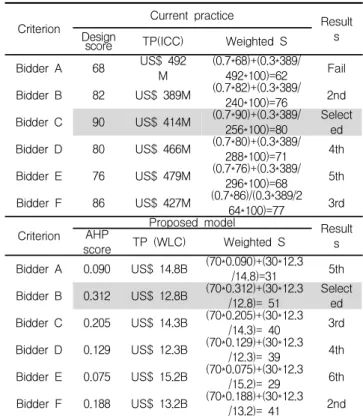
Tables 8 to 10 compare the results using these adjusted evaluation methods. In both the current practice and the proposed model, the same bid is selected for the detailed design.

Although the proportion to the difference between Wa and Ww in the weighted evaluation method is applied differently, for example Wa:Ww

= 75:25, 60:40, 55:45, and 50:50, the same bid is selected for the detailed design in the adjusted and weighted evaluation methods. This supports the findings of Yu and Kim [39].

Table 9. Comparison by Adjusted evaluation selection method -Adjusted S

Criterion

Current practice

Results Design

score TP(ICC) Adjusted S

Bidder A 68 US$ 492 M (68*486)/304=67 Fail Bidder B 82 US$ 389M (82*486)/240=103 2nd Bidder C 90 US$ 414M (90*486)/256=106 Selecte

d Bidder D 80 US$ 466M (80*486)/288=83 4th Bidder E 76 US$ 479M (76*486)/296=77 5th Bidder F 86 US$ 427M (86*486)/264=98 3rd

Criterion

Proposed model

Results score AHP TP

(WLC) Adjusted S Bidder A 0.090 US$

14.8B (0.090*15)/14.8= 0.091 5th Bidder B 0.312 US$

12.8B (0.312*15)/12.8= 0.367 Selecte d Bidder C 0.205 US$

14.3B (0.205*15)/14.3= 0.215 2nd Bidder D 0.129 US$

12.3B (0.129*15)/12.3= 0.157 4th Bidder E 0.075 US$

15.2B (0.075*15)/15.2= 0.074 6th Bidder F 0.188 US$

13.2B (0.188*15)/13.2= 0.213 3rd

If six bidders are near enough to the same price, the results will be the same as the best AHP score in the fixed price method, where decisions depend entirely on the AHP scores.

This is totally contrary to the low bidder-fully qualified selection method, and is used when there is no similar previous project, such as for a world cup stadium, where extreme safety is required and a D-B project is a creative and national landmark project. The selection can be based solely on the AHP relative score, which is a decisive criterion provided that the bid price is within the fixed project price. In this method, Bidder B will be selected for the detailed design through the proposed evaluation, while Bidder C would have been selected in the current practice.

Table 10. Comparison by Weighted criteria method

Criterion Current practice Result

s Design

score TP(ICC) Weighted S

Bidder A 68 US$ 492

M (0.7*68)+(0.3*389/

492*100)=62 Fail Bidder B 82 US$ 389M (0.7*82)+(0.3*389/

240*100)=76 2nd Bidder C 90 US$ 414M (0.7*90)+(0.3*389/

256*100)=80 Select ed Bidder D 80 US$ 466M (0.7*80)+(0.3*389/

288*100)=71 4th Bidder E 76 US$ 479M (0.7*76)+(0.3*389/

296*100)=68 5th Bidder F 86 US$ 427M (0.7*86)/(0.3*389/2

64*100)=77 3rd

Criterion Proposed model Result

AHP s

score TP (WLC) Weighted S Bidder A 0.090 US$ 14.8B (70*0.090)+(30*12.3

/14.8)=31 5th Bidder B 0.312 US$ 12.8B (70*0.312)+(30*12.3

/12.8)= 51 Select ed Bidder C 0.205 US$ 14.3B (70*0.205)+(30*12.3

/14.3)= 40 3rd Bidder D 0.129 US$ 12.3B (70*0.129)+(30*12.3

/12.3)= 39 4th Bidder E 0.075 US$ 15.2B (70*0.075)+(30*12.3

/15.2)= 29 6th Bidder F 0.188 US$ 13.2B (70*0.188)+(30*12.3

/13.2)= 41 2nd

Table 11 Comparison by best AHP score on fixed price selection method

If Bidder C were selected based on the design

score in current practice, the D-B project would be

(11)

at a much higher risk of cost and time overruns, because the current practice does not consider the whole life performance criteria applied in the proposed model. Table 11 shows a comparison of current practice and the proposed model.

3.3 WLP bid evaluation stage 3

: WLP bid evaluation stage of the selected Bidder This is the stage to determine whether the selected bidder ’s detailed design can consistently meet the client ’s requirements in terms of whole life cost, service life planning, and design quality.

In the current practice, the qualified and selected bidder has to submit the detailed design documents, and the selected bidder is awarded within sixty (60) days after submission once the detailed design has successfully passed the committee. Only the detailed design documents are assessed to award a project without scrutinizing the bid price based on the detailed design. This may lead to cost and time overruns at the end of a project. Therefore, in the proposed model, the selected bidder is evaluated with detailed design documents as well as using the sub-element WLC plan at level 4 data, not only to reduce the risk of cost and time overruns, but also to determine whether the selected bidder meets the client ’s requirements for design quality.

4. Process implementation and validation

The pairwise comparisons, calculation of priorities, scoring of bidders and aggregation of weights were implemented in MS Office Excel 2007 and provided by this research. The proposed three-stage process was tailored to help decision-makers in the selection of a design-builder. This process was tested, and the findings were validated by six experts: two senior

government officers, two academics, and two senior project managers. These six referees had all worked for more than 15 years in the Korean construction industry, and represented different judgment and professional attitudes. The aim of validation is to consider the proposed process in practical terms, and to test this process as a bid evaluation tool for the Korean public sector.

The referees were asked to answer the following questions.

·Does the proposed process model theoretically suit public clients in Korea as a way to select a design-build unit in terms of selection stage, evaluation criteria and methods?

·Is the proposed process model practical, in an overall sense?

·Does the analytic hierarchy process (AHP) method suit this proposed process model for the public client in Korea to select a design-build unit?

All six referees gave affirmative answers to the above questions. Their comments were fairly similar, and included:

·The proposed process model was found to be comprehensive and practical.

·Flexibility in the levels and sub-criteria in the current hierarchy structure is essential to satisfy different public clients ’ needs and project requirements by client type and project type.

·User-friendly and simple software, based on this proposed model, could be developed for a public client to use practically.

The proposed model has been proven to enable the public sector to make better decisions in selecting a design-builder based on the whole life performance as a systematic and holistic approach.

The development of user-friendly software based

on this proposed model was recommended.

(12)

5. Conclusion

The increasing use of design-build in the Korean public sector has highlighted the need to seek ways to change the present bid selection system from one based on lowest price to one based on best value over the whole life of the facility. But despite a greater awareness of the need to obtain better value for money for the Korean public sector, there has been little research on integrating whole life cost and performance into design-build projects in Korea .

The proposed model involves complex decision-making situations to select the right design-builder using AHP. Cost, time, and quality should not be under- or over-weighted, so an effective selection process is crucial for clients wishing to strike a balance for successful project outcomes [25]. This research describes three stages of WLP bid evaluation dealing with three key criteria in a hierarchic structure: whole life cost for cost, service life planning for time, and design quality for quality. The focus of this paper was to develop a systematic bid evaluation based on whole life performance in order to select a design-builder that satisfies the client ’s needs for budget, time and adequate quality standards through an analytic hierarchy process.

The selection of a design-builder involves criteria and priorities that are determined by the public client ’s requirements, their preferences, and the characteristics of a project and its bidders.

The proposed model as a decision-making tool in the bid evaluation has the capacity to manage a great number of different criteria that reflect complex and complicated practice, as the AHP allows the consideration of multi-criteria and group decision-making so that individual and subjective judgments in a group are aggregated

into a single representative judgment for the entire group, and a group choice is constructed from individual choices.

As such, the proposed model enables the public client to refine various criteria in a hierarchic structure to achieve its objective. This is important, as each design-build project creates unique deliverables - products, services, or results - with their own characteristics. By incorporating the AHP scores into the bid evaluation, this proposed three-stage process has been shown to be convenient as a user-friendly method.

The proposed WLP bid evaluation was developed and designed to offer various improvements and contributions to select an appropriate design-builder in the Korean public sector. These improvements and contributions include:

1) Enabling the public client to concentrate on the bid evaluation based on long-term cost-effectiveness and whole life performance (NOT only the lowest bid price) when assessing the qualified bidders.

2) Enabling the tracing of client preferences and the decisions made at each stage to be analyzed through the selection process.

3) Assisting the public client in constructing their design-build requirements and representing their judgments of them, so that qualified bidders can be evaluated.

4) Allowing the public client to reach a better solution through the systematic consideration of various evaluation criteria in a hierarchic structure, and providing a decision-making tool for measuring or evaluating whole life cost, service life planning and design quality so that the level of bidders can be explicitly compared with evaluation criteria in a hierarchic structure.

As a tool to aid a decision-maker in bid

evaluation, this model has the capacity to handle a

(13)

great number of different criteria in a way that truly reflects the complexities of reality, without losing its practicality.

References

1. Global Construction Perspectives and Oxford Economics.

Global construction 2020 - a global forecast for the construction industry over the next decade to 2020. Final report 3 Mar 2011, London: 2011. 200 p.

2. You T, Zi H. The economic crisis and efficiency change:

evidence from the Korean construction industry. Applied Economics. 2007 Apr;39(14):1833-42.

3. Park S, Flanagan R. Integrating whole life cost into the evaluation of design-build in Korea. In: Dainty A, editors.

Proceedings of 25th Annual ARCOM Conference;2009 Sept 7-9; Nottingham. UK: Association of Researchers in Construction Management; 2009. p. 227-37.

4. Wardani M, Messner J, Horman M. Comparing procurement methods for Design-Build projects. Journal of Construction Engineering and Management. 2006 Mar;132(3):230-39.

5. Mosey D. Design and build in action, 1st ed. Oxford:

Chandos Publishing; 1998. 172 p.

6. Ndekugri I, Turner A. Building procurement by design and build approach. Journal of Construction Engineering and Management, 1994;120(2):243-56.

7. Chan A, Scott D, Lam E. Framework of success criteria for Design/Build projects. Journal of Management in Engineering. 2002 July;18(3):120-28.

8. Songer A, Molenaar K. Selecting design-build: Public and private sector owner attitudes. Journal of Management in Engineering, 1996 Nov;12(6): 47-53.

9. Ministry of Land, Transport and Maritime Affairs. Turnkey and alternatives procurement system. Technique and Safety Division. 2003. 26 p.

10. Russell J, Skibniewski M, Cozier D. Qualifier-2:

knowledge-based system for contractor prequalification.

Journal of Construction Engineering and Management. 1990 Mar;116(1):157-71.

11. Crowley L, Hancher D. Risk assessment of competitive procurement. Journal of Construction Engineering and Management. 1995 June;121(2):230-37.

12. Mahdi I, Riley M, Fereig S, Alex A. A multi-criteria approach to contractor selection. Engineering Construction and Architectural Management. 2002 Feb;9(1):29-37.

13. Hatush Z, Skitmore M. Criteria for contractor selection.

Construction Management & Economics. 1997;15(1): 19-38.

14. Bouachera T, Kishk M, Power, L. Towards a generic framework for whole life costing in the oil industry. In:

Boyd D, editors. Proceedings of 23rd Annual ARCOM Conference;2007 Sept 3-5; Belfast, UK: Association of Researchers in Construction Management; 2007. p. 863-71.

15. Lee S, Lee S. A study on the introduction of best value selection. Seoul (Korea): Construction & Economy Research Institute of Korea; 2006. 126 p.

16. Ahmad I. Decision-support system for modeling bid/No-bid decision problem. Journal of Construction Engineering and Management. 1990 Dec;116(4):595-608.

17. Holt G, Olomolaiye P, Harris F. A conceptual alternative to current tendering practice. Building Research &

Information. 1993;21(3):167-72.

18. Korman T, Opfer N, Son J. Public sector design-build selection criteria. AACE International Transactions, 2002;6(PM04):1-7.

19. Diekmann E. Cost-plus contractor selection: an analytical method. Engineering Costs and Production Economics. 1983 Mar;7(2):147-58.

20. Hatush Z, Skitmore M. Contractor selection using multicriteria utility theory: An additive model. Building and Environment. 1998 Mar;33(2): 105-15.

21. Nguyen V. Tender evaluation by fuzzy sets. Journal of Construction Engineering and Management. 1985 Sep;111(3): 231-43.

22. Singh D, Tiong R. A fuzzy decision framework for contractor selection. Journal of Construction Engineering and Management. 2005 Jan;131(1):62-70.

23. Belton V. A comparison of the analytic hierarchy process and a simple multi-attribute value function. European Journal of Operational Research. 1986 July;26(1):7-21.

24. Mustafa M, Ryan T. Decision support for bid evaluation.

International Journal of Project Management. 1990 Nov;8(4):230-35.

25. Fong P, Choi S. Final contractor selection using the analytical hierarchy process. Construction Management and Economics. 2000 Oct;18(5):547-57.

26. Al-Harbi K. Application of the AHP in project management.

International Journal of Project Management. 2001 Jan;19(1):19-27.

27. Topcu Y. A decision model proposal for construction

contractor selection in Turkey. Building and Environment.

(14)

2004 Apr;39(4):469-81.

28. Waara F, Bröchner J. Price and nonprice criteria for contractor selection. Journal of Construction Engineering and Management. 2006 Aug;132(8):797-804.

29. Dyer J. Remarks on the Analytical Hierarchy Process.

Management Science. 1990 Mar;36(3):249-58

30. Belton V, Goodwin P. Remarks on the application of the Analytic Hierarchy Process to judgmental forecasting.

International Journal of Forecasting. 1996 Mar;12(1):155-61.

31. Saaty T, Vargas L. The Logic of Priorities, 1st ed.

Pittsburgh, PA: RWS Publications; 1991. 509 p.

32. Vargas L. Reply to Remarks on the Analytic Hierarchy Process. Management Science. 1990 Mar;36(3):269-73 33. Ministry of Land, Transport and Maritime Affairs. Design

evaluation manual for Design-build and Alternatives procurement system. Technique and Safety Division.

2007.149 p.

34. Saaty, T. Decision making with the analytic hierarchy process. International Journal of Services Sciences. 2008 Mar;1(1):83-98.

35. Park S. Whole life performance assessment: critical success factors. Journal of Construction Engineering and Management, 2009 Nov;135(11):1146-61.

36. International Standardization Organization. ISO 15686-5:

Building and Constructed Assets - Service Life Planning:

Part 5 - Life Cycle Costing, ISO, 1st ed. Geneva: British Standards; 2008. 42 p.

37. Gann D, Salter A, Whyte J. Design quality indicator as a tool for thinking. Building Research and Information. 2003 Sep;31(5):318-33.

38. Office of Government Commerce. Achieving excellence in construction procurement Guide number 09: Design quality.

London: OGC; 2007. 26 p.

39. Yu I, Kim K. Project delivery systems and project

performance: an evaluation model for public construction

projects. Korea Institute of Construction Engineering and

Management. 2007 Apr;07(2):41-7.

(15)

Bidder A Bidder B Bidder C Bidder D Bidder E Bidder F

Pre-Qualification

Performance records 20years 45 years 62 years 30years 18years 23years

Technology evaluation 3,286 employees

High tech

4,316 employees

High tech

4,417 employees

High tech

2,359 employees

High tech

1,943 employees

High tech

3,429 employees High

tech

Management evaluation Total turnover

US$ 4.8B Total turnover

US$ 5.9B Total turnover

US$ 4.9B Total turnover

US$ 4.3B Total turnover

US$ 3.6B Total turnover US$3.1B

Creditability High High High Above average Above average High

Total (100) 87 93 91 84 81 80

Design score 68 82 90 80 76 86

WLC evaluation Bidder A Bidder B Bidder C Bidder D Bidder E Bidder F

Whole life costs* US$ 14.8B US$ 12.8B US$ 14.3B US$ 12.3B US$ 15.2B US$ 13.2B

Initial capital costs US$ 492M US$ 389M US$ 414M US$ 466M US$ 478M US$ 427M

Operation costs US$ 735M p.a. US$ 636M

p.a. US$ 716M

p.a. US$ 596M

p.a. US$ 754M p.a. US$ 656M p.a.

Maintenance costs US$ 47M p.a. US$ 39M p.a. US$ 42M p.a. US$ 49M p.a. US$ 49M p.a. US$ 42M p.a.

End-of-life value US$ 138M US$ 164M US$ 155M US$ 142M US$ 130M US$ 160M

Service life planning

Physical life Accurate Accurate Very accurate Average

accurate Below average

accurate accurate

Economic life Below average Average Excellent Poor Average Excellent

Functional life Medium High Low Medium Low Medium

Service life Probable Very probable Probable Not probable Impossible Probable

Design life Impossible Probable Probable Probable Probable Very probable

Technological life Probable Probable Probable Very probable Impossible Very probable

Design Quality

Functionality Medium Medium Low Low Low High

Impact Less positive Positive Very positive Less positive Less positive Positive Build quality Below average Average Excellent Below average Below average Average

* Whole life costs including initial capital costs, operation costs, maintenance costs are estimated by Net Present Value, according to the ratio of 2% (initial capital costs) : 6% (maintenance costs) : 92% (operation and personnel costs) set by the US Green Building Council and the US Department of Energy.

Appendix A. Example of bidders

(16)

Appendix B. The proposed WLC process map for Design-Build by client and design-builder in Korea

(17)

Criterion WLC Service planning life

Design

quality Priority Vector

WLC 0.624 0.661 0.564 0.617

Service life

planning 0.209 0.221 0.285 0.238

Design

quality 0.167 0.117 0.151 0.145

Sum 1.00 1.00 1.00 1.000

Appendix C. Illustration of Normalised- column matrix and and the priority of each criterion

The Tables illustrate a simple example of how to aggregate the evaluation of different respondents involved in the questionnaire survey and decision process, normalized-column matrices of level 2 and level 3.

Respondent A in level 2 with respect to level 1 Criterion WLC

Service plannin life

g

Desig

quality n Mean Priority Vector

WLC 1 3 3 2.080 0.594

Service

planning life 1/3 1 2 0.874 0.249

Design

quality 1/3 1/2 1 0.550 0.157

Sum Σ …… …… …… 3.504 1.000

Respondent B in level 2 with respect to level 1 Criterion WLC

Service plannin life

g

Desig

quality n Mean Priority Vector

WLC 1 7 3 2.759 0.695

Service

planning life 1/7 1 2 0.659 0.166

Design

quality 1/3 1/2 1 0.550 0.139

Sum Σ …… …… …… 3.968 1.000

Respondent C in level 2 with respect to level 1 Criterion WLC

Service plannin life

g

Desig

quality n Mean Priority Vector

WLC 1 5 3 2.466 0.657

Service

planning life 1/5 1 2 0.737 0.196

Design

quality 1/3 1/2 1 0.550 0.147

Sum Σ …… …… …… 3.753 1.000

Aggregated Evaluation from A to C Criterion WLC

Service plannin life

g

Desig

quality n Mean Priority Vector

WLC 1 4.718 3 2.419 0.650

Service planning life

1/4.71

8 1 2 0.751 0.202

Design

quality 1/3 1/2 1 0.550 0.148

Sum Σ …… …… …… 3.720 1.000

To illustrate the aggregation process of three respondents ’ evaluation, a slight difference between

‘WLC’ and ‘Service life planning’ criteria is assumed.

The geometric mean values are obtained. For example, the first row of the ‘Mean’ column in Respondent A is calculated such that ³√1 x 3 x 3 = 2.080. To aggregate all of the evaluations on criteria, the mean values are summed and each mean value is divided by the sum to obtain the normalized priority/weight. In the ‘aggregated evaluation from A to C ’ table, the inverse of the geometric mean of a set of numbers is equal to the geometric mean of the inverse of the same numbers.

For example, ³√3 x 5 x 7 = ³√(1/3) x (1/5) x (1/7) = 4.718.

The computed eigenvectors are accepted as the weight importance or relative priority of a specific criterion relative to all other criteria after a consistency check.

Normalized-column matrix of level 2 with respect to level 1 from the questionnaire survey

λmax (Eigenvalue) = 3.019, CI (Consistency Index) = 0.009 RC (Random Consistency) = 0.580 (n=3),

CR (Consistency Ratio) = 0.016 (CR=CI/RC) CR < 0.10

(18)

Criterion in Level 2 Local priority Global priority Criterion in Level 3 Local priority* Global priority**

Whole life costs

(WLC) 0.617 0.617

Initial capital costs (ICC) 0.463 0.285***

Operation costs (OC) 0.279 0.172

Maintenance costs (MC) 0.187 0.115

End-of-life costs (EC) 0.071 0.044

Service life planning

(SLC) 0.238 0.238

Physical life (PL) 0.105 0.025

Economic life (EL) 0.366 0.087

Functional life (FL) 0.159 0.038

Service life (SL) 0.157 0.037

Design life (DL) 0.106 0.025

Technological life (TL) 0.108 0.026

Design

quality (DQ) 0.145 0.145

Functionality (FU) 0.498 0.072

Impact (IM) 0.210 0.030

Build quality (BQ) 0.292 0.042

* Local priority is derived from judgement with respect to a single criterion.

** Global priority is derived from multiplication by the priority of the parent criterion.

*** This figure is calculated as follows: 0.617 (the priority of the criterion in Level 2) x 0.463 (the local priority of the criterion in Level 3) = 0.285.

The global priority of each criterion in level 2 and 3 from the questionnaire survey Normalized-column matrix example of level 3 under DQ from

the questionnaire survey Criterion WLC Service

planning life

Design

quality Priority Vector

WLC 0.495 0.526 0.473 0.498

Service life

planning 0.194 0.206 0.229 0.210

Design

quality 0.311 0.268 0.298 0.292

Sum 1.00 1.00 1.00 1.000

λmax (Eigenvalue) = 3.005, CI (Consistency Index) = 0.002 RC (Random Consistency) = 0.580 (n=3),

CR (Consistency Ratio) = 0.004 (CR=CI/RC) CR < 0.10

The consistency ratio (CR) is a tool for controlling the consistency of a pairwise comparison. CR is the ratio of consistency index (CI) to the average random index (RI). A CI is represented by (λmax - n)/( n - 1), where λmax is the maximum or principal eigenvalue, and n is the number of criteria in the matrix. RI is the consistency index of a randomly generated decision matrix on the scale 1 to 9. If CR=0, the judgments are completely consistent.

Based on numerous empirical studies, Saaty (1990)

stated that a consistency ratio of 0.10 or less is

considered acceptable.

(19)

ICC A B C D E F Priorities OC A B C D E F Priorities

A 1 1/8 1/6 1/3 1/2 1/5 0.038 A 1 1/4 1/2 1/4 1 1/3 0.064

B 8 1 1 3 7 4 0.384 B 4 1 4 4 5 2 0.389

C 6 1 1 1 3 1 0.214 C 2 1/4 1 2 2 1 0.150

D 3 1/3 1 1 2 1 0.144 D 4 1/4 1/2 1 3 2 0.177

E 2 1/7 1/3 1/2 1 1/2 0.068 E 1 1/5 1/2 1/3 1 1/3 0.062

F 5 1/4 1 1 2 1 0.153 F 3 1/2 1 1/2 3 1 0.158

λ max = 6.184 CI=0.037 CR=0.030 < 0.1 OK λ max = 6.371 CI=0.074 CR=0.060 < 0.1 OK

MC A B C D E F Priorities EC A B C D E F Priorities

A 1 1/2 1 1 1 1 0.112 A 1 1/3 1 1 3 1/2 0.129

B 5 1 2 4 5 2 0.376 B 3 1 3 3 6 2 0.372

C 1 1/2 1 1 5 1 0.170 C 1 1/3 1 1 3 1 0.143

D 1 1/5 1 1 2 1/2 0.111 D 1 1/3 1 1 2 1 0.133

E 1 1/4 1/5 1/2 1 1/3 0.063 E 1/3 1/6 1/3 1/2 1 1/2 0.059

F 1 1/2 1 2 3 1 0.168 F 2 1/2 1 1 2 1 0.164

λ max = 6.269 CI=0.054 CR=0.043 < 0.1 OK λ max = 6.101 CI=0.020 CR=0.016 < 0.1 OK

PL A B C D E F Priorities EL A B C D E F Priorities

A 1 1/2 1/2 4 3 1/2 0.182 A 1 1/2 1/2 2 1 1/3 0.106

B 2 1 1/2 2 2 1 0.188 B 2 1 1/3 3 1/2 2 0.184

C 2 2 1 1 3 1 0.232 C 2 3 1 3 2 1 0.258

D 1/4 1/2 1 1 2 1 0.136 D 1/2 1/3 1/3 1 1/3 1/3 0.061

E 1/3 1/2 1/3 1/2 1 1/2 0.074 E 1 2 1/2 3 1 1/3 0.151

F 2 1 1 1 2 1 0.189 F 3 1/2 1 3 3 1 0.240

λ max = 6.569 CI=0.114 CR=0.092 < 0.1 OK λ max = 6.568 CI=0.114 CR=0.092 < 0.1 OK

FL A B C D E F Priorities SL A B C D E F Priorities

A 1 1 3 1 1 1 0.188 A 1 1 2 1 3 1/2 0.185

B 1 1 4 2 5 2 0.306 B 1 1 1/2 3 6 2 0.257

C 1/3 1/4 1 1 1 1/2 0.087 C 1/2 2 1 1 3 1 0.189

D 1 1/2 1 1 2 1/2 0.133 D 1 1/3 1 1 2 1 0.138

E 1 1/5 1 1/2 1 1/3 0.089 E 1/3 1/6 1/3 1/2 1 1/2 0.059

F 1 1/2 2 1 3 1 0.197 F 2 1/2 1 1 2 1 0.172

λ max = 6.295 CI=0.059 CR=0.048 < 0.1 OK λ max = 6.530 CI=0.106 CR=0.085 < 0.1 OK

DL A B C D E F Priorities TL A B C D E F Priorities

A 1 1/3 1/2 1/3 1/2 1/5 0.060 A 1 2 1 1/4 1 1/3 0.122

B 3 1 1 1 2 2 0.224 B 1/2 1 1 1/2 2 1 0.142

C 2 1 1 1 1/3 1 0.149 C 1 1 1 1/2 2 1 0.150

D 3 1 1 1 2 1/2 0.175 D 4 2 2 1 3 1/2 0.257

E 2 1/2 3 1/2 1 1/3 0.151 E 1 1/2 1/2 1/3 1 1/3 0.079

F 5 1/2 1 2 3 1 0.240 F 3 1 1 2 3 1 0.250

λ max = 6.592 CI=0.118 CR=0.096 < 0.1 OK λ max = 6.460 CI=0.092 CR=0.074 < 0.1 OK

FU A B C D E F Priorities IM A B C D E F Priorities

A 1 2 1/2 3 3 1/2 0.157 A 1 1/7 1/7 1/4 3 1/2 0.064

B 1/2 1 1/4 5 1 1/4 0.097 B 7 1 1/2 4 6 2 0.286

C 2 4 1 5 7 1/3 0.273 C 7 2 1 4 5 3 0.374

D 1/3 1/5 1/5 1 1/2 1/8 0.039 D 4 1/4 1/4 1 2 1 0.113

E 1/3 1 1/7 2 1 1/3 0.074 E 1/3 1/6 1/5 1/2 1 1/2 0.050

F 2 4 3 8 3 1 0.360 F 2 1/2 1/3 1 2 1 0.113

λ max = 6.420 CI=0.084 CR=0.068 < 0.1 OK λ max = 6.405 CI=0.081 CR=0.065 < 0.1 OK

BQ A B C D E F Priorities

λmax = Eigenvalue CI = Consistency Index CR = Consistency Ratio Priorities are normalised.

A 1 1/5 1/3 2 2 1/2 0.098

B 5 1 1/5 3 4 1 0.208

C 3 5 1 3 5 2 0.361

D 1/2 1/3 1/3 1 1 1/5 0.063

E 1/2 1/4 1/5 1 1 1/5 0.052

F 2 1 1/2 5 5 1 0.218

λmax = 6.486 CI=0.097 CR=0.078 < 0.1 OK

Appendix D. Hypothetical illustration of the relative scores of six bidders

수치

Table 1. Comparison of evaluation methods
Figure 1. Hierarchy for design-builder selection
Table 5. Final results shown as relative and idealized scores Bidder Relative
Table 7. Comparison by Low bidder-fully qualified selection method Criterion Current practice Results Proposedmodel Results
+2

참조

관련 문서

• 이명의 치료에 대한 매커니즘과 디지털 음향 기술에 대한 상업적으로의 급속한 발전으로 인해 치료 옵션은 증가했 지만, 선택 가이드 라인은 거의 없음.. •

 The Dutch physicist Pieter Zeeman showed the spectral lines emitted by atoms in a magnetic field split into multiple energy levels...  With no magnetic field to align them,

Modern Physics for Scientists and Engineers International Edition,

그리고 인터넷을 통해 이 세상의 PC나 휴대폰이 모두 연결 될 수 있으므로, 제3단계부터 본격적으로 사이버 스페이스로

The index is calculated with the latest 5-year auction data of 400 selected Classic, Modern, and Contemporary Chinese painting artists from major auction houses..

The Public Authority for Manpower (PAM) has linked the disbursement of additional financial support for the national personnel in the private sector with their

PI protection technologies necessary in the public environment in Korea were examined from multiple viewpoints with reference to related research. A table of the PI

The Joseon government designed and promulgated the Taegeukgi as a national flag for diplomatic and political purposes, but it was the independence movement that made it