119 This is an Open-Access article distributed under the terms of the Creative Commons Attribution Non-Commercial License (http://
creativecommons.org/licenses/by-nc/3.0) which permits unrestricted non-commercial use, distribution, and reproduction in any medium, provided the original work is properly cited.
J. Mushrooms 2016 September, 14(3): 119-126 http://dx.doi.org/10.14480/JM.2016.14.3. 119 Print ISSN 1738-0294, Online ISSN 2288-8853
© The Korean Society of Mushroom Science
*Corresponding author E-mail : [email protected]
Tel : +82-31-882-8190, Fax : +82-31-882-4430 Received September 20, 2016
Revised September 28, 2016 Accepted September 30, 2016
고온피해 경감을 위한 표고 원목재배사 모델개발
김원수1· 김선철2,* · 이병석2· 권혁우2· 고한규2 · 박흥수2
1
산림청
2
산림조합중앙회 산림버섯연구센터
Development of Cultivation Facility Models to Reduce High Temperature Damage in Oak Mushroom (Lentinula edodes) Cultivation Using Bed-logs
Own-Su Kim1, Seon-Cheol Kim2,*, Byeong-Seok Lee2, Hyuk-Woo Kwon2, Han-Gyu Ko2, and Heung-Soo Park2
1
Korea Forest Service, Daejeon 35208, Korea
2
Forest Mushroom Research Center, Gyeonggi, Yeoju 12653, Korea
ABSTRACT: Five empirical farmhouses were selected to reduce the high temperature damage in oak mushroom cultivation using
bed-logs. The cultivation facilities were categorized as follows: those having two blackout curtains or one blackout curtain and outdoor oak mushroom cultivation. The inequality of the indoor condition, oak mushroom hyphae rampant ratio, and fruit body production in each test condition was evaluated. 3
oC was lower in indoor temperature of cultivation facility having two blackout curtains than one blackout curtain. Specifically, the indoor air humidity average of cultivation facilities having one or two blackout curtains was 10% lower than that of outdoor oak mushroom cultivation. This condition is not ideal for oak mushroom cultivation as continuous indoor humidity control is essential for producing good fruit bodies. The Inoculated bed-log surface and oak mushroom hyphae rampant ratio of bed-logs cultivated with two blackout curtains was superior to other tested conditions. The mushroom production ratio observed in facilities with two blackout curtains was 117-204% higher than those cultivated in facilities with only one blackout curtain. Furthermore, the mushroom production ratio increased in based on these findings, we recommended five cultivation facility models to reduce high temperature damage in oak mushroom cultivation using bed-logs.
KEYWORDS: High temperature damage, Cultivation facility, Lentinula edodes, Oak mushroom
서 론
국내 표고버섯 생산량은 2010년도(건표고 2,742톤, 생 표고 20,806톤, 2,229억원) 부터 감소세로 전환하여 2014
년에는 건표고 943톤, 생표고 18,456톤으로 2010년의 절 반 수준인 총 25,350톤(생표고 환산 : 건표고×7.31) 1,860 억원을 기록했다(Shin, 2015).
이렇듯 2009년까지 우리나라 버섯산업 중에 생산액 1 위로 단기소득 임산물로써 매우 중요한 위치를 차지하였 지만, 이상고온 등 급변하는 재배환경 변화에 대처하지 못하고 고온, 건조 및 다습 등의 균사활착과 버섯발생에 불리한 환경에 장시간 방치되어 병해충 피해, 버섯 품질 저하와 버섯 생산량이 줄어들어 소득이 감소하는 농가가 늘어나고 있는 실정이다. 표고재배사내 온도 및 습도의 변화에 관한 연구가 많이 진행되어 왔으며(Son, 2000, Ryul & Koo, 2005), 이런 재배사내 환경조건의 조절을 통하여 생산된 표고의 품질을 향상시킬 수 있다는 것이 보고되었다(Son & Choi, 2005). 산림청은 1997~1999년 3년에 걸쳐 버섯 생산성 향상 및 내재해형 모델과 국내에 적합한 균상재배용 모델(Lee et al., 1999)을 개발 및 보
120
김원수 · 김선철 · 이병석 · 권혁우 · 고한규 · 박흥수
급하였지만, 최근 지구온난화에 따라 해가 거듭될수록 봄, 겨울이 줄어들고 여름 고온시기가 증가하고 있어(Jeon et al., 2010) 원목재배시 균사 배양시기부터 전 과정에 걸쳐 고온피해가 가장 심각하다. 특히 원목재배의 경우 대부분 부업형태의 영세한 규모로 이루어지고 있으며(Seok et al., 2004), 이상고온 등 급변하는 재배환경 변화에 대처하 지 못하고 그 피해가 가중되어 심각한 경제적 손실을 입 고 있다(Choi, 2015).따라서 본 연구에서는 표고버섯 원목재배시 고온에 의 한 피해를 경감시키기 위하여 권역별로 실증지를 선정하 였고, 기존 1중 재배시설의 내부 지붕에 2중 차광망을 추 가로 설치하여 내부 온습도, 균사 만연도 및 버섯생산성 을 조사하였다.
재료 및 방법
임가실증실험
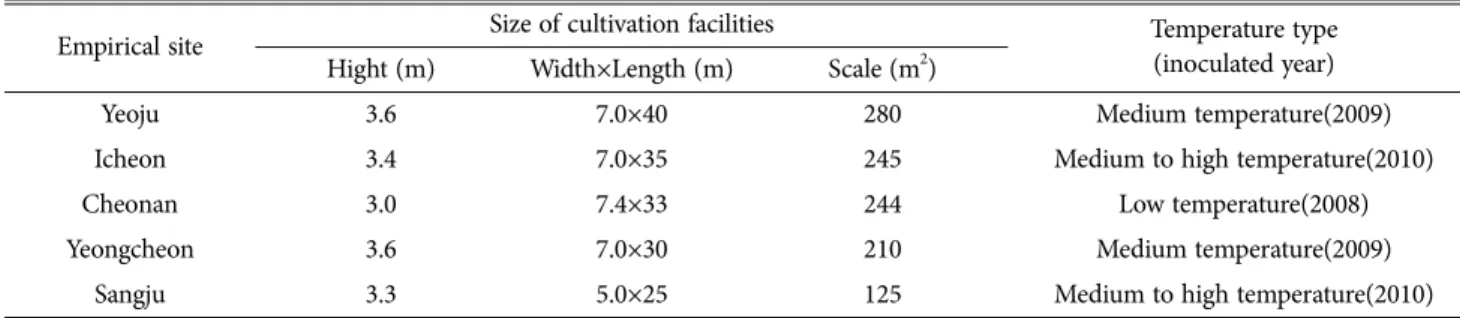
고온피해 경감 효과를 규명하기 위하여 재배량이 가장 많은 중(고)온성, 저온성 품종의 주요 산지로 중남부권에 위치한 경기 여주, 이천, 충남 천안, 경북 영천 및 상주 지 역 5개소를 선정하였다. 매우 다양한 형태의 재배사가 원 목표고 재배를 위하여 전국에서 사용되고 있으며(Table 1), 이중 본연구의 대상지역인 경기 여주, 이천과 경북 영
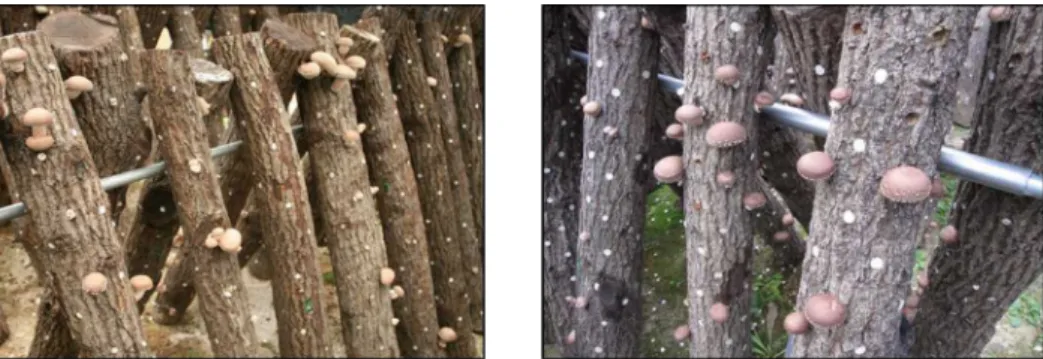
천, 상주에 위치한 재배사는 중(고)온성 품종 재배시설로 동고 3.3~3.6 m (125~280 m2)이고, 충남 천안은 저온성 품종 재배시설로 동고 3 m(244 m2)로 선정하였다. 이중 경기 여주(중온성), 충남 천안(저온성)과 경북 영천(중온 성)은 2009년도에 시설을 보완하였고, 경기 이천(중고온 성), 경북 영천(중온성)은 2010년에 시설을 보완하여 시험 을 진행하였다(Table 2, Fig. 1).
재배시설 개선은 기존 재배사 내부 지붕에 2중 차광망 을 추가하여 서까래 간격을 1 m 간격으로 설치비가 저렴 하고 개보수가 쉽도록 설치하였고, 동일한 환경에서 배양 된 버섯목을 기존시설과 개선형 재배시설에 나누어 시험 을 진행하였다.
시설 형태에 따른 재배사 내부 온습도 비교
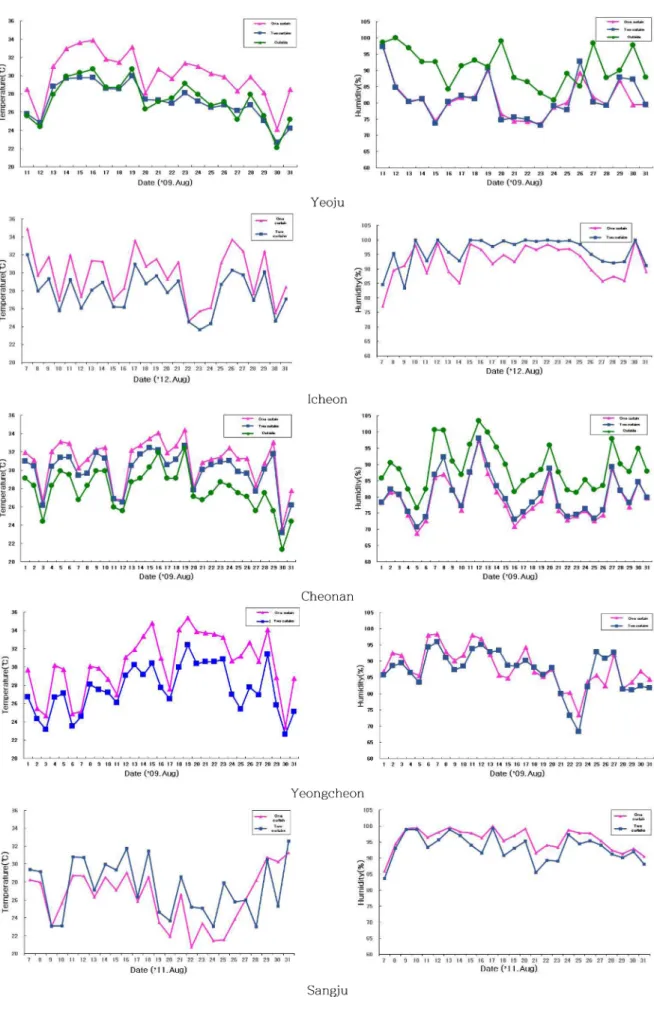
임가실증지 5개소를 대상으로 기존 재배사(1중)와 개선 형 재배시설(내부 2중 차광)의 내부 온습도 비교를 비교 하기 위하여 각 하우스 내부에 온습도기록계(tinytag TV- 4500, Tinytaq, United Kingdom)를 설치하였고, 재배기간 중 여름철 재배환경 변화를 분석하기 위해 8월중 시설 내 부의 최고 온도 및 평균습도를 비교하였다. 특히, 경기 여 주와 충남 천안 2개소는 시험포 내에 위치한 임내재배장 의 최고 온도 및 평균습도를 같이 비교 분석하였다.
Table 1. Condition of cultivation facilities using bed-logs.
Location Height Presence or absence of
roof open facilities
No. of
covers Cultivation facility type Less than 3 m 3~3.7 m More than 3.7 m Yes No Single roof Double roof Single Double
Yongin 5 95 0 100 0 95 5 100 0
Hwaseong 50 50 0 70 30 90 10 95 5
Gwangju 80 20 0 70 30 90 10 90 10
Buyeo 40 60 0 70 30 90 10 90 10
Hongseong 90 10 0 80 20 90 10 100 0
Yeongdong 95 5 0 20 80 100 0 100 0
Jangheung 40 50 10 70 30 100 0 95 5
Jinan 30 70 0 70 30 100 0 100 0
Gyeongju 60 35 5 35 65 95 5 70 30
Numbers in the table are indicated to ratio for each conditions.
Table 2. Condition of cultivation facilities located in five empirical farmhouses.
Empirical site Size of cultivation facilities Temperature type
(inoculated year) Hight (m) Width×Length (m) Scale (m
2)
Yeoju 3.6 7.0×40 280 Medium temperature(2009)
Icheon 3.4 7.0×35 245 Medium to high temperature(2010)
Cheonan 3.0 7.4×33 244 Low temperature(2008)
Yeongcheon 3.6 7.0×30 210 Medium temperature(2009)
Sangju 3.3 5.0×25 125 Medium to high temperature(2010)
시설 형태에 따른 균사 만연도 비교
시설형태(경기 여주)에 따른 표고균의 만연도를 비교하 기 위하여 2009년 4월에 중온성 품종을 접종하고, 5월에 내부 2중 차광망을 추가 설치하였다. 6개월간 배양한 후 각 처리구별로 임의로 5본씩 선발하여 양쪽 말단에서 10 cm 정도를 절단한 후 3등분 하였고, 면적계(Digital planimeter Placom KP-92, Koizumi, Japan)를 이용하여 균사 만연율을 계산하였다.
시설 형태에 따른 버섯 생산량 비교
임가실증지 3개소를 대상으로 기존 재배사(1중)와 개선 형 재배시설(내부 2중 차광) 형태에 따른 버섯 생산량을 비교하기 위하여 품종에 알맞은 발생시기에 발생년수에 따라 24~36시간 수분을 공급하여 버섯을 발생시켰다.
충남 천안 실증지에서는 2008년도에 저온성 품종을 접
종하여 실증지 임내에서 접종 후 동일하게 관리하였고, 2009년 6월 2중 차광망을 설치하여 접종목을 나누어 각각 4개월간 관리하였다. 그 후 2009년 9월과 11월, 2010년 3 월에 버섯 생산량(3회)을 비교하였다.
경기 이천과 경북 상주 실증지에서는 2010년 4월에 중 고온성 품종을 접종(2,000본/개소)하여 4개월간 배양, 관 리를 하였고, 2010년 9월에 1개동에 내부 2중 차광망을 설치하여 관리하였다. 그 후 2011~2012년 2년간 버섯 생 산량을 비교하였다.
원목재배시설 신규 표준모델 개발
현재 표고버섯 원목재배농가 대부분이 이상고온에 따른 피해로 표고균 활착 불량과 병해충 피해를 입고 있으며 이로 인한 버섯생산성 및 품질 저하에 의하여 그 피해가 가중되고 있는 실정이다. 따라서 관련 전문가, 협회 및 생
Fig. 1. Panorama of two empirical farmhouses. Left : Yeoju, Right : Cheonan.
122
김원수 · 김선철 · 이병석 · 권혁우 · 고한규 · 박흥수
Fig. 2. Comparison of indoor temperature and humidity according to cultivation facilities. Left : temperature, Right : humidity.
산단체를 중심으로 자문위원을 구성하여 원목재배 실태조 사와 임가실증시험 결과를 토대로 고온피해 경감과 버섯 생산성 향상에 적합한 모델을 선정하였다.
결과 및 고찰
2009~2012년도 재배기간 중 여름철(8월) 재배환경 변 화를 분석한 결과 재배사 내부 최고 온도는 기존 1중 재 배사에 비하여 개선형 재배사가 평균 약 3~4oC의 온도 저 하효과가 있었지만, 평균습도는 그와는 달리 기존 1중 재 배사와 개선형 재배사간에 큰 차이는 없었다(Fig. 2). 특 히 경기 여주와 충남 천안 실증지 조사결과 기존 1중 재 배사와 개선형 재배사 모두 임내재배장보다 평균습도가 10% 정도 낮아 건조한 불량환경이 유지되어 원목재배 시 설재배시 버섯 품질과 생산성 향상을 위해서는 고온피해
경감과 아울러 지속적인 수분관리로 건조피해를 예방하는 것이 매우 중요함을 알 수 있었다.
시설형태에 따른 버섯목 표면과 내부 표고균의 균사 만 연도를 비교한 결과 표면은 임내와 개선형 재배사에서 배 양한 처리구가 각각 45.8%, 44.8%로 가장 우수하였고 기 존 1중 재배사 처리구가 41.8%로 가장 저조하였다. 그와 달리 내부는 개선형 재배사 처리구가 50.5%로 가장 우수 하였고, 임내와 기존 1중 재배사는 각각 42.9%, 42.5%로 비슷한 양상을 보여 표고균의 균사 만연도는 개선형 재배 사 처리구가 가장 우수하였다(Fig. 3, 4).
시설 형태에 따른 버섯 생산성을 조사한 결과 경기 여 주 실증지는 시험재배사 동고가 3.6 m로 기존 1중 재배사 (120 kg)에 비하여 개선형 재배사 처리구가 140 kg로 약 116.7% 증수되었다. 시험재배사 동고가 3.4 m인 경기 이 천 실증지는 기존 1중 재배사(260 kg)에 비하여 개선형
Fig. 3. Comparison of oak mushroom hyphae rampant ratio according to cultivation facilities. Left : surface, Right : inside.
124
김원수 · 김선철 · 이병석 · 권혁우 · 고한규 · 박흥수
재배사 처리구가 392 kg로 약 116.7% 증수되었고, 경북 상주 실증지는 기존 1중 재배사(480 kg)에 비하여 개선형 재배사 처리구가 720 kg로 약 116.7% 증수되었다. 실증 지 중에서 시험재배사 동고가 3 m로 가장 낮은 충남 천안 실증지는 기존 1중 재배사(424 kg)에 비하여 개선형 재배 사 처리구가 866.3 kg로 약 204%로 증수되어 높이가 낮 을수록 개선형 재배시설의 효과가 큰 것을 알 수 있었다 (Fig. 5).
고온피해 경감과 버섯생산성 및 품질 향상에 적합한 모 델을 개발하기 위하여 관련 전문가, 협회 및 생산단체를 중심으로 자문위원을 구성하여 원목재배 실태조사를 한 결과 관행적으로 기존시설 규격보다 낮은 동고 2.5~3.5 m
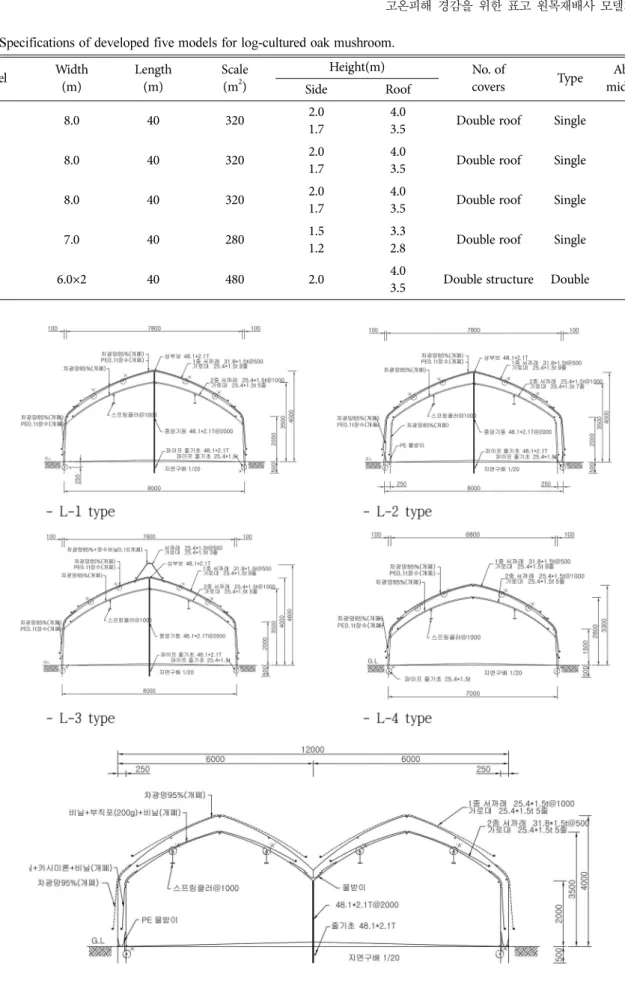
의 1중 시설에서 재배가 이루어지고 있어 고온피해로 인 한 피해가 심각한 수준이었다(Table 1). 따라서 시설형태 에 따른 온습도와 표고균의 균사 만연도 및 버섯생산성 검증결과를 토대로 고온피해 경감을 위한 내부 2중 차광 시설을 반영한 원목재배사 표준모델 5종을 제시하였다 (Table 3, Fig. 6).
앞으로 기후변화 대응 재배기술 보급을 위하여 품종 및 권역별로 실증지를 확대하여 다양한 공동연구를 진행할 예정이다.
적 요
표고버섯 원목재배시 고온피해를 경감시키기 위하여 임 가실증지 5개소를 선정하였고, 기존 1중(비닐+차광)재배 사의 내부 지붕에 2중으로 차광망을 추가 설치(개선형)하 였다. 기존 재배사와 개선형 재배사 형태에 따른 내부 온 습도, 균사 만연도 및 버섯 생산성을 조사하였다.
조사결과 시설 내부 최고온도는 개선형 재배사가 기존 1중 재배사 보다 평균 약 3~5oC정도 낮았으나, 평균습도 는 그와 달리 기존 1중 재배사와 개선형 재배사간에 큰 차이는 없었다. 특히 기존형과 개선형 재배사 모두 임내 재배장보다 평균습도가 10% 정도 낮아 건조한 불량환경 이 유지되어 버섯 품질과 생산성 향상을 위해서는 지속적 인 수분관리가 중요함을 알 수 있었다.
Fig. 4. Comparison of oak mushroom hyphae rampant ratio
according to cultivation facilities.Fig. 5. Comparison of fruit body production according to cultivation facilities. Left : Yeoju, Right : Cheonan.
Table 3. Specifications of developed five models for log-cultured oak mushroom.
Model Width
(m)
Length (m)
Scale (m
2)
Height(m) No. of
covers Type Absence of middle pillars
Side Roof
L-1 8.0 40 320 2.0
1.7
4.0
3.5 Double roof Single Yes
L-2 8.0 40 320 2.0
1.7
4.0
3.5 Double roof Single Yes
L-3 8.0 40 320 2.0
1.7
4.0
3.5 Double roof Single Yes
L-4 7.0 40 280 1.5
1.2
3.3
2.8 Double roof Single No
L-5 6.0×2 40 480 2.0 4.0
3.5 Double structure Double Yes
Fig. 6. Five cultivation facility models developed for high temperature damage eduction in oak mushroom cultivation using
bed-logs.126
김원수 · 김선철 · 이병석 · 권혁우 · 고한규 · 박흥수
버섯목 표면, 내부의 균사 만연도를 비교한 결과 개선형 재배사가 가장 우수하였고, 임내재배사, 기존 1중 재배사 가 순으로 저조하였다.버섯 생산성을 비교한 결과 기존 1중 재배사에 비하여 117~204% 증수 효과가 있었으며, 재배사 동고 높이가 낮 을수록 개선효과는 극대화 되었다.
따라서 시험결과를 토대로 고온피해 경감을 위한 원목 재배사 모델 5종을 제시하였다.
참고문헌