• 검색 결과가 없습니다.

Effect of Post Heat Treatment on Wear Characteristics of Thermally Sprayed Co-based Self-flux Alloy Coating

N/A
N/A
Protected

Academic year: 2021

Share "Effect of Post Heat Treatment on Wear Characteristics of Thermally Sprayed Co-based Self-flux Alloy Coating"

Copied!
6
0
0

로드 중.... (전체 텍스트 보기)

전체 글

(1)

Vol. 18, No. 1, pp. 106-111, February 2014

코발트기 자융성합금 코팅의 마모특성에 미치는 후열처리의 영향 Effect of Post Heat Treatment on Wear Characteristics of Thermally

Sprayed Co-based Self-flux Alloy Coating

이재홍*․김영식**†

Jae-Hong Lee and Yeong-Sik Kim

(접수일 : 2013년 09월 25일, 수정일 : 2013년 12월 20일, 채택확정 : 2013년 12월 20일)

Abstract: This article describes effect of post heat treatment on wear characteristics of thermally sprayed Co-based self-flux alloy coating. Co-based self-flux alloy coatings were deposited on steel substrates using a flame spray process. Post heat treatments were carried out at 800, 900, 1000 and 1100℃ for 30min in a vacuum chamber. For analysis of effect of post heat treatment on mechanical properties, wear test and hardness test were performed for post heat-treated coating specimen. Microstructures of heat treated coating layer and wear track were examined using SEM and EDS. Wear loss and hardness became lower with increasing post heat treatment temperature.

Key Words: Co-based Self-flux Coating, Post Heat Treatment, Microstructure, Wear Microhardness

**†김영식(교신저자) : 부경대학교 기계자동차공학과 E-mail : [email protected], Tel : 051-629-6155

*이재홍 : 부경대학교 대학원

**†Yeong-Sik Kim(corresponding author) : Department of Mechanical & Automotive Engineering, Pukyong National University

E-mail : [email protected], Tel : 051-629-6155

*Jae-Hong Lee : Graduate School, Pukyong National University

1. 서 론

고온에서의 내식성과 내마모성이 뛰어난 자융 성합금은 고온 환경에서 사용되는 보일러 또는 열 교환기와 제지산업의 열간압연용 테이블 롤러 등 에서 널리 사용되고 있다.

1-2)

자융성합금은 본질적 으로 코팅층을 후열처리하도록 설계되어 있어, 다 른 용사장치에 비해 구조가 간단하고 운용비용이 저렴한 화염용사장치(flame spray system)를 이용하 여도 양질의 코팅층을 형성할 수 있다. 자융성합 금에 포함된 원소인 B와 Si는 후열처리시 코팅층 의 융점을 낮추고 유동성을 증가시키며, 재용융 동안 산화물 및 기공을 제거하고 기재와 코팅층간

의 밀착성을 증가시킨다. 일반적으로 자융성합금 코팅층의 후열처리는 화염토치를 사용하는데, 이 방법은 형상이 복잡하거나 큰 치수를 가진 부재 및 부품에 적용하는 데에는 적절하지 못하다. 또 한 작업자에 따라 그 결과가 달라지므로 후열처리 에 대한 일관성이 부족하며 정량적인 판단이 어려 워 양질의 코팅층 제작에 어려움이 있다.

지금까지 이루어진 자융성합금에 대한 연구는 대부분 니켈기 자융성합금에 관한 것으로

3-5)

, 코발 트기 자융성합금에 대한 연구는 그리 많지 않다.

저자들은 선행 연구에서 통계적 기법을 이용하여

코발트기 자융성합금 코팅의 최적공정설계에 관한

연구를 수행한 바 있다.

6)

본 연구는 그 후속연구

(2)

Composition(wt%) Size(μm)

Co Ni Cr Mo Si B Fe C

53 ~ 125

Bal. 27 18 6 3.5 3 2.5 0.2

Table 1 Characteristics of powder used for flame spray

로서 코발트기 자융성합금 코팅의 후열처리가 코 팅층의 기계적특성에 미치는 영향을 분석한 것이 다. 화염용사법으로 제작된 코발트기 자융성합금 코팅층을 진공가열로에서 후열처리하고, 경도시험 및 마모시험을 실시하여 후열처리 조건이 이들 특 성에 미치는 영향을 SEM(scanning electron microscope)과 EDS(Energy Dispersive Spectrometer) 를 통해 분석하였다.

2. 실험방법

본 실험에서 사용된 용사장치는 Sulzer Metco Co.의 flame spray system(6P-Ⅱ)이고, 용사재료는 Sulzer Metco Co.의 코발트기 자융성합금 분말인 18C이다. Table 1에 본 실험에서 사용된 코발트기 자융성합금 분말의 화학적 조성과 크기를 나타내 었다. 기재는 5mm 두께의 일반구조용강 SS400 강 판을 사용하였으며, 용사전 기재의 표면을 #23 알 루미나 그릿트로 블라스트처리를 하고 아세톤에서 초음파 세척을 하였다. 전처리된 기재의 표면에 저자들의 선행연구에서 도출한 최적조건으로 코팅 을 실시하였다. Table 2는 본 실험에서의 용사조건 을 나타낸 것이다. 코팅된 시험편을 진공로에서 800, 900, 1000 및 1100℃로 온도를 변화시키며 각 각 30분간 후열처리를 실시하였다. Table 3은 후열 처리 조건을 나타낸 것이다. SEM을 사용하여 열 처리 전(as-sprayed) 및 열처리 후(post heat-treated) 코팅층의 미세구조를 관찰하고 경도시험 및 마모 시험을 통하여 기계적 특성을 분석하였다. 경도시 험은 마이크로 비커스 경도시험기를 사용하여 열 처리 조건에 따른 코팅층의 경도를 측정하였다.

작용하중 300 g, 압입시간 10 sec의 조건으로 실시 하였으며, 기재와 코팅층의 경계면으로부터 100 μm

Oxtgen gas flow 53 (ft

3

/h) Acetylene gas flow 55 (ft

3

/h) Powder feed rate 36 (lb/h) Spray distance 240 (mm) Thickness of coating

layer 700 ± 50 (μm) Table 2 Spray parameters

Temperatures 800, 900, 1000, 1100℃

Holding time 30 min Heating time 30 min Atmosphere vacuum Table 3 Post heat treatment conditions

의 지점에서 10회 측정하였다. 또한 이들 시험편 에 대해 #2000의 연마지를 사용하여 표면조도를 일정하게 한 후 ball-on-disk 타입의 마모시험기로 건식 미끄럼 마모시험을 실시하였다. 상대마모재 로는 직경 8 mm의 Al

2

O

3

ball을 사용하였으며, 미 끄럼 속도 0.1 m/s, 작용하중 20 N, 마모 거리 1000 m의 조건으로 실시하였다.

3. 결과 및 고찰

Fig. 1은 코발트기 자융성합금의 as-sprayed 코팅

층과 온도를 달리하여 후열처리를 실시했을 때의

단면 미세구조를 나타낸 것이다 . 800℃에서 후열

처리된 코팅층은 as-sprayed 코팅층과 거의 동일한

미세구조를 가지고 있는데, 여기에는 용융되지 않

(3)

Fig. 1 Microstructures of coating layer : (a)as-sprayed, post heat-treated at (b)800℃, (c)900℃, (c)1000℃ and (d)1100℃

Co Ni Cr

Fig. 2 EDS-mapping image of coating layer post heat-treated at 1100℃

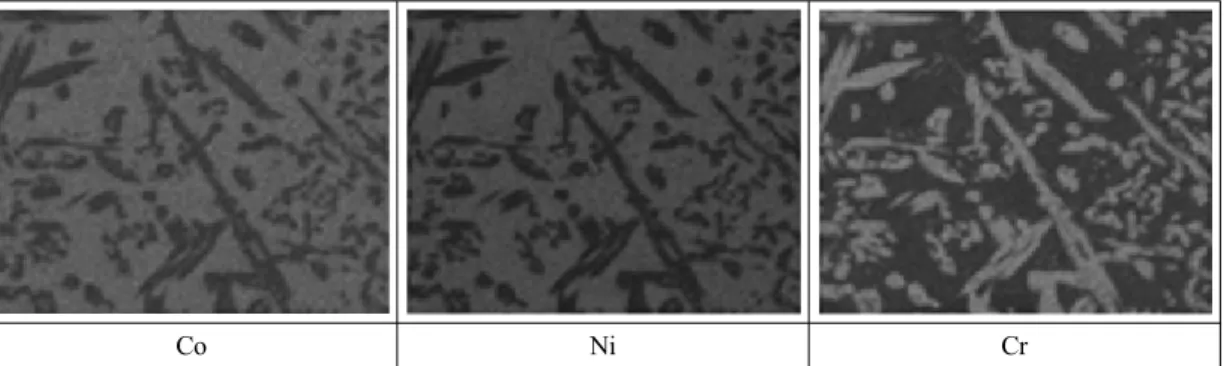
은 일부 입자들, 기공 그리고 splat간의 경계면이 잘 나타나 있다. 후열처리 온도가 증가함에 따라 코팅층의 미용융입자와 기공 그리고 splat간의 경 계면은 점차 감소하며 , 1000℃로 후열처리된 코팅 층의 경우에는 이들이 대부분 소멸된다 . 1100℃에 서 후열처리된 코팅층은 완전히 재용융되어 이전 과는 전혀 다른 미세구조를 형성하고 있다. Fig. 2 는 1100℃에서 후열처리된 코발트기 자융성합금 코팅층에 대한 EDS-mapping image를 나타낸 것이 다 . 이 결과에 의하면 1100℃에서 후열처리된 코 발트기 자융성합금 코팅층은 Co 및 Ni 기지 내에

Cr이 주성분인 막대모양의 화합물이 혼재되어있음 을 잘 알 수 있다. 코발트기 자융성합금의 후열처 리에 관한 다른 연구로서 Kazunori Sakata 등

7)

은 후열처리에 따른 미세구조의 변화를 관찰한 바 있 는데 , 1100℃이상의 온도에서 후열처리된 코팅층 은 M

2

B상, (Cr, Co, W)B상 및 α상의 3가지 상이 혼재되어 있음을 확인하였다. 본 연구에서는 W가 포함된 상은 관찰되지 않았는데, 이는 연구에 사 용한 분말의 조성차이 때문인 것으로 판단된다.

Fig. 3은 코팅층의 후열처리 온도에 따른 경도의

변화를 나타낸 것이다. as-sprayed 코팅층이 가장

(4)

Fig. 3 Variation of hardness according to post heat treatment temperature

Fig. 4 Variation of wear rate according to post heat treatment temperature

높은 경도값을 나타내고, 후열처리 온도가 높아짐 에 따라 경도가 감소하는 경향을 나타낸다. 이러 한 경향은 as-sprayed 상태의 코팅층의 미용융 및 반용융입자들이 후열처리 온도가 높아짐에 따라 재용융상태에 가까워지므로써 경도가 감소된 것으 로 생각된다. 한편 후열처리 온도가 높아짐에 따 라 경도의 편차가 감소하고 있는데, 이는 후열처 리 온도가 높아짐에 따라 코팅층 내부의 미용융입 자와 기공 그리고 splat간의 경계면이 감소하여 상 대적으로 균질한 코팅층을 형성하기 때문인 것으 로 판단할 수 있다. K. T. Kim 등의 연구

8)

에서도 후열처리 온도가 높아짐에 따라 코팅층의 경도 편

Fig. 5 Microstructures of wear track post heat-treated at (a)800℃ and (b)1100℃

차가 줄어든다는 결과를 보고한 바 있다.

Fig. 4는 코팅층의 후열처리 온도에 따른 마모율 의 변화를 나타낸 것이다. 마모율도 경도와 마찬 가지로 후열처리온도가 증가할수록 감소하는 경향 을 나타내고 있는데 , 1100℃에서 후열처리된 코팅 층은 as-sprayed 코팅층에 비해 약 40% 정도의 낮 은 마모율을 보여주고 있다.

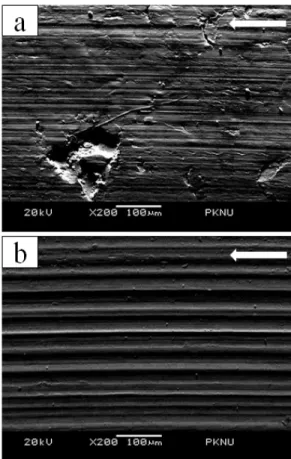
Fig. 5는 800℃ 및 1100℃로 후열처리된 코팅층 의 마모트랙을 비교하여 나타낸 것이다. 1100℃에 서 후열처리된 코팅층의 마모트랙은 주마모거동으 로서 연삭마모가 뚜렷이 관찰된다. 반면에 800℃

에서 후열처리된 시험편은 연삭마모와 함 께 splat

detachment가 관찰되며, 특히 기공 주위에서 큰

splat detachment의 흔적이 관찰되었다. 또한 두 시

험편의 마모흔을 비교해보면 1100℃에서 후열처리

(5)

Fig. 6 Microstructures of cross section of wear track post heat-treated at (a)800℃ and (b)1100℃

된 시험편의 마모트랙이 더욱 뚜렷하고 크게 나타 난다. 이는 1100℃에서 후열처리된 시험편이 800℃

에서 후열처리된 시험편보다 경도가 낮기 때문이 며 , 그럼에도 불구하고 1100℃에서 후열처리된 시 험편의 마모율이 상대적으로 더 낮은 것은 800℃

에서 후열처리된 코팅층과 달리 splat detachment가 발생하지 않기 때문인 것으로 판단된다.

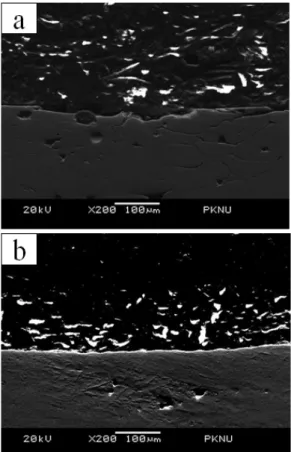
Fig. 6은 800℃ 및 1100℃로 후열처리된 코팅층 의 마모트랙 단면을 나타낸 것이다 . 800℃에서 후 열처리된 코팅층은 그 표면에 깊게 패인 흔적이 관찰되는데, 이는 splat detachment로 인해 생긴 흔 적이다. 반면 1100℃에서 후열처리된 코팅층의 단 면에서는 연삭마모의 흔적만 관찰된다.

이상의 결과들을 종합해 보면, as-sprayed 상태의 코발트기 자융성합금 코팅층의 주마모거동은 splat

detachment이고, 후열처리 온도가 높아짐에 따라 splat detachment는 점차 감소하며 주마모거동은 연 삭마모로 천이된다. 일반적으로는 경도가 높아질 수록 마모율은 낮아지는 경향을 나타내지만,

9)

본 연구에서는 1100℃에서 후열처리된 코팅층의 경우 상대적으로 경도가 낮음에도 불구하고 마모율이 감소하는 경향을 보였다.

4. 결 론

본 연구는 코발트기 자융성합금 코팅의 후열처 리가 코팅층의 기계적 특성에 미치는 영향을 분석 한 것이다. 화염용사법으로 제작된 코발트기 자융 성합금 코팅층을 진공가열로에서 후열처리하고, 경도시험 및 마모시험을 실시하여 후열처리 조건 이 이들 특성에 미치는 영향을 분석하였다. 주요 한 결과를 요약하면 다음과 같다.

1) 후열처리 온도가 높아짐에 따라서 코팅층 내 의 기공 및 미용융입자들이 점차 감소하며 1100℃

로 후열처리를 할 경우 코팅층은 완전히 재용융되 었다.

2) 후열처리 온도가 높아질수록 코팅층의 경도 와 마모율은 함께 감소하는 경향을 나타내었다.

3) as-sprayed 코팅층, 800℃ 및 900℃로 후열처 리된 코팅층의 마모시험에 있어서는 연삭마모거동 과 splat detachment가 함께 관찰되며, 1000℃ 및 1100℃에서 후열처리된 코팅층의 경우에는 연삭마 모거동만 관찰되었다.

4) as-sprayed 코팅층의 주마모거동은 splat detachment이며, 후열처리 온도가 높아짐에 따라서 연삭마모로 천이된다.

References

1. M. Rosso and A. Bennani, 1998, "Studies of New Applications of Ni-based Powders for Hardfacing Processes", PM World Congress Thermal Spraying/Spray Forming, pp. 524-530.

2. M. W. Bae, B. H. Park and J. Hwa, 2012, "A Study

on Improvement of Duratbility for Run-out Table

(6)

Roller with Hot Rolling by Porous Self-fluxing Alloy Coating", Journal of the Korean Society of Marine Engineering, pp. 276-285.

3. H. Akebono, J. Komotori and M. Shimizu, 2008,

"Effect of coating microstructure on the fatigue properties of steel thermally sprayed with Ni-based self-fluxing alloy", International Journal of Fatigue, Vol. 30, No. 5, pp. 814-821.

4. H. J. Kim, S. Y. Hwang, C. H. Lee and P. Juvanon, 2003, "Assessment of wear performance of flame sprayed and fused Ni-based coatings", Journal of Surface and Coatings Technology, Vol. 172, No. 2-3, pp. 262-269.

5. H. Chen, C. Xu, J. Qu, I. M. Hutchings, P. H. Shipway and J. Liu, 2005, "Sliding wear behaviour of laser clad coatings based upon a nickel-based self-fluxing alloy co-deposited with conventional and nanostructured tungsten carbide-cobalt hardmetals", Journal of Wear, Vol. 259, No. 7-12, pp. 801-806.

6. J. H. Lee and Y. S. Kim, 2013, "Process Optimization for Co-based Self-flux Alloy Coating By Taguchi Method", Abstract Book of 2013 Spring Conference of KSME, pp. 158-159.

7. K. Sakata, K. Nakano, Y. Matsubara and K. Ogi, 2007, "Microstructure Control of Thermallly Sprayed Co-Based Self-fluxing Alloy Coatings by diffusion Treatment", Journal of Thermal Spray Technology, Vol. 16 No. 5-6, pp. 991-997.

8. K. T. Kim, Y. S. Kim and M. S. Oh, 2007, "Effect of Heat Treatment Conditions on the Microstructure and Wear Behavior of Ni-based Self-flux Alloy Coatings", Journal of The Korean Society for Power System Engineering, Vol. 11, No. 1, pp. 121-126.

9. R. G. Bayer, 2002, "Wear Analysis for Engineers",

HNB Publishing.

수치

Table 1 Characteristics of powder used for flame spray
Fig. 2 EDS-mapping image of coating layer post heat-treated at 1100℃
Fig. 3 Variation of hardness according to post heat  treatment temperature
Fig. 6 Microstructures of cross section of wear track  post heat-treated at (a)800℃ and (b)1100℃

참조

관련 문서

The purpose of this research was to identify the mediating effect of unconditional self-acceptance and the moderated mediating effect of emotional

3. In case of gold alloy inner crown, gold alloy outer crown was better than GES outer crown in retentive force. However, retentive force of gold alloy outer

LIST OF TABLES... LIST

본 실험에서는 불소이온의 흡착능력을 증대시키기 위하여 대나무 탄화물 제조를 다르게 하였다. Effect of temperature of heat treatment on the adsorption of F - by

Based on the above results, the characteristics of the wrestling Greco-Roman style of athletes were statistically significant in terms of basic physical

Data were collected using a self-administered questionnaire consisting of general characteristics, work related characteristics, health behavior related

An Effect of Group Art Therapy on the Anxiety, Depression and Self-Esteem of single-parented children.. 2009년

Control of Mechanical Properties by Proper Heat Treatment in Iron-Carbon