• 검색 결과가 없습니다.

Sodium Intake, Blood Pressure and Cardiovascular Disease

N/A
N/A
Protected

Academic year: 2022

Share "Sodium Intake, Blood Pressure and Cardiovascular Disease"

Copied!
17
0
0

로드 중.... (전체 텍스트 보기)

전체 글

(1)

ABSTRACT

Sodium intake reduction has been emphasized because sodium adversely impacts health, especially blood pressure (BP), and the cardiovascular (CV) disease risk. However, data obtained from several cohort studies have raised questions regarding the effects of high sodium intake on BP and the CV disease risk. In the present study, we systematically reviewed the literature to evaluate these associations. Studies showing negative associations between urine sodium and BP and CV outcomes relied on estimated 24-hour urine sodium from spot urine that is inappropriate for determining sodium intake at an individual level. Furthermore, controversy about the association between 24-hour urine sodium and BP may have been caused by different characteristics of study populations, such as age distribution, ethnicity, potassium intake and the inclusion of patients with hypertension, the different statistical methods and BP measurement methods. Regarding the association between sodium intake and the CV disease risk, studies showing negative or J- or U-shaped associations used a single baseline measurement of 24-hour urine sodium in their analyses. However, recent studies that employed average of subsequently measured 24-hour urine sodium showed positive, linear associations between sodium intake and CV outcomes, indicating that controversies are caused by the different sodium intake measurement methods and analytic designs. In conclusion, the study shows that positive associations exist between sodium intake and BP, CV outcomes, and mortality, and that the argument that reducing sodium intake is dangerous is invalid. Sodium intake reduction should be recommended to all, and not limited to patients with hypertension or CV disease.

Keywords: Sodium intake; Urine; Blood pressure; Cardiovascular

INTRODUCTION

Excessive sodium intake has been shown to have major impacts on blood pressure (BP) and the risk of cardiovascular (CV) disease,

1)2)

and to increase the risk of stroke,

3)

left ventricular hypertrophy,

4)

the progression of renal disease,

5)

renal stones and osteoporosis

6)

and possibly the risk of stomach cancer.

7)

Accordingly, the World Health Organization (WHO) and many countries are making efforts to reduce sodium intakes.

Nevertheless, some scientists argue reducing sodium intake to or below the recommended level is dangerous,

8)9)

and that there is no clear evidence that sodium intake reduction

Review Article

Received: Feb 3, 2020 Revised: Feb 23, 2020 Accepted: Mar 10, 2020 Correspondence to Moo-Yong Rhee, MD, PhD

Cardiovascular Center, Dongguk University Ilsan Hospital, 27, Dongguk-ro, Ilsandong-gu, Goyang 10326, Korea.

E-mail: [email protected] Copyright © 2020. The Korean Society of Cardiology

This is an Open Access article distributed under the terms of the Creative Commons Attribution Non-Commercial License (https://

creativecommons.org/licenses/by-nc/4.0) which permits unrestricted noncommercial use, distribution, and reproduction in any medium, provided the original work is properly cited.

ORCID iDs Moo-Yong Rhee

https://orcid.org/0000-0002-1595-3627 Yun-Jeong Jeong

https://orcid.org/0000-0001-9144-7403 Conflict of Interest

Rhee MY has received lecture honoraria from Pfizer Inc., LG Life Sciences Ltd, Boehringer Ingelheim Pharma GmbH & Co. KG., Hanmi Pharm. Co. Ltd., Yuhan Co. Ltd., Boryung Pharmaceutical Co. Ltd., Fees for consulting from Hanmi Pharm. Co. Ltd., and research grant from Boryung Pharmaceutical Co. Ltd.

and Dong-A Pharmaceutical Co., Ltd.

The other authors have no financial conflicts of interest.

Moo-Yong Rhee , MD, PhD

1

, and Yun-Jeong Jeong , MD

2

1

Cardiovascular Center, Dongguk University Ilsan Hospital, Goyang, Korea

2
Department of Internal Medicine, Dongguk University Ilsan Hospital, Goyang, Korea

Sodium Intake, Blood Pressure and

Cardiovascular Disease

(2)

Author Contributions

Conceptualization: Rhee MY; Data curation:

Rhee MY, Jeong YJ; Formal analysis: Rhee MY, Jeong YJ; Investigation: Jeong YJ; Project administration: Rhee MY; Writing - original draft: Rhee MY, Jeong YJ; Writing - review &

editing: Rhee MY, Jeong YJ.

decreases the incidence of CV diseases.

10)

However, these studies have methodologic limitations that warrant consideration.

In this article, we review recent publications on the assessment of salt intake and on the associations between high sodium intake and BP and the risk of CV diseases.

MEASUREMENT OF SALT INTAKE

Sodium intake is usually measured using a dietary survey-based or urine collection methods. Dietary survey-based methods rely on food intakes determined by questionnaire or interview, and subsequently, nutrient intakes are calculated using food composition tables. Dietary surveys are commonly used in large population surveys because they are convenient and readily applicable. However, they may result in inaccurate estimations of dietary sodium intake because of their inherent limitations, such as reporting errors, inaccurate or incomplete food composition tables, missing data, and coding errors.

11-13)

In addition, the use of dietary surveys makes it difficult to compare sodium intakes between countries, studies, and surveys because of the different dietary survey methods and food composition tables used.

Therefore, measurement of 24-hour urine sodium is recommended as a gold standard method of sodium intake estimation because of its accuracy and consistency. However, multiple 24-hour urine collection is needed to obtain accurate results because of large day- to-day variations in sodium intakes.

14)

In a recent study, the means of three to seven 24-hour urinary sodium measurements during the study periods showed a linear association with mortality, but baseline 24-hour urinary sodium showed no relationship with mortality.

15)

These findings indicate multiple subsequent 24-hour urine collection should be used to assess the risk of future CV events rather that single baseline 24-hour urine sodium. However, many studies have used single or double 24-hour urine collection because multiple collection of 24-hour urine without any loss of urine in population survey is much difficult.

Because 24-hour urine collection requires skills and resources in large scaled population health survey, considerable efforts have been made to use spot urine in the estimation of sodium intake, and WHO recommend the use of spot urine to estimate sodium intake in low and middle income countries.

16)

Furthermore, the latest Prospective Urban Rural Epidemiology (PURE) study, which challenged the need to reduce sodium intake to or below the recommended level, used a spot urine collection method to estimate sodium intake.

8)9)

Many formulae have been developed and are widely used for the estimation of sodium intake, but despite its convenience and low cost, the calculation of 24-hour urine sodium based on spot urine should be considered with caution because of inaccuracy.

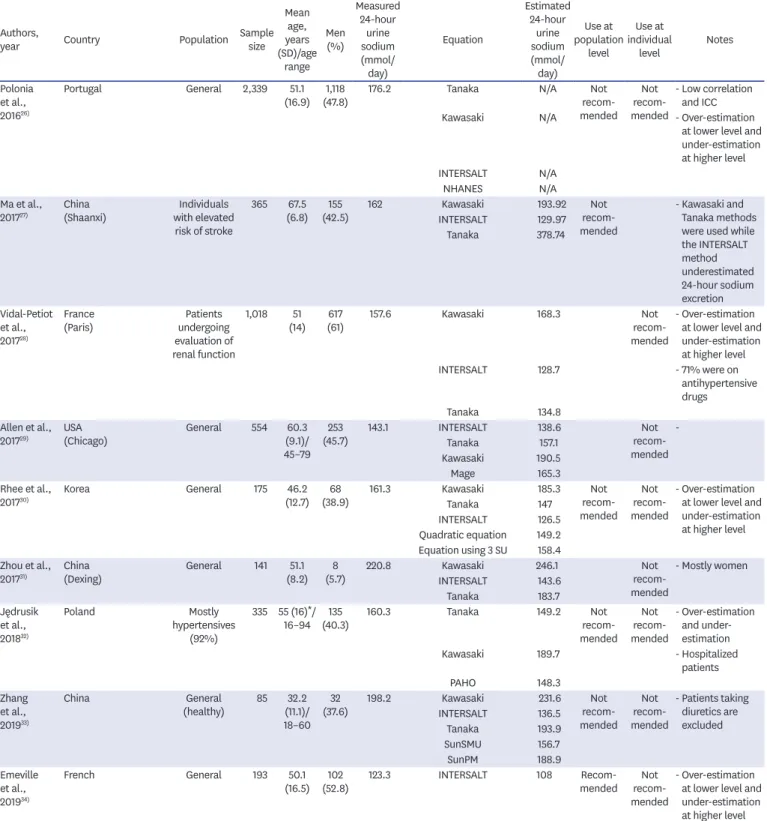
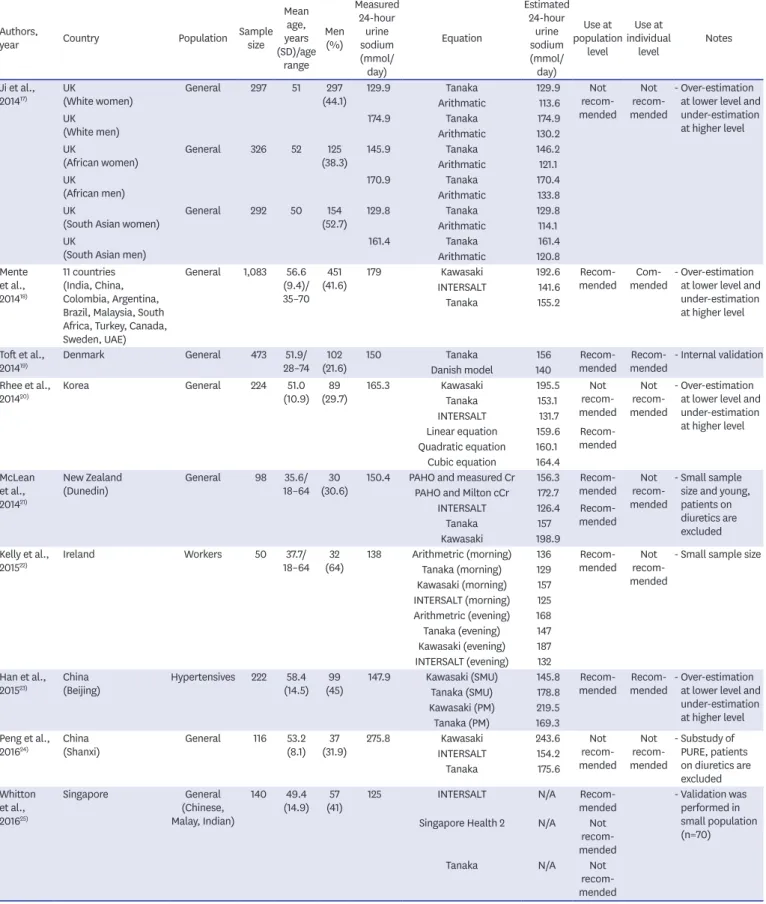
To explore the validity of the spot urine method, we performed a systematic review of

published studies. The electronic database of PubMed from publication date of January 2014

to September 2019 was searched using applicable terms (search terms in Appendix 1). The

inclusion criteria used were as follows: human, sodium intake measured by 24-hour urine

collection (single or multiple), sodium intake calculated by single or multiple spot urine

collection, and comparison between measured and calculated urine sodium level. Potentially

eligible articles were identified, and full texts were then reviewed. Eighteen eligible studies

were identified (Table 1).

17-34)

(3)

Table 1. Studies that evaluated the validity of spot urine collection method for the estimation of sodium intake

Authors,

year Country Population Sample size

Mean age, years (SD)/age

range Men (%)

Measured 24-hour

urine sodium (mmol/

day)

Equation

Estimated 24-hour

urine sodium (mmol/

day)

Use at population

level

Use at individual

level Notes

Ji et al., 2014

17)

UK

(White women) General 297 51 297

(44.1) 129.9 Tanaka 129.9 Not

recom- mended

recom- Not mended

- Over-estimation at lower level and under-estimation at higher level

Arithmatic 113.6

UK (White men) 174.9 Tanaka 174.9

Arithmatic 130.2

UK (African women) General 326 52 125

(38.3) 145.9 Tanaka 146.2

Arithmatic 121.1

UK (African men) 170.9 Tanaka 170.4

Arithmatic 133.8

UK (South Asian women) General 292 50 154

(52.7) 129.8 Tanaka 129.8

Arithmatic 114.1

UK (South Asian men) 161.4 Tanaka 161.4

Arithmatic 120.8

Mente et al., 2014

18)

11 countries (India, China, Colombia, Argentina, Brazil, Malaysia, South Africa, Turkey, Canada, Sweden, UAE)

General 1,083 56.6 (9.4)/

35–70 451

(41.6) 179 Kawasaki 192.6 Recom-

mended Com-

mended - Over-estimation at lower level and under-estimation at higher level

INTERSALT 141.6

Tanaka 155.2

Toft et al.,

2014

19)

Denmark General 473 51.9/

28–74 102

(21.6) 150 Tanaka 156 Recom-

mended Recom-

mended - Internal validation

Danish model 140

Rhee et al.,

2014

20)

Korea General 224 51.0

(10.9) 89

(29.7) 165.3 Kawasaki 195.5 Not

recom- mended

recom- Not mended

- Over-estimation at lower level and under-estimation at higher level

Tanaka 153.1

INTERSALT 131.7

Linear equation 159.6 Recom- mended Quadratic equation 160.1

Cubic equation 164.4 McLean

et al., 2014

21)

New Zealand

(Dunedin) General 98 35.6/

18–64 30

(30.6) 150.4 PAHO and measured Cr 156.3 Recom-

mended Not

recom- mended

- Small sample size and young, patients on diuretics are excluded PAHO and Milton cCr 172.7

INTERSALT 126.4 Recom-

mended

Tanaka 157

Kawasaki 198.9

Kelly et al.,

2015

22)

Ireland Workers 50 37.7/

18–64 32

(64) 138 Arithmetric (morning) 136 Recom-

mended Not

recom- mended

- Small sample size Tanaka (morning) 129

Kawasaki (morning) 157 INTERSALT (morning) 125 Arithmetric (evening) 168 Tanaka (evening) 147 Kawasaki (evening) 187 INTERSALT (evening) 132 Han et al.,

2015

23)

China

(Beijing) Hypertensives 222 58.4

(14.5) 99

(45) 147.9 Kawasaki (SMU) 145.8 Recom-

mended Recom-

mended - Over-estimation at lower level and under-estimation at higher level Tanaka (SMU) 178.8

Kawasaki (PM) 219.5 Tanaka (PM) 169.3 Peng et al.,

2016

24)

China

(Shanxi) General 116 53.2

(8.1) 37

(31.9) 275.8 Kawasaki 243.6 Not

recom- mended

recom- Not mended

- Substudy of PURE, patients on diuretics are excluded

INTERSALT 154.2

Tanaka 175.6

Whitton et al., 2016

25)

Singapore General

(Chinese, Malay, Indian)

140 49.4 (14.9) 57

(41) 125 INTERSALT N/A Recom-

mended - Validation was performed in small population (n=70) Singapore Health 2 N/A Not

recom- mended

Tanaka N/A Not

recom- mended

(continued to the next page)

(4)

Table 1. (Continued) Studies that evaluated the validity of spot urine collection method for the estimation of sodium intake

Authors,

year Country Population Sample size

Mean age, years (SD)/age

range Men (%)

Measured 24-hour

urine sodium (mmol/

day)

Equation

Estimated 24-hour

urine sodium (mmol/

day)

Use at population

level

Use at individual

level Notes

Polonia et al., 2016

26)

Portugal General 2,339 51.1

(16.9) 1,118

(47.8) 176.2 Tanaka N/A Not

recom- mended

recom- Not mended

- Low correlation and ICC

Kawasaki N/A - Over-estimation

at lower level and under-estimation at higher level

INTERSALT N/A

NHANES N/A

Ma et al., 2017

27)

China

(Shaanxi) Individuals

with elevated risk of stroke

365 67.5 (6.8) 155

(42.5) 162 Kawasaki 193.92 Not

recom- mended

- Kawasaki and Tanaka methods were used while the INTERSALT method underestimated 24-hour sodium excretion

INTERSALT 129.97

Tanaka 378.74

Vidal-Petiot et al., 2017

28)

France

(Paris) Patients

undergoing evaluation of renal function

1,018 51 (14) 617

(61) 157.6 Kawasaki 168.3 Not

recom- mended

- Over-estimation at lower level and under-estimation at higher level

INTERSALT 128.7 - 71% were on

antihypertensive drugs

Tanaka 134.8

Allen et al., 2017

29)

USA

(Chicago) General 554 60.3

(9.1)/

45–79 253

(45.7) 143.1 INTERSALT 138.6 Not

recom- mended

-

Tanaka 157.1

Kawasaki 190.5

Mage 165.3

Rhee et al.,

2017

30)

Korea General 175 46.2

(12.7) 68

(38.9) 161.3 Kawasaki 185.3 Not

recom- mended

recom- Not mended

- Over-estimation at lower level and under-estimation at higher level

Tanaka 147

INTERSALT 126.5

Quadratic equation 149.2 Equation using 3 SU 158.4 Zhou et al.,

2017

31)

China

(Dexing) General 141 51.1

(8.2) 8

(5.7) 220.8 Kawasaki 246.1 Not

recom- mended

- Mostly women

INTERSALT 143.6

Tanaka 183.7

Jędrusik et al., 2018

32)

Poland Mostly

hypertensives (92%)

335 55 (16) * / 16–94 135

(40.3) 160.3 Tanaka 149.2 Not

recom- mended

recom- Not mended

- Over-estimation and under- estimation

Kawasaki 189.7 - Hospitalized

patients

PAHO 148.3

Zhang et al., 2019

33)

China General

(healthy) 85 32.2 (11.1)/

18–60

(37.6) 32 198.2 Kawasaki 231.6 Not

recom- mended

recom- Not mended

- Patients taking diuretics are excluded

INTERSALT 136.5

Tanaka 193.9

SunSMU 156.7

SunPM 188.9

Emeville et al., 2019

34)

French General 193 50.1

(16.5) 102

(52.8) 123.3 INTERSALT 108 Recom-

mended Not

recom- mended

- Over-estimation at lower level and under-estimation at higher level Cr = creatinine; ICC = intraclass correlation coefficient; INTERSALT = International Cooperative Study on Salt, Other Factors, and Blood Pressure; Milton = age- and sex-specific measured 24-hour creatinine excretion from 24-hour urine samples collected in the New Zealand Milton Study; N/A = not available; PAHO = Pan American Health Organization; PM = post meridiem; PURE = Prospective Urban Rural Epidemiology; SD = standard deviation; SMU = second morning urine; SU = spot urine.

* Age before exclusion.

(5)

Thirteen studies concluded that calculation result from spot urine could not be

recommended in the estimation of 24-hour urine sodium estimation at an individual level because of tendencies of underestimation at high sodium intake and over-estimation at low sodium intake.

17)20-22)24)26)28-34)

Even the study of Mente et al.

18)

showed a tendencies to over- estimate at low sodium intake and under-estimate at high sodium intake although they did not comment about that finding. In terms of 24-hour urine sodium estimation at a population level, eight studies suggested the use of spot urine collection method for the estimation of sodium intake at the population level.

18-23)25)34)

However, the result of calculated sodium intake from spot urine may be inappropriate at the population level as the various formulae produced inconsistent bias between measured and estimated 24-hour urine. For example, the bias between measured and estimated 24-hour urine sodium (as determined using Kawasaki formula) ranged from −32.2 to 84.5 mmol/day. Even in the largest study conducted on this topic by Mente et al.,

18)

the bias between measured and estimated 24-hour urine sodium level (calculated using the Kawasaki formula) was not small (bias=13.6 mmol/day, 7.8% of average 24-hour urine sodium of study population).

Inaccurate estimation of 24-hour urine sodium level by formulae using spot urine sodium concentration may have inherent problem considering the method to develop formulae. Most of these formulas were developed using regression models in specific populations. Therefore, estimated 24-hour urine sodium values may depend on the mean of 24-hour urine sodium in the population used for formula development, and thus, calculated 24-hour urine sodium do not accurately reflect values in populations with different characteristics from the formula development population.

We evaluated this hypothesis. Populations of studies that were conducted in year 2012,

20)

2014,

30)

and from 2013 to 2014

35)

were combined and analyzed. The method to determine the completeness of 24-hour urine collection was described elsewhere.

20)30)35)

Among 1,115 participants, 791 had a valid 24-hour urine collection and spot urine sample (Table 2). Study population was divided by septiles of 24-hour urine sodium level. The means of measured 24-hour urine sodium and estimated 24-hour urine sodium (calculated using the Kawasaki Table 2. Demographic and clinical characteristic of study population

Variables Values

Number of subject

Total 791

Study 2012, number (% and total number of primary study) 325 (64.7, 502) Study 2013–2014, number (% and total number of primary study) 192 (68.8, 279) Study 2013, number (% and total number of primary study) 274 (82.0, 334)

Age (years) 50.5±11.9

Men 315 (39.8)

Body weight (kg) 62.5±10.7

Height (cm) 162.7±8.2

Hypertension 253 (32.0)

Use of antihypertensive drugs 90 (11.4)

Diabetes 50 (6.3)

Serum sodium (mmol/L) 140.4±6.6

Serum potassium (mmol/L) 4.4±0.4

Serum creatinine (mg/dL) 0.80±0.16

24-hour urine sodium (mmol/day) 161.3±63.2

Estimated 24-hour urine sodium (by Kawasaki formula) (mmol/day) 190.0±53.2 Estimated 24-hour urine sodium (by Danish formula) (mmol/day) 156.9±37.2

24-hour urine potassium (mmol/day) 63.0±24.3

Populations of study in 2012, 2013–2014 and 2014 were combined. Data are expressed as mean±standard

deviation or number (%) not otherwise specified.

(6)

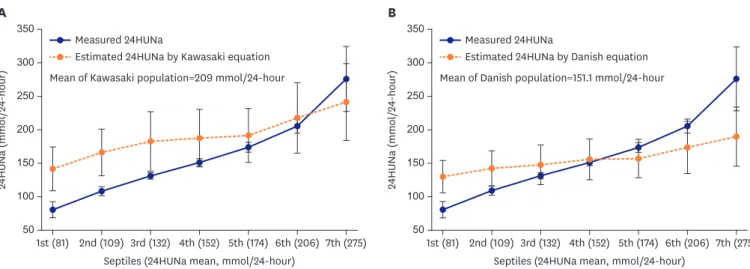
and Danish formula) were compared (Figure 1). When the 24-hour urine sodium excretion is calculated by applying the formulas to groups with smaller 24-hour urine sodium excretion than that of formula development population, there is a tendency of overestimation of 24-hour urine sodium. On the other hands, in groups with greater 24-hour urine sodium than that of the development population, there is a tendency of underestimation of 24- hour urine sodium. This phenomenon has been observed in many studies that validated spot urine collection methods. Some studies that validated the Kawasaki formula showed if mean measured 24-hour urine sodium in the validation population was lower than that in the population used to develop Kawasaki formula (209 mmol/day), mean estimated 24- hour urine sodium in the validation population was higher than mean measured 24-hour urine sodium,.

18)20-22)27-30)32)33)

and conversely, if mean measured 24-hour urine sodium in the validation population was higher than that in development population, mean estimated 24- hour urine sodium in the validation population was lower than mean measured 24-hour urine sodium.

24)

However, many large studies are needed to verify our hypothesis and find method for accurate estimation of 24-hour urine from spot urine in a population level.

SODIUM INTAKE AND BLOOD PRESSURE

Many intervention studies have reported sodium intake reduction lowers BP and has a profound effect in individuals with hypertension.

36)

Furthermore, this effect was observed even after modest sodium intake reduction.

37)

However, the majority of intervention studies were conducted over the short- or medium-term and few long-term studies have been undertaken, presumably because long-term dietary intervention studies are much more difficult to perform. In a previous study,

38)

we found 5 dietary intervention studies performed over more than 6 months.

39-43)

Four of these studies reported lowering sodium intake significantly lowered BP.

39-42)

In the Trials of Hypertension Prevention (TOHP) II study, the effect of sodium intake reduction on BP was observed, and although the effect declined with time, it remained significant until 36 months and reduced the incidence of hypertension.

41)

On the other hand, a study performed in young healthy nulliparous pregnant

350 300 250 200 150 100 50

24 HUNa (mmol/ 24 -hour ) Mean of Kawasaki population=209 mmol/24-hour Mean of Danish population=151.1 mmol/24-hour

Septiles (24HUNa mean, mmol/24-hour)

A

7th (275) 1st (81) 2nd (109) 3rd (132) 4th (152) 5th (174) 6th (206)

Measured 24HUNa

Estimated 24HUNa by Kawasaki equation

Measured 24HUNa

Estimated 24HUNa by Danish equation 350

300 250 200 150 100 50

24 HUNa (mmol/ 24 -hour )

Septiles (24HUNa mean, mmol/24-hour)

B

7th (275) 1st (81) 2nd (109) 3rd (132) 4th (152) 5th (174) 6th (206)

Figure 1. Comparison between measured and estimated 24HUNa in septile groups divided according to measured 24HUNa. Estimated 24-hour urine sodium was calculated by using previously suggested equations. (A) Kawasaki, and (B) Danish equation. When the 24HUNa is calculated by applying the formulas to groups with smaller 24HUNa than that of formula development population, there is a tendency of overestimation of population mean 24-hour urine sodium. On the other hands, in groups with greater 24-hour urine sodium than that of the formula development population, there is a tendency of underestimation of 24-hour urine sodium.

24HUNa = 24-hour urine sodium excretion.

(7)

women concluded a low sodium diet had no effect on BP or on the incidence of gestational hypertension.

43)

The International Cooperative Study on Salt, Other Factors, and Blood Pressure (INTERSALT) was a representative population-based cross-sectional study that evaluated the relationship between salt intake and blood pressure.

44)

This study showed that 24-hour urine sodium and BP were significantly related, but unfortunately, did not determine whether BP reductions were dose-dependently related to 24-hour urine sodium levels.

To investigate the dose-dependent effect of sodium intake on BP in population-based

epidemiological studies, we searched PubMed from January 2009 to September 2019 for

cross-sectional studies that evaluated the relationship between BP and sodium intake

(search terms in Appendix 2). The inclusion criteria used were as follows: human, sodium

intake measured by 24-hour urine collection (single or multiple), and BP data (casual or

ambulatory). We identified 374 articles. Studies used spot urine collection to estimate

24-hour urine sodium or a dietary survey-based method were excluded for the reasons

mentioned above. Titles and abstracts were screened, potentially eligible articles were

identified, and the full text were reviewed. As a result, 15 studies were eligible for analysis

(Table 3).

45-59)

Of these 15 studies, 9 reported a significant association between sodium

intake and BP,

45-53)

and 6 studies found no significant association.

54-59)

Jackson et al. analyzed

data obtained from 766 participants in the National Health and Nutrition Examination

Survey (2014) conducted in the United States,

51)

and reported significant, dose-dependent

associations between BP and 24-hour urine sodium (positive association) and potassium

(negative association). On the other hand, a study by Mente et al.

55)

performed as part of

the Prospective Urban Rural Epidemiological (PURE)-Canadian study found no linear

association between BP and 24-hour urine sodium excretion. The differences between these

studies were; 1) determination method of complete 24-hour urine collection, 2) 24-hour

urine potassium excretion, and 3) ethnicity. Mente et al.

55)

used para-aminobenzoic acid to

determine complete 24-hour urine collection but did not use it in individual over 65 years

old, and thus, it was not clear whether complete 24-hour urine collection was performed in

those over 65-years old. The most obvious difference between the 2 studies was that the study

population of Mente's study

55)

had a higher potassium intake and a lower urine sodium-to-

potassium ratio than those of Jackson's study had

51)

(sodium-to-potassium ratios were 1.93 vs

2.98, respectively). In a study by Xu et al.

49)

on 2,281 Chinese individuals, a significant linear

association was observed between BP and 24-hour urine sodium excretion. In this study,

average 24-hour urine potassium was 25.3 mmol/day and the urine sodium-to-potassium

ratio was 6.8. In a previous study, we found a significant association between urinary sodium-

to-potassium ratio and BP.

53)

These findings suggest that high potassium intake and a low

sodium-to-potassium ratio may reduce the effect of sodium intake on BP. Furthermore,

ethnicity may have contributed to result disparities. The population studied by Jackson et

al. included more than 10% African-Americans, but the population studied by Mente et

al.

55)

included 9.1% non-Europeans (the proportion of Black people was not reported). BP

response to sodium intake is not as uniform as response to antihypertensive drugs, which

can be explained by sodium sensitivity. In general population, 20–50% of individuals exhibit

sodium sensitivity,

60)

and the condition is highly prevalent in Black people, those with

hypertension or metabolic syndrome, and in older people and women.

61)

Therefore, the

inclusion of a large number of sodium resistant individuals might blur the dose-dependent

effect of sodium intake on BP. As an example, Mohammadifard et al.

57)

included young

and healthy individuals without diabetes, hypertension, a history of diuretic use, or renal

(8)

insufficiency (i.e. large number of sodium resistant individuals may be included), and reported no association between sodium intake and BP. In terms of statistical analysis, we Table 3. Cross-sectional epidemiologic studies that evaluated the association between sodium intake and blood pressure

Authors, year Country Number Participants Age range (years)

Mean (SD)

age (years) Mean (SD) urine sodium (mmol/day)

measurement BP

method Findings Notes

Angell et al.,

2014

45)

USA

(New York) 1,656 General,

41.8% men ≥18 N/A 140.8 OBP Significant linear

association with SBP 26.6% was black, 35.6%

was hypertensive Xu et al., 2014

46)

China

(Yantai) 191 General,

51.3% men 18–69 42.3 (13.5) 201.5 (77.7) OBP Significant linear association with SBP Rodrigues

et al., 2015

47)

Brazil

(Vitória) 272 General,

47.4% men 18–69 44 (14) 176.5 (70.9) OBP Significant

association with SBP Positive association between salt and systolic BP was more striking when salt intake was greater than 9 g/d Ndanuko

et al., 2017

48)

Australia

(Illawarra) 327 General, 27%

men 25–54 43.6 (8) 139 (median) OBP, supine Significant linear

association with SBP Over-weighted BMI 25–40 kg/m

2

Xu et al., 2017

49)

China

(Fushan, Gaomi, Xinyl, Ganyu)

2,281 General,

49.8% men 18–69 42.1 (13.4) 166.9 (25.6) OBP Significant

association with SBP Sodium intake was estimated from 24-hour urine sodium by using PC-SIDE

Glatz et al.,

2017

50)

Swiss (Vaud, Geneva, Valais, Fribourg, Luzern, Basel, Zürich, St Gallen, Ticino)

1,336 General,

48.7% men >15 German 48.8 (18), French

47.8 (18.1), Italian 45.3

(18.4)

156.8 OBP Significant

association with SBP Participants in eight predefined sex- and age- strata (men and women aged 15–29, 30–44, 45–59 and ≥60 years) Jackson

et al., 2017

51)

USA

(National) 766 General,

48.4% men 20–69 43.6 Hypertensive 162.6 mmol/day, prehypertensive 154.5 mmol/day, Optimal 159.0

mmol/day

OBP Significant linear association with SBP

and DBP

Sodium intake was estimated from 24-hour urine sodium by using measurement error model to account day-to- day variation, National Health and Nutrition Examination Survey Maseko et al.,

2018

52)

South Africa [Johannesburg (Soweto)]

547 General,

36.7% men >18 45.3 (18.5) 105.6 (78.4) ABP Significant association with SBP

and DBP in normal BMI participants

44.9% of 1,219 recruited participants were included in the analysis Kim et al.,

2019

53)

Korea (Goyang, Paju, Seoul, Chuncheon, Gyeongju)

740 General,

41.1% men 20–70 48 (median) 153.9 (median) ABP Significant linear or non-linear association with SBP and DBP in older ages McLean

et al., 2015

54)

New Zealand (Dunedin, Wellington)

299 General,

48.5% men 18–64 N/A 147.2 (63.1) OBP No association 24-hour urine sodium was entered as a dependent variable Mente et al.,

2016

55)

Canada (Vancouver, Hamilton, Ottawa, and Quebec City)

1,700 General,

49.4% men 37–72 59.6 (9.0) 144.6 (63.8) OBP No association 90.9% European 21.9% Hypertensives

Mizéhoun- Adissoda et al., 2016

56)

Benin

(Bohicon, Tanvè) 354 General,

48.5% men 25–64 43.0 (11.3) 173.9 (82.6) OBP No association Participants rested throughout the 24-hour period in the health care center

Mohammadifard et al., 2017

57)

Iran

(Isfahan) 796 Non-

hypertensive adults, 43.3%

men

>18 38.9 (11.4) 176.9 (72.0) OBP No association Young healthy individuals without diabetes, hypertension, history of using diuretics, renal insufficiency

Vallejo et al.,

2017

58)

Mexico

(Mexico City) 711 General,

32.1% men 20–50 37.4 (9.0) 137 OBP No association

Chen et al.,

2018

59)

Norway

(Oslo) 159 General 20–67 40.3 (11.1) 137.9 (61.3) OBP No association Immigrants of Somalis

from east Africa

ABP = ambulatory blood pressure; BMI = body mass index; BP = blood pressure; DBP = diastolic blood pressure; N/A = not available; OBP = office measured blood

pressure; SBP = systolic blood pressure; SD = standard deviation; PC-SIDE = PC Software for Intake Distribution Estimation.

(9)

used multiple regression with restricted cubic splines,

53)

and found a non-linear (curvilinear) association between 24-hour urine sodium excretion and BP, which contrasts with that found by Mente et al.

55)

and others. In addition, BP measurement methods might have contributed to result disparities. We previously reported a significant linear association between 24- hour urine sodium and nighttime BP and a curvilinear association with daytime BP in older individuals (≥55 years old).

53)

Accordingly, the different relations between sodium intake and BP in cross-sectional studies might be caused by study population, statistical method, and/or BP measurement differences.

SODIUM INTAKE AND CARDIOVASCULAR DISEASE

Although the association between sodium intake and BP is generally accepted, relations between the effects of sodium intake on CV events and mortality have been debated. Few long-term intervention trials have evaluated the effect of sodium intake on CV outcomes and studies conducted have lacked the statistical power to access the relation between CV events and sodium intake. A long-term maintenance of dietary sodium intakes in large populations is difficult for cost and ethical reasons, especially in high risk patients. Although the phase I and II TOHP did not include CV outcomes as primary efficacies, they did perform long- term follow-ups (over 20 years) to determine CV outcomes, after the original studies had been terminated.

62)

This long-term study showed a linear increase in all-cause mortality of 12% for every 1 g/day increase in sodium consumption and no evidence of a J-shaped or nonlinear relation.

63)

On the other hand, the Trial of Nonpharmacologic Intervention in the Elderly (TONE) study showed no difference between the CV event rates in a reduced sodium intervention group and a usual lifestyle intervention group.

64)

However, a meta-analysis that included data from the TOHP I, TOHP II, and TONE studies showed sodium intake reduction significantly reduced CV events.

65)

Stolarz-Skrzypek et al.

66)

reported an inverse association between 24-hour urine sodium and risk of CV mortality in a general population and in individuals with hypertension without CV disease. Actually, several cohort studies have reported different associations between sodium intake and CV outcomes.

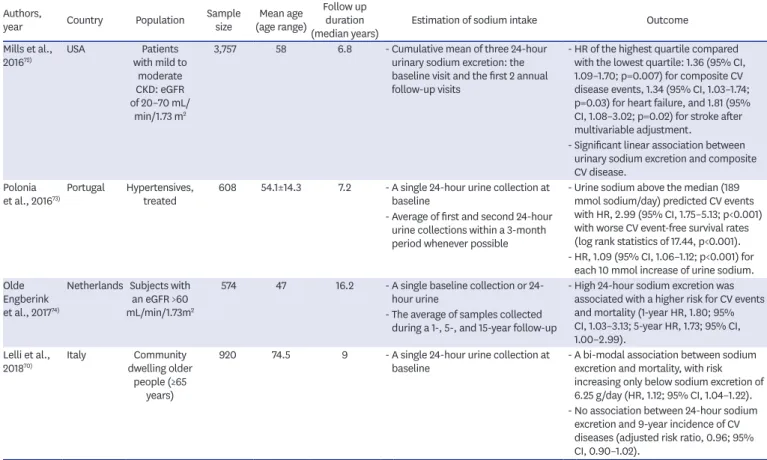
We searched cohort studies that evaluated association between sodium intake and CV outcomes in PubMed from 2009 to 2019 (search terms in Appendix 3) and initially identified 619

articles. We included studies that used 24-hour urine collection method to determine sodium intakes and excluded studies that used spot urine collection or a dietary survey. Titles and abstracts were screened and potentially eligible articles were identified and reviewed full text in detail. Of the 10 studies included (Table 4), 5 studies

66-70)

used single 24-hour urine sodium measurements at baseline and the other 5 studies

63)71-74)

used averages of subsequently measured multiple 24-hour urine sodium measurements to estimate sodium intake. The five studies performed using single 24-hour urine sodium measurements showed inverse,

66)

J- or U-shaped associations,

67)70)

a positive association,

68)

or no association

69)

with CV outcomes. However, in the 5 studies that used average of subsequently measured multiple 24-hour urine sodium,

63)71-74)

high 24-hour urine sodium excretion was associated with a higher risk of CV outcomes and 24- hour urine sodium excretion and CV outcomes were found to be linearly associated.

The different results may be explained by the difference in measurement methods of sodium

intake, a single measurement of 24-hour urine sodium or subsequently multiple measurement

of 24-hour urine sodium. A single 24-hour urine sodium measurement at baseline cannot

reflect day-to-day variations in sodium intake. For example, many people change their dietary

(10)

habits during follow-up in cohort studies. In a study by Olde Engberink et al.,

74)

50% of subjects showed more than 0.8 g (34 mmol) difference between sodium intake at baseline and averages of subsequent measurements taken over 5 years, and 50% subjects were classified into different sodium intake groups when long-term 24-hour urine sodium measurements were used to classify sodium intake groups rather than single baseline measurements. Similarly, the hazard Table 4. Cohort studies that evaluated the association between sodium intake and cardiovascular outcomes

Authors,

year Country Population Sample

size Mean age (age range)

Follow up duration

(median years) Estimation of sodium intake Outcome

Stolarz- Skrzypek et al., 2011

66)

Northern

Belgium General and hypertensive (without CV

disease)

3,681 40.9 7.9 - A single 24-hour urine collection at baseline

- Criteria of a complete urine collection: N/A

- CV deaths decreased across increasing tertiles for 24-hour urinary sodium: low tertile (death rate, 4.1%; 95% CI, 3.5–4.7), medium tertile, (death rate, 1.9%; 95%

CI, 1.5–2.3); and high tertile (death rate, 0.8%,95% CI, 0.5–1.1; p<0.001).

- The risk of CV mortality was inversely associated with 24-hour urinary sodium (p=0.02) and the HR in the low tertile was 1.56 (95% CI, 1.02–2.36; p=0.04).

Thomas

et al., 2011

67)

Finland Adults with type 1 diabetes

without ESRD

2,807 39 10 - A single 24-hour urine collection at baseline

- Criteria of a complete urine collection: N/A

- Urinary sodium excretion was nonlinearly associated with all-cause mortality (individuals with the highest daily urinary sodium excretion, as well as the lowest excretion, had reduced survival, p<0.001).

- Urinary sodium excretion was inversely associated with the cumulative incidence of ESRD (p<0.001).

Joosten

et al., 2014

68)

Netherlands Adults free of CV and kidney disease

(PREVEND study)

7,543 (28–75) 10.5 - A single 24-hour urine collection at baseline

- Criteria of a complete urine collection: N/A

- Each 1-g/day increment in sodium excretion was associated with an increased risk for CHD

1) In subjects with hypertension (adjusted HR, 1.14; 95% CI, 1.01–1.28; n=2,363) and 2) In subjects with NT-proBNP

concentrations above the sex-specific median (adjusted HR, 1.16; 95% CI, 1.03–1.30; n=3,771).

Cook et al.,

2014

71)

USA Pre-

hypertensive 2,275 not in a sodium reduction intervention

(30–54) 10–15 - Mean of subsequent multiple 24-hour

urine sodium measurement: - Compared to those with sodium excretion of 3,600 to <4,800 mg/24-hr, risk for those with sodium <2,300 mg/24-hr was 32%

lower after multivariable adjustment (HR, 0.68; 95% CI, 0.34–1.37, p for trend=0.13).

- There was a linear 17% increase in risk per 1,000 mg/24-hr (p=0.05).

1) 5 (lifestyle interventions) or 7 (nutritional supplement interventions) scheduled collections during 18 months in TOHP I

2) 3 or up to 5 scheduled collections during 3 years in TOHP II Singer et al.,

2015

69)

USA Participants in a work site hypertension

program

3,505 52±10 18.6 - A single 24-hour urine collection at

baseline - Sodium intake was

1) After the medication washout period

2) Subjects were instructed to follow their usual diet while avoiding

“excessively salty foods” for a period of 4–5 days preceding the collection

1) Not significantly associated with all CV mortality (QI vs. QIV: HR, 1.00; 95% CI, 0.71–0.42; p=0.99).

2) Significantly associated with non-CV disease mortality (QI vs. QIV: HR, 0.57;

95% CI, 0.41–0.80; p=0.001), 50% was cancers.

3) No U- or J-shape association.

Cook et al.,

2016

63)

USA Pre-

hypertensive adults

3,011 43 24 (more

extended follow-up of

TOHP)

- Mean of subsequent multiple 24-hour

urine sodium measurements: - Direct linear association between average sodium intake and mortality.

1) 5 (lifestyle interventions) or 7 (nutritional supplement interventions) scheduled collections during 18 months in TOHP I

- HR, 1.12 per 1,000 mg/24-hr (95% CI, 1.00–1.26; p=0.05).

- No J-shaped association.

2) 3 or up to 5 scheduled collections during 3 years in TOHP II

(continued to the next page)

(11)

ratios of CV events and mortality were altered by up to 85% when average of subsequently measured long-term 24-hour urine sodium measurements were used.

In the present review, we excluded studies that estimated sodium intakes from spot urine measurements using formulae, although the estimation of 24-hour urine sodium from spot urine is inexpensive and easily performed in large populations. Several large-scale studies have evaluated the association between sodium intake and CV outcomes and mortality using estimated 24-hour urine sodium values calculated in this manner, and these studies have consistently found paradoxical J- or U-shaped associations between sodium intake and CV outcomes and mortality.

8)9)75)

However, in addition to the reasons as mentioned above, a recently published study demonstrated the inappropriateness of using estimated dietary sodium intake from spot urine when investigating the association between sodium intake and mortality.

76)

In this study, a significant linear association was reported between the averages of subsequently measured 24-hour urine sodium and mortality, but J- or U-shaped relationships were found between estimated 24-hour urine sodium levels using spot urine and mortality.

CONCLUSION

The findings of the present systematic review can be summarized as follows:

1) The spot urine collection method is inaccurate and should not be recommended to measure sodium intake at the individual level, and further studies for its use to measure Authors,

year Country Population Sample

size Mean age (age range)

Follow up duration

(median years) Estimation of sodium intake Outcome

Mills et al.,

2016

72)

USA Patients

with mild to moderate CKD: eGFR of 20–70 mL/

min/1.73 m

2

3,757 58 6.8 - Cumulative mean of three 24-hour urinary sodium excretion: the baseline visit and the first 2 annual follow-up visits

- HR of the highest quartile compared with the lowest quartile: 1.36 (95% CI, 1.09–1.70; p=0.007) for composite CV disease events, 1.34 (95% CI, 1.03–1.74;

p=0.03) for heart failure, and 1.81 (95%

CI, 1.08–3.02; p=0.02) for stroke after multivariable adjustment.

- Significant linear association between urinary sodium excretion and composite CV disease.

Polonia

et al., 2016

73)

Portugal Hypertensives,

treated 608 54.1±14.3 7.2 - A single 24-hour urine collection at baseline

- Average of first and second 24-hour urine collections within a 3-month period whenever possible

- Urine sodium above the median (189 mmol sodium/day) predicted CV events with HR, 2.99 (95% CI, 1.75–5.13; p<0.001) with worse CV event-free survival rates (log rank statistics of 17.44, p<0.001).

- HR, 1.09 (95% CI, 1.06–1.12; p<0.001) for each 10 mmol increase of urine sodium.

Olde Engberink et al., 2017

74)

Netherlands Subjects with an eGFR >60 mL/min/1.73m

2

574 47 16.2 - A single baseline collection or 24-

hour urine - High 24-hour sodium excretion was associated with a higher risk for CV events and mortality (1-year HR, 1.80; 95%

CI, 1.03–3.13; 5-year HR, 1.73; 95% CI, 1.00–2.99).

- The average of samples collected during a 1-, 5-, and 15-year follow-up Lelli et al.,

2018

70)

Italy Community

dwelling older people (≥65

years)

920 74.5 9 - A single 24-hour urine collection at

baseline - A bi-modal association between sodium

excretion and mortality, with risk increasing only below sodium excretion of 6.25 g/day (HR, 1.12; 95% CI, 1.04–1.22).

- No association between 24-hour sodium excretion and 9-year incidence of CV diseases (adjusted risk ratio, 0.96; 95%

CI, 0.90–1.02).

CHD = coronary heart disease; CI = confidence interval; CKD = chronic kidney disease; CV = cardiovascular; eGFR = estimated glomerular filtration rate; ESRD = end-stage renal disease; HR = hazard ratio; N/A = not available; Q = quintile; TOHP = Trials of Hypertension Prevention.

Table 4. (Continued) Cohort studies that evaluated the association between sodium intake and cardiovascular outcomes

(12)

sodium intake at the population level are required.

2) High sodium intake is positively associated with BP.

3) Associations between high sodium intake and CV outcomes are significant, but reverse causality cannot be ruled out.

Although many studies have reported no, inverse, or J- or U-shaped associations of sodium intake with BP, CV outcomes, and mortality, these studies used biased methods to determine sodium intakes. This review convincingly shows sodium intake is associated with BP, CV outcomes, and mortality and invalidates the argument that reducing sodium intake is dangerous and unnecessary. Therefore, we conclude that sodium intake reduction should be generally recommended and not limited to patients with hypertension or CV disease.

REFERENCES

1. He FJ, MacGregor GA. A comprehensive review on salt and health and current experience of worldwide salt reduction programmes. J Hum Hypertens 2009;23:363-84.

PUBMED | CROSSREF

2. Adrogué HJ, Madias NE. Sodium and potassium in the pathogenesis of hypertension. N Engl J Med 2007;356:1966-78.

PUBMED | CROSSREF

3. Nagata C, Takatsuka N, Shimizu N, Shimizu H. Sodium intake and risk of death from stroke in Japanese men and women. Stroke 2004;35:1543-7.

PUBMED | CROSSREF

4. Kupari M, Koskinen P, Virolainen J. Correlates of left ventricular mass in a population sample aged 36 to 37 years. Focus on lifestyle and salt intake. Circulation 1994;89:1041-50.

PUBMED | CROSSREF

5. Cianciaruso B, Bellizzi V, Minutolo R, et al. Salt intake and renal outcome in patients with progressive renal disease. Miner Electrolyte Metab 1998;24:296-301.

PUBMED | CROSSREF

6. Cappuccio FP, Kalaitzidis R, Duneclift S, Eastwood JB. Unravelling the links between calcium excretion, salt intake, hypertension, kidney stones and bone metabolism. J Nephrol 2000;13:169-77.

PUBMED

7. Tsugane S, Sasazuki S, Kobayashi M, Sasaki S. Salt and salted food intake and subsequent risk of gastric cancer among middle-aged Japanese men and women. Br J Cancer 2004;90:128-34.

PUBMED | CROSSREF

8. Mente A, O'Donnell M, Rangarajan S, et al. Urinary sodium excretion, blood pressure, cardiovascular disease, and mortality: a community-level prospective epidemiological cohort study. Lancet

2018;392:496-506.

PUBMED | CROSSREF

9. O'Donnell M, Mente A, Rangarajan S, et al. Urinary sodium and potassium excretion, mortality, and cardiovascular events. N Engl J Med 2014;371:612-23.

PUBMED | CROSSREF

10. Adler AJ, Taylor F, Martin N, Gottlieb S, Taylor RS, Ebrahim S. Reduced dietary salt for the prevention of cardiovascular disease. Cochrane Database Syst Rev 2014:CD009217.

PUBMED | CROSSREF

11. Rhee MY. High sodium intake: review of recent issues on its association with cardiovascular events and measurement methods. Korean Circ J 2015;45:175-83.

PUBMED | CROSSREF

12. Espeland MA, Kumanyika S, Wilson AC, et al. Statistical issues in analyzing 24-hour dietary recall and 24-hour urine collection data for sodium and potassium intakes. Am J Epidemiol 2001;153:996-1006.

PUBMED | CROSSREF

13. Brown IJ, Tzoulaki I, Candeias V, Elliott P. Salt intakes around the world: implications for public health. Int J Epidemiol 2009;38:791-813.

PUBMED | CROSSREF

(13)

14. Luft FC, Fineberg NS, Sloan RS. Estimating dietary sodium intake in individuals receiving a randomly fluctuating intake. Hypertension 1982;4:805-8.

PUBMED | CROSSREF

15. He FJ, Campbell NR, Ma Y, MacGregor GA, Cogswell ME, Cook NR. Errors in estimating usual sodium intake by the Kawasaki formula alter its relationship with mortality: implications for public health. Int J Epidemiol 2018;47:1784-95.

PUBMED | CROSSREF

16. The WHO STEPwise approach to noncommunicable disease risk factor surveillance [Internet]. Geneva:

World Health Organization; 2017 [cited 2019 October 10]. Available from: http://www.who.int/chp/steps/en/

17. Ji C, Miller MA, Venezia A, Strazzullo P, Cappuccio FP. Comparisons of spot vs 24-h urine samples for estimating population salt intake: validation study in two independent samples of adults in Britain and Italy. Nutr Metab Cardiovasc Dis 2014;24:140-7.

PUBMED | CROSSREF

18. Mente A, O'Donnell MJ, Dagenais G, et al. Validation and comparison of three formulae to estimate sodium and potassium excretion from a single morning fasting urine compared to 24-h measures in 11 countries. J Hypertens 2014;32:1005-14.

PUBMED | CROSSREF

19. Toft U, Cerqueira C, Andreasen AH, et al. Estimating salt intake in a Caucasian population: can spot urine substitute 24-hour urine samples? Eur J Prev Cardiol 2014;21:1300-7.

PUBMED | CROSSREF

20. Rhee MY, Kim JH, Shin SJ, et al. Estimation of 24-hour urinary sodium excretion using spot urine samples. Nutrients 2014;6:2360-75.

PUBMED | CROSSREF

21. McLean R, Williams S, Mann J. Monitoring population sodium intake using spot urine samples:

validation in a New Zealand population. J Hum Hypertens 2014;28:657-62.

PUBMED | CROSSREF

22. Kelly C, Geaney F, Fitzgerald AP, Browne GM, Perry IJ. Validation of diet and urinary excretion derived estimates of sodium excretion against 24-h urine excretion in a worksite sample. Nutr Metab Cardiovasc Dis 2015;25:771-9.

PUBMED | CROSSREF

23. Han W, Sun N, Chen Y, Wang H, Xi Y, Ma Z. Validation of the spot urine in evaluating 24-hour sodium excretion in Chinese hypertension patients. Am J Hypertens 2015;28:1368-75.

PUBMED | CROSSREF

24. Peng Y, Li W, Wang Y, et al. Validation and assessment of three methods to estimate 24-h urinary sodium excretion from spot urine samples in Chinese adults. PLoS One 2016;11:e0149655.

PUBMED | CROSSREF

25. Whitton C, Gay GM, Lim RB, Tan LW, Lim WY, van Dam RM. Evaluation of equations for predicting 24- hour urinary sodium excretion from casual urine samples in Asian adults. J Nutr 2016;146:1609-15.

PUBMED | CROSSREF

26. Polonia J, Lobo MF, Martins L, Pinto F, Nazare J. Estimation of populational 24-h urinary sodium and potassium excretion from spot urine samples: evaluation of four formulas in a large national representative population. J Hypertens 2017;35:477-86.

PUBMED | CROSSREF

27. Ma W, Yin X, Zhang R, et al. Validation and assessment of three methods to estimate 24-h urinary sodium excretion from spot urine samples in high-risk elder patients of stroke from the rural areas of Shaanxi province. Int J Environ Res Public Health 2017;14:1211.

PUBMED | CROSSREF

28. Vidal-Petiot E, Joseph A, Resche-Rigon M, et al. External validation and comparison of formulae estimating 24-h sodium intake from a fasting morning urine sample. J Hypertens 2018;36:785-92.

PUBMED | CROSSREF

29. Allen NB, Zhao L, Loria CM, et al. The validity of predictive equations to Estimate 24-hour sodium excretion: the MESA and CARDIA urinary sodium study. Am J Epidemiol 2017;186:149-59.

PUBMED | CROSSREF

30. Rhee MY, Kim JH, Shin SJ, et al. Estimating 24-hour urine sodium from multiple spot urine samples. J Clin Hypertens (Greenwich) 2017;19:431-8.

PUBMED | CROSSREF

31. Zhou L, Tian Y, Fu JJ, et al. Validation of spot urine in predicting 24-h sodium excretion at the individual level. Am J Clin Nutr 2017;105:1291-6.

PUBMED | CROSSREF

(14)

32. Jędrusik P, Symonides B, Gaciong Z. Comparison of three formulas to estimate 24-hour urinary sodium and potassium excretion in patients hospitalized in a hypertension unit. J Am Soc Hypertens 2018;12:457-69.

PUBMED | CROSSREF

33. Zhang Y, Peng Y, Li K, Peng X. Assessing whether a spot urine specimen can predict 24-h urinary sodium excretion accurately: a validation study. J Hypertens 2019;37:99-108.

PUBMED | CROSSREF

34. Emeville E, Lassale C, Castetbon K, et al. Estimating sodium intake from spot urine samples at population level: a validation and application study in French adults. Br J Nutr 2019;122:186-94.

PUBMED | CROSSREF

35. Rhee MY, Lee SY, Oh SW, et al. Study for the Effect of Natrium Intake on the Prevalence of Cardiovascular Disease.

Cheongju: Ministry of Food and Drug Safety; 2014.

36. Graudal NA, Hubeck-Graudal T, Jurgens G. Effects of low sodium diet versus high sodium diet on blood pressure, renin, aldosterone, catecholamines, cholesterol, and triglyceride. Cochrane Database Syst Rev 2017:CD004022.

PUBMED | CROSSREF

37. He FJ, Li J, Macgregor GA. Effect of longer term modest salt reduction on blood pressure: Cochrane systematic review and meta-analysis of randomised trials. BMJ 2013;346:f1325.

PUBMED | CROSSREF

38. Rhee OJ, Rhee MY, Oh SW, et al. Effect of sodium intake on renin level: Analysis of general population and meta-analysis of randomized controlled trials. Int J Cardiol 2016;215:120-6.

PUBMED | CROSSREF

39. Whelton PK, Appel L, Charleston J, et al. The effects of nonpharmacologic interventions on blood pressure of persons with high normal levels. Results of the Trials of Hypertension Prevention, Phase I.

JAMA 1992;267:1213-20.

PUBMED | CROSSREF

40. Jula AM, Karanko HM. Effects on left ventricular hypertrophy of long-term nonpharmacological treatment with sodium restriction in mild-to-moderate essential hypertension. Circulation 1994;89:1023-31.

PUBMED | CROSSREF

41. The Trials of Hypertension Prevention Collaborative Research Group. Effects of weight loss and sodium reduction intervention on blood pressure and hypertension incidence in overweight people with high- normal blood pressure. The Trials of Hypertension Prevention, phase II. Arch Intern Med 1997;157:657-67.

PUBMED | CROSSREF

42. Takahashi Y, Sasaki S, Okubo S, Hayashi M, Tsugane S. Blood pressure change in a free-living population- based dietary modification study in Japan. J Hypertens 2006;24:451-8.

PUBMED | CROSSREF

43. van Buul BJ, Steegers EA, van der Maten GD, et al. Dietary sodium restriction does not prevent gestational hypertension: a Dutch two-center randomized trial. Hypertens Pregnancy 1997;16:335-46.

CROSSREF

44. Intersalt Cooperative Research Group. Intersalt: an international study of electrolyte excretion and blood pressure. Results for 24 hour urinary sodium and potassium excretion. BMJ 1988;297:319-28.

PUBMED | CROSSREF

45. Angell SY, Yi S, Eisenhower D, et al. Sodium intake in a cross-sectional, representative sample of New York city adults. Am J Public Health 2014;104:2409-16.

PUBMED | CROSSREF

46. Xu J, Wang M, Chen Y, et al. Estimation of salt intake by 24-hour urinary sodium excretion: a cross- sectional study in Yantai, China. BMC Public Health 2014;14:136.

PUBMED | CROSSREF

47. Rodrigues SL, Souza Júnior PR, Pimentel EB, et al. Relationship between salt consumption measured by 24-h urine collection and blood pressure in the adult population of Vitória (Brazil). Braz J Med Biol Res 2015;48:728-35.

PUBMED | CROSSREF

48. Ndanuko RN, Tapsell LC, Charlton KE, Neale EP, O'Donnell KM, Batterham MJ. Relationship between sodium and potassium intake and blood pressure in a sample of overweight adults. Nutrition 2017;33:285-90.

PUBMED | CROSSREF

49. Xu J, Chen X, Ge Z, et al. Associations of usual 24-hour sodium and potassium intakes with blood pressure and risk of hypertension among adults in China's Shandong and Jiangsu provinces. Kidney Blood Press Res 2017;42:188-200.

PUBMED | CROSSREF

(15)

50. Glatz N, Chappuis A, Conen D, et al. Associations of sodium, potassium and protein intake with blood pressure and hypertension in Switzerland. Swiss Med Wkly 2017.147:w14411.

PUBMED | CROSSREF

51. Jackson SL, Cogswell ME, Zhao L, et al. Association between urinary sodium and potassium excretion and blood pressure among adults in the United States: National Health and Nutrition Examination Survey, 2014. Circulation 2018;137:237-46.

PUBMED | CROSSREF

52. Maseko M, Mashao M, Bawa-Allah A, Phukubje E, Mlambo B, Nyundu T. Obesity masks the relationship between dietary salt intake and blood pressure in people of African ancestry: the impact of obesity on the relationship between sodium and blood pressure. Cardiovasc J Afr 2018;29:172-6.

PUBMED | CROSSREF

53. Kyung Kim M, Kwon M, Rhee MY, et al. Dose-response association of 24-hour urine sodium and sodium to potassium ratio with nighttime blood pressure at older ages. Eur J Prev Cardiol 2019;26:952-60.

PUBMED | CROSSREF

54. McLean R, Edmonds J, Williams S, Mann J, Skeaff S. Balancing sodium and potassium: estimates of intake in a New Zealand adult population sample. Nutrients 2015;7:8930-8.

PUBMED | CROSSREF

55. Mente A, Dagenais G, Wielgosz A, et al. Assessment of dietary sodium and potassium in Canadians using 24-hour urinary collection. Can J Cardiol 2016;32:319-26.

PUBMED | CROSSREF

56. Mizéhoun-Adissoda C, Houinato D, Houehanou C, et al. Dietary sodium and potassium intakes: data from urban and rural areas. Nutrition 2017;33:35-41.

PUBMED | CROSSREF

57. Mohammadifard N, Khaledifar A, Khosravi A, et al. Dietary sodium and potassium intake and their association with blood pressure in a non-hypertensive Iranian adult population: Isfahan salt study. Nutr Diet 2017;74:275-82.

PUBMED | CROSSREF

58. Vallejo M, Colín-Ramírez E, Rivera Mancía S, et al. Assessment of sodium and potassium intake by 24 h urinary excretion in a healthy mexican cohort. Arch Med Res 2017;48:195-202.

PUBMED | CROSSREF

59. Chen SL, Dahl C, Meyer HE, Madar AA. Estimation of salt intake assessed by 24-hour urinary sodium excretion among Somali adults in Oslo, Norway. Nutrients 2018;10:900.

PUBMED | CROSSREF

60. Shin SJ, Lim CY, Rhee MY, et al. Characteristics of sodium sensitivity in Korean populations. J Korean Med Sci 2011;26:1061-7.

PUBMED | CROSSREF

61. Elijovich F, Weinberger MH, Anderson CA, et al. Salt sensitivity of blood pressure: a scientific statement from the American Heart Association. Hypertension 2016;68:e7-46.

PUBMED | CROSSREF

62. Cook NR, Cutler JA, Obarzanek E, et al. Long term effects of dietary sodium reduction on cardiovascular disease outcomes: observational follow-up of the Trials of Hypertension Prevention (TOHP). BMJ 2007;334:885-8.

PUBMED | CROSSREF

63. Cook NR, Appel LJ, Whelton PK. Sodium intake and all-cause mortality over 20 years in the Trials of Hypertension Prevention. J Am Coll Cardiol 2016;68:1609-17.

PUBMED | CROSSREF

64. Appel LJ, Espeland MA, Easter L, Wilson AC, Folmar S, Lacy CR. Effects of reduced sodium intake on hypertension control in older individuals: results from the Trial of Nonpharmacologic Interventions in the Elderly (TONE). Arch Intern Med 2001;161:685-93.

PUBMED | CROSSREF

65. He FJ, MacGregor GA. Salt reduction lowers cardiovascular risk: meta-analysis of outcome trials. Lancet 2011;378:380-2.

PUBMED | CROSSREF

66. Stolarz-Skrzypek K, Kuznetsova T, Thijs L, et al. Fatal and nonfatal outcomes, incidence of hypertension, and blood pressure changes in relation to urinary sodium excretion. JAMA 2011;305:1777-85.

PUBMED | CROSSREF

67. Thomas MC, Moran J, Forsblom C, et al. The association between dietary sodium intake, ESRD, and all- cause mortality in patients with type 1 diabetes. Diabetes Care 2011;34:861-6.

PUBMED | CROSSREF

(16)

68. Joosten MM, Gansevoort RT, Mukamal KJ, et al. Sodium excretion and risk of developing coronary heart disease. Circulation 2014;129:1121-8.

PUBMED | CROSSREF

69. Singer P, Cohen H, Alderman M. Assessing the associations of sodium intake with long-term all-cause and cardiovascular mortality in a hypertensive cohort. Am J Hypertens 2015;28:335-42.

PUBMED | CROSSREF

70. Lelli D, Antonelli-Incalzi R, Bandinelli S, Ferrucci L, Pedone C. Association between sodium excretion and cardiovascular disease and mortality in the elderly: a cohort study. J Am Med Dir Assoc 2018;19:229-34.

PUBMED | CROSSREF

71. Cook NR, Appel LJ, Whelton PK. Lower levels of sodium intake and reduced cardiovascular risk. Circulation 2014;129:981-9.

PUBMED | CROSSREF

72. Mills KT, Chen J, Yang W, et al. Sodium excretion and the risk of cardiovascular disease in patients with chronic kidney disease. JAMA 2016;315:2200-10.

PUBMED | CROSSREF

73. Polonia J, Monteiro J, Almeida J, Silva JA, Bertoquini S. High salt intake is associated with a higher risk of cardiovascular events: a 7.2-year evaluation of a cohort of hypertensive patients. Blood Press Monit 2016;21:301-6.

PUBMED | CROSSREF

74. Olde Engberink RH, van den Hoek TC, van Noordenne ND, van den Born BH, Peters-Sengers H, Vogt L.

Use of a single baseline versus multiyear 24-hour urine collection for estimation of long-term sodium intake and associated cardiovascular and renal risk. Circulation 2017;136:917-26.

PUBMED | CROSSREF

75. O'Donnell MJ, Yusuf S, Mente A, et al. Urinary sodium and potassium excretion and risk of cardiovascular events. JAMA 2011;306:2229-38.

PUBMED | CROSSREF

76. He FJ, Ma Y, Campbell NR, MacGregor GA, Cogswell ME, Cook NR. Formulas to estimate dietary sodium intake from spot urine alter sodium-mortality relationship. Hypertension 2019;74:572-80.

PUBMED | CROSSREF

(17)

APPENDIX 1

Search terms for validation study of spot urine collection method (n=301)

#1 (salt[Text Word]) OR sodium[Text Word]

#2 (urine[Text Word]) OR urinary[Text Word]

#3 ((((24 hour*[Text Word]) OR 24-hr*[Text Word]) OR 24-h*[Text Word]) OR 24-hour*[Text Word]) OR 24 hr*[Text Word]

#4 ((((((spot[Text Word]) OR casual[Text Word]) OR random[Text Word]) OR timed[Text Word]) OR morning[Text Word]) OR fractional[Text Word]) OR afternoon[Text Word]

#5 (((#1) AND #2) AND #3) AND #4

#6 ((“2014/01/01”[Date - Publication]: “2019/09/30”[Date - Publication])) AND #5

APPENDIX 2

Search terms of salt intake and blood pressure in cross-sectional epidemiologic studies (n=374)

#1 (salt[Text Word]) OR sodium[Text Word]

#2 (urine[Text Word]) OR urinary[Text Word]

#3 intake[Text Word]

#4 blood pressure[Text Word]

#5 (((#1) AND #2) AND #3) AND #4

#6 ((#5) AND (“2009/01/01”[Date - Publication]: “2019/09/30”[Date - Publication])) NOT intervention

APPENDIX 3

Search terms of salt intake and cardiovascular outcome (n=619)

#1 (salt[Text Word]) OR sodium[Text Word]

#2 (urine[Text Word]) OR urinary[Text Word]

#3 (((((((((cardiovascular[Text Word]) OR coronary[Text Word]) OR cerebrovascular[Text Word]) OR stroke[Text Word]) OR myocardial[Text Word]) OR heart failure[Text Word]) OR outcome[Text Word]) OR heart[Text Word]) OR transient ischemic attack[Text Word]) OR mortality[Text Word]

#4 ((((24 hour*[Text Word]) OR 24-hr*[Text Word]) OR 24-h*[Text Word]) OR 24-hour*[Text Word]) OR 24 hr*[Text Word]

#5 (((#1) AND #2) AND #3) AND #4

#6 ((“2009/01/01”[Date - Publication]: “2019/09/30”[Date - Publication])) AND #19

수치

Table 1. Studies that evaluated the validity of spot urine collection method for the estimation of sodium intake
Table 1. (Continued) Studies that evaluated the validity of spot urine collection method for the estimation of sodium intake
Figure 1. Comparison between measured and estimated 24HUNa in septile groups divided according to measured 24HUNa
Table 4. (Continued) Cohort studies that evaluated the association between sodium intake and cardiovascular outcomes

참조

관련 문서

1 John Owen, Justification by Faith Alone, in The Works of John Owen, ed. John Bolt, trans. Scott Clark, &#34;Do This and Live: Christ's Active Obedience as the

Similarly, when sodium levels spike, the body signals the kidneys to conserve water and expel excess salt in concentrated urine, according to two

Therefore, this study aims to identify the relations between gastroesophageal reflux disease and body mass index, and waist measurement as indexes of obesity.. For the

24 Comparison between profiles of acoustic pressure and heat transfer augmentation in case of output power level of 300W.. 25 Comparison between profiles of acoustic pressure

Using selected engine performance simulation results as input to the intake faces of the nozzles and ejector CFD simulation to determine pressure loss, temperature levels and

Therefore, as a recovery method during exercise, it is more effective for recovery of exercise fatigue and prevention of body acidification due to high

• Flow in the reservoir and central core of the tube: primary forces are pressure and gravity forces.. • Selective withdrawal: Colder water is withdrawn into the intake channel

24) John Lisle, “Vagrancy Law; Its Faults and Their Remedy”, Journal of the American Institute of Criminal Law and Criminology Vol.. Marsh, “Causes of Vagrancy and