Safety and Efficacy of Conversion from Twice-Daily Tacrolimus to Once-Daily Tacrolimus One Month after Transplantation:
Randomized Controlled Trial in Adult Renal Transplantation
Chang-Kwon Oh,
1* Kyu Ha Huh,
2* Jong Soo Lee,
3Hong Rae Cho,
4and Yu Seun Kim
21Department of Surgery, Ajou University School of Medicine, Suwon;
2Department of Transplantation Surgery, Severance Hospital, Yonsei University Health System, Seoul;
Departments of 3Nephrology and 4Surgery, University of Ulsan College of Medicine, Ulsan, Korea.
Received: December 16, 2013 Revised: May 20, 2014 Accepted: May 21, 2014
Corresponding author: Dr. Yu Seun Kim, Department of Surgery,
Yonsei University College of Medicine, 50-1 Yonsei-ro, Seodaemun-gu, Seoul 120-752, Korea.
Tel: 82-2-2228-2115, Fax: 82-2-313-8289 E-mail: [email protected]
*Chang-Kwon Oh and Kyu Ha Huh contributed equally to this work.
∙ The authors have no financial conflicts of interest.
© Copyright:
Yonsei University College of Medicine 2014 This is an Open Access article distributed under the terms of the Creative Commons Attribution Non- Commercial License (http://creativecommons.org/
licenses/by-nc/3.0) which permits unrestricted non- commercial use, distribution, and reproduction in any medium, provided the original work is properly cited.
Purpose: The purpose of this study was to compare once-daily tacrolimus with twice-daily tacrolimus in terms of safety, efficacy, and patient satisfaction. Materi- als and Methods: This prospective, randomized, open-label, multicenter study was conducted at three institutes. Patients in the investigational group were con- verted from tacrolimus twice daily to the same dose of extended-release tacrolim- us once daily at 1 month post-transplantation, while patients in the control group were maintained on tacrolimus twice daily. The efficacies, safeties, and patient sat- isfaction for the two drugs at 6 months post-transplantation were compared. Re- sults: Sixty patients were enrolled and randomized to the investigational group (28 of 29 patients completed the study) or the control group (26 of 31 patients com- pleted the study). At 6 months post-transplantation, composite efficacy failure rates including the incidences of biopsy-confirmed acute rejection in the investiga- tional and control groups were 0% and 10.7%, respectively; patient survival was 100% in each group. No difference in estimated glomerular filtration rate values were observed at 6 months post-transplantation (p=0.97). The safety and satisfac- tion profile (immunosuppressant therapy barrier scale) of once-daily tacrolimus was comparable with that of twice-daily tacrolimus (p=0.35). Conclusion: Con- version from twice-daily tacrolimus to once-daily tacrolimus one month after transplantation is safe and effective.
Key Words: Acute rejection, efficacy, extended-release tacrolimus, kidney trans- plantation, safety
INTRODUCTION
Once-daily tacrolimus is an extended-release formulation of tacrolimus that can be administered once daily in the morning. Previous studies have demonstrated the non-inferiority of once-daily tacrolimus (Advagraf®, Astellas Pharma Inc., Tokyo, Japan) to twice-daily tacrolimus (Prograf®, Astellas Pharma Inc., Tokyo, Japan) in terms of its efficacy and safety for de novo renal transplant recipients. Studies have
with the following doses: 500 mg on the day of operation and 250 mg on the day after, and corticosteroids were ta- pered to a maintenance dose of more than 5 mg a day (pred- nisolone or equivalent) orally twice or once a day. Target dose of mycophenolate mofetil was 1000--2000 mg/day, orally twice a day, for both groups throughout the study pe- riod. Tacrolimus (Prograf®) was initiated at 0.05--0.1 mg/kg, starting on the day before transplantation. Within a month after transplantation, dosages were individually adjusted to achieve a trough blood level between 5 and 15 ng/mL. Pa- tients in the investigational group were converted to the same milligram-for-milligram daily dose of once-daily ta- crolimus (Advagraf®, Astellas Pharma Inc., Tokyo, Japan) on the 28th day post-transplantation and were then main- tained at tacrolimus trough levels of 3 to 12 ng/mL through- out the study. The patients in the control group continued to take twice-daily tacrolimus (Prograf®) at targeted blood trough levels of 3 to 12 ng/mL from 1 month post-trans- plantation.
Efficacy and safety
Efficacy and safety analyses were performed using a modi- fied intent-to-treat population composed of all randomized patients that received at least one dose of study drug. A composite primary efficacy endpoint was assessed: that is, efficacy failure rate at 6 months post-transplantation, in- cluding any mortality, graft failure (return to dialysis for
>30 days or re-transplant), treatment for biopsy-confirmed acute rejection (BCAR), or loss to follow-up. The latter was defined as a lack of follow-up information for at least 3 months (90 days). Secondary endpoints incuded patient and graft survival rates at 6 months, incidences of BCAR at 1 and 6 months, estimated glomerular filtration rate (eGFR) as determined using the Nankivell method at 6 months,10 the amount of proteinuria in 24-hour urine at 6 months, cre- atinine clearance in 24-hour urine at 6 months, and the im- munosuppressant therapy barrier scale (ITBS). Adverse events (AE) were recorded and coded during the study pe- riod. An adverse event was defined as any untoward medi- cal occurrence, including an exacerbation of a per-existing condition, in a patient in a clinical investigation who re- ceived a pharmaceutical product. The event did not neces- sarily have a causal relationship with this treatment. The se- verity grade of AE was defined as: 1) mild, usually transient in nature and generally not interfering with normal activi- ties; 2) moderate, sufficiently discomforting to interfere with normal activities; and 3) severe, prevents normal ac- even demonstrated that kidney transplant recipients con-
verted to once-daily tacrolimus could be safely maintained using the same therapeutic monitoring and patient care techniques used for twice-daily tacrolimus.1-5
Once-daily tacrolimus may improve adherence, resulting in better post-transplant outcomes. Successful outcomes af- ter renal transplantation depend on patient adherence with immunosuppressive medications, because the effectiveness of medications in terms of preventing acute rejection after transplantation depend not only on the right choice of drugs, but also on active patient cooperation.6-9
However, prospective clinical trials have yet to assess con- version of twice-daily tacrolimus to once-daily tacrolimus for the specific same period.
The primary endpoint of this study was to determine the safety and efficacy of once-daily tacrolimus in kidney trans- plant recipients converted from twice-daily tacrolimus one month after transplantation. The secondary endpoint was to compare patient satisfaction between once-daily and twice- daily tacrolimus using the immunosuppressant therapy bar- rier scale (ITBS).
MATERIALS AND METHODS
Study design
This open-label, randomized (1:1), double arm, multicenter, non-inferiority, conversion study was conducted at three transplant centers in Korea from April 2010 to June 2012.
The study protocol was approved by the Institutional Re- view Board at all participating centers to ensure that study procedures were in accord with the Helsinki Declaration.
Eligibility criteria
The study inclusion criteria were an age between 20 and 65 years and recipient of a primary kidney transplant from a de- ceased or living donor between 15 and 65 years of age. The study exclusion criteria were receipt or scheduled receipt of an organ transplant other than a kidney or scheduled receipt of a kidney from a non-heart beating or ABO blood group incompatible or lymphocyte cross match positive donor.
Immunosuppression
All recipients were administered twice-daily tacrolimus (Prograf®, Astellas Pharma Inc.,Tokyo, Japan) with prednis- olone and mycophenolate mofetil until 1 month post-trans- plantation. Methyl-prednisolone was injected intravenously
calculated to have 80% power, 25% non-inferiority margin, and a 10% drop out rate. To allow for discontinuations, 60 patients (n=30 per group) were initially randomly assigned.
RESULTS
Study population
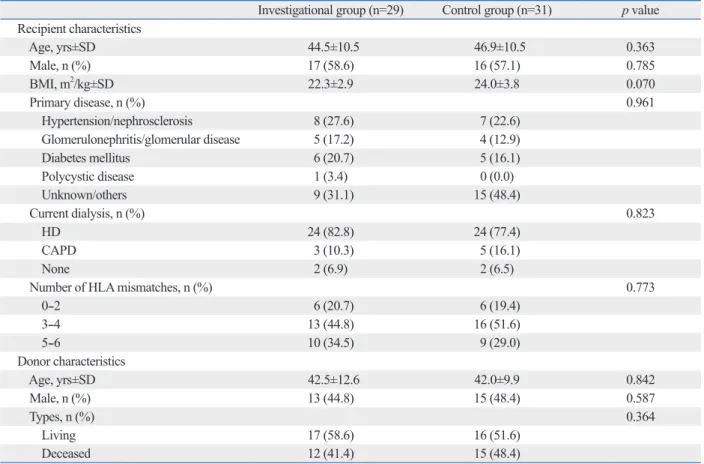
In total, 60 patients were enrolled in this study and random- ized to either the investigational group (n=29) or the control group (n=31). Fifty-four (90.0%) patients remained on study medication at 6 months post-transplantation. One patient (3.4%) in the investigational group and 5 patients (16.1%) in the control group prematurely discontinued medication dur- ing follow-up. The reasons for premature discontinuations were adverse events (n=1), withdrawal of consent (n=3), graft loss (n=1), and protocol deviation (n=1). Donor and recipient characteristics were comparable in the two study groups (Table 1).
Primary composite endpoint
Composite efficacy failure rates including the incidence of biopsy-confirmed acute rejection until 6 months post-trans- plantation were 0% in the investigational group and 10.7%
in the control group, and the investigational group was sta- tistically non-inferior to the control group. One graft loss in the control group and no patient death in either group were recorded. No statistical differences were observed between the groups in terms of Kaplan-Meier estimates of patient proportions free of composite efficacy failure at 6 months post-transplantation (100% in the investigational group and 89.3% in the control group; p=0.236).
Incidence of biopsy-confirmed acute rejection
The incidences of treated BCAR within 6 months of trans- plantation were not significantly different between the two groups: 0% in the investigational group and 10.7% in the control group (p=0.075), which was statistically non-inferi- or to the investigational group.
Graft renal function
Mean eGFRs (by the Nankivell method) in the investiga- tional group were 40.2±6.9 mL/min/1.73 m2 at 1 month, 41.7±6.3 mL/min/1.73 m2 at 2 months, 41.2±6.0 mL/
min/1.73 m2 at 4 months, and 41.8±6.1 mL/min/1.73 m2 at 6 months post-transplantation, and in the control group were 41.0±5.2 mL/min/1.73 m2 at 1 month, 41.6±5.3 mL/
tivities. Serious adverse events (SAEs) were defined as any AE undesirable signs, symptoms, or medical conditions that met any one of the following criteria: 1) was fatal or life-threatening, 2) resulted in persistent or significant dis- ability/incapacity, 3) required hospitalization or prolonga- tion of existing hospitalization, 4) was a congenital anoma- ly/birth defect, or 5) was an important medical event that might jeopardize the patient and might require medical or surgical intervention to prevent one of the outcomes listed above. Differences between adverse event incidences and the incidences of predefined potentially clinically signifi- cant laboratory values in the two study groups were as- sessed and analyzed.
Patient satisfaction using ITBS
ITBS is a 13-item scale that measures barriers to immuno- suppressant adherence in transplant patients. ITBS was mea- sured at 6 months post-transplantation. Each item was mea- sured on a 5-point scale (1=strongly disagree, to 5=strongly agree) assessing respondent agreement with each statement.
Items consisted of questions about how often: 1) they for- got to take their immunosuppressants, 2) were careless about taking their immunosuppressants, 3) stopped taking their immunosuppressants because they felt worse, and 4) missed taking their immunosuppressants for any reason.11 Evaluation schedule
Study visits took place prior to transplantation (baseline) and at 1, 2, 4, and 6 months post-transplantation. At each visit, a complete physical examination was performed and laborato- ry values concerning kidney, liver, hematology, proteinuria, and tacrolimus in blood were measured. Blood pressure, weight, and any problems between visits were documented.
All adverse and severe adverse events were documented.
Statistical analyses
All assessments of non-inferiority were made using a pre- specified margin of 25% with a 0.05 level of significance.
Frequency distributions were plotted for categorical vari- ables. The χ² test or Fisher’s exact test were used to compare the two treatment groups. Descriptive statistics were ana- lyzed as continuous variables using Student’s t-test. Continu- ous variables were expressed as means±standard deviations.
Based on reference to a previous study, the efficacy fail- ure rates at post-transplant 6 months for the control and in- vestigational groups were 14.0% and 15.1%, respectively.12 A sample size of 25 patients per each treatment group was
plantation were comparable between the two groups (71.4%
of patients in the investigational group and 75.0% in the control group; p=0.763), and incidences of SAEs were also comparable (14.7% in the investigational group and 15.5%
in the control group; p=0.415). The incidences of adverse events by system organ class were generally similar be- tween the groups, and most were mild-to-moderate in se- verity (Table 3).
Immunosuppressant therapy barrier scale (ITBS) The summed score of the 13 items of the ITBS (highest val- ue possible 65 and lowest 13) of the investigational group at 6 months post-transplantation was 17.5±3.1, which was comparable to that of the control group (18.4±4.0; p=0.345).
DISCUSSION
As far as we know, there has not been a prospective trial designed to assess conversion from twice-daily tacrolimus to once-daily tacrolimus at the same point in time, one min/1.73 m2 at 2 months, 42.5±5.9 mL/min/1.73 m2 at 4
months, and 41.9±5.8 mL/min/1.73 m2 at 6 months post- transplantation. Group renal functions were not statistically different at any time (p>0.05).
Measured creatinine clearance by 24-hour urine collec- tion at 6 months post-transplantation were similar between the two groups (64.1±21.5 mL/min/1.73 m2 in the investi- gational group and 63.64±21.3 mL/min/1.73 m2 in the con- trol group; p=0.933).
Excreted protein amounts at 6 months post-transplanta- tion were similar at 104.3±84.4 and 91.4±83.4 mg per day in the investigational and control groups (p=0.589).
Doses, blood trough levels, and tacrolimus dose adjustments
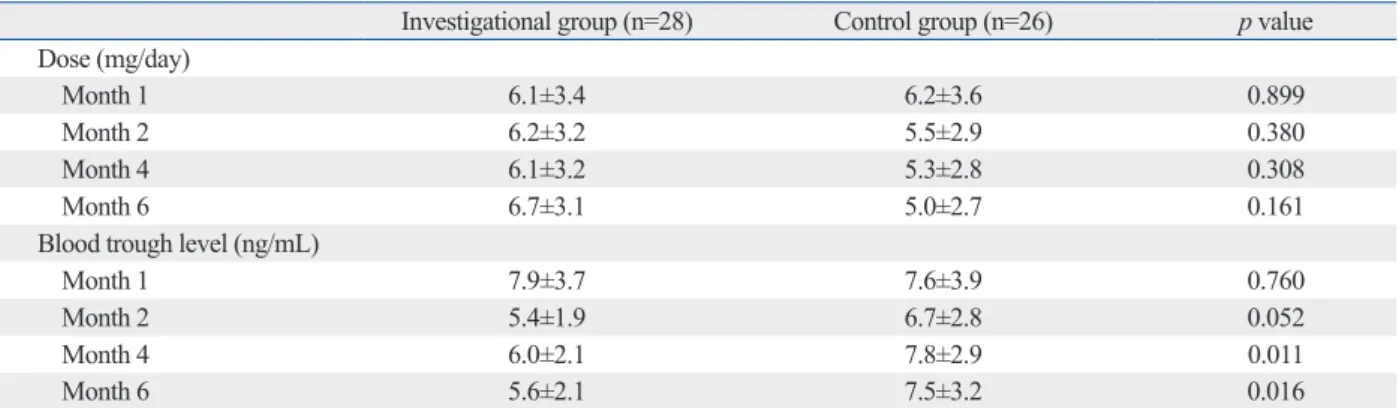
At follow-up visits, most subjects did not require dose ad- justment. The mean daily doses and whole blood concen- trations of tacrolimus are summarized in Table 2.
Adverse events
Overall incidences of adverse events at 1 month post-trans-
Table 1. Baseline Demographics and Clinical Characteristics of the Study Population (ITT Population)
Investigational group (n=29) Control group (n=31) p value Recipient characteristics
Age, yrs±SD 44.5±10.5 46.9±10.5 0.363
Male, n (%) 17 (58.6) 16 (57.1) 0.785
BMI, m2/kg±SD 22.3±2.9 24.0±3.8 0.070
Primary disease, n (%) 0.961
Hypertension/nephrosclerosis 8 (27.6) 7 (22.6)
Glomerulonephritis/glomerular disease 5 (17.2) 4 (12.9)
Diabetes mellitus 6 (20.7) 5 (16.1)
Polycystic disease 1 (3.4) 0 (0.0)
Unknown/others 9 (31.1) 15 (48.4)
Current dialysis, n (%) 0.823
HD 24 (82.8) 24 (77.4)
CAPD 3 (10.3) 5 (16.1)
None 2 (6.9) 2 (6.5)
Number of HLA mismatches, n (%) 0.773
0--2 6 (20.7) 6 (19.4)
3--4 13 (44.8) 16 (51.6)
5--6 10 (34.5) 9 (29.0)
Donor characteristics
Age, yrs±SD 42.5±12.6 42.0±9.9 0.842
Male, n (%) 13 (44.8) 15 (48.4) 0.587
Types, n (%) 0.364
Living 17 (58.6) 16 (51.6)
Deceased 12 (41.4) 15 (48.4)
ITT, intention-to-treat; BMI, body mass index; HD, hemodialysis; CAPD, continuous ambulatory peritoneal dialysis; HLA, human leukocyte antigen.
Continuous variables are expressed as the mean±standard deviation (SD) and their p-values were calculated with t-test. Categorical variables are ex- pressed as number (%) and their p-values were calculated with Fisher’s exact test.
blood trough levels of once-daily tacrolimus were lower than those of twice-daily tacrolimus, especially at post-trans- plant 4 and 6 months. The rate of increasing tacrolimus dose was higher in the once-daily tacrolimus group than twice-daily tacrolimus group. Therefore, in order to prevent development of acute rejection, especially during the early post-transplant period, blood trough levels should be cau- tiously monitored when twice-daily tacrolimus is converted to once-daily. A recent report revealed another pharmacoki- netic difference between once-daily and twice-daily tacroli- mus regarding the intravariability of blood trough concen- tration (C0), which was significantly lower for once-daily tacrolimus.18
Although the present study was not powered to test for superiority, the BCAR rate at 6 months was lower for once- daily tacrolimus. This finding suggests that the efficacy of once-daily tacrolimus is at least equivalent to that of twice- daily tacrolimus. Only when the blood trough levels are ap- propriately maintained, tacrolimus-based immunosuppres- sion should be enough to suppress acute rejection regardless of its frequency of dosing (once-daily or twice-daily). Pre- vious studies have failed to demonstrate the equivalence of month after transplantation, which is the main reason why
we conducted this trial. Because many transplant doctors are accustomed to using twice-daily tacrolimus and main- taining a dose of tacrolimus that is usually determined at one month post-transplantation, we considered one month after transplantation as an optimal timing for conversion of twice-daily tacrolimus to once-daily tacrolimus. The results of the present clinical trial show that the once-daily tacroli- mus is effective with good tolerability and safety when ad- ministered from 1 month after transplantation. In the pres- ent study, during the 6-month post-transplantation period, no graft was lost and no patient death occurred in the inves- tigational group. Furthermore, no episode of biopsy-proven acute rejection was encountered in the investigational group.
Despite the finding that once-daily tacrolimus provided more stable drug blood concentrations than twice-daily ta- crolimus,13 it was found to be necessary to use higher doses of once-daily tacrolimus to reach targeted trough levels af- ter conversion from twice-daily tacrolimus, which concurs with previous reports.14-17 As shown in the results, adminis- tered doses of once-daily tacrolimus were higher than those of twice-daily tacrolimus after conversion, and the mean
Table 2. Tacrolimus Doses, Blood Levels, and Dose Adjustment Over the Time (PP Population)
Investigational group (n=28) Control group (n=26) p value
Dose (mg/day)
Month 1 6.1±3.4 6.2±3.6 0.899
Month 2 6.2±3.2 5.5±2.9 0.380
Month 4 6.1±3.2 5.3±2.8 0.308
Month 6 6.7±3.1 5.0±2.7 0.161
Blood trough level (ng/mL)
Month 1 7.9±3.7 7.6±3.9 0.760
Month 2 5.4±1.9 6.7±2.8 0.052
Month 4 6.0±2.1 7.8±2.9 0.011
Month 6 5.6±2.1 7.5±3.2 0.016
PP, per-protocol.
Continuous variables are expressed as the mean±standard deviation and their p-values were calculated with t-test.
Table 3. Adverse Events after 1 Month Post-Transplantation (ITT Population)
Investigational group (n=29) Control group (n=31) p value
Any AE 20 (70.0) 21 (67.7) 0.782
SAEs 10 (34.5) 13 (41.9) 0.513
Severe AEs 0 (0.0) 1 (3.2)
AEs leading to study drug discontinuation 0 (0.0) 0 (0.0)
Most frequently reported AEs (≥20% of patients in any treatment group)
Gastro-intestinal system disorders 8 (27.6) 7 (22.6)
Metabolic and nutritional disorders 6 (20.7) 6 (19.4)
Respiratory system disorders 6 (20.7) 7 (22.6)
Urinary system disorders 4 (13.8) 6 (19.4)
ITT, intention-to-treat; AE, adverse event; SAE, serious adverse event.
Categorical variables are expressed as number (%) and their p-values were calculated with Fisher’s exact test.
men to a once-daily tacrolimus extended-release formulation in stable kidney transplant recipients. Transplantation 2007;83:1648- 2. Alloway R, Steinberg S, Khalil K, Gourishankar S, Miller J, Nor-51.
man D, et al. Conversion of stable kidney transplant recipients from a twice daily Prograf-based regimen to a once daily modified release tacrolimus-based regimen. Transplant Proc 2005;37:867- 70.
3. Krämer BK, Charpentier B, Bäckman L, Silva HT Jr, Mondragon- Ramirez G, Cassuto-Viguier E, et al. Tacrolimus once daily (AD- VAGRAF) versus twice daily (PROGRAF) in de novo renal transplantation: a randomized phase III study. Am J Transplant 2010;10:2632-43.
4. Silva HT Jr, Yang HC, Abouljoud M, Kuo PC, Wisemandle K, Bhattacharya P, et al. One-year results with extended-release ta- crolimus/MMF, tacrolimus/MMF and cyclosporine/MMF in de novo kidney transplant recipients. Am J Transplant 2007;7:595- 608.
5. Guirado L, Cantarell C, Franco A, Huertas EG, Fructuoso AS, Fernández A, et al. Efficacy and safety of conversion from twice- daily to once-daily tacrolimus in a large cohort of stable kidney transplant recipients. Am J Transplant 2011;11:1965-71.
6. Butler JA, Roderick P, Mullee M, Mason JC, Peveler RC. Fre- quency and impact of nonadherence to immunosuppressants after renal transplantation: a systematic review. Transplantation 2004;
77:769-76.
7. Weng FL, Israni AK, Joffe MM, Hoy T, Gaughan CA, Newman M, et al. Race and electronically measured adherence to immuno- suppressive medications after deceased donor renal transplanta- tion. J Am Soc Nephrol 2005;16:1839-48.
8. First MR, Fitzsimmons WE. Modified release tacrolimus. Yonsei Med J 2004;45:1127-31.
9. Regazzi MB, Alessiani M, Rinaldi M. New strategies in immuno- suppression. Transplant Proc 2005;37:2675-8.
10. Nankivell BJ, Gruenewald SM, Allen RD, Chapman JR. Predict- ing glomerular filtration rate after kidney transplantation. Trans- plantation 1995;59:1683-9.
11. Chisholm MA, Lance CE, Williamson GM, Mulloy LL. Develop- ment and validation of an immunosuppressant therapy adherence barrier instrument. Nephrol Dial Transplant 2005;20:181-8.
12. Cross SA, Perry CM. Tacrolimus once-daily formulation: in the prophylaxis of transplant rejection in renal or liver allograft recipi- ents. Drugs 2007;67:1931-43.
13. Kurnatowska I, Krawczyk J, Oleksik T, Nowicki M. Tacrolimus dose and blood concentration variability in kidney transplant re- cipients undergoing conversion from twice daily to once daily modified release tacrolimus. Transplant Proc 2011;43:2954-6.
14. de Jonge H, Kuypers DR, Verbeke K, Vanrenterghem Y. Reduced C0 concentrations and increased dose requirements in renal al- lograft recipients converted to the novel once-daily tacrolimus for- mulation. Transplantation 2010;90:523-9.
15. Jelassi ML, Lefeuvre S, Karras A, Moulonguet L, Billaud EM.
Therapeutic drug monitoring in de novo kidney transplant receiv- ing the modified-release once-daily tacrolimus. Transplant Proc 2011;43:491-4.
16. Crespo M, Mir M, Marin M, Hurtado S, Estadella C, Gurí X, et al.
De novo kidney transplant recipients need higher doses of Adva- graf compared with Prograf to get therapeutic levels. Transplant Proc 2009;41:2115-7.
17. Hougardy JM, Broeders N, Kianda M, Massart A, Madhoun P, Le
the efficacy of once-daily versus twice-daily tacrolimus in de novo kidney transplant patients.3,4 In the present study, we initiated immunosuppression with twice-daily tacrolimus during this critical period, and then converted to once-daily tacrolimus. This conversion at 1 month post-transplantation may have avoided the risk of acute rejection immediately after transplantation, because this period is vulnerable to development of acute rejection. In addition, it is easier to adjust optimal blood trough levels using twice-daily tacroli- mus than once-daily tacrolimus.
Generally, adherence has been reported to increase from 59% for 3 times daily dosing regimens to 83% for once daily regimens,19 which leads to the conclusion that reduc- ing the dosage frequency is one of the most important means of improving adherence. However, all kidney transplant pa- tients enrolled in this study were taking adjunctive immu- nosuppressants, such as glucocorticoid and mycophenolate mofetil, which required twice-daily dosing. We believe that this explains why ITBS scores were not found to differ sig- nificantly in our two groups (p=0.345). The limitations of this study include that it could not provide evidence of drug adherence associated with the dosage frequency and that it failed to demonstrate only once-daily drug as statistically superior for this study population who were taking con- comitant medications twice a day.
In conclusion, conversion to once-daily tacrolimus at 1 month after kidney transplantation was found to be non-infe- rior in terms of efficacy and safety to twice-daily tacrolimus.
In terms of patient satisfaction, despite once-daily tacrolimus would be partly useful to reducing the frequency of dosing, it failed to be statistically superior for this study population who were taking concomitant medications twice a day.
ACKNOWLEDGEMENTS
This corporation-initiated trial (CIT) was funded by Astellas Pharma Korea, Inc. This study was registered with www.
clinicaltrials.gov; registration identifier=NCT01742624.
Yu Seun Kim has received grants from Novartis, Astel- las, Wyeth, Roche.
REFERENCES
1. Alloway R, Steinberg S, Khalil K, Gourishankar S, Miller J, Nor- man D, et al. Two years postconversion from a prograf-based regi-
sion from prograf to advagraf in stable kidney transplant recipi- ents. Transplantation 2011;92:648-52.
19. Eisen SA, Miller DK, Woodward RS, Spitznagel E, Przybeck TR.
The effect of prescribed daily dose frequency on patient medica- tion compliance. Arch Intern Med 1990;150:1881-4.
Moine A, et al. Conversion from Prograf to Advagraf among kid- ney transplant recipients results in sustained decrease in tacrolimus exposure. Transplantation 2011;91:566-9.
18. Wu MJ, Cheng CY, Chen CH, Wu WP, Cheng CH, Yu DM, et al.
Lower variability of tacrolimus trough concentration after conver-