Korean J Radiol 2(4), December 2001 231
A Case Report of Inflammatory
Pseudotumor Involving the Clivus:
CT and MR Findings
The authors describe a rare case of inflammatory pseudotumor involving the clivus, where a soft tissue mass lesion, with extension into the prevertebral retropharyngeal space and the cavernous sinuses, was detected by CT and MRI.
The mass resembled a malignant tumor or aggressive infectious lesion, and the final diagnosis of inflammatory pseudotumor was a diagnosis of exclusion, decid- ed after histopathological examination.
nflammatory pseudotumors are etiologically enigmatic, nosologically confusing, and biologically often unpredictable. They are characterized histologically by the presence of acute and chronic inflammatory cells with a variable fibrous response (1, 2). Inflammatory pseudotumors of the head and neck most commonly occur in the orbits or, rarely, in the skull base. We describe a rare case of inflammatory pseudotumor involving the clivus, extending into the cav- ernous sinuses and prevertebral retropharyngeal space, and mimicking a malignant neoplasm or aggressive infectious lesion. A knowledge of the imaging features of in- flammatory pseudotumor can help avoid unnecessary radical surgery prior to histopathological proof of malignancy, though to exclude the possibility of a malignant neoplasm or aggressive infectious condition, biopsy is recommended.
CASE REPORT
A 42-year-old male patient with a two-month history of headache underwent con- servative therapy at a local clinic, but the symptoms showed no improvement. Abrupt- onset diplopia developed four days before admission into the neurology ward of our hospital, but the patient’s medical history was otherwise unremarkable. Neurologic ex- amination revealed limitation of the extraoccular muscles during right lateral gaze, with aggravated diplopia, suggesting right 6th cranial nerve palsy. Laboratory tests suggested no significant abnormality.
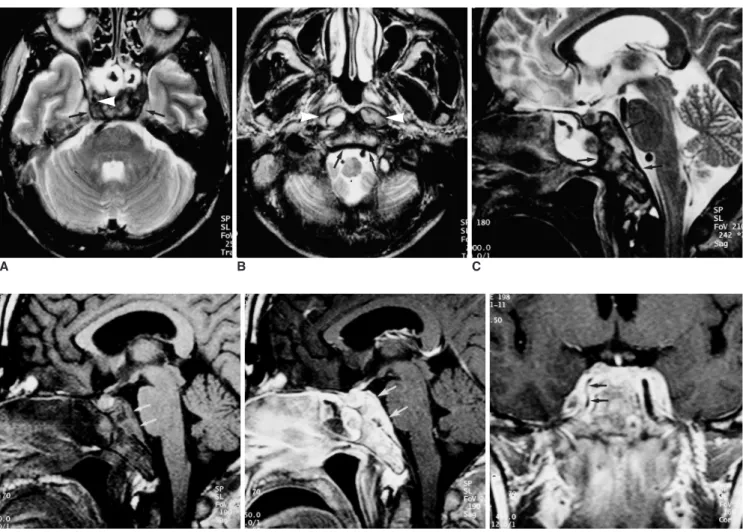
T2-weighted MR imaging of the brain demonstrated replacement of the entire clival bone marrow and cavernous sinus by heterogeneous low signal intensity and small ar- eas of high signal intensity, and there was evidence of sphenoid sinusitis (Figs. 1A-C).
The prevertebral muscles showed mixed high and intermediate signal intensity at T2- weighted axial imaging (Fig. 1B), and the pituitary gland was normal in size and shape, with an intact cortical signal void of sellar floor. T1-weighted imaging of the lesion demonstrated mixed intermediate and low signal intensity (Fig. 1D), and at gadolini- um- enhanced T1-weighted imaging, intense enhancement was observed (Fig. 1E). The bilateral cavernous sinuses were also involved by the lesion, with diffuse narrowing of the cavernous portion of the right internal carotid artery (Figs. 1A, F). At that time, Jae Hee Lee, MD1
Kijun Kim, MD1
Sung Woo Chung, MD2 Yong Chul Choi, MD3 Ahnhi Lee, MD4
Index terms :
Pseudotumor, clivus inflammatory
Korean J Radiol 2001;2:231-234 Received April 26, 2000; accepted after revision September 20, 2001.
Departments of 1Radiology, 2Neurology,
3Otolaryngology, and 4Pathology, Our Lady of Mercy Hospital, The Catholic University of Korea
Address reprint requests to : Kijun Kim, MD, Department of Radiology, Our Lady of Mercy Hospital, The Catholic University of Korea, 665 Pupyong-dong, Pupyong-gu, Incheon 403-720, Republic of Korea.
Telephone: (8232) 510-5531 Fax: (8232) 529-0964 e-mail: [email protected]
I
differential diagnoses included metastatic carcinoma, lym- phoma, and an indolent aggressive infectious disease such as fungal infection.
Transsphenoidal clival biopsy was performed, but there was no evidence of fungal infection in the nasal cavity or sphenoid sinus. Biopsy specimens from the clivus revealed only chronic inflammatory cells with thick fibrosis.
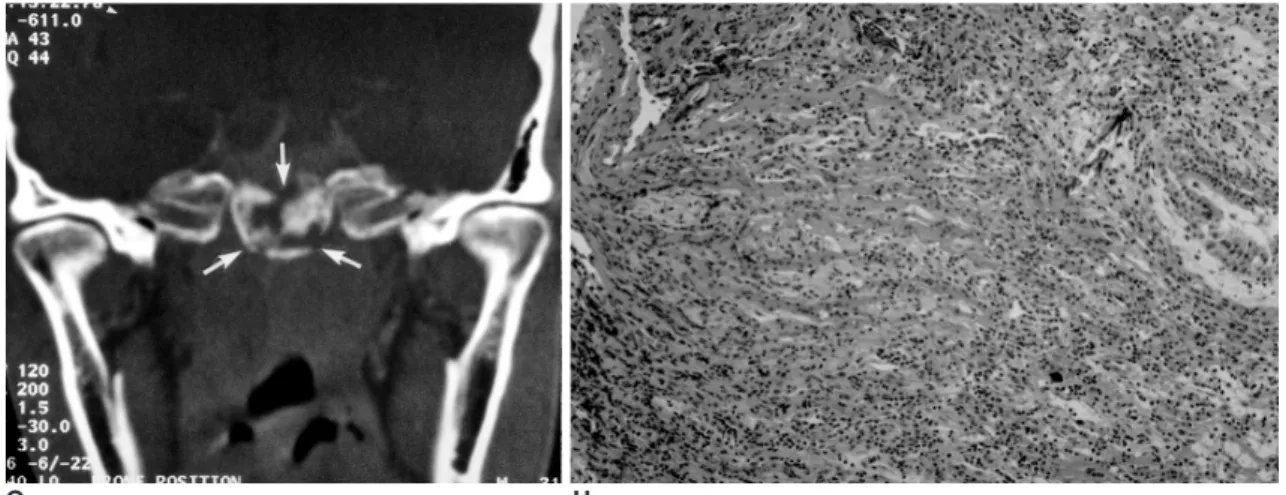
Immunohistochemistry was positive for vimentin but nega- tive for cytokeratin, CEA, and CD 34. After clival biopsy, a CT examination was performed : the images obtained de- picted multifocal permeative bone destruction in the clivus
(Fig. 1G) and a bulky retropharyngeal mass of soft tissue density.
A biopsy of the retropharyngeal mass was subsequently perfomed, but the mucosal lining of the nasopharynx re- vealed no abnormality. Biopsy specimens from the retropharyngeal soft tissue mass-like lesion showed bun- dles of fibroblasts admixed with inflammatory cells com- posed of lymphocytes and plasma cells (Fig. 1H). A high- power field view showed no evidence of mitosis or cellular atypism.
The patient was treated with high-dose corticosteroid Lee et al.
232 Korean J Radiol 2(4), December 2001
A B C
D E F
Fig. 1. A 42-year-old male patient who presented with a two-month history of headache and a four-day history of diplopia.
A. T2-weighted axial MR image at the level of the sphenoid sinus shows very low heterogeneous signal intensity involving the clivus and bilateral cavernous sinuses, with sphenoid sinusitis (arrows). Note the narrowing of the cavernous part of the right internal carotid artery (arrowhead).
B. T2-weighted axial MR image at the level of the nasopharynx shows a high signal intensity lesion in the prevertebral muscles (arrow- heads) and a heterogeneous mixed high and low signal intensity lesion in the clivus (arrows).
C. T2-weighted mid-sagittal MR image reveals an expansile heterogeneous low signal intensity lesion involving the entire clivus (arrows).
Note the presence of an apparently normal pituitary gland and intact sellar floor.
D. T1-weighted mid-sagittal MR image at the same level as C shows mixed intermediate and low signal intensity replacing the entire cli- val bone marrow. The posterior line of the cortical dark signal has been destroyed (arrows).
E. Contrast-enhanced T1-weighted sagittal MR image at the same level as C demonstrates strong enhancement of the lesion (arrows), with small nonenhancing areas.
F. Contrast-enhanced T1-weighted coronal MR image at the level of the pituitary stalk shows bilateral involvement of the cavernous si- nuses associated with narrowing of the cavernous portion of the right internal carotid artery due to infiltration of the lesion (arrows).
and discharged after showing clinical improvement.
DISCUSSION
Inflammatory pseudotumor is a chronic inflammatory tumefaction of unknown origin. Because the term ‘inflam- matory pseudotumor’ is nonspecific and lesions have a va- riety of histologic presentations, several alternative names have been used to refer to them : inflammatory myofibrob- lastic tumor, plasma cell granuloma or pseudotumor, xan- thomatous pseudotumor, pseudosarcomatous myofibrob- lastic proliferation, inflammatory myofibrohistiocytic pro- liferation, and myofibroblastoma (1). Although early de- scriptions of lesions classified as inflammatory pseudotu- mors focused on their occurrence in the lung, the lesions occur in diverse extrapulmonary locations.
In the head and neck, inflammatory pseudotumor most commonly involves the orbit. According to the pathology literature, a diagnosis of inflammatory pseudotumor of the head and neck has been applied rather indiscriminately.
Histopathologically, two characteristics of the lesions have been described. Firstly, the tumor was found to consist of a mixed proliferation of vimentin-positive fibroblasts and smooth muscle actin-positive myofibroblasts, with the for- mer predominating. The cells were arranged in fascicles or sheets, or occasionally in whorls, and mitoses were absent.
Secondly, inflammatory cells were present. These lesions probably have a neoplastic origin, and authors have pre- ferred to use the term ‘inflammatory myofibroblastic tu- mor’ or ‘inflammatory fibrosarcoma’ (1).
Reports have stated that extraorbital inflammatory pseudotumors of the head and neck involve the maxillary sinuses (2, 3), infratemporal fossa (4, 5), nasopharynx (in-
cluding the parapharyngeal space) (4 6), pterygopalatine fossa (6, 7), and the major salivary gland (6). Involvement of the clivus or cavernous sinus by fibrosing inflammatory pseudotumors centered in the nasopharynx, orbit, or mas- ticator space has been described in a previous article (4).
To our knowledge, however, a case in which an expansile and infiltrating lesion mainly involved the clivus has not previously been reported.
According to previous reports (2 7), it is very difficult, both clinically and radiologically, to decide whether a le- sion involving an infiltrating soft tissue mass, with bony de- struction, is a pseudotumor or a malignant neoplasm. In our case, for example, the tumor was at first thought to be a malignant neoplasm such as a lymphoma or metastatic carcinoma, or an aggressive infectious process. There were no signs or symptoms of infection such as fever, and it was unlikely that the heterogeneous signal observed at T2- weighted imaging indicated malignant lymphoma. The co- incidence of lesions of differing signal intensity involving the clivus and prevertebral muscle was thought to be un- usual for metastatic carcinoma. Without a biopsy, howev- er, differentiation between metastatic carcinoma, lym- phoma, and chronic fungal disease was impossible.
Multiple biopsies of the clivus and retropharyngeal soft tis- sue showed only chronic inflammatory cells with thick fi- brosis but no mitoses, and the mucosal lining of the na- sopharynx was free of both malignancy and infection.
Although pathologists eschew the term ‘inflammatory pseudotumor’ this was our diagnosis on the basis of these findings, and high-dose corticosteroid therapy was indicat- ed.
The administration of high-dose corticosteroid is the pri- mary treatment of choice for inflammatory pseudotumor, Imaging of Inflammatory Pseudotumor Involving the Clivus
Korean J Radiol 2(4), December 2001 233
G H
Fig. 1. A 42-year-old male patient who presented with a two-month history of headache and a four-day history of diplopia.
G. Coronal bone algorithm CT scan obtained at the level of the pituitary gland shows permeative bone destruction of the clivus (arrows).
H. Pathologic specimen obtained from the clivus shows thick fibrous bands with scattered chronic inflammatory cells (H&E staining, origi- nal magnification 100).
and response to medical therapy is thought to roughly par- allel the acuity of the inflammatory process. Acute lesions typically respond to high doses of corticosteroid, but chronic lesions, which tend to have more fibrosis, generally do not respond to medical therapy (8). In their series, how- ever, Han et al. (4) found no relationship between the du- ration of signs and symptoms, and degree of fibrosis. We consider that the findings of MR imaging are a good predic- tor of therapeutic response. It is postulated that in lesions which show high signal intensity at T2-weighted imaging and strong enhancement, there is a relative abundance of free water and mobile protons. If the response to steroid is poor, complete surgical resection is advocated; when such resection is not possible, local radiation therapy has been shown to be effective in some cases (3, 8).
Where a soft tissue mass involving the clivus shows het- erogeneous low signal intensity at T2-weighted imaging, has an infiltrative appearance in the presence of an appar- ently normal pituitary gland, and there is no known under- lying malignancy, inflammatory myofibroblastic tumor, in other words ‘inflammatory pseudotumor’, should be in- cluded in the differential diagnosis.
References
1. Batsakis JG, Luna MA, El-Naggar AK, Goepfert H. “Inflamma-
tory pseudotumor”: What is it? How does it behave? Ann Otol Rhinol Laryngol 1995;104:329-332
2. Som PM, Brandwein MS, Maldjian C, Reino AJ, Lawson W.
Inflammatory pseudotumor of the maxillary sinus: CT and MR findings in six cases. AJR 1994;163:689-692
3. Maldjian JA, Norton KI, Groisman GM, Som PM. Inflmmatory pseudotumor of the maxillary sinus in a 15-year-old boy. AJNR 1994;15:784-786
4. Han MH, Chi JG, Kim MS, et al. Fibrosing inflammatory pseudotumors involving the skull base: MR and CT manifesta- tions, with histopathologic comparison. AJNR 1996;17:515-521 5. Weisman RA, Osguthorpe JD. Pseudotumor of the head and
neck masquerading as neoplasia. Laryngoscope 1998;98:610- 614
6. Vuysere SD, Hermans R, Sciot R, Crevits I, Marchal G. Extra- orbital inflammatory pseudotumor of the head and neck: CT and MR findings in three patients. AJNR 1999;20:1133-1139 7. Ribeiro AC, Joshi VM, Funkhouser WK, Mukherji SK. Inflam-
matory myofibroblastic tumor involving the pterygopalatine fossa. AJNR 2001;22:518-520
8. Sclafani AP, Kimmelman CP, McCormick SA. Inflammatory pseudotumor of the larynx: Comparison with orbital inflamma- tory pseudotumor, with clinical implications. Otolaryngol Head Neck Surg 1993;109:548-551
Lee et al.
234 Korean J Radiol 2(4), December 2001