CO 2 농도 상승 효과에 의한 고추 세균점무늬병 발병 양상 분석
장종옥1, 김병혁1, 문두경1, 고상욱1, 좌재호2*
1 농촌진흥청, 국립원예특작과학원, 온난화대응농업연구소
2 농촌진흥청, 국립원예특작과학원, 감귤연구소
Received: August 28, 2017 / Revised: November 28, 2017 / Accepted: January 5, 2018
서 론
사회·경제적발전과기후정책에따라대기중누적 CO2
농도의 예측 모델링은 다양하게 제시되고 있다. RCP
(Representative Concentration Pathway, 대표농도경로) 시
나리오에따르면 2100년지구평균 CO2농도는온실가스배
출량이낮은시나리오인 RCP 2.6일때 500 ppm 미만으로 줄어들지만, 중간 시나리오인 RCP 4.5와 RCP 6.0일 때 500−600 ppm, 온실가스배출이매우높은시나리오인 RCP 8.5일때는 1,000 ppm 이상증가할것으로예상하고있다[1].
대기중 CO2의농도는 1750년이후 30%가증가하였으며,
2100년에는현재수준에서두배혹은그이상이될것으로
예상된다. 미국해양대기청(National Oceanic and Atmospheric Administration, NOAA)에따르면 2015년 3월전지구의 CO2
농도가 400.83 ppm으로, 관측이래처음으로 400 ppm이넘 었다고발표하였다. 우리나라의경우안면도기후변화감시 소에서 1999년 관측을 시작한 이래 2012년 399.9 ppm,
2013년 402.4 ppm, 2016년 409 ppm으로매년 2.09 ppm씩 증가하는추세이다.
CO2의상승은식물병원성미생물의발병력과기주식물
의저항성에영향을미칠것이며, 기주와병원체의상호작 용에도영향을미칠것으로예상된다. CO2는식물에직접적인 생물학적영향을미칠수있는요소이며, 식물병원성미생물 에도직접또는간접적으로영향을미친다[2, 3]. 식물병원성 세균인 Erwinia carotovora와 Pseudomonas fluorescens는 높은 CO2농도에서생장저해를받으며, 식물병원성곰팡 이인 Phytophthora capsici는포자형성에영향을받는다는 연구결과가이미보고되었다[4, 5]. 1990년대부터영국, 호주, 미국, 독일등많은나라에서 CO2농도증가와병원성미생 물에대한연구를발표하였으나대부분 350 ppm에서 700 ppm 으로증가하였을때의결과이며, 빠르게변하는기후하에서 병원균과기주식물간의새로운데이터는매우부족한실정 이다[6, 7].
식물은 외부적 스트레스에 저항하기위해 과민성반응 (hypersensitive response, HR)을보이거나, HR의반응결 과로병저항성(pathogenesis-related, PR) 단백질이유도된
다[8−10]. 병원성미생물이나곤충등에의한환경스트레스
에의해식물스스로방어할수있는반응기작인 HR은감 Analysis of Bacterial Spot Disease in Red Pepper Caused by Increase of CO2 Concentration
Jong-Ok Jang1, Byung-Hyuk Kim1, Doo-Gyung Moon1, Sang-wook Koh1, and Jae-Ho Joa2*
1Research Institute for Climate Change and Agriculture, 2Citrus Research Institute, NIHHS, RDA, Jeju 63240, Republic of Korea
An increase in CO2 will affect plant pathogenic microorganisms, the resistance of host plants, and host- pathogen interactions. This study used Capsicum annuum and Xanthomonas euvesicatoria, a pathogenic bacterium of pepper, to investigate the interactions between hosts and pathogens in conditions of increased CO2 concentrations. Our analysis of disease resistance genes under 800 ppm CO2 using quantita- tive RT-PCR showed that the expression of CaLRR1, CaPIK1, and PR10 decreased, but that of negative reg- ulator WRKY1 increased. Additionally, the disease progress and severity was higher at 800 ppm than 400 ppm CO2. These results will aid in understanding the interaction between red pepper and X. euvesicatoria under increased CO2 concentrations in the future.
Keywords: CO2, red pepper, Xanthomonas euvesicatoria, bacterial spot disease
*Corresponding author
Tel: +82-64-730-4172, Fax: +82-64-733-9564 E-mail: [email protected]
© 2018, The Korean Society for Microbiology and Biotechnology
염된부위를아주빠르게괴사시켜병원체의감염을차단하
여식물체를보호하며[11, 12], 차후병원균의침입을억제할
수있는전신획득저항성(systemic acquired resistance, SAR) 을유도시킨다[13, 14]. 식물체의대표적인 HR 관여유전자 는 PIK1 [15, 16], LRR1 [17, 18], WRKY1 [19, 20] 등이있다. 고추(Capsicum annuum L.)는 2013년국내재배면적이
45,360 ha로, 경제적으로매우중요한작물이며우리나라의
식생활문화와도밀접한관계를가진다[21]. 고추에세균점
무늬병을일으키는 Xanthomonas campestris pv. vesicatoria
(Xcv)는식물체의각부분에발병하지만주로잎에황녹색의
점무늬를나타내며병반이점차확대되면잎전체가황화되
어조기낙엽을유발한다. Xcv에감염된고추는 HR 반응과
함께유전자-유전자간의상호작용에의해병에대한저항
성이조절된다[22]. 병원체에의해고추에유도된 CaLRR1
(Leucine-rich repeat)은 5개의 glycosylation 부위와 5개의 LRR domain을가지며효소억제제, 리보솜결합단백질, 호 르몬수용체등다수의활성단백질의주요구조에서발견 된다[23−26]. CaLRR과마찬가지로 HR 반응에의해유도되
는식물의 WRKY 전사요소군은생리및대사조절작용에
관여하는매우독특한전사조절체라보고되어있다[27−29].
고추 식물체에서 확인된 CaWRKY1 (zinc finger-domain transcription factor 1) 유전자는비숙주병원균인 Xanthomonas axonopodis에의해감염된고추에서확인되었다[30].
Protein kinase는유전자의발현, 세포의성장과분화조
절에관여하는생물학적시스템의주요요소이며[31, 32], 병
원균을인식하여식물의방어반응을유발하는데필수적단 백질이다[33, 34]. Protein kinase의 하나인 CaPIK1은 VIGS (virus-induced gene silencing) 방법을이용하여 CaPIK1 knockdown 된고추식물체에서 Xanthomonas campestris pv. vesicatoria의감염에감수성이증가하였고, 이러한결과 는 CaPIK1이 Xcv의감염에대한방어및내성의양성조절
인자로서기능을한다는것을알수있다[35].
PR 단백질은병원체의감염, 식물체의발달과정, 생물학
적인스트레스에적응할때유도되는단백질로, 많은식물
에서발견된다[36, 37]. 그중병원체의감염에의해유도되
는 PR 단백질은감염부위에국소적, 전신적(SAR)으로축적 되는종특이적단백질로곰팡이, 박테리아또는바이러스의
감염에과민혹은저항의반응으로다량생산된다[38]. 세포
외 PR 단백질은가수분해효소(chitinase, β-glucanase 등) 와항균성물질등이있으며, 세포내 PR 단백질은배양된 파슬리에서 elicitor 처리에의해처음기술되었고[39], 그외 담배의 PR-1, 2, 3, 4 등과토마토의 PR-6, 7 등 14가지이상 의 PR 단백질이알려져있다[40, 41]. 특히고추는우리나라 에서활발하게연구되고있는데잎조직에서매우낮은수
준의 CaPR10 단백질은담배모자이크바이러스 TMV-P0에
의해극적으로유도되었으며이는 ribonucleolytic 활성의증 가와관련이있다는보고가있다[42]. 또한고추의 PR4b 단백
질은 LRR1 단백질과상호작용하여식물세포사멸및방어
반응의양성조절인자로서기능을한다는보고가있다[43].
본연구는 CO2상승환경에서기주와병원체간의상호작 용을연구하기위하여고추와고추에세균점무늬병을일으 키는 Xanthomonas euvesicatoria를이용하였다. 고추식물 체에 X. euvesicatoria를접종후, 대기의 CO2 농도와유사한 400 ppm과 대기보다 2배높은 800 ppm의 CO2환경에서 CaLRR1, CaWRKY1, CaPIK1 그리고 CaPR10 유전자를 Quantitative RT-PCR로분석하여고추병저항성관련유전 자의발현양상을확인하였고, 최종적으로고추식물체에서 의점무늬병발병양상을확인하였다. 본연구결과를통해 미래의 CO2증가환경에서우리나라의중요경제작물인고 추와고추의주요피해병원균인 X. euvesicatoria의발병양 상을이해하는기초자료가될것으로사료된다.
재료 및 방법
공시재료
본 실험에서 사용한 고추(Capsicum annuum)는 Early Calwonder (ECW) 계통인 ECW-30R을경북대학교원예학 과로부터분양받아사용하였다. 각종자는유리온실내에서 육묘용상토가담긴 72공포트에파종하여발아시켰으며, 4엽
이되었을때지름 9 cm의포트에옮겨심었다. 고추에세균
점무늬병을일으키는병원균인 Xanthomonas euvesicatoria KACC 18722는 25% glycerol stock 상태로 -80℃에보관하 며사용하였다.
병원균 접종 및 CO2 처리
병원균은 8주된 ECW-30R에접종하였다. X. euvesicatoria 는 TSB (Tryptic Soy Broth, 1.7% pancreatic digest of casein, 0.3% papaic digest of casein, 0.25% dextrose, 0.5% sodium chloride, 0.25% dipotassium phosphate) 배지에 접종 후 25℃에서 24시간진탕배양하였다. 미네랄오일 : 병원균현 탁액은 1:4가되도록혼합하여최종병원균의양은 108 cfu/ml 이되게한후분무기를이용하여식물체에접종하였다. 각 pot의배양조건은온도는 30℃로유지되며, CO2의농도는 각각 400 ppm과 800 ppm의조건이유지되는생장상에서각 각습실처리하였다. 병접종후 2일뒤에유전자분석을위 한시료를채취하였고, 병접종후 2주뒤발병도를조사하 였다.
Total RNA 추출 및 cDNA 합성
X. euvesicatoria 접종 2일후병징이나타난고추잎조직
을액체 질소에 얼려 분쇄한 후, Quick-RNATM Miniprep Kit (Zymo Research, USA)를이용하여 total RNA를추출하였 다. 추출한 RNA는 DeNovix DS-11+ Spectrophotometer (DeNovix, USA)로정량하였다. cDNA 합성은 2 μg의 RNA와 1 μl oligo dT (100 pmol/l)를혼합후, DEPC-treated distilled water로전체부피를 16 μl로맞춘뒤, 70℃에서 5분간처리 하였다. 이후, 5× reverse transcription master mix (Elpis Biotech, Korea)를 4 μl 첨가하고, 42℃에서 90분, 94℃에서 5분간반응하여 cDNA를합성하였다.
Quantitative RT-PCR에 의한 병 관련 유전자 분석
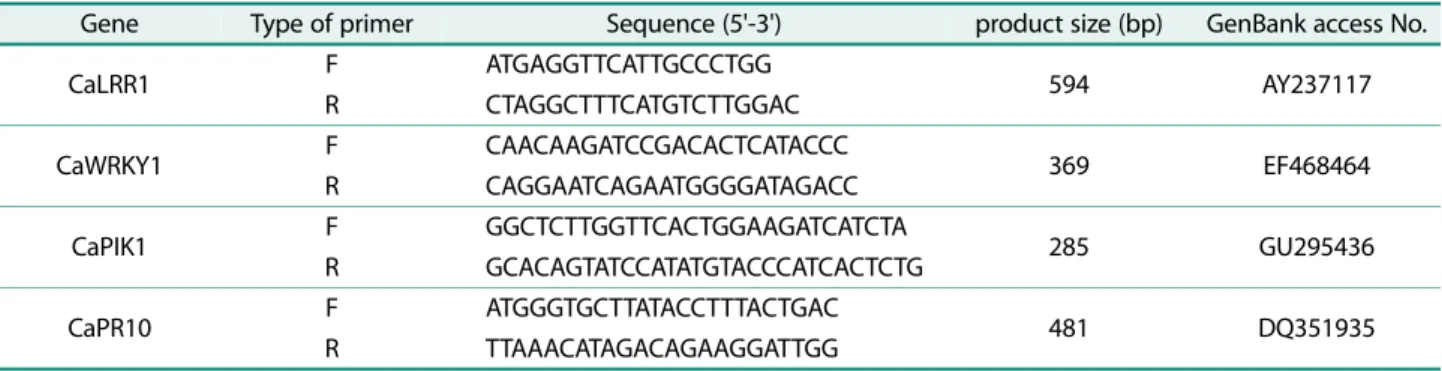
병관련유전자분석을위한 primer는 NCBI에등록되어
있는 유전자를 참조하였으며, primer3 (http: //primer3.
ut.ee/)를이용하여설계하였다(Table 1). 각유전자의발현 양은 quantitative RT-PCR (Real Time-PCR)을 수행하여 분석하였다. qRT-PCR 분석을위한 standard clone은설계 된 primer를이용하여 PCR한후, 각각의 PCR 산물을 All- in-one vector (Biofact, Korea)에 cloning하였으며, plasmid DNA는 HiGeneTM Plasmid Mini Prep Kit (Biofact, Korea)를이용하여추출하였다. 염기서열분석은 All-in-one Vector systems manual에 따라 M13-20F와 M13-20R primer를이용하여분석하였고, BLAST search를통해확인 하였다. 염기서열이확인된 plasmid DNA는 real-time PCR (Bio-Rad, USA)을이용하여 melting curve 분석후정량분석 을위한표준유전자(artificial standard clone)로사용하였다. 정량 PCR은 CFX96 TouchTM Real-Time PCR Detection System (Bio-Rad, USA)과 QuantiFast® SYBR® Green PCR Kit (Qiagen, Germany)을이용하였다. 각유전자의정
량 PCR은앞에서 설계한각각의 primer를이용하였으며
(Table 1), 반응조건은 95℃에서 15 min 동안 pre-denaturation 시켜, 95℃에서 30 sec denaturation, 각유전자별로 30 sec annealing, 72℃에서 30 sec extension후 fluorescence를측 정하고 45 cycles을 수행하였다. CaLRR1, CaWRKY1,
CaPIK1, CaPR10 유전자의 annealing 값은 각각 64.2℃, 64.0℃, 62.6℃및 62.6℃이다. Final extension은 72℃에서 5 min 동안수행하였다. Melting curve 분석은 65℃부터 95℃까지 0.2℃씩증가시키면서 fluorescence를측정하였다. 정량을위한표준유전자를 1 ng/μl부터 serial dilution하 여 qRT-PCR을수행하였으며, 분석하고자하는 DNA 농도 는 NanoDrop ND-2000 (Thermo Scientific, USA)을이용 하여 1 ng/μl를분석에이용하였다.
발병 조사
CO2농도에따른고추세균점무늬병의발병양상을확인 하기위해 X. euvesicatoria를접종후 14일뒤에이병엽률을 확인하였으며, 이병엽률은발병엽수와전체엽수를조사하 여백분율로산출하였다. 발병도조사는각잎의병반부위 를세어 0−4 (0; 병반부위없음, 1; 1−20개, 2; 21−40개, 3;
41−60개, 4; 61개이상)로발병정도를구분하여, 구분된수 의평균값을발병도로정의하였다.
결과 및 고찰
CO2농도 상승 조건에서의 CaLRR1 유전자 발현 양상 CO2농도에따른 X. euvesicatoria 처리구와무처리구의 CaLRR1 qRT-PCR 결과는 Fig. 1과같다. 400 ppm에서 X.
euvesicatoria 무처리구는 1.0 × 10³ molecule· copy/μl, 처리 구는 1.7 × 10⁴ molecule· copy/μl로처리구에서약 17배증가 하였다. 800 ppm에서는무처리구 9 × 10³ molecule· copy/
μl, 처리구는 1.5 × 10⁴ molecule· copy/μl로약 1.6배증가하 였다. 400 ppm과 800 ppm의무처리구에서 CaLRR1 발현 량이 800 ppm에서 9배로높았으나, X. euvesicatoria 처리구 에서는 800 ppm이 400 ppm보다감소하는경향을보였다. 이것은사탕수수에서 Collectotrichum graminicola에의한 SLRR 유전자의발현이나[44], X. campestris pv. vesicatoria 에의한고추에서의 CaLRR1 유전자의발현연구에서병원
Table 1. Nucleic acid sequence of oligonucleotide primers used qRT-PCR assay for the disease resistance gene of Capsicum annuum L. in this study.
Gene Type of primer Sequence (5'-3') product size (bp) GenBank access No.
CaLRR1 F ATGAGGTTCATTGCCCTGG
594 AY237117
R CTAGGCTTTCATGTCTTGGAC
CaWRKY1 F CAACAAGATCCGACACTCATACCC
369 EF468464
R CAGGAATCAGAATGGGGATAGACC
CaPIK1 F GGCTCTTGGTTCACTGGAAGATCATCTA
285 GU295436
R GCACAGTATCCATATGTACCCATCACTCTG
CaPR10 F ATGGGTGCTTATACCTTTACTGAC
481 DQ351935
R TTAAACATAGACAGAAGGATTGG
성박테리아에의한식물체의감염이 LRR 유전자의발현에 관여된다는연구결과와마찬가지로각각의 CO2농도에서 X. euvesicatoria를접종시 CaLRR1의발현량이높아졌다. 400 ppm과 800 ppm의대조구를 비교하면 800 ppm에서 CaLRR1의발현량이높아졌으나, X. euvesicatoria를접종한 처리구를비교하면 800 ppm에서의발현량이 400 ppm 보다 13% 낮아졌다.
CO2농도 상승 조건에서의 CaWRKY1 유전자 발현 양상
WRKY 단백질은노화, 병원체로부터방어등생물학적또
는비생물학적인프로그램을조절하며 arabidopsis에서 100 여개가 발견되는 superfamily이다[45, 46]. CO2 농도 400 ppm에서무처리구와처리구의 qRT-PCR 결과는각각 5.2 × 10³ molecule· copy/μl와 5.8 × 10³ molecule· copy/μl로 X.
euvesicatoria에의한유전자의변화는크게차이가나지않았 다. 800 ppm에서는무처리구와처리구가 3.1 × 10³ molecule·
copy/μl, 8.9 × 10³ molecule· copy/μl로 X. euvesicatoria 처 리구가무처리구보다약 3배높았다(Fig. 2). 무처리구간비 교시 800 ppm이 400 ppm 보다 40% 감소하였으나, 처리구 간비교시에는 800 ppm이 45% 증가하였다. CaWRKY1은
본연구에서분석한다른 3개의유전자와달리 400 ppm 처
리구보다 800 ppm 처리구에서발현량이증가하였다. 식
물의방어는대사와성장을포함하여 up-regulation이되는
유전자도있지만 down-regulation의경향을보이는유전자
도있다. 이는고추의 CaWRKY1 단백질이병원균을방어하
기위해 negative regulator의역할을하며, CaWRKY1 단백 질이과발현된담배식물체가담배모자이크바이러스에감 염되었을때대조군보다더광범위한괴사병변을보인결 과와유사하다[47]. 즉, CaWRKY1 유전자가 800 ppm에서 발현이높아졌다는것은 X. euvesicatoria에의한 CaWRKY1
단백질의 발현이 적어졌다는 것을 유추할 수 있으며, X.
euvesicatoria의병원성에 400 ppm 보다 800 ppm의환경에 서고추식물체가더많은영향을받았기때문이라사료된 다. 무처리구에서는 400 ppm 보다 800 ppm에서 CaWRKY1 유전자발현이낮아진이유도이러한맥락으로해석이가능 할것이다.
CO2농도 상승 조건에서의 CaPIK1 유전자 발현 양상 CaPIK1은 RLCK (receptor-like cytoplasmic protein
kinase)와높은유사성을가진다. RLCK는식물에서만발견
되는독특한단백질로알려져있다[48, 49]. 본연구에서 CO2
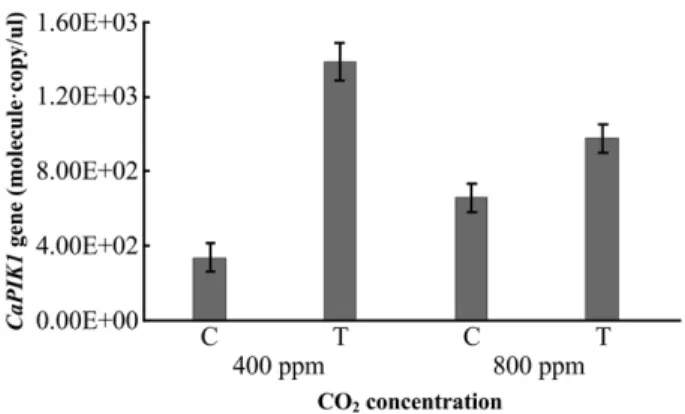
농도에따른 CaPIK1 유전자의발현패턴을분석한결과 400
ppm일경우대조구에서는 3.3 × 10² molecule· copy/μl, 처리 구에서는 1.3 × 10³ molecule· copy/μl로발현되었으며처리 구에서약 4배높게발현되었다. 800 ppm일경우대조구는 6.6 × 10² molecule·copy/μl, 처리구에서는 9.8 × 10² molecule·
copy/μl로약 1.4배높게발현되었다(Fig. 3). 각 CO2농도의 무처리구만비교하면 400 ppm보다 800 ppm에서 2배정도 발현량이증가하였지만, X. euvesicatoria가접종된처리구
에서는발현량이 30% 정도감소하였다. Kim 등의연구에따
르면 X. campestris pv. vesicatoria에의해감염초기단계
에서고추식물체내높은수준의 CaPIK1 유전자가발현되
었으며이결과는 CaPIK1 단백질이병원균침입에대한고
추식물의방어 반응과연관된것이라는결과와유사하다
[35]. 즉, 400 ppm에서대조구와비교해처리구에서의발현
양이증가한것은 X. euvesicatoria에의한고추식물의방어 반응에대한결과이며, 800 ppm의 X. euvesicatoria 처리구
는 800 ppm의대조구보다는발현양이높지만 400 ppm의
처리구보다낮게발현되었기때문에 400 ppm 보다 800 ppm 에서 X. euvesicatoria에의한식물체의방어반응이낮아질 Fig. 1. Expression of disease resistance gene CaLRR1 in Cap-
sicum annuum L. by Xanthomonas euvesicatoria. The control means none treated X. euvesicatoria. C; control, T; treatment.
Fig. 2. Expression of disease resistance gene CaWRKY1 in Capsicum annuum L. by Xanthomonas euvesicatoria. The con- trol means none treated X. euvesicatoria. C; control, T; treatment.
것이라예상된다.
CO2농도 상승 조건에서의 CaPR10 유전자 발현 양상 CO2농도에따른 CaPR10 유전자의발현양상은 Fig. 4와 같다. CO2농도 400 ppm의무처리구에서는 CaPR10 유전 자가 발현되지 않았으나, X. euvesicatoria 처리구에서는 5.7 × 10³ molecule·copy/μl가발현되었다. 400 ppm과 800 ppm
의처리구간비교결과 800 ppm에서발현량이 10% 감소하
였으며이는 CaLRR1, CaWRKY1, CaPIK1과같은양상을
보인다. 다른유전자발현과차별되는결과는 800 ppm에서
의무처리구와처리구의발현양상이다. 무처리구에서의발 현량은 7.2 × 10³ molecule· copy/μl, 처리구에서는 5.1 × 10³ molecule· copy/μl로다른유전자와는다르게무처리구에서
의 CaPR10의 발현이 더 높았다. 유도성 방어 유전자인
PR10 유전자는 salicylic acid, ethylene 같은저분자의물질
또는암(dark) 상태나가뭄의환경적스트레스에의해서유
도가된다[50−53]. 같은조건의 1일차고추식물체샘플에서
도무처리구의 CaPR10 유전자발현이처리구의발현보다 높았던것과 35℃에서같은조건으로실험했을때도유사한 결과(data not shown)가나왔던것을감안한다면 CaPR10 유전자가 CO2의농도에영향을받는것으로추측할수있다. 하지만, 현재까지 CO2와 CaPR10에대한연구가부족한실 정이기때문에앞으로더많은연구가필요할것으로판단 된다.
CO2 농도 상승 조건에서의 발병조사
현재 대기 중의 CO2 농도인 400 ppm과 2배 높은 800 ppm의조건에서 X. euvesicatoria에의한고추세균점무늬 병의발병정도는 Table 2와같으며, X. euvesicatoria를접 종하지않은대조구에서는세균점무늬병이발병하지않음을 확인하였다. 각 CO2 농도에서 이병엽률은 400 ppm에서 34.7%, 800 ppm에서 61.6%로약 2배높아졌다. 또한, 발병 도는 400 ppm에서 0.8, 800 ppm에서 1.2로이병률과마찬
가지로발병도역시 800 ppm이높은것으로확인하였다. 고
추에세균점무늬병을일으키는 X. euvesicatoria는과거에 Xanthomonas campestris pv. vesicatoria로 표기되었으나 최근분자유전학적분류체계의발전으로 X. euvesicatoria, X.
vesicatoria, X. perforans 그리고 X. gardneri의 4종으로세 분화되었으며, 그중 X. euvesicatoria가고추의세균점무늬 병을일으키는주요원인균으로보고되었다[54−56]. 우리나 라에서는대부분 X. campestris pv. vesicatoria에대한연구 가주를이루며, 2010년경부터 X. euvesicatoria를연구하기
시작하여관련연구결과가부족한상황이다. 그러나 Shin과
Yun의보고에의하면, X. campestris pv. vesicatoria는온도와
CO2의증가가발병률증가와연관이있다하였고, 이는 X.
euvesicatoria로연구한본실험의결과와유사하다[57].
또한, Phytophthora capsici에대한감수성과저항성고추 식물체의 PR 관련유전자를분석한결과저항성품종이감 수성품종보다 PR 관련유전자가높게발현된다고보고되 었고[58], 식물면역에관여하는 chitinase인 ChiIV3 유전자 는 PCI (Phytophthora capsici inoculation)에의해 유도되 며유도유전자침묵(virus-induced gene silencing)과일시 Fig. 3. Expression of disease resistance gene CaPIK1 in Cap-
sicum annuum L. by Xanthomonas euvesicatoria. The control means none treated X. euvesicatoria. C; control, T; treatment.
Table 2. Effect of CO2 on disease ratio and severity by Xan- thomonas euvesicatoria.
CO2 concentration
(ppm)
Treated X. euvesicatoria
Ratio of diseased leaves (%)
Disease severity
400 X 0 0
O 34.7 ± 1.2 0.8 ± 0.1
800 X 0 0
O 61.6 ± 3.8 1.2 ± 0.25
The temperature of the incubation room is maintained at 30℃.
Fig. 4. Expression of disease resistance gene CaPR10 in Cap- sicum annuum L. by Xanthomonas euvesicatoria. The control means none treated X. euvesicatoria. C; control, T; treatment.
적인과발현(transient overexpression)에의해 PR 유전자의 상향조절을유발한다고보고되었다[59]. 즉, 식물체는면역 반응에의해 PR 관련유전자가높게발현되어외부스트레 스에대응하지만본연구에서는높은 CO2환경에서 PR 관 련유전자의발현량이감소하는결과를보였으며, 이는발병 도및이병률이낮아지는결과와연관되는것으로사료된다.
CO2증가에따른병원성미생물과식물의상호작용연구
는두가지관점으로나누어볼수있다. 첫번째관점은 CO2
의증가에따른병원성미생물생장의변화이다. 탄저병인 Collectotrichum gloeosporioides은 2배높은 CO2농도에서 초기의생장이지연되었으나한번콜로니가형성되면빠르 게생장률이높아졌고[60], 보리흰가루병인 Erysiphe graminis 는 350 ppm 보다 700 ppm의 CO2에서생장률이높아졌다 는보고가있다[61]. 두번째관점은 CO2증가에따른식물 의변화로형태적변화나생리적변화로인해병원성미생 물에대한저항성의변화이다. 예를들어, CO2가 700 ppm
으로 상승된 경우 식물의 defense structure인 파필라
(papilla)의형성과기공의밀도감소에의한병원체의침입
방지는식물체의내성증가와관련된다[61, 62]. 하나는미
생물의변화이고다른하나는식물의변화이지만두관점 모두 CO2 농도가높아짐에따라 병원체와기주식물의변 화는일어나며, 결론적으로환경요인이어느쪽으로더유 리하게작용하는가에따라결과가달라질수있다는것을 의미한다.
본연구는대기중 CO2농도가현재보다 2배증가할경우 고추세균점무늬병의발병양상을예측하기위해병원성관 련유전자의발현패턴을분석하고, 병의표현형인발병도 및이병엽률을조사하였다. 실험결과 X. euvesicatoria가접 종된처리구의 CaLRR1, CaPIK1 그리고 CaPR10 유전자
는 400 ppm 보다 800 ppm에서 발현 양이 감소하였고,
negative regulator인 CaWRKY1은발현양이 증가하였다. X. euvesicatoria 접종 14일후식물체의표현형을확인한결 과이병엽률과발병도모두 800 ppm에서증가되었으며, 이 결과로부터높은대기중 CO2농도는이병엽률과발병도증 가의원인이될수있음을추측할수있다. 추가적으로 4가 지병원성관련유전자는식물의병저항성을증가또는감
소시킬수있지만, 800 ppm의 CO2환경에서식물체병저
항성의감소와연관성이있을것으로추측된다. 따라서미래 의 CO2증가환경에서고추세균점무늬병의발병은지금보 다증가할것으로예상되며, 본연구는이에대응하기위한 기초자료로활용이가능할것으로사료된다.
요 약
CO2의상승은식물병원성미생물의발병력과기주식물
의저항성에영향을미칠것이며, 기주와병원체의상호작 용에도영향을미칠것으로예상된다. 본연구는 CO2상승 환경에서기주와병원체간의상호작용을연구하기위하여
고추(Capsicum annuum)와 세균점무늬병을 유발하는 X.
euvesicatoria를이용하였다. 고추식물체의병저항성관련 유전자인 CaLRR1, CaWRKY1, CaPIK1 그리고 CaPR10 유전자를 quantitative RT-PCR로분석한결과 800 ppm에 서 CaLRR1, CaPIK1 그리고 PR10 유전자의발현이감소하 였으며, negative regulator인 CaWRKY1 유전자는발현이 증가하였다. 400 ppm과 800 ppm의 CO2농도에서이병엽률
과발병도를확인한결과 800 ppm에서발병도가증가된것
을확인하였다. 이들결과는미래의 CO2농도가증가된환 경에서고추와고추의주요피해병원균인 X. euvesicatoria 에의한고추세균점무늬병의발병양상을이해하는기초자 료로활용할수있을것이다.
Acknowledgments
This study was supported by 2016 the RDA Fellowship Program (Project title: Impact assessment on disease incidence of bacterial spot of pepper according to increase of temperature and CO2 con- centration, No. PJ011966012017) of National Institute of Horticultural and Herbal Science, Rural Development Administration, Republic of Korea. We also thank Dr. Byung-Soo Kim, who kindly provided the pepper seeds ECW-30R for this study.
References
1. Jones C, Robertson E, Arora V, Friedlingstein P, Shevliakova E, Bopp L, et al. 2016. Twenty-first-century compatible CO2 emis- sions and airborne fraction simulated by CMIP5 earth system models under four representative concentration pathways. J.
Clinmate. 26: 4398-4413.
2. Coakley SM, Seherm H, Chakraborty S. 1999. Climate change and plant disease menagement. Annu. Rev. Phytopathol. 37:
399-426.
3. Manning WJ, Tiedemann AN. 1995. Climate change: Potential effects of increased atmospheric carbon dioxide (CO2), ozone (O3), and ultraviolet (UV-B), radiation on plant diseases. Environ.
Pollut. 88: 219-245.
4. Wells JM. 1974. Grwoth of Erwinia carotovora, E. atroseptica and Pseudomonas fluorescens in low oxygen and high carbon diox- ide atmospheres. Phyopathol. 64: 1012-1015.
5. Mitchell DJ, Zentmyer GA. 1971. Effect of oxygen and carbon dioxide tensions on gowth of several species of Phytophthora.
Phyopathol. 61: 787-791.
6. Chakraborty S, Luck J, Hollaway G, Freeman A, Norton R, Garrett KA, et al. 2008. Impacts of global change on diseases of agricul- tural crops and forest trees. CAB Reviews: Perspectives in Agricul- ture, Veterinary Science, Nutr. Nat. Resour. 3: 1-15.
7. Percy KE, Awmack CS, Lindroth RL, Kubiske ME, Kopper BJ, Ise- brands JG, et al. 2002. Altered performance of forest pests under atmospheres enriched by CO2 and O3. Nature 420: 403- 407.
8. Mesarich CH, Stergiopoulos I, Beenen HG, Cordovez V, Guo Y, Jashni MK, et al. 2016. A conserved proline residue in dothideo- mycete Avr4 effector proteins is required to trigger a Cf-4- dependent hypersensitive response. Mol. Plant Pathol. 17: 84- 95.
9. Roeschlin RA, Favaro MA, Chiesa MA, Alemano S, Vojnov AA, Castagnaro AP, et al. 2017. Resistance to citrus canker induced by a variant of Xanthomonas citri ssp. citri is associated with a hypersensitive cell death response involving autophagy-asso- ciated vacuolar processes. Mol. Plant Pathol. 18: 1267-1281.
10. Hayashi K, Fujita Y, Ashizawa T, Suzuki F, Nagamura Y, Hayano- Saito Y. 2016. Serotonin attenuates biotic stress and leads to lesion browning caused by a hypersensitive response to Mag- naporthe oryzae penetration in rice. Plant J. 2016: 46-56.
11. Guo A, Salih G, Klessig DF. 2000. Activation of a diverse set of genes during the tobacco resistance response to TMV is inde- pendent of salicylic acid; induction of a sibset is also ethylene independent. Plant J. 21: 409-418.
12. Nurnberger T, Brunner F, Kemmerling B, Piater L. 2004. Innate immunity in plants and animals: striking similarities and obvi- ous differences. Immunol. Rev. 198: 249-266.
13. Stahl E, Bellwon P, Huber S, Schlaeppi K, Bernsdorff F, Vallat- Michel A, et al. 2016. Regulatory and functional aspects of indolic metabolism in plant systemic acquired resistance.
Molecular Plant. 9: 662-681.
14. Niu D, Wang X, Wang Y, Song X, Wang J, Guo J, et al. 2016. Bacil- lus cereus AR156 activates PAMP-triggered immunity and induces a systemic acquired resistance through NPR1-and SA- dependent signaling pathoway. Biochem. Bioph. Res. Co. 469:
120-125.
15. Kim DS, Kim NH, Hwang BK. 2015. The Capsicum annuum class IV chitinase ChitIV interacts with receptor-like cytoplasmic pro- tein kinase PIK1 to accelerate PIK1-triggered cell death and defence responses. J. Exp. Bot. 66: 1987-1999.
16. Kim NH, Kim DS, Chung EH, Hwang BK. 2014. Pepper suppres- sor of the G2 Allele of skp1 interacts with the receptor-like cytoplasmic kinase1 and type III effector AvrBsT and promotes the hypersensitive cell death response in an phosphorylation dependent manner. Plant Physiol. 165: 76-91.
17. Caddell DF, Park C-J, Thomas NC, Canlas PE, Ronald PC. 2017.
Silencing of the rice gene LRR1 compromises rice Xa21 tran- script accumulation and XA21-mediated immunity. RICE. 10: 1- 11.
18. Huang L-F, Lin K-H, He S-L, Chen J-L, Jiang J-Z, Chen B-H, et al.
2016. Multiple patterns of regulation and overexpression of a ribonuclease-like pathogenesis-related protein gene, OsPR10a, conferring disease resistance in rice and Arabidopsis. PLoS One 11: 1-27.
19. Qiao Z, Li C-L, Zhang W. 2016. WRKY1 regulates stomatal
movement in drought stressed Arabidopsis Thaliana. Plant Mol.
Biol. 91: 53-65.
20. Konda AK, Farmer R, Soren KR, S. SP, Setti A. 2017. Structural modelling and molecular dynamics of a multi-stress respon- sive WRKY TF-DNA complex towards elucidating its role in stress signalling mechanisms in chickpea. J. Biomol. Struct. Dyn.
1-13.
21. Park J-H, Park S-J, Kwon O-H, Choi S-Y, Park S-D, Kim J-E. 2015.
Effect of mixed treatment of nitrogen fertilizer and zeolite on soil chemical properties and growth of hot pepper. Korean J.
Soil Sci. Fert. 48: 44-49.
22. Minsavage GV, Dahlbeck D, Whalen MC, Kearney B, Bonas U, Staskawicz BJ, et al. 1990. Gene-for-gene relationships specify- ing disease resistance in Xanthomonas campestris pv. vesicato- ria - pepper interactions. Mol. Plant Microbe. Interact. 3: 41-47.
23. Dangle JL, Jones JDG. 2001. Plant pathogens and intergrated defense response to infection. Nature 411: 826-833.
24. Kobe B, Deisenhofer J. 1994. The leucine-rich repeat: a versatile binding motif. Trends Biochem. Sci. 19: 415-421.
25. Jung HW, Hwang BK. 2007. The leucine-rich repeat (LRR) pro- tein, CaLRR1, interacts with the hypersensitive induced reac- tion (HIR) protein, CaHIR1, and suppresses cell death induced by the CaHIR1 protein. Mol. Plant Pathol. 8: 503-514.
26. Hong JK, Hwang IS, Hwang BK. 2017. Functional roles of the pepper leucine-rich repeat protein and its interactions with pathogenesis-related and hypersensitive-induced proteins in plant cell death and immunity. Planta 246: 351-364.
27. Chen L, Song Y, Li S, Zhang L, Zou C, Yu D. 2012. The role of WRKY transcription factors in plant abiotic stresses. Biochim.
Biophys. Acta. 1819: 120-128.
28. Tang M, Lu S, Jing Y, Shou X, Sun J, Shen S. 2005. Isolation and identification of a cold-inducible gene encoding a putative DRE-binding transcription factor from Festuca arundinacea.
Plant Physiol. Biochem. 43: 233-239.
29. Eulgem T. 2006. Dissecting the WRKY web of plant defense regulators. PLos Pathogens. 2: 1028-1030.
30. Oh S-K, Baek K-H, Park JM, Yi SY, Yu SH, Kamoun S, et al. 2008.
Capsicum annuum WRKY protein CaWRKY1 is a negative regu- lator of pathogen defense. New Phytol. 177: 177-989.
31. Johnson LN, Noble MEM, Owen DJ. 1996. Active and inactive protein kinases: structural basis for regulation. Cell 85: 149-158.
32. Afzal AJ, Wood AJ, Lightfoot DA. 2008. Plant receptor like ser- ine threonine kinase: roles in signaling and plant defense. Mol.
Plant Microbe. Interact. 21: 507-517.
33. Zhang X, Dai Y, Xiong Y, DeFraia C, Li J, Dong X, et al. 2007.
Overexpression of Arabidopsis MAP kinase kinase 7 leads to activation of plant basal and systemic acquired resistance.
Plant J. 52: 1066-1079.
34. Asai T, Tena G, Plotnikova J, Willmann MR, Chiu WL, Gomez- Gomez L, et al. 2002. MAP kinase signalling cascade in Arabi- dopsis innate immunity. Nature 415: 977-983.
35. Kim DS, Hwang BK. 2011. The pepper receptor-like cytoplas- mic protein kinase CaPIK1 is involved in plant signaling of