⋅Corresponding author: Younbyoung Chae, Acupuncture &
Meridian Science Research Center, College of Korea Medicine, Kyung Hee University, 1 Hoegi-dong, Dongdaemun-gu, Seoul 130-701, Korea
Tel: +82-2-961-2208, Fax: +82-2-963-2175 E-mail: [email protected]
⋅Received November 16, 2012, Revised December 16, 2012, Accepted December 17, 2012
This research was supported by Basic Science Research Program through the National Research Foundation of Korea (NRF) funded by the Ministry of Education, Science and Technology (No.
2005-0049404) and the Professor-Student Collaboration Program of Kyung Hee University.
요통 침치료를 위한 경혈 선정에 관한 체계적 문헌 고찰
이인선ㆍ조희진ㆍ이순호ㆍ정원모ㆍ김송이ㆍ박히준ㆍ이혜정ㆍ채윤병
경희대학교 한의과대학 침구경락과학연구센터
Systematic Review of Selection of Acupuncture Points for Lower Back Pain
In-Seon Lee, Hee-Jin Jo, Soon-Ho Lee, Won-Mo Jung, Song Yi Kim, Hi-Joon Park, Hyejung Lee, Younbyoung Chae
Acupuncture and Meridian Science Research Center, College of Korean Medicine, Kyung Hee University
Abstract
Objectives : The purpose of this study is to figure out which acupoints are selected to treat low back pain and attempt to analyze the effectiveness of those acupoints in current clinical trials.
Methods : We searched the three electronic databases(PUBMED, RISS, KISS) and manually checked related Korean journals and reference lists up to April 2012. We included randomized controlled trials, clinical controlled trials, and case reports/series using needle type acupunc- ture(manual acupuncture, electronic acupuncture) to treat low back pain in English and Korean. We investigated the frequency of selected acupoints, change of visual analogue scale of low back pain and statistical significance in each study among trials.
Results : We included 37 articles(Domestic 17, International 20) 53 studies(Domestic 28, International 25) in this study. The most frequently adopted acupoints were BL23, BL24, BL25, GB30, BL26, BL60, BL32, BL40, KI3, GV3, ST36 in domestic studies and BL23, BL25, BL40, BL60, GB30, GB34, BL32, BL26 in international studies. There were differential effectiveness of acupoints between domestic and the international studies using statistical significance of visual analog scale for low back pain.
Conclusions : These results suggest that both proximal and distal acupoints based on meridian theory were used in clinical trials to treat low back pain. It would be helpful to provide clinical guideline, evaluate the results of clinical trials appropriately, and reveal the effective- ness of acupoints.
Key words : meridian, acupuncture point, lower back pain, systematic review, network medicine
I. 서 론
요통은 한방의료기관 이용률이 가장 높은 질환
으로
1,2)많은 요통 환자들이 침 치료를 받고 있다
3-5).
요통은 한의학의 주된 치료 목적이 되는 질환일
뿐만 아니라, 요통의 통증 조절 및 기능 개선을 위
한 침 치료 연구가 많이 진행되어 왔다. 예를 들어
무작위 대조군 임상 연구(Randomized controlled
trials: RCT)와 같은 임상 연구와 임상 진료 지침 의 개발
6), 임상 연구 방법론
7)등의 논의가 진행되 어 왔으며 여러 편의 체계적 문헌고찰(Systematic review: SR), 메타분석(Meta analysis)
3,5,8-12)을 통 해 그 치료 효과의 임상적 의의를 분석하고자 했 다. 그럼에도 불구하고 요통에 대한 침 치료 효과 를 명확하게 증명하는 것에 대해서는 논란의 여지 가 남아 있다
13,14). 예를 들어 Ernst의 연구
11)에서는 침이 다른 치료법보다는 효과가 있지만 플라시보 (Placebo)보다 좋은 효과를 보인다고 볼 수 있는 근거는 부족하다고 했으며, Furlan 등
8)의 연구에서 는 통증 정도에 따라 플라시보와 비교했을 때의 결과가 서로 다르게 나타났다. Yuan 등
9)의 연구에 서는 침 시술이 무처치 대조군에 비해 더 좋은 단 기 진통 효과를 보이는 데 적당한 근거가 있다고 판단한 반면, 중기 진통 효과에 대해서는 침 자극 방법에 따라 서로 상충된 근거들이 제시됐다고 판 단했다.
기존의 침 임상 연구의 문제점을 지적한 논문에 따르면 연구에 포함된 환자에 대해 정확한 진단을 하지 않거나, 임상적 효과를 객관적으로 측정하지 않는 문제 뿐 아니라 여러 종류의 침 치료 방법을 사용했다는 것도 연구 결과를 해석하는 데 어려움 을 더 한다
15-18). 특히 침 치료에서는 선혈(選穴), 즉 어떤 경혈을 선정할 것인지는 치료 전략에서 중요한 부분을 차지한다. 그러나 지금까지의 연구 에서는 여러 경혈을 자극한 침 시술을 하나의 침 치료법으로 인식하고 그 치료 전략의 복합성을 반 영하는 결과를 보여주는 데 어려움을 겪고 있다.
또한 같은 이유로 기존의 임상연구 및 체계적 문 헌고찰을 통해서 침 치료를 시행하고자 할 때 어 떤 경혈을 선정하면 좋을지에 대한 답을 제시하지 는 못하고 있다. 이러한 문제점을 인식하고 Yuan 등
18)의 논문에서는 문헌, 임상 연구, 그리고 실제 임상에서 요통에 대한 침 치료 전략이 어떻게 다 른지 알아보고 이를 통해 서로 다른 침 치료 방법 의 효과를 비교하기 위한 연구의 필요성을 제기하 였다. 이 연구에서는 치료 방법의 여러 요소 중 치 료 주기, 부수적으로 사용된 치료법, 침 치료 경혈 의 수, 치료 횟수와 경혈을 선정하는 것이 문헌과 연구, 실제 임상 치료 부분에서 서로 다른 것으로
나타났으나, 경혈에 관한 구체적인 자료와 경혈 선 정에 도움이 될 만한 근거를 제시하지 않고 있다.
임상 연구 결과를 해석하는 데 문제가 되는 이유 로는 기존 무작위 대조군 임상연구의 목적이 유효 성(Efficacy)을 알아보기 위한, 즉 치료법이 제한된 환경에서 얼만큼 치료 효과를 나타내는지 알아보 기 위한 것에 있다
19). 요통치료를 위해서 임상연구 에서 사용된 경혈의 빈도나 각 경혈의 임상적 효 과에 대한 정보를 체계적으로 비교 분석한 연구는 아직 없다.
본 연구에서는 무작위 대조군 임상연구(RCT), 대조군 임상연구(Controlled clinical trial: CCT), 및 임상 사례보고(Case report/series)를 포함한 현 재의 임상 연구에서 사용된 경혈의 빈도와 각 연 구에서 제시하고 있는 치료 효과를 분석하였다. 이 과정을 통해 어떤 경혈이 요통을 치료하는 데 많 이 선정되었는지 알아보고 연구의 결과를 이용해 선정된 경혈의 효과를 비교하여 요통 치료에 어떤 경혈을 선정할 수 있는지에 대한 치료전략을 분석 하였다.
II. 재료 및 방법 1. 국내 및 해외 논문 검색
국내 논문 검색을 위하여 1차적으로 학술연구정 보서비스[RISS(http://www.riss.kr)]와 한국학술정 보[KISS(http://kiss.kstudy.com)] 전자 검색을 이 용하여 ‘침’과 ‘요통’의 검색어를 사용하여 검색하였 다(2012. 5. 24). 국내 검색엔진에 누락될 수 있는 문헌을 추가적으로 포함시키기 위하여 ≪대한한의 학회지≫, ≪대한경락경혈학회지≫, ≪대한침구학 회지≫, ≪한방재활의학과학회지≫, 및 ≪척추신경 추나의학회지≫에서 ‘요통’으로 검색하였다(2012. 5.
30). 해외 논문의 경우, PubMed(http://www.
pubmed.com) 검색엔진을 사용, 다음과 같은 검색 식으로 검색하였다: (((acupuncture[Title/Abstract]
AND low back pain[Title/Abstract]) OR(acu-
puncture[Title/Abstract] AND lumbago[Title/ Ab-
stract])) OR(acupuncture[Title/Abstract] AND lum-
bar pain[Title/Abstract])) OR(acupuncture [Title/
Abstract] AND lower back pain[Title/ Abstract]) (2012. 4. 23). 이후 체계적 문헌고찰(Systematic review)에 포함된 국내 논문과 해외 논문 중 포함 되는 연구는 없는지 수작업으로 찾아서 누락되는 논문이 없도록 하였다.
2. 논문 선택 기준
다음의 조건을 만족하는 논문을 포함하였다.
① RCT, CCT, Case report 및 Case series를 포 함하였다.
② 다양한 침의 종류 중에서 피부를 뚫는 침 (Manual, electronic acupuncture)만을 포함하였다.
③ 추가적인 치료 없이 침 치료만 시행한 환자 군을 포함하여 하나의 연구로 취급하였다.
④ 영어와 한글로 작성된 논문을 포함하였다.
논문을 선택하는 데 있어서 국내 논문의 경우 검색된 학위 논문을 포함시켰으며 동일한 연구가 학술지에 기재된 경우 내용 확인 후 학술지를 기 준으로 정리하였다. 침 치료의 경우 피부를 뚫는 침을 이용한 경우를 포함시키고 레이저 침, 경혈 마사지 등과 특수한 경혈을 이용하는 이침, 수지침 등을 제외하였다. 또한 기존의 침 치료에 약물적 치료 효과가 가미된 봉독 요법의 경우 침의 효과 만을 갖고 있다고 볼 수 없기에 제외하였다. Co- intervention의 경우 기존에 복용하던 약물을 그대 로 복용하게 한 경우, 진통제, 한약, 뜸, 마사지 등 을 추가로 사용한 경우, 그리고 동반된 우울증 치 료를 위해 정신과 의사의 치료를 받은 경우 등을 제외시켰다. 그러나 원래 약물 복용하던 환자에게 실험에 참여할 때에는 복용을 금지한 경우
20,21)는 포함시켰다.
3. 자료 분석 방법 1) 경혈의 빈도 분석
① 경혈은 연구에 사용된 모든 경혈을 포함시켰 으며, 경혈이 중복으로 언급된 횟수는 고려하지 않 았다.
② 팔체질침, 사암침 등 경혈의 조합을 이용하는 경우 이용한 경혈을 나눠서 기술하였다.
③ Trigger point, Tender point, Ashi point로 기 술된 경우에는 아시혈로 분류하였다.
④ 침 놓은 곳을 부위나 근육으로 설명하고 경 혈이 아닌 것이 확실한 경우 비경혈점으로 분류하 였다.
⑤ 경혈이 조합을 이루어 선정된 경우를 알아보 기 위해, 다른 경혈과 함께 사용된 빈도를 총 사용 빈도로 나누어 조합율을 계산하였다.
2) 경혈의 치료 효과 분석
이 연구에서는 요통을 치료하는 데 있어서 중요 한 요소인 통증 개선 효과를 이용하여 경혈의 치 료 효과를 평가하였다. 치료 전과 치료 후의 요통 통증에 대한 시각상사척도(Visual analogue scale:
VAS)값을 비교하여, Paired t test 기준으로 p value 0.05를 기준으로, 통계적으로 유의하게 증상 개선이 있는 경우와 통계적으로 유의하지 않은 증 상 개선이 있는 경우를 구분하여 표시하였다. 치료 전이라 함은 치료를 시작하기 전에 측정된 값으로, 치료 후라 함은 모든 치료가 종료된 후 측정된 값 으로 정의하였다. 치료 종료 후 일정 기간이 지난 뒤 측정된 값은 제외하였다.
III. 결 과 1. 국내 논문 검색 결과
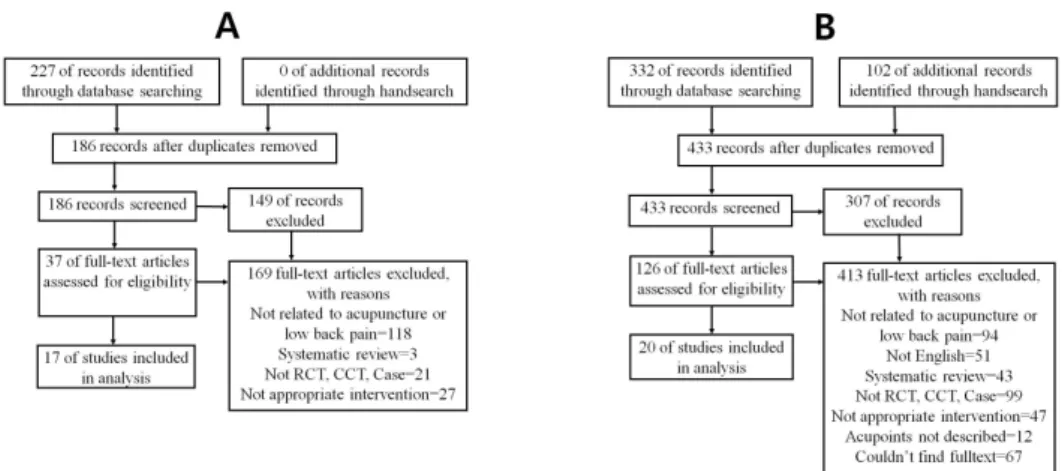
총 227편의 논문이 검색되었으며 이 가운데 중 복 검색된 논문을 제외한 후 제목과 초록을 확인 했을 때 37편의 논문이 포함됐으며, 원문을 모두 확인하여 최종적으로 17편의 논문이 포함되었다.
제외된 논문 중 침, 요통과 관련된 것이 아닌 논문 이 118편, SR논문이 3편, RCT, CCT 혹은 Case report/series가 아닌 논문이 21편, 적절한 치료 중 재가 아닌 논문이 27편이었다(Fig. 1).
포함된 17편의 국내 논문의 연구 설계는 각각
RCT 6편, CCT 6편, Case report/series 5편이었으
며, 이 중 25개의 연구가 분석되었다. 환자의 특성
으로는 병력 기간을 제시하거나 특정 질환 환자,
특정 체질 환자(예: 토양 체질), 혹은 비특이적 요
통 환자 등이 포함되었으며 결과 지표는 VAS 12
Fig. 1. Flowchart of articles selection (A: Domestic articles, B: International articles).
편, Oswestry disability index(ODI) 6편, 증상의 호 전을 기술하거나 단계를 나눠 보고한 것 3편, Roland Morris disability questionnaire(RMDQ) 1 편 등이 사용되었다(Table 1).
2. 해외 논문 검색 결과
상기 방법으로 검색한 결과 332편의 논문이 검 색되었으며, 수작업으로 102편의 논문을 더 찾았다.
중복을 제외한 후 제목과 초록을 확인했을 때 포 함된 논문은 126편이었으며, 원문을 확인하고 최종 적으로 포함된 논문은 20편이다. 이 중 침, 요통에 관한 것이 아닌 논문이 94편, 영어가 아닌 논문이 51편, systematic review가 43편, RCT, CCT 혹은 Case report/series가 아닌 것이 99편, 치료군과 대 조군의 치료 조건이 포함 조건에 맞지 않는 논문 이 47편, 침을 놓은 위치에 대한 기술이 없는 논문 이 12편이었다. 또한 포함된 논문의 대부분을 원문 을 찾을 수 없는 1편의 systematic review에 포함된 논문 67편(중국 저널)을 제외하였다.
포함된 해외 논문에 대한 내용은 다음과 같다 (Table 2). 20편의 해외 RCT 9편, CCT 3편, Case report/series 8편이 포함됐으며, 이 중 28개의 연구 가 분석되었다. 환자로는 병력 기간을 기준으로 포 함시킨 환자, 비특이적 요통 환자, 특정 질환 환자, 임신 여성 등이 포함됐으며 결과 지표는 증상의 호전을 기술하거나 단계를 나눠 보고한 것 9편,
VAS 7편, ODI 3편, McGill pain questionnaire (MPQ) 2편, RMDQ 1편 등이 사용되었다.
3. 연구에 사용된 경혈의 빈도 및 효과 1) 국내 연구 경혈의 빈도 및 효과
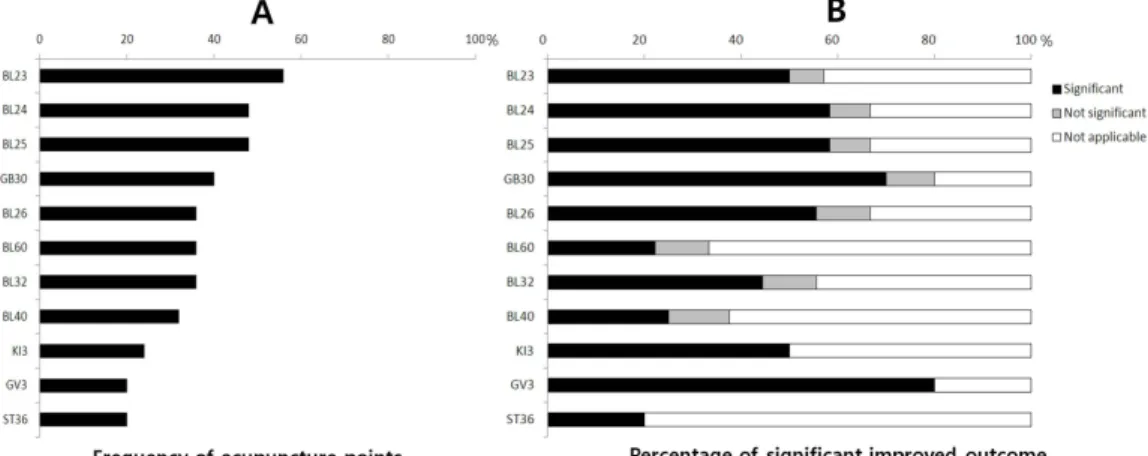
국내 25개의 요통 연구에서 20% 이상의 빈도로 선정된 경혈은 순서대로 신수(BL23: 14회, 56%);
기해수, 대장수(BL24, BL25: 12회, 48%); 환도 (GB30: 10회, 40%); 관원수, 곤륜, 차료(BL26, BL60, BL32: 9회, 36%); 위중(BL40: 8회, 32%), 태계(KI3: 6회, 24%); 요양관, 족삼리(GV3, ST36:
5회, 20%)이다(%=경혈이 사용된 연구의 수/전체 요통 연구의 수×100).
치료 전후 요통 VAS값의 p value를 이용해 통 계적 유의성을 확인할 수 있는 연구 중 유의한 결 과가 나온 비율은 태계, 요양관, 족삼리(100%); 신 수, 기해수, 대장수, 환도(87.5%); 관원수(83.3%);
차료(80%); 곤륜, 위중(66.7%) 순으로 나타났다 (%=경혈이 사용된 연구 중 통계적으로 유의한 결 과가 나타난 수/경혈이 사용된 연구 중 통계적 유 의성을 확인할 수 있는 수×100) (Fig. 2).
2) 해외 연구 경혈의 빈도 및 효과
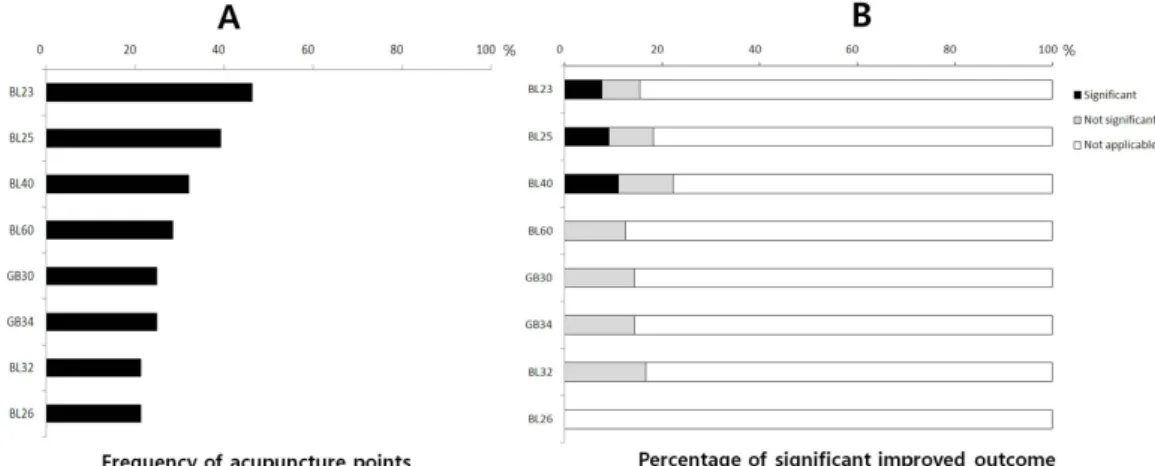
해외 28개의 요통 연구에서 20% 이상의 빈도로 선정된 경혈은 순서대로 신수(BL23: 13회, 46%);
대장수(BL25: 11회, 39%); 위중, 곤륜, 비경혈점
Author(year)*
Study design/
included patients
Intervention(No.†)/
session acupoints Outcomes Results(before Tx/after
Tx)‡ p value§ Yun(2010)22) RCT/LBP
HIVD
MA(30)/10
Std:BL23, BL24, BL25, BL32, BL52, BL62, GB30, SI3
VAS, ODI, Odom's degree
① 7.77±1.10/6.33±1.35
② 21.70±7.93/16.86±8.11
① Sig
② Sig
Kim (2001)_123) CCT/LBP MENS(17)/6
Std:BL24, BL25, BL26, BL27
VAS, ODI, ROM ① 69.12±13.86/31.18±14.42
② 16.71±5.82/12.00±5.36
① Sig
② N Sig Kim (2001)_223) CCT/LBP MA(16)/6
Std:BL24, BL25, BL26, BL27
VAS, ODI, ROM ① 64.25±15.05/41.62±14.39
② 18.13±7.97/13.88±5.11
① NA
② N Sig Moon (2001)_124) CCT/LBP MA(43)/9
Std:Non-acupoints
Body shape and balance
ND ① NA
② NA Moon (2001)_224) CCT/LBP MA(50)/9
Std:BL23, BL24, BL25, BL26, BL31, BL32, BL33, BL34, BL37, BL40, BL57, BL60, GB30
Ind:BL36, BL52, BL56, GB31, GB34, GB39, CV4, GV1, GV3, GV4, GV16, GV26, KI3, SP6, SP9, ST36, LI4, LI10, ST44, SI3, Ashi points
Body shape and balance
ND ① NA
② NA
Cho(2010)25) Case/LBP
≥3 months
MA(34)/12
Ind:BL23, BL24, BL25, BL37, BL40, GB12, GB26, GB30, GB34, GB41, GB43, ST4, ST36, SP13, SP14, GV3, GV4, GV5, GV26, CV24
VAS, ODI, SF-36, BDI, X-ray, Adverse events, Expectation
① 6.70±1.19/2.90±2.37
② 27.02±9.93/14.91±8.07
① Sig
② Sig
Lim(2005)26) CCT/LBP MA(17)/Various Std:BL40, BL60, GB34,
ST36, LI4, TE5, Non-acupoints
Ind:LU8, KI3, KI7, KI10, SP1, SP2, SP3, HT8, LR1, LR4, LR8
VAS, ODI ① 6.84/2.51
② 20.06/6.88
① NA
② NA
Lee(2010)_127) RCT/LBP
≤6 weeks Pancreotonia
MA(40)/1
Std:BL23, BL24, BL25, BL26, GV3
Ind:BL31, BL32, BL33, BL34, GB30
VAS, ROM ① 10.00±0.00/7.13±2.41 ① Sig
② NA Table 1. Summary of Included Domestic Articles
Author(year)*
Study design/
included patients
Intervention(No.†)/session
acupoints Outcomes Results(before Tx/after
Tx)‡ p value§ Lee(2010)_227) RCT/LBP
≤6 weeks Pancreotonia
MA(40)/1
Std:KI3, KI7, KI10, LU8, HT8, SP2, SP3, SP9, HT3, HT7
VAS, ROM ① 10.00±0.00/5.88±2.27 ① Sig
② NA
Jeong(2011)28) RCT/LBP
≤6 weeks
MA(21)/3
Std:BL23, BL24, BL25, BL26, BL27, BL60, BL62, GB29, GB30, KI3
VAS, ODI ① 6.20±1.52/3.13±1.30
② 19.13±5.44/9.47±4.14
① Sig
② Sig
Cha(2004)29) CCT/LBP
≤1 month HNP
MA(13)/7
Std:Acupoints on Bladder and Governor Vessel meridian, GB30, GB34, GB39, ST36
Improvement rate of VAS, ODI
② 30.54±1.37/19.08±2.83 ① NA
② Sig
Ahn(2002)30) RCT/LBP MA(20)/12
Std:BL23, BL24, BL25, BL26, BL31, BL32, BL33, BL34, BL40, BL57, BL60, GB30
Ind:Acupoints varies on symptoms
VAS, PDI, PRS
① 5.02±2.56/4.53±2.86 ① N Sig
② NA
Lee(2009)_131) RCT/LBP
≤6 weeks Pancreotonia
MA(25)/1
Std:BL23, BL24, BL25, BL26, GV3
Ind:BL31, BL32, BL33, BL34, GB30
VAS, ROM ① 10.00±0/7.24±2.47 ① Sig
② NA
Lee(2009)_231) RCT/LBP
≤6 weeks Pancreotonia
MA(25)/1
Std:SP2, SP3, SP9, KI3, KI7, KI10, LU8, HT3, HT7, HT8
VAS, ROM ① 10.00±0/6.08±2.36 ① Sig
② NA
Kwon(2007)_132) RCT/LBP
≥3 months
MA(25)/12
Std:BL23, BL29, BL40, BL52, BL60, BL62, SI3, CV2, CV4, GB30
VAS, RMDQ, PGA, DT, Adverse events
① 52.24±19.76/33.00±15.75 ① Sig
② NA
Kwon(2007)_232) RCT/LBP
≥3 months
MA(25)/12 Std:Non-acupoint
VAS, RMDQ, PGA, DT, Adverse events
① 51.28±21.42/35.52±15.22 ① Sig
② NA Jung(2003)_133) CCT/LBP
IMD
MA(22)/3 Std:LR2, LR3
VAS, Thomas test
① 77.68±8.35/15.50±14.15 ① Sig
② NA Jung(2003)_233) CCT/LBP
IMD
MA(23)/3
Std:Acupoints on Bladder meridian
VAS, Thomas test
① 75.65±7.32/25.65±21.50
① Sig
② NA
Son(2004)34) Case/LBP EA(25)/VariousStd:BL23, BL24, BL25, BL26, BL32, BL52, GV3, GV4, GB30, Ashi points
VAS ① 75.04±13.85/33.60±19.91
① Sig
② NA
Table 1. ContinuedAuthor(year)*
Study design/
included patients
Intervention(No.†)/session
acupoints Outcomes Results(before Tx/after
Tx)‡
p value
§ Sung(2005)35) Case/LBP MA(11)/1Std:ST36, PC6, SP4, LI4, LR3Ind:SI5, ST41, ST43, ST45, GB41, LI1
VAS, VNRS, ROM, Muscle Tenderness
① 8.18±1.54/2.18±0.87
① NA
② NA
Kim(1989)36) Case/LBP Lumbar spondylosis
EA(50)/Various Std:BL23, BL24, BL25,
BL26
2nd Std:BL60, LR3, KI3, KI7
Improvement ND
① NA
② NA
Song(1989)_137) CCT/CLBP (1∼5 years)
MA(9)/3
Std:BL23, BL32, BL40, BL60
β-endorphin, ACTH, Cortisol, Improvement
ND
① NA
② NA
Song(1989)_237) CCT/CLBP(1∼5 years)
MA(14)/3
Std:BL23, BL32, BL40, BL60
β-endorphin, ACTH, Cortisol, Improvement
ND
① NA
② NA
Song(1989)_337) CCT/CLBP(1∼5 years)
MA(7)/3
Std:BL23, BL32, BL40, BL60
β-endorphin, ACTH, Cortisol, Improvement
ND
① NA
② NA
Chung (1976)38) Case/LBPDegenerative OA
EA(20)/Various Std:BL23, BL24, BL25
Improvement ND
① NA
② NA
① VAS for pain, ② ODI.
*Author(Year)_Numbering of studies included in same article; This study analysis each patient group data as single study. †RCT no.=Randomized number; CCT no.=Allocated number; Case no.=Analyzed number. ‡Mean±Standard deviation, §Sig (Significant) indicates statistically significant (p<0.05) change from before treatment; N Sig (Not significant) indicates no statistically significance difference between before and after treatment.
BDI : Beck's depression inventory Case, Case reports/series, CCT : Clinical controlled trial, CLBP : Chronic low back pain, DT : Digital thermography, EA : Electro-acupuncture, HIVD : Herniated intervertebral disc, HNP : Herniated nucleosus pulposus, IMD : Iliopsoas muscle disorder, Ind : Individualized acupoints, LBP : Low back pain, MA : Manual acupuncture, MENS : Microcurrent electrical neuromuscular stimulation, N Sig : Not significant, NA : Not applicable, ND : Not described, No. : Number, OA : Osteoarthritis, ODI : Oswestry disability index, PDI : Pain disability index, PGA : Patients global assessment, PRS : Pain rating score, RCT : Randomized controlled trial, RMDQ : Roland Morris disability questionnaire, ROM : Range of movement, SF-36 : The short form (36) health survey, Sig : Significant, Std : Standardized acupoints, Tx : Treatment, VAS : Visual analogue scale, VNRS : Verbal numerical rating scale.
Table 1. Continued
(BL40, BL60: 8회, 29%); 환도, 양릉천(GB30, GB34: 7회, 25%); 차료, 관원수, 아시혈(BL32, BL26: 6회, 21%)이다(%=경혈이 사용된 연구의 수/전체 요통 연구의 수×100).
치료 전후 요통 VAS값의 p value를 이용해 통 계적 유의성을 확인할 수 있는 연구 중 유의한 결 과가 나온 비율은 신수, 대장수, 위중(50%)이고, 곤륜, 환도, 양릉천, 차료, 관원수는 통계적으로 유 의한 결과를 관찰할 수 없었다(%=경혈이 사용된
연구 중 통계적으로 유의한 결과가 나타난 수/경 혈이 사용된 연구 중 통계적 유의성을 확인할 수 있는 수×100) (Fig. 3).
3) 국내 및 해외 연구의 경혈 조합
국내 요통 연구에서 경혈이 조합되어 사용된 비
율을 나타낸 결과, 신수(BL23)와 함께 사용된 경
혈은 기해수, 대장수(BL24, BL25: 71%); 관원수,
(BL23)는 대장수(BL25: 77%); 양릉천(GB34:
Author(year)*
Study design/
included patients
Intervention(No.†)/session
acupoints Outcomes Results
(before Tx/after Tx)‡ p value§ Lin(2010)39) RCT/CLBP
≥6 months EA(36)/12
Std:BL23, BL25, BL40, SP6
VAS, ODI, SF-36 ND ① Sig
② Sig Shankar(2011)40) RCT/CLBP
≥6 months EA(30)/10
Std:BL23, BL24, BL36, BL37, BL40, BL57, BL60, GB30, GB34, GV4
VAS, E:I ratio, 30:15 ratio, BP, PCT, SHT, GPE
① 6.80±1.33/3.30±1.58 ① NA
② NA
Tuck(2010)41) CR/LBPCance r
MA(1)/1
Std:BL22, BL23, BL25, Non-acupoints
VAS ① 2/1 ① NA
② NA Wasan
(2010)_142)
RCT/CLBP
≥6 months MA(22)/1 Std:LI4
ODI, BDI-Ⅱ, PASS, NEO-FFI, NRS, NPQ, PCS, ERS, Blinding, MASS, Genetic predictors
ND ① NA
② NA
Wasan (2010)_242)
RCT/CLBP
≥6 months MA(22)/1 Std:LI4
ODI, BDI-Ⅱ, PASS, NEO-FFI, NRS, NPQ, PCS, ERS, Blinding, MASS, Genetic predictors
ND ① NA
② NA
Liu (2009)43)
CR/LBP 2 years Scoliosis
MA(1)/18
Std:BL22, BL23, BL24, BL52, BL60
Improvement, Radiograph
ND ① NA
② NA Itoh(2009)21) RCT/LBP
≥6 months MA(8)/5
Std:BL23, BL25, BL32, BL40, BL60, GB30, GB34
VAS, RMDQ ① 60.0±19.8/37.4±25.9 ① N Sig
② NA Inoue
(2008a)_144)
CR/LBPSCS MA(9)/8
Std:EX-B2, Ashi points
VAS, CWD ① 46.3±17.4/45.3±17.4 ① N Sig
② NA Inoue
(2008a)_244)
CR/LBPSCS EA(9)/8
Std:Non-acupoints
VAS, CWD ① ND /39.2±14.0 ① NA
② NA Inoue
(2008b)_145)
CCT/LBP (1)SCS(2) HIVD
MA((1)10 (2)15)/10 Std:EX-B2
Improvement of LBP, Lower limb pain, Lower limb dysesthesia, CWD
ND ① NA
② NA
Inoue (2008b)_245)
CCT/LBP (1)SCS(2)HI VD
EA((1)11 (2)8)/8 Std:Non-acupoints
(1) VAS, Lower limb dysesthesia(2) Improvement
① 52.5±15.1/47.1±13.8 ① Sig
② NA
Inoue (2008b)_345)
CCT/LBP (1)SCS(2)HI VD
EA((1)14 (2)3)/Various Std:Non-acupoints
(1)Lower limb pain, Lower limb
dysesthesia, CWD(2) Improvement
ND ① NA
② NA
Inoue(2006)46) RCT/LBP MA(15)/ND Std:Non-acupoints
VAS, ROM ① 61±11/47±7 ① Sig
② NA Table 2. Summary of Included International Articles
Author(year)* Study design/
included patients
Intervention(No.†)/session
acupoints Outcomes
Results (before Tx/
after Tx)‡
p value§
Kvorning (2004)20)
RCT/LBPPregna nt
MA(50)/Various
Ind:BL22, BL23, BL24, BL25, BL26, BL60, SI3, LR3, GV20, Ashi points, Non-acupoints
Pain intensity, Physical activity, Adverse events, Birth weight/Apgar score of infants
ND ① NA
② NA
Forrester (2003)47)
CR/CLBP Pregnant
MA(1)/9
Std:BL23, BL25, BL57, EX-B2
Improvement ND ① NA
② NA Thomas
(1994)_148)
CCT/CLBP
≥6 months MA(-)/Various
Ind:BL23, BL25, BL26, BL32, BL40, BL60, GB30, GB34, ST36, SI6
ADL, Pain descriptors, Subjective assessment, Mobility
ND ① NA
② NA
Thomas (1994)_248)
CCT/CLBP
≥6 months EA(-)/Various
Ind:BL23, BL25, BL26, BL32, BL40, BL60, GB30, GB34, ST36, SI6
ADL, Pain descriptors, Subjective assessment, Mobility
ND ① NA
② NA
Thomas (1994)_348)
CCT/CLBP
≥6 months EA(-)/Various
Ind:BL23, BL25, BL26, BL32, BL40, BL60, GB30, GB34, ST36, SI6
ADL, Pain descriptors, Subjective assessment, Mobility
ND ① NA
② NA
Garvey(1989)49) RCT/LBPStrain MA(20)/ND Std:Ashi points
Improvement rate of VAS, Improvement
ND ① NA
② NA Wang(1987)50) CR/LBP EA(55)/Various
Std:BL23, BL25, BL54, Non-acupoints
Improvement ND ① NA
② NA Dong(1982)51) CR/LBPStrain MA(43)/Various
Std:SI6
Improvement ND ① NA
② NA Fox(1976)52) CCT/CLBP MA(12)/ND
Std:BL24, BL26, BL62 MPQ(PPI, PRI), Mean
duration of pain relief ND ① NA
② NA Ceccherelli
(2002)_153)
RCT/CLMP MA(21)/8
Std:BL40, BL62, GV6, GB34, EX-B8
2nd Std:Ashi points
MPQ(The number of words, PRI)
ND ① NA
② NA
Ceccherelli
(2002)_253) RCT/CLMP MA(21)/8
Std:BL40, BL62, GB34, GV6, EX-B8
2nd Std:Ashi points
MPQ(The number of
word, PRI) ND ① NA
② NA
Weiss(1975)54) CR/CLBP EA(50)/Various
Std:BL22, BL23, BL24, BL25, BL26, BL27, BL28, BL29, BL30, BL31, BL32, BL33, BL34, BL35, BL47, BL48, BL49, BL55, BL56, BL57, BL58, BL60, GV1, GV2, GV3, GV4, GV5, GB30, Ashi points Ind:BL50, BL51, BL52, BL53, BL54, BL59
Improvement, Adverse effects
ND ① NA
② NA Table 2. Continued
Author(year)* Study design/
included patients
Intervention(No.†)/session
acupoints Outcomes
Results (before Tx/
after Tx)‡
p value§
Leung(1979)55) CR/LBP EA(20)/Various
Std:BL23, BL32, BL40, GB30
Improvement ND ① NA
② NA Edelist
(1976)_156)
RCT/LBP EA(15)/3 Std:BL25, BL57
Improvement ND ① NA
② NA Edelist
(1976)_256)
RCT/LBP EA(15)/ND Std:Non-acupoints
Improvement ND ① NA
② NA
① VAS for pain, ② ODI.
*Author(Year)_Numbering of studies included in same article, This study analysis each patient group data as single study. †RCT n : Randomized number, CCT n : Allocated number, Case report n : Analyzed number. ‡ Mean±Standard deviation. §Sig (Significant) indicates statistically significant (p<0.05) change from before treatment, N Sig (Not significant) indicates no statistically significance difference between before and after treatment.
ADL : Activities of daily life, BDI : Beck depression inventory, BP : Blood pressure, Case : Case reports/series, CCT : Clinical controlled trial, CLBP : Chronic low back pain, CLMP : Chronic lumbar myofascial pain, CWD : Continuous walking distance, EA : Electro-acupuncture, ERS : Expectations for relief scale, GPE : Global perceived effect, HIVD : Herniated intervertebral disc, HNP : Herniated nucleosus pulposus, Ind : Individualized acupoints, LBP : Low back pain, MA : Manual acupuncture, MASS : Massachusetts general hospital acupuncture sensation scale, MPQ : McGill pain questionnaire, N Sig : Not significant, NA : Not applicable, ND : Not described, NEO-FFI : NEO personality inventory-short form, No. : Number, NPQ : Neuropathic pain questionnaire, NRS : Numerical rating scale, PASS : Pain anxiety symptoms scale, ODI : Oswestry disability index, PCS : Pain catastrophizing scale, PCT : Postural challenge test, PPI : Present pain intensity, PRI : Pain rating index, RCT : Randomized controlled trial, RMDQ : Roland Morris disability questionnaire, ROM : Range of movement, SCS : Spinal canal stenosis, SF-36 : The short form (36) health survey, SHT : Sustained handgrip test, Sig : Significant, Std : Standardized acupoints, Tx : Treatment, VAS : Visual analogue scale.
Table 2. Continued
Fig. 2. Frequency and effectiveness of acupoints in domestic studies.
(A) Frequency of acupoints selected in each studies (%). Frequency %=Number of studies using certain acupoint/Total number of studies×100. (B) Percentage of Significant, not significant improved outcome studies, and not applicable studies.
Significant %=Number of studies showing significantly improved outcome studies using certain acupoint/Total number of studies using certain acupoint×100. Not significant %=Number of studies showing not significantly improved outcome studies using certain acupoint/Total number of studies using certain acupoint×100. NA %=Number of not applicable studies using certain acupoint/Total number of studies using certain acupoint×100.
Fig. 3. Frequency and effectiveness of acupoints in international studies.
(A) Frequency of acupoints selected in each studies (%). Frequency %=Number of studies using certain acupoint/Total number of studies×100. (B) Percentage of Significant, not significant improved outcome studies, and not applicable studies.
Significant %=Number of studies showing significantly improved outcome studies using certain acupoint/Total number of studies using certain acupoint×100. Not significant %=Number of studies showing not significantly improved outcome studies using certain acupoint/Total number of studies using certain acupoint×100. NA %=Number of not applicable studies using certain acupoint/Total number of studies using certain acupoint×100.
Fig. 4. Acupoint combination rate (A: Domestic studies, B: International studies).
Combination rate=Number of groups using certain acupoint with other/Total number of groups using certain acupoint. The brighter matrix indicates the greater combination rate of acupuncture points.