Correlation of Berg Balance Scale and Functional Reach Test
Eun-young Park, Ph.D., P.T.
Dept. of Rehabilitation Welfare, Woosuk University Won-ho Kim, Ph.D., P.T
Dept. of Physical Therapy, Ulsan College
Abstract.1)
The purposes of this study were to provide the basic data and investigate the reliability of functional reach test and identify correlation of Berg balance scale (BBS) and functional reach test (FRT). The sub- jects were twenty healthy young adults and forty-five over 65 years old in order to compare balance ability. These data were analyzed by independent t-test and Pearson's correlation test using SPSS WIN 10.0. The results were as follows. Intrarater reliability coefficients of FRT was .976 and interrater was .942. FRT was significantly correlated with age, height, and BBS (p<.05). There were no significant dif- ferences in FRT and BBS by sex. There was significant difference in reach distance between below 74 elderly and above in FRT. FRT is very reliable test for balance and significantly correlated with BBS.
Therefore, it is suggested that FRT is a clinically useful tool to substitute for BBS measuring balance ability in the elderly.
Key Words: Balance; Berg balance scale; Elderly; Functional reach test.
Introduction
Balance is defined as the ability to maintain the pro- jected center of gravity within the limits of the base of support. The mechanism of balance is based on an in- trinsic co-operation between the vestibular system, proprioceptive and tactile information, and vision (O'Sullivan, 2007). Balance not only depends on the in- tegrity of these systems, but also on the sensory in- tegration within the central nervous system, vision, and spatial perception, effective muscle tone which adapts rapidly to change, muscle strength and joint flexibility (Allison, 1995). Any deficits in these factors will cause fall or functional limitations (Kauffman, 1990).
Balance is necessary factor for functional activities (Berg et al, 1989). Katz et al (1963) said that the ability of balance was significant factor in order to maintain activity daily livings in elderly. Judge et al (1995) said that balance was highly correlated with instrument activity daily livings. Thus, balance is
treated as major issue to prevent fall and improve physical activities in elderly.
Balance tests include Berg balance scale (BBS), postural sway, Romberg test, clinical test for sensory interaction on balance, functional reach test (FRT).
These can be classified by types such as quiet stand- ing, active standing, sensory manipulation, and func- tional scales. There is no single test that can ad- equately measure different facets of postural control (Alleson, 1995). Among of balance tests, BBS is widely used to test balance in older adults. This test uses 14 functional tasks rated 0 to 4, where zero is unable to perform and four is able to perform without difficulty. The test is reported to have good test-re- test and interrater reliability. Shumway-Cook et al (1997) reported that BBS was the best single predictor of fall status in community-dwelling older adults.
Limitation of BBS were heavily weighted toward tasks requiring steady-state and anticipatory postural control. No task on it requires reactive postural
Corresponding author: Won-ho Kim[email protected]
control. Also, it take a lot of time to measure and re- quire a positive participation and high concentration of the client because they perform many movements.
Any other balance tests require high prices and techniques of equipment, and a lot of time in usage, while FRT is able to applicate easily in clinic with- out special equipment. Duncan et al (1990) used FRT to assess the ability of static balance in the elderly.
At the early stage, FRT was used for measure the distance of operation equipment which can grasp by spreading out the arm in National Aeronautics and Space Administration (NASA) and transport system (Stoudt, 1973). But recently it was made practice to assess the balance ability of the elderly in commun- ity and the ability of balance and functional perform- ance at the clinic.
In korea, FRT was used to assess balance ability and compare intervention effects after balance train- ing in many clinics. But, we have no normative val- ues of FRT in korean elderly. The amounts of reach was compared with data of foreign elderly, although the amount of reach is influenced by the size and height of the individual. Also, researches about FRT, including the evidence of reliability and correlation with BBS are insufficient.
The purposes of this study were to provide the ba- sic data and investigate reliability of FRT for healthy young adults and elderly above 65 years. Also, the purpose of this study was to examine the usability of FRT through determining the correlation with BBS
Methods Subjects
Participants were forty-five elderly above 65 years old and twenty healthy young adults in the commun- ity in Ulsan city. To quality for participation, volun- teers had to performance independently activities of daily living, be able to follow instructions, and be absence of neurological or musculoskeletal disorders.
Procedures
Prior to the experiment, participants heard about the purpose and method of the study. First, basic data, including sex, height, and weight, on partic- ipants was collected. Second, a brief explanation and demonstration of FRT and BBS were presented to participants. Forty-five elderly above 65 years old carried out both BBS and FRT, while twenty healthy young adults performed FRT only.
Instruments
Functional Reach Test (FRT)
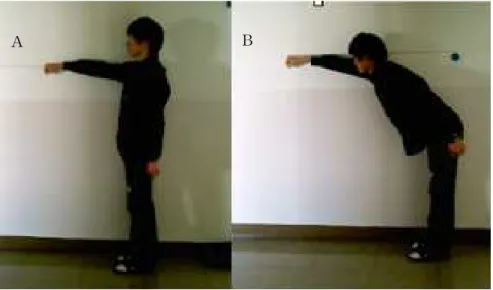
FRT was used to assess balance in all the par- ticipants and identify interrater and intrarater reliability. It is the maximal distance one can reach forward beyond arm's length while maintaining a fixed base of support in the standing position. The subjects flexed one arm to an angle 90° and ex- tended elbow with fisted the hand, while standing with legs about shoulder width apart. An initial measurement was made of the position of the 3rd metacarpal along the yardstick mounted at shoulder height. For forward reach, the subjects was in- structed to lean as far forward as possible without losing balance or taking a step. A second measure- ment was taken also using the 3rd metacarpal for reference. This measurement was then subtracted from the initial measurement (Figure 1).
Berg Balance Scale (BBS)
BBS consists of 14 items which assess the bal- ance ability of static and dynamic objectively. The scoring uses five-point ordinal scale, with scores ranging 0 to 4. A maximal score of 56 point is possible. The items of BBS were sitting to standing (B1), standing unsupported (B2), sitting with back unsupported but feet supported on floor or on a stool (B3), standing to sit (B4), transfers (B5), standing unsupported with eyes closed (B6), standing un- supported with feet together (B7), reaching forward with outstretched arm while standing (B8), pick up
A B
Figure 1. Functional reach test (A: starting position, B: last position).
object from the floor from a standing position (B9), turning to look behind over your left and right shoulders while standing (B10), turn 360° (B11), place alternate foot on step or stool while standing unsupported (B12), standing unsupported one foot in front (B13), and standing on one leg (B14). The BBS has been shown to have excellent interrater and test-retester reliability (Berg et al, 1989).
Data Analysis
The corrected materials were analysed by SPSS version 10.0. Descriptive statistics was presented to investigate general characteristics of subjects and in- dependent t test was executed to determine differ- ences of BBS and FRT according to sex and age.
Pearson correlation test was used to investigate cor- relation between FRT and general characteristics of subjects and BBS. A significant level of p<.05 was selected for all statistical tests.
Results
General Characteristics of Subjects
Average age of the elderly was 79.09 years, height was 152.78 ㎝, weight was 50.62 ㎏. Average age of the healthy young adults was 23.25 years, height
was 164.20 ㎝, weight was 54.15 ㎏. Percentage of female participant was higher than male (Table 1).
Reliability Coefficients of FRT
Intrarater reliability coefficients of FRT was .976 and inter-rater was .942 (p<.05).
Comparison of BBS and FRT by Age
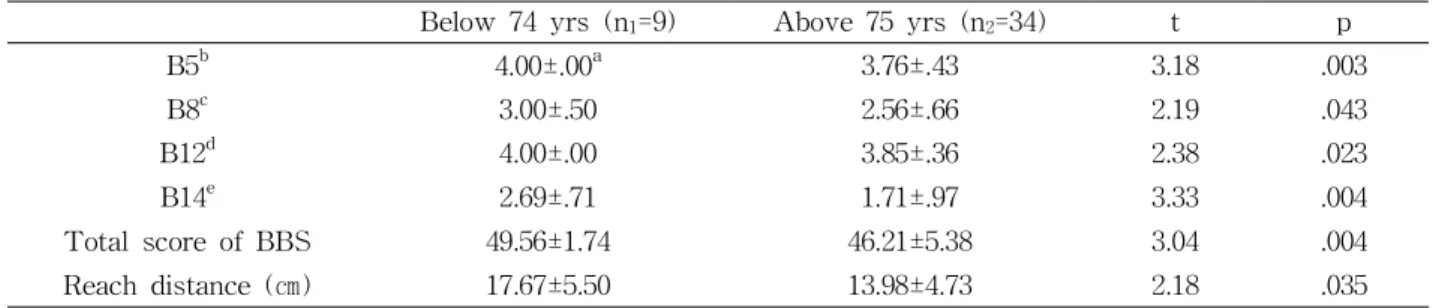
Average of Berg balance scale was 49.56 score in the elderly below 74 years old group and 46.21 in the elderly above 75 years old group. There was significant difference between two groups (p<.05). In FRT, mean distance was 17.67 ㎝ in below 74 years old group and 13.98 ㎝ in above 75 years old group.
There was significant difference between two groups (p<.05). Also, there were significant differences in transfer, reaching forward while standing, stool stepping, and standing on one leg of BBS's items (Table 2) (p<.05).
Reach distance of FRT was 14.24 ㎝ in the elderly group above 65 years old and 34.30 ㎝ in healthy young adults group. There was significant difference in reach distance between two groups (Table 3) (p<.05).
Age (yrs) Height (㎝) Weight (㎏) Sex
Young adults 23.25±2.02a 164.20±8.34 54.15±9.14 6 males (30%)
14 females (70%)
Elderly 79.09±6.33 152.78±7.45 50.62±9.37 9 males (20%)
36 females (80%)
aMean±SD.
Table 1. General characteristics of subjects (N=65)
Below 74 yrs (n1=9) Above 75 yrs (n2=34) t p
B5b 4.00±.00a 3.76±.43 3.18 .003
B8c 3.00±.50 2.56±.66 2.19 .043
B12d 4.00±.00 3.85±.36 2.38 .023
B14e 2.69±.71 1.71±.97 3.33 .004
Total score of BBS 49.56±1.74 46.21±5.38 3.04 .004
Reach distance (㎝) 17.67±5.50 13.98±4.73 2.18 .035
aMean±SD.
bB5: transfer.
cB8: reaching forward while standing.
dB12: stool stepping.
eB14: standing on one leg.
Table 2. Comparison of BBS and FRT by age in the elderly (N=45)
Elderly group (n1=45) Young adults group (n2=20) t p
Reach distance (㎝) 14.24±5.14a 34.30±5.87 -13.89 .00
aMean±SD.
Table 3. Comparison of reach distance of FRT by age (N=65)
Male (n1=9) Female (n2=36) t p
Total score of BBS 47.33±3.61a 46.89±5.44 .23 .81
Reach distance (㎝) 16.44±4.67 13.69±5.17 .14 .15
aMean±SD.
Table 4. Total score of BBS and FRT by sex in the elderly group (N=45)
Height Age B8a B12b Total score of Berg
Reach distance (㎝) .40* -.43* .85* .29** .39*
*p<.05.
**p<.01.
aB8: reaching forward while standing.
bB12: stool stepping.
Table 5. Correlation between BBS and FRT
Total score of BBS and FRT by sex in the Elderly Group
Total score of BBS was 47.33 in the male and
46.89 in female. There was no significant difference by sex (p>.05). Reach distance of FRT was 16.44 ㎝ in the male, and 13.69 ㎝ in the female. There was no significant difference by sex (Table 4) (p>.05).
Correlation Between BBS and FRT
Pearson correlation test was executed to examine correlation between BBS and FRT. The results from Person test showed that FRT was significant corre- lated with height and age. Also, FRT was significant correlated with reaching forward while standing (B8) and stool stepping (B12) of BBS's items (p<.05).
Also, it have a significant correlation with total score of BBS (Table 5) (p<.05).
Discussion
The purposes of this study were to investigate the basic data and reliability of FRT on healthy young adults group and elderly above 65 years old. Also, the clinical usefulness of FRT was examined through determining the correlation between BBS and FRT.
Previous researches have reported that the balance ability decreased with advancing age (Duncan et al, 1990; Hageman et al, 1995; Mayers et al, 1991).
Generally, the elderly above 75 years old was classi- fied into the frail elderly (Guccione, 1992). Most adults in the physically frail older are independent in basic activities of daily living but dependent in many instrumental activities of daily living (Shumway-Cook and Woollacott, 2001). At this study, the result of measurement on BBS and FRT in the elderly group above 75 years old was lower significantly than be- low 74 years old group. BBS was 49.56 point in frail elderly and 46.21 point in the others. According to Shumway-Cook et al (1997), in range 56 to 54, each 1 point drop in the Berg was associated with a 3%
to 4% increase in fall risk. However, in the range of 54 to 46, 1 point change in the Berg was associate with a 6% to 8% increase in fall risk. Below 36, fall risk was close to 100%. Duncan et al (1990) re- searched the correlation between the performance of FRT and aging. They reported normative values of FRT. The result of FRT in 20 to 40 years old was 16.7±1.9 inches in male and 14.6±2.2 inches in female and in 70 to 87 years was 13.2±1.6 inches in male
and 10.5 ±3.5 inches in female. The result of this study showed 34.30 ㎝ (13.5 inches) in young adults group and 14.24 ㎝ (5.6 inches) in the elderly above 65 years old on FRT. The performance of FRT had a correlation with height (Duncan et al, 1990). As the results of this study, it was a significant correlation between the performance of FRT and height and ag- ing (p<.05). As a results study, the reach distance of FRT was shorter than the results of Duncan et al (1990). Because mean height in the korean is shorter than the western foreign, reach distance is short.
Thus we need to establish normative values by ages to determine balance ability. Because reach distance is affected by motor strategy (Park et al, 2000), this study allowed to use only hip strategy during FRT.
Generally, there was no differences of a balance abil- ity according to sex (Maki et al, 1990; Stribley et al, 1974). It is the same result of this study.
BBS has been shown to have excellent interrater and test-retest reliability. Lynch et al (1998) reported the intrarater reliability of FRT was .93 in patients with spinal cord injury. Duncan et al (1990) sug- gested .81 of the intrarater reliability of FRT in nor- mal subject, also. This study proposed the reliability of FRT. The reliability was determined by three testers through three repeated measurements in twenty elderly. The reliability was so high as the intrarater (.976) and interrater (.942).
Many Researches have been performed on the correlation between BBS and functional assessment instrument. According to Podsiadlo and Richardson (1991), Get-up and Go Test had a high correlation (r=-.81) with BBS. Whitney et al (1998) reported the literature review about the correlation of instruments to evaluate a balance ability. They suggested that the correlation between BBS and Get-up and Go Test was r=.76, and the correlation with Tinetti bal- ance scale was r=.91. Also, BBS was significantly associated with sensory organization test of compu- terized dynamic posturography (Berg et al, 1992;
Jung et al, 2001; Whitney et al, 1998). In this study, BBS was significantly correlated with FRT (r=.39).
Even though the correlation coefficient was relatively low, the FRT was considered the useful instrument to provide a quick screen of balance problems in older adults in clinic setting.
The first five items in BBS are considered basic balance items while the last nine items are consid- ered more advanced balance task (O'Sullivan, 2007).
FRT was associated with relatively difficulty items of BBS (B8, B12). Thus, it can be useful to test the balance of high-functioning, community-dwelling in- dividuals (Harada et al, 1995).
Conclusion
The purposes of this study were to provide the basic data and to investigate reliability of FRT. Also, the purpose of this study was to examine the us- ability of FRT through determining the correlation with BBS. The intrarater reliability of functional reach test was .976 and the interrater was .942. The FRT was significantly correlated with height, aging, and BBS. The items of reaching forward while standing (B8) and stool stepping (B12) in BBS were associated with FRT. The results of this study sug- gested that FRT was considered helpful test to eval- uate balance ability of the elderly, specially in- dividuals with high-functioning.
References
Allison L. Balance disorders. In: Umphred DA, ed.
Neurological Rehabilitation. 3rd ed. St. Louis, Mosby Inc., 1995:802-807.
Berg KO, Wood-Dauphinee S, Williams JI, et al.
Measuring balance in the elderly: Preliminary development of an instrument. Physiother Can.
1989;41:304-311.
Berg KO, Maki BE, Williams JI, et al. Clinical and laboratory measures of postural balance in an elderly population. Arch Phys Med Rehabil.
1992;73(11):1073-1080.
Duncan PW, Weiner DK, Chandler J, et al.
Functional reach: A new clinical measure of balance. J Gerontol. 1990;45(6):M192-M197.
Guccione AA. Implications of an aging population for rehabilitation: Demography, mortality, and mor- bidity in the elderly. In: Guccione AA, ed.
Geriatric Physical Therapy. St. Louis, Mosby Inc., 1992:13-14.
Hageman PA, Leibowitz JM, Blanke D. Age and gender effects on postural control measures.
Arch Phys Med Rehabil. 1995;76(10):961-965.
Harada N, Chiu V, Damron-Rodriquez, et al.
Screening for balance and mobility impairment in the elderly individuals living in residental care facilities. Phys Ther. 1995;75(6):462-469.
Judge JO, King MB, Whipple R, et al. Dynamic bal- ance in older persons: Effects of reduced visual and proprioceptive input. J Gerontol A Bio Sci Med Sci. 1995;50(5):M263-M270.
Jung HY, Kim MO, Kwak JR. Correlation between Berg balance scale and sensory organization test of computerized dynamic posturography in brain injured patients. Journal of Korean Academy of Rehabilitation Medicine. 2001;25(3):404-411.
Katz S, Ford AB, Moskowitz RW, et al. Studies of illness in the aged. The index of ADL: A standardized measure of biological and psycho- logical function. JAMA. 1963;185:914-919.
Kauffman T. Impact of aging-related musculoskeletal and postural changes on falls. Top Geriatr Rehabil. 1990;5(2):34-43.
Lynch SM, Leahy P, Barker SP. Reliability of meas- urements obtained with a modified functional reach test in subjects with spinal cord injury.
Phys Ther. 1998;78(2):128-133.
Maki BE, Holliday PJ, Fernie GR. Aging and postur- al control: A comparison of spontaneous-and in- duced-sway balance tests. J Am Geriatr Soc.
1990;38(1):1-9.
Mayers AH, Baker SP, Van Natta ML, et al. Risk factors associated with falls and injuries among
This article was received September 13, 2007, and was accepted October 26, 2007.
elderly institutionalized persons. Am J Epidemiol.
1991;133(11):1179-1190.
O'Sullivan SB. Examination of motor function: Motor control and motor learning. In: O'Sullivan SB, Schmitz TJ, eds. Physical Rehabilitation:
Assessment and treatment. 5th ed. Philadelphia, F.A. Davis Co., 2007:249-259.
Park JS, Kwon OY, Choi HS, et al. Effects of the movement strategies on functional forward reach in standing. Journal of the Korean Academy of University Trained Physical Therapists.
2000;7(1):46-54.
Podsiadlo D, Richardson S. The timed "Up & Go": A test of basic functional mobility for frail elderly persons. J Am Geriatr Soc. 1991;39(2):142-148.
Shumway-Cook A, Baldwin M, Polissar NL, et al.
Predicting the probability of falls in commun- ity-dwelling older adults. Phys Ther.
1997;77(8):812-819.
Shumway-Cook A, Woollacott MH. Aging and pos- tural control. In: Shymway-Cook A, Woollacott MH, eds. Motor Control: Theory and practical applications. 2nd ed. Baltimore, Lippincott Williams & Wilkins, 2001:224-226.
Stoudt HW. Arm lengths and arm reaches: Some inter- relationships of structural and functional body dimensions. Am J Phys Anthropol. 1973;38(1):151-161.
Stribley RF, Albers JW, Tourtellotte WW, et al. A quantitative study of stance in normal subjects.
Arch Phys Med Rehabil. 1974;55(2):74-80.
Whitney SL, Poole JL, Cass SP. A review of balance instruments for older adults. Am J Occup Ther.
1998;52(8):666-671.