Purpose: This study was done to better understand how sick children and their families define chronic illness; what behav- iors they used for managing chronic illness; and how they perceived the socio-cultural context of Korea. Methods: This study was a secondary analysis of qualitative studies. Articles on children with a chronic illness and their families located in electronic databases were selected for review. Twenty one qualitative studies were reviewed. Qualitative studies that had used an analysis tool, the Family Management Style Framework were reviewed. Results: Children with chronic ill- ness and their families tended to accept illness as a negative outcome and thought that they were deprived of the context of normality. In the traditional Korean family style, parents-in-law demand absolute obedience from their daughter-in-law, leading to a conflict between the two parties, which, in turn, may have negatively affected their perceptions of chronic ill- ness. Western and oriental medical treatments were used, and participants sought an array of folk remedies. Conclusion:
Culturally specific findings can help to better understand the difficulties faced by children with a chronic illness and their fami- lies and can provide invaluable input into the development of culturally appropriate and sensitive nursing interventions.
Key words:Children, Chronic disease, Life experience
From Their Own Response: Experiences of Korean Children with Chronic Illness and Their Families
Park, Eun-Sook
1Oh, Won-Oak
2Suk, Min-Hyun
3Yoon, Young-Mi
41
Professor, College of Nursing, Korea University, Seoul
2
Associate Professor, Department of Nursing, Dongguk University, Gyeongju
3
Associate Professor, Department of Nursing, College of Health Science, CHA University, Pocheon
4
Professor, Department of Nursing, Seoil College, Seoul, Korea
INTRODUCTION
A health care system and a flexible mutual relationship with health care provider are essential for children with a chronic ill- ness and their families to successfully adapt to their situation. In cases involving a child with a chronic illness, nurses provide a broad range of expertise as health manager, assistants and coun- selors in addition to their nursing care. Therefore, nurses need to understand the experiences of children with a chronic illness and their families to help them sustain a family life and meet their daily needs.
The growing incidence of chronic illness among children is a social concern (Allen & Vessey, 2004). In the United States (US), 31% of children under age 18 have reported to suffer from at least
one illness, which indicates an increase in the number of children with a long-term illness or physical disability that affects their daily lives (Melnyk & Feinstein, 2001). Children with a chronic illness must deal with physical and emotional issues as they become physically inactive and undergo various treatments and examina- tions related to their illness. Consequently, their parents face uncer- tainty over the physical and psychological development of their children who are experiencing fluctuations in their symptoms over the course of their illness (Sharkey, 1995). Taking care of a chronically ill child can be a source of tension and strife for fami- ly members (Hockenbery-Eaton, Wilson, & Winkelstein, 2005).
This study aimed to understand how chronically ill children and their families in Korea deal with daily life and respond to the ch- ronic illness. This study used the Family Management Style Fra-
*This work was supported by the Nursing research institute grant of Korea University.
Address reprint requests to: Oh, Won-Oak
Department of Nursing, Dongguk University, 707 Seokjang-dong, Gyeongju 780-714, Korea Tel: 82-54-770-2619 Fax: 82-54-770-2616 E-mail: [email protected]
Received: July 15, 2009 Revision received: October 6, 2009 Accepted: October 12, 2009
mework (FMSF) as an analysis tool. Because most qualitative studies of chronic illness have focused on a specific topic or con- cept, these have rarely been provided a comprehensive understand- ing of how the family as a unit incorporates the demands of the child illness into family life. Knafl and Deatrick (1990) suggest- ed the FMSF and to identify key aspects to explain how the fam- ily as a unit responded to childhood illness. This framework has been provided evidences of its usefulness by other researches (Knafl
& Deatrick, 2003).
A secondary analysis of qualitative studies was conducted. Be- cause secondary analysis is an effective method for answering new research questions and procuring scientific outcomes (Yi, 2004), this study attempted to analyze the other qualitative studies relat- ed to chronic illness of children by using this method. Cultural- ly-specific findings can help to better understand the difficulties faced by children with a chronic illness and their families in Korea and can provide valuable input into the development of cultur- ally appropriate and sensitive nursing interventions.
METHODS
Design
This study used a secondary analysis of qualitative studies to better understand the experiences of children with a chronic ill- ness and their families in Korea by reviewing published qualita- tive studies that had used an analysis tool, the FMSF (Knafl &
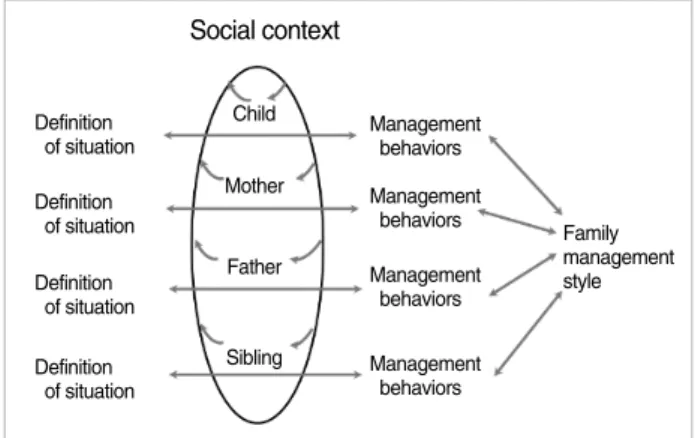
Deatrick, 1990). Even though FMSF was developed long time ago, this is accepted as an useful framework among research areas of chronic illness and family (Figure 1).
Secondary analysis poses a limitation in many cases because it is based on data derived from questions posed in previous stud- ies (Szabo & Strang, 1997); therefore, bias from the analyst can be incorporated into the results because we cannot observe the original interviews or determine supporting information for un- derstanding the original studies (Thorne, 1994). Despite these limitations, a secondary analysis can be an effective way to pro- duce new findings that would be impossible to formulate with the small sample size in qualitative studies and to verify the reac- tive questions established in original studies. Additionally, sec- ondary analysis does not place a burden on participants who are physically or mentally ill because participants are not required to be involved in the study (Thorne, 1994).
Sample
Since the 1970s, nursing health care studies involving children have been conducted in Korea, and qualitative studies began to be released in 1993. Articles on children with a chronic illness and their family were searched in electronic databases of the Na- tional Assembly Library from 1993 to August 2008. At first, qualitative researches was searched and then entered key words such as ‘chronic illness’, ‘chronic disease’, or ‘specific chronic dis- ease name as asthma, cancer et al.’. Seven major journals, includ- ing the Korean Society of Nursing Science, were selected for re- view because they were nursing science-related academic societies.
Articles were searched by the table of contents. A total of 221 studies were retrieved. Of the 221 retrieved studies, 26 were qual- itative studies. Of these qualitative studies, five were excluded from review due to topics that were inconsistent with the pur- pose of this study or only contained summarized raw data. This resulted in 21 studies for review (Appendix).
Among the 21 studies, six used a phenomenologic approach while 3 used a grounded theory approach and 3 used a ethnog- raphy. The other eight studies used a qualitative content analy- sis and only one article used a interpretative approach. The chron- ic diseases addressed in these studies included pediatric cancers, cerebral palsy, and asthma. Interviews were conducted with chil- dren with a chronic illness, siblings, mothers, and other family members. The majority of studies included data from mothers (57%). The main research topics included the particular illness, parental experiences with sick children and illness, uncertain-
Figure 1. Model of the Family Management Style Framework.
Social context
Definition of situation
Definition of situation
Definition of situation
Definition of situation
Management behaviors
Management behaviors
Management behaviors
Management behaviors
Family management style Child
Mother
Father
Sibling
ties, burdens, feelings of hopelessness, and family characteristics.
Data analysis
The FMSF was applied to family responses in the original 21 studies. The experiences of children with a chronic illness and their families can vary depending on the sociocultural context. This framework is used to explain for differences in social and culture- specific experiences. In this study, researchers selected the FMSF as inclusion criteria for review because this framework was con- sidered to be an overarching construct that encompasses a vari- ety of specific management styles (Knafl & Deatrick, 1990). The FMSF is a working model developed by Knafl and Deatrick (1990).
In this model, issues involving children with a chronic illness and their families are explained by three components: a defini- tion of the situation, the management behaviors, and the socio- cultural context (Knafl & Deatrick, 1990).
Definition of the situation is defined as the subjective mean- ing family members attributed to important elements of their situation. Management behaviors are defined as efforts directed toward caring for the illness and adapting family life to illness- related demands. Sociocultural context is defined as factors that shape how the family defined and managed the situation. For example, how a family responds to a chronic illness varies. The responses are based on each family members’ attitude regarding the situation facing them; the consequences of the behavior for each family member; and how those consequences influenced his or her definition of the situation. This mutual effect can be perceived as a distinct sociocultural phenomena.
Twenty one studies were carefully reviewed for their findings.
Text was extracted that reflected the participants’ experiences. In the studies that had used a grounded theory approach, we found that the abstraction of concepts and categories used by the rese- archers to be quite diverse. Therefore, researchers decided to not use the identified concepts and categories for our study. Resear- chers underwent a process that included re-reading, re-review- ing, and re-discussing the truncated text that were extracted from the studies in order to define the main concepts. The definitions of the main concepts were compared against the original text, reviewed, and categorized.
FINDINGS
The FMSF with the three major components resulted in 30 di- fferent concepts and 9 categories (Table 1).
Definition of the situation
Three categories were created to capture the following concepts related to “a definition of situation”: the meaning of chronic ill- ness, the attitude of a child with a chronic illness, and perception of the situation involving a chronic illness.
The meaning of chronic illness
Children and their family members tended to accept chronic illness as “an incurable disease that must be coped with”, “a type of fate”, and “punishment”. Participants thought they should cope with a chronic illness during life while taking time and enduring difficulties. Some of the participants regarded a chronic illness as fate, citing sinister signs in their conception. Others believed that they were being punished for wrongdoings committed in a previous life.
The attitude of a child with a chronic illness
Participants described their child with a chronic illness as “a weak child who would not grow normally”, “a source of worry”,
“my karma”, and “the connecting string between family mem- bers”. Chronically ill children were seen as weak children who could not grow normally because of a spate of sicknesses and sub- sequent growth retardation, and their violent, inattentive behav- iors combined with impulsiveness and stubbornness became a source of worry for family members. These children were regard- ed as a burden, a cross to bear, or karma that could not change.
However, these children were also seen as connecting family mem- bers together even during a crisis.
Perception of the situation involving a chronic illness
The situation involving a chronic illness was perceived in terms of “suffering”, “running down everyday life”, “endless tunnel”, and
“deprived of the context of normality”, and “it is like walking on
thin ice”. Suffering, one of the most common experiences, resulted
in not only physical weakness and sluggishness but also psycho-
logical setbacks, such as despair and sadness. Given their expres-
sion of “it is like walking on thin ice”, anxiety was prominent as participants were always concerned about the treatment, prog- nosis, and future of their children and the child’s possible death.
When a child was chronically ill and financial resources were limited, fatigue and desperation led family members to have a feeling akin to “walking on thin ice”. Participants found that they could not afford to do anything for themselves in their daily lives.
Once they lost confidence with the treatment or became disap- pointed when symptoms did not improve, the participants be- came uneasy, despairing, desperate, and hopeless as if they were standing in an endless tunnel. Because of the perception that they differed from those in mainstream society, the participants had a feeling of being deprived of the context of normality.
Management behaviors
Children and their families engaged in various behaviors for the treatment of disease. Three categories were created to cap- ture the following concepts: the attitude toward treatment and
consequent behaviors, the parental attitudes and behaviors, and the response to the situation.
The attitude and behaviors of illness management
The attitude of participants to the illness management was characterized as “compliance with treatment”, “therapeutic lim- itation”, “balance maintenance”, and “improving empowerment”.
Although some participants had trouble complying with the treatment suggested by health care providers, most participants showed good compliance with medical treatment regimens or instructions and accepted the inconvenience associated with the treatment such as limited physical activities. participants helped their children maintain physical and physiological balance through exercise and a balanced diet and improved their children’s abili- ties by stimulating independence and self-esteem.
The parental attitudes and behaviors
Given the slowed growth rate in chronically ill children, there
Domain Categories Concepts
Definition of the situation The meaning of chronic illness An incurable disease that must be coped with A type of fate punishment
The attitude of a child with a chronic illness A weak child who would not grow normally A source of worry, my karma
The connecting string between family members Perception of the situation involving a chronic illness Suffering
Running down everyday life Endless tunnel
Deprived of the context of normality It is like walking on thin ice Management The attitude and behaviors of illness management Compliance with treatment
Therapeutic limitation Balance maintenance Improving empowerment
The parental attitudes and behaviors Closeness between mother and child The priority of a sick child
The response to the situation It’s up to God
Accept it as part of life Conceal it
Express my true feelings Sociocultural context The social response to chronic illness Stigma
Belief based on shamanism Traditional family style and relationship Dominant control of parents-in-law
Importance of having a son to continue the family line Health care environment A combination of Western and Oriental treatments
The use of folk remedies
Limited insurance coverage and coverage period A lack of a social support system
Table 1. Experience in Korean Family of Children with Chronic Illness
were diverse forms of parenting attitudes and behaviors. The most prominent parental attitudes were “closeness between mother and child” and “the priority of a sick child”. In many families, the mo- ther took responsibility for taking care of a chronically sick child;
unconditional maternal love easily over-indulged sick children.
The response to the situation
Participants had different attitudes toward the situation involv- ing chronic illness by saying “it’s up to God”, “accept it as part of life”, “conceal it”, and “express my true feelings”. When par- ticipants viewed a chronic illness as a kind of fate, they relied on God. Some participants accepted the illness by showing a posi- tive attitude, while others hid the fact that their child suffered from a chronic illness. There were several participants who ex- pressed their anger and negative attitude by using profanities.
Sociocultural context
Social and cultural factors, including the social response to ch- ronic illness and the health care system, influenced the way par- ticipants responded to a chronic illness. Attributes related to the sociocultural context were classified into three categories: the social response to chronic illness, traditional family style and relation- ship, and health care environment.
The social response to chronic illness
Participants expressed a social “stigma” attached to chronic illness because a chronic illness is deemed as a punishment, an abnormal condition, or an infectious disease in society. participants thought that they were discriminated against and not treated equally or fairly. Also, “shamanism” was influential in shaping the social attitude toward chronic illness in Korea. Many people thought the incidence and treatment of chronic diseases occurred by supernatural power. This notion is related to the view that the incidence of chronic disease is God’s will (“sky” in shamanism) or a punishment, and participants sometimes sought shamanic healing from witches.
Traditional family style and relationship
The traditional family style and relationship was also an impor- tant factor in influencing the way participants responded to chron- ic illness in Korea. participants described the characteristics of
their family style and relationship as “dominant control of par- ents-in-law” and “importance of having a son to continue the family line”. Under the influence of Confucianism, parents-in- law demand absolute obedience from their daughter-in-law, lead- ing to conflict between the two parties, which in turn negatively affected their response to chronic illness. A chronic illness occur- ring in the oldest son of a family is deemed as a heavy burden of guilt, emphasizing the importance of continuing the family line.
Health care environment
The “health care environment” for the management of chronic illness was characterized as “a combination of Western and Ori- ental treatments”, “the use of folk remedies”, “limited insurance coverage and coverage period”, and a “lack of a social support system”. Korea has a health system in which both Western and Oriental medical treatments are used, and participants sought an array of folk remedies. Participants also pointed out a struc- tural inadequacy of the health care system by citing limited cov- erage and coverage periods for chronic diseases and the lack of a social support system.
DISCUSSION
This study was intended to help better understand how sick children and their families feel about chronic illness, what behav- iors they take for the management of illness, and how they per- ceive the sociocultural context.
This study revealed that children with a chronic illness and their
families tended to accept the illness as fate, karma, and punish-
ment. This fatalism was likely to be rooted in the cause and effect
beliefs of traditional folklore. Family members regarded their sick
children as weak or as a source of worry. This finding is consistent
with those of Knafl, Brietmayer, Gallo, and Zoeller (1996) who
found that families with chronically ill children regarded their
sick children as a problem or tragedy. In the same study, children
with a chronic illness were also viewed as a part of ordinary exis-
tence. This type of view was not observed in our study. Thus,
Korean families with a chronically ill child had a more negative
attitude than their counterparts in Western countries, signifying
the need for an approach focusing on the normal consequences
of chronic illness rather than abnormal consequences.
The most common experience of children with a chronic ill- ness and their families was “suffering” as the circumstance and situation facing them. Suffering is a unique and subjective expe- rience and is a feeling composed of sorrow, depression, despair, desperation, guilt, diffidence, hopelessness, uneasiness, and anger (Kang, 1996).
Participants described their feelings as despair, uncertainty, desperation, and sadness in this study. This finding is consistent with the adversity facing participants who care for a child with a progressive illness during the complex chronic phase (Gravelle, 1997). Participants were faced with chronic uncertainty and com- pared their life to an endless tunnel or walking on thin ice. This kind of uncertainty can be explained by two different points of view. First, uncertainty is associated with a fatalistic view that the occurrence of a chronic disease in their children was prede- termined. They believe that they can do nothing to change their destiny. Second, families caring for a chronically ill child appear to be faced with uncertainty. Oh (1999) suggested that families caring for children with cancer experienced uncertainty; howev- er, the levels of uncertainty changed over the course of the illness, and nursing interventions were required to help them reduce or relieve the uncertainty. It may be possible to help families car- ing for chronically ill children to reduce the level of uncertainty through nursing interventions.
Participants also thought that they were deprived of the con- text of normality because they were ignored in society. This neg- ative thought is related to the social stigma that they feel. A stig- ma refers to something bad or unusual about a person, and stigma- tization is the process by which a society bestows its own nega- tive meaning on the behaviors, signs, or attitudes of an individ- ual (Joachim & Acorn, 2000). Stigmatizing chronic illness would have a negative impact on sick children and their families who try to cope with their difficult situation (Joachim & Acorn, 2000).
The Korean culture has traditionally been unreceptive to inher- ited chronic illnesses, viewing these conditions with a sense of disgrace. Given this traditional background, families with chroni- cally ill children are faced with a more negative social response than their counterparts in Western countries; therefore, support programs should be designed to ameliorate understanding of children with chronic illnesses and their families.
Management behaviors, a component of the FMSF, were con-
ceptualized as the management of illness, parental attitudes, and parental behaviors to the situation. Most participants complied with the requirements or restraints of the treatment regimen. Re- straints placed on children, such as limited diet or physical activ- ity, can take their toll. When the ultimate purpose of treatment is to help the children grow normally (Wong, Hockenbery-Eaton, Wilson, Winkelstein, & Schwartz, 2001), it is necessary to exam- ine how children with a chronic illness respond to restraints placed on them and to propose ideas to reduce the number of restraints for medical management.
Participants showed a diversity of parental attitudes. Howev- er a close relationship between the mother and child, and the priority of the sick child were the most prominent phenomenon of the overall parental attitude. The closeness between a mother and sick child was attributable to mothers being the primary care providers of their sick children among the family members;
the role of fathers and mothers is clearly divided in Korean fam- ilies. Thus, they may have different experiences in taking care of a child with a chronic illness, although this was not found in the present study. Pelchat, Lefebvre, and Perreault (2003) reported in their study of caring for disabled children that the father’s ex- pectations were attuned to the outer world; the actual day-to-day tasks related to the child’s care were not the father’s priority. The mothers were less demanding, and their expectations were more self-focused.
Also, another reason is that the majority of studies included data from mothers (57%) in this study. Further studies are need- ed to determine how the roles of fathers and mothers are altered when one of their children has a chronic illness and further exam- ine how their roles differ. As mentioned earlier, participants also became apathetic toward their sick child and abandoned their usual parenting philosophy to put priority on the care or the de- mands of their sick child. This type of attitude is interpreted as a problem faced by families taking care of sick children. Moth- ers with disabled children experience a struggle with the past and the present, and must simultaneously deal with their own and their child's issues and feelings. However, being overprotec- tive and having a relenting attitude will result in over-indulging sick children and hinder their developmental growth (Park, 1993;
Wong et al., 2001). Parental support should be provided in a way
that promotes physical and psychological aspects of sick children.
Participants responded to their situation differently by stating,
“it’s up to God”, “I try to hide the fact that I have a child with chronic illness”, “I express my feelings”, or “I accept it as part of my life”. The attitude expressed as “it’s up to God” was associat- ed with religion, which is a main source of psychological support for families caring for chronically ill children. Nursing care com- bined with a religious approach would be more beneficial. The attitude expressed as “I accept it as part of my life” was meant to be positive in regard to the situation, and those having that atti- tude have tried to cope with all the difficulties and inconveniences caused by sick children in their daily lives. This attitude was per- ceived in terms of normalization progress in many studies of fam- ilies caring for chronically ill children (Shephard & Mahon, 2000), with normalization being the process, state, style, or philosophi- cal approach attempted to meet social standards by behaving and thinking as if the children were healthy (Morse, Wilson, & Pen- vod, 2000). Given the results of numerous studies that children with a chronic illness and their families are ultimately interest- ed in normalization, further studies are needed to determine the factors influencing normalization efforts.
We found that social and cultural factors have an impact on the medical environment, family style and relationship, and social value. Boys were traditionally preferred over girls due to the im- portance of continuing the family line, putting more burden on mothers who are taking care of sick children. Deeply rooted in Confucianism, age equates to wisdom and reverence in the Kore- an society. In a family, a mother-in-law demands obedience of her daughter-in-law, blames the daughter-in-law for the chronic disease, and even interferes in family matters, including family nursing care for a sick child, which leads to family strife. The response of grandparents to chronic illness should also be inves- tigated to develop nursing strategies for families in which the disease is inherited from the mother’s side. Developing a better understanding of how families with chronically ill children res- pond to the chronic illness will be important for reducing the uncertainty facing these families and increasing their resilience in caring for the sick child (Patterson, 2004).
CONCLUSION
This study identified how Korean families caring for chronical-
ly ill children respond to their situation and found useful infor- mation suggesting the direction of further research. However, this was a secondary analysis of qualitative studies, which is not ideal for the overall purpose of the study; data originating from previous studies can be somewhat problematic. Additionally, it was difficult to collect sufficient information due to differences in the research methods used in this study and the original studies.
While these limitations must be acknowledged, they do not inval- idate this study.
This study provides evidence that a diverse range of strategies is required to address the emotional issues facing children with a chronic illness and their families. The most imminent need appears to be for an improvement in the social response to chron- ic illness to help families maintain a context of normality. The development of nursing strategies also seems to be important to help these families normalize their feelings and lives through pro- moting positive thinking and discouraging fatalistic negative responses. An investigation into the responses of children with chronic illnesses to the use of restraints for medical management and the associated outcomes would be desirable for developing better nursing techniques with the goal of promoting normal growth.
REFERENCES
Allen, P. J., & Vessey, J. A. (2004). Primary care of the child with a
chronic condition. (4th. ed.). St. Louis, MO: Mosby.Gravelle, A. M. (1997). Caring for a child with a progressive illness during the complex chronic phase: Parents’ experience of facing adversity. Journal of Advanced Nursing, 25, 738-745.
Hockenbery-Eaton, M., Wilson, D., & Winkelstein, M. L. (2005).
Wong’s essentials of pediatric nursing. (7th ed.). St. Louis: Mosby.
Joachim, G., & Acorn, S. (2000). Living with Chronic Illness : The Interface of Stigma and Normalization. Canadian Journal of
Nursing Research, 32, 37-48.Kang, K. A. (1996). Concept analysis and development of suffering -
application of Hybrid method-. Unpublished doctoral disserta-tion, The Younsei University of Korea, Seoul.
Knafl, K. A., Brietmayer, B., Gallo, A., & Zoeller, L. (1996). Fami- ly response to childhood chronic illness: Description of man- agement styles. Journal of Pediatric Nursing, 11, 315-326.
Knafl, K. A., & Deatrick, J. A. (1990). Family management style:
Concept analysis and development. Journal of Pediatric Nurs-
ing, 5, 4-14.Knafl, K. A., & Deatrick, J. A. (2003). Further refinement of the
family management style framework. Journal of Family Nursing, 9, 232-255.
Melnyk, B. M., & Feinstein, N. F. (2001). Coping in parents of children who are chronically ill: Strategies for assessment and intervention. Journal of Pediatric Nursing, 27, 548-558.
Morse, J. M., Wilson, S., & Penvod, J. (2000). Mothers and their disabled children refining the concept of normalization. Health Care for Women International, 21, 659-676.
Oh, W. O. (1999). Uncertainty experience in parents of children with cancer. Unpublished doctoral dissertation, The Korea Universi- ty of Korea, Seoul.
Park, E. S. (1993). A study on the attitudes of family with asthmatic children. Unpublished doctoral dissertation, The Yonsei Uni- versity of Korea, Seoul.
Patterson, J. (2004). Family stress theory and research, In Family Inter- vention for the Chronically ill Patients. Korea University, Interna- tional Conference of the Nursing College of Korea University, Korea, Seoul.
Pelchat, D., Lefebvre, H., & Perreault, M. (2003). Difference and
similarities between mothers’ and fathers’ experience of parent- ing a child with a disability. Journal of Child Health Care, 7, 231- 247.
Sharkey, T. (1995). The effects of uncertainty in families with chil- dren who are chronically ill. Home Healthcare Nurse, 13, 81-88.
Shephard, M. P., & Mahon, M. M. (2000). Chronic conditions and the family. In Primary care of children with chronic condition.
(3rd ed.). St. Louis, MO: Mosby.
Szabo, V., & Strang, V. R. (1997). Secondary analysis of qualitative data. Advances in Nursing Science, 20, 66-74.
Thorn, S. (1994). Secondary analysis in qualitative research: issues and implications. In J. Morse (Ed.), Critical issues in qualitative research methods. Thousand Oaks, a cancer journal for clinicians:
Sage Publications. (pp.263-279).
Wong, D. L., Hockenbery-Eaton, M., Wilson, D., Winkelstein, M.
L., & Schwartz, P. (2001). Wong’s Essentials of Pediatric Nursing.
(6th ed.). St. Louis, MO: Mosby.
Yi, M. S. (2004). Secondary analysis: focusing on qualitative research.
Journal of Korean Academy of Nursing, 34, 35-44.
No. Author(s) Publication
Title Research method
year
1 Park, E. S. 1993 A study on the attitudes of family with asthmatic children Content analysis 2 Jung, M. 1994 Caring experiences of mothers with a schizophrenic child: Interpretive approach
An interpretive approach
3 Lee, W. J. et al. 1996 Lived experience of mothers who have child with cerebral palsy Phenomenological method 4 Jang, H. S. 1997 Parenting experience of mothers of children with mental retardation Content analysis 5 Cheon, N. Y. 1998 The experience of sibling if children with cancer Content analysis 6 Lee, M. S. 1998 The lived experience of mothers mentally handicapped daughters having Content analysis
menarche at puberty
7 Choi, M. H. 1998 Caring experience of mothers of IDDM children Grounded theory method
8 Park. E. S. et al. 1998 Maternal uncertainty in childhood chronic illness Content analysis 9 Oh, W. O. 1999 Uncertainty experience in parents of children with cancer Grounded theory method 10 Lee, M. K. 2000 Experiences of home-nursing by the mothers with mentally ill children Grounded theory method 11 Oh, S. N. 2000 Illness experiences of children with juvenile rheumatoid arthritisc Content analysis 12 Oh, S. E. 2000 The lived experience of mothers of children with muscular dystrophy Phenomenological method 13 Choi, H. J. 2000 Disease experiences of adolescents of patients with Diabetic Mellitus Ethnographic mehodology
14 Kim, S. L. 2001 Burden of mothers of children with CP Phenomenological method
15 Jin, J. H. 2001 School reentry experience of childhood cancer early survival children Content analysis 16 Lee, K. H. 2001 An Ethnography on Korean adolescents’ substant abuse Ethnographic mehodology 17 Yun, M. S. 2001 The experience of the mothers about powerlessness of children with Ethnographic mehodology
congenital Heart disease
18 Bak, K. S. 2001 The lived experience of mothers about rearing of school children with cerebral palsy Phenomenological method 19 Lee, E. J. 2002 Experences of mothers with cardiac disease children Phenomenological method 20 Park. E. S. et al. 2006 Health behavior and perception of therapeutic restriction in chronically ill Content analysis
children and their parents
21 Na, H. K. 2006 Phenomenological study on the parenting stress in the mother of atopic child Phenomenological method Appendix. The qualitative studies for analysis