• 검색 결과가 없습니다.

Overview of Hydrolysis : A Review Part I- Hydrolysis Mechanism

N/A
N/A
Protected

Academic year: 2021

Share "Overview of Hydrolysis : A Review Part I- Hydrolysis Mechanism"

Copied!
9
0
0

로드 중.... (전체 텍스트 보기)

전체 글

(1)

(Received May 19, 2020, Revised June 17, 2020, Accepted June 19, 2020)

Abstract: The hydrolysis mechanisms as well as the hydrolysis measurement technique and its practical applications in material manufacturing fields are revised. This chapter, Part 1, elaborates the theoretical aspects of the hydrolysis mech- anism. Acid-catalyzed and base-catalyzed hydrolysis mechanisms are reviewed. The quantitative analysis method based on the SIM technique using py-GC-MS is reviewed. Examples of hydrolysis of alkoxysilane in elastomer composites currently used in the industry and hydrolysis of amine in plastic composites are shown. Moreover, Part 2 discusses the mechanical property changes in elastomer and plastic composites after hydrolysis.

Keywords: hydrolysis mechanism, characteristics, silane, polyamide, rubber, review

Introduction

가수분해(hydrolysis)는 현장에서 발생하는 고분자복합소재 의 물성변화를 야기하는 중요한 여러 원인들 중의 하나이다.

물성변화의 근본이 되는 기전(mechanism)에 대한 이해가 충 분하다면 소재의 특성이 변화하는 원리를 이해할 수 있으며 이에 따른 변화를 방지 할 수 있는 대책을 세우는데 매우 유 용할 것이며, 이를 이용하여 고무나 프라스틱의 신소재 및 신 부품 개발을 하는 연구소 및 산업현장의 인력들에게 도움이 될 것이라 확신한다. 본 편에서는 가수분해의 기전 및 측정방 법, 실란(silane) 및 아미드(amide)의 가수분해의 예를 예시하 였다.

Experimental

1. Hydrolysis Mechanism

1

1.1. 산 촉매화 가수분해(Acid catalyzed hydrolysis) 가수분해는 수분이 분자사슬에 가해져서 수분의 영향을 받 은 분자의 사슬이 분해를 일으킨다는 것을 의미한다. 복합소 재 내에 존재하는 수분은 가수분해(hydrolysis)에 영향을 미친 다. Non-glass용기내에서 중성(neutral), 저 이온(low ionic) 상 태의 고순도의 수분과 접촉하고 있는 상태에서는 실란(silane) 은 수주 혹은, 달 동안 안정한 상태를 유지한다, 하지만, 수돗 물과 접촉을 할 경우 알콕시실란(alkoxysilane)의 가수분해는 수시간 내에 상당히 진행된다.

2

알콕시실란의 가수분해에 적

용되는 촉매는 축합반응의 진행에도 적용되며 수상(water- borne) 실란은 위의 대조표준 실란보다 유리 표면과의 접착을 향상시킨다.

2

이는 수분(moisture) 내에 존재하는 촉매가 실리 카(silica)표면의 실란결합을 현저히 증가시킨다는 것을 의미 한다. 1차반응은 수분의 존재 하에 실란화(silanization)반응의 증가, 2차반응은 더 많은 수분함량에 따라 증가한다.

3-5

실리카 표면의 수분은 실리카와 커플링(coupling) 제와의 반응을 선 호한다, 따라서 입자간의 반응을 감소시킨다.

4

기존의 hydrolysis반응과 축합반응 mechanism에 대하여 다 시 정리하였다.

6

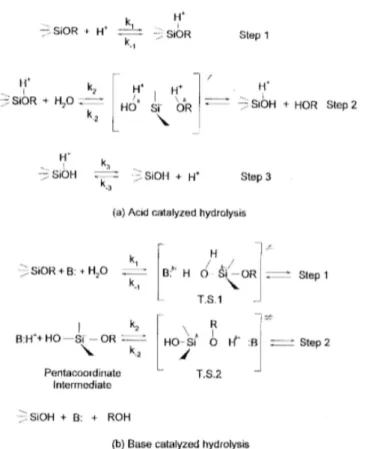
Figure 1은 알콕시실란의 염(base-)과 산(acid-) 촉매작용에 의한 가수분해 기전을 보여준다.

반응이 진행됨에 따라 반응배위(reaction coordinate)는 반응 체(reactant)에서 부터 전이상태(transition state)까지 극성 파 라미터(polar parameter)값(*)과 입체 파라미터(steric parameter) 값(s)이 구조내 변화와 전하(charge)분배를 정성적으로 보여 주고 있다.

10

Figure 1(a)는 산촉매작용 가수분해 기전을 보여준다. 실리 콘원자 주위에 5개의 치환기들이 S

N

2-Si의 형태로 존재한다, 접 근하는 친핵체와 떠나는 잔여집단(outgoing leaving group)들 이 실리콘원자와 하이브리드화(hybridized) 하여 친핵제와 잔 여집단간 sp3d 하이브리드화된 5배위 중간생성물(penta- coordinate intermediate) 상태를 형성한다. *와 s 값들이 작 다는 의미는 Figure 1(a)에서 보여주었듯이 반응 기전은 기질 (substrate)의 평형상태에서의 신속한 양성자화(equilibrium protonation) 후에 수분분자가 잔여집단(leaving group)과 양- 분자(bimolecular) 되면서 S

N

2-type 치환(displacement)을 하는 것이다.

7,8

Corresponding author E-mail: [email protected]

(2)

1.2. 염기 촉매화 가수분해 (Base catalyzed hydrolysis) 염촉매작용 가수분해 기전이 Figure 1(b)에 예시되었다. 5 배위 중간생성물과 함께 양-분자 친핵 치환반응 (S

N

2**-Si or S

N

2*-Si)을 한다; S

N

2**-Si는 5배위 중간생성물 형성 속도결 정(k

1

< k

2

), S

N

2*-Si는 분해(break-down)속도결정(k

1

> k

2

)을 의미한다.

7,9

*값이 크다는 의미는 전이상태(transition state) 가 실리콘원자에 붙어있는 전자흡수그룹(electron withdrawing group)에 의해 반응물(reactants)보다 더 안정되어있다는 것을 의미한다. 제시된 기전에서는 전이상태(T.S.1 혹은 T.S.2)에서 실리콘원자에서의 음전하(negative charge)가 상당히 높다. 입 체파라미터값(s)이 크다는 것은 전이상태가 반응물 보다 입체 적으로 더욱 혼잡하다는 것을 의미한다.

11

sp3 하이브리드화 된 실리콘은 sp3d와 같은 전이상태를 형성하면서 재하이브리 드화 되면서 도입되는 하이드록사이드 음이온(hydroxide anion)과 결합을 형성하게 된다. 실리콘표면에 단단히 고정된 음하전밀도(negative charge density)와 친핵 산소간에 단단히 연결된 전이상태를 이룬다.

12

Figure 2는 tialkoxysilane의 pH에 따른 hydrolysis mech- anism을 나타낸다.

13

Allen모델

14

과 Kay & Assink모델

15

에 따 르면, 염 촉매화 가수분해반응은 알콕시그룹(-(OR)

3

)이 -(OSi)

3

그룹(하단좌측)으로 치환하면 축합반응, 알콕시그룹(-(OR)

3

) 이 하이드록시그룹(-(OH)

3

)(하단우측)으로 치환하면 이를 가

수분해라 부른다. 산 가수분해는 염기 가수분해보다 현저히 크고 다른 카본-결합 치환체들로부터 최소한으로 영향을 받 는다. Moore

16

가 예시한 Osterholtz & Pohl

17

의 결과는 가수분 해가 제일 늦게 일어날 때는 neutral pH이며 pH단위가 1pH 씩 변화할 때마다 10배씩 변화한다. 축합반응 역시 pH에 의 해 영향을 받는데 반응최소 pH는 4 이다. 알코올의 가수분해 반응은 가역적(reverse) 이며 용액을 장시간 동안 안정화시 킨다.

1.3. 폴리아미드(PA) 가수분해

18

자동차의 경량화소재로 잘 알려진 플라스틱(plastic) 소재는 엔지니어링플라스틱(engineering plastic (EnPla))이다. 최근 전기자동차의 등장으로 인해 차량의 NVH성능의 향상이 요 구되고 있고 이를 만족하는 소재는 비 금소재속인 플라스틱 소재의 사용이 더욱 확대되고 있다. 이 전에 CAFE (corporate average fuel economy) 규정에 의한 연비증가 및 CO

2

절감을 만족하기 위하여 자동차 경량화 부품의 주 소재로서의 적용 을 해야 하는 부분도 있기 때문이다.

19,20

재활용이 가능한 대표적인 엔지니어링 플라스틱(EnPla) 소 재로써 아미드(-CONH-)결합에 의하여 단량체가 연결된 중합 체인 폴리아미드(polyamide; PA)는 aliphatic 폴리아미드의 한 종류로 Carothers와 Berchet에 의해 1935년에 최초로 개발되 었다.

21

PA66는 높은 결정화도에 의한 우수한 기계적 강도와 100~150℃ 환경에서 연속사용이 가능한 내열성, 뛰어난 내 마모성 등의 장점을 가지고 있는 소재이며 PA66에 대한 연 Figure 1. Hydrolysis mechanism for (a) acid catalyzed [adopted

from ref. 7,8], (b) base catalyzed [adopted from ref. 7,9] systems

Figure 2. Effect of pH on hydrolysis mechanism for alkoxy silanes

[adopted from ref. 12-15].

(3)

현장에서 사용되는 차량의 파워트레인 마운트(PM) 중의 하 나인 엔진 마운트(EM) 부품에 요구되는 소재는 고인장 강도 의 물성을 필요로 하는 폴리아미드66/유리섬유(PA/GF) 복합 소재들이다. 노즐 부품과 같이 수분이나 glycol에 노출되는 부 품은 내가수분해(hydrolysis resistance)의 특성이 있는 소재가 요구되며, 엔진룸에서 발생하는 열(150℃) 및 외부 환경온도 (40℃), 충격, 염화칼슘에 의한 부식, 오일이나 워셔액 등에 의한 부식 등에 노출되는 부품에는 그 부품에 특화된 소재가 요구된다.

가수분해는 PA의 최대 약점으로서, PA의 내가수분해 특성 을 향상시켜 소재의 물성 저하를 최소화하고 기계적 강도 저 하를 최소화시켜서 고성능 자동차의 부품으로 적용하기 위한 가수분해 저항성이 향상된 PA66 복합소재의 개발이 필요한 실정이며 이로 인해 내가수분해성 소재개발에 대한 연구는 최 근에 여러 산업체에서 많은 관심을 갖고 있다.

33,34,37-42

2. 개스크로마토그라피(gas chromatography)를 적용한 가 수분해 측정

2.1. Py-GC/MS를 적용한 열분해 분자구조 정성분석 Py-GC/MS는 복합재료의 고분자 및 첨가제의 정성분석에 널리 사용되며 분자구조의 정보를 얻을 수 있는 분석 방법이 다.

43

가수분해를 정량적 측정방법으로는 각 조건의 소재 내

-NH)와 상호작용에 의한 결합을 하고 가수분해가 진행되는 것으로 알려져 있다.

37

PA66가 열분해되어 생성되는 성분으로 는 cyclopentanone, hexamethylenediamine, cyclic monomer 등이 있다.

46-50

MacKerron과 Gordon이

51

표현한 PA66의 열분 해에 대한 기전(mechanism)을 Figure 3에 나타내었으며 PA66 의 열분해는 분자사슬의 아디프 산(adipic acid) 분자의 분해 부터 시작되어 cyclopentanone, hexamethylenediamine 등이 생성되고, 이 생성된 물질들의 사슬이 절단(scission) 및 재형 성(reorganization) 반응을 하여 cyclic monomer가 생성됨은 알려져 있다.

42,52

Lee와 Kim은 py-GC/MS을 통해 DTR(D), DuPont(Z), Kopla (K), BASF(A) 사의 PA66/GF(동급) 복합소재들의 열분해 생 성물을 정량적으로 확인하고 기계적 물성과 비교하였다.

18,42

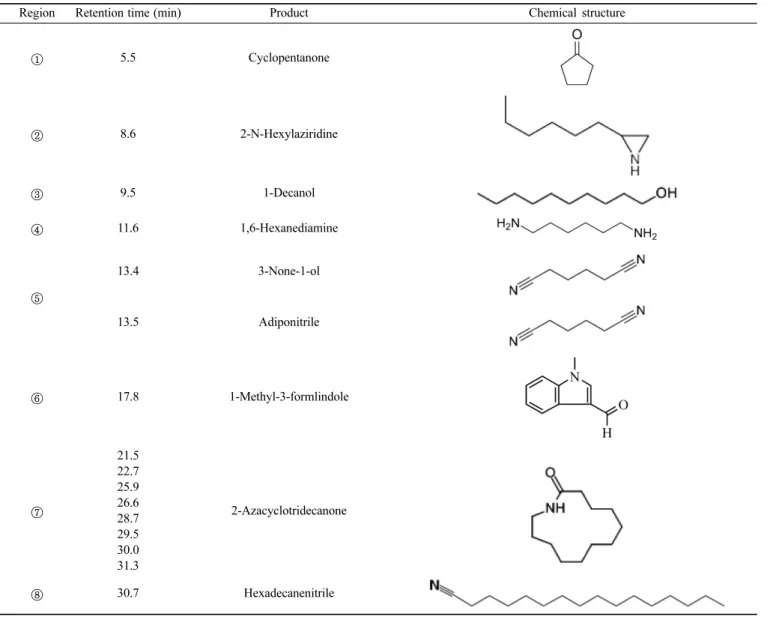
MEG (mono ethylene glycol)용액에 침지 전후의 크로마토그 램을 비교한 결과, cyclopentanone (retention time(r.t.) 5분, ①), 2-N-Hexylaziridine (r.t. 8.6분, ②), 1-Decanol (r.t. 9.5분, ③), 1,6-Hexanediamine (r.t. 11.6분, ④), 3-None-1-ol (r.t. 13.4분,

⑤), Adiponitrile (r.t. 13.5분, ⑤), 1-Methyl-3-formlindole (r.t.

17.8분, ⑥), 2-Azacyclotridecanone (r.t. 21.5~31.3분, ⑦), Hexadecanenitrile (r.t. 30.7분, ⑧) 등의 열분해 생성물이 침지 후 검출량이 공통적으로 증가하는 것을 관찰하였고 Table 1 와 같은 결과를 얻었다.

침지 후 PA66 복합소재의 증가한 열분해 물질들의 retention

Figure 3. Degradation mechanism and its products of the of PA66 [adopted from ref. 51].

(4)

time (r.t.) 및 화학구조는 Table 1에 정리하였다.

18,51

이는 함침 시간에 따라 PA66 복합소재 표면에 수분과 MEG 의 hydroxy기가 흡착하여 PA66의 사슬의 절단에 관여하여 저 분자 및 아디프 산 분자 구조로 분해되기 때문으로 판단되는 데, 이는 즉, 가수분해 반응에 의해 MEG 및 수분의 hydroxy 기가 PA66의 극성 관능기(C=O, -NH)와 결합함에 따라 carboxylic acid와 alkylamine의 물질이 증가한 것을 의미한다.

침지 전후의 변화된 크로마토그램 특성 피크결과를 Figure 4 에 나타내었다.

18

2.2. Py-GC/MS의 SIM 모드를 적용한 가수분해 정량분석

18

Figure 5는 Figure 4에서 얻어진 질량스펙트럼으로부터 가 장 이온강도가 크고, 선택성이 좋은 1,6-Hexanediamine 이온 (m/z=30)을 선택하여 정량분석에 이용하였고. GC/MS-selected ion monitoring (SIM)모드로 분석한 결과를 Figure 5에 정리

하였는데, 침지 1,008시간 후 각 PA66/GF 복합소재들 (D, Z, K, A)에서 1,6-Hexanediamine 이온의 검출량이 증가함을 확 인하였다. 이는 MEG 및 수분의 hydroxy기의 PA66의 사슬과 의 반응하여 가수분해가 진행되어 1,6-Hexanediamine 저분자 구조로 분해된 것이기 때문이다. 가수분해로 분해된 고분자 는 분자량의 감소에 따른 물성 저하를 보고하였다.

53,54

이는 파트2에서 다루겠다.

2.3. Headspace GC를 적용한 가수분해 정량분석

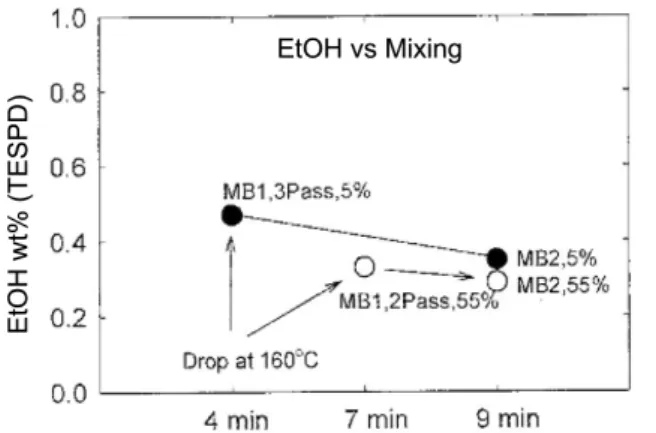
Figure 6는 headspace/gas chromatographic technique으로 측 정한 복합소재내 TESPD가 가수분해 후 TESPD내에 반응을 하지 않은 잔류 알코올(alcohol)의 양을 나타낸다.

44

믹싱전에 실리카에 수분을 첨가한 소재(open circle)의 알코올 잔유량은 수분을 첨가하지 않은 소재(closed circle)보다 낮았고 또한, 믹 싱시간이 증가하면서 두소재의 잔유알콜양이 감소하였다. 이 Table 1. The Decomposition Products of PA66 Composite

Region Retention time (min) Product Chemical structure

① 5.5 Cyclopentanone

② 8.6 2-N-Hexylaziridine

③ 9.5 1-Decanol

④ 11.6 1,6-Hexanediamine

13.4 3-None-1-ol

13.5 Adiponitrile

⑥ 17.8 1-Methyl-3-formlindole

21.5 22.7 25.9 26.6 28.7 29.5 30.0 31.3

2-Azacyclotridecanone

⑧ 30.7 Hexadecanenitrile

(5)

는 수분이 존재할수록, 믹싱시간이 증가할수록 실란과 실리 카의 가수분해반응이 증가한다는 것을 의미한다.

3. Alkoxysilane 및 PA 가수분해 기전

3.1. 실란화반응 기전(silanization reaction mechanism)

55

양기능성 알콕시실란은(bifunctional alkoxysilane) 직접적

이거나 두 가지 중요단계를 거친다.

Figure 7은 첫째단계로 알콕시실란은 물분자에 의하여 가수 분해가 이루어지고 난 후에 수화된(hydrolyzed) 실란은 실리 카표면의 hydroxy기와 축합반응을 일으켜 실리카표면에 화학 적으로 결합을 하게 된다.

44

둘째단계로, 실란의 다른 쪽 끝 황 원소는 고무사슬의 2중결합과 화학적으로 반응을 하게 된다.

이 단계에서 황(S8)고리는 개환(ring open)을 하여 고무사슬

Figure 4. Pyrolysis-GC/MS pyrograms of composites of (a) D, (b) Z, (c) K, and (d) A with respect to immersion time increase.

(6)

의 2중결합과 함께 가류된다. 그리고 나서 실리카와 고무사이 에 3차원적 망상조직이 형성된다고 알려져있다.

1,56-58,60,61

3.2. PA 가수분해 기전

18,62

고분자의 흡수성은 고분자 사슬의 자유 용적(free volume)

65,66

과 수분과 고분자와의 hydrogen bond와 연계된다.

65,66

PA66 는 사슬구조 내 산소(O) 및 질소(N) 원자가 물분자와 수소결 합으로 반응하여 수분을 흡수하는 특성으로 인해 가수분해에 의하여 PA66 사슬의 절단에 의한 물성이 저하되는 특성을 보 이는 것으로 보고되어 있다.

67-69

PA 가수분해의 반응 기전 (mechanism)을 Figure 8에 표현하였다.

70

조금 더 자세히 고찰하면, 수분이나 MEG의 극성 관능기인 hydroxyl group은 PA66의 산소, 질소 원자와의 쌍극자 상호 작용(dipole-dipole interaction)에 의한 수소 결합을 형성하고, Figure 5. GC-MS SIM peak area corresponding to 1,6-hexa-

nediamine in PA66/GF composites with respect to immersion time increase [adopted from ref. 18].

Figure 6. Ethoxy% remain in the 3-pass and 2-pass compounds [adopted from ref. 44].

Figure 7. Schematic presentation of hydrolysis and condensation reaction of a trialkoxy silane [redraw from ref. 44].

Figure 8. Hydrolysis of polyamide [adopted from ref. 70].

(7)

타난다. 가수분해가 진행됨에 따라 복합소재의 인장강도 및 탄성률의 감소, 충격강도, 신장율의 증가. 가수분해된 PA66의 열분해 생성물에 대한 정량평가를 통해 가수분해의 정도를 측 정할 수 있다.

18,79

MEG 및 수분의 hydroxy기가 PA66의 극성 관능기(C=O, -NH)와 상호작용에 의한 결합을 하고 가수분해가 진행된

다.

38-42,63-78

또한 수분을 구성하는 -OH group은 쌍극자 상호

작용(dipole-dipole interaction)에 의해 PA분자에 흡착되어 가 수분해가 진행된다.

19,27

이는 인장강도의 감소로 이어지고 시 험 결과에서도 같은 경향이 관찰된다.

18

또한 GF가 충전된 복합소재 내에서 수분이 흡착되면 복합 소재의 인장강도와 인장탄성률 감소가 관찰되는데, 이는 수분 흡착에 의해 낮아진 매트릭스 수지와 GF 계면간의 응력 전 달능력(stress transfer capability)의 감소가 GF의 보강성을 저 하시키는 원인으로 알려져 있다.

80

Conclusion

가수분해(hydrolysis)의 기전(mechanism) 과 측정방법, 그리 고 실제 소재 제조공정에서 적용되는 분야에서의 가수분해의 이론적인 부분에 대하여 고찰하였다.

기존의 py-GC-MS의 용도는 정성적인 분석에 응용하였지 만 SIM응용기법을 적용하면 정량적인 분석도 가능하다고 학 계에 알려진 부분을 산업현장에서 PA66의 가수분해에 의한 degradation을 정량적인 분석을 적용하여 측정하는 방법을 최 초로 적용하고 소개하였다. 이는 다음 파트에서 소개할 수분 에 의한 PA소재 물성저하와의 관계에서 원인규명에 핵심적 인 과학적 근거를 제시한다. 위에 예시한 가수분해 이외에도 수많은 기초적인 과학지식들이 현장에서도 응용을 통하여 더 욱 많은 과학적인 발전이 확대대기를 기대한다.

References

1. K. J. Kim and J. VanderKooi, “Moisture Effects on TESPD- Silica/CB/SBR Compounds”, Rubber Chem. Technol., 78, 84 (2005).

2. B. Arkles, J. R. Steinmetz, J. Zazyczny, and P. Metha, in:

“Silanes and other coupling agents”, K. L. Mittal, Eds., VSP, Utrechi (1992) p. 93.

3. U. oral and A. Hunsche, ”Advanced investigations into the

ilane and organosilane/polymer. Part 1: reaction mechanism and reaction model for silica/organosilane”, Kautsch. Gummi Kunstat. 50, 881 (1997).

6. K. L. Mittal, Eds., Silane Coupling Agents, VSP, Utrechi (1992).

7. K. J. McNeil, J. A. DiCapri, D. A. Walsh, and R. F. Pratt,

“Kinetics and mechanism of hydrolysis of a silicate triester, tris(2-methoxyethoxy)phenylsilane”, J. Am. Chem. Soc., 102, 1859 (1980).

8. M. G. Vorokonov, V. P. Meleshkevisk, and Y. A. Yuzekelvski,

“The Siloxane Bond”, Plenum Press, New York (1978) p.

375-380.

9. E. R. Pohl, “Society of the plastics industry”, Proc. 38

th

Annu.

Tech. Conf. Reinforced Plastics/Composites Inst. Section 4-B (1983).

10. R. W. Taft, Jr., “Steric effects in Organic Chemistry”, M. S.

Newman, Eds., John Wiley, New York (1956), Ch. 13.

11. D. F. DeTar, “Effects of alkyl groups on rates of acyl-transfer reactions”, J. Org. Chem., 45, 5166 (1980).

12. W. P. Jencks and K. Salvesen, “Equilibrium deuterium isotope effects on the ionization of thiol acids”, J. Am. Chem. Soc., 93, 4433 (1971).

13. M. Prassas and L. L. Hench, “Ultrastructure Processing of Ceramics”, L. Hench and D. Ulrich, Eds., John Wiley, New York (1984) p. 100.

14. K. W. Allen, in: “Silane Coupling Agents”, K. L. Mittal, Eds., VSP, Utrechi (1992) p. 93.

15. B. D. Kay and R. A. Assink, “Sol-gel kinetics: II. Chemical speciation modeling”, J. Non-Cryst. Solids, 104, 112 (1988).

16. M. J. Moore, “Mold makers make anti-dumping plea to ITC”, Rubber Plast. News, June 3, 2002, p. 14.

17. F. D. Osterholtz and E. P. Pohl, in: “Silane Coupling Agents”, K. L. Mittal, Eds., VSP, Utrechi (1992) p. 93.

18. J. Y. Lee and K. J. Kim, ”MEG effects on hydrolysis of poly- amide 66/glass fiber composites and mechanical property changes”, Molecules, 24, 755 (2019).

19. D. Forsström and B. Terselius, “Thermo oxidative stability of polyamide 6 films I. Mechanical and chemical characteriza- tion”, Polym. Degrad. Stab., 67, 69 (2000).

20. J. Rohrer, Rubber World, 252, 4 (2015).

21. W. H. Carothers and G. J. Berchet, “Studies on polymerization

and ring formation. VIII. Amids from -aminocaproic acid”,

G··

(8)

J. Am. Chem. Soc., 52, 5289 (1930).

22. W. Y. Jung and J. I. Weon, “Characterization of Thermal Deg- radation of Polyamide 66 Composite: Relationship between Lifetime Prediction and Activation Energy”, Polymer(Korea), 36, 712 (2012).

23. J. H. Park, W. N. Kim, I. H. Kwon, S. H. Lim, M. B. Ko, and C. R. Choe, “Effects of Processing Conditions of Injection Molding on the Microstructure of Long Fiber Reinforced Nylon Composites”, Polymer(Korea), 23, 681 (1999).

24. B. S. Yoon, D. J. Woo, M. H. Suh, and S. H. Lee, “A study on the Ternary GF/PA/PP Composites Manufactured by Using Pre-impregnated Glass Fiber”, Polymer(Korea), 24, 701 (2000).

25. B. J. Holland and J. N. Hay, “Thermo oxidative stability of polyamide 6 films I. Mechanical and chemical characteriza- tion”, Polym. Int., 49, 943 (2000).

26. C. H. Do, E. M. Pearce, and B. J. Bulkin, ”FT–IR spectro- scopic study on the thermal and thermal oxidative degrada- tion of nylons”, J. of Polym. Sci.: Part A: Polym. Chem., 25, 2409 (1987).

27. U. S. Ishiaku, H. Hamada, M. Mizoguchi, W. S. Chow, and Z.

A. Mohd Ishak, “The effect of ambient moisture and tempera- ture conditions on the mechanical properties of glass fiber/

carbon fiber/nylon 6 sandwich hybrid composites consisting of skin‐core morphologies”, Polym. Composites, 26, 52 (2005).

28. A. Valle’s-Lluch, W. Camacho, A. Ribes-Greus, and S. Karls- son, “Microwave‐assisted synthesis of new optically active poly(ester‐imide)s containing N,N′‐(pyromellitoyl)‐bis‐L‐phe- nylalanine moieties”, J. Appl. Polym. Sci., 85, 2211-2216 (2002).

29. R. P. Singh, S. M. Desai, and G. Pathak, “Thermal decompo- sition kinetics of photooxidized nylon 66”, J. Appl. Polym.

Sci., 87, 2146 (2003).

30. M. A. Schaffer, K. B. McAuley, E. K. Marchildon, and M. F.

Cunningham, “Thermal degradation kinetics of nylon 66:

Experimental study and comparison with model predictions”, Macromol. React. Eng., 1, 563 (2007).

31. S. V. Levchik, E. D Weil, and M. Lewin, “Thermal decompo- sition of aliphatic nylons”, Polym. Int., 48, 532 (1999).

32. Z. A. Alothman, M. M. Alam, and M. Naushad, “Heavy toxic metal ion exchange kinetics: Validation of ion exchange pro- cess on composite cation exchanger nylon 6,6 Zr(IV) phos- phate”, J. Indus. Eng. Chem., 19, 956 (2013).

33. W. H. Jang and J. S. Go, Korean Soc. Ind. Eng. Chem., 10, 1136 (1999).

34. B. Y. Shin, M. H. Ha, and D. H. Han, “Morphological, rheo- logical, and mechanical properties of polyamide 6/polypro- pylene blends compatibilized by electron-beam irradiation in

the presence of a reactive agent”, Materials, 9, 342 (2016).

35. B. D. Viers, Polymer Data Handbook, Oxford University Press, Oxford, 1999.

36. R. K. Gupta, E. Kennel, K. J. Kim,

, Science Press, Beijing, 2011.

ISBN: 978-7-03-032137-4 (2011).

37. R. van Mullekom, D. Joachimi, A. Karbach, P. Persigehl, and M. De Bock, “Molding compositions and their use”, U.S.

Patent 20050043443 (2005).

38. D. Joachimi, H. Schlte, W. Littek, and J. Kadelka, “Highly viscous polyamide for use in extrusion blow molding”, U.S.

Patent 20,030,092,822 (2003).

39. S. M. Kim and K. J. Kim, “Effects of Moisture and Tempera- ture on Recrystallization and Mechanical Property Improve- ment of PA66/GF Composite”, Polymer(Korea), 39, 880 (2015).

40. L. Huang, Q. Pei, Q. Yuan, H. Li, F. Cheng, and J. Ma, “Brit- tle–ductile transition in PP/EPDM blends: effect of notch radius”, Polymer, 44, 3125 (2003).

41. S. C. Tjong, W. D. Li, and R. K. Y.Li, “Impact toughening behaviour of quaternary PP/HDPE/EPDM/EP blends”, Eur.

Polm. J., 34, 755 (1998).

42. K. J. Kim, “Overview of Hydrolysis: A Review Part II- Hydrolysis Application”, Elast. Compos., (in print)

43. R. P. Lattimer, “Direct analysis of polypropylene compounds by thermal desorption and pyrolysis—mass spectrometry”, J.

Anal. Appl. Pyrolysis, 26, 65 (1993).

44. K. J. Kim and J. Vanderkooi, “Reactive Batch Mixing for Improved Silica-Silane Coupling”, Int. Polym. Process., 19, 364 (2004).

45. J. Y. Lee and K. J. Kim, “Measurement of degree of hydroly- sis of a PA66/GF composite using a py-GC/MS analysis”, Elast. Compos., 52, 59 (2017).

46. G. Montaudo and C. Puglisi, Thermal Degradation Mecha- nisms in Condensation Polymers, in Developments in Poly- mer Degradation, N. Grassie, Ed. Applied Science, London, 1987.

47. G. Montaudo and C. Puglisi, Thermal Degradation of Con- densation Polymers, in Comprehensive Polymer Science, Per- gamon Press, Oxford, 1992.

48. H.-J. Dussel, H. Rosen, and D. O. Hummel, “Feldionen‐ und Elektronensto‐Massenspektrometrie von Polymeren und Copolymeren, 5. Aliphatische und aromatische Polyamide und Polyimide”, Makromol. Chem., 177, 2343 (1976).

49. H. Ohtani, I. Nagaya, Y. Sugimura, and S. Tsuge, “Studies on thermal degradation of aliphatic polyamides by pyrolysis- glass capillary chromatography”, J. Anal. Appl. Pyrol., 4, 117 (1982).

50. P. R. Hornsby, J. Wang, R. Rothon, G. Jackson, G. Wilkinson,

(9)

mers, CRC Press, Boca Raton London Washington, 2001.

53. E. Lissi, “Entropic control of chemiluminescent reactions”, J.

Am. Chem. Soc., 98, 3386 (1976).

54. N. Chaupart, G. Serpe, and J. Verdu, “Molecular weight dis- tribution and mass changes during polyamide hydrolysis”, Polymer, 39, 1375 (1998).

55. S. M. Kim and K. J. Kim, “Effects of accelerator on silica vs.

carbon black filled natural rubber compounds”, Poly- mer(Korea), 37, 269 (2013).

56. J. L. White and K. J. Kim, Thermoplastic and Rubber Com- pounds Technology and Physical Chemistry, Hanser Pub- lisher, Munich, Cincinnati (2008) ISBN-13: 978-3-446- 40980-4

57. R. K. Gupta, E. Kennel, and K. J. Kim, Polymer Nanocompos- ites Handbook, CRC Press, Boca Raton, ISBN: 9780849397776, ISBN 10: 0849397774, 2009.

58. E. P. Plueddemann, Silane Coupling Agents, Plenum Press, New York, 1982.

59. K. J. Kim and J. VanderKooi, “Moisture Effects on Improved Hydrolysis Reaction for TESPT and TESPD-Silica Com- pounds”, Composite Interfaces, 11, 471 (2004).

60. K. J. Kim and J. VanderKooi, “Temperature Effects of Silane Coupling on Moisture Treated Silica Surface”, J. Appl.

Polym. Sci., 95, 623 (2005).

61. A. S. Hashim, B. A. Zahare, Y. Ikeda, and S. K. Ohjiya, “The Effect of Bis(3-Triethoxysilylpropyl) Tetrasulfide on Silica Reinforcement of Styrene-Butadiene Rubber”, Rubber Chem.

Technol., 78, 289 (1998).

62. S. M. Kim and K. J. Kim, “Hydrolysis resistance and mechanical property changes of glass fiber filled polyketone composites upon glass fiber concentration”, Elast. Compos., 52, 1 (2017).

63. M. H. Cohen and D. Turnbull, “Molecular Transport in Liq- uids and Glasses”, J. Chem. Phys., 31, 1164 (1959).

64. C. A. Kumins and T. K. Kwei, Free volume and other Theo- ries, in Diffusion in polymers edited by J. Crank and G.S Park, 1968.

65. P. Moy and F. E. Karasz, “Epoxy‐water interactions”, Polym.

Eng. Sci., 20, 315 (1980).

66. I. Merdas, F. Thominette, A. Tcharkhtchi, and J. Verdu, “Fac- tors governing water absorption by composite matrices”, Compos. Sci. Technol., 62, 487 (2002).

water by aliphatic polyamides. Review”, Polym. Sci. USSR, 27, 751 (1985).

69. X. Colin and J. Verdu, Humid Ageing of Organic Matrix Composites, in Durability of Composites in a Marine Envi- ronment, vol. 208, P. Davies and Y. D. S. Rajapakse, Eds.

Dordrecht: Springer Netherlands, 2014.

70. H. H. G. Jellinek and S. R. Dunkle, Degradation and Stabili- zation of Polymers, Elsevier, New York, 1983.

71. N. Sombatsompop and K. Chaochanchaikul, “Effect of mois- ture content on mechanical properties, thermal and structural stability and extrudate texture of poly(vinyl chloride)/wood sawdust composites”, Polym. Int., 53, 1210 (2004).

72. H. K. Reimschuessel, “Relationships on the effect of water on glass transition temperature and young's modulus of nylon 6”, J. Polym. Sci. Polym. Chem. Ed., 16, 1229 (1978).

73. M. Akay, “Moisture absorption and its influence on the tensile properties of glass-fibre reinforced polyamide 6,6”, Polym.

Polym. Compos., 2, 349 (1994).

74. B. Jacques, M. Werth, I. Merdas, F. Thominette, and J. Verdu,

“Hydrolytic ageing of polyamide 11. 1. Hydrolysis kinetics in water”, Polymer, 43, 6439 (2002).

75. J. L. Thomason, “Structure–property relationships in glass‐rein- forced polyamide, Part 3: Effects of hydrolysis ageing on the dimensional stability and performance of short glass–fiber‐rein- forced polyamide 66”, Polym. Compos., 28, 344 (2007).

76. M. Kohan, Nylon Plastics Handbook, Hanser/Gardner, New York, 1995.

77. A. Lasagabaster, M. J. Abad, L. Barral, and A. Ares, “FTIR study on the nature of water sorbed in polypropylene (PP)/

ethylene alcohol vinyl (EVOH) films”, Eur. Polym. J., 42, 3121 (2006).

78. E. S. Goncalves, L. Poulsen, and P. R. Ogilby, “Mechanism of the temperature-dependent degradation of polyamide 66 films exposed to water”, Polym. Degrad. Stab., 92, 1977 (2007).

79. D. H. Mackerron and R. P. Gordon, “Minor products from the pyrolysis of thin films of poly(hexamethylene adipamide)”, Polym. Degrad. Stab., 12, 277 (1985).

80. J. L. Thomason, “The influence of fibre length, diameter and

concentration on the impact performance of long glass-fibre

reinforced polyamide 6,6”, Compos. Part A-Appl. Sci. Manuf.,

40, 114 (2009).

수치

Figure 2. Effect of pH on hydrolysis mechanism for alkoxy silanes [adopted  from  ref
Figure  3.  Degradation  mechanism  and  its  products  of  the  of  PA66  [adopted  from  ref
Figure 6는 headspace/gas chromatographic technique으로 측 정한 복합소재내 TESPD가 가수분해 후 TESPD내에 반응을 하지 않은 잔류 알코올(alcohol)의 양을 나타낸다
Figure  7.  Schematic  presentation  of  hydrolysis  and  condensation  reaction  of  a  trialkoxy  silane  [redraw  from  ref

참조

관련 문서

And that result interpreted that water hydrolysis of adhesive resin cause porphyrin value loss, so that adhesive resin was degradated.. Thus, by using the

Anaerobic acidogenic reactor (0.5 m 3 ) for organic acid production from effluent of semi-anaerobic hydrolysis/acidogenic reactor

The index is calculated with the latest 5-year auction data of 400 selected Classic, Modern, and Contemporary Chinese painting artists from major auction houses..

It considers the energy use of the different components that are involved in the distribution and viewing of video content: data centres and content delivery networks

After first field tests, we expect electric passenger drones or eVTOL aircraft (short for electric vertical take-off and landing) to start providing commercial mobility

1 John Owen, Justification by Faith Alone, in The Works of John Owen, ed. John Bolt, trans. Scott Clark, &#34;Do This and Live: Christ's Active Obedience as the

The initial rate of the hydrolysis reaction is much larger than the sum of the rates of the condensation reactions so that [SiOH] equals the consumption of H 2 O by hydrolysis.

Based on the parametric study on the characteristic of solid NaBH 4 hydrolysis using the NaHCO 3 agent, a prototype of the hydrogen generation system was developed