ARTICLE
Int J Thyroidol 2019 November 12(2): 105-112 https://doi.org/10.11106/ijt.2019.12.2.105Received February 11, 2019 / Revised July 5, 2019 / Accepted July 8, 2019
Correspondence: Jeonghoon Ha, MD, Division of Endocrinology and Metabolism, Department of Internal Medicine, Seoul St. Mary’s Hospital, College of Medicine, The Catholic University of Korea, 222 Banpo-daero, Seocho-gu, Seoul 06591, Korea
Tel: 82-2-2258-6372, Fax: 82-2-599-3589, E-mail: [email protected]
Copyright ⓒ 2019, the Korean Thyroid Association. All rights reserved.
This is an open-access article distributed under the terms of the Creative Commons Attribution Non-Commercial License (http://creative- commons.org/licenses/by-nc/4.0/), which permits unrestricted non-commercial use, distribution, and reproduction in any medium, provided the original work is properly cited.
Association High-Iodine-Containing Seaweed Soup Consumption after Birth and Subclinical Hypothyroidism in Korean Women: Korea
National Health and Nutrition Examination Survey IV (2013–2015)
Hyunsam Kim
1, Ha Ni Lee
2and Jeonghoon Ha
1Division of Endocrinology and Metabolism, Department of Internal Medicine, Seoul St. Mary’s Hospital, College of Medicine, The Catholic University of Korea1, Seoul, Health Promotion Center, Department of Internal Medicine, Bobath Memorial Hospital2, Seongnam, Korea
Background and Objectives: This study was to investigate the association between the previous history of seaweed intake after childbirth and subclinical hypothyroidism (SCH) occurrence in Korean women based on the latest nationally representative epidemiological survey data, the Sixth Korea National Health and Nutrition Examination Survey (KNHANES VI). Materials and Methods: This study used data from KNHANES VI, a cross-sectional, nationally representative survey that comprises a health interview survey, health examination survey, and nutrition survey. Of the initial 22,948 Korean participants enrolled in KNHANES VI, 2,046 women were selected for this analysis. To examine SCH, the thyroid-stimulating hormone (TSH) reference range was defined using a population-based TSH range. Results: Subclinical hypothyroidism was increased in those who consumed seaweed soup after childbirth, but this was not significant (OR 1.3, CI: 0.80-2.13, p=0.293). However, the odd ratio for SCH differed according to the duration of seaweed soup consumption. When seaweed soup was consumed within 1 week after birth, the OR was increased in the crude model (OR 2.61, CI: 1.39-4.89, p=0.002), but this was no longer significant in the adjusted model (OR 1.89, CI: 0.79-4.50). Conclusion: The notable finding from this study is that the previous history of excessive seaweed consumption during post-partum period may not be a risk factor for SCH in Korean women.
Key Words: Subclinical hypothyroidism, Iodine, Seaweed
Introduction
Subclinical hypothyroidism (SCH) is defined as an isolated elevated serum thyrotropin level despite a normal serum thyroid hormone level.1) The prevalence of SCH ranges from 3% to 12%2,3) and can be up to 20% in women older than 60 years.4) The prevalence
is dependent on the thyroid-stimulating hormone (TSH) reference range used, and the TSH level is strongly influenced by sex, area of residence, iodine intake, and presence of autoantibodies.2,5,6) A preva- lence of SCH up to 18% has been reported in io- dine-rich areas,7,8) and Korea is classified as an io- dine-rich area. A previous study reported that the average iodine intake of healthy adults in Korea is 479
μg/day and that the average urinary iodine concen- tration (UIC) is 674 μg/g creatinine.9) Given that more than 500 μg/g creatinine of the UIC is considered to indicate excessive iodine intake,10) Korea is a high io- dine-intake area.11) This high intake may reflect the frequent nationwide dietary intake of iodine-rich sea- weeds such as laver and kelp.11) In Korea, it is a tra- dition for a mother to consume seaweed soup after childbirth to increase breast milk supply. The purposes of this study were to investigate the association be- tween the previous history of seaweed intake after childbirth and SCH occurrence in Korean women based on the latest nationally representative epi- demiological survey data, the Sixth Korea National Health and Nutrition Examination Survey (KNHANES VI).
Materials and Methods
Study Population
KNHANES VI was performed by the Korea Centers for Disease Control and Prevention (CDC) and com- prises a health interview survey, health examination survey, and nutrition survey. It uses a stratified multi- stage probability sampling design. Informed written consent for participation was obtained from all study participants. The study was approved by the Korea CDC Institutional Review Board.
The TSH reference range was calculated based on the enrolled population, and the values corresponding to 2.5th and 97.5th percentiles were defined as refer- ence ranges (0.62-6.68 μIU/mL). Of the initial 22,948 Korean participants, 2,046 women were selected for this analysis by excluding those who did not meet the inclusion criteria: male gender (n=10,411), age <19 years (n=2,338), pregnant (n=16), history of delivery within 1 year (n=96), history of treatment for thyroid disease (n=71), insufficient urine iodine data (n=390), insufficient serum free thyroxine (FT4) data or FT4 lev- el not within the normal range (n=7,345), or insufficient TSH data or concentration <0.62 μIU/mL (n=235).
Measurements
All measurements and data from questionnaires
were collected by specially trained investigators.
Detailed anthropometric measurements were made as in previous studies.12-14) Creatinine, TSH, FT4 were measured in blood collected after overnight fasting.
TSH concentration was measured using an E-TSH kit (Roche Diagnostics). FT4 concentration was measured using an E-Free T4 kit (Roche Diagnostics) for which the reference range was 0.89-1.76 ng/mL. Clinical practice guidelines suggest the use of population-based reference ranges for TSH.15) In the present study, the range 0.62-6.68 μIU/mL, which corresponds to the 2.5th to 97.5th percentiles of serum TSH concentration in the studied population, was used to define SCH.
Iodine-intake status was evaluated using the urine io- dine/creatinine ratio determined using inductively cou- pled plasma-mass spectrometry (PerkinElmer; Waltham, MA, USA). The duration of ingestion of seaweed soup after birth was classified as 1 week, 2 weeks, 3 weeks, 1 month, 2 months, and more than 2 months after birth.
Statistical Analysis
Statistical analyses were performed using SAS ver- sion 9.3 (SAS Institute, Cary, NC, USA). P-values
<0.05 were significant. The data are expressed as number and percentage or as mean±standard deviation. Differences between participants with SCH and without SCH were evaluated using the Wilcoxon rank-sum test or the χ2 test, as appropriate.
Differences between the four quartiles of serum TSH concentration were identified using a generalized line- ar model (Duncan’s test of multiple comparisons).
Multivariable adjusted logistic regression analysis was conducted to determine odds ratios (ORs) and 95%
confidence intervals (CIs) for the risk of SCH across variables. Because of the complex sampling design, a weighted sampling method was used to assign par- ticipants representative of the Korean population in the analysis of data. Detailed characteristics of the stat- istical analysis of KNHANES have been reported previously.13,14)
Results
The characteristics of the study population are
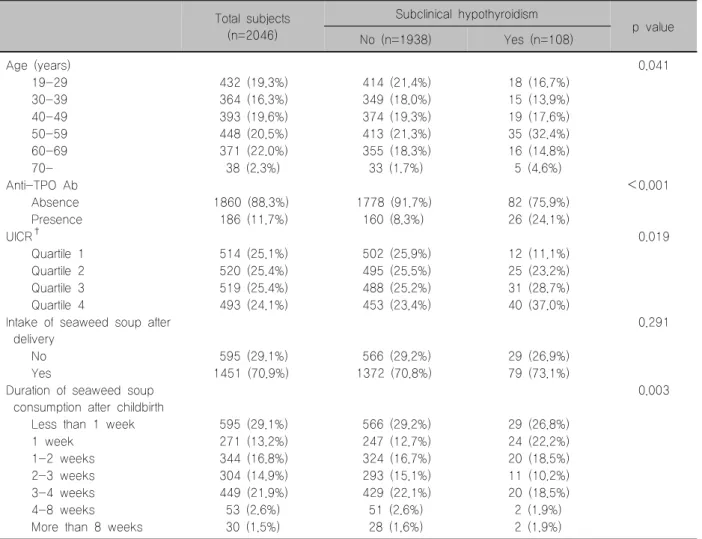
Table 1. Characteristics of study population*
Total subjects (n=2046)
Subclinical hypothyroidism
p value
No (n=1938) Yes (n=108)
Age (years) 0.041
19-29 432 (19.3%) 414 (21.4%) 18 (16.7%)
30-39 364 (16.3%) 349 (18.0%) 15 (13.9%)
40-49 393 (19.6%) 374 (19.3%) 19 (17.6%)
50-59 448 (20.5%) 413 (21.3%) 35 (32.4%)
60-69 371 (22.0%) 355 (18.3%) 16 (14.8%)
70- 38 (2.3%) 33 (1.7%) 5 (4.6%)
Anti-TPO Ab <0.001
Absence 1860 (88.3%) 1778 (91.7%) 82 (75.9%)
Presence 186 (11.7%) 160 (8.3%) 26 (24.1%)
UICR† 0.019
Quartile 1 514 (25.1%) 502 (25.9%) 12 (11.1%)
Quartile 2 520 (25.4%) 495 (25.5%) 25 (23.2%)
Quartile 3 519 (25.4%) 488 (25.2%) 31 (28.7%)
Quartile 4 493 (24.1%) 453 (23.4%) 40 (37.0%)
Intake of seaweed soup after delivery
0.291
No 595 (29.1%) 566 (29.2%) 29 (26.9%)
Yes 1451 (70.9%) 1372 (70.8%) 79 (73.1%)
Duration of seaweed soup consumption after childbirth
0.003
Less than 1 week 595 (29.1%) 566 (29.2%) 29 (26.8%)
1 week 271 (13.2%) 247 (12.7%) 24 (22.2%)
1-2 weeks 344 (16.8%) 324 (16.7%) 20 (18.5%)
2-3 weeks 304 (14.9%) 293 (15.1%) 11 (10.2%)
3-4 weeks 449 (21.9%) 429 (22.1%) 20 (18.5%)
4-8 weeks 53 (2.6%) 51 (2.6%) 2 (1.9%)
More than 8 weeks 30 (1.5%) 28 (1.6%) 2 (1.9%)
*Data are presented as mean±SD, n (weighted %), Statistics were carried out using Rao-Scott Chi-square test; †Iodine intake status was evaluated by urine iodine creatinine ratio, UICR, Quartile 1: <Q1 (141.5), Quartile 2: ≥Q1 and <Q2 (281.8), Quartile 3: ≥Q2 and <Q3 (664.6), Quartile 4: ≥Q3.
SD: standard deviation
shown in Table 1. Of the total 2,046 Korean women included, 108 (5.28%) were confirmed to have SCH.
Participants with SCH were more likely to be older. Of those with SCH, 51.8% were aged >50 years, and 4.6% were aged >70 years. The median TSH con- centration was highest (2.66 μIU/mL) in the >70- year age group (Supplementary Table 1). TPOAb was detected in 26 (24.1%) participants with SCH. The urine iodine creatinine ratio (UICR) was uniformly dis- tributed in the non-SCH group, whereas more partic- ipants fell within in the higher UICR quartile in the SCH group. It was found that 70.9% of Korean women consumed seaweed soup for more than one week after childbirth. The remaining 29.1% were found to
not consume seaweed soup at all or consume sea- weed soup for less than one week after childbirth.
Participants who consumed seaweed soup for more than one week after childbirth mostly consumed sea- weed soup for up to 3 to 4 weeks after childbirth (21.9%). The SCH group most often consumed sea- weed soup in the first week after childbirth, and the non-SCH group for up to 3 to 4 weeks after childbirth.
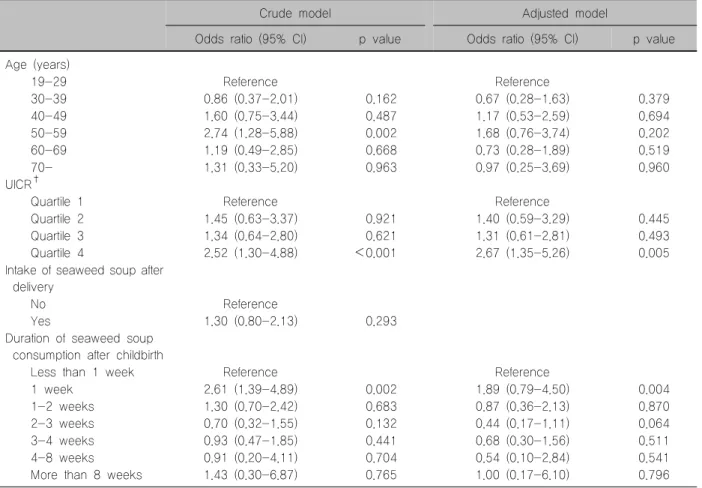
The OR for SCH was increased in those who con- sumed seaweed soup after childbirth, but this was not significant (OR 1.3, CI: 0.80-2.13, p=0.293) (Table 2).
The ORs for SCH differed according to the duration of seaweed soup consumption. When seaweed soup
Table 2. Logistic regression analysis of subjects with subclinical hypothyroidism*
Crude model Adjusted model
Odds ratio (95% CI) p value Odds ratio (95% CI) p value Age (years)
19-29 Reference Reference
30-39 0.86 (0.37-2.01) 0.162 0.67 (0.28-1.63) 0.379
40-49 1.60 (0.75-3.44) 0.487 1.17 (0.53-2.59) 0.694
50-59 2.74 (1.28-5.88) 0.002 1.68 (0.76-3.74) 0.202
60-69 1.19 (0.49-2.85) 0.668 0.73 (0.28-1.89) 0.519
70- 1.31 (0.33-5.20) 0.963 0.97 (0.25-3.69) 0.960
UICR†
Quartile 1 Reference Reference
Quartile 2 1.45 (0.63-3.37) 0.921 1.40 (0.59-3.29) 0.445
Quartile 3 1.34 (0.64-2.80) 0.621 1.31 (0.61-2.81) 0.493
Quartile 4 2.52 (1.30-4.88) <0.001 2.67 (1.35-5.26) 0.005
Intake of seaweed soup after delivery
No Reference
Yes 1.30 (0.80-2.13) 0.293
Duration of seaweed soup consumption after childbirth
Less than 1 week Reference Reference
1 week 2.61 (1.39-4.89) 0.002 1.89 (0.79-4.50) 0.004
1-2 weeks 1.30 (0.70-2.42) 0.683 0.87 (0.36-2.13) 0.870
2-3 weeks 0.70 (0.32-1.55) 0.132 0.44 (0.17-1.11) 0.064
3-4 weeks 0.93 (0.47-1.85) 0.441 0.68 (0.30-1.56) 0.511
4-8 weeks 0.91 (0.20-4.11) 0.704 0.54 (0.10-2.84) 0.541
More than 8 weeks 1.43 (0.30-6.87) 0.765 1.00 (0.17-6.10) 0.796
*Data are presented OR (95% CI), Statistics were carried out using Logistic regression; †Iodine intake status was evaluated by urine iodine creatinine ratio, UICR, Quartile 1: <Q1 (141.5), Quartile 2: ≥Q1 and <Q2 (281.8), Quartile 3: ≥Q2 and <Q3 (664.6), Quartile 4: ≥Q3.
was consumed within 1 week after birth, the OR was increased in the crude model (OR 2.61, CI:
1.39-4.89, p=0.002), but this was no longer sig- nificant in the adjusted model (OR 1.89, CI:
0.79-4.50) (Table 2).
Discussion
This study evaluated the association between the history of excessive seaweed intake after childbirth and SCH occurrence in Korean women based on the most recently released nationally representative data.
In Korean women, seaweed soup intake after child- birth was not significantly related to SCH occurrence.
SCH is known to be a risk factor for cardiovascular disease,16-18) especially for vascular calcification.19,20) Therefore, treatment is recommended for those who have cardiovascular diseases.21)
Most studies have reported that age, presence of TPOAb, female sex, and high iodine intake are risk factors for SCH.7) Vadiveloo et al.22) analyzed data of 153,127 participants and found that the median TSH concentration increased with age. The US National Health and Nutrition Examination Survey III reported a trend toward a higher prevalence of SCH in individuals positive for TPOAb.2) The Whickham survey reported that the risk of developing overt hypothyroidism was four times higher in individuals positive for TPOAb.23) Iodine intake is another risk factor for SCH. Excessive iodine intake alters thyroid function through direct toxic effects or immunological alterations.24)
Australia’s New South Wales (NSW) government has officially warned that seaweed soup is harmful to mothers and newborns because it contains excessive iodine.25) Korean women traditionally consume brown Undaria pinnatifida “Miyeok
Guk”, daily during the early postpartum period to in- crease breast milk production. According to the NSW government, dried seaweed soup contains 9000 μg of iodine per 100 g of seaweed, which is >33 times the recommended daily intake.25) Benotti et al.26) measured the amount of iodine content in dried sea- weed soup spectrophotometrically and suggested that 1 bowl (250 mL) of seaweed broth contains an aver- age of 487±178 μg of iodine. Korean women con- sume seaweed soup at least three times daily in the first postpartum week.27) Rhee et al.28) reported that Korean women consume on average at least 1400 μg/day of iodine in the first postpartum week, which was calculated based on the consumption of 250 mL of seaweed soup broth three times daily. Given that the World Health Organization (WHO) guidelines rec- ommend 250 μg/day (upper limit of 500 μg/day) of iodine intake during pregnancy and lactation, Korean women seem to be consuming excess iodine during the postpartum period.27) Our study clarifies if seaweed soup intake during the postpartum period is related to the occurrence of SCH. In the crude model, the intake of seaweed soup within the first postpartum week seemed to increase the risk of SCH in mothers, but this association was no longer significant in the ad- justed model.
The mechanism to explain this apparent lack of as- sociation between SCH risk and intake of seaweed soup is unclear. The effects of excessive iodine are dependent on several factors, including an underlying thyroid disease, thyroid autoimmunity, and the iodine levels before iodine exposure.28) Although the thyroid gland is the main reservoir for iodine, breast and cer- vical tissues are also involved in iodine storage,29) thus causing women to store excess iodine. Even if iodine is absorbed excessively, it can be stored in each tis- sue to some extent to prevent any harmful effects of excessive iodine intake. Possibly, SCH develops only when a certain threshold of iodine intake is exceeded.
Changes in the breast and cervix associated with pregnancy may increase the capacity for iodine storage.
Our study has several limitations. First, it was a cross-sectional study; therefore, our results do not
prove causality. Second, the data were self-reported because of the nature of the questionnaire-based research. The presence of medical illness and a de- tailed history of treatment were assessed based on the information provided by the participants. Third, due to the nature of data acquisition, the amount of iodine in seaweed soup was not quantified. Based on the re- sults of a previous study on Korean individuals, it is estimated that about 1400 μg/day of iodine was consumed after childbirth.28) Additional quantitative analysis of the iodine content in seaweed soup is necessary.
This study has shown that the seaweed soup com- monly consumed by Korean women does not have a significant effect on SCH occurrence, and that, al- though the duration of intake during postpartum is long, the effect is not significant. In a prospective study of the effects of excessive iodine on postpartum thy- roiditis in Korean mothers, it was reported that intake of seaweed soup did not affect the incidence of post- partum thyroiditis.30) Therefore, the NSW recom- mendation should be interpreted only as a warning that excessive seaweed soup intake will possibly re- sult in thyroid dysfunction in Korean postpartum women. In the present study, seaweed soup con- sumption for even more than 8 weeks did not affect the occurrence of SCH in Korean women. Excessive concern about Korea’s tradition of postpartum care with seaweed soup is not appropriate. However, in- dividuals within the Korean population may have dif- ferent responses to iodine consumption depending on the presence of autoimmune markers and the resi- dential area. Further research is needed to determine whether these results are characteristic only to Korean women and if they differ depending on the ethnicity or residential area.
To our knowledge, this is the first study to inves- tigate the association between the duration of sea- weed soup consumption and the occurrence of SCH in Korean women who commonly consume seaweed soup during the postpartum period. Our analysis of population-based data showed that seaweed intake after childbirth and SCH occurrence may not be related. Further prospective studies are needed to de-
termine whether there is a causal relationship and the long-term outcomes of high iodine intake during the postpartum period.
Conflict of Interest
The authors declare no conflict of interest.
References
1) Cooper DS. Clinical practice. Subclinical hypothyroidism. N Engl J Med 2001;345(4):260-5.
2) Hollowell JG, Staehling NW, Flanders WD, Hannon WH, Gunter EW, Spencer CA, et al. Serum TSH, T(4), and thyroid antibodies in the United States population (1988 to 1994):
National Health and Nutrition Examination Survey (NHANES III). J Clin Endocrinol Metab 2002;87(2):489-99.
3) Kim WG, Kim WB, Woo G, Kim H, Cho Y, Kim TY, et al. Thyroid Stimulating Hormone Reference Range and Prevalence of Thyroid Dysfunction in the Korean Population:
Korea National Health and Nutrition Examination Survey 2013 to 2015. Endocrinol Metab (Seoul) 2017;32(1):106-14.
4) Canaris GJ, Manowitz NR, Mayor G, Ridgway EC. The Colorado thyroid disease prevalence study. Arch Intern Med 2000;160(4):526-34.
5) Aghini-Lombardi F, Antonangeli L, Martino E, Vitti P, Maccherini D, Leoli F, et al. The spectrum of thyroid disorders in an iodine-deficient community: the Pescopagano survey. J Clin Endocrinol Metab 1999;84(2):561-6.
6) Laurberg P, Pedersen KM, Hreidarsson A, Sigfusson N, Iversen E, Knudsen PR. Iodine intake and the pattern of thyroid disorders: a comparative epidemiological study of thyroid abnormalities in the elderly in Iceland and in Jutland, Denmark.
J Clin Endocrinol Metab 1998;83(3):765-9.
7) Kim YA, Park YJ. Prevalence and risk factors of subclinical thyroid disease. Endocrinol Metab (Seoul) 2014;29(1):20-9.
8) Konno N, Makita H, Yuri K, Iizuka N, Kawasaki K.
Association between dietary iodine intake and prevalence of subclinical hypothyroidism in the coastal regions of Japan. J Clin Endocrinol Metab 1994;78(2):393-7.
9) Kim JY, Moon SJ, Kim KR, Sohn CY, Oh JJ. Dietary iodine intake and urinary iodine excretion in normal Korean adults.
Yonsei Med J 1998;39(4):355-62.
10) WHO, UNICEF, ICCIDD. Assessment of iodine deficiency disorders and monitoring their elimination: A guide for programme managers. 3rd ed. Geneva: World Health Organization; 2007.
11) Cho YY, Kim HJ, Oh SY, Choi SJ, Lee SY, Joung JY, et al. Iodine status in healthy pregnant women in Korea: a first report. Eur J Nutr 2016;55(2):469-75.
12) Lee SH, Han K, Yang HK, Kim HS, Cho JH, Kwon HS, et al. A novel criterion for identifying metabolically obese but normal weight individuals using the product of triglycerides and glucose. Nutr Diabetes 2015;5(4):e149.
13) Tran BT, Jeong BY, Oh JK. The prevalence trend of metabolic
syndrome and its components and risk factors in Korean adults:
results from the Korean National Health and Nutrition Examination Survey 2008-2013. BMC Public Health 2017;17(1):71.
14) Kim J. Association between serum vitamin D, parathyroid hormone and metabolic syndrome in middle-aged and older Korean adults. Eur J Clin Nutr 2015;69(4):425-30.
15) Baloch Z, Carayon P, Conte-Devolx B, Demers LM, Feldt-Rasmussen U, Henry JF, et al. Laboratory medicine practice guidelines. Laboratory support for the diagnosis and monitoring of thyroid disease. Thyroid 2003;13(1):3-126.
16) Suh S, Kim DK. Subclinical hypothyroidism and cardio- vascular disease. Endocrinol Metab (Seoul) 2015;30(3):246-51.
17) Luboshitzky R, Aviv A, Herer P, Lavie L. Risk factors for cardiovascular disease in women with subclinical hypothyroidism.
Thyroid 2002;12(5):421-5.
18) Walsh JP, Bremner AP, Bulsara MK, O'Leary P, Leedman PJ, Feddema P, et al. Subclinical thyroid dysfunction as a risk factor for cardiovascular disease. Arch Intern Med 2005;165(21):
2467-72.
19) Hak AE, Pols HA, Visser TJ, Drexhage HA, Hofman A, Witteman JC. Subclinical hypothyroidism is an independent risk factor for atherosclerosis and myocardial infarction in elderly women: the Rotterdam Study. Ann Intern Med 2000;132(4):270-8.
20) Ichiki T. Thyroid hormone and atherosclerosis. Vascul Pharmacol 2010;52(3-4):151-6.
21) Surks MI, Ortiz E, Daniels GH, Sawin CT, Col NF, Cobin RH, et al. Subclinical thyroid disease: scientific review and guidelines for diagnosis and management. JAMA 2004;291(2):
228-38.
22) Vadiveloo T, Donnan PT, Murphy MJ, Leese GP. Age- and gender-specific TSH reference intervals in people with no obvious thyroid disease in Tayside, Scotland: the Thyroid Epidemiology, Audit, and Research Study (TEARS). J Clin Endocrinol Metab 2013;98(3):1147-53.
23) Vanderpump MP, Tunbridge WM, French JM, Appleton D, Bates D, Clark F, et al. The incidence of thyroid disorders in the community: a twenty-year follow-up of the Whickham Survey. Clin Endocrinol (Oxf) 1995;43(1):55-68.
24) Mahmoud I, Colin I, Many MC, Denef JF. Direct toxic effect of iodide in excess on iodine-deficient thyroid glands: epithelial necrosis and inflammation associated with lipofuscin accumula- tion. Exp Mol Pathol 1986;44(3):259-71.
25) Government NSW. Warning for pregnant and breastfeeding women. 2011 [cited July 17, 2019]. Available from:
http://www.mhcs.health.nsw.gov.au/publicationsandresources/pdf/
publication-pdfs/9120/ahs-9120-eng.pdf/view.
26) Benotti J, Benotti N, Pino S, Gardyna H. Determination of total iodine in urine, stool, diets, and tissue. Clin Chem 1965;
11(10):932-6.
27) Moon S, Kim J. Iodine content of human milk and dietary iodine intake of Korean lactating mothers. Int J Food Sci Nutr 1999;50(3):165-71.
28) Rhee SS, Braverman LE, Pino S, He X, Pearce EN. High iodine content of Korean seaweed soup: a health risk for lactating women and their infants? Thyroid 2011;21(8):927-8.
29) Ahad F, Ganie SA. Iodine, Iodine metabolism and Iodine
deficiency disorders revisited. Indian J Endocrinol Metab 2010;
14(1):13-7.
30) Kim WB, Alavi A, Walsh S, Pope E. Reply to Frane:
epidermolysis bullosa pruriginosa: a systematic review exploring genotype-phenotype correlation. Am J Clin Dermatol 2015;16(4):
339.
Supplementary Table 1. Median TSH according to age group of Korean women
Age Median TSH (IU/mL)
19-29 2.37
30-39 2.25
40-49 2.20
50-59 2.55
60-69 2.26
70- 2.66
TSH: thyroid stimulating hormone