Introduction
Hepatitis A is a kind of viral hepatitis, with the incidence rate of approximately 1000 to 10,000 cases annually in Korea and 4000 to 30,000 cases in USA.
1,2)Hepatitis A virus (HAV) belongs to the family picornaviridae and the genus hepatovirus, and is a non-enveloped RNA virus with the diameter of 27 nm.
3,4)HAV viral transmission occurs in a fecal-oral fashion; therefore, hygiene and socio-economic status play important role in hepatitis A pathology.
5)After infection, HAV lies dormant for approximately
25 days, and infectivity is the strongest in this stage. Then, the subsequent hepatic cell damage causes elevation of serum liver enzymes and influenza-like symptoms such as fatigue, weakness, anorexia, nausea, vomiting, abdominal pain, and fever. This is followed by elevated bilirubin stage, causing jaundice.
6)Hepatitis A is highly contagious, but does not become chronic, and symptomatic treatments, such as resting and providing sufficient nutrition, are enough due to spontaneous cure within 6 months.
7)However, about 15 % of hepatitis A cases have a prolonged clinical stage of over 6 months, and 20 % of hepatitis A cases
Case Report for Severe Hepatitis A Treated in a Korean Hospital
Sul-Ki Kim
1, Cheon-Hoo Jeon
3, Nam-Heon Lee
2, Jung-Hyo Cho
1, Chang-Gue Son
1*1Liver and Immunology Research Center, Dunsan Oriental Hospital of Daejeon Univ., Daejeon, Republic of Korea
2Liver and Immunology Research Center, Cheonan Oriental Hospital of Daejeon Univ., Cheonan, Republic of Korea
3Department of Internal Medicine, Dunsan Oriental Hospital of Daejeon Univ., Daejeon, Republic of Korea Case Report
⋅Received:16 December 2020 ⋅Revised:22 January 2020 ⋅Accepted:28 January 2020
⋅Correspondence to:Chang-Gue Son
Liver and Immunology Research Center, Dunsan Oriental Hospital of Daejeon University 75, Daedeok-daero 176beon-gil, Seo-gu, Daejeon, Republic of Korea
Tel:+82-42-470-9134, Fax:+82-42-470-9008, E-mail:[email protected]
A 25-year-old male presented with influenza-like symptoms and took Western anti-inflammatory analgesic drugs for 2 days. The symptoms aggravated, so the patient decided to rely on Korean medicine (KM). Based on the highly elevated hepatic enzymes (AST 4,621 IU/L and ALT 2,763 IU/L) with a positive result of anti-HAV IgM, he was diagnosed with hepatitis A. The patient was hospitalized and given herbal drugs (Chunggan-plus extract, Innae-Tang) and acupuncture, according to symptom differentiation, the accumulation of damp heat (濕熱蘊結)”. The subjective symptoms (fatigue, nausea, gastric discomfort) including jaundice and dark urine as well as laboratory abnormalities gradually improved gradually in 10 hospital days, and the patient completely recovered in 25 days as an out-patient.
This case presents a classic case of severe hepatitis A in 2019 Korean outbreak, and is informative to physicians for diagnosis and treatment in the traditional Korean medicine field.
Key Words : epatitis A, HAV, Traditional Korean medicine
such as acute liver failure, renal failure, interstitial nephritis, pancreatitis, red blood cell aplasia, and so on. Fulminant hepatitis occurs in 0.14~0.35 % of hepatitis A cases, which may require liver transplantation.
9)Recently, reports of poor prognosis of hepatitis A, including such complications as liver transplantation, and death have been steadily increasing in the developed countries including Korea.
10,11)Furthermore, many cases of hepatitis A could be misdiagnosed as a common cold, which leads to administration with antipyretic analgesic including acetaminophen, most of which have to be avoided.
12)Korean medicine (KM) describes hepatitis A as jaundice, a typical symptom of hepatitis A. In fact, approximately 70 % of hepatitis A cases present jaundice. Hepatitis A has been well controlled in KM clinics from the ancient period; however, to the recent ban on chemical/immunological diagnostic tools, it has become a rare disease treated by Oriental doctors.
Therefore, this case study presents severe hepatitis A in a 20’s male in the 2019 outbreak of hepatitis A in Chungcheong-do province, Korea will arouse awareness of the misdiagnosis of hepatitis A and provide therapeutically useful information in Korean Medicine-based treatments.
Report of the case
1. Patient and diagnosis
A 25-year-old male felt sudden severe fatigue and pantalgia. He thought he had a cold and took over-the-counter medicine (Dexibuprofen 300 mg, Acetaminophen 320 mg) for two days. However, symptoms did not resolve, and when his urine
family history of liver disease. He denied traveling, eating contaminated food or water, and consuming alcohol, energy drinks, or illicit drugs within the last two months. On physical examination, mild jaundice of the sclera was observed, and there was a mild tenderness in the epigastric point. The tongue was red without fur, and the pulse was floating. His symptom differentiation was the
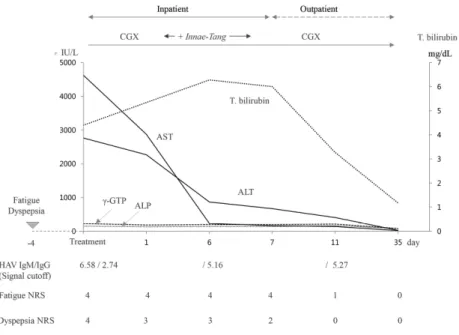
“Accumulation of damp heat(濕熱蘊結)”. The initial serum liver enzymes were more than 100 times higher than the normal range (AST 4,621 IU/L and ALT 2,763 IU/L). Total bilirubin (4.4 mg/dL), γ -GTP (227 IU/L), ALP (151 IU/L) and monocytes portion in CBC (21.0%) were also notably elevated.
Anti-HAV IgM was elevated to 6.58 signal cutoff (S/Co), and other hepatitis virus tests were negative.
There was no significant abnormal shadow on Abdomen X-ray. Based on these results, he was diagnosed as hepatitis A and hospitalized.
2. Treatment and course of symptoms
Based on the diagnosis of hepatitis A, two herbal
drugs CGX and Innae-Tang (Table 1) were given to
the patient, 3 times a day. Acupuncture was
performed twice daily (morning and afternoon)
mainly at LI4 (合谷), LR3 (太衝), PC6 (內關), SP4
(公孫) for 15 minutes at the depth of 10mm. To
provide sufficient volume and nutrition, 1000 ml of
dextrose 5 % mixed with a vitamin complex was
supplied intravenously each day. Improvement of
the symptoms was soon noted: fatigue on Day 4
and dyspepsia on Day 7. On Day 8, AST (163
IU/L), ALT (667 IU/L) was decreased, and the
patient discharged on Sep. 18
th. 2019. The
subsequent blood tests showed the normalization of
items including AST (20 IU/L), ALT (27 IU/L),
and total bilirubin (1.17 mg/dL) on Day 35 (Figure 1).
Discussion and Conclusion
HAV is usually an asymptomatic infection in young children, but its clinical symptoms become more severe in adults.
13)In recent years, hygiene in South Korea has dramatically improved, and seroprevalence of HAV has changed.
14)In the young adult group, HAV seropositivity was over 80
% during the 1970s, but decreased to below 20 % in 2006.
15)Accordingly, the high susceptibility to HAV in young adults increases the incidence rate of hepatitis A with a poor prognosis. Pandemics occurred in 2009 and 2019.
16,17)In 2009, 15,231 people were diagnosed with hepatitis A in 2009; in 2019, this number reached 17,636.
18,1)The case reported in this study showed a severe liver injury, which required attention for the risk of a poor prognosis. In clinics, many doctors could misdiagnose hepatitis as a cold and usually
Fig. 1. Summary for changes of laboratory results and treatment courses.
Abbreviation; NRS, numeric rating scale.
The upper limits are follow; 40 IU/L for AST and ALT, 64 IU/L for γ-GTP, 120 IU/L for ALP, 1.2 mg/dL for Total bilirubin.
Table 1. Prescription and Compositional Volume of Drugs Prescription Compositional Volume of Drugs(gram) Chunggan-plus
(淸肝plus)
Artemisia capillaris Herba (5), Trionycis Carapax (5),Raphani Semen(5), Atractylodis Rhizoma Alba (3), Hoelen (3), Alismatis Rhizoma (3), Atractylodis rhizoma (3), Salvia miltiorrhizae Raidx (3), Polyporus (2), Amomi Fructus (2), Ponciri Fructus (2), Glycyrrhizae Radix (1), Auklandiae Radix (1)
Innae-Tang
(茵萊湯) Artemisia capillaris Herba(50), Raphani Semen(20), Glycyrrhizae Radix(10)