INTRODUCTION
Malignant melanoma (MM), the most aggressive cat- egory of skin cancers has been proved to be associated with both endogenous factors, such as family history
and exogenous factors such as excessive sun exposure [1]. The mechanisms for the development of MM have been proved to be correlated with the dysfunctions of many signaling pathways, such as RAS-RAF-mitogen- activated protein kinase and extracellular signal-reg-
Received: Apr 28, 2020 Revised: Jun 29, 2020 Accepted: Aug 2, 2020 Published online Aug 28, 2020 Correspondence to: Xiaoqiang Liu https://orcid.org/0000-0003-0809-1966
Department of Urology, Tianjin Medical University General Hospital, 154 Anshan Road, Heping District, Tianjin 300052, China.
Tel: +86-17731859376, Fax: +86-022-7303550, E-mail: [email protected] Copyright © 2021 Korean Society for Sexual Medicine and Andrology
Phosphodiesterase Type 5 Inhibitors and Risk of Skin Cancers in Men: A Meta-Analysis and Trial Sequential Analysis Involving 7,479,852 Subjects
Yi Patrick. Lu1 , Shujun Fan2 , Zhen Liang1 , Yuxuan Song1 , Kang Liu1 , Kechong Zhou1 , Xiao Wang1 , Jiaqi Kang1 , Yongjiao Yang3 , Xiaoqiang Liu1
1Department of Urology, Tianjin Medical University General Hospital, Tianjin, 27th Department, Plastic Surgery Hospital, Chinese Academy of Medical Sciences and Peking Union Medical College, Beijing, 3Department of Urology, The Second Hospital of Tianjin Medical University, Tianjin, China
Purpose:
Purpose: We conducted a systematic review and meta-analysis to quantify the association between phosphodiesterase type 5 inhibitors (PDE5Is) use and skin cancers and we also examined whether down-expression of the PDE5A gene was related to worse prognosis for malignant melanoma (MM) patients.
Materials and Methods:
Materials and Methods: The PubMed, Cochrane Library, Web of Science, EMBASE, and ClinicalTrails.gov databases were searched. Odds ratios (ORs) and 95% confidence intervals (CIs) were calculated to evaluate the association between PDE5Is use and risk of skin cancers. Cumulative meta-analysis and trial sequential analysis (TSA) were also conducted. Survival out- comes were analyzed online.
Results:
Results: After pooling all 8 eligible studies comprising 7,479,852 subjects, we found that PDE5Is use was significantly associ- ated with slightly increased risk of developing MM (OR: 1.13, 95% CI: 1.05 to 1.21, I2=67.1%), basal cell carcinoma (OR:
1.16, 95% CI: 1.13 to 1.19, I2=49.6%), and squamous cell carcinoma (OR: 1.07, 95% CI: 1.01 to 1.13, I2=0.0%). Totally, PDE5Is increased the risk of developing skin cancers (OR: 1.13, 95% CI: 1.09 to 1.17, I2=70.8%). TSA results showed that the sample size was enough to reach a positive conclusion.
Conclusions:
Conclusions: The use of PDE5Is may be slightly associated with increased risk of developing skin cancers. There should be a balance between drug benefits and potential safety issues. However, the pooled results should be considered tentative until confounding factors such as sun exposure and lifestyle are well-controlled in further studies.
Keywords:
Keywords: Erectile dysfunction; Melanoma; Meta-analysis; Phosphodiesterase type 5 inhibitors; Skin neoplasms
This is an Open Access article distributed under the terms of the Creative Commons Attribution Non-Commercial License (http://creativecommons.org/licenses/by-nc/4.0) which permits unrestricted non-commercial use, distribution, and reproduction in any medium, provided the original work is properly cited.
pISSN: 2287-4208 / eISSN: 2287-4690 World J Mens Health 2021 Oct 39(4): 683-696 https://doi.org/10.5534/wjmh.200082
Health promotion, disease prevention, and lifestyle
ulated kinase (RAS-RAF-MEK-ERK) [1,2]. The associa- tion between 3’, 5’-cyclic nucleotide phosphodiesterase type 5 (PDE5) and MM was firstly introduced in 1993 by Drees et al [3] through the isolation of a cyclic gua- nosine monophosphate (cGMP)-specific PDE isoenzyme in B16 mouse MM cells and the relationship has been proved by subsequent studies [4]. Notably, publications have shown that more women get MM while more men die from MM and it was hypothesized that the sex differences in incidence and mortality of MM was ascribed to the late presentation of MM, which might be related to the tumor biology [5,6]. Thus, it is impor- tant to clarify more controllable risk factors of MM, especially in men.
Erectile dysfunction (ED), which causes great damage to both physiological and psychological health is one of the most common male sexual dysfunction and is estimated to affect about 0.3 billion men worldwide by 2025 [7-9]. Phosphodiesterase type 5 inhibitors (PDE5Is), including sildenafil, tadalafil, vardenafil, and avanafil, is the first-line therapy for ED approved by the United States Food and Drug Administration [10]. PDE5Is can inhibit cGMP-specific PDE5A in the vascular smooth muscle cell and result in the relaxation of vascular smooth muscle, increasing the blood flow, and maintain or enhance the erection status [11]. Interestingly, some studies showed that activation of the cGMP pathway may promote the growth and migration of MM. How- ever, the mechanism remains unknown [12,13].
Some laboratory studies in in vitro cells have dem- onstrated that PDE5Is were associated with enhanced ability of proliferation and survival of melanocytes [12,14]. The first observational study to explore the as- sociation between PDE5Is use and the risk of MM in human was conducted by Li et al [15] in 2014 and they found that PDE5Is were significantly associated with a higher risk of MM compared with non-use. Unfor- tunately, their study included only 142 patients. After their research, there were only 5 other published ob- servational studies between 2014–2017 [16-20]. In 2018 and 2019, two studies including 5,945,237 subjects were conducted to examine the associations between PDE5Is use and the risk of skin cancers in the USA [21,22]. For the inconsistencies existed among these studies, it is impossible to identify the relationship between PDE5Is and the risk for the development of skin cancers. Ad- ditionally, great demands for PDE5Is to treat ED will definitely increase the number of users. Therefore, un-
derstanding the possible associations between PDE5Is and risk of MM is essential to public health.
Overall, we performed a meta-analysis to quantita- tively evaluate the possible association between the use of PDE5Is and the risk of developing skin cancers with the aim of providing a comprehensive summary based on the available evidence. We also conducted cu- mulative meta-analysis to evaluate the stability of the results and trial sequential analysis (TSA) to promote scientific preciseness. Furthermore, we also sought to determine whether down-expression of the PDE5A gene was related to worse prognosis for MM patients through survival analysis.
MATERIALS AND METHODS
1. Data sources and search strategy
Before the literature search, a detailed inclusion cri- terion was made following the established reporting guidelines [23,24]. We independently and systemati- cally searched the PubMed, Cochrane Library, Web of Science, EMBASE, and ClinicalTrails.gov in April 2020, and assessed the association between exposure to PDE5Is and risk for development of skin cancer. To en- sure reliability, the search process was performed by 3 authors using the following search terms: (sildenafil or vardenafil or avanafil or tadalafil or phosphodiesterase type 5 or phosphodiesterase-5 or PDE5 or “Phosphodies- terase 5 Inhibitors”[Mesh]) and (melanoma or basal cell carcinoma or squamous cell carcinoma or skin cancer or “Melanoma”[Mesh]). The agreement in the search process was reached through discussion.
2. Inclusion and exclusion criteria
Studies were considered to be eligible if they met the following criteria: (1) Population: male population.
(2) Interventions: PDE5Is use or individuals diagnosed with skin cancers. (3) Comparators: non-PDE5Is use or placebo use, or individuals without diagnosis of skin cancers. (4) Outcomes: the risk of skin cancers develop- ment. The primary outcome of interest was risk for de- veloping MM, and secondary outcomes were basal cell carcinoma (BCC) and squamous cell carcinoma (SCC).
(5) Study design: randomized controlled trials (RCTs) or observational studies. (6) Follow-up for at least one year (not applicable to case-control studies) and studies with enough reported information relevant to cancer incidence. Notably, no restriction was made on the in-
dications of PDE5Is and whether cancers were treated or not was not of interest. Studies failing to conform to the inclusion criteria above were excluded.
3. Data collection
The 3 authors independently read and screened the retrieved titles and abstracts. The details retrieved from each study included the first author, publication year, study design, study year, country, patient demo- graphics, drug use, selection criteria, the definition of exposure and control, adjusted covariates, and out- comes. Hazard ratio (HR) with 95% confidence interval (CI), odds ratio (OR) with 95% CI, and relative ratio (RR) with 95% CI were extracted if appropriate. Any miss- ing or unclear information was obtained by contacting the article authors. Information was defined as not re- ported if the authors did not reply.
4. Risk of bias assessment
Each of the 3 authors assessed the risk of bias (RoB) of each included study independently. Any disagree- ments were resolved by consensus and communication among the 3 and with article authors. RoB of observa- tional studies was assessed by using a modified New- castle–Ottawa scale (NOS) [25]. The scores of studies were graded from 0 to 9 according to the NOS scale for
observational studies.
5. Statistical analysis
ORs with 95% CIs were pooled to reveal the associa- tions between PDE5Is using and the risk of developing skin cancers. The reported effect measurements were different between cohort studies (HR or RR) and case- control studies (OR), but when the event incidence was low these relative measures were close [26]. Moreover, subgroup analyses by cancer type, PDE5Is doses, type of PDE5Is, study region, study design, NOS score, publi- cation year, and MM stages were also performed. Given the various definitions of different doses in each study, thus they were only shown in Supplement Table 1 (no available data on the cut-off value of each PDE5I).
According to the DerSimonian and Laird method [27], random-effect models were used when we found sig- nificant heterogeneity (p<0.05 in Cochrane Q-test) and I2>50%. Otherwise, fixed-effect models were used for calculations. We conducted Begg’s test and created fun- nel plots to assess the publication bias and small-study effects. Sensitivity analyses were performed by exclud- ing a study at one time to evaluate the robustness of the findings. TSA was conducted to reduce the risk of type I error by keeping the overall 5% risk of a type I error and 20% risk of a type II error (power of 80%) to
IncludedEligibilityScreeningIdentification
Records identified through database searching (n=209)
PubMed (n=77), Cochrane Library (n=15), Web of Science (n=107), EMBASE (n=65),
and ClinicalTrails.gov (n=5)
Additional records identified through other sources (n=19)
Irrelevant records excluded (n=164) Not on the topic (n=85), reviews, case report, or editorials (79) Records after duplicates removed
(n=185)
Records screened (n=185)
Full-text articles assessed for eligibility (reviewed with application of inclusion and
exclusion criteria) (n=21)
Full-text articles excluded (n=13) Not in English (5), study sample
less than 50 patients (6), no information about outcomes (2)
Studies included in qualitative synthesis and quantitative synthesis (meta-analysis)
(n=8) Fig. 1. PRISMA flow chart of the the data
search.
evaluate the acquired information size (AIS). Kaplan–
Meier analysis was conducted to evaluate the relation between PDE5A gene expression and prognosis in MM patients. For this analysis, MM patients were divided equally into lower 50% and upper 50% concerning their PDE5A gene expression. Overall survival were ana- lyzed by OncoLnc (http://www.oncolnc.org/) and Gene Expression Profiling Interactive Analysis (GEPIA, http://gepia.cancer-pku.cn/). Disease-free survival was analyzed only by GEPIA. Statistical analyses were per- formed by using STATA 12.0 (Stata-Corp., College Sta- tion, TX, USA). The significance level was set as a two- tailed p<0.05 in all data analyses.
RESULTS
1. Literature search
By searching the electronic databases with the search strategy mentioned above and reviewing the reference lists of the retrieved studies, we identified 185 records after removing 103 duplicated records.
Another 164 records were excluded because they were case reports, reviews, editorials, or not relevant topics.
In the remaining 21 records, 13 of the records were ex- cluded because they were small in study samples, not published in English, or did not have sufficient infor- mation for outcome measurements. After screening for the form of data reporting, 8 observational studies [15- 22] (7,479,852 patients) were pooled in the final meta- analysis (Fig. 1).
2. Characteristics of included studies
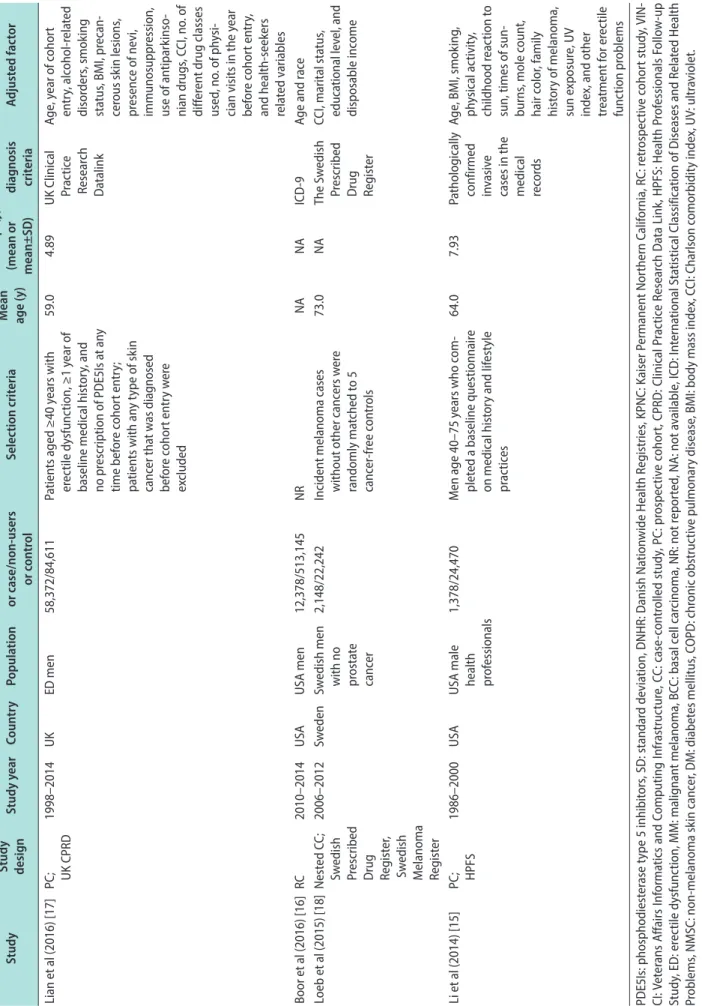
The main features of the 8 studies are presented in Table 1. Six cohort studies [15-17,19,21,22] and 2 case- control studies [18,20] involving 7,479,852 patients were included in the meta-analysis. Two studies might have overlapping subjects because they were conducted by using the same database [17,19]. Both studies were in- cluded in the meta-analysis because they had different study design and inclusion criteria. The publication dates ranged from 2014 to 2019, with 6 studies being published before 2017 and the others being published after 2017. These studies were conducted across 4 coun- tries: USA, Denmark, Sweden, and the UK. For cancer type, 7 studies examined MM, 6 studies reported BCC, and 3 studies reported SCC. Stages of MM were divided into in situ, localized (N0 and M0), and non-localized (N1 or M1). Among the 8 studies, only 5 of them mentioned
comorbidities [17-20,22], 2 reported associated cancers [18,20], and 6 referred to confounding factors [15,17-21].
Although some of the studies adjusted the duration of PDE5Is use in multivariable analysis, unlike doses of PDE5Is, none of them showed available information on this that could be stratified. All the studies had NOS grades ≥6, which showed that all the studies were de- signed with high methodological quality (Supplement Table 2).
3. The associations between
phosphodiesterase type 5 inhibitors use and risk for development of skin cancers
The pooled analysis results demonstrated that PDE5Is were associated with increased risk of de- veloping MM (adjusted OR: 1.13, 95% CI: 1.05 to 1.21, I2=67.1%), BCC (adjusted OR: 1.16, 95% CI: 1.13 to 1.19, I2=49.6%), and SCC (adjusted OR: 1.07, 95% CI: 1.01 to 1.13, I2=0.0%). Totally, we found that PDE5Is use was related to an elevated risk of developing skin cancers (adjusted OR: 1.13, 95% CI: 1.09 to 1.17, I2=70.8%) (Fig. 2).
4. Subgroup analyses
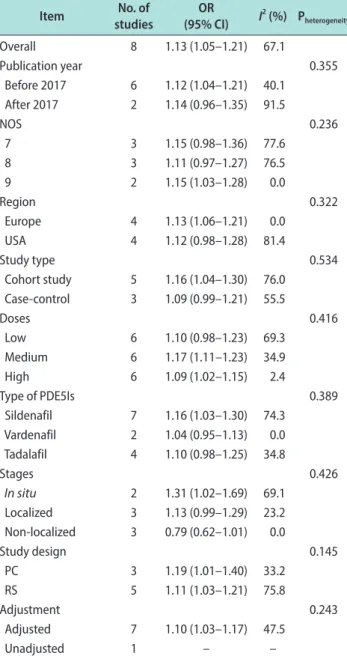
Furthermore, we performed meta-regression and subgroup analyses to identify the source of hetero- geneity (Table 2, Supplement Fig. 1-7). The subgroup analysis by doses indicated medium doses and high doses use were linked with higher risk of MM develop- ment (adjusted OR: 1.17, 95% CI: 1.11 to 1.23, I2=34.9%;
adjusted OR: 1.09, 95% CI: 1.02 to 1.15, I2=2.4%, re- spectively). Subgroup by PDE5Is type showed only sildenafil was associated with increased risk of MM (adjusted OR: 1.16, 95% CI: 1.03 to 1.30, I2=74.3%). The subgroup analysis stratified by publication year re- vealed an increased risk of MM (adjusted OR: 1.12, 95%
CI: 1.04 to 1.21, I2=40.1%) in studies published before 2017. The subgroup analysis by NOS grades showed an increased risk of MM (adjusted OR: 1.15, 95% CI:
1.03 to 1.28, I2=0.0%) in studies with a NOS score of 9.
Another subgroup analysis by study region found an increased risk of MM (adjusted OR: 1.13, 95% CI: 1.06 to 1.21, I2=0.0%) in studies conducted in Europe. PDE5Is use was significantly associated with increased risk of MM in cohort studies (adjusted OR: 1.16, 95% CI: 1.04 to 1.30, I2=76.0%). Additionally, the subgroup analysis according to stages of MM revealed that PDE5Is use was associated with increased risk for the development of in situ MM (adjusted OR: 1.31, 95% CI: 1.02 to 1.69,
Table 1. Characteristics of included studies StudyStudy designStudy yearCountryPopulationNo. of PDE5Is users or case/non-users or controlSelection criteria Mean age (y) Follow-up (y) (mean or mean±SD)
Skin cancers diagnosis criteriaAdjusted factor Christie et al (2019) [21]RC; VINCI database
1998–2017USAUSA Veterans1,274,274/1,274,274Male veterans with ED, aged 18–99 years, who had received PDE5I prescriptions (sildenafil, vardenafil, tadalafil, and avanafil) and had no preexist- ing diagnosis of MM or BCC and no diagnosis of MM or BCC for at least 1 year prior to inclusion and matched 1:1 by race, age, and geography to unexposed controls
58.958.7±4.2ICD-9 and 10Race, age, and geogra- phy Shkolyar et al (2018) [22]RC; Truven Health Mar- ketScan claims database
2007–2015USAPrivately insured individuals in USA 2,404,839/991,850individuals who were prescribed PDE5Is and individuals who were not prescribed PDE5Is as controls
53.684.25ICD-9Age, gender, obesity, diabetes, smoking, no. of outpatient visits, and geographic location Pottegård et al (2016) (DNHR) [20]CC; DNHR database
2000–2012DenmarkDanish men4,603/72,892Men with histologically verified melanoma (cases) matched on birth year to 10 cancer-free controls NANAThe Danish Cancer Registry
Age, calendar time, use of medications, diagnoses of NMSC, DM, COPD, alcohol- related disease, renal disease, and educa- tion status Pottegård et al (2016) (KPNC) [20]
CC; KPNC electronic health records
2000–2014USANorthern California men 6,033/26,246Men with histologically verified melanoma (cases) matched on birth year to 11 cancer-free controls
NANAKPNC Cancer RegistryAge, calendar time, use of medications, diagnoses of NMSC, DM, COPD, alcohol- related disease, renal disease, and socio- economic status Matthews et al (2016) [19]PC and matched study, UK CPRD database
1999–2014 UKUK men145,104/560,993All adult men initiating a PDE5Is and with no prior cancer diagnosis were identified and matched on age, diabetes status, and general practice to ≤4 unexposed controls 57.0 23.8National Health Service and ICD-10 Age, alcohol use, no. of consultations in the year before index date, BMI category, alcohol use, smoking status
Table 1. Continued StudyStudy designStudy yearCountryPopulationNo. of PDE5Is users or case/non-users or controlSelection criteria Mean age (y) Follow-up (y) (mean or mean±SD)
Skin cancers diagnosis criteriaAdjusted factor Lian et al (2016) [17]PC; UK CPRD1998–2014 UKED men58,372/84,611Patients aged ≥40 years with erectile dysfunction, ≥1 year of baseline medical history, and no prescription of PDE5Is at any time before cohort entry; patients with any type of skin cancer that was diagnosed before cohort entry were excluded
59.0 4.89UK Clinical Practice Research Datalink
Age, year of cohort entry, alcohol-related disorders, smoking status, BMI, precan- cerous skin lesions, presence of nevi, immunosuppression, use of antiparkinso- nian drugs, CCI, no. of different drug classes used, no. of physi- cian visits in the year before cohort entry, and health-seekers related variables Boor et al (2016) [16]RC2010–2014 USAUSA men12,378/513,145NRNANAICD-9Age and race Loeb et al (2015) [18]Nested CC; Swedish Prescribed Drug Register, Swedish Melanoma Register
2006–2012SwedenSwedish men with no prostate cancer 2,148/22,242Incident melanoma cases without other cancers were randomly matched to 5 cancer-free controls 73.0 NAThe Swedish Prescribed Drug Register
CCI, marital status, educational level, and disposable income Li et al (2014) [15]PC; HPFS1986–2000USAUSA male health professionals
1,378/24,470Men age 40–75 years who com- pleted a baseline questionnaire on medical history and lifestyle practices 64.0 7.93Pathologically confirmed invasive cases in the medical records
Age, BMI, smoking, physical activity, childhood reaction to sun, times of sun- burns, mole count, hair color, family history of melanoma, sun exposure, UV index, and other treatment for erectile function problems PDE5Is: phosphodiesterase type 5 inhibitors, SD: standard deviation, DNHR: Danish Nationwide Health Registries, KPNC: Kaiser Permanent Northern California, RC: retrospective cohort study, VIN- CI: Veterans Affairs Informatics and Computing Infrastructure, CC: case-controlled study, PC: prospective cohort, CPRD: Clinical Practice Research Data Link, HPFS: Health Professionals Follow-up Study, ED: erectile dysfunction, MM: malignant melanoma, BCC: basal cell carcinoma, NR: not reported, NA: not available, ICD: International Statistical Classification of Diseases and Related Health Problems, NMSC: non-melanoma skin cancer, DM: diabetes mellitus, COPD: chronic obstructive pulmonary disease, BMI: body mass index, CCI: Charlson comorbidity index, UV: ultraviolet.
I2=69.1%), a trend to increased risk for the develop- ment of localized MM (adjusted OR: 1.13, 95% CI: 0.99 to 1.29, I2=23.2%), and a trend to decreased risk for the development of non-localized MM (adjusted OR: 0.79, 95% CI: 0.62 to 1.01, I2=0.0%). Due to the small number of studies reporting the associations between BCC/SCC development and PDE5Is use, no further analysis was conducted although some of them showed significant heterogeneity.
5. Publication bias
Begg’s funnel plot and Egger’s test were conducted to analyze the publication bias. No significant publication bias was found (MM: Begg’s test, p=0.711; Egger’s test, p=0.543 [Fig. 3]; BCC: Begg’s test, p=0.707; Egger’s test, p=0.371; SCC: Begg’s test, p=0.602; Egger’s test, p=0.826).
6. Cumulative meta-analysis and sensitivity analysis
We deleted each included study in each analysis to
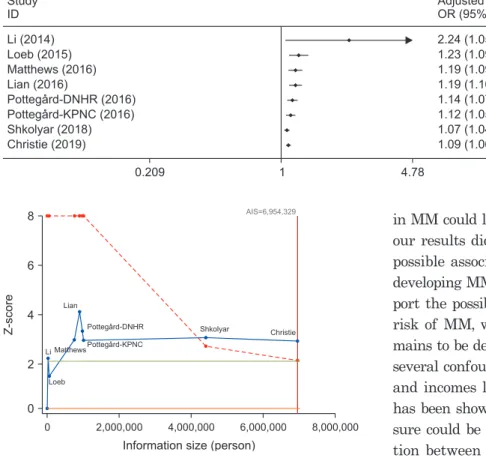
see whether the individual data might influence the pooled results. The results showed that the pooled results were not significantly affected by a single in- dividual, suggesting that the combined results of the meta-analysis were reliable (Fig. 4). The cumulative meta-analysis was performed and was ordered by pub- lication year (Fig. 5). The results showed that PDE5Is use was related to a little increase in the risk of de- veloping MM. Furthermore, we found that the 95% CI narrowed as the pooled results gradually moved near the null.
7. Trial sequential analysis
As is shown in Fig. 6, the sample size of the 7th study investigating the relation between risk of MM and PDE5Is use had crossed the TSA boundary. The positive conclusion could be obtained in advance and the sample size had reached the AIS (6,954,329 indi- viduals) to reach a positive conclusion.
Fig. 2. The association between phosphodiesterase type 5 inhibitors use and risk for development of skin cancers. OR: odds ratio, CI: confidence interval, MM: malignant melanoma, DNHR: Danish Nationwide Health Registries, KPNC: Kaiser Permanente Northern California, BCC: basal cell carcinoma, SCC: squamous cell carcinoma.
Study ID MM Li (2014) Loeb (2015) Matthews (2016) Lian (2016)
Pottegard-DNHR (2016) Pottegard-KPNC (2016) Shkolyar (2018) Christie (2019)
Subtotal ( =67.1%, p=0.003) BCC
Li (2014) Loeb (2015) Matthews (2016) Lian (2016) Shkolyar (2018) Christie (2019)
I
I
I I
2
2
2
2
Subtotal ( =49.6%, p=0.077) SCC
Li (2014) Lian (2016) Shkolyar (2018)
Subtotal ( =0.0%, p=0.544) Overall ( =70.8%, p<0.001)
Note: Weights are from random effects analysis.
Weight (%) Adjusted
OR (95% CI)
0.20 5.06 4.72 2.03 5.72 3.88 10.45 6.42 38.48
2.03 9.86 10.68 7.29 9.34 11.28 50.48
0.38 1.59 9.07 11.04 100.00 2.24 (1.05, 4.78)
1.21 (1.08, 1.36) 1.14 (1.01, 1.29) 1.18 (0.95, 1.47) 1.06 (0.96, 1.18) 1.01 (0.91, 1.21) 1.05 (1.01, 1.09) 1.25 (1.14, 1.37) 1.13 (1.05, 1.21)
1.05 (0.84, 1.30) 1.19 (1.14, 1.25) 1.15 (1.11, 1.19) 1.07 (0.99, 1.16) 1.14 (1.08, 1.20) 1.19 (1.16, 1.22) 1.16 (1.13, 1.19)
0.80 (0.46, 1.37) 1.12 (0.87, 1.44) 1.07 (1.01, 1.13) 1.07 (1.01, 1.13) 1.13 (1.09, 1.17)
0.209 1 4.78
8. Survival outcomes
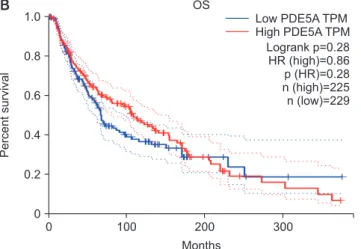
From the two databases, we found that PDE5A gene expression was not associated with poor prognosis in MM patients (p>0.05 for all) (Fig. 7).
DISCUSSION
In the meta-analysis, after pooling results from the 8 observational studies (7,479,852 participants), we found that PDE5Is use was significantly associated with
slightly increased risks of developing MM, SCC, as well as BCC. In the subgroup analyses, we found no evi- dence of associations between PDE5Is doses and the de- velopment of MM. In the meta-regression analysis, no related factors could significantly influence the pooled results. Notably, results showed that only sildenafil could significantly increase the risk of developing MM and the increased risk of developing MM could only be observed in the European populations. In the cumula- tive meta-analysis, results indicated a weak association, and the point estimate gradually moved near the null.
TSA results showed that the evidence was reliable.
Although several studies in cell lines have reported that PDE5Is could promote the growth and migration of MM cells and illustrated the possible mechanisms
1.02 Li (2014) Loeb (2015) Matthews (2016) Lian (2016) Pottegard-DNHR (2016) Pottegard-KPNC (2016) Shkolyar (2018) Christie (2019)
1.27 Meta-analysis estimates, given named study is omitted.
1.24
1.04 1.14
Lower CI limit Estimate Upper CI limit
Fig. 4. Sensitivity analysis based on the association between phos- phodiesterase type 5 inhibitors use and the risk of developing malig- nant melanoma. CI: confidence interval.
0.0 1.0
0.5
0.0
0.5
0.4
Logarithm(hazardratio)
Standard error of logarithm (hazard ratio) 0.2
Begg's funnel plot with pseudo 95% confidence limits
Fig. 3. Funnel plots based on the association between phosphodi- esterase type 5 inhibitors use and the risk of developing malignant melanoma.
Table 2. Subgroup analyses of association between PDE5Is and risk of MM
Item No. of
studies OR
(95% CI) I2 (%) Pheterogeneity
Overall 8 1.13 (1.05–1.21) 67.1
Publication year 0.355
Before 2017 6 1.12 (1.04–1.21) 40.1 After 2017 2 1.14 (0.96–1.35) 91.5
NOS 0.236
7 3 1.15 (0.98–1.36) 77.6
8 3 1.11 (0.97–1.27) 76.5
9 2 1.15 (1.03–1.28) 0.0
Region 0.322
Europe 4 1.13 (1.06–1.21) 0.0
USA 4 1.12 (0.98–1.28) 81.4
Study type 0.534
Cohort study 5 1.16 (1.04–1.30) 76.0 Case-control 3 1.09 (0.99–1.21) 55.5
Doses 0.416
Low 6 1.10 (0.98–1.23) 69.3
Medium 6 1.17 (1.11–1.23) 34.9
High 6 1.09 (1.02–1.15) 2.4
Type of PDE5Is 0.389
Sildenafil 7 1.16 (1.03–1.30) 74.3 Vardenafil 2 1.04 (0.95–1.13) 0.0 Tadalafil 4 1.10 (0.98–1.25) 34.8
Stages 0.426
In situ 2 1.31 (1.02–1.69) 69.1
Localized 3 1.13 (0.99–1.29) 23.2 Non-localized 3 0.79 (0.62–1.01) 0.0
Study design 0.145
PC 3 1.19 (1.01–1.40) 33.2
RS 5 1.11 (1.03–1.21) 75.8
Adjustment 0.243
Adjusted 7 1.10 (1.03–1.17) 47.5
Unadjusted 1 – –
PDE5Is: phosphodiesterase type 5 inhibitors, MM: malignant mela- noma, OR: odds ratio, CI: confidence interval, NOS: Newcastle-Ottawa scale, PC: prospective cohort, RS: retrospective study.
[12,14]. Laboratory studies are expected to find out the effect of PDE5Is use on generating irreversible changes in gene expression [15]. To the best of our knowledge, evidence of the association between PDE5Is use and risk of developing MM is still inconsistent. Differ- ent from a previous study, the meta-analysis results showed no dose-dependent association between PDE5Is use and the risk of developing MM. More observational studies and randomized trials are expected to explore the problem. Additionally, significant associations be- tween increased risk of developing MM and PDE5Is use could only be observed in European populations.
However, there was also an increased risk for the de- velopment of MM in United States populations, but it was not of statistical difference. Factors such as socioeconomic, cultural differences, and different gene expression (race) might explain the different findings between the two populations.
Previous studies showed that low PDE5A expression
in MM could lead to poor survival [13,28]. Even though our results did not support this, it didn’t exclude the possible association between PDE5Is and the risk of developing MM. Although the results in our study sup- port the possible association between PDE5Is use and risk of MM, whether the association is causative re- mains to be determined. The results can be affected by several confounders, such as sun exposure, educational and incomes level, and medical seeking behaviors. It has been shown by Matthews et al [19] that sun expo- sure could be one of the factors influence the associa- tion between PDE5Is use and risk of MM and they found that solar keratosis was significantly related to PDE5Is use, which meant that men with higher sun exposure were more likely to take PDE5Is. Neverthe- less, both the observational studies and meta-analyses were restricted by the lack of enough information on sun exposure in subjects. Furthermore, we also found increases in the risk of developing both BCC and SCC.
Non-MM skin cancers are more related to chronic sun exposure, while MM is more related to intermittent sun exposure. It is unknown whether PDE5Is could increase the risk of BCC or SCC in a molecular or cel- lular level. Additionally, studies by Loeb et al [18] and Christie et al [21] indicated that PDE5Is users usually had higher educational status and annual incomes and the two factors were significantly related to the risk of developing MM. Furthermore, Pottegård et al [20]
showed that PDE5Is users tended to have lower stage or grade of MM than nonusers, suggesting that more medical seeking behaviors might contribute to the slightly increased risk of developing MM by resulting in earlier detection. Finally, patient skin type and life- style might also be the confounding factors of the as- sociation [22]. At present, the causality remains elusive, and no RCTs has evaluated the possible increased risk of MM in PDE5Is users. Further well-designed prospec-
8
6
4
2
8,000,000
Z-score
Information size (person) 0
0 2,000,000 4,000,000 6,000,000
Lian
Pottegard-DNHR Pottegard-KPNC Matthews
Li
Loeb
Shkolyar Christie AIS=6,954,329
Fig. 6. Trial sequential analysis of the association between phospho- diesterase type 5 inhibitors use and the risk of malignant melanoma.
The acquired information size (AIS) was calculated based on a two side α=5%, β=15% (power 80%), and a relative risk reduction of 12%. DNHR: Danish Nationwide Health Registries, KPNC: Kaiser Per- manente Northern California.
Study ID Li (2014) Loeb (2015) Matthews (2016) Lian (2016)
Pottegard-DNHR (2016) Pottegard-KPNC (2016) Shkolyar (2018) Christie (2019)
Adjusted OR (95% CI) 2.24 (1.05, 4.78) 1.23 (1.09, 1.38) 1.19 (1.09, 1.29) 1.19 (1.10, 1.28) 1.14 (1.07, 1.21) 1.12 (1.05, 1.18) 1.07 (1.04, 1.10) 1.09 (1.06, 1.12)
0.209 1 4.78
Fig. 5. Cumulative meta-analysis of the association between phosphodiesterase type 5 inhibitors use and risk for devel- opment of malignant melanoma, based on year of publication. OR: odds ratio, CI:
confidence interval, DNHR: Danish Na- tionwide Health Registries, KPNC: Kaiser Permanente Northern California.
tive studies and randomized trials considering all the possible confounders with sufficient sample size and follow-up time are remained to be done to confirm our findings.
The mechanism of PDE5Is related MM hasn’t been illustrated clearly. The pathogenesis and progression of MM link tightly with the activation the RAS/RAF/
MEK/ERK signaling pathway and the activation of the pathway has been proved to be a result of BRAF somatic mutation, which down-regulates the cGMP- specific PDE5A and lowers the degradation of cGMP, finally contributing to an increase of intracellular Ca2+
[1,2]. It has been proved by several studies that PDE5Is, functioning as the inhibitors of cGMP-specific PDE5A mimics the effects of the RAS/RAF/MEK/ERK path- way and can promote the MM cells growth and migra- tion [13,29]. Notably, previous clinical trials and a meta- analysis showed that MM patients with BRAF somatic mutations were more likely to have poor prognosis than those with no mutations [30-32]. For the reason that patients with BRAF mutations usually have a
higher risk of advanced MM, the association between PDE5Is use and risk of MM may not reach statistical significance in those patients. Recently, the study con- ducted by Jorgenson et al [33] was possibly to promote the elucidation the mechanisms for PDE5Is related MM: single-minded family basic helix-loop-helix tran- scription factor 1 (SIM1) gene could affect sex and body weight through the regulation of melanocortin 4 recep- tor (MC4R) expression, and the alpha melanocortin- stimulating hormone (α-MSH) could bind to MC4R and thereby leads to ED [34]. Moreover, MC1R, the receptor of α-MSH is also associated with the development of MM [35]. All these findings might open up new per- spectives for advancement into mechanisms of PDE5Is related MM.
To rule out the confounding factors, we attempted to conduct subgroup analysis through adjustment for con- founders and study design (Table 2, Supplement Fig.
8-10). For MM, pooled results from all the 3 prospective studies with adjusted outcomes indicated that PDE5Is were related to increased risk of MM development (ad-
0 100
80
60
40
20
12,000
%Surviving
Days 0
Low (n=229) High (n=229)
10,000 8,000
6,000 4,000
2,000 0
1.0
0.8
0.6
0.4
0.2
Percentsurvival
Months 0
Low PDE5A TPM High PDE5A TPM
100 200 300
Logrank p=0.28 HR (high)=0.86 p (HR)=0.28 n (high)=225 n (low)=229
0 1.0
0.8
0.6
0.4
0.2
Percentsurvival
Months 0
Low PDE5A TPM High PDE5A TPM
100 200 300
Logrank p=0.58 HR (high)=0.93 p (HR)=0.58 n (high)=225 n (low)=229
A B
C
OS
DFS
Fig. 7. Overall survival (OS) and disease-free survival (DFS) analysis for different expression levels of phosphodiesterase A (PDE5A) gene.
(A) OS analysis and data were obtained from OncoLnc, (B) OS analysis and data was obtained from GEPIA, (C) DFS analysis and data was obtained from GEPIA. TPM: transcripts per million, HR: hazard ratio.
justed OR: 1.19, 95% CI: 1.01 to 1.40, I2=33.2%) and in the subgroup by adjustment for confounders, PDE5Is use was also associated with elevated risk of MM (adjusted OR: 1.10, 95% CI: 1.03 to 1.17, I2=47.5%). After pooling all the adjusted ORs, we found that PDE5Is use was still significantly associated with increased risks of developing MM (adjusted OR: 1.10, 95% CI: 1.03 to 1.17, I2=47.5%), BCC (adjusted OR: 1.15, 95% CI: 1.11 to 1.18, I2=49.6%) and SCC (adjusted OR: 1.07, 95% CI: 1.01 to 1.13, I2=0.0%). Totally, PDE5Is were related to increased risks of developing skin cancers (adjusted OR: 1.11, 95%
CI: 1.07 to 1.15, I2=58.9%). Although we tried to control the confounders, the limitation on this should be con- sidered carefully and further studies that specified all factors are expected to investigate the issue better.
Some factors, such as comorbidities, associated can- cers, and lifestyle etc. in included studies that may potentially affect the results and induce biases should be pointed out. Some differences existed on the dem- onstration and control of these factors among the 8 studies. As for comorbidities, few of them specified exact diseases, two studies adopted the Charlson co- morbidity index (CCI) to show information on this [17,18], they both reported lower comorbidity scores and lower comorbidity burdens in PDE5Is users and they involved CCIs into adjustment for HRs or ORs, which were used and pooled in the meta-analysis. Matthews et al [19] matched the comorbidities when selecting the population, thus no need to make adjustment on this.
Only the study conducted by Shkolyar et al [22] deter- mined medical comorbidities using International Clas- sification of Diseases and Related Health Problems, 9th revision (ICD-9), while they made adjustments for HRs without the comorbidities. As for associated cancers, only two studies mentioned this and one of them selected cancer-free population, except for skin cancers [20], which therefore effectively avoided bias.
However, analysis from another study conducted by Loeb et al [18] only accounted for potential confounder of prostate cancer because of its association with both exposure and outcome. Most of the included studies reported confounding factors, including age, year of cohort entry, alcohol-related disorders, smoking status, body mass index, CCI, and already known risky factors of skin cancers and some of them tried to control these factors through adjustment in the multivariable analy- sis. Although sufficient efforts were done to adjust for variables, the same limitation they shared on this is
that no enough information on the past events, such as leisure exposure to sunburn and health seeking behaviors. However, based on the nature of observa- tional studies, we supposed that the 8 included studies had already included key potential variables and the results from the meta-analysis should be interpreted with caution until proved by further RCTs with long term follow-up.
The findings from the study may have some im- plications for basic and clinical researches. Firstly, we aimed to summarize current evidence and make quantitative analysis about the relationship between PDE5Is use and skin cancers, while whether PDE5Is use is associated with elevated risks of skin cancers and whether the association is causative are warranted to be validated in the future. Future clinical studies should focus on residual confounders from environ- mental exposure, such as sun exposure and differences in geography. Secondly, for the already established pathway mentioned above, theoretically rational as- sociation might exist between PDE5Is use and elevated risk of MM, whether the association remains true in BCC and SCC is still lacking of experimental evidence.
Thirdly, PDE5Is should not be abandoned to use in clinical practice. Similar to a previous study that indi- cated the association between angiotensin converting enzyme inhibitors and increased risk of lung cancer [36], we emphasized the value of “big data” approach to as- sessing the topic. Furthermore, no available RCTs were conducted in the field, thus our results have no chal- lenges to RCTs and should not change the guidelines in prescribing PDE5Is. The findings that PDE5Is were associated with a 13% relatively elevated skin cancers incidence (95% CI: 9.0% to 17.0%) might not contribute to a large absolute risk, we supposed these findings are important because of the tremendous use of PDE5Is use in the world, not only in ED population but also in patients with pulmonary hypertension or lower urinary tract symptoms. Notably, in each individual, concerns about the long-term risk of skin cancers should be balanced with the gains in life quality and life expectancy that brought by PDE5Is. Further well- designed studies with enough follow-up are needed to enhance the evidence level of the long-term safety of these drugs.
Our study has several strengths. Firstly, to the best of our knowledge, this is the most comprehensive and the newest meta-analysis (included all available litera-
ture to date) to clarify the association between PDE5Is use and the risk of skin cancers. Secondly, detailed subgroup analysis and cumulative meta-analysis were conducted to examine the reliability of the results.
Thirdly, evidence from high-quality observational stud- ies was included in the study with large total sample size and we have conducted TSA to reduce the risk of type I error to increase preciseness.
Finally, some limitations of this meta-analysis and included studies should be addressed. Firstly, although we searched several databases, no available RCTs were identified. Some biases are inevitable for the nature of observational studies. Secondly, because of the dif- ferent geographic features and doses inconsistency, it is impossible to conduct subgroup analysis by this and is difficult to eliminate the heterogeneity across studies in the meta-analysis. Thirdly, confounding ef- fects of sun exposure, incomes and educational levels, skin type, gene expression, and family history were not determined and the adjustment among studies for demography features was inconsistent. Additionally, although some of the studies adjusted for smoking status, detailed information on the duration and inten- sity of smoking lacked, which might be closely related to the cancer incidence. Three eligible methods could be applied to minimize the errors: (a) Setting a rigid and unified methodology in this kind of study, such as the approaches adopted in the previous study [36]. (b) Selecting literature that involved the same or similar confounders in one meta-analysis at a time. (c) Pooling adjusted results only. Although with the above limita- tions, the publication bias and sensitivity analysis indi- cated the reliability of the results.
CONCLUSIONS
In the meta-analysis, we found that the use of PDE5Is may be slightly associated with increased risk of developing MM, SCC, and BCC, whether the associa- tion is causative remains to be determined. Given the limitations of the study and practical factors in select- ing appropriate therapies, the pooled findings should not affect the gold standard oral treatment for ED.
Further large, well-designed prospective studies with clear definitions of duration and doses and enough consideration for potential confounders to explore PDE5Is use and its association with skin cancers are warranted.
ACKNOWLEDGEMENTS
This work was supported by the Zhao Yi-Cheng Medical Science Foundation, China (grant no. ZYY- FY2018031).
Conflict of Interest
The authors have nothing to disclose.
Author Contribution
Conceptualization: YPL, SF. Data curation: YS, YPL, ZL, JK, XW. Formal analysis: ZL, YS, KZ, KL, YY. Project administra- tion: XL. Resources: KL, KZ. Software: ZL, YS. Supervision: XL.
Validation: XW, YY, XL. Visualization: SF. Writing – original draft: YPL. Writing – review & editing: all authors.
Supplementary Materials
Supplementary materials can be found via https://doi.
org/10.5534/wjmh.200082.
REFERENCES
1. Gray-Schopfer V, Wellbrock C, Marais R. Melanoma biology and new targeted therapy. Nature 2007;445:851-7.
2. Thompson JF, Scolyer RA, Kefford RF. Cutaneous melanoma in the era of molecular profiling. Lancet 2009;374:362-5.
3. Drees M, Zimmermann R, Eisenbrand G. 3’,5’-Cyclic nucleo- tide phosphodiesterase in tumor cells as potential target for tumor growth inhibition. Cancer Res 1993;53:3058-61.
4. Murata T, Shimizu K, Watanabe Y, Morita H, Sekida M, Taga- wa T. Expression and role of phosphodiesterase 5 in human malignant melanoma cell line. Anticancer Res 2010;30:355-8.
5. Enninga EAL, Moser JC, Weaver AL, Markovic SN, Brewer JD, Leontovich AA, et al. Survival of cutaneous melanoma based on sex, age, and stage in the United States, 1992-2011.
Cancer Med 2017;6:2203-12.
6. Siegel RL, Miller KD, Jemal A. Cancer statistics, 2020. CA Cancer J Clin 2020;70:7-30.
7. Yang Y, Song Y, Lu Y, Xu Y, Liu L, Liu X. Associations between erectile dysfunction and psychological disorders (depression and anxiety): a cross-sectional study in a Chinese population.
Andrologia 2019;51:e13395.
8. Yang Y, Lu Y, Song Y, Chen H, Liu X. Correlations and strati- fication analysis between premature ejaculation and psycho- logical disorders. Andrologia 2019;51:e13315.
9. Shamloul R, Ghanem H. Erectile dysfunction. Lancet 2013;381:153-65.
10. Palit V, Eardley I. An update on new oral PDE5 inhibi- tors for the treatment of erectile dysfunction. Nat Rev Urol 2010;7:603-9.
11. Wright PJ. Comparison of phosphodiesterase type 5 (PDE5) inhibitors. Int J Clin Pract 2006;60:967-75.
12. Dhayade S, Kaesler S, Sinnberg T, Dobrowinski H, Pe- ters S, Naumann U, et al. Sildenafil potentiates a cGMP- dependent pathway to promote melanoma growth. Cell Rep 2016;14:2599-610.
13. Arozarena I, Sanchez-Laorden B, Packer L, Hidalgo-Carcedo C, Hayward R, Viros A, et al. Oncogenic BRAF induces mela- noma cell invasion by downregulating the cGMP-specific phosphodiesterase PDE5A. Cancer Cell 2011;19:45-57.
14. Dhayade S, Kaesler S, Sinnberg T, Thunemann M, Feil S, Naumann U, et al. CNP-derived cGMP and Sildenafil pro- mote melanoma growth in vitro and in vivo in mice. Paper presented at: 81th Annual Congress of the German Society for Experimental and Clinical Pharmacology and Toxicology (DGPT); 2015 Mar 10-12; Kiel, Germany. p.S13.
15. Li WQ, Qureshi AA, Robinson KC, Han J. Sildenafil use and increased risk of incident melanoma in US men: a prospective cohort study. JAMA Intern Med 2014;174:964-70.
16. Boor P, Nardone B, Polisetty S, Huynh T, West D, Martini M.
Melanoma in men treated with PDE5A inhibitors: a report from the RADAR (Research on Adverse Drug Events And Reports) project. J Am Acad Dermatol 2016;74:AB190.
17. Lian Y, Yin H, Pollak MN, Carrier S, Platt RW, Suissa S, et al.
Phosphodiesterase type 5 inhibitors and the risk of melanoma skin cancer. Eur Urol 2016;70:808-15.
18. Loeb S, Folkvaljon Y, Lambe M, Robinson D, Garmo H, In- gvar C, et al. Use of phosphodiesterase type 5 inhibitors for erectile dysfunction and risk of malignant melanoma. JAMA 2015;313:2449-55.
19. Matthews A, Langan SM, Douglas IJ, Smeeth L, Bhaskaran K. Phosphodiesterase type 5 inhibitors and risk of malignant melanoma: matched cohort study using primary care data from the UK clinical practice research datalink. PLoS Med 2016;13:e1002037.
20. Pottegård A, Schmidt SA, Olesen AB, Achacoso N, Van Den Eeden SK, Hallas J, et al. Use of sildenafil or other phos- phodiesterase inhibitors and risk of melanoma. Br J Cancer 2016;115:895-900.
21. Christie A, Vera PL, Higgins M, Kumar S, Lane M, Preston D.
Erectile dysfunction medications and skin cancer: an analysis in US veterans. Urology 2019;126:116-20.
22. Shkolyar E, Li S, Tang J, Eisenberg ML. Risk of melanoma
with phosphodiesterase type 5 inhibitor use among patients with erectile dysfunction, pulmonary hypertension, and lower urinary tract symptoms. J Sex Med 2018;15:982-9.
23. Stroup DF, Berlin JA, Morton SC, Olkin I, Williamson GD, Rennie D, et al. Meta-analysis of observational studies in epidemiology: a proposal for reporting. Meta-analysis Of Ob- servational Studies in Epidemiology (MOOSE) group. JAMA 2000;283:2008-12.
24. Knobloch K, Yoon U, Vogt PM. Preferred reporting items for systematic reviews and meta-analyses (PRISMA) statement and publication bias. J Craniomaxillofac Surg 2011;39:91-2.
25. Stang A. Critical evaluation of the Newcastle-Ottawa scale for the assessment of the quality of nonrandomized studies in meta-analyses. Eur J Epidemiol 2010;25:603-5.
26. Li L, Li S, Deng K, Liu J, Vandvik PO, Zhao P, et al. Dipepti- dyl peptidase-4 inhibitors and risk of heart failure in type 2 diabetes: systematic review and meta-analysis of randomised and observational studies. BMJ 2016;352:i610.
27. DerSimonian R, Kacker R. Random-effects model for meta- analysis of clinical trials: an update. Contemp Clin Trials 2007;28:105-14.
28. Dhayade S, Feil S, Griessinger C, Kneilling M, Schittek B, Feil R. A cGMP/cGKI signaling pathway in melanoma cells. Paper presented at: 78th Annual Congress of the German Society for Experimental and Clinical Pharmacology and Toxicology (DGPT); 2012 Mar 19-22; Dresden, Germany. p.S21.
29. Mitra D, Robinson KC, Fisher DE. Melanoma and viagra:
an unexpected connection. Pigment Cell Melanoma Res 2011;24:16-8.
30. Santiago-Walker A, Gagnon R, Mazumdar J, Casey M, Long GV, Schadendorf D, et al. Correlation of BRAF mutation sta- tus in circulating-free DNA and tumor and association with clinical outcome across four BRAFi and MEKi clinical trials.
Clin Cancer Res 2016;22:567-74.
31. Siroy AE, Aung PP, Torres-Cabala CA, Tetzlaff MT, Nagara- jan P, Milton DR, et al. Clinical significance of BRAF V600E mutational status in capsular nevi of sentinel lymph nodes in patients with primary cutaneous melanoma. Hum Pathol 2017;59:48-54.
32. Kim SY, Kim SN, Hahn HJ, Lee YW, Choe YB, Ahn KJ.
Metaanalysis of BRAF mutations and clinicopathologic characteristics in primary melanoma. J Am Acad Dermatol 2015;72:1036-46.e2.
33. Jorgenson E, Matharu N, Palmer MR, Yin J, Shan J, Hoff- mann TJ, et al. Genetic variation in the SIM1 locus is as- sociated with erectile dysfunction. Proc Natl Acad Sci U S A 2018;115:11018-23.
34. Van der Ploeg LH, Martin WJ, Howard AD, Nargund RP, Aus-
tin CP, Guan X, et al. A role for the melanocortin 4 receptor in sexual function. Proc Natl Acad Sci U S A 2002;99:11381- 6.
35. Le Pape E, Passeron T, Giubellino A, Valencia JC, Wolber R, Hearing VJ. Microarray analysis sheds light on the dediffer-
entiating role of agouti signal protein in murine melanocytes via the Mc1r. Proc Natl Acad Sci U S A 2009;106:1802-7.
36. Hicks BM, Filion KB, Yin H, Sakr L, Udell JA, Azoulay L.
Angiotensin converting enzyme inhibitors and risk of lung cancer: population based cohort study. BMJ 2018;363:k4209.