서 론
비알코올성 지방간질환(
nonalcoholic fatty liver disease
,NAFLD
)은 알코올 남용력이 없으나 알코올성 지방간질환과 유사한 간 조직형태를 보이는 질환으로 단순 지방간에서 지방간염, 간 경변증까지 진 행할 수 있다.1,2) 비알코올성 지방간질환의 발병기전에는 지방 조직 에 의한 인슐린 저항성이 중요한 역할을 하며3) 비만, 제
2
형 당뇨, 고 지혈증, 대사증후군 등과 밀접한 연관성을 보이고 있다.4,5) 이들 비Received August 14, 2020 Accepted January 13, 2021 Corresponding author Jung-Eun Oh
Tel: +82-41-570-2238, Fax: +82-41-592-3810 E-mail: [email protected]
ORCID: https://orcid.org/0000-0001-9117-0571
Copyright © 2021 The Korean Academy of Family Medicine
This is an open-access article distributed under the terms of the Creative Commons At- tribution Non-Commercial License (http://creativecommons.org/licenses/by-nc/4.0) which permits unrestricted noncommercial use, distribution, and reproduction in any medium, provided the original work is properly cited.
Original Article
https://doi.org/10.21215/kjfp.2021.11.1.39 eISSN 2233-9116
Korean J Fam Pract. 2021;11(1):39-45
Korean Journal of Family Practice
KJFP
건강한 성인에서 비알코올성 지방간질환과 고감도 C-반응성 단백질의 관련성
최윤형
1, 오정은
1,*, 이 진
1, 신황식
1, 조용진
1, 김선희
2, 조 현
2, 유병욱
2, 홍성호
2, 조주연
2, 손두용
3, 신경숙
31순천향대학교 부속 천안병원 가정의학과, 2순천향대학교 부속 서울병원 가정의학과, 3순천향대학교 부속 구미병원 가정의학과
Relationship between Nonalcoholic Fatty Liver Disease and High Sensitivity C-Reactive Protein in Healthy Adults
Yunhyoung Choi1, Jung-Eun Oh1,*, Jin Lee1, Hwang-Sik Shin1, Yong-Jin Cho1, Sun-Hee Kim2, Hyun Joe2, Byung-Wook Yoo2, Sung-Ho Hong2, Choo-Yon Cho2, Doo-Yong Son3, Kyung-Suk Shin3
1Department of Family Medicine, Soonchunhyang University Cheonan Hospital, Soonchunhyang University College of Medicine, Cheonan; 2Department of Family Medicine, Soonchunhyang University Seoul Hospital, Soonchunhyang University College of Medicine, Seoul; 3Department of Family Medicine, Soonchunhyang University Gumi Hospital, Soonchunhyang University College of Medicine, Gumi, Korea
Background: Recent studies have shown that nonalcoholic fatty liver disease (NAFLD) is associated with higher levels of high sensitivity C-reactive protein (hs-CRP), a predictor of increased risk of developing cardiovascular disease. The aim of this study was to investigate the relationship between NAFLD and hs-CRP in healthy adults.
Methods: Among 13,709 participants aged 20 years and over who underwent a health check-up between March 2016 and February 2017 at a health promotion center, we studied 849 participants without underlying medical conditions, excessive alcohol consumption, or serum hs-CRP level >5.
The subjects were divided into three groups according to the tertiles of serum hs-CRP levels.
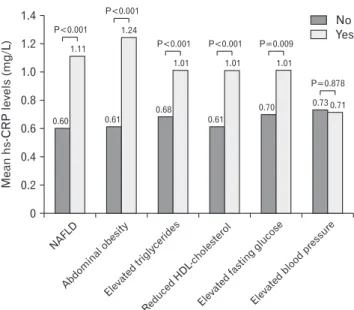
Results: Compared with control group, the mean level of serum hs-CRP was higher in the NAFLD group (0.60 and 1.11 mg/L, respectively, P-value
<0.001). The proportion of participants with NAFLD in the first, second, and third tertiles was 5.8%, 22.7%, and 42.9%, respectively (P-value<0.001).
When compared with the lowest tertile group, the adjusted odds ratios for NAFLD in the middle and highest tertile groups were 2.557 (95%
confidence interval [CI], 1.317–4.965) and 2.771 (95% CI, 1.420–5.408), respectively.
Conclusion: We found that NAFLD was significantly related to serum hs-CRP in healthy adults. This result was still significant after adjusting for age, sex, body mass index, waist circumference, fasting blood glucose, systolic and diastolic blood pressures, and triglyceride and high-density lipoprotein cholesterol levels.
Keywords: Nonalcoholic Fatty Liver Disease; High Sensitivity C-Reactive Protein; Cardiovascular Disease; Risk Factors
Yunhyoung Choi, et al. Relationship between NAFLD and hs-CRP in Healthy Adults
Korean Journal of Family Practice
KJFP
만, 제
2
형 당뇨, 고지혈증, 대사증후군은 잘 알려진 심혈관 질환의 위험요인들인데,6,7) 최근 연구들에서는 비알코올성 지방간질환도 심 혈관 질환의 독립적인 위험인자임을 보여주고 있다.8-10)심혈관 질환의 발생을 예측하는 방법들 중 하나로는 고감도
C-
반 응성 단백질(high sensitivity C-reactive protein
,hs-CRP
)이 있는데, 이 는 급성기 반응 물질 중 하나로 미국 질병통제 예방센터/미국 심장 협회(The Centers for Disease Control and Prevention
/American Heart Association
)는 심혈관 질환 과거력이 없는 성인에서 심혈관 질환 위 험도 평가 시hs-CRP
측정이 도움이 될 수 있다고 언급하였다.11) 심 혈관 질환 과거력이 없는 연구 대상자들에서 비알코올성 지방간질환과
hs-CRP
가 유의한 관련성이 있음을 보여주는 여러 연구들이 있는데,
Ndumele
등12)은 비알코올성 지방간, 비만, 대사증후군이 각각 높은hs-CRP
수치와 유의한 연관이 있으며 각 요인들이 중첩될수록 교차비가 높아짐을 보고하였고,Kumar
등13)도 비알코올성 지방간질환과
hs-CRP
가 독립적으로 유의한 관련성이 있음을 보여주었다.국내에서는 경동맥 내막 두께(
carotid intima media thickness
)나 프래 밍햄 위험 점수(Framingham Risk Score
)을 통해 심혈관 질환 과거력 이 없는 성인에서 비알코올성 지방간질환이 심혈관 질환의 위험인 자임을 보여준 연구들이 있으나,14,15) 비알코올성 지방간질환과hs- CRP
의 관련성에 대한 연구는 많지 않다. 이에 기저질환이 없는 건 강한 성인에서 비알코올성 지방간질환과hs-CRP
와의 관련성을 확 인하고자 하였다.방 법
1. 연구 대상
2016
년3
월부터2017
년2
월까지 일개 대학병원 건강증진센터를 방문하여 건강검진을 받은 만20
세 이상의 성인 수검자13
,709
명을 대상으로 하였다. 이 중 고혈압, 당뇨, 심혈관 질환, 뇌혈관 질환, 만 성 바이러스성 간염, 만성 신장 질환, 악성 종양 등의 과거력이 있거 나 검진 결과 상기 질환이 의심되는 사람은 제외하였다. 또한 스테 로이드, 여성 호르몬제 등 간 내 지방축적에 영향을 줄 수 있는 약 물 복용력이 있는 사람도 제외하였다.알코올성 지방간질환의 가능성을 배제하기 위해 알코올 섭취량 이 남자
210 g
/주, 여자140 g
/주를 초과한 사람은 제외하였다.16) 혈 청hs-CRP
수치가5 mg
/L
를 초과한 경우 급성 감염 등 다른 원인에 의한 상승 가능성을 배제하기 위해 제외하였다. 최종적으로849
명 (남자303
명, 여자546
명)을 연구 대상자로 하였다.2. 연구 방법
자가 문진표를 통해 수검자의 과거력, 약물 복용력, 음주력, 흡연력 을 조사하였다. 음주력은 주당 음주 횟수,
1
회 섭취 시 주종(소주, 맥 주, 막걸리, 와인, 양주)과1
회 음주량을 조사하였다.[
술의 양(mL
)×술의 도수(%)×알코올 비중(
0
.79
)/100=
술에 함유된 알코올양(g
)]
의 계산식을 통해,17) 소주1
잔은6 g
(360 mL 1
병=8
잔, 도수17
%), 맥주1
잔은8 g
(1
잔200 mL
, 도수5
%), 막걸리1
잔은7 g
(750 mL 1
병=5
잔, 도수6
%), 와인1
잔은12 g
(750 mL 1
병=6
잔, 도수12
%), 양주1
잔은9
.5 g
(1
잔30 mL
, 도수40
%)으로 하여 일주일 동안 섭취한 알코올양 을 구했다. 흡연력을 통해 비흡연자, 과거 흡연자, 현재 흡연자로 분 류하였다. 체질량지수는 몸무게(kg
)를 키의 제곱(m
2)으로 나누어 계산하였다. 혈압은10
분간 휴식 후 안정 상태에서, 자동혈압측정계 로 양쪽 상완에서 측정하여 높은 쪽을 선택하였다. 허리둘레는 늑 골 최하단 부위와 장골능 최상단 부위의 중간 부위를 측정하였다.10
시간 이상 금식 후 혈액을 채취하여 공복혈당, 당화혈색소, 저밀 도 지단백 콜레스테롤(low density lipoprotein cholesterol
), 고밀도 지 단백 콜레스테롤(high density lipoprotein cholesterol
), 총 콜레스테롤, 중성지방,aspartate aminotransferase
,alanine aminotransferase
, γ-glutamyl transferase
, 혈청 크레아티닌, 요산,hs-CRP
를 측정하였다.상복부 초음파는
Philips iU22
(Philips
,Amsterdam
,Netherlands
)를 사 용하여2
명의 숙련된 영상의학과 전문의가 판독하였고 간 실질의 에코가 우측 신장 수질의 에코보다 높은 경우 지방간으로 진단하였 다.18)비알코올성 지방간질환은 상복부 초음파상 지방간 소견이 보이 면서 알코올 섭취량이 남자
210 g
/주, 여자140 g
/주 이하이고 바이 러스성 간염 과거력이나 간 내 지방축적에 영향을 줄 수 있는 약물 복용력이 없으며 검진상B
형 간염 바이러스 항원 음성,C
형 간염 바이러스 항체 음성인 경우로 정의하였다.16) 혈청hs-CRP
수치 상승 에 영향을 줄 수 있는 대사증후군은National Cholesterol Education Program Adult Treatment Panel III
(NCEP-ATP III
)의 진단기준을 수 정한modified ATP III
를 적용하여,19) 복부비만(허리둘레 남성90 cm
이상, 여성85 cm
이상), 상승한 혈압(수축기 혈압130 mmHg
이상 또는/그리고 이완기 혈압85 mmHg
이상), 공복 고혈당(공복혈당100 mg
/dL
이상), 고중성지방혈증(중성지방150 mg
/dL
이상), 저 고 밀도 지단백 콜레스테롤혈증(고밀도 지단백 콜레스테롤 남성40 mg
/dL
미만, 여성50 mg
/dL
미만) 등5
개 항목 중3
가지 이상에 해 당할 경우로 정의하였다.3. 통계적 분석
연구 대상자의 임상적인 특성을 분석하기 위해 단일변량 분석을
최윤형 외. 건강한 성인에서 NAFLD와 hs-CRP의 관련성 Korean Journal of Family Practice
KJFP
이용하여 각 변수의 평균과 표준편차, 빈도를 구하였다.
T-
검정을 통해 비알코올성 지방간질환과 대사증후군의5
가지 진단 항목들의 유무에 따른 혈청hs-CRP
수치의 평균을 비교하였다. 연구 대상자 를 혈청hs-CRP
수치의 백분율 분포에 따라 삼분위로 나누어(제1
분 위:0–0
.26 mg
/L
, 제2
분위:0
.27–0
.60 mg
/L
, 제3
분위:0
.61–5
.00 mg
/L
) 구분한 후 명목 변수는 카이 제곱 검정을, 연속변수는 일원배치 분 산분석을 시행하여 각 군의 임상적인 특성을 비교하였다. 연령, 성 별, 체질량지수 및 허리둘레, 공복혈당, 혈압, 중성지방, 고밀도 지단 백 콜레스테롤과 같은 대사증후군 구성요소들의 영향을 보정한 후 로지스틱 회귀분석을 이용하여 혈청hs-CRP
수치에 따른 비알코올 성 지방간질환의 교차비를 구했다. 통계적 분석은IBM SPSS statistics version 26
.0
(IBM Co
.,Armonk
,NY
,USA
)을 사용하였으며,P-value
가0
.05
미만인 경우 통계적으로 유의한 것으로 판단하였다.결 과
1. 연구 대상자의 임상적 특성
연구 대상자
849
명의 평균 연령은39
.61
±7
.99
세였으며 남성303
명 (35
.7
%), 여성546
명(64
.3
%)이었다.11
.0
%가 흡연자였고 평균 체질량 지수는22
.92
±3
.23 kg
/m
2였으며 평균 허리둘레는75
.96
±9
.53 cm
였 다. 평균 수축기, 이완기 혈압은 각각112
.19
±10
.47 mmHg
,68
.94
±7
.79 mmHg
였고 공복혈당88
.98
±8
.50 mg
/dL
, 당화혈색소5
.35
%±0
.31
%였다. 평균 중성지방은102
.91
±63
.01 mg
/dL
, 고밀도 지단백 콜 레스테롤은58
.87
±15
.43 mg
/dL
였다. 상복부 초음파에서 지방간 소 견을 보인 사람은207
명(24
.4
%)이었고 혈청hs-CRP
수치의 평균은0
.73
±0
.89 mg
/L
였다(Table 1
).2. 비알코올성 지방간질환 및 대사 증후군 진단 항목의 유무에 따른 평균 혈청 hs-CRP 수치
비알코올성 지방간질환군에서 평균 혈청
hs-CRP
수치는1
.11 mg
/L
로 정상군의0
.60 mg
/L
보다 유의하게 높았다(P-value<0
.001
). 대사증 후군의5
가지 진단 항목들 중 복부비만, 고중성지방혈증, 저 고밀도 지단백 콜레스테롤혈증, 공복 고혈당에 해당할 경우 역시 정상군에 비해 평균값이 유의하게 높았다. 반면 상승한 혈압은 정상군과 비교 해 유의한 차이를 보이지 않았다(Figure 1
).NAFLD
Abdominal obesity
Elevated triglycerides
Reduced HDL
-cholesterol
Elevated fasting
glucose
Elevated blood
pressure 1.4
1.2 1.0 0.8 0.6 0.4 Meanhs-CRPlevels(mg/L) 0.2
0
No Yes
0.60 0.61
0.68 0.70 0.73 0.71
0.61 1.11
1.24
1.01 1.01 1.01
P<0.001
P=0.009
P=0.878 P<0.001
P<0.001 P<0.001
Figure 1. The mean hs-CRP levels according to NAFLD and each com- ponent of metabolic syndrome. hs-CRP, high sensitivity C-reactive pro- tein; NAFLD, nonalcoholic fatty liver disease; HDL, high density lipo- protein.
Table 1. Baseline characteristics of study subjects
Variable Value
Age (y) 39.61±7.99
Sex
Male 303 (35.7)
Female 546 (64.3)
Smoking
Non smoker 651 (76.7)
Ex-smoker 105 (12.4)
Current smoker 93 (11.0)
Body mass index (kg/m2) 22.92±3.23
Waist circumference (cm) 75.96±9.53
Systolic blood pressure (mmHg) 112.19±10.47 Diastolic blood pressure (mmHg) 68.94±7.79 Fasting plasma glucose (mg/dL) 88.98±8.50
HbA1c (%) 5.35±0.31
LDL-cholesterol (mg/dL) 127.96±32.03
Total cholesterol (mg/dL) 192.36±33.12
Triglyceride (mg/dL) 102.91±63.01
HDL-cholesterol (mg/dL) 58.87±15.43
AST (IU/L) 19.17±8.25
ALT (IU/L) 18.71±16.28
γ-GT (IU/L) 18.49±17.00
Uric acid (mg/dL) 4.76±1.34
Fatty liver
Yes 207 (24.4)
No 642 (75.6)
hs-CRP (mg/L) 0.73±0.89
Values are presented as mean±standard deviation or number (%).
HbA1c, hemoglobin A1c; LDL, low density lipoprotein; HDL, high density lipo- protein; AST, aspartate aminotransferase; ALT, alanine aminotransferase; γ-GT, gamma-glutamyl transpeptidase; hs-CRP, high sensitivity C-reactive protein.
Yunhyoung Choi, et al. Relationship between NAFLD and hs-CRP in Healthy Adults
Korean Journal of Family Practice
KJFP
3. 혈청 hs-CRP 수치에 따른 세 군 간의 임상적 특성
혈청
hs-CRP
수치가 가장 낮은 제1
분위에서 가장 높은 제3
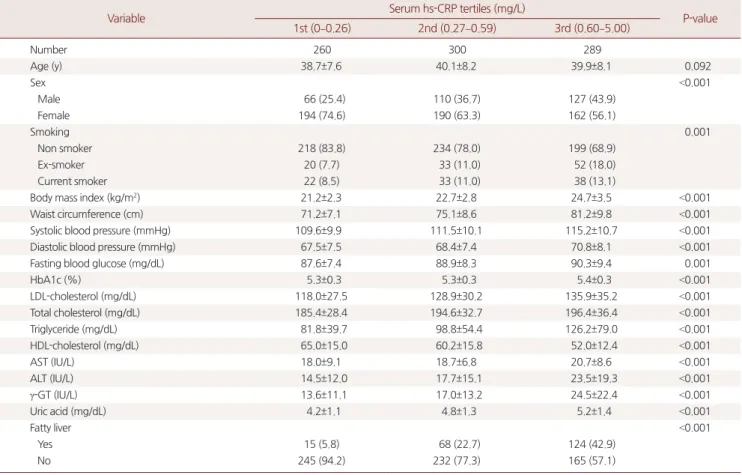
분위까 지의 세 군을 비교하였을 때, 지방간 소견을 보인 비율은 각각5
.8
%,22
.7
%,42
.9
%로 제1
분위에서 가장 낮고 제3
분위에서 가장 높았다 (P-value<0
.001
). 또한 제3
분위에서 흡연자의 비율이 가장 높았고, 평 균 체질량지수, 허리둘레, 수축기 혈압, 이완기 혈압, 공복혈당, 당화 혈색소, 중성지방, 총 콜레스테롤, 저밀도 지단백 콜레스테롤도 가장 높았으며 평균 고밀도 지단백 콜레스테롤은 가장 낮았다(Table 2
).4. 혈청 hs-CRP 수치에 따른 비알코올성 지방간질환의 교차비 혈청
hs-CRP
수치의 제1
분위를 기준으로 할 때 제2
분위, 제3
분위 의 비알코올성 지방간질환의 교차비는 각각4
.787
(95
%confidence interval [CI]
,2
.661–8
.612
),12
.275
(95
%CI
,6
.935–21
.727
)였다. 연령, 성 별, 체질량지수, 허리둘레, 공복혈당, 수축기 혈압, 중성지방, 고밀도 지단백 콜레스테롤의 교란변수를 보정한 후 교차비는 각각2
.557
(95
%CI
,1
.317–4
.965
),2
.771
(95
%CI
,1
.420–5
.408
)이었다(Table 3
).Table 2. Clinical characteristics of subjects according to serum high sensitivity C-reactive protein (hs-CRP) tertiles
Variable Serum hs-CRP tertiles (mg/L)
P-value 1st (0–0.26) 2nd (0.27–0.59) 3rd (0.60–5.00)
Number 260 300 289
Age (y) 38.7±7.6 40.1±8.2 39.9±8.1 0.092
Sex <0.001
Male 66 (25.4) 110 (36.7) 127 (43.9)
Female 194 (74.6) 190 (63.3) 162 (56.1)
Smoking 0.001
Non smoker 218 (83.8) 234 (78.0) 199 (68.9)
Ex-smoker 20 (7.7) 33 (11.0) 52 (18.0)
Current smoker 22 (8.5) 33 (11.0) 38 (13.1)
Body mass index (kg/m2) 21.2±2.3 22.7±2.8 24.7±3.5 <0.001
Waist circumference (cm) 71.2±7.1 75.1±8.6 81.2±9.8 <0.001
Systolic blood pressure (mmHg) 109.6±9.9 111.5±10.1 115.2±10.7 <0.001
Diastolic blood pressure (mmHg) 67.5±7.5 68.4±7.4 70.8±8.1 <0.001
Fasting blood glucose (mg/dL) 87.6±7.4 88.9±8.3 90.3±9.4 0.001
HbA1c (%) 5.3±0.3 5.3±0.3 5.4±0.3 <0.001
LDL-cholesterol (mg/dL) 118.0±27.5 128.9±30.2 135.9±35.2 <0.001
Total cholesterol (mg/dL) 185.4±28.4 194.6±32.7 196.4±36.4 <0.001
Triglyceride (mg/dL) 81.8±39.7 98.8±54.4 126.2±79.0 <0.001
HDL-cholesterol (mg/dL) 65.0±15.0 60.2±15.8 52.0±12.4 <0.001
AST (IU/L) 18.0±9.1 18.7±6.8 20.7±8.6 <0.001
ALT (IU/L) 14.5±12.0 17.7±15.1 23.5±19.3 <0.001
γ-GT (IU/L) 13.6±11.1 17.0±13.2 24.5±22.4 <0.001
Uric acid (mg/dL) 4.2±1.1 4.8±1.3 5.2±1.4 <0.001
Fatty liver <0.001
Yes 15 (5.8) 68 (22.7) 124 (42.9)
No 245 (94.2) 232 (77.3) 165 (57.1)
Values are presented as number (%) or mean±standard deviation.
HbA1c, hemoglobin A1c; LDL, low density lipoprotein; HDL, high density lipoprotein; AST, aspartate aminotransferase; ALT, alanine aminotransferase; γ-GT, gamma- glutamyl transpeptidase.
P-values were calculated by one way ANOVA test or chi-square test.
Table 3. The odds ratio (OR) and 95% confidence interval of nonalcoholic fatty liver disease according to serum high sensitivity C-reactive protein (hs-CRP) tertiles
Serum hs-CRP tertiles (mg/L)
1st (0–0.26) 2nd (0.27–0.59) 3rd (0.60–5.00)
Unadjusted OR 1.00 4.787 (2.661–8.612)b 12.275 (6.935–21.727)b
Adjusted ORa 1.00 2.557 (1.317–4.965)c 2.771 (1.420–5.408)d
Values are presented as OR (95% confidence interval).
aAdjusted for age, sex, body mass index, waist circumference, fasting blood glucose, systolic blood pressure, diastolic blood pressure, triglyceride and high density lipo- protein-cholesterol. bP-value<0.001. cP-value=0.006. dP-value=0.002.
P-values were calculated by logistic regression analysis.
최윤형 외. 건강한 성인에서 NAFLD와 hs-CRP의 관련성 Korean Journal of Family Practice
KJFP
고 찰
본 연구는 기저질환이 없는 건강한 성인을 대상으로 하여 비알코 올성 지방간질환과
hs-CRP
의 관련성을 조사하였으며, 혈청hs-CRP
수치가 낮은 군에 비해 높은 군에서 비알코올성 지방간질환의 비율 이 높고 연령, 성별, 체질량지수 및 허리둘레, 공복혈당, 혈압, 중성 지방, 고밀도 지단백 콜레스테롤과 같은 대사증후군 구성요소들을 보정한 후에도 유의한 연관성이 있음을 확인하였다.비알코올성 지방간질환과 심혈관 질환의 관련성은 여러 연구들 에서 보고되었다. 제
2
형 당뇨 환자를 대상으로 한Targher
등의 연구 에서20) 비알코올성 지방간질환이 동반된 환자들은 그렇지 않은 환 자들에 비해 높은 심혈관 질환의 유병률을 보였고, 관상동맥 질환 과거력이 없는 환자를 대상으로 한Arslan
등의 연구에서21) 비알코올 성 지방간질환은 심혈관 질환의 유병률 및 중등도와 관련성을 보였 다.비알코올성 지방간질환과 심혈관 질환 사이에 관여하는 기전은 아직 확실히 알려지지 않았으나 내장 지방조직, 인슐린 저항성, 전 신 염증 반응, 혈관 내피세포 기능 저하, 혈중 응고인자 변화 등 다 양한 기전이 비알코올성 지방간질환 환자의 심혈관 질환 발생 위험 성에 관여하는 것으로 추정된다.8,22) 전신의 염증은 혈관 내피세포의 기능 저하와 혈관의 죽상화를 초래하여 심혈관 질환 발생에 영향을 주는데23) 이러한 염증 상태를 반영하는 지표들 중
hs-CRP
는 심혈관 질환이 없는 사람에게서 심혈관 질환의 발생 위험도를 평가할 때, 그리고 심혈관 질환이 발생했던 환자에서 심혈관 질환의 재발과 사 망을 예측하는 데에 도움이 될 수 있다.11)심혈관 질환 과거력이 없는 성인에서 비알코올성 지방간질환과
hs- CRP
의 유의한 관련성을 보고한 여러 연구들이 있는데Kumar
등13) 은 관상동맥 질환과 고지혈증이 없는 성인에서 비알코올성 지방간질환과
hs-CRP
이 독립적으로 유의미한 관련성이 있음을 보여주었고Chiang
등24)은 심혈관 질환이 없는 건강한 성인에서 비알코올성 지 방간질환의 중증도와 혈청hs-CRP
수치 상승이 유의한 연관이 있음 을 보고하였다. 국내에서도Kim
등25)은 심혈관 질환과 당뇨병이 없 는 성인에서 비알코올성 지방간군이 정상군에 비해 혈청hs-CRP
수 치가 유의하게 높음을 보고하였다. 본 연구 결과에서도 기저질환이 없는 건강한 성인에서 비알코올성 지방간질환과 혈청hs-CRP
수치 는 유의한 관련성을 보였다.본 연구에는 여러 제한점들이 있다. 첫째, 단면연구이므로 비알코 올성 지방간질환과 혈청
hs-CRP
상승의 인과관계를 설명하기에는 한계가 있다. 둘째, 일개 대학병원 건강증진센터의 수검자를 대상으 로 하였기에 연구 결과를 일반화하기는 어렵다. 셋째, 과거력, 음주력, 약물 복용력을 자가 문진표를 통해 조사하였기 때문에 보고되 지 않은 고혈압, 당뇨, 심혈관 질환 등 기저질환을 가진 환자나 알코 올성 지방간, 약물에 의한 지방간 등 다른 간질환을 가진 환자가 포 함되었을 수 있다. 넷째, 비알코올성 지방간질환의 진단이 조직검사 가 아닌 상복부 초음파 소견을 통해 이루어져 진단이 정확하지 않 았을 가능성이 있고 검사자도
1
명이 아닌 복수의 영상의학과 전문 의로 구성되었기 때문에 검사자 간의 오차 역시 배제할 수 없다.결론적으로 본 연구에서는 기저질환이 없는 건강한 성인에서 비 알코올성 지방간질환과 심혈관 질환 위험 예측 인자 중 하나인
hs- CRP
간의 유의한 관련성이 있었다. 따라서 심혈관 질환 과거력이나 당뇨 등의 기저질환이 없더라도 비알코올성 지방간질환이 있다면 심혈관 질환 발생 위험성에 대한 고려가 필요하겠으며 향후 비알코 올성 지방간질환과 혈청hs-CRP
상승의 인과관계에 대한 전향적인 연구가 필요할 것으로 생각된다.요 약
연구배경: 최근 연구들에서 비알코올성 지방간질환이 심혈관 질환 의 독립적인 위험인자로 보고되고 있으며 심혈관 질환 위험 예측 인 자 중 하나인 고감도
C-
반응성 단백질(hs-CRP
)과의 연관성을 보여 주는 연구들도 다수 있다. 그러나 국내에서는 이에 관한 연구가 많 지 않아 기저질환이 없는 건강한 성인에서 비알코올성 지방간질환 과hs-CRP
간의 관련성을 확인하고자 하였다.방법:
2016
년3
월부터2017
년2
월까지 일개 대학병원 건강증진센터 에서 건강검진을 받은20
세 이상의 성인 수검자 중 심혈관 질환, 바 이러스 간염, 당뇨 등의 기저질환 및 알코올 남용력이 없고 혈청hs- CRP
수치가5 mg
/L
를 초과한 사람을 제외한 총849
명을 연구 대상 으로 하여 비알코올성 지방간질환 유무에 따른 평균 혈청hs-CRP
수치를 구하고 연구 대상자를 혈청hs-CRP
수치의 백분율 분포에 따 라 삼분위로 구분한 후 비알코올성 지방간질환의 교차비를 구했다.결과: 정상군에 비해 비알코올성 지방간질환군에서 평균 혈청
hs- CRP
수치가 유의하게 높았다. 혈청hs-CRP
수치가 낮은 군에 비해 높은 군, 특히 가장 높은 제3
분위에서 비알코올성 지방간질환의 비 율이 높았다. 혈청hs-CRP
수치의 제1
분위를 기준으로 하였을 때, 제2
분위, 제3
분위의 비알코올성 지방간질환의 교차비는 각각4
.787
(95
%confidence interval [CI]
,2
.661–8
.612
),12
.275
(95
%CI
,6
.935–
21
.727
)이었으며 연령, 성별, 체질량지수, 허리둘레, 공복혈당, 혈압, 중성지방, 고밀도 지단백 콜레스테롤의 교란변수를 보정한 후 교차 비는 각각2
.557
(95
%CI
,1
.317–4
.965
),2
.771
(95
%CI
,1
.420–5
.408
)이 었다.Yunhyoung Choi, et al. Relationship between NAFLD and hs-CRP in Healthy Adults
Korean Journal of Family Practice
KJFP
결론: 기저질환이 없는 건강한 성인을 대상으로 한 본 연구에서 비 알코올성 지방간질환은
hs-CRP
와 유의한 관련성을 보였으며, 이는 교란변수를 보정한 후에도 여전히 의미 있는 것으로 나타났다.중심단어: 비알코올성 지방간질환; 고감도
C-
반응성 단백질; 심혈관 질환; 위험인자CONFLICT OF INTEREST
No potential conflict of interest relevant to this article was reported
. ORCIDYunhyoung Choi
,https
://orcid
.org
/0000-0002-0133-0402 Jung-Eun Oh
,https
://orcid
.org
/0000-0001-9117-0571 Jin Lee
,https
://orcid
.org
/0000-0003-3161-5430 Hwang-Sik Shin
,https
://orcid
.org
/0000-0003-0166-8523 Yong-Jin Cho
,https
://orcid
.org
/0000-0002-5932-1138 Sun-Hee Kim
,https
://orcid
.org
/0000-0001-9468-2791 Hyun Joe
,https
://orcid
.org
/0000-0002-5134-2866 Byung-Wook Yoo
,https
://orcid
.org
/0000-0002-8753-9660 Sung-Ho Hong
,https
://orcid
.org
/0000-0002-6037-6830 Choo-Yon Cho
,https
://orcid
.org
/0000-0003-0981-9787 Doo-Yong Son
,https
://orcid
.org
/0000-0002-2895-6165 Kyung-Suk Shin
,https
://orcid
.org
/0000-0002-2456-1406
REFERENCES
1. Ludwig J, Viggiano TR, McGill DB, Oh BJ. Nonalcoholic steatohepatitis:
Mayo Clinic experiences with a hitherto unnamed disease. Mayo Clin Proc 1980; 55: 434-8.
2. Matteoni CA, Younossi ZM, Gramlich T, Boparai N, Liu YC, McCullough AJ. Nonalcoholic fatty liver disease: a spectrum of clinical and pathological severity. Gastroenterology 1999; 116: 1413-9.
3. Lomonaco R, Ortiz-Lopez C, Orsak B, Webb A, Hardies J, Darland C, et al.
Effect of adipose tissue insulin resistance on metabolic parameters and liver histology in obese patients with nonalcoholic fatty liver disease. Hepatology 2012; 55: 1389-97.
4. Angulo P. Nonalcoholic fatty liver disease. N Engl J Med 2002; 346: 1221-31.
5. Kotronen A, Yki-Järvinen H. Fatty liver: a novel component of the metabolic syndrome. Arterioscler Thromb Vasc Biol 2008; 28: 27-38.
6. National Cholesterol Education Program (NCEP) Expert Panel on Detec- tion, Evaluation, and Treatment of High Blood Cholesterol in Adults (Adult Treatment Panel III). Third Report of the National Cholesterol Education
Program (NCEP) Expert Panel on Detection, Evaluation, and Treatment of High Blood Cholesterol in Adults (Adult Treatment Panel III) final report.
Circulation 2002; 106: 3143-421.
7. Hayden JM, Reaven PD. Cardiovascular disease in diabetes mellitus type 2:
a potential role for novel cardiovascular risk factors. Curr Opin Lipidol 2000; 11: 519-28.
8. Targher G, Day CP, Bonora E. Risk of cardiovascular disease in patients with nonalcoholic fatty liver disease. N Engl J Med 2010; 363: 1341-50.
9. Musso G, Cassader M, Gambino R. Diagnostic accuracy of adipose insulin resistance index and visceral adiposity index for progressive liver histology and cardiovascular risk in nonalcoholic fatty liver disease. Hepatology 2012;
56: 788-9.
10. Targher G, Bertolini L, Poli F, Rodella S, Scala L, Tessari R, et al. Nonalcoholic fatty liver disease and risk of future cardiovascular events among type 2 dia- betic patients. Diabetes 2005; 54: 3541-6.
11. Pearson TA, Mensah GA, Alexander RW, Anderson JL, Cannon RO 3rd, Criqui M, et al. Markers of inflammation and cardiovascular disease: appli- cation to clinical and public health practice: a statement for healthcare pro- fessionals from the Centers for Disease Control and Prevention and the American Heart Association. Circulation 2003; 107: 499-511.
12. Ndumele CE, Nasir K, Conceiçao RD, Carvalho JA, Blumenthal RS, Santos RD. Hepatic steatosis, obesity, and the metabolic syndrome are indepen- dently and additively associated with increased systemic inflammation. Ar- terioscler Thromb Vasc Biol 2011; 31: 1927-32.
13. Kumar R, Porwal YC, Dev N, Kumar P, Chakravarthy S, Kumawat A. Asso- ciation of high-sensitivity C-reactive protein (hs-CRP) with non-alcoholic fatty liver disease (NAFLD) in Asian Indians: a cross-sectional study. J Fam- ily Med Prim Care 2020; 9: 390-4.
14. Choi SY, Kim D, Kang JH, Park MJ, Kim YS, Lim SH, et al. Nonalcoholic fatty liver disease as a risk factor of cardiovascular disease: relation of non-alco- holic fatty liver disease to carotid atherosclerosis. Korean J Hepatol 2008; 14:
77-88.
15. Keum SH, Lee KM, Jung SP. Nonalcoholic fatty liver disease as a risk factor for cardiovascular disease: using the estimation of Framingham risk score and carotid artherosclerosis. Korean J Health Promot 2012; 12: 163-9.
16. Chalasani N, Younossi Z, Lavine JE, Diehl AM, Brunt EM, Cusi K, et al. The diagnosis and management of non-alcoholic fatty liver disease: practice Guideline by the American Association for the Study of Liver Diseases, American College of Gastroenterology, and the American Gastroentero- logical Association. Hepatology 2012; 55: 2005-23.
17. Babor TF, Higgins-Biddle JC, Saunders JB, Monteiro MG. AUDIT the alco- hol use disorders identification test: guidelines for use in primary care. 2nd ed. Geneva: World Health Organization; 2001.
18. Osawa H, Mori Y. Sonographic diagnosis of fatty liver using a histogram technique that compares liver and renal cortical echo amplitudes. J Clin Ul- trasound 1996; 24: 25-9.
19. Grundy SM, Cleeman JI, Daniels SR, Donato KA, Eckel RH, Franklin BA, et al. Diagnosis and management of the metabolic syndrome: an American Heart Association/National Heart, Lung, and Blood Institute Scientific Statement. Circulation 2005; 112: 2735-52.
20. Targher G, Bertolini L, Padovani R, Rodella S, Tessari R, Zenari L, et al. Preva- lence of nonalcoholic fatty liver disease and its association with cardiovascu- lar disease among type 2 diabetic patients. Diabetes Care 2007; 30: 1212-8.
최윤형 외. 건강한 성인에서 NAFLD와 hs-CRP의 관련성 Korean Journal of Family Practice
KJFP
21. Arslan U, Türkoğlu S, Balcioğlu S, Tavil Y, Karakan T, Cengel A. Association between nonalcoholic fatty liver disease and coronary artery disease. Coron Artery Dis 2007; 18: 433-6.
22. Francque SM, van der Graaff D, Kwanten WJ. Non-alcoholic fatty liver dis- ease and cardiovascular risk: pathophysiological mechanisms and implica- tions. J Hepatol 2016; 65: 425-43.
23. Ross R. Atherosclerosis--an inflammatory disease. N Engl J Med 1999; 340:
115-26.
24. Chiang CH, Huang CC, Chan WL, Chen JW, Leu HB. The severity of non- alcoholic fatty liver disease correlates with high sensitivity C-reactive pro- tein value and is independently associated with increased cardiovascular risk in healthy population. Clin Biochem 2010; 43: 1399-404.
25. Kim HJ, Pae SW, Kim DJ, Kim SK, Kim SH, Rhee YM, et al. Association of serum high sensitivity C-reactive protein with risk factors of cardiovascular diseases in type 2 diabetic and nondiabetic subjects without cardiovascular diseases. Korean J Med 2002; 63: 36-45.