1. Introduction
In the global markets, there are three types of plated steels that are used as automotive panels. North America, which focuses on the United States, uses electrogalvanized steels that have a relatively high-quality surface and good paint adhesion properties as well as relatively cheap power cost, while European automakers have used highly pro- ductive hot-dip galvanized steels for a long time.
Latecomers in Asia mainly use galvannealed steels that improved an excellent welding and painting properties,
a disadvantage of hot-dip galvanized steels, rather than relatively expensive electrogalvanized steels. The former is manufactured by the alloying reaction by Fe(steel)→Zn diffusion by heat treatment at 450 to 550 °C. The plating layer of galvannealed steels exhibits conflicting character- istics in powdering and flaking properties according to alloying degree, so precision alloying management de- pends on the quality of the steel sheet [1,2].
With intensifying global competition among automakers in recent years, material for automobiles is undergoing major changes from three perspectives. That is, the enact- ment of the Euro(VI) environmental regulations on the basis of zero emissions, the light weight for improving fuel efficiency of automobiles, and the cost reduction strat- egy of automobile companies, are the driving force of change. In this light, automotive steels are more likely to employ eco-friendly and low-cost materials, as well as
†Corresponding author: [email protected] (Du-Hwan Jo)
†Corresponding author: [email protected] (Moon-Hi Hong) Du-Hwan Jo: Senior Principal Researcher, Sang-Man Yun: Junior Principal Researcher, Doo-Jin Paik: Senior Manager, Myung-Soo Kim: Vice President, Moon-Hi Hong: Executive Vice President
Corrosion Resistance of Mg-Added Galvannealed Steel Sheets with Nano-Composite Coating
Du-Hwan Jo1,†, Sang-Man Yun2, Doo-Jin Paik3, Myung-Soo Kim4, and Moon-Hi Hong5,†
1Automotive Steel Surface Research Group, POSCO Technical Research Laboratories, 37859, Pohang, Republic of Korea
2Welding & Joining Research Group, POSCO Technical Research Laboratories, 21985, Incheon, Republic of Korea
3AHSS Steel Quality Management Section, POSCO Gwangyang Works, 57807, Gwangyang, Republic of Korea
4Automotive Steel Surface Research Group, POSCO Technical Research Laboratories, 57807, Gwangyang, Republic of Korea
5Steel Solution Center, POSCO Coated & Color Steel Co. Ltd, 37866, Pohang, Republic of Korea (Received January 03, 2020; Revised March 04, 2020; Accepted March 05, 2020)
As competition among global automakers intensifies, demand for materials that are better in price and performance is increasing. While steel and plastic materials compete for automotive fuel tanks, plastic materials have advantages such as light weight for automobiles. However, they have high prices. Accordingly, in this paper, four types of Zn-X plated steel sheets, electroplating (X = none, Sn) and galvannealed (X = Fe, Fe-Mg), were manufactured and their applicability as a fuel tank material was evaluated. Nano-composite coating solution with good conductivity was treated on the surface of plated steels using a roll coater and then cured through induction furnace to improve corrosion resistance. Quality characteristics such as corrosion resistance, fuel resistance to diverse gasoline and diesel fuels, and seam weldability were evaluated for the above plated steels. Their properties were compared and analyzed with conventional Zn-Ni electroplating steels. Among the above plated steels, Zn-Fe-Mg galvannealed steels coated with nano-composite coating exhibited better properties than other steels. Detailed experimental results suggest that evenly distributed Mg elements on the coating layer play a key role in the enhanced quality performance.
Keywords: Galvannealed steel, Corrosion resistance, Fuel tank, Automotive steel
high strength steel and high corrosion resistant materials.
Due to the depletion of zinc metals and rapid price rises, various attempts are under way to reduce the total zinc plating amount by strengthening the corrosion resistance of plated layers using alloy elements [3]. In particular, aluminum and magnesium alloy elements have been ap- plied to plated steels for construction panel for a long time as they have excellent effects on improving corrosion resistance. However, the increased content of alloy ele- ments improved the corrosion resistance, but the poor plat- ing workability, press forming and welding properties made the application of steel sheets for automobiles limited. Hong M.-H. and others recently reported research results on improving corrosion resistance of galvannealed steels added with magnesium alloy element [4].
The auto fuel tank market is becoming increasingly com- petitive between steel and plastic materials. The com- petitiveness of steel materials has been recovering some- what following the recent effectuation of the Euro(VI) bill in the advanced countries. However, steel materials need to be developed and applied with low-priced materials to surpass the cost competitiveness of plastic materials that are highly corrosion-resistant and design-free. Several years ago, India’s automaker developed and used a galvan- nealed steels coated with an organic-inorganic composite coating as a panel for diesel commercial vehicles and mo- torbike fuel tanks to reduce production costs. However, there is a need to improve the corrosion resistance of gal- vannealed steels to improve durability of the fuel tank due to the improvement of the life of the car. In particular, the automaker's specifications require not only a decade or more of corrosion resistance warranty, but also the im- portance of the material's corrosion protection as biofuel usage increases significantly [5,6]. In this paper, in order to further improve the corrosion resistance, magnesium added galvannealed steels coated with nano-composite coating were manufactured and compared with pure zinc electrogalvanized steels, galvannealed steels and zinc-tin double layer electrogalvanized steels as an existing low-priced materials. And these plated steels were then evaluated for their potential as panels for automotive fuel tanks.
2. Experimental
2.1 Preparation of Zn-X (X = none, Sn, Fe, Fe-Mg) Plated Steel Sheets
The galvanized steels used in this paper are manufac- tured by plating on the cold-rolled steel sheets (CR, thick- ness 0.8 mm) as follows. Firstly zinc electroplating steels (X=none; Zn) were produced through horizontal electro-
plating cell after cleaning the cold rolled steels with alkali degreasing, acid cleaning, and water cleaning process on the electrogalvanized line (plating weight, 30±2 g/m2).
Electrolytic zinc-tin (X=Sn; Zn-Sn) double layer plated steels were prepared as follows. First, the cold-rolled steels were stirred in Mucasol (Brand GmbH, 3% concen- tration) solution at 70 °C for 30 minutes and then cleaned and dried. Tin plating steels (plating weight, 1.5±0.1 g/m2) were prepared from in the electroplating facility as the following method. Tin plating was performed under the conditions [Sn(II) 30 g/L, ethylene α-naphtolsulphonic acid 6 g/L, phenylsulfonic acid 16 g/L, 40 °C in temper- ature, flow rate 3 m/s, current density 50 A/dm2] and then surface refinement was done during the reflow heating process at 220 °C. Zinc electroplating (plating weight, 18.5±1.0 g/m2) was performed on each tin-plated speci- mens under the condition [Zn(II) 45 g/L, Na2SO4 40 g/L, pH 1.2, current density 60 A/dm2, plating time 12 seconds, 60 °C in temperature and flow rate 1.5 m/s]. Zinc-nickel electroplating steels (plating weight, 30±2.0 g/m2; Ni 11±1%) were produced by electrogalvanizing line, are used as a comparative material for automotive fuel tanks.
Galvannealed steels (X=Fe; Zn-Fe) produced in con- tinuous galvanized line and used (plating weight, 45±2.0 g/m2; Fe 11±1%). Magnesium-added galvannealed steels (X=Fe-Mg; Zn-Fe-Mg) were also produced in the con- tinuous galvanized line and used (plating weight, 45±2.0 g/m2; Fe 15±1%; Mg 0.18±0.02%) [4].
2.2. Nano-composite Coating Solution
Nano-composite coating solution was prepared by pre- cisely dispersing nano-material into polymeric composite solution in aqueous medium. The polymeric composite solution was prepared by adding anti-corrosive ingredients and fluidity enhancers to the acryl modified polyurethane (average Mw, 25,000; Tg, 20 °C) in aqueous solution. And nano-material was produced by dispersive surface mod- ification of nano-sized metal powder (average diameter, 70 nm) with organic surfactant at 3000 rpm stirring for 24 hours by using ultrafast ball-mill diffuser (VMX Dispermat, VMA-Getzmann GmbH). The nano-composite solution was precisely prepared and adjusted the solid con- tent to 14±1% and the viscosity of the Brookfield to 8.0±0.1 cps by adding water, and then stirred for 24 hours.
2.3. Nano-composite Coated Steel Sheets
The nano-composite coated steels were manufactured as follows by using a nano-composite coating solution pre- pared above. Nano-composite coated steels for the four types of plated steels are manufactured so that the coating weight is a range of 1.0±0.1 g/m2 on the surface of the
plating steels by use of roll coater and then hardening it in the induction furnace at 180±5 °C. The coating amounts were measured by a portable Near-IR meter or wet method using a pre-written calibration.
2.4. Evaluation Methods and Instrumentations
In this paper, the evaluation of surface properties of nano-composite coated steels was performed by the follow- ing methods and instruments. Both alloying concentration and property of the plating layer were investigated from the cross-sectional view of the plated layer through the scanning electron microscope (JSM-6610LV, JEOL Ltd.), field emission-electron probe micro-analyzer (JXA-8530F, JEOL Ltd.) and glow discharge spectrometer (GDS 850A, LECO Ltd.). The plating weight was calculated by dissolv- ing the plated layer by wet analysis method and then con- verting it after ICP (ICAP 6000 series, Thermo Scientific) elemental analysis. Corrosion resistance was evaluated for flat and cup-drawn parts up to the time of white and red rust appearance in the salt spray test (SST) and cyclic corrosion test (CCT) [7]. The durability for the fuel was evaluated in the following ways: The cup-drawn specimen for simulating the shape of the fuel tank was manufactured by cutting the steels to 110 mm in diameter and processing it with a punch diameter of 50 mm, drawing height of 30 mm and a radius of curvature (punch radius = die radius
= 6R) using a universal test machine. The fuel durability was evaluated by putting fuel of 30 mL into the drawn cup and then analyzing the corrosion appearance inside the cup and the amount of metal dissolved in the residual fuel after shaking it at 60 rpm in given conditions, i.e., 1000 hours at 50 °C for gasoline and 8weeks at 80 °C for diesel [8]. The diverse fuel compositions for test, as
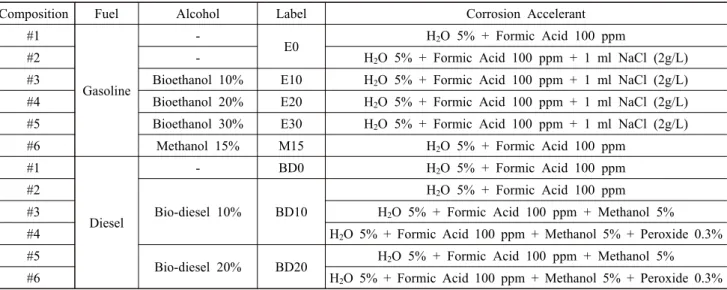
shown in Table 1, were prepared by using gasoline and diesel fuel, biofuels (bioethanol, biodiesel), corrosive acid compounds and salts, and evaluated to accelerate corrosion in fuel tanks due to aging. The seam weldability evaluations of nano-composite coated steels were performed as follows. The seam welder used in inverter DC welder (Hyosung Co. Ltd.) and evaluation conditions were 8 mm in electrode diameter, 4 kN in loading pressure, 3 mpm in weld speed, 50 ms in electricity generation time, and 33 ms in resting time.
3. Results and Discussion
Iron is not only economical, but also has excellent me- chanical properties, forming and welding properties, and is used as a structural material in most industries, but it has a fatal weakness against corrosion. While various methods are applied to complement this, the technique of plating on the steel surface with metal of low electro- chemical electromotive force such as zinc metal with supe- rior sacrificial property, is most commonly used. As a way to improve the corrosion resistance of galvanized steels, it is possible, firstly to increase the amount of plat- ing, and secondly to alloy the plating layer, third to plate it in a two- or three-layer structure using zinc and other metals [9,10]. For the first purpose, the hot-dip galvanizing has an advantage over the electrogalvanizing. Generally, galvanized steels have zinc plating around 20, 45 and around dozens to hundreds g/m2 for home appliances, auto- mobiles, and indoors and outdoors panels of construction, respectively. For the second purpose, the metals with ex- cellent corrosion resistance such as Al, Cr, Ni, Mg, and Sn, is added to the alloy with zinc to enhance the corrosion
Composition Fuel Alcohol Label Corrosion Accelerant
#1
Gasoline
- E0 H2O 5% + Formic Acid 100 ppm
#2 - H2O 5% + Formic Acid 100 ppm + 1 ml NaCl (2g/L)
#3 Bioethanol 10% E10 H2O 5% + Formic Acid 100 ppm + 1 ml NaCl (2g/L)
#4 Bioethanol 20% E20 H2O 5% + Formic Acid 100 ppm + 1 ml NaCl (2g/L)
#5 Bioethanol 30% E30 H2O 5% + Formic Acid 100 ppm + 1 ml NaCl (2g/L)
#6 Methanol 15% M15 H2O 5% + Formic Acid 100 ppm
#1
Diesel
- BD0 H2O 5% + Formic Acid 100 ppm
#2
Bio-diesel 10% BD10
H2O 5% + Formic Acid 100 ppm
#3 H2O 5% + Formic Acid 100 ppm + Methanol 5%
#4 H2O 5% + Formic Acid 100 ppm + Methanol 5% + Peroxide 0.3%
#5 Bio-diesel 20% BD20 H2O 5% + Formic Acid 100 ppm + Methanol 5%
#6 H2O 5% + Formic Acid 100 ppm + Methanol 5% + Peroxide 0.3%
Table 1 List of diverse gasoline and diesel compositions
resistance of the plated layer [11,12]. Corresponding prod- ucts include hot-dip galvanized steels such as Zn-Al, Zn-Mg and Zn-Al-Mg plating as well as electrogalvanized steels such as Zn-Ni, Zn-Cr and Sn-Zn plating. Alloyed plating is also aimed at reducing the amount of galvanizing by improving corrosion resistance, against rising prices and the depletion of zinc. For the third purpose, there is also a two- or three-layer plated product that has been galvanized after Ni, Sn and Cu plating on the surface of steels [9,10].
Generally, materials for automotive fuel tanks are re- lated to human safety, so the durability of the material is most important. In particular, the corrosion resistance of the material should not be a problem even after 10 years of driving. The galvanized steels are subjected to additional surface treatment on the plated layer surface to enhance corrosion resistance. Although coating technol- ogy is being developed to enhance the corrosion resistance of galvanized layers with thin film as possible, to guaran- tee weldability is not deemed satisfactory. The fabrication of the fuel tank is completed by connecting the top and bottom plates with seam welding after press forming.
When the joint is incomplete during seam welding, it not only creates a problem of water leaking during the hy-
draulic test, but also affects productivity. Therefore, meth- ods are required to improve the electrical conductivity in a composite coating layer on the surface of galvanized steels.
3.1. Zn-X Plated Steel Sheets
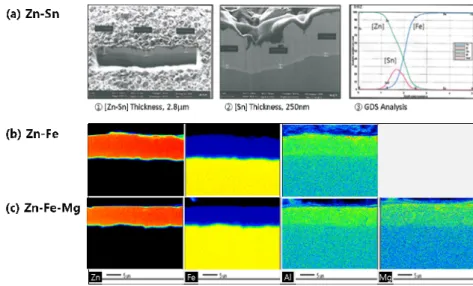
In this study, two types of electroplating and two types of hot-dip galvannealed steels as low-priced steels were manufactured as described in Fig. 1 to evaluate their properties. Pure zinc electroplating steels has been manu- factured with a higher plating weights of 30±2 g/m2 for improved corrosion resistance compared to conventional plating weights of 20±2 g/m2. Zn-Sn electroplating steels were selected as an alloy electroplating material. Tin met- al was not only easy to electroplating, but also had a high- er electrochemical reduction potential of -0.14 V com- pared to -0.76 V of zinc, which made it difficult to sacri- fice, but it was determined that barrier characteristics for steel plates would be excellent. Since Sn is an expensive metal, it cannot greatly increase the amount of plating, so 0.5 (2.5%), 1.0 (5.0%), and 1.5 g/m2 (7.5%) of Sn were plated and then zinc was electroplated to produce steels with total plating weights of 20±2 g/m2. The SEM and GDS analyses, as shown in Fig. 2a, on the plating
Fig. 1 Procedure for manufacture of the Zn-X plated steels coated with nano-composite coating.
Fig. 2 SEM, GDS and EPMA analyses for cross-sectional plating layer of Zn-X plated steels.
layer of Zn-Sn two-layer structure confirmed that the plat- ing was done well, and the corrosion resistance evaluation gave the best results at 7.5% of Sn among above concentrations. Galvannealed steels with an alloying de- gree of 11±1% and a plating weight of 45±2 g/m2 were used. Galvannealed steels were manufactured with 0.13%
Al added for the purpose of improving plating wettability and controlling the initial diffusion rate of Fe element of steel substrate, and reheating at 450 to 500 °C to control the Fe alloying degree of 11±1%. Recently, Hong M.-H.
and others carried out research on Zn-Fe-Mg galvan- nealed steels with the addition of Mg element to improve corrosion resistance [4]. Although it was found in the above study that the addition of Mg element (0.2, 0.5, and 1.0%) was effective in improving corrosion resist- ance, it was reported that at concentrations greater than 0.5%, it was not desirable commercially due to not only the incomplete formation of the Fe-Al inhibited layer and un-uniform plating phenomenon, but also to the increased temperature of alloying. Therefore, Zn-Fe-Mg galvan- nealed steels with the addition of 0.18% Mg used in this study were plated with plating weights of 45±2.0 g/m2 and reheated at 470 °C to produce steel sheets with an alloying degree of 15%. Generally, it is known that con- centrated Mg metals on the surface form passive film of MgO and Mg(OH)2 during the SST evaluation, which im- proves corrosion resistance [13,14]. EPMA analysis of the cross section of the Zn-Fe-Mg plated layer shows that the Mg elements are diffused on the entire plated layer, as shown in Fig. 2c, and the concentration slightly in- creased as going to the surface layer.
3.2. Nano-composite Coated Steel Sheets
Since the fuel tank is manufactured by the seam welding of press-formed steel plates consisting of top and bottom plates, the organic-inorganic composite coating for im- proving corrosion resistance shall be treated as thin as possible. Conventional composite coating solution include corrosion-resistant additives such as silica in polymeric urethane resin solution. In this study, nano-composite coating solution was prepared by mixing composite resin solution and nano-size conductive materials to improve electrical conductivity by using high speed bead-mill dis- persion technology. Although conductive materials are generally higher gravity than organic polymers, their sur- face tension between the particles is significantly reduced when the 70nm size of nano-material is distributed to or- ganic surfactant by surface modification, thus improving the dispersion stabilization within the solution. The devel- oped solution is a composite coating containing nano-ma- terial, and is designed to have a 4 : 6 ratio of organic
to inorganic compounds for excellent corrosion, chemical resistance, and heat resistance. The manufactured solution is coated by roll coater and the coating is treated as 1.0±0.1 g/m2 on the surface of the plated steels, and is dried at the PMT = 180±5 °C. The nano-composite coated steel sheet, as shown in Fig. 1, is manufactured.
3.3. Quality Characteristics
Generally, galvanized steel sheets require good corro- sion resistance, forming and welding for use as automotive panels. In particular, galvanized steels with polymeric based composite coating improve corrosion and forming properties as the amount of coating increases, but their surface electrical conductivity decreases [15]. The surface electro-conductivity is closely related to the weldability of the automotive manufacturing process, so it is recom- mended to be as good as possible. Thus, nano-composite coating treated on galvanized steel surface should derive the optimum amount of coating weights considering the above characteristics. In this study, it was determined that the nano-composite coating was satisfied with the opti- mum quality in terms of corrosion resistance, fuel resist- ance and weldability when applied with 1.0±0.1 g/m2. 3.3.1. Corrosion Resistance
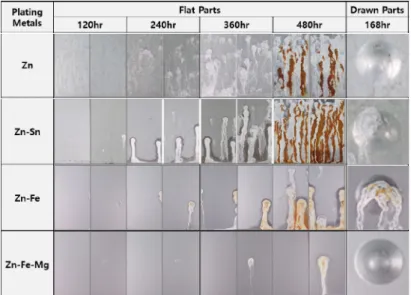
The corrosion resistance evaluation of nano-composite coated steels was evaluated under the salt spray test (SST) and the cyclic corrosion test (CCT) conditions. The corro- sion resistance of Zn-Sn electroplating compared to Zn electroplating was not improved in the evaluation of the flat panel in Fig. 3. This result is judged to be the reason why the Sn plated layer is not thick enough to be 0.25 mm, which not only lacks barrier property, but also has a worse scrificiality than zinc itself. Meanwhile, Zn-Fe-Mg galvannealed steels compared to Zn-Fe galvannealed steels have shown significant improvement, this is determined to be due to the Mg component distributed evenly among plated layers, as shown in Fig. 2. This result was similar in the evaluation of ericksen- and cup-drawn units, as in Fig. 4. In the salt spray and cyclic corrosion evaluation, the Zn-Fe galvannealed steels were inferior to the forming part's corrosion resistance compared to the Zn electro- plating steels, but was greatly improved by the addition of small amount of Mg metal. This result is judged to be the result of the formation of passive film on a plated surface, such as Mg(OH)2. However, only the Zn-Fe-Mg galvannealed steels from the four types of plated steels evaluated is judged to be satisfied with the conditions re- quired by automotive customers, which are no appearance of red rust at more than 480 hours of flat corrosion resist- ance [8]. However, it still lacks corrosion resistance com-
pared to the Zn-Ni electroplating steels currently in use [16].
3.3.2. Fuel Durability
In order to clarify the applicability of the vehicle fuel tank to the four types of plated steels above mentioned, the fuel resistance for various fuels was evaluated under the same conditions as in Table 1. The use of biofuels has been increasing in Europe and North America recently in preparation for the depletion of fossil fuels by car fuel.
Gasoline uses mainly corn-based bioethanol mixed (E10-30, bioethanol %), but diesel fuel tends to mix bio-diesel (BD5-20, biodiesel %) such as soy or palm oil.
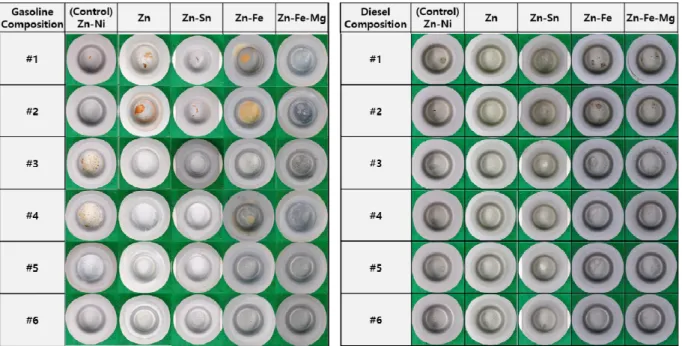
The water and organic acid added to evaluate fuel resist- ance was simulate to water and organic acids that are sub- ject to condensation in the fuel tank and aging of the fuel during the vehicle's use. As shown in Fig. 5, the composi- tions (#1, 2) without adding bioethanol in the evaluation of diverse gasoline compositions were significantly cor- roded inside the cup compared to compositions (#3, 4, 5, 6) with bioethanol and methanol added, resulting in a red rust. These results are believed to be related to the concentration of formic acid. This is because the addition of bio-alcohol results in lower acidity as the formic acid remains in a mixed layer of water and alcohol, slowing the reactivity of the steel surface. Meanwhile, Zn-Ni plat- Fig. 3 Evaluation on the corrosion resistance in flat and ericksen-drawn specimens of Zn-X plated steels coated with nano-composite coating.
Fig. 4 Evaluation on the corrosion resistance of cup-drawn specimen of Zn-X plated steels coated with nano-composite coating.
(Left, SST; Right, CCT)
ed steels used as a comparative material were rather cor- roded in the composition with bio-alcohol. Further re- search is deemed necessary. Overall, in the fuel resistance to gasoline, Zn-Fe-Mg galvannealed steels were the best among the four types of plated steels. On the other hand, those steels in Fig. 5 show generally good results for all of fuel compositions of diesel and biodiesel with corrosive additives. The results are that gasoline fuel (C5 to C7, carbon number in unit molecule) has a smaller molecular weight than diesel (C10 to C18), which is considered to be the result of active molecular movement along with free acid. The total dissolution of metal elements (Zn, Fe, Ni, and Mg) from the recovered fuels after evaluation in all configurations, together with an evaluation of the ap-
pearance of the cup interior above, were analyzed and presented in Fig. 6. Gasoline compositions not only showed a large difference in dissolution output by compo- sition, but also achieved a different result than the apparent evaluation of cup inside. It was roughly evaluated in the order of corrosion resistance; Zn-Fe < Zn-Sn < Zn <
Zn-Fe-Mg. Although there is no significant difference be- tween four types of materials in diesel composition, it has achieved somewhat good results from Zn-Sn steel plates.
What is unique is that the high concentration of Fe from the red rust corrosion products of Zn-Ni and Zn-Fe plated steels is determined to be due to the crack seen in the both plated layers [17,18]. These results are judged to be derived from the previously described characteristics of Fig. 5 Evaluation of the fuel durability in the diverse gasoline (left) and diesel (right) compositions for the Zn-X plated steels coated with nano-composite coating.
Fig. 6 Plots of the dissolved metal concentrations analyzed from cup interior after fuel resistance evaluation in the diverse gasoline (left) and diesel (right) compositions.
diesel fuel. Based on the above results, four types of low-priced materials are considered suitable for diesel fuel rather than gasoline fuel. However, compared with the current Zn-Ni electroplating steels, it is also judged that Zn-Fe-Mg galvannealed steels are applicable for gasoline vehicles.
3.3.3. Weldability
The weldability of the fuel tank steels is closely related to the electrical conductivity of the steel surface.
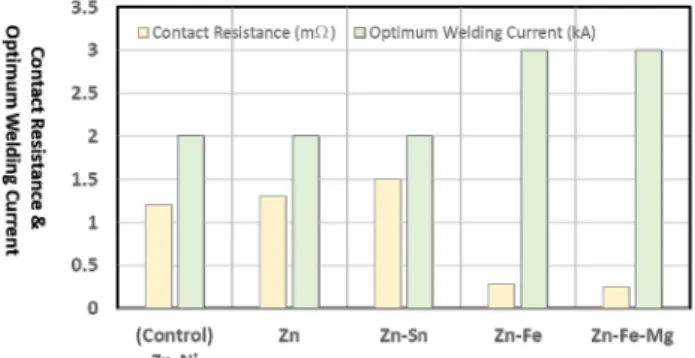
Organic-inorganic coating treated to enhance corrosion re- sistance on the surface of Zn-Ni electroplating steels shall have good fuel durability on the interior and good paint adhesion on the exterior. Thus, the developed nano-compo- site coating was applied to improve the surface conductivity of steels as the best method for reducing the interfacial contact resistance of steel plates [15]. Measurements of weld resistance, as shown in Fig. 7, show that the four types of plated steels have good conductivity of not more than 2.0 mW. This is judged to be the result of four types of plated steels and nano-composite coating with good sur- face electrical conductivity. The optimum current range value was evaluated as an indicator of the accessibility
of the fuel tank when it was manufactured by the automo- bile customers. In Fig. 7, two electroplating steel sheets and a comparison material, Zn-Ni plated steels, were found to have a stable seam weld in the range of 2.0 kA, whereas two galvannealed steels were weldable in the range of 3.0 kA. These results are judged to be the result of improved electrical conductivity due to reduced resistance of the con- tact surface of Fe alloying and nano-material, although galvannealed steels have a larger amount of plating. This advantage is expected to improve the productivity of the fuel tank manufacturer.
4. Conclusion
As competition among global automakers intensifies, demand for materials that are more competitive in price and performance is increasing. The competition between steel and plastic materials for automotive fuel tank has long been under way, but the competitiveness of plastic materials, which are high in price but favorable in terms of design-free and corrosion resistance, has been ahead in recent years in line with the trend of lightening cars.
Accordingly, in this paper, the applicability of automotive fuel tank materials was evaluated through the study of extreme low-priced plating steels.
In this study, four types of Zn-X (X, none, Sn, Fe and Fe-Mg) plated steel sheets were manufactured to adopt nano-composite coating for improved corrosion, weld- ability and forming for automotive application. Nano-com- posite coated steels are manufactured by roll coating on the surface of plating steels with a nano-composite coating solution. After evaluating corrosion and fuel resistance for diverse gasoline and diesel fuels, the characteristics of four types of galvanized steel sheets including the conventional Zn-Ni electroplating steels are summarized in Table 2.
First, in the corrosion resistance evaluation, four types of Zn-X plated steels are considered to be of poor corro- sion resistance compared to the conventional Zn-Ni fuel
Plating Steels
Zn-X (g/m2)
Alloy Elements (%) Nano- cmposite
(mg/m2)
Friction Coefficient
Corrosion Resistance
Fuel Resistance Seam Weldability
Fe Ni Mg Sn Gasoline Diesel
Zn 30 - - - - 1000 0.15 △ △ ◎ ○
Zn-Sn 20 - - - 7.5 1100 0.15 △ △ ◎ ○
Zn-Fe 45 11 - - - 1150 0.18 △ ○ ◎ ◎
Zn-Fe-Mg 45 15 - 0.18 - 1130 0.17 ○ ◎ ◎ ◎
(Control)
Zn-Ni 30 11 - - 1200 0.17 ◎ ◎ ◎ ○
Table 2 Summary on the quality evaluation for the Zn-X plated steels Fig. 7 Comparisons of contact resistance and weldable current
range in seam weld for the Zn-X plated steels coated with nano-composite coating.
tank steels. However, Zn-Fe-Mg galvannealed steels showed performance that met the requirements of automo- tive customers. This is judged to be due to the formation of passive film by Mg element evenly distributed in plated layer. Second, in the fuel resistance assessment, Zn-X plated steels performed better in diesel fuel than gasoline fuel. It is expected that cost reduction will be effected when applying materials for fuel tank of commercial ve- hicles that use diesel fuel. Third, in the seam weldability evaluation, the properties of Zn-X galvanealed steels coat- ed with nano-composite solution, compared to the conven- tional Zn-Ni plated steels, were excellent. It is judged that the contact resistance of the interfacial surfaces of nano-composite steels as well as Fe and Mg alloying has been significantly reduced, thereby greatly improving the weldable current range.
Due to the above characteristics, in this study, Zn-Fe-Mg galvannealed steels among the Zn-X plated steels coated with nano-composite solution were found to have superior properties over other materials in terms of corrosion resist- ance, fuel resistance and weldability. In order to be applied to steels for automobiles in the future, it is further de- termined that the optimization study for Mg content and alloying ratio will show better characteristics.
Acknowledgments
The author greatly appreciates J.-G. Ahn and Y.-S. Sohn of TCC Steel Corp. (Korea) for helping to manufacture Sn plated specimens in this study.
References
1. S. M. A. Shibli, B. N. Meena, and R. Remya, Surf.
Coat. Technol., 262, 210 (2015).
https://doi.org/10.1016/j.surfcoat.2014.12.054
2. J. D. Culcasi, P. R. Sere´, C. I. Elsner, and A. R. Di Sarli, Surf. Coat. Technol., 122, 21 (1999).
https://doi.org/10.1016/S0257-8972(99)00404-1
3. J. I. Jeong, J. H. Yang, J. H. Jung, K. H. Lee, H. J.
Kim, Y. H. Jung, T. Y. Kim, M. H. Lee, S. H. Hwang, P. Wu, J.-H. Kim, and S. S. Kim, Sci. Rep., 8, 3760 (2018). https://doi.org/10.1038/s41598-018-22097-z 4. M.-H. Hong, D.-G. Kang, D.-J. Paik, H.-S. Hwang, and
S.-H. Park, Korean J. Met. Mater., 54, 723 (2016).
https://doi.org/10.3365/KJMM.2016.54.10.723
5. Strategic Alliance for Steel Fuel Tanks (SASFT), https://
www.sasft.org (2002-2004).
6. P. Mould, R. Sheffield, and B. Wilkinson, Strategic Alliance for Steel Fuel Tanks (SASFT), https://www.sasft.org (2010).
7. JIS Standards Z 2371:2000, Methods of salt spray testing, Japanese Standards Association (2000).
8. Hyundai Motors, Material Specification MS-322 (2017).
9. ECOTRIOTM, www.nipponsteel.com (2019).
https://www.nipponsteel.com/en/product/catalog_download/
10. Hariyant, Nippon Steel & Sumitomo Metal Technical Report, 108, 47 (2015).
11. I. H. Karahan and H. S. Güder, Trans. IMF, 87, 155 (2009). https://doi.org/10.1179/174591909X438875 12. B. Chatterjee, Researchgate, 31 (2017).
13. P.-W. Chu and E. A. Marquis, Corros. Sci., 101, 94 (2015). https://doi.org/10.1016/j.corsci.2015.09.005 14. T. Prosek, A. Nazarov, U. Bexell, D. Thierry, and J.
Serak, Corros. Sci., 50, 2216 (2008).
https://doi.org/10.1016/j.corsci.2008.06.008
15. D.-H. Jo, S.-G. No, J.-T. Park, and C.-H. Kang, Corros.
Sci. Tech., 14, 213 (2015).
https://doi.org/10.14773/cst.2015.14.5.213
16. D.-H., Jo, S.-M. Yun, K.-C. Park, M.-S. Kim, and J.-S.
Kim, Corros. Sci. Tech., 18, 16 (2019).
https://doi.org/10.14773/cst.2019.18.1.16
17. M.-J. Kwon, D.-H. Jo, S.-H. Cho, H.-T. Kim, J.-T. Park, and J.-M. Park, Surf. Coat. Technol., 288, 163 (2016).
https://doi.org/10.1016/j.surfcoat.2016.01.027
18. S. Lazik, C. Esling, and J. Wegria, Texture. Microstruct., 23, 131 (1995). https://doi.org/10.1155/TSM.23.131