Chromate-free Hybrid Coating for Corrosion Protection of Electrogalvanized Steel Sheets
Du-Hwan Jo1,†, Moonjae Kwon1, and Jong-Sang Kim2
1Surface Technology Research Group, POSCO Technical Research Laboratories, Pohang, 790-300, Korea
2Surface Technology Research Group, POSCO Technical Research Laboratories, Gwangyang, 545-090, Korea (Received February 28, 2012; Revised February 28, 2012; Accepted February 28, 2012)
Both electrogalvanized and hot-dip galvanized steel sheets have been finally produced via organic-inorganic surface coating process on the zinc surface to enhance corrosion resistance and afford additional functional properties. Recently, POSCO has been developed a variety of chromate-free coated steels that are widely used in household, construction and automotive applications. New organic-inorganic hybrid coating solutions as chromate alternatives are comprised of surface modified silicate with silane coupling agent and inorganic corrosion inhibitors as an aqueous formulation.
In this paper we have prepared new type of hybrid coatings and evaluated quality performances such as corrosion resistance, spot weldability, thermal tolerance, and paint adhesion property etc. The electrogalvanized steels with these coating solutions exhibit good anti-corrosion property compared to those of chromate coated steels. Detailed components composition of coating solutions and experimental results suggest that strong binding between organic-inorganic hybrid coating layer and zinc surface plays a key role in the advanced quality performances.
Keywords : chromate, Cr-free, hybrid, electrogalvanized steel, corrosion resistance
†Corresponding author: [email protected]
1. Introduction
Up to date, zinc and zinc-alloy coated steel sheets have been treated using both chromate chemical conversion and/
or chromate-free (denotes Cr-free) coating on the zinc sur- face to enhance corrosion resistance and additional func- tional properties. Typically chromate treatment is effective for rust-prevention on a metal layer which is widely used because of both performance and economical aspect. Most important reason for the excellent performance of the chro- mate coating seems to be polymeric network in the layer through the bridge between Cr(VI) and oxo-/hydroxo anion. Steel makers have used chromate as a protective coating substance of zinc coated steels for a long time.
But several yaers ago, EPA classifies the chemicals as a human carcinogen when inhaled, and heavily regulates its use and disposal. Especially EU directives have pro- found impact on the protective coating for metals. From July 2006 EU directives target the electrical and electronic equipment industries with further restrictions.1)-2) For a decade, POSCO had manufactured two types of chromate
treated electrogalvanized steels which have different chro- mate coating weights, denotes light and heavy, respectively.
Recently a variety of new Cr-free coated steel products have been developed in POSCO according to the previously described situation. These products are manufacturing and are widely used in household, construction and automotive steels. Especially to replace inorganic chromate conversion coating we have endeavored and finally developed by in- troducing organic-inorganic hybrid coating technology, shown in Scheme 1. Therefore in this paper we describe the development and quality performances of environ- mentally-benign Cr-free coated electrogalvanized steel products that were replaced chromate analogs.
Cr‐free
Cr‐free Hybrid Coating Chromate
Sheme 1
M M
M
M
M M
M
M
M
M M
M O
O
Metal substrate O
O
O O
O O O
O
O O O O
O O O O
O O
O
O
M M
M
M
M M
M
M
M
M M
M O
O
Metal substrate
Inhibitor
O O
O O
O O O
O
O O O O
O O O O
O O
O
O
M : Si or Polymer moeity
M M
M
M
M M
M
M
M
M M
M O
O
Metal substrate O
O
O O
O O O
O
O O O O
O O O O
O O
O
O
M M
M
M
M M
M
M
M
M M
M O
O
Metal substrate
Inhibitor
O O
O O
O O O
O
O O O O
O O O O
O O
O
O
M : Si or Polymer moeity
9Barrier Effect
• Polymer
• Organic-Inorganic Compound
• Nano Clay 9Self-Healing Effect in the scratched surface
• Silica/ Silicate
• High Valent Metal Oxide or Chelate
• Organic inhibitor Polymeric inorganic network
(Anode) Zn → Zn+ + 2e-
(Cathode) Cr2O72-+ 8H++ 6e-→Cr(OH)3↓ + H2O Soluble Cr(VI) Insoluble Cr(III)
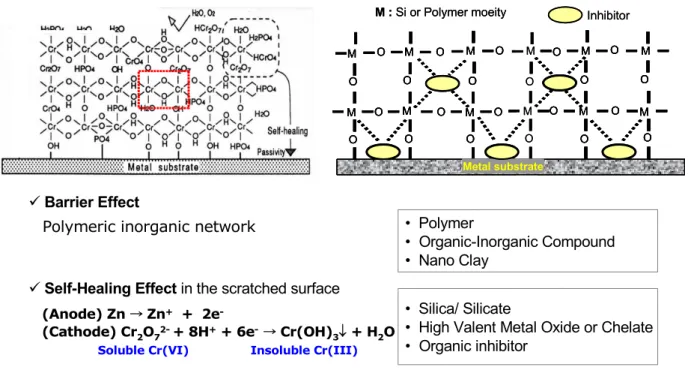
Fig. 1. Concept of Cr-free development in the coating layer. Chromate (left) and Cr-free (right) coating layer.
2. Experimental
The electrogalvanized specimens in this paper were pre- pared with four types of coated steels which are comprised of two types of conventional chromate (light and heavy) and two types of developed Cr-free coated electrogalva- nized steels (denotes light and heavy, respectively). The former have chromium coating weights of 20 mg/m2 for light and 100 mg/m2 for heavy, and the latter have coating weights of 300 mg/m2 for light and 800 mg/m2 for heavy.
New Cr-free hybrid solutions were prepared by stepwise mixing both surface modified solution of silicate sol by organic silane coupling agent and inorganic additives in the dilute phosphate solution. The quality performances of these specimens were evaluated by the condition as followings. The corrosion resistance was evaluated by salt spray test (SST, JIS Z2371), which was applied to the specimens with their rear face and edges sealed with scotch tape. Paint adhesion test was conducted by mela- mine-alkyd resin painting which was applied on the speci- men under the specified standard of ISO 18278-2 (force 250 kgf, weld time 13cycles, electrode tip Cu-Cr type;
tip size 6 mmφ (paint thickness 30 μm, curing time 30 min. under 170 ℃). These were then immersed in boiling water for 30 min and subjected to tape peeling tests that were carried out after cross-hatching (100squares, 1 mm interval). The electric conductivity was evaluated by sur- face resistance which was measured by four-pin probe
method (LORESTA GP, Mitsubishi Chemical Corpora- tion), that is commercial testing method for surface con- ductivity of the steel. The spot weldability was evaluated by the continuous welding test of the specimen with a thickness of 0.7 mm under the specified conditions.
Thermal tolerance tests for both the Cr-free steels (light
& heavy) and anti-fingerprint steels, which was prepared by organic polymer-based resin coating solution, were measured by color differences during 1 hr standing at the oven temperature, 100, 150, 200 and 250 ℃, respectively.
3. Results and discussion
3.1 Cr-free Hybrid Coating
New Cr-free hybrid coating technology achieves out- standing results by creating a thin organic-inorganic hybrid layer on the zinc coated surface that replaces the chromate used in commercial steels for a long time. The concept of the Cr-free coating layer was designed by mimic poly- meric network structure of chromate layer, as shown in Fig. 1. Actually chromate shows excellent anticorrosion properties from both protective and self-healing effect that comprise of inorganic polymeric structure and high valent chromium element. In our development, the polymeric moiety comprise of silane molecule which is shows a bar- rier effect. Meanwhile, self-healing effect comes from high valent titanate molecule as a inhibitor.
The Cr-free hybrid solution was prepared by stepwise
Plain Drawing Cr-free (heavy) Plain
Drawing
SST 96hr SST 72hr
Chromate (heavy)
Plain Drawing
Cr-free (heavy) Plain
Drawing
SST 96hr SST 72hr
Chromate (heavy) Drawing
Chromate
(light) Plain
SST 48hr SST
72hr
SST 24hr SST
48hr
Cr-free (light) Drawing Chromate
(light) Plain
SST 48hr SST
72hr
SST 24hr SST
48hr
Cr-free (light)
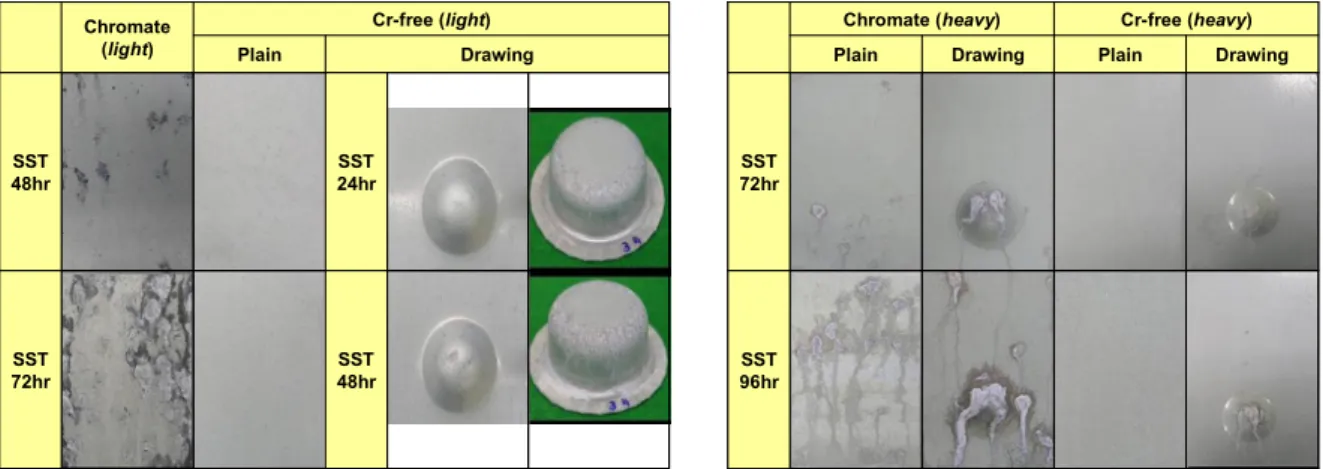
Fig. 2. Corrosion resistance for the chromate and Cr-free coated steels with light (left) and heavy (right) coating weights.
chromate (light) chromate (heavy) Cr-free (light) Cr-free (heavy) 4
5 6 7 8 9 10
Spot welding current (KA)
Coated steels 0 200 400 600 800 1000 1200 1400 1600
0 100 200 300 400
Tensile shear strength (Kgf cm)
No. of spot welds
Cr-free (light) Cr-free (heavy)
chromate (light) chromate (heavy) Cr-free (light) Cr-free (heavy) 4
5 6 7 8 9 10
Spot welding current (KA)
Coated steels
chromate (light) chromate (heavy) Cr-free (light) Cr-free (heavy) 4
5 6 7 8 9 10
Spot welding current (KA)
Coated steels 0 200 400 600 800 1000 1200 1400 1600
0 100 200 300 400
Tensile shear strength (Kgf cm)
No. of spot welds
Cr-free (light) Cr-free (heavy)
Fig. 3. Continuous spot welding performance of the Cr-free coated steels (left) and spot welding currents (right).
mixing both surface modified silicate sol with silane cou- pling agent and inorganic corrosion inhibitor such as or- ganic-titanate compound in the dilute phosphate solution.
When the solution treated on the electrogalvanized steels, organic-inorganic conversion layer was formed from the strong binding between silane-silicate-titanate hybrid layer and zinc surface. It is suggested that these hybrid layer may affords excellent quality performances as like a poly- meric layer of chromate analog.3)-5) In addition, new hybrid coating solutions are fairly stable in the acidic or alkaline conditions and withstand several weeks without quality deterioration. We have developed two types of Cr-free coated electrogalvanized steel products with different coat- ing weights which are comparable to conventional chro- mate light and heavy analogs.
3.2 Corrosion Resistance
Corrosion resistance tests of conventional chromate and Cr-free coated steel products are shown in Fig. 2. We have prepared two types of Cr-free products to substitute two
types of conventional chromate products, light and heavy.
As shown in Fig. 2, both light and heavy Cr-free coated products with coating weight of 300 and 800 mg/m2, re- spectively, show excellent corrosion resistance in both plain and drawing from the salt spray test, and exhibit dependence of Cr-free coating weights on the zinc surface.
These results are well compared with both conventional chromate coated steels even if Cr-free steels have approx- imately 3-fold in total coating weights. It is suggest that the formation of organic-inorganic hybrid layers between silane-silicate-titanate hybrid and zinc surface gives ex- cellent barrier and self-healing effect.
3.3 Electric Conductivity and Spot Weldability
In the household appliances surface electric conductivity is important due to electrical grounding of the instruments and weldability to fabricate parts. Therefore small coating weight is usually adopted to overcome drawback of in- sulating property of organic coating layer in the surface coated steels. Both new Cr-free coated steels exhibit sur-
Cr-free (light) Chromate (light)
Exterior appearance Cr-free (light) Chromate (light)
Exterior appearance
Cr-free (light)
Cross-hatch + Ericksen 10mm + Tape peeling
Adhesion Cr-free (light)
Cross-hatch + Ericksen 10mm + Tape peeling
Adhesion
Cr-free (light) Chromate (light)
Corrosion resistance after X-cut (SST, 240hr)
Cr-free (light) Chromate (light)
Corrosion resistance after X-cut (SST, 240hr)
Fig. 4. Paint adhesion tests of the Cr-free and chromate coated steels with light coating weight.
face electrical resistances less than 0.06 mΩ that is com- parable to those of conventional chromate steels. These results suggest that strong binding between organic-in- organic hybrid layer with small coating weight and zinc surface causes high surface electric conductance. Fig. 3 shows the tensile shear strength and spot welding current for Cr-free coated steels in the specified continuous weld- ing test and the latter compare four types of coated steels.
Both Cr-free coated steels show more than 1000 con- tinuous spot welds. And spot welding currents of Cr-free coated steels are well compare with those of chromate steels. Two types of Cr-free coated steels that have thin coating layer, less than 1 μm, assures excellent con- ductivity and weldability.
3.4 Paint adhesion and Thermal Tolerance
Fig. 4 shows the comparison of the exterior appearance, paint adhesion test, and salt spray test between new light Cr-free coated steels and light chromate alternative. Due to strong adhesion of the hybrid coating layer to zinc sur- face, new development exhibits excellent paint adhesion property.
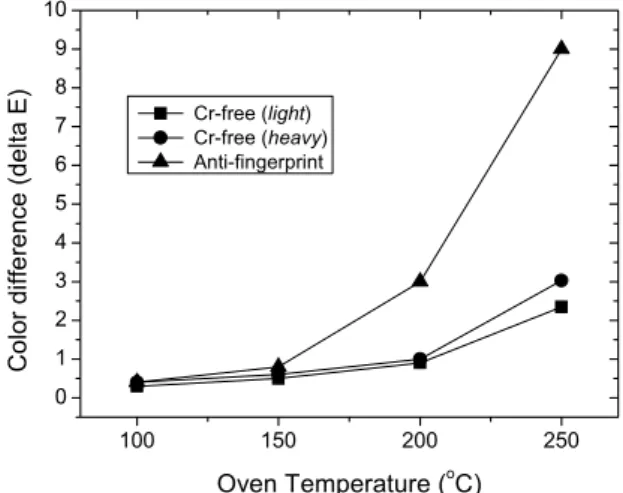
Fig. 5 shows the thermal tolerance test results of the Cr-free coated steels compared with conventional anti-fin- gerprint steels as references that consist of mainly organic polymer resin. Usually organic polymer resins cannot with- stand at elevated heating temperature, more than 200 ℃, because of thermal breaking or yellowing of the polymer.
New Cr-free hybrid products can withstand at typical cure temperature without strong deterioration of coating layer, even though slightly changed at 250 ℃. These results can be explained by the strong binding and thermal stability of the organic-inorganic hybrid layer on the zinc surface.
4. Concluding remarks
To afford an environmental-friendly steel sheets we have developed new two types of Cr-free hybrid coated electrogalvanized steels that consist of surface modified silicate with silane and titanate compound in the dilute
100 150 200 250
0 1 2 3 4 5 6 7 8 9 10
Color difference (delta E)
Oven Temperature (oC)
Cr-free (light) Cr-free (heavy) Anti-fingerprint
Fig. 5. Thermal tolerance tests for the Cr-free (light & heavy) and polymer-based anti-fingerprint coated steels.
Fig. 6. Typical correlation between the coating weights vs.
electrical conductivity, corrosion resistance, and abrasion property on the organic polymer-based resin coated steels.
phosphate solution. In general, among the surface electric conductivity, electric conductivity, and abrasion property in the organic polymer-based resin coated steels show good correlation with coating weights on the zinc surface shown in Fig. 6. As the coating weight increases, electrical conductivity decreases due to insulation property of the coating layer, however anti-corrosive property increase be- cause of increased barrier effect of the thicker coating layer. Also the more coating weight gives better abrasion property that affords good press formability. For the household appliances a proper coating weights (or thick- ness) of the Cr-free coating layer is the most important to get high formability and good weldability. Generally these performances are changed drastically at about 1.0 g/m2 by coating weights. Therefore new Cr-free coated steels are developed two-types of Cr-free coated products with less than 1.0 g/m2 coating weights by using new hy- brid coating solution.
The anti-corrosion properties of new Cr-free products provide equal or better performance compared with those of conventional chromate analogs. It is proposed that these results come from the strong binding of modified sili- cate-silane-titanate hybrid layer on the zinc surface to af- ford high barrier and self-healing effect. Both the surface electric conductivity and spot weldability of the Cr-free coated steels exhibit comparable performance compared to the chromate alternatives. Since new hybrid coating sol-
utions don't use dangerous and harmful chemicals, workers who process and handle the Cr-free coated steels enjoy a healthier work environment. Moreover the new hybrid solutions are fairly stable in solution state and withstand for several decades without deterioration of the quality performance. Therefore the new coating solution could be used for longer period of time without disposal of the used solution which is normally meet in organic polymer based coating solution. These two types of Cr-free coated steels are under production in electrogalvanizing line of POSCO and will expand customer application for household appli- ance and automotive.
References
1. Official Journal of EU, L 37/19, 13, 2 (2003).
2. Official Journal of EU, L 37/24, 13, 2 (2003).
3. M. Yamshita et al., “Growing Steel Sheets and Coated Steel Sheets”, The 167th and 168th Nishiyama Memorial Technical Symposium, p. 158, Tokyo (1998).
4. W. J. Van Ooij, A. Seth, T. Mugada, G. Pan, and D. W.
Scgaefer, “A Novel Self-Priming Coating for Corrosion Protection”, Proceedings of the 3rd International Engi- neering Congress, Orlando, FL, August 2-4 (2004).
5. P. Innocenzi, T. Kidchob, and T. Yoko, “Hybrid Organic- Inorganic Sol-Gel Materials Based on Epoxy-Amine Systems”, Journal of Sol-Gel Science and Technology, 35, 225 (2005).