38 Coronavirus disease 2019 (COVID-19) caused by the novel severe acute respiratory syndrome coronavirus 2 has continued to influence healthcare dynamics, social patterns, and economic systems worldwide. As of mid-March 2021, COVID-19 has already resulted in more than 97,000 infections and 1,690 deaths in South Korea. To date, no treatment has demonstrated its effectiveness with a sufficient level of scientific evidence. Fortunately, a major milestone in the efforts against this pandemic was the rapid and successful development of different vaccines against COVID-19. However, the development of vaccines alone cannot overcome COVID-19. Until the transition to normalcy is achieved, appropriate management for high- risk groups will continue to be one of the main strategies for combating COVID-19.
It has been recommended that patients with high risk for COVID-19 should be given access to early diagnosis and management.1 Older patients and those with underlying comorbidities or at long-term care facilities may be vulnerable to COVID-19 outbreaks or an increased risk of poor prognosis and death.2,3 Most patients with dementia have these 3 risk factors.
We conducted a retrospective observational study to examine the relationship between the mortality of patients with COVID-19 infection and underlying comorbidities, including dementia. Using de-identified data from the Health Insurance Review and Assessment Service (HIRA) of Korea, which were collected until April 8, 2020, we analyzed all patients who had been tested for COVID-19 and who had a history of medical service use for the past 5 years. All patients with COVID-19 were categorized as reverse transcription polymerase chain reaction (RT-PCR) test-positive cases when the diagnosis was confirmed by RT-PCR using respiratory tract specimens. Underlying comorbidities were selected with reports of possible association with COVID-19 in Charlson's comorbidities and previous methods with HIRA of Korea. Thus, the following data were extracted: age at the time of diagnosis, sex, underlying comorbidities during the past 5 years, and mortality. The comorbidities were as follows:
hypertension, heart failure, chronic kidney disease, chronic lung disease, diabetes mellitus, ischemic heart disease, dyslipidemia, history of malignancy, arthritis or arthropathy, stroke, Parkinson's disease, epilepsy, and dementia (Supplementary Table 1). Non-surviving patients were identified in addition to those who had died despite medical intervention after confirmation of COVID-19.
A total of 1,697 COVID-19 patients with a PCR-confirmed diagnosis were identified. The mean±standard deviation for age was 47.0±21.4 years (with 30.6% of patients ≥60 years old), and 41.7% of the patients were men. The overall mortality was 3.5% (59 of 1,697 patients) in Dement Neurocogn Disord. 2021 Jul;20(3):38-40
https://doi.org/10.12779/dnd.2021.20.3.38 pISSN 1738-1495·eISSN 2384-0757
Letter to the Editor
Received: Mar 26, 2021 Revised: May 8, 2021 Accepted: May 20, 2021 Correspondence to Moon Ho Park
Department of Neurology, Korea University Ansan Hospital, 123 Jeokgeum-ro, Danwon- gu, Ansan 15355, Korea.
E-mail: [email protected]
© 2021 Korean Dementia Association This is an Open Access article distributed under the terms of the Creative Commons Attribution Non-Commercial License (https://
creativecommons.org/licenses/by-nc/4.0/) which permits unrestricted non-commercial use, distribution, and reproduction in any medium, provided the original work is properly cited.
ORCID iDs Dae-Sung Kyoung
https://orcid.org/0000-0003-3993-716X Jeongwoo Lee
https://orcid.org/0000-0002-1381-6039 Hyewon Nam
https://orcid.org/0000-0002-2225-7689 Moon Ho Park
https://orcid.org/0000-0002-4892-3475 Conflict of Interest
Park MH has no financial conflicts of interest.
Hanmi Pharmaceutical Company provided support in the form of salaries for the other authors (Lee J, Nam H, Kyoung DS), but did not have any additional role in the study design, data collection and analysis, decision to publish, or preparation of the manuscript.
Author Contributions
Conceptualization: Park MH; Data curation:
Dae-Sung Kyoung ,1 Jeongwoo Lee ,1 Hyewon Nam ,1 Moon Ho Park 2
1Department of Data Science, Hanmi Pharmaceuticals Co., Ltd, Seoul, Korea
2Department of Neurology, Korea University Ansan Hospital, Ansan, Korea
Dementia and COVID-19 Mortality in South Korea
https://dnd.or.kr
Lee J, Nam H, Kyoung DS; Formal analysis:
Lee J, Nam H, Kyoung DS; Investigation: Park MH, Lee J; Methodology: Park MH, Lee J;
Validation: Park MH, Lee J; Writing - original draft: Park MH; Writing - review & editing: Park MH, Kyoung DS.
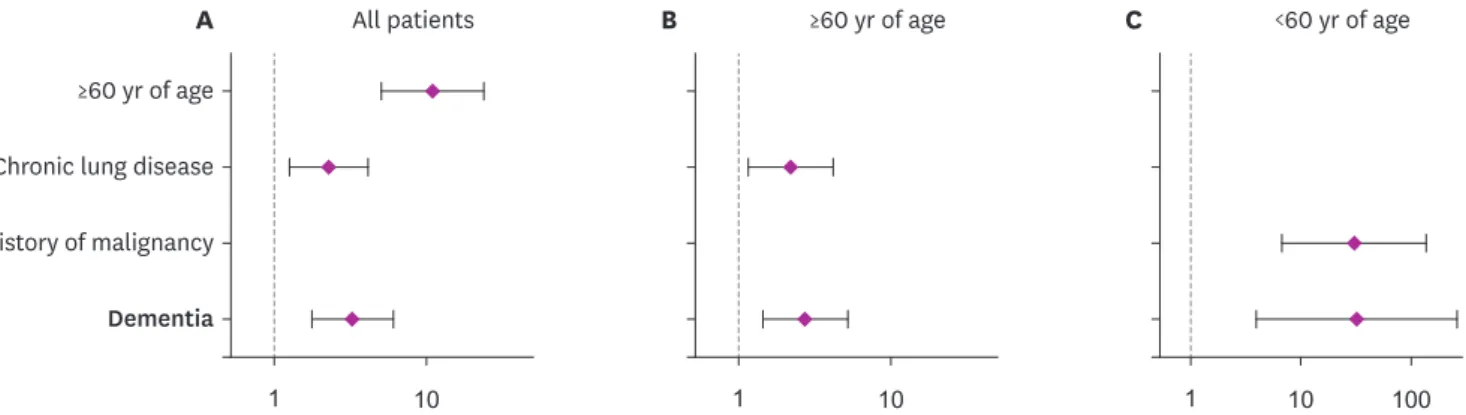
this study population. By a multivariable logistic regression analysis, independent predictors of in-hospital death for COVID-19 were old age (odds ratio [OR], 10.75; 95% confidence interval [CI], 4.93–23.44), chronic lung disease (OR, 2.24; 95% CI, 1.25–4.03), and dementia (OR, 3.19; 95% CI, 1.71–5.93) (Fig. 1 and Supplementary Table 2). The age-stratified analysis for COVID-19-related death revealed that patients ≥60 years of age had accompanying chronic lung disease (OR, 2.14; 95% CI, 1.13–4.04) and dementia (OR, 2.68; 95% CI, 1.41–5.09), whereas patients <60 years of age had accompanying history of malignancy (OR, 30.31; 95%
CI, 6.58–139.60) and dementia (OR, 32.37; 95% CI, 3.95–265.10).
This study showed that dementia was an important risk factor for in-hospital deaths of COVID-19 patients in South Korea, regardless of the age. Patients with dementia face a
“double burden,” as the pandemic exacerbates both their vulnerability due to increased morbidity and mortality and breakdown of their social support and access to the healthcare system due to lockdown and social distancing measures.4 Clinicians and policy makers can use our results to tailor management strategies for patients with dementia, whereas researchers can utilize our findings to improve patient-important outcomes.
ACKNOWLEDGEMENTS
The authors appreciate healthcare professionals dedicated to treating COVID-19 patients in Korea, and the Ministry of Health and Welfare and the Health Insurance Review &
Assessment Service of Korea for sharing invaluable national health insurance claims data in a prompt manner.
SUPPLEMENTARY MATERIALS
Supplementary Table 1
Definitions and ICD-10 codes used for identifying comorbidities Click here to view
39 https://doi.org/10.12779/dnd.2021.20.3.38
Dementia and COVID-19 Mortality
https://dnd.or.kr
1
All patients
10
≥60 yr of age
Dementia History of malignancy Chronic lung disease A
1
≥60 yr of age
10
B
1
<60 yr of age
10 100
C
Fig. 1. Risk factors associated with death among coronavirus disease 2019 patients. Multivariable logistic regression analyses are shown with odds ratios and 95% confidence intervals.
Supplementary Table 2
Univariable and multivariable analysis of risk factors associated with death among COVID-19 patients
Click here to view
REFERENCES
1. Sun Q, Qiu H, Huang M, Yang Y. Lower mortality of COVID-19 by early recognition and intervention:
experience from Jiangsu Province. Ann Intensive Care 2020;10:33.
PUBMED | CROSSREF
2. Wu Z, McGoogan JM. Characteristics of and important lessons from the coronavirus disease 2019 (COVID-19) outbreak in China: summary of a report of 72314 cases from the Chinese Center for Disease Control and Prevention. JAMA 2020;323:1239-1242.
PUBMED | CROSSREF
3. McMichael TM, Currie DW, Clark S, Pogosjans S, Kay M, Schwartz NG, et al. Epidemiology of COVID-19 in a long-term care facility in King County, Washington. N Engl J Med 2020;382:2005-2011.
PUBMED | CROSSREF
4. Brown EE, Kumar S, Rajji TK, Pollock BG, Mulsant BH. Anticipating and mitigating the impact of the COVID-19 pandemic on Alzheimer's disease and related dementias. Am J Geriatr Psychiatry 2020;28:712-721.
PUBMED | CROSSREF
40 https://doi.org/10.12779/dnd.2021.20.3.38
Dementia and COVID-19 Mortality
https://dnd.or.kr