Towards Actualizing the Value Potential of Korea Health
Insurance Review and Assessment (HIRA) Data as a Resource for Health Research: Strengths, Limitations, Applications, and
Strategies for Optimal Use of HIRA Data
Health Insurance and Review Assessment (HIRA) in South Korea, also called National Health Insurance (NHI) data, is a repository of claims data collected in the process of reimbursing healthcare providers. Under the universal coverage system, having fee-for- services covering all citizens in South Korea, HIRA contains comprehensive and rich information pertaining to healthcare services such as treatments, pharmaceuticals, procedures, and diagnoses for almost 50 million beneficiaries. This corpus of HIRA data, which constitutes a large repository of data in the healthcare sector, has enormous potential to create value in several ways: enhancing the efficiency of the healthcare delivery system without compromising quality of care; adding supporting evidence for a given intervention; and providing the information needed to prevent (or monitor) adverse events. In order to actualize this potential, HIRA data need to actively be utilized for research. Thus understanding this data would greatly enhance this potential. We introduce HIRA data as an important source for health research and provide guidelines for researchers who are currently utilizing HIRA, or interested in doing so, to answer their research questions. We present the characteristics and structure of HIRA data. We discuss strengths and limitations that should be considered in conducting research with HIRA data and suggest strategies for optimal utilization of HIRA data by reviewing published research using HIRA data.
Keywords: National Health Insurance; Claims Data; Health Research; Healthcare Services;
Health Insurance Review and Assessment Service; HIRA Data; Korea Jee-Ae Kim,1 Seokjun Yoon,2
Log-Young Kim,1 and Dong-Sook Kim1
1Pharmaceutical Policy Research Team, Health Insurance Review & Assessment Service, Wonju, Korea; 2Department of Preventive Medicine, College of Medicine, Korea University, Seoul, Korea Received: 4 September 2016
Accepted: 28 January 2017 Address for Correspondence:
Dong-Sook Kim, PhD
Department of Research, Health Insurance Review &
Assessment Service, 60 Hyeoksin-ro, Wonju 26465, Republic of Korea
E-mail: [email protected]
https://doi.org/10.3346/jkms.2017.32.5.718 • J Korean Med Sci 2017; 32: 718-728
INTRODUCTION
Medical practices today strive to be evidenced-based. Random- ized clinical trials (RCTs) are widely recognized as the type of studies that generally have the greatest level of quality with re- spect to generating evidence for medical decisions. However, due to some limitations of RTCs, quasi-experimental studies and observational studies are also important sources for pro- viding evidence. One drawback of RCTs is that they usually have sample sizes that are often not large enough to capture rare events.
RCTs also tend to under-represent vulnerable populations such as the elderly and those associated with “low income.” More- over, they usually require significant resources — such as time, labor, and funds — the needs for which tend to increase as tar- get sample sizes increase. Despite their advantages in minimiz- ing the risk of bias due to confounding, their generalizability vis-à-vis the general population may be limited because RCTs are usually conducted in highly controlled environments that are different from those in routine practice (1-3).
Observational studies with secondary health data can be an alternative to RCTs by addressing these shortcomings of RCTs, and in recent years, they have been grown (4). One kind of im- portant secondary data is health insurance claims data, which are routinely collected for payment of healthcare services. Such data offer details on medical procedures, treatments including pharmaceuticals, and socio-demographic characteristics of beneficiaries such as gender, residence, and income status. By contrast, claims data have variations depending on the type and scope of program. They are representative and compre- hensive for large patient populations, encompassing elderly, children, the very poor and the institutionalized — i.e., all who exist at the furthest margins of our society and thus easily ex- cluded or under-represented in clinical trials. Since claims data are already collected, they are less expensive to procure than an RCT and tend to be free of ethical obstacles — for instance a clinical equipoise that assumes no better intervention exists than designing an RCT (5); the necessity of sufficient belief that the intervention under investigation is safe; and the risk of ad- Medical Informatics
verse health effects as a consequence of an RCT.
Several forms of claims data have been utilized in North Amer- ica, Europe, and Asia. The United States have multiple databas- es operated by private insurers such as Kaiser Permanente and those belonging to public programs such as Medicare and Med- icaid. In Europe, the General Practice Research Database (GPRD) in the United Kingdom is most widely used (6). The GPRD con- sists of longitudinal medical records from primary care and of- fers accurate information on diagnoses, prescriptions and other healthcare services because the database is generated from med- ical records from general practitioners. Taiwan is the leading country in utilizing claims data for healthcare service research in Asia. Health insurance in Taiwan is based on fee-for-services and has features of health policy similar to that of Korea such as the single-payer, universal, and compulsory healthcare insur- ance model. This system covers 99% of the residents in Taiwan.
The Taiwan National Health Research Institute (NHRI) is en- trusted with continuously and systematically collecting relevant registration and claims data present in the insurance system.
The National Health Insurance Research Database (NHIRD) contains comprehensive computerized National Health Insur- ance (NHI) records of the entire population in Taiwan. As a reli- able data source for health research, it has been utilized for aca- demic research in various scientific disciplines. As a result, the number of research articles pertaining to such data have rapidly increased (7).
The Health Insurance and Review Assessment data are health insurance claims data which is also called NHI data, as they are generated in the process of reimbursing claims for healthcare services under the NHI system in Korea. Availability of HIRA data for research was limited to a few research projects that were mainly commissioned by the government. HIRA data become publically available for research in 2009 and the use of the data has increased since then. The availability of the data has been accelerated by a government initiative promoting “Opening and Sharing Big Data for Value Creation” in 2013.
Despite the large potential value of HIRA data in answering a wide spectrum of research questions in health research encom- passing outcomes, public health, epidemiology, biostatistics, health informatics and health economics, research with HIRA data was not actively conducted in Korea compared to the US and other European countries. This may be partly due to lack of awareness of its existence and its potential and barriers to ac- cessing the data arising from its complicated structures and nu- merous variables that require significant efforts to understand before extracting any of the necessary information.
To transform the potential of HIRA data into actual value, the data need to be precisely utilized for research. Thus understand- ing the characteristics of the data is essential. To this purpose, we provide guidelines on the use of HIRA data for researchers who are interested in using the data in answering their research
questions. The paper consists of 5 sections. The first section pres- ents the establishment and roles of HIRA and describes the gen- eral features of HIRA. The second section examines advantages and limitations of HIRA data that can compromise the validity of studies. In the third section, we present application of HIRA data by examining previous studies that have used this data, to suggest areas of research where HIRA data may be applicable and strategies to overcome limitations of the data. In this sec- tion, we also present ways to access the data. The next section contains the discussion and implications for policy and the fi- nal section is conclusion.
THE GENERAL FEATURES OF HIRA DATA Establishment of HIRA
Having introduced a medical insurance program for compa- nies with 500 or more employees in 1977, Korea gradually ex- panded the coverage and achieved universal coverage in 1989.
In order to drive the health insurance system more efficiently and effectively — through implementing measures such as re- ducing administrative cost, enhancing management efficiency, simplifying systems for claims and reimbursement, bolstering financial stability, and pooling national risk — integration of multiple-insurers into single-insurers was deliberated. In 1998, the health insurance system was reformed to integrate the frag- mented regional medical insurance societies for the self-em- ployed, farmers and fishermen with the then-prevalent medical insurance service provided for government employees and pri- vate school employees. In order to complete this reform, the NHI Act was enacted in 1999. Through the enactment of this legislation, the full integration of all medical insurance societies, including those that had served company employees, was attain- ed through the formation of the unified NHI system in 2000. The HIRA and the National Health Insurance Service (NHIS) were thereby established.
The HIRA was founded as an independent single agency dis- tinct from the insurer, providers and other interested parties. The HIRA has 2 main roles: reviewing medical fees for reimburse- ment decisions; and assessing quality of healthcare services provided to beneficiaries. The HIRA assures the appropriate healthcare provisions through the fair and objective review and assessment in the partnership with NHIS. In addition to these routine procedures, the HIRA has the research department per- form research to improve reviews and assessment and to pro- vide the government with the policy-making resources based on its research. The HIRA develops data and information con- cerning clinical, social, and economic implications of health care. The NHIS reviews the eligibility of insured policy holders;
imposes and collects contributions; negotiates the medical fee schedule with healthcare service providers; and reimburses healthcare services provided in accordance with the HIRA’s re-
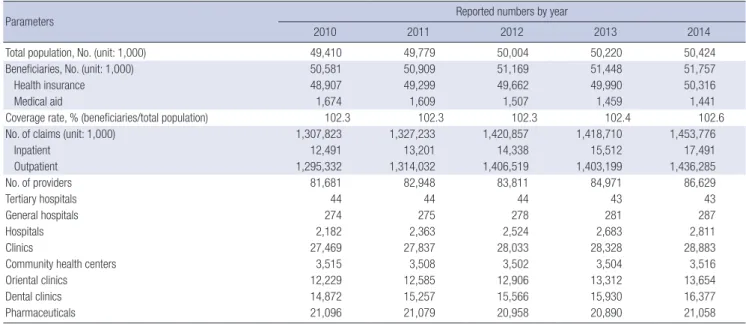
Table 1. NHI program from 2010
Parameters Reported numbers by year
2010 2011 2012 2013 2014
Total population, No. (unit: 1,000) 49,410 49,779 50,004 50,220 50,424
Beneficiaries, No. (unit: 1,000) 50,581 50,909 51,169 51,448 51,757
Health insurance 48,907 49,299 49,662 49,990 50,316
Medical aid 1,674 1,609 1,507 1,459 1,441
Coverage rate, % (beneficiaries/total population) 102.3 102.3 102.3 102.4 102.6
No. of claims (unit: 1,000) 1,307,823 1,327,233 1,420,857 1,418,710 1,453,776
Inpatient 12,491 13,201 14,338 15,512 17,491
Outpatient 1,295,332 1,314,032 1,406,519 1,403,199 1,436,285
No. of providers 81,681 82,948 83,811 84,971 86,629
Tertiary hospitals 44 44 44 43 43
General hospitals 274 275 278 281 287
Hospitals 2,182 2,363 2,524 2,683 2,811
Clinics 27,469 27,837 28,033 28,328 28,883
Community health centers 3,515 3,508 3,502 3,504 3,516
Oriental clinics 12,229 12,585 12,906 13,312 13,654
Dental clinics 14,872 15,257 15,566 15,930 16,377
Pharmaceuticals 21,096 21,079 20,958 20,890 21,058
NHI = National Health Insurance.
Providers
Provide healthcare services
Submit claims to HIRA
HIRA
Review claims
Decide on reimbursement
Save claims paid in DW DW
- Assess benefit quality - Produce statistics for healthcare services - Provide data for research
Fig. 1. Flow of data generation of HIRA data.
HIRA = Health Insurance and Review Assessment, DW = data warehouse.
imbursement decisions.
NHI has covered almost 98% of the total population, which numbered approximately 50 million as of 2014 in Korea (Table 1). Under the terms of universal health coverage, all healthcare providers — numbering approximately 80,000 — and all citi- zens are required to be covered under NHI, which is based on fee-for-services except in cases involving seven types of condi- tions (Table 1).
Data generation process
HIRA data is generated in the process of reimbursing providers under NHI and contain specific yet comprehensive information on the relevant healthcare services such as procedures, surger-
ies, examinations, and treatment, including prescriptions as well as the socio-demographic characteristics of patients.
Claims are electronically submitted by providers to HIRA which reviews claims and makes reimbursement decisions. Billing state- ments for claims for which reimbursement has been completed are stored in the data warehouse (DW) as a record within a da- tabase consisting of multiple datasets (Fig. 1). Datasets in the DW become sources of generating statistics on healthcare ser- vices, developing indices on quality for each respective type of care, and for health research.
Structure of HIRA data
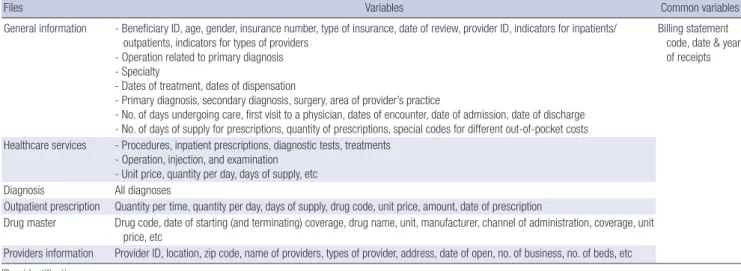
HIRA research data consists of 6 files (Table 2): 1) the general information file; 2) the healthcare services file, including inpa- tient prescriptions; 3) the diagnoses file; 4) the outpatient pre- scriptions file; 5) the drug master file; and 6) the provider infor- mation file.
The general information file is a common denominator file and is essential in identifying the study population of interest, as it contains variables representing such fields as the benefi- ciary’s socio-economic characteristics (age and gender), type of insurance (health insurance and medical aid), and 2 diagnoses of which treatment require the most intensive resources (pri- mary and secondary). The file includes variables related to dates pertaining to such events as patient-provider encounters, ad- mission to hospitals and discharge, and lengths of stay for inpa- tients. Cost information is also included (patient out-of-pocket costs and payer costs) along with payer information (e.g. type and size of practice). The file includes information on whether an operation for a primary diagnosis was performed and the date it was performed. Beneficiary identification (ID) and pro- vider ID are all stored in an encrypted format in order to protect
personal information.
The healthcare services file houses specific and detailed in- formation for healthcare services provided to beneficiaries such as procedures, diagnostic tests, treatments, and inpatient pre- scriptions.
The diagnosis file includes records of all diagnoses that a ben- eficiary has received. This file is useful in identifying co-mor- bidities or assessing the general health status via such figures as the Charlson Comorbidity Index (CCI) (8) and Elixhauser Co- morbidity Index (9). Diagnoses are coded in compliance with Korean Standard Classification of Diseases Version 6 (KCD6) which is based on International Classification of Diseases 10th Revision (ICD-10).
The outpatient prescription file contains detailed informa- tion on each outpatient prescription, including the following:
date of drug prescribed; prescriber ID; name of drug and active ingredients; dose; quantity; number of days of supply; and cost.
When prescription drugs are of main interest, researchers need to select either the healthcare service table for inpatient prescrip- tions, outpatient prescription table, or both tables depending on the scope of drugs studied.
The drug master file is a relational database that provides in- formation such as product code; start and expiry date for cover- age; quantity and unit of measure; manufacturer; routes of ad- ministration; coverage status indicator (e.g., covered/non-cov- ered, deleted); indicator of eligibility for generic substitution;
and therapeutic drug classification codes delineated by the Min- istry of Health and Welfare of Korea. The drug master file is reg- ularly updated by accumulating new or altered information.
Thus researchers need to use an instance of the database con- current with the period of the analysis. The drug master file is linked with the outpatient prescription file and healthcare ser- vice file by using product codes, which are unique identifiers, as foreign keys.
The provider information file carries information about health- care providers such as the provider ID; practice location(s); pro- vider type (i.e., primary, secondary, or tertiary); the number of beds; and inception date of institution. This file is useful in ex- ploring patterns or behavior on the part of physicians in prescrib- ing drugs, performing procedures, and administering treatment.
Each file is linkable via encrypted beneficiary ID and billing state- ment codes assigned to an individual claim, as shown in Fig. 2.
ADVANTAGES AND LIMITATIONS OF HIRA DATA Advantages
Research using HIRA data have more reliable and rigorous find- ings than ones containing sample data, which may have limita- tions in representing the populations of interest. The data in- clude information on almost 50 million patients, covering 98%
of the total population through the universal coverage system, in which all citizens are covered and all healthcare service pro- viders provide services to patients in Korea. The collection of Table 2. List of files with variables (selective)
Files Variables Common variables
General information - Beneficiary ID, age, gender, insurance number, type of insurance, date of review, provider ID, indicators for inpatients/
outpatients, indicators for types of providers - Operation related to primary diagnosis - Specialty
- Dates of treatment, dates of dispensation
- Primary diagnosis, secondary diagnosis, surgery, area of provider’s practice
- No. of days undergoing care, first visit to a physician, dates of encounter, date of admission, date of discharge - No. of days of supply for prescriptions, quantity of prescriptions, special codes for different out-of-pocket costs
Billing statement code, date & year of receipts
Healthcare services - Procedures, inpatient prescriptions, diagnostic tests, treatments - Operation, injection, and examination
- Unit price, quantity per day, days of supply, etc Diagnosis All diagnoses
Outpatient prescription Quantity per time, quantity per day, days of supply, drug code, unit price, amount, date of prescription
Drug master Drug code, date of starting (and terminating) coverage, drug name, unit, manufacturer, channel of administration, coverage, unit price, etc
Providers information Provider ID, location, zip code, name of providers, types of provider, address, date of open, no. of business, no. of beds, etc ID = identification.
Fig. 2. Linkage of files.
ID = identification.
Diagnosis file Health service file Outpatient prescription file Lab
data
Provider information
file
Drug master file
Product code Product code
Billing statement code
Patient ID Provider ID
Billing statement code
Billing statement code General
information file
data is quite complete because 99% of claims are electronically submitted by providers, and the chances of missing claims are highly unlikely. The NHI system in South Korea, which is based on a fee-for-service delivery system except in a few specific cas- es which presented 7 conditions are reimbursed with diagnosis related group (DRG), provides highly comprehensive benefits covering conditions ranging from mildly acute conditions — such as colds and upper respiratory infections — to severe con- ditions such as malignancy and leukemia. To be specific, both inpatients and outpatients are included in the data, allowing follow-up of the entire healthcare service utilization of any giv- en patient over the course of treatment. Consequently, HIRA data contain healthcare service records from the infant to the elderly across the full range of health care settings regardless of geographic location, unlike claims data from Medicare and Med- icaid programs, which cover either the elderly or those in the low income bracket in the United States.
This representativeness and comprehensiveness offer rese- arch opportunities that would not be feasible using RCTs — for instance when studying rare conditions, adverse reactions to drugs, and populations at the margins of the society, such as the elderly, the disabled, and the institutionalized — as all these demographic groups are excluded or under-represented in RCTs.
Due to the large scale of the data, it is possible to have a suffici- ently large sample size to secure corresponding statistical pow- er for sophisticated analyses in studies while having narrower margins of error. Researchers are also able to derive variables from this data, which contain rich and specific information on healthcare utilization, procedures, diagnoses, treatment, and payments.
Records of healthcare service utilizations and diagnoses of individual beneficiaries are continuously accumulated in the database, and this enables researchers to track the same sub- jects over a period of time. This longitudinal characteristic of the data may be conducive to conducting cohort studies and exploring long-term outcomes (effects) from exposures that may not be immediately observed. Furthermore, information in HIRA data is provided exclusively by healthcare providers;
consequently, studies employing this data can avoid errors aris- ing from patient self-reporting and non-response, both of which are issues in survey-based studies (10).
Due largely to its secondary nature, HIRA data offers the key advantage that utilizing it is economical compared to primary data, because the data is already collected. Thus making it un- necessary to expend resources such as time, labor, and money for data collection. The likelihood of studies based on HIRA data of facing ethical issues is not great, unlike RCTs, where for in- stance the decision on whether to assign a patient to a control group vs. a treatment group is fraught with such ethical consid- erations whenever there are any potential risks during treatment.
In contrast to those based on RCTs, studies based on HIRA data
provide support for effectiveness of interventions among the general population in routine care; and HIRA-based studies are thus more useful in assessing efficacy and likely have a higher degree of external validity.
Limitations
Despite advantages, HIRA data have limitations that need to be dealt with in conducting research. Firstly, HIRA data lack some kinds of information. The data do not have records accumulat- ed from laboratories, notably on the severity of conditions and health behavior of beneficiaries. For example, although the data may contain information on whether a diagnosis of cancer has been made, there are no indications on the severity or stage of the cancer. Information pertaining to health behavior such as smoking status, drinking, exercise, and diet is not included in the data — even while these pieces of absent information are often as important as outcomes, risk factors, or exposures.
As the claims data are generated to reimburse healthcare ser- vices eligible for coverage, services such as cosmetic surgical pro- cedures or over-the-counter drugs that are, as matters of policy, not covered under the system are also absent in the data. Con- sequently, studying non-covered healthcare services is not pos- sible when relying solely on HIRA data.
Discrepancies occur between diagnoses entered in the data and diseases that a patient has in reality; and this can be a po- tential source of another limitation of HIRA data. This discrep- ancy implies that some patients do not necessarily have the medical conditions corresponding to their diagnoses, possibly producing a sort of bias, or at best compromise in the study’s validity. This problem arises from the fact that diagnostic classi- fication is a crucial component for analyses. Such discrepancies may arise from the inherent nature of claims data, which are fashioned to obtain reimbursement, and not designed for clini- cal research purposes. Claims are made with the purpose of generating income for providers, and those who submit them are principally guided by this function. Such a profit-driven mo- tivation may often result in billing practices that use the codes that would provide the highest reimbursement that can plausi- bly be supported by the medical records. Reimbursement poli- cies can also be a contributing factor in these sorts of discrep- ancies. For instance, since the diagnosis itself is the factor that determines whether drugs will be covered, the prescribed drugs are often justified by making a diagnosis that is eligible for cov- erage even though a patient may actually have a condition that is excluded from coverage. Diagnoses that were given prior to ordering a diagnostic test sometimes remain in the data even if they are ruled out by a negative result. Another sort of discrep- ancy may be variations in diagnoses among physicians, who inevitably vary in the procedures they employ and the treatments they prescribe for any given type of medical condition.
Such discrepancies between diagnosis information and the
actual status of health conditions appear not only in HIRA data but also in most other claims data, though HIRA data may have a higher degree of problems largely due to the fee-for-service system and reimbursement policies. A study that examines the accordance of diagnosis in HIRA data to the actual status of health conditions by comparing medical record reports shows that, on average, 70% of diagnoses correspond to diagnoses in medical charts although the accordance rate was different depending on conditions and care setting or types providers (11). Diagno- ses in HIRA data tend to be more accurate for severe conditions rather than acute and minor conditions; for inpatient settings than for outpatient settings; and in hospitals than in clinics (11).
Malignant tumors and injuries had high accordance rates of 77.6% and 81.2%, respectively, while asthma and arthritis had low accordance rates of 41.2% and 59.6%, respectively (11). The accordance rate was 75.9% for inpatient settings and 55.8% for outpatient settings (11).
Another discrepancy can occur. The information about resi- dence of beneficiaries may not be reliable because HIRA data is collected based on the location of providers. As beneficiaries are free to visit any physician without any restrictions, it is pos- sible that the location where a beneficiary has received the health- care service is different from the area where beneficiaries actu- ally live.
Although HIRA data are continuously accumulated, they are available only for a 5-year period beginning from the current year: this is due to the fact that the HIRA regulates store claims for 5 years in the DW and records of claims are removed from the DW after 5 years. Research projects that require long-term follow-up exceeding 5 years are not feasible. Recently, the poli- cy of the storage period has been changed; and accordingly, HIRA plans to expand data storage for 10 years.
The above described limitations are not only found in HIRA data but also in other claims data because they are collected for administrative purposes, not for research. Nonetheless, bene- fits from utilizing HIRA data outweigh those for not utilizing them when limitations are dealt with by employing strategies that will be discussed in the next section.
APPLICATION OF HIRA DATA
Research areas and strategies for the optimal use of HIRA data
In order to find studies with HIRA data, we queried literature using Medline and Cochrane using various combinations of terms such as claims data, administrative data, insurance, health insurance, and HIRA while specifying the search term “Korea”
along with the boolean operator “AND.” We chose to have the search results limited to the period from 2009 to 2015. The rea- son is that HIRA was only accessible by those doing research on a government-commissioned basis prior to 2009,and the data-
base has been accessible to all researchers since 2009. We ex- cluded literature using the data obtained from the NIHS of Ko- rea. As shown in Table 3, HIRA data were used in various rese- arch areas ranging from medication adherence, prescribing pat- terns, adverse events, cost-effectiveness, burden of disease, health- care service utilization, disease incidence and prevalence, out- comes, policy evaluation, and others such as severity and heal- th informatics.
These studies provide exemplary strategies on how to over- come limitations of HIRA data. For information absent in the HIRA database such as general health status, severity of condi- tion, and cause of death, studies link HIRA data with other sour- ces of governmental-owned data and lab data provided by hos- pitals. A study obtained causes of death by linking investigators’
notes from the National Police Agency to identify suicides, which were not accounted for in the HIRA database as identified sui- cides (12). Studies retrieved and analyzed lifestyle factors such as smoking status and lab data such as spirometry test data by linking to the Korean National Health and Nutritional Survey (KNHANES) of Korea Center for Disease Control and Preven- tion (CDC) (13,14).
Some studies derive (create) variables by using the existing information in the data. Cases of derivation (or creation) of val- ues for variables from the existing information include those in which CCI was derived using diagnosis information for comor- bidities (15-18), medication possession ratio (MPR) and cumu- lative medication adherence (CMA) for medication adherenc- es. These values were derived by extracting the number of days of supply and dates of dispensation from the data (19-24).
To obtain study populations based on conditions more accu- rately, studies developed algorithms rather than simply using diagnostic information, which is one way to address the possi- ble discrepancies between diagnosis in HIRA records and the disease that a patient actually has. Algorithms can be made by supplementing diagnoses with procedures, treatments, or pre- scriptions for treatment. Studying chronic obstructive pulmo- nary disease (COPD) is a paradigmatic example of this approach.
In studies on COPDs with the use of HIRA data, COPD patients are defined as those who are at or above 40 years old with diag- nosis codes of ICD-10 in (J42.x–J44, except J430) and have at least 2 claims for COPD prescriptions per year in long-acting muscarinic antagonist (LAMA), long-acting beta-2 agonist (LA- BA), inhaled corticosteroids (ICS), ICS plus LABA (ICS+LABA), short-acting muscarinic antagonist (SAMA), short-acting beta- 2 agonist (SABA), or theophylline (17,25-28).
Studies using claims data are mostly observational studies, which are susceptible to bias resulting from factors such as se- lection bias and confounding. Therefore, a key challenge in con- ducting observational studies with HIRA data is to address sour- ces of these biases. In doing this, statistical methods can be ad- opted to minimize biases (a complete elimination of biases may
be ideal but often not possible). Multiple regressions, instrumen- tal variables (IVs), and propensity score matching (PSM) are statistical methods to control biases. Each method has its own advantages and disadvantages. PSM is easy to implement but is unable to control biases from unobserved factors whereas it is hard to find suitable IVs, which are strongly correlated with ex-
posure but not with the outcome (29). Studies adopted various statistical approaches depending on study designs, outcomes of interest and topics. Some studies presented only a descrip- tive summary of statistics (30-37) while other studies utilized more advanced statistical approaches to control confounders such as multiple (or logistic) regression (19,20,22-24), Kaplan- Table 3. Research areas using HIRA (or NHI) data
Class Reference Linkage to other data Derived variables Working
definitions Methods
Adherence and persistence, prescribing pattern
(21) No Persistency Yes Kaplan-Meier survival analysis
(22) No Persistency Yes Cox proportional hazard
(20) No MPR Yes Multivariate logistic regression analysis
(24) No CMA Yes Multiple logistic regression analysis
(23) No CMA Yes Multiple logistic regression analysis
(19) No MPR Yes Cox proportional hazard
Healthcare
utilization (40) NHIC — Medicaid-aid case
management center No No Logistic regression analysis (multivariate)
(41) No No No Multivariate logistic regression analysis
(12) Suicides were identified by the investigator’s note from National Police Agency
No No Multiple logistic regression analysis, repeated-measure data analysis (proc mixed procedure)
(42) No Crude surgery rate Yes Poisson regression model
(13) No No No Multivariate logistic regression analysis
(43) No No No Multilevel analysis (linear mixed models with random intercept)
(44) No No No Two-level random effect logistic regression model
(45) No No No Multiple regression analysis
(46) No No No Multiple logistic regression analysis
(14) KNHANES II No No Multivariate logistic regression analysis
(18) No CCI No Multiple logistic regression model
(47) No No No Descriptive summary of statistics
(48) No No No Descriptive summary of statistics
(49) No No No Multiple regression analysis
(16) No CCI No Descriptive summary of statistics
(50) No No No Descriptive summary of statistics
(51) No No No Multiple regression analysis
(25) No No No Multiple regression analysis
Burden of disease (52) No No No Descriptive summary of statistics
Incidence or preva-
lence (30) No No No Descriptive summary of statistics
(53) No No No Descriptive summary of statistics
(31) No No No Descriptive summary of statistics
(32) No No No Descriptive summary of statistics
(33) No No No Descriptive summary of statistics
(34) No No No Life table method
(35) No No No Descriptive summary of statistics
(36) No No No Descriptive summary of statistics
(37) No No No Descriptive summary of statistics
Outcomes (54) No No Yes PSM/Cox proportional hazard
(17) No Charlson score Yes Descriptive summary of statistics/multivariate regression
Adverse event (15) No Charlson score No PSM
Policy evaluation (55) No No No Adjusted rate
(56) No No No -
(57) No No No Descriptive summary
Health informatics and others
(58) Population data from Statistics Korea
Lengthiness index, costliness index, etc
No Clustering, decision tree, stratification (59) National Cancer Center Charlson score No Multivariate analysis
(60) Statistics Korea No No Multivariate logistic analyses
HIRA data is also called NHI data; The list is selective and not mutually exclusive because some fall into multiple categories.
HIRA = Health Insurance and Review Assessment, NHI = National Health Insurance, NHIC = National Health Information Center, MPR = medication possession ratio, CMA = cumulative medication adherence, KNHANES = Korean National Health and Nutritional Survey, CCI = Charlson Comorbidity Index, PSM = propensity score matching.
Meiser survival analysis and Cox proportional hazard regres- sion (19,21,22).
Accessing HIRA data
There are 3 ways to access HIRA data. First, researchers can ac- cess the raw data, often called big data, either by visiting seven research centers located nationwide or by remote access. Raw data are available for researchers in academics and government agencies and for those in the private sector such as pharmaceu- tical companies and medical device companies. The scope of the raw data provided is more limited to those in the private sec- tor. Researchers who are interested in using the raw data need to go through the following procedures. First they need to send an email requesting a consultation for the data use; and such a consultation is made in person at the HIRA. After the consulta- tion, the researcher submits the application including a study proposal for the use of data. HIRA holds committees to review the application for approval of the use of data. Once the approv- al is given, HIRA extracts the data from the DW system tailored for the proposed study. ID information in the data are encrypt- ed to protect private information. The encrypted data are up- loaded in a system where analytical tools such as SAS, SPSS, R, and STATA are installed. The system is accessible only by the individual researcher for the study.
Secondly, the HIRA offers four types of patient samples: 13%
of the national inpatient sample (HIRA-NIS); 3% of the national patient sample (HIRA-NPS); 20% of the aged population sam- ple (HIRA-APS); and 10% of the pediatric patient sample (HI- RA-PPS). Patient samples are available from 2009 to 2015. How- ever, it is not possible to follow an individual over a duration of time, as each sample is cross sectional and none are linkable by individual. No review process is required to acquire samples such as raw data.
Thirdly, summary statistics related to healthcare services such as healthcare expenditures and utilization — including prescrip- tions, medical conditions, and healthcare providers — are pub- licly available through the healthcare big data open system (http:
//opendata.hira.or.kr).
DISCUSSION AND POLICY IMPLICATIONS
HIRA data have a relatively short history of use in research in Korean studies compared to those in European countries and the United States, despite offering advantages such as complete- ness, comprehensiveness, representativeness, and longitudinal characteristics. This is due to the fact that availability and access to HIRA data had been somewhat restricted and the knowledge that such data exists was shared among few researchers. Fur- thermore, even if researchers are interested in using the data, working with HIRA data is not easy. Researchers first have to understand the complex structure, characterized by a large num-
ber of variables, in order to identify information essential for re- search. Once they identify information needed, they should be able to extract information and make a dataset for the analysis.
Researchers also need to adopt a proper statistical approach that best suits the problems related to selection bias and con- founding effects that often threaten the internal validity of ob- servational studies. Observing these caveats require a signifi- cant amount of time, knowledge, skills, and experience. Conse- quently, researchers neglecting or lacking any of these prereq- uisites may become frustrated and abandon any consideration of using HIRA data.
The use of HIRA data to support research suggests further roles for HIRA. The HIRA needs to provide data that are more research friendly and processed with immediate applicability to research. To offer a case in point, the inclusion of variables for specific conditions derived from the data can be provided with variables for conditions derived through algorithms using records of healthcare service utilization, in addition to diagno- sis codes. HIRA also need to encourage studies on identifying severity distribution for conditions.
The case of the United States can be a good example in sup- porting the use of claims data for research. The Center for Medi- care and Medicaid Services (CMS) in the United States provides systematic support for researchers who are interested in using CMS data, such as Medicare and Medicaid data, via contracts with the Research Data Assistance Center (ResDAC) (38) and the Chronic Condition Data Warehouse (CCW) (39). ResDAC provides technical support for researchers in accessing CMS data; training programs in which researchers become aware of strengths and limitations of the CMS database; and expertise on how claims-based studies can explore important health care issues (38). The CCW, another contractor for CMS data, delivers CMS data that have been processed through beneficiary match- ing, deduplication, and merging of the files in order to make it ready for implementation in study analyses (39).
Limitations of HIRA data suggest important policy implica- tions. To fully realize the potential of HIRA data, linkage to ex- ternal data from government sectors and private sectors should be made feasible to fill information absent in HIRA data, which in spite of its deficiencies, nevertheless constitute important components of healthcare service research. These data include causes of death recorded in the Statistics Korea Department, the cancer registry of the National Cancer Center, the Korean Genome and Epidemiology study (KoGES) of CDC, and lab data managed by hospitals. In addition, linkage with spatiotemporal data such as meteorological information supplied by the Korea Meteorological Administration and air pollution information provided by the Ministry of Environment allows studies explor- ing possible associations with the environment on entire popu- lations. The linkage will significantly provide added value to HIRA data by allowing health research, which in turn can en-
hance public health.
Linkage can be possible by working on the following issues.
First, government agencies need to develop the willingness to share and provide its own data for research, which would be enhanced by acknowledging the fact that data provides value that ultimately benefits public health. Institutional support for the linkage of data from different sources needs to be organized, and this can be the most challenging because it requires autho- rization from multiple government agencies that possess data.
Institutional support can be provided via 2 possible options: es- tablishing a new entity or designating a government agency as a service entity. The former, namely establishment of a new en- tity, necessitates a governmental budget, whereas the latter one would face opposition by a non-designated agency, due to the fact that transferring data to another government agency for linkage can be viewed as forfeiting or compromising an organi- zation’s ownership of the data. Last but not least, personal in- formation protection also should be addressed; and this issue is not only laden with technical considerations but also with po- litical considerations involving processes related to modifying regulations on matters such as the proper scope of personal in- formation.
CONCLUSION
HIRA data, which can be described as big data containing health- care service information for most of the Korean population, has enormous potential for research in its ability to create value in several forms such as generating effectiveness data for medi- cine; improving quality of care; delivering an efficient health- care system; monitoring the safety of drugs; and evaluating health policy. As availability and access of HIRA data has grown in the recent years, HIRA data can offer a powerful tool for the assess- ment of healthcare services use and outcomes as long as the appropriate attention is given in regards to their potential limi- tations. HIRA data can enhance its value as al big data source by completing it via linkage with other data found in govern- mental sectors and private sectors.
DISCLOSURE
The authors have no potential conflicts of interest to disclose.
AUTHOR CONTRIBUTION
Conceptualization: Kim JA, Kim DS. Investigation: Kim JA. Writ- ing - review & editing: Kim JA, Yoon S, Kim LA, Kim DS.
ORCID
Jee-Ae Kim http://orcid.org/0000-0002-3195-2552
Seokjun Yoon http://orcid.org/0000-0003-3297-0071 Log-Young Kim http://orcid.org/0000-0002-6160-8357 Dong-Sook Kim http://orcid.org/0000-0003-2372-1807
REFERENCES
1. Booth CM, Cescon DW, Wang L, Tannock IF, Krzyzanowska MK. Evolu- tion of the randomized controlled trial in oncology over three decades. J Clin Oncol 2008; 26: 5458-64.
2. Dans AL, Dans LF, Guyatt GH, Richardson S. Users’ guides to the medical literature: XIV. How to decide on the applicability of clinical trial results to your patient. Evidence-Based Medicine Working Group. JAMA 1998; 279:
545-9.
3. Meyer RM. Generalizing the results of cancer clinical trials. J Clin Oncol 2010; 28: 187-9.
4. Arana A, Rivero E, Egberts TC. What do we show and who does so? An analysis of the abstracts presented at the 19th ICPE. Pharmacoepidemiol Drug Saf 2004; 13: S330-1.
5. Cook C, Sheets C. Clinical equipoise and personal equipoise: two neces- sary ingredients for reducing bias in manual therapy trials. J Manual Ma- nip Ther 2011; 19: 55-7.
6. García Rodríguez LA, Pérez Gutthann S. Use of the UK General Practice Research Database for pharmacoepidemiology. Br J Clin Pharmacol 1998;
45: 419-25.
7. Chen YC, Wu JC, Chen TJ, Wetter T. Reduced access to database. A pub- licly available database accelerates academic production. BMJ 2011; 342:
d637.
8. Deyo RA, Cherkin DC, Ciol MA. Adapting a clinical comorbidity index for use with ICD-9-CM administrative databases. J Clin Epidemiol 1992;
45: 613-9.
9. Elixhauser A, Steiner C, Harris DR, Coffey RM. Comorbidity measures for use with administrative data. Med Care 1998; 36: 8-27.
10. Kendler KS, Gallagher TJ, Abelson JM, Kessler RC. Lifetime prevalence, demographic risk factors, and diagnostic validity of nonaffective psycho- sis as assessed in a US community sample. The National Comorbidity Survey. Arch Gen Psychiatry 1996; 53: 1022-31.
11. Park BJ, Sung J, Park K, Seo SW, Kim SH. Studying on diagnosis accuracy for health insurance claims data in Korea. Seoul: Seoul National Univer- sity, 2003.
12. Cho J, Lee WJ, Moon KT, Suh M, Sohn J, Ha KH, Kim C, Shin DC, Jung SH.
Medical care utilization during 1 year prior to death in suicides motivat- ed by physical illnesses. J Prev Med Public Health 2013; 46: 147-54.
13. Chung K, Kim K, Jung J, Oh K, Oh Y, Kim S, Kim J, Kim Y. Patterns and de- terminants of COPD-related healthcare utilization by severity of airway obstruction in Korea. BMC Pulm Med 2014; 14: 27.
14. Jung JY, Kang YA, Park MS, Oh YM, Park EC, Kim HR, Lee SD, Kim SK, Chang J, Kim YS. Chronic obstructive lung disease-related health care utilisation in Korean adults with obstructive lung disease. Int J Tuberc Lung Dis 2011; 15: 824-9.
15. Shin JY, Park MJ, Lee SH, Choi SH, Kim MH, Choi NK, Lee J, Park BJ. Risk of intracranial haemorrhage in antidepressant users with concurrent use of non-steroidal anti-inflammatory drugs: nationwide propensity score matched study. BMJ 2015; 351: h3517.
16. Lee JY, Jo MW, Yoo WS, Kim HJ, Eun SJ. Evidence of a broken healthcare delivery system in Korea: unnecessary hospital outpatient utilization among
patients with a single chronic disease without complications. J Korean Med Sci 2014; 29: 1590-6.
17. Kim J, Kim K, Kim Y, Yoo KH, Lee CK, Yoon HK, Kim YS, Park YB, Lee JH, Oh YM, et al. The association between inhaled long-acting bronchodila- tors and less in-hospital care in newly-diagnosed COPD patients. Respir Med 2014; 108: 153-61.
18. Kim SY, Park JH, Kim SG, Woo HK, Park JH, Kim Y, Park EC. Disparities in utilization of high-volume hospitals for cancer surgery: results of a Kore- an population-based study. Ann Surg Oncol 2010; 17: 2806-15.
19. Shin S, Jang S, Lee TJ, Kim H. Association between non-adherence to statin and hospitalization for cardiovascular disease and all-cause mortality in a national cohort. Int J Clin Pharmacol Ther 2014; 52: 948-56.
20. Han E, Suh DC, Lee SM, Jang S. The impact of medication adherence on health outcomes for chronic metabolic diseases: a retrospective cohort study. Res Social Adm Pharm 2014; 10: e87-98.
21. Ahn SH, Choi NK, Kim YJ, Seong JM, Shin JY, Jung SY, Park BJ. Drug per- sistency of cholinesterase inhibitors for patients with dementia of Alzhei- mer type in Korea. Arch Pharm Res 2015; 38: 1255-62.
22. Cho SK, Sung YK, Choi CB, Bae SC. Impact of comorbidities on TNF in- hibitor persistence in rheumatoid arthritis patients: an analysis of Korean National Health Insurance claims data. Rheumatol Int 2012; 32: 3851-6.
23. Shin DW, Park JH, Park JH, Park EC, Kim SY, Kim SG, Choi JY. Antihyper- tensive medication adherence in cancer survivors and its affecting fac- tors: results of a Korean population-based study. Support Care Cancer 2011; 19: 211-20.
24. Park JH, Shin Y, Lee SY, Lee SI. Antihypertensive drug medication adher- ence and its affecting factors in South Korea. Int J Cardiol 2008; 128: 392-8.
25. Rhee CK, Yoon HK, Yoo KH, Kim YS, Lee SW, Park YB, Lee JH, Kim Y, Kim K, Kim J, et al. Medical utilization and cost in patients with overlap syn- drome of chronic obstructive pulmonary disease and asthma. COPD 2014;
11: 163-70.
26. Kim JH, Park JS, Kim KH, Jeong HC, Kim EK, Lee JH. Inhaled corticoste- roid is associated with an increased risk of TB in patients with COPD. Chest 2013; 143: 1018-24.
27. Kim J, Rhee CK, Yoo KH, Kim YS, Lee SW, Park YB, Lee JH, Oh Y, Lee SD, Kim Y, et al. The health care burden of high grade chronic obstructive pul- monary disease in Korea: analysis of the Korean Health Insurance Review and Assessment Service data. Int J Chron Obstruct Pulmon Dis 2013; 8:
561-8.
28. Kim J, Lee JH, Kim Y, Kim K, Oh YM, Yoo KH, Rhee CK, Yoon HK, Kim YS, Park YB, et al. Association between chronic obstructive pulmonary dis- ease and gastroesophageal reflux disease: a national cross-sectional co- hort study. BMC Pulm Med 2013; 13: 51.
29. Martens EP, Pestman WR, de Boer A, Belitser SV, Klungel OH. Instrumen- tal variables: application and limitations. Epidemiology 2006; 17: 260-7.
30. Kim HA, Kim S, Seo YI, Choi HJ, Seong SC, Song YW, Hunter D, Zhang Y.
The epidemiology of total knee replacement in South Korea: national reg- istry data. Rheumatology (Oxford) 2008; 47: 88-91.
31. Kim SA, Kilgore PE, Lee SY, Nyambat B, Ki M. Trends in pneumonia and influenza-associated hospitalizations in South Korea, 2002-2005. J Health Popul Nutr 2011; 29: 574-82.
32. Kwon GY, Lee H, Gwack J, Lee SW, Ki M, Youn SK. Regional distribution of hepatitis C virus infection in the Republic of Korea, 2007-2011. Gut Liv- er 2014; 8: 428-32.
33. Lee EJ, Park HM. Trends in laparoscopic surgery for hysterectomy in Ko-
rea between 2007 and 2009. J Obstet Gynaecol Res 2014; 40: 1695-9.
34. Lee JH, Park YS, Choi JS. The epidemiology of appendicitis and appen- dectomy in South Korea: national registry data. J Epidemiol 2010; 20: 97- 105.
35. Lee WJ, Ko Y, Cha ES. Acute pesticide poisoning among children in South Korea: findings from National Health Insurance claims data, 2006-2009. J Trop Pediatr 2014; 60: 4-9.
36. Lee YK, Ha YC, Yoon BH, Koo KH. National trends of hip arthroscopy in Korea. J Korean Med Sci 2014; 29: 277-80.
37. Lee YK, Yoon BH, Nho JH, Kim KC, Ha YC, Koo KH. National trends of surgical treatment for intertrochanteric fractures in Korea. J Korean Med Sci 2013; 28: 1407-8.
38. Research Data Assistance Center (ResDAC) (US) [Internet]. Available at http://www.resdac.org/ [accessed on 6 November 2016].
39. Chronic Condition Data Warehouse (CCW) (US) [Internet]. Available at Available at http://www.ccwdata.org/ [accessed on 6 November 2016].
40. Ahn YH, Kim ES, Ham OK, Kim SH, Hwang SS, Chun SH, Gwon NY, Choi JY. Factors associated with the overuse or underuse of health care servic- es among medical aid beneficiaries in Korea. J Community Health Nurs 2011; 28: 190-203.
41. Cho GJ, Kim LY, Hong HR, Lee CE, Hong SC, Oh MJ, Kim HJ. Trends in the rates of peripartum hysterectomy and uterine artery embolization.
PLoS One 2013; 8: e60512.
42. Choi HG, Hah JH, Jung YH, Kim DW, Sung MW. Influences of demogra- phic changes and medical insurance status on tonsillectomy and adenoi- dectomy rates in Korea. Eur Arch Otorhinolaryngol 2014; 271: 2293-8.
43. Chung W. Psychiatric inpatient expenditures and public health insurance programmes: analysis of a national database covering the entire South Korean population. BMC Health Serv Res 2010; 10: 263.
44. Chung W, Chang HS, Oh SM, Yoon CW. Factors associated with long-stay status in patients with schizophrenia: an analysis of national databases covering the entire Korean population. Int J Soc Psychiatry 2013; 59: 207- 16.
45. Han K, Cho M, Chun K. Determinants of health care expenditures and the contribution of associated factors: 16 cities and provinces in Korea, 2003-2010. J Prev Med Public Health 2013; 46: 300-8.
46. Hong JS, Kang HC. Relationship between the use of new or used comput- ed tomography scanners and image retake rates in South Korea. Acta Ra- diol 2013; 54: 428-34.
47. Kim V, Kim H, Lee K, Chang S, Hur M, Kang J, Kim S, Lee SW, Kim YE. Vari- ation in the numbers of red blood cell units transfused at different medi- cal institution types from 2006 to 2010 in Korea. Ann Lab Med 2013; 33:
331-42.
48. Koh IJ, Kim TK, Chang CB, Cho HJ, In Y. Trends in use of total knee arthro- plasty in Korea from 2001 to 2010. Clin Orthop Relat Res 2013; 471: 1441- 50.
49. Lee HS. The impact of emergency room utilization by depression patients on medical treatment expense in Korea. Osong Public Health Res Perspect 2013; 4: 240-5.
50. Lee K, Kim H, Heo JH, Bae HJ, Koh IS, Chang S. Application of magnetic resonance imaging and magnetic resonance angiography as diagnostic measures for the first attack of suspected cerebrovascular diseases in Ko- rea. Yonsei Med J 2011; 52: 727-33.
51. Park HS, Choi BY, Kwon YD. Rapid increase in the national treatment costs for hepatitis A infections in Korea. Tohoku J Exp Med 2012; 226: 85-93.
52. Kim C, Yoo KH, Rhee CK, Yoon HK, Kim YS, Lee SW, Oh YM, Lee SD, Lee JH, Kim KJ, et al. Health care use and economic burden of patients with diagnosed chronic obstructive pulmonary disease in Korea. Int J Tuberc Lung Dis 2014; 18: 737-43.
53. Kim HA, Koh SH, Lee B, Kim IJ, Seo YI, Song YW, Hunter DJ, Zhang Y. Low rate of total hip replacement as reflected by a low prevalence of hip os- teoarthritis in South Korea. Osteoarthritis Cartilage 2008; 16: 1572-5.
54. Kim YJ, Choi NK, Kim MS, Lee J, Chang Y, Seong JM, Jung SY, Shin JY, Park JE, Park BJ. Evaluation of low-dose aspirin for primary prevention of isch- emic stroke among patients with diabetes: a retrospective cohort study.
Diabetol Metab Syndr 2015; 7: 8.
55. Lee K, Lee S. Effects of the DRG-based prospective payment system op- erated by the voluntarily participating providers on the cesarean section rates in Korea. Health Policy 2007; 81: 300-8.
56. Bae G, Park C, Lee H, Han E, Kim DS, Jang S. Effective policy initiatives to
constrain lipid-lowering drug expenditure growth in South Korea. BMC Health Serv Res 2014; 14: 100.
57. Heo JH, Suh DC, Kim S, Lee EK. Evaluation of the pilot program on the real-time drug utilization review system in South Korea. Int J Med Inform 2013; 82: 987-95.
58. Kim YJ, Oh Y, Park S, Cho S, Park H. Stratified sampling design based on data mining. Healthc Inform Res 2013; 19: 186-95.
59. Seo HJ, Yoon SJ, Lee SI, Lee KS, Yun YH, Kim EJ, Oh IH. A comparison of the Charlson comorbidity index derived from medical records and claims data from patients undergoing lung cancer surgery in Korea: a popula- tion-based investigation. BMC Health Serv Res 2010; 10: 236.
60. Park HK, Yoon SJ, Ahn HS, Ahn LS, Seo HJ, Lee SI, Lee KS. Comparison of risk-adjustment models using administrative or clinical data for outcome prediction in patients after myocardial infarction or coronary bypass sur- gery in Korea. Int J Clin Pract 2007; 61: 1086-90.