Epidemiology of Hip Replacements in Korea from 2007 to 2011
We analyzed national data collected by the Health Insurance Review and Assessment Service in Korea from 2007 to 2011; 1) to document procedural numbers and procedural rate of bipolar hemiarthroplasty (BH), primary and revision total hip arthroplasties (THAs), 2) to stratify the prevalence of each procedure by age, gender, and hospital type, and quantified, 3) to estimate the revision burden and evaluate whether the burden is changed over time. Our final study population included 60,230 BHs, 40,760 primary THAs, and 10,341 revision THAs. From 2007 to 2011, both the number and the rate of BHs, primary THAs increased steadily, whereas there was no significant change in revision THAs. Over the 5 yr, the rate of BHs and primary THAs per 100,000 persons significantly increased by 33.2% and 21.4%, respectively. The number of revision THAs was consistent over time.
The overall annual revision burden for THA decreased from 22.1% in 2007 to 18.9% in 2011. In contrast to western data, there were no changes in the number and rate of revision THAs, and the rates of primary and revision THAs were higher for men than those for women. Although 5 yr is a short time to determine a change in the revision burden, there have been significant decreases in some age groups.
Keywords: Epidemiology; Hip; Arthroplasty; Prevalence Pil Whan Yoon,1 Young-Kyun Lee,2
Jeonghoon Ahn,3 Eun Jin Jang,3,4 Yunjung Kim,3 Hong Suk Kwak,5 Kang Sup Yoon,5 Hee Joong Kim,5,6 and Jeong Joon Yoo5
1Department of Orthopedic Surgery, Asan Medical Center, Seoul; 2Department of Orthopedic Surgery, Seoul National University Bundang Hospital, Seongnam; 3Office of Health Services Research, National Evidence-Based Healthcare Collaborating Agency, Seoul; 4Department of Information Statistics, Andong National University, Andong;
5Department of Orthopedic Surgery, Seoul National University College of Medicine, Seoul; 6Medical Research Center, Seoul National University, Seoul, Korea
Received: 29 January 2014 Accepted: 10 April 2014 Address for Correspondence:
Jeong Joon Yoo, MD
Department of Orthopedic Surgery, Seoul National University College of Medicine, 101 Daehak-ro, Jongno-gu, Seoul 110-744, Korea
Tel: +82.2-2072-1994, Fax: +82.2-764-2718 E-mail: [email protected]
This study was funded by the National Evidence-based Healthcare Collaborating Agency (NECA) (project no.
NECA-B-12-003) and by a grant from the Seoul National University Hospital Research Fund (#3020130080).
http://dx.doi.org/10.3346/jkms.2014.29.6.852 • J Korean Med Sci 2014; 29: 852-858
INTRODUCTION
Total hip arthroplasty (THA) has promising outcomes in the treatment of end stage hip disease, which had led to its increas
ed popularity in most western countries over the past decade (18). Some previous studies also showed a steady increase in the annual incidence of revision THA, despite continual devel
opment in implant design, bearing couples, and surgical tech
nique (1, 2, 4, 8). Conversely, results from the Norwegian Ar
throplasty Register reported a decreased THA revision risk (9).
These populationbased epidemiological studies can provide important information about national trends of hip replace
ments as well as public health costs, which are needed to estab
lish healthcare policies.
Western epidemiological data cannot be directly applied to Asian countries. Some studies have shown disparities in the rate of THA based on ethnicity (10, 11). There are two previous epidemiological studies from Asian countries (12, 13). One per
formed in Korea reported a relatively low rate of THA compared to western countries and increased annual incidence of THA
from 2002 to 2006 (13). However, the study was limited to pri
mary THA for patients with osteoarthritis and did not determine the prevalence and trends of revision THA. The other study performed in Taiwan reported on the use of partial hip replace
ment, primary, and revision THAs; different epidemiology of hip disease was evident between Han Chinese and Caucasians (12). This study was based on a national health insurance re
search database over the 9yr period; however, trends by age and gender as well as revision burden were not documented.
The purpose of this study was to analyze national data col
lected by the Health Insurance Review and Assessment Service (HIRA) in South Korea from 2007 to 2011 and to document pro
cedural numbers and the procedural rate of primary and revi
sion THA stratified by age, gender, and hospital type. We also quantified the revision burden and evaluated whether the bur
den changed over time. Data of bipolar hemiarthropalsty (BH) use was also analyzed by same methods because the utilization of BH has recently increased to treat the increased number of patients with hip fractures in Korea (14, 15), and some portion of revision THA may be attributed to failed BHs. We therefore Musculoskeletal Disorders
determined 1) whether the use of hip replacements (BH, pri
mary, and revision THAs) and revision burden stratified by gen
der and age have increased over time, and 2) whether the epi
demiological findings in Korea are different from data in west
ern countries. We also determined 3) whether an increasing proportion of procedures had been performed with time by higher volume hospitals, such as tertiary and general hospitals.
MATERIALS AND METHODS Data sources
The Korean HIRA database includes medical claims for all Ko
rean citizens. In Korea, 97% of the population is legally oblig ed to enroll in the Korea National Health Insurance Program (KNHIP). Patients pay on average 30% of total medical costs to clinics or hospitals. All clinics and hospitals then submit claims data for inpatient and outpatient care including diagnoses (cod
ed according to the International Classification of Disease, Tenth Revision, Clinical Modification [ICD10CM]), procedures, pre
scription records, demographic information, and direct medi
cal costs to HIRA to obtain 70% reimbursement of the total me
dical costs from the government. The remaining 3% of the pop
ulation not insured by a KNHIP are covered by a Medical Aid program. Claims data covered by Medical Aid program are also reviewed by HIRA. Thus, almost all information about patients and their medical records is available from the HIRA database.
Hip replacements were identified by their principal procedure codes in the HIRA database. Surgical procedures in Korea are translated from the Electronic Data Interchange code of the KNHIP. Records with the procedure codes of BH (N0715), pri
mary THA (N0711), and revision THA (N1711 and N1721) were selected. Femoral and acetabular component revision THAs (N1715 and N1725) were also included as revision THA. Prima
ry ICD10CM diagnostic codes were analyzed to determine the most common underlying diagnoses for hip replacements.
The average length of hospital stay and total inpatient hospital
ization cost were also determined for each procedure.
Data and statistical analyses
We calculated the number of hip replacement procedures ac
cording to age, gender, and hospital type. Age categories in yr are the same as were used previously (i.e., < 45, 4564, 6574, 7584, and ≥ 85) (1). In Korea, the hospital type is classified as clinics, hospital, general hospital, and tertiary hospital. Clinics mainly focus on outpatient care but are legally allowed to have up to 29 inpatients beds. Hospitals have a minimum of 30 inpa
tients beds and general hospitals are institutions that have a minimum of 100 inpatients beds and provide physician spe
cialist services in major areas. Tertiary hospitals indicate gener
al hospitals that are approved to provide most types of advanc
ed medical care and treat severely ill patients with a minimum
of 20 departments. The rate of hip replacements was calculated by dividing the number of surgical procedures by the corre
sponding yearspecific Korean population based on a census database managed by the National Statistical Office and then adjusting to the rate per 100,000 persons. We also evaluated the change in the procedural rate from 2007 to 2011. A Poisson re
gression analysis was used to estimate the magnitude of the an
nual change in the procedural rate (rate ratio). Briefly, if there is no change in the procedural rate over time, the rate ratio will be 1.0. A rate ratio exceeding 1.0 suggests a procedural rate that is increasing over time. By examining the magnitude of this rate ratio and testing it against the null value of 1.0, we could evalu
ate whether there were significant changes in procedural rates over the 5 yr study period. The effects of age and gender on pro
cedural rates of hip replacements were evaluated. In addition, the annual change rates of hip replacements were assessed us
ing a simple linear regression, stratified by age and/or gender group. The annual revision burden was calculated by dividing the number of revision THAs by the total number of primary and revision THAs (16). The revision burden was stratified by both age and gender. Simple linear regression was used to eval
uate the yeartoyear change in the burden. Similarly, the change of procedural rates according to type of hospital was examined with the simple linear regression.
Ethics statement
This study protocol was exempted for review by the institutional review board of the Seoul National University Hospital (E1401
049547) in accordance with the exemption criteria, and approv
ed by institutional reiew board of NECA (NECAIRB12004).
RESULTS
Epidemiology of hip replacements and the revision burden
Our final study population included 60,230 BHs, 40,760 prima
ry THAs, and 10,341 revision THAs. The demographic charac
teristics of patients undergoing hip replacements are summa
rized in Tables 1 and 2.
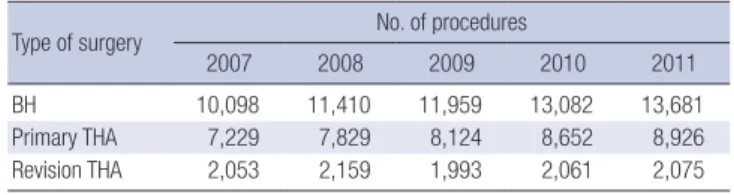
Between 2007 and 2011, both the number and the rate of BHs and primary THAs increased substantially, whereas there was no significant change in the number and rate of revision THAs. Over the 5 yr, the rates of both BHs and primary THAs
Table 1. Number of hip replacements in Korea from 2007 to 2011
Type of surgery No. of procedures
2007 2008 2009 2010 2011
BH 10,098 11,410 11,959 13,082 13,681
Primary THA 7,229 7,829 8,124 8,652 8,926
Revision THA 2,053 2,159 1,993 2,061 2,075
BH, bipolar hemiarthropalsty; THA, total hip arthroplasty.
significantly increased by 33.2% (20.5 per 100,000 in 2007 to 27.3 per 100,000 in 2011) and 21.4% (14.7 per 100,000 in 2007 to 17.8 per 100,000 in 2011), respectively (P < 0.001). However, the rate of revision THAs remained at an average of 4.2 per 100,000 (range, 4.0 to 4.4 per 100,000). The rate of BH and primary THA increased by 1.7 and 0.8 procedures per 100,000 persons per year, respectively (Fig. 1).
Overall, 63% of patients treated with BH were ≥ 75 yr of age, while 66% and 51% of patients treated with primary and revi
sion THAs were < 65 yr of age, respectively (Table 2). The rate of BHs significantly increased in those ≥ 65 yr of age (P < 0.001) (Fig. 2), with females displaying a consistent 2.9times higher rate throughout the 5yr period. The rate of primary THAs sig
nificantly increased in all age groups (P < 0.01), except those
≥ 85 yr of age (Fig. 3), and a consistent 1.3times higher male prevalence was evident. Although the overall rate of revision THAs remained constant over time, a significant decrease in
the rate was found in those < 65 yr of age (P < 0.003), and males displayed a consistent 1.4times higher revision THA rate (Fig. 4).
The primary ICD10CM diagnostic codes were identified.
The two most common reasons for BH were femoral neck frac
ture (ICD10CM: S720, 75%) and intertrochanteric fracture of the femur (ICD10CM: S721, 20%). For primary THA, osteone
crosis (ICD10CM: M87, 59%) was the most common diagno
sis, followed by osteoarthritis (ICD10CM: M16, 28%). Revision THAs were most commonly performed due to aseptic loosen
ing (ICD10CM: T840, T848, and T 895, 64%) and infection (ICD10CM: T814 and T845, 11%).
Over the 5yr period, the revision burden for primary THA averaged 20.3% and steadily decreased from 22.1% in 2007 to 18.9% in 2011 (Fig. 5). The linear regression model of yearto
year change in revision burden showed that the revision bur
Table 2. Demographic characteristics of patients who had hip replacements
Parameters BH Primary THA Revision THA
Total procedural number (2007-2011) 60,230 40,760 10,341
Age category (yr) < 45 45-64 65-74 75-84 ≥ 85
781 (1.3%) 5,586 (9.3%) 15,743 (26.1%) 26,192 (43.5%) 11,928 (19.8%)
8,054 (19.8%) 18,741 (46.0%) 9,835 (24.1%) 3,690 (9.1%)
440 (1.1%)
999 (9.7%) 4,271 (41.3%) 3,280 (31.7%) 1,526 (14.8%) 265 (2.6%) Gender
Male
Female 26.0%
74.0% 55.8%
44.2% 58.0%
42.0%
Two most common primary diagnoses Femoral neck fracture (75%) Intertrochanteric fracture (20%)
Osteonecrosis (59%) Osteoarthritis (28%)
Aseptic loosening (64%) Infection (11%) BH, bipolar hemiarthropalsty; THA, total hip arthroplasty.
Fig. 1. Procedural rates of bipolar hemiarthroplasty, primary, and revision total hip ar- throplasties in Korea from 2007 to 2011.
Procedure rates (per 100,000 persons)
Year
2007 2008 2009 2010 2011 30.0
25.0
20.0
15.0
10.0
5.0
BH Primary THA Revision THA
20.5
14.7
4.2 4.4 4.0 4.1 4.1
15.8 16.3 17.1 17.8
23.0 24.0
25.9
27.3
Fig. 2. Procedural rates of bipolar hemiarthroplasty stratified by age group.
Procedure rates (per 100,000 persons)
Year
2007 2008 2009 2010 2011
900.0 800.0 700.0 600.0 500.0 400.0 300.0 200.0 100.0 0.0
596.2
329.3
86.1 93.8 91.5 95.2 95.5
347.0 345.9 355.0 367.6
679.6 708.9
679.8
766.3 65-74
75-84
≥ 85
Fig. 4. Procedural rates of revision total hip arthroplasty stratified by age group.
Procedure rates (per 100,000 persons)
Year
2007 2008 2009 2010 2011 8.0
7.0 6.0 5.0 4.0 3.0 2.0 1.0 0.0
0.7 0.7 0.6 0.6 0.5
7.4
6.0 6.9
6.0
6.6
< 45 45-64 Fig. 3. Procedural rates of primary total hip arthroplasty stratified by age group.
Procedure rates (per 100,000 persons)
Year
2007 2008 2009 2010 2011 70.0
60.0 50.0 40.0 30.0 20.0 10.0 0.0
51.5
45.8
27.4 28.2 28.6 28.9 30.7
4.8 4.9 5.0 5.3 5.5
49.7
46.8
50.7 52.7
57.7 59.6 60.5 59.4
< 45 45-64 65-74 75-84
Fig. 5. The revision burden for primary total hip arthroplasty in Korea from 2007 to 2011.
Year
2007 2008 2009 2010 2011 24.0
22.0 20.0 18.0 16.0 14.0 12.0 10.0
%
22.1 21.6
19.7 19.2
18.9
Table 3. Annual change in the revision burden of total hip arthroplasty, by age and gender, in Korea from 2007 to 2011(%)
Age groups All Male Female
< 45 -1.01 (-1.67, -0.35)* -0.56 (-1.29, 0.17) -1.97 (-3.43, -0.51)*
45-64 -0.98 (-2.01, 0.06) -0.92 (-2.00, 0.16) -1.05 (-2.48, 0.37) 65-74 -0.94 (-1.29, -0.58)* -0.70 (-1.95, 0.55) -1.14 (-2.11, -0.16)*
75-84 -1.01 (-1.89, -0.12)* -0.65 (-3.13, 1.83) -1.18 (-3.13, 0.78)
≥ 85 0.31 (-4.13, 4.74) -2.65 (-8.51, 3.21) 1.45 (-5.24, 8.14)
*P value < 0.05. BH, bipolar hemiarthropalsty; THA, total hip arthroplasty.
den for primary THA remained consistent for men. For women, there were significant annual decreases of 1.97% (95% confi
dence interval [CI], 3.43 to 0.51) in the less than those 45yr
ofage and 1.14% (95% CI, 2.11 to 0.16) for those 65 to 74yr
old (Table 3).
Hospital characteristics
Between 2007 and 2011, BHs were most commonly performed
at general hospitals (50.4%), followed by hospitals (30.3%), ter
tiary hospitals (17.4%), and clinics (1.9%). The number of pri
mary THAs was the greatest in general hospitals (36.1%), fol
lowed by tertiary hospitals (33.6%), hospitals (28.8%), and clin
ics (1.5%). The proportion of primary THAs performed in hos
pitals increased significantly from 26.1% in 2007 to 30.9% in 2011, whereas the proportion of primary THAs performed in general hospitals significantly decreased from 39.2% in 2007 to 33.8% in 2011. The number of revision THAs was the highest in tertiary hospitals (39.3%), followed by general hospitals (38.1%), hospitals (21.7%), and clinics (0.9%) (Table 4).
The average length of hospital stay for BH, primary THA, par
tial component revision THA, and all component revision THA was 23.7, 19.6, 23.7, and 26.5 days, respectively. The average in
patient hospital charges for each procedure were consistent dur
ing the study period: BH (US $5,947), primary THA (US $6,247), and partial component revision THA (US $5,866), and all com
ponent revision THA (US $8,272). The total inpatient hospital charges were increased by 42% (US $58,493,180 in 2007 to US
$83,221,020 in 2011) for BH and by 25% (US $44,656,681 in 2007 to US $55,666,826 in 2011) for primary THA. However, that of
revision THA remained relatively constant over time, with a mean US $7,582,408 (range, US $7,222,503 to US $8,126, 854) The average exchange rate of the South Korean won to the US dollar for 2011 was $1 to ₩1,108, according to the Bank of Korea.
DISCUSSION
Most epidemiological studies from western countries have shown an increased annual incidence of primary THA over the past few decades (17, 17). Our results also indicate that the number and rate of primary THA increased substantially be
tween 2007 and 2011 in Korea. However, the rate of primary THA of 17.8 per 100,000 in 2011 was similar to the annual inci
dence of primary THA in Taiwan (15 per 100,000 between 1996 and 2004) (12), lower than those reported for the United States (69 per 100,000 in 2002) (1), Iceland (43 per 100,000 in 1982) (2), Denmark (101 per 100,000 in 1996) (4), and England (87 per 100,000 in 1996) (18). Kim et al. (13) reported the rate of prima
ry THA in Korea using a national database from 2002 to 2006 in a previous study. However, the total number and rate reported in their study were much lower than our data because their study focused mainly on primary THAs for osteoarthritis. Al
though many factors are associated with disparity in the rate of primary THA between western and Asian countries, one reason may be the different indications for primary THAs. Western ep
idemiological studies showed that more than 75% of primary THAs were performed for osteoarthritis (16, 19), while the most common indication for primary THA in Korea and Taiwan was osteonecrosis of the femoral head (12, 13), which is consistent with our findings. A few studies have reported that the preva
lence of hip osteoarthritis in Asian countries (range, 1.2% to 5.4%) was much lower than that of western countries (13, 20, 21). The fact that osteonecrosis of the femoral head affects most
ly young male adults within their 3rd to 5th decade may explain why the rate of primary THA in Korea was consistently higher for men than for women in contrast to western data, and why 66% of the patients treated with primary THA were < 65yrof
age while the majority of patients in western countries were
≥ 65yrofage (1, 3, 5, 16, 18).
Our results indicate that both the number and rate of BH in
creased substantially over the 5 yr. It is impossible to compare the nationwide trends and prevalence of BH in Korea with those in western countries because, to our knowledge, no previous epidemiological study focused on BH. The most common indi
cation for BH was hip fractures, therefore our data concurs with the results of two nationwide epidemiological studies for the incidence of hip fractures and trends of surgical treatment in femoral neck fractures conducted in Korea. Two previous stud
ies showed an increasing tendency of hip fractures, especially in women (14, 22), and another documented that the proportion of femoral neck fracture patients who underwent BH increased steadily in Korea from 2006 to 2011 (15). In contrast, the num
ber of hip fractures and the proportion of BH for hip fractures remained nearly the same in the United States between 2000 and 2009 (23). Kannan et al. reported a relatively low revision rate of about 3% of BH over a 5yr period in western countries, but the risk of revision increased in patients < 75yrofage (24).
Considering the significant increasing rate of BH even in patients
< 75yrofage, BH is likely to become a substantial socioeco
nomic burden due to its future revision in Korea.
In western countries, the rate of revision THA has increased substantially over the past few decades (1, 2, 4, 8), while during this 5yr period, the rate of revision THA in Korea has remained nearly the same and even significantly decreased in those < 65
yrofage. However, overall revision burden for primary THA (20.3%) in Korea from 2007 to 2011 was greater than those for western countries (6.4% to 18.3%), and the Korean revision bur
den of 18.9% in 2011 was comparable with the Australian (18.2%
for 1999 through 2002) (25) and Finnish (17.1% for 1999 through 2003) (26) revision burdens. In Sweden, the revision burden of 6.4% for the elderly population (≥ 65yrofage) was much low
er than the 11% reported for the general population (27). In contrast, the revision burden from 2007 to 2011 for the elderly population (≥ 65yrofage) in Korea (26.6%) was substantially Table 4. National trends of hip replacements according to hospital types in Korea from 2007 to 2011
Type of surgery Hospital type* Total procedural number Mean percentage (a to b)* The mean annual number of procedure†
BH Tertiary Hospital
General Hospital Hospital Clinics
10,471 30,339 18,274 1,146
17.4% (18.1% to 16.9%) 50.4% (48.8% to 51.8%) 30.3% (30.5% to 29.8%) 1.9% (2.5% to 1.6%)‡
45.9 21.4 7.6 1.7 Primary THA Tertiary Hospital
General Hospital Hospital Clinics
13,688 14,695 11,749 628
33.6% (32.5% to 34.0%) 36.1% (39.2% to 33.8%)‡ 28.8% (26.1% to 30.9%)‡
1.5% (2.3% to 1.4%)
60.0 10.4 4.9 0.9 Revision THA Tertiary Hospital
General Hospital Hospital Clinics
4,059 3,941 2,246 95
39.3% (39.8% to 38.8%) 38.1% (40.2% to 37.9%) 21.7% (18.8% to 22.8%) 0.9% (1.1% to 0.3%)
17.8 2.8 0.9 0.1
*a, percentage in 2007; b, percentage in 2011. †Calculated by dividing total number of each procedure by total number of each hospital type; ‡The change is statistically signif- icant (P < 0.05). BH, bipolar hemiarthropalsty; THA, total hip arthroplasty.
greater than that for the general population (20.3%). This dis
crepancy between western and Korean revision burden may be partly explained by the different proportion of age groups un
dergoing primary and revision THAs. The relatively low revision burden for the elderly population in western countries is be
cause the majority of patients undergoing primary THA are el
derly (1, 5, 16, 19). Conversely, in Korea the proportion of the elderly population undergoing primary THA was only 34%, al
though the proportion of the elderly population undergoing re
vision THA is almost same as that of the other population.
In Korea, 32.2% of BHs and 30.3% of primary THAs were per
formed in hospitals and clinics, and the mean annual number of each procedure was fewer than 10 procedures. Similarly, 60.7% of revision THAs was performed in general hospitals, hospitals, and clinics that performed fewer than three proce
dures a year (Table 4). Although it is contentious whether or not hospital volume affects patient outcome (19), an association between higher volume and improved patient outcomes for hip replacements has been reported (8). Based on these data, there have been efforts to regionalize major surgical procedures, such as THA, to higher volume medical centers. A previous study reported minimal evidence of regionalization of THA in the United States between 1991 and 2005 (8). In contrast, we found that the proportion of primary THAs performed in low
volume hospitals substantially increased in Korea during the study period.
The average length of hospital stay for hip replacements in Korea was much longer than those reported in the United States (6.9 days for BH, 4.3 days for primary THA, and 5.9 days for re
vision THA). Nevertheless, it is noteworthy that the average in
patient hospital charges for each procedure was about 6times lower than those reported in the United States (19). South Ko
rea has a universal healthcare system controlled by the govern
ment and managed under the National Health Insurance Cor
poration. Since medical care costs are tightly controlled by gov
ernment, a high supply of health and hospital services can be provided at low prices in Korea.
To our best knowledge, this is the second populationbased epidemiological study in Asia, based on the nationwide data
base to document the longitudinal trends in use of BH, prima
ry, and revision THA in terms of the procedural number and rate, stratified by age and gender (12). However, the present study is the first to document the annual revision burden and the yeartoyear change in the burden in Asia stratified by both age and gender. We also reported the change of procedural rates according to type of hospital.
Several limitations in this study should be noted. First, our study was limited in terms of duration because HIRA limited the study period to a maximum of 6 yr. Therefore, our findings over the 5yr period may not represent longitudinal trends of hip replacements in Korea over a longer period. Second, this
was not a registrybased study and thus we could not provide all information associated with each procedure such as type of admission, surgical technique, and outcomes. Third, we could not exactly provide the trends of hospital choice of the patients because we did not exclude several populations in whom sur
gery is typically more emergent and hospital choice is more limited. Fourth, the comparative rates of primary and revision THAs between countries are not exactly reflected period be
cause of no recent nationwide populationbased data is lack at similar period. Fifth, HIRA data cannot explain the diagnosis of primary THA other than osteonecrosis and osteoarthritis and also the causes of revision THA other than infection and loos
ening, and number of repeated revision correctly. Sixth, the time for search is too short and did not explain the difference of rate of revision THA according to region or hospital.
Our study demonstrates that both the number and rate of BH and primary THA have increased substantially from 2007 to 2011 in Korea. However, the overall rate of revision THA remain
ed constant over time and significant decrease of the rate was found in the younger population. The revision burden for pri
mary THA steadily decreased over the 5yr period. However, it was still greater than that reported for western countries. In contrast to western countries, primary and revision THAs were performed more commonly in the younger male population, and the proportion of primary and revision THAs performed in lowvolume hospitals substantially increased over time. To de
crease revision burden in Korea, nationwide efforts should be made by using optimized bearing surfaces in terms of enhanc
ing implant longevity, especially in younger male population at particular risk for mechanical wear of their hip replacements.
In addition, a policy increasing regionalization of hip replace
ments as well as improving quality in lower volume hospitals might be helpful to decrease revision burden in Korea in the fu
ture.
ACKNOWLEDGMENTS
We thank Sohee Oh from Department of Biostatistics, Seoul National University Boramae Hospital for statistical advice.
DISCLOSURE
The authors declare no potential conflicts of interest.
ORCID
Pil Whan Yoon http://orcid.org/0000-0001-7354-0989 YoungKyun Lee http://orcid.org/0000-0001-6564-4294 Jeonghoon Ahn http://orcid.org/0000-0002-0177-0192 Eun Jin Jang http://orcid.org/0000-0002-9137-9815 Yunjung Kim http://orcid.org/0000-0002-0449-1279
Hong Suk Kwak http://orcid.org/0000-0001-5204-6201 Kang Sup Yoon http://orcid.org/0000-0001-5917-1881 Hee Joong Kim http://orcid.org/0000-0002-3994-5672 Jeong Joon Yoo http://orcid.org/0000-0002-6304-0101
REFERENCES
1. Kurtz S, Mowat F, Ong K, Chan N, Lau E, Halpern M. Prevalence of pri- mary and revision total hip and knee arthroplasty in the United States from 1990 through 2002. J Bone Joint Surg Am 2005; 87: 1487-97.
2. Ingvarsson T, Hägglund G, Jónsson H Jr, Lohmander LS. Incidence of total hip replacement for primary osteoarthrosis in Iceland 1982-1996.
Acta Orthop Scand 1999; 70: 229-33.
3. Lohmander LS, Engesaeter LB, Herberts P, Ingvarsson T, Lucht U, Puo
lakka TJ. Standardized incidence rates of total hip replacement for pri- mary hip osteoarthritis in the 5 Nordic countries: similarities and differ- ences. Acta Orthop 2006; 77: 733-40.
4. Pedersen AB, Johnsen SP, Overgaard S, Søballe K, Sørensen HT, Lucht U.
Total hip arthroplasty in Denmark: incidence of primary operations and revisions during 1996-2002 and estimated future demands. Acta Orthop 2005; 76: 182-9.
5. Melton LJ 3rd, Stauffer RN, Chao EY, Ilstrup DM. Rates of total hip ar- throplasty; a population-based study. N Engl J Med 1982; 307: 1242-5.
6. Wells VM, Hearn TC, McCaul KA, Anderton SM, Wigg AE, Graves SE.
Changing incidence of primary total hip arthroplasty and total knee ar- throplasty for primary osteoarthritis. J Arthroplasty 2002; 17: 267-73.
7. Järvholm B, From C, Lewold S, Malchau H, Vingård E. Incidence of sur- gically treated osteoarthritis in the hip and knee in male construction workers. Occup Environ Med 2008; 65: 275-8.
8. Cram P, Lu X, Callaghan JJ, VaughanSarrazin MS, Cai X, Li Y. Long-term trends in hip arthroplasty use and volume. J Arthroplasty 2012; 27: 278- 85.e2.
9. Fevang BT, Lie SA, Havelin LI, Engesaeter LB, Furnes O. Improved re- sults of primary total hip replacement. Acta Orthop 2010; 81: 649-59.
10. Hoaglund FT, Oishi CS, Gialamas GG. Extreme variations in racial rates of total hip arthroplasty for primary coxarthrosis: a population-based study in San Francisco. Ann Rheum Dis 1995; 54: 107-10.
11. Oishi CS, Hoaglund FT, Gordon L, Ross PD. Total hip replacement rates are higher among Caucasians than Asians in Hawaii. Clin Orthop Relat Res 1998; (353): 166-74.
12. Lai YS, Wei HW, Cheng CK. Incidence of hip replacement among na- tional health insurance enrollees in Taiwan. J Orthop Surg Res 2008; 3:
42.
13. Kim HA, Koh SH, Lee B, Kim IJ, Seo YI, Song YW, Hunter DJ, Zhang Y.
Low rate of total hip replacement as reflected by a low prevalence of hip
osteoarthritis in South Korea. Osteoarthritis Cartilage 2008; 16: 1572-5.
14. Yoon HK, Park C, Jang S, Jang S, Lee YK, Ha YC. Incidence and mortality following hip fracture in Korea. J Korean Med Sci 2011; 26: 1087-92.
15. Lee YK, Ha YC, Park C, Koo KH. Trends of surgical treatment in femoral neck fracture: a nationwide study based on claim registry. J Arthroplasty 2013; 28: 1839-41.
16. Malchau H, Herberts P, Eisler T, Garellick G, Söderman P. The Swedish total hip replacement register. J Bone Joint Surg Am 2002; 84-A: 2-20.
17. Abbott KC, Bucci JR, Agodoa LY. Total hip arthroplasty in chronic dialy- sis patients in the United States. J Nephrol 2003; 16: 34-9.
18. Birrell F, Johnell O, Silman A. Projecting the need for hip replacement over the next three decades: influence of changing demography and thresh- old for surgery. Ann Rheum Dis 1999; 58: 569-72.
19. Zhan C, Kaczmarek R, LoyoBerrios N, Sangl J, Bright RA. Incidence and short-term outcomes of primary and revision hip replacement in the Unit- ed States. J Bone Joint Surg Am 2007; 89: 526-33.
20. Nevitt MC, Xu L, Zhang Y, Lui LY, Yu W, Lane NE, Qin M, Hochberg MC, Cummings SR, Felson DT. Very low prevalence of hip osteoarthritis among Chinese elderly in Beijing, China, compared with whites in the United States: the Beijing osteoarthritis study. Arthritis Rheum 2002; 46: 1773-9.
21. Lau EM, Lin F, Lam D, Silman A, Croft P. Hip osteoarthritis and dyspla- sia in Chinese men. Ann Rheum Dis 1995; 54: 965-9.
22. Kim SR, Ha YC, Kim JR, Kim R, Kim SY, Koo KH. Incidence of hip frac- tures in Jeju Island, South Korea: a prospective study (2002-2006). Clin Orthop Surg 2010; 2: 64-8.
23. Kim SH, Meehan JP, Lee MA. Surgical treatment of trochanteric and cer- vical hip fractures in the United States: 2000-2009. J Arthroplasty 2013;
28: 1386-90.
24. Kannan A, Kancherla R, McMahon S, Hawdon G, Soral A, Malhotra R.
Arthroplasty options in femoral-neck fracture: answers from the nation- al registries. Int Orthop 2012; 36: 1-8.
25. Australian Orthopaedic Association National Joint Replacement Regis
try: annual report 2003. Available at https://aoanjrr.dmac.adelaide.
edu.au/documents/10180/75178/Annual%20Report%202003?version=
1.1&t=1349407014597 [accessed on 1 March 2014].
26. National Agency for Medicines. The 2002-2003 implant yearbook on or- thopaedic endoprostheses: Finnish Arthroplasty Register. Available at:
http://www.fimea.fi/instancedata/prime_product_julkaisu/fimea/em- beds/fimeawwwstructure/19717_julkaisut_Orthopaedic_Endoprosthe- ses_2003_v.pdf.pdf [accessed on 15 May 2014].
27. Malchau H, Herberts P, Garellick G, Söderman P, Eisler T. Prognosis of total hip replacement: update of results and risk-ratio analysis for revi- sion and re-revision from the Swedish National Hip Arthroplasty Regis- ter 1979-2000. Available at http://www.shpr.se/Libraries/Documents/
AAOS2002.sflb.ashx [accessed on 1 March 2014].